Are you sure you want to exit?

  Yes                   No
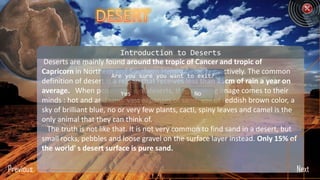
Introduction to Deserts
            Deserts are mainly found around the tropic of Cancer and tropic of
           Capricorn in Northern and Southern Hemispheres respectively. The common
                                   Are you sure you want to exit?
           definition of desert is a region that receives less than 25cm of rain a year on
           average. When people Yes of deserts, the following image comes to their
                                      think                   No
           minds : hot and arid land, vast expanses of sand, soil of reddish brown color, a
           sky of brilliant blue, no or very few plants, cacti, spiny leaves and camel is the
           only animal that they can think of.
             The truth is not like that. It is not very common to find sand in a desert, but
           small rocks, pebbles and loose gravel on the surface layer instead. Only 15% of
           the world' s desert surface is pure sand.

Previous                                                                                    Next
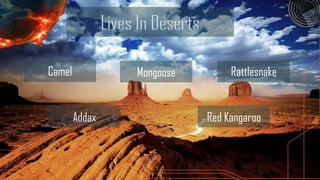
Camel           Mongoose        Rattlesnake


        Addax              Red Kangaroo
Camel
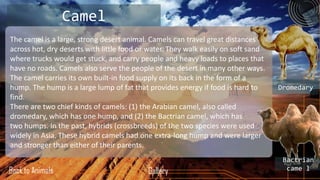
The camel is a large, strong desert animal. Camels can travel great distances
   •
across hot, dry deserts with little food or water. They walk easily on soft sand
where trucks would get stuck, and carry people and heavy loads to places that
have no roads. Camels also serve the people of the desert in many other ways.
The camel carries its own built-in food supply on its back in the form of a
hump. The hump is a large lump of fat that provides energy if food is hard to      Dromedary
find.
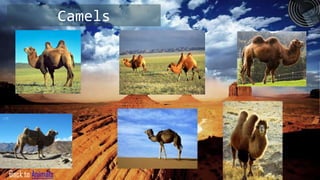
There are two chief kinds of camels: (1) the Arabian camel, also called
dromedary, which has one hump, and (2) the Bactrian camel, which has
two humps. In the past, hybrids (crossbreeds) of the two species were used
widely in Asia. These hybrid camels had one extra-long hump and were larger
and stronger than either of their parents.
                                                                                    Bactrian
Back to Animals                            Gallery                                   came l
Camels


Back to Animals
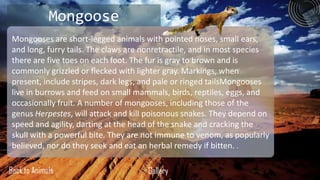
Mongoose
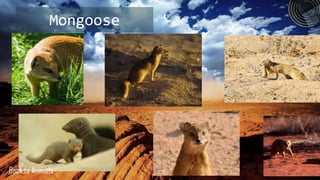
Mongooses are short-legged animals with pointed noses, small ears,
and long, furry tails. The claws are nonretractile, and in most species
there are five toes on each foot. The fur is gray to brown and is
commonly grizzled or flecked with lighter gray. Markings, when
present, include stripes, dark legs, and pale or ringed tailsMongooses
live in burrows and feed on small mammals, birds, reptiles, eggs, and
occasionally fruit. A number of mongooses, including those of the
genus Herpestes, will attack and kill poisonous snakes. They depend on
speed and agility, darting at the head of the snake and cracking the
skull with a powerful bite. They are not immune to venom, as popularly
believed, nor do they seek and eat an herbal remedy if bitten. .

Back to Animals                      Gallery
Mongoose


Back to Animals
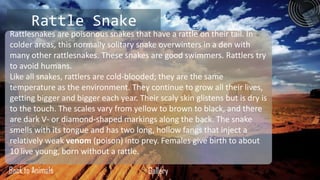
Rattle Snake
Rattlesnakes are poisonous snakes that have a rattle on their tail. In
colder areas, this normally solitary snake overwinters in a den with
many other rattlesnakes. These snakes are good swimmers. Rattlers try
to avoid humans.
Like all snakes, rattlers are cold-blooded; they are the same
temperature as the environment. They continue to grow all their lives,
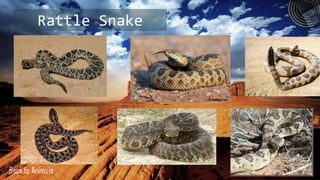
getting bigger and bigger each year. Their scaly skin glistens but is dry is
to the touch. The scales vary from yellow to brown to black, and there
are dark V- or diamond-shaped markings along the back. The snake
smells with its tongue and has two long, hollow fangs that inject a
relatively weak venom (poison) into prey. Females give birth to about
10 live young, born without a rattle.

Back to Animals                         Gallery
Rattle Snake


Back to Animals
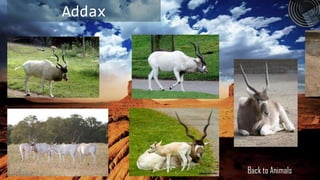
Addax
Addax also known as the screw horn antelope, is a critically
endangered species of antelope that lives in the Sahara desert. As suggested
by its alternative name, this pale antelope has long, twisted horns. It is closely
related to theoryx, but differs from other antelopes by having large square
teeth like cattle and lacking the typical facial glands. Although extremely rare in
its native habitat due to unregulated hunting, it is quite common in
captivity.[1] They are sometimes hunted as trophies on ranches in the United
States.
They are amply suited to live in the deep desert under extreme conditions.
Addax can survive without free water almost indefinitely, because they get
moisture from their food and dew that condenses on plants. Scientists believe
that the Addax has a special lining in its stomach that stores water in pouches
to use in times of dehydration. They also produce highly concentrated urine to
conserve water.
                                  Back to Animals                         Gallery
Addax


        Back to Animals
Red Kangaroo
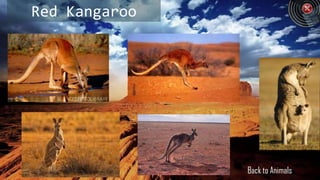
Red kangaroos are large animals with extremely long and powerful
hind legs and feet. Their tail is also long and muscular but their front
limbs are short. When moving fast they hop on their hind legs, using
their tail as a counterbalance, and when moving slowly they use their
tail as an extra limb, taking their weight on their front limbs and tail
while hopping their hind feet forwards.
The Red Kangaroo is mainly active in the cool of the evening or night,
and lives alone or in small groups called 'mobs' (although food
shortages can cause them to congregate into larger groups).
Membership of these groups is very flexible, and males (boomers) are
not territorial, fighting only after females (flyers) which come into
heat. The largest males are dominant, and control most of the
matings.
.
                                   Back to Animals                       Gallery
Red Kangaroo


               Back to Animals
Presented by:
1) Brinsil
2) Divakar
    VI A

Ppt on deserts and animals

  • 1.
    Are you sureyou want to exit? Yes No
  • 2.
    Introduction to Deserts Deserts are mainly found around the tropic of Cancer and tropic of Capricorn in Northern and Southern Hemispheres respectively. The common Are you sure you want to exit? definition of desert is a region that receives less than 25cm of rain a year on average. When people Yes of deserts, the following image comes to their think No minds : hot and arid land, vast expanses of sand, soil of reddish brown color, a sky of brilliant blue, no or very few plants, cacti, spiny leaves and camel is the only animal that they can think of. The truth is not like that. It is not very common to find sand in a desert, but small rocks, pebbles and loose gravel on the surface layer instead. Only 15% of the world' s desert surface is pure sand. Previous Next
  • 3.
    Camel Mongoose Rattlesnake Addax Red Kangaroo
  • 4.
    Camel The camel isa large, strong desert animal. Camels can travel great distances • across hot, dry deserts with little food or water. They walk easily on soft sand where trucks would get stuck, and carry people and heavy loads to places that have no roads. Camels also serve the people of the desert in many other ways. The camel carries its own built-in food supply on its back in the form of a hump. The hump is a large lump of fat that provides energy if food is hard to Dromedary find. There are two chief kinds of camels: (1) the Arabian camel, also called dromedary, which has one hump, and (2) the Bactrian camel, which has two humps. In the past, hybrids (crossbreeds) of the two species were used widely in Asia. These hybrid camels had one extra-long hump and were larger and stronger than either of their parents. Bactrian Back to Animals Gallery came l
  • 5.
  • 6.
    Mongoose Mongooses are short-leggedanimals with pointed noses, small ears, and long, furry tails. The claws are nonretractile, and in most species there are five toes on each foot. The fur is gray to brown and is commonly grizzled or flecked with lighter gray. Markings, when present, include stripes, dark legs, and pale or ringed tailsMongooses live in burrows and feed on small mammals, birds, reptiles, eggs, and occasionally fruit. A number of mongooses, including those of the genus Herpestes, will attack and kill poisonous snakes. They depend on speed and agility, darting at the head of the snake and cracking the skull with a powerful bite. They are not immune to venom, as popularly believed, nor do they seek and eat an herbal remedy if bitten. . Back to Animals Gallery
  • 7.
  • 8.
    Rattle Snake Rattlesnakes arepoisonous snakes that have a rattle on their tail. In colder areas, this normally solitary snake overwinters in a den with many other rattlesnakes. These snakes are good swimmers. Rattlers try to avoid humans. Like all snakes, rattlers are cold-blooded; they are the same temperature as the environment. They continue to grow all their lives, getting bigger and bigger each year. Their scaly skin glistens but is dry is to the touch. The scales vary from yellow to brown to black, and there are dark V- or diamond-shaped markings along the back. The snake smells with its tongue and has two long, hollow fangs that inject a relatively weak venom (poison) into prey. Females give birth to about 10 live young, born without a rattle. Back to Animals Gallery
  • 9.
  • 10.
    Addax Addax also knownas the screw horn antelope, is a critically endangered species of antelope that lives in the Sahara desert. As suggested by its alternative name, this pale antelope has long, twisted horns. It is closely related to theoryx, but differs from other antelopes by having large square teeth like cattle and lacking the typical facial glands. Although extremely rare in its native habitat due to unregulated hunting, it is quite common in captivity.[1] They are sometimes hunted as trophies on ranches in the United States. They are amply suited to live in the deep desert under extreme conditions. Addax can survive without free water almost indefinitely, because they get moisture from their food and dew that condenses on plants. Scientists believe that the Addax has a special lining in its stomach that stores water in pouches to use in times of dehydration. They also produce highly concentrated urine to conserve water. Back to Animals Gallery
  • 11.
    Addax Back to Animals
  • 12.
    Red Kangaroo Red kangaroosare large animals with extremely long and powerful hind legs and feet. Their tail is also long and muscular but their front limbs are short. When moving fast they hop on their hind legs, using their tail as a counterbalance, and when moving slowly they use their tail as an extra limb, taking their weight on their front limbs and tail while hopping their hind feet forwards. The Red Kangaroo is mainly active in the cool of the evening or night, and lives alone or in small groups called 'mobs' (although food shortages can cause them to congregate into larger groups). Membership of these groups is very flexible, and males (boomers) are not territorial, fighting only after females (flyers) which come into heat. The largest males are dominant, and control most of the matings. . Back to Animals Gallery
  • 13.
    Red Kangaroo Back to Animals
  • 14.