THE DESERT BIOME By christine leak
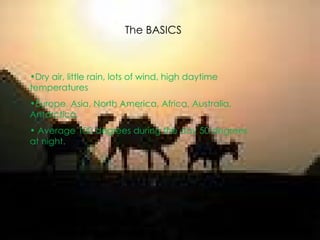
The BASICS Dry air, little rain, lots of wind, high daytime temperatures  Europe, Asia, North America, Africa, Australia, Antarctica. Average 100 degrees during the day 50 degrees at night.
How much is too much? Most people today can go 3 weeks without eating. If water is in short supply it is important not to eat anything because it increases your water needs to digest the food. Normally humans can only 2-3 days without water. The human body has a normal temperature of  98.6 degrees. Three to five days per week for 15-20 minutes in direct sun exposure is safe.
HUMAN ADAPTATIONS The body tries to adjust to this extreme environment by sweating. Under extreme heat, a human being may lose as much as 5 pints (3 liters) of moisture in an hour and up to 21 pints (12 liters) in a day. This water must be replaced, however, or the person will die from dehydration.  When the body looses water, it compensates it by moving water into blood vessels from cells. . hormones like anti-diuretic hormone (ADH) work with the kidney to limit the amount of water lost in the urine when the body needs to conserve water.
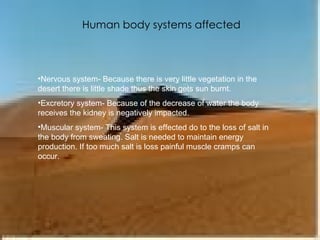
Human body systems affected Nervous system- Because there is very little vegetation in the desert there is little shade thus the skin gets sun burnt. Excretory system- Because of the decrease of water the body receives the kidney is negatively impacted. Muscular system- This system is effected do to the loss of salt in the body from sweating. Salt is needed to maintain energy production. If too much salt is loss painful muscle cramps can occur.
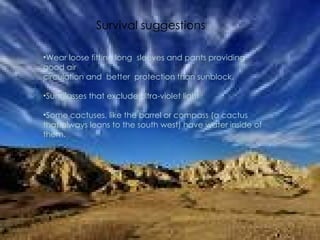
What to wear Survival suggestions Wear loose fitting long  sleeves and pants providing  good air  circulation and  better  protection than sunblock.  Sunglasses that exclude ultra-violet light Some cactuses, like the barrel or compass (a cactus that always leans to the south west) have water inside of them.

Desert Powerpoint

  • 1.
    THE DESERT BIOMEBy christine leak
  • 2.
    The BASICS Dryair, little rain, lots of wind, high daytime temperatures Europe, Asia, North America, Africa, Australia, Antarctica. Average 100 degrees during the day 50 degrees at night.
  • 3.
    How much istoo much? Most people today can go 3 weeks without eating. If water is in short supply it is important not to eat anything because it increases your water needs to digest the food. Normally humans can only 2-3 days without water. The human body has a normal temperature of 98.6 degrees. Three to five days per week for 15-20 minutes in direct sun exposure is safe.
  • 4.
    HUMAN ADAPTATIONS Thebody tries to adjust to this extreme environment by sweating. Under extreme heat, a human being may lose as much as 5 pints (3 liters) of moisture in an hour and up to 21 pints (12 liters) in a day. This water must be replaced, however, or the person will die from dehydration. When the body looses water, it compensates it by moving water into blood vessels from cells. . hormones like anti-diuretic hormone (ADH) work with the kidney to limit the amount of water lost in the urine when the body needs to conserve water.
  • 5.
    Human body systemsaffected Nervous system- Because there is very little vegetation in the desert there is little shade thus the skin gets sun burnt. Excretory system- Because of the decrease of water the body receives the kidney is negatively impacted. Muscular system- This system is effected do to the loss of salt in the body from sweating. Salt is needed to maintain energy production. If too much salt is loss painful muscle cramps can occur.
  • 6.
    What to wearSurvival suggestions Wear loose fitting long sleeves and pants providing good air circulation and better protection than sunblock. Sunglasses that exclude ultra-violet light Some cactuses, like the barrel or compass (a cactus that always leans to the south west) have water inside of them.