-By SAKSHAM KANSAL
-Class- 7 A
 Deserts are formed by mountains blocking
the path of precipitation
 Deserts can be hot or cold but they are
always dry.
 They receive less than 25 cm of precipitation
annually.
 They cover 22 million km2
or 1/5 of the
earth’s surface.
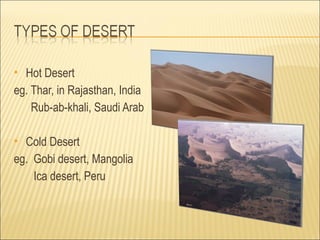
 Hot Desert
eg. Thar, in Rajasthan, India
Rub-ab-khali, Saudi Arab
 Cold Desert
eg. Gobi desert, Mangolia
Ica desert, Peru
A Desert’s
CharacteristicsCharacteristics
Climate
Animals
Plants and species
Water availability
Vegetation
ClimateClimate
The desert is the hottest area on Earth. It also has its
extremes.
It can be over 50 degrees during the day and below 32 degrees
at night.
Less than 25 cm or rainfall every year.
The amount of rainfall varies, but when it rains…it POURS!!!!
After a storm, the desert may not see any rain for weeks or
months.
The animals include
snakes, owls, mice,
armadillo lizards, fennec
foxes, gila monsters,
bats, and vultures.
Endangered AnimalsEndangered Animals
Black Rhino
Grevy’s
Zebra
King Cheetah
The major causes of
endangered animals
in the desert are
mainly poachers and
unexpected drought.
PlantsPlants
A Variety of cactuses
Prickly Pear
Dragon Tree
Octillo Plant
Desert Spoon
Boojum
There are several plants that are able to survive in the desert.
Most plants survive by their long roots to reach underground water
sources.
 It includes the flora and fauna.
 Deserts typically have a plant cover that is sparse but
enormously diverse.
 Almost all of the animals living in the desert have
adapted to be able to better survive in the desert.
Some desert flora include shrubs
eg. Prickly Pearls, Desert Holly and the Brittlebush.
Most desert plants are drought- or salt-tolerant
eg. Xerophites
Other desert plants have long Taproots
eg. Turnip
 Includes animals that remain hidden during daylight
hours.
 As to control body temperature or to limit moisture
needs.
 These animals adapted to live in deserts are called
Xerocoles
eg. Jack Rabbit, Kangaroo Rat, Coyote, etc.
Deserts are arid regions, generally receiving less than 25 centimeters (10
inches) of precipitation a year, or regions where the potential
evaporation rate is significantly greater than the precipitation. In most
cases, deserts possess a high average temperature with large differences
between daytime and nighttime temperatures. Arid regions can also be
defined as environments in which water is the limiting factor for
biosystems . This means that survival. This desert in Valley of the
Tsauchab, Namibia illustrates the vegetation, desert crust, and
occasionally pooled water that characterize these arid regions. Annual
rainfall in Namibia's coastal desert is 50 millimeters (about 2 inches).
of life in these regions involves a constant struggle to obtain this limited
commodity and to draw the maximum benefit from it.
Desert vegetation is an amazing example of adaptive
power of plants and trees. Many are the ways of
survival, and it would take us much to far to go into
details. Due to the fact that in most area’s, more then
80 % of the surface consists of bedrock, vegetation is
largely confined to wadi beds, where some soil may
have accumulated. It is also in these wadi’s that we
find most of plant life.
 Some of the major deserts are:
• Sahara (Africa)
• Great Basin (North America)
• Atacama (South America)
• Mojave (North America)
• Great Victoria (Australia)
The ten largest deserts
Rank Desert Area (km²) Area (mi²)
1 Antarctic Desert (Antarctica) 13,829,430 5,339,573
2 Arctic Desert (Arctic) 13,726,937 1,003,600+
3 Sahara Desert (Africa) 9,100,000+ 3,320,000+
4 Arabian Desert (Middle East) 2,330,000 900,000
5 Gobi Desert (Asia) 1,300,000 500,000
6 Kalahari Desert (Africa) 900,000 360,000
7 Patagonian Desert (South America) 670,000 260,000
8 Great Victoria Desert (Australia) 647,000 250,000
9 Syrian Desert (Middle East) 520,000 200,000
10 Great Basin Desert (North America) 492,000 190,000
Desert

Desert

  • 1.
  • 2.
     Deserts areformed by mountains blocking the path of precipitation  Deserts can be hot or cold but they are always dry.  They receive less than 25 cm of precipitation annually.  They cover 22 million km2 or 1/5 of the earth’s surface.
  • 3.
     Hot Desert eg.Thar, in Rajasthan, India Rub-ab-khali, Saudi Arab  Cold Desert eg. Gobi desert, Mangolia Ica desert, Peru
  • 5.
  • 6.
    ClimateClimate The desert isthe hottest area on Earth. It also has its extremes. It can be over 50 degrees during the day and below 32 degrees at night. Less than 25 cm or rainfall every year. The amount of rainfall varies, but when it rains…it POURS!!!! After a storm, the desert may not see any rain for weeks or months.
  • 8.
    The animals include snakes,owls, mice, armadillo lizards, fennec foxes, gila monsters, bats, and vultures.
  • 9.
    Endangered AnimalsEndangered Animals BlackRhino Grevy’s Zebra King Cheetah The major causes of endangered animals in the desert are mainly poachers and unexpected drought.
  • 11.
    PlantsPlants A Variety ofcactuses Prickly Pear Dragon Tree Octillo Plant Desert Spoon Boojum There are several plants that are able to survive in the desert. Most plants survive by their long roots to reach underground water sources.
  • 12.
     It includesthe flora and fauna.  Deserts typically have a plant cover that is sparse but enormously diverse.  Almost all of the animals living in the desert have adapted to be able to better survive in the desert.
  • 14.
    Some desert florainclude shrubs eg. Prickly Pearls, Desert Holly and the Brittlebush. Most desert plants are drought- or salt-tolerant eg. Xerophites Other desert plants have long Taproots eg. Turnip
  • 16.
     Includes animalsthat remain hidden during daylight hours.  As to control body temperature or to limit moisture needs.  These animals adapted to live in deserts are called Xerocoles eg. Jack Rabbit, Kangaroo Rat, Coyote, etc.
  • 18.
    Deserts are aridregions, generally receiving less than 25 centimeters (10 inches) of precipitation a year, or regions where the potential evaporation rate is significantly greater than the precipitation. In most cases, deserts possess a high average temperature with large differences between daytime and nighttime temperatures. Arid regions can also be defined as environments in which water is the limiting factor for biosystems . This means that survival. This desert in Valley of the Tsauchab, Namibia illustrates the vegetation, desert crust, and occasionally pooled water that characterize these arid regions. Annual rainfall in Namibia's coastal desert is 50 millimeters (about 2 inches). of life in these regions involves a constant struggle to obtain this limited commodity and to draw the maximum benefit from it.
  • 20.
    Desert vegetation isan amazing example of adaptive power of plants and trees. Many are the ways of survival, and it would take us much to far to go into details. Due to the fact that in most area’s, more then 80 % of the surface consists of bedrock, vegetation is largely confined to wadi beds, where some soil may have accumulated. It is also in these wadi’s that we find most of plant life.
  • 22.
     Some ofthe major deserts are: • Sahara (Africa) • Great Basin (North America) • Atacama (South America) • Mojave (North America) • Great Victoria (Australia)
  • 24.
    The ten largestdeserts Rank Desert Area (km²) Area (mi²) 1 Antarctic Desert (Antarctica) 13,829,430 5,339,573 2 Arctic Desert (Arctic) 13,726,937 1,003,600+ 3 Sahara Desert (Africa) 9,100,000+ 3,320,000+ 4 Arabian Desert (Middle East) 2,330,000 900,000 5 Gobi Desert (Asia) 1,300,000 500,000 6 Kalahari Desert (Africa) 900,000 360,000 7 Patagonian Desert (South America) 670,000 260,000 8 Great Victoria Desert (Australia) 647,000 250,000 9 Syrian Desert (Middle East) 520,000 200,000 10 Great Basin Desert (North America) 492,000 190,000