Climate
• The seasons are generally warm
throughout the year and very hot in the
summer.
• The winters usually bring little
precipitation.
• Temperatures exhibit daily extremes
because the atmosphere contains little
humidity to block the Sun’s ray.
• Deserts are dry. There are very few clouds.
• Two kinds of deserts:
– Hot deserts
– Cold deserts
• Hot deserts
– Temperatures are very warm all year
round
– The summers are very hot
• Cold deserts
– Short, warm summers
– Long, cold winters
– Found in places near the north and south
poles
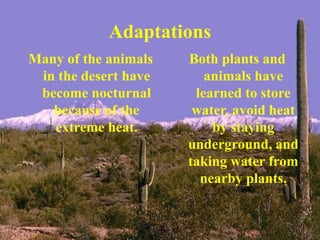
Adaptations
Many of the animals
in the desert have
become nocturnal
because of the
extreme heat.
Both plants and
animals have
learned to store
water, avoid heat
by staying
underground, and
taking water from
nearby plants.
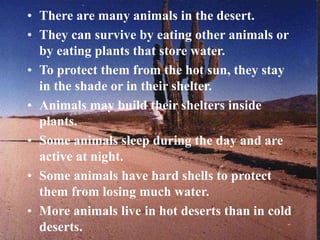
• There are many animals in the desert.
• They can survive by eating other animals or
by eating plants that store water.
• To protect them from the hot sun, they stay
in the shade or in their shelter.
• Animals may build their shelters inside
plants.
• Some animals sleep during the day and are
active at night.
• Some animals have hard shells to protect
them from losing much water.
• More animals live in hot deserts than in cold
deserts.
ANIMALS
The animals include
snakes, owls, mice,
armadillo lizards,
fennec foxes, gila
monsters, bats, and
vultures.
Roadrunner
Anteater
Scorpion
Gila monster (lizard)
Camel
Plant Life of Deserts
A Variety of cactuses
•Prickly Pear
•Dragon Tree
•Octillo Plant
•Desert Spoon
•Boojum
There are several plants that are able to survive in the desert.
Most plants survive by their long roots to reach underground
water sources.
Desert Plants
• They usually grow close to the ground.
• These plants have special parts that
help them save water.
• The special parts are: thick stem,
shallow and wide roots, and thick skin
covered with spines instead of leaves.
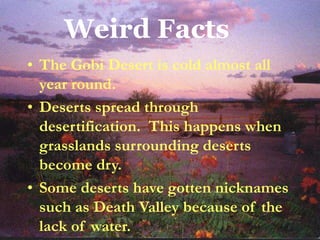
Weird Facts
• The Gobi Desert is cold almost all
year round.
• Deserts spread through
desertification. This happens when
grasslands surrounding deserts
become dry.
• Some deserts have gotten nicknames
such as Death Valley because of the
lack of water.
Oasis
• Oases are parts of the desert where
plants grow and water is almost
always available.
• An oasis is formed by a pool of water
trapped between layers of rock and
the desert floor.
• The water can allow people to settle
and even grow crops in the desert.
THE END
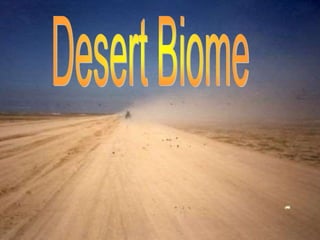
Note: this is not a dirt road.

desert new.ppt

  • 2.
    Climate • The seasonsare generally warm throughout the year and very hot in the summer. • The winters usually bring little precipitation. • Temperatures exhibit daily extremes because the atmosphere contains little humidity to block the Sun’s ray.
  • 3.
    • Deserts aredry. There are very few clouds. • Two kinds of deserts: – Hot deserts – Cold deserts • Hot deserts – Temperatures are very warm all year round – The summers are very hot • Cold deserts – Short, warm summers – Long, cold winters – Found in places near the north and south poles
  • 4.
    Adaptations Many of theanimals in the desert have become nocturnal because of the extreme heat. Both plants and animals have learned to store water, avoid heat by staying underground, and taking water from nearby plants.
  • 5.
    • There aremany animals in the desert. • They can survive by eating other animals or by eating plants that store water. • To protect them from the hot sun, they stay in the shade or in their shelter. • Animals may build their shelters inside plants. • Some animals sleep during the day and are active at night. • Some animals have hard shells to protect them from losing much water. • More animals live in hot deserts than in cold deserts.
  • 6.
    ANIMALS The animals include snakes,owls, mice, armadillo lizards, fennec foxes, gila monsters, bats, and vultures.
  • 7.
  • 8.
    Plant Life ofDeserts A Variety of cactuses •Prickly Pear •Dragon Tree •Octillo Plant •Desert Spoon •Boojum There are several plants that are able to survive in the desert. Most plants survive by their long roots to reach underground water sources.
  • 9.
    Desert Plants • Theyusually grow close to the ground. • These plants have special parts that help them save water. • The special parts are: thick stem, shallow and wide roots, and thick skin covered with spines instead of leaves.
  • 10.
    Weird Facts • TheGobi Desert is cold almost all year round. • Deserts spread through desertification. This happens when grasslands surrounding deserts become dry. • Some deserts have gotten nicknames such as Death Valley because of the lack of water.
  • 11.
    Oasis • Oases areparts of the desert where plants grow and water is almost always available. • An oasis is formed by a pool of water trapped between layers of rock and the desert floor. • The water can allow people to settle and even grow crops in the desert.
  • 12.
    THE END Note: thisis not a dirt road.