DESERT ECOSYSTEM
By ; Mehwish Manzoor
What is a Desert?
• A desert is defined as a region which
receives an annual precipitation of
less than 250mm [10 inches] on an
average.
• Other than low precipitation,deserts
are also characterized by scarce
vegetation and extreme temperatures
oscillating between 115F or more
during daytime and 32F or less at
night.
Cont……
• Deserts have dry climate due to rain-
blocking mountain ranges and
remoteness from oceanic moisture.
What is Desert Ecosystem?
• In an ecosystem,the biological community
interacts with the abiological physical
environment for its survival. The desert is
characterized by extreme, specialized and
very sensitive ecosystem.
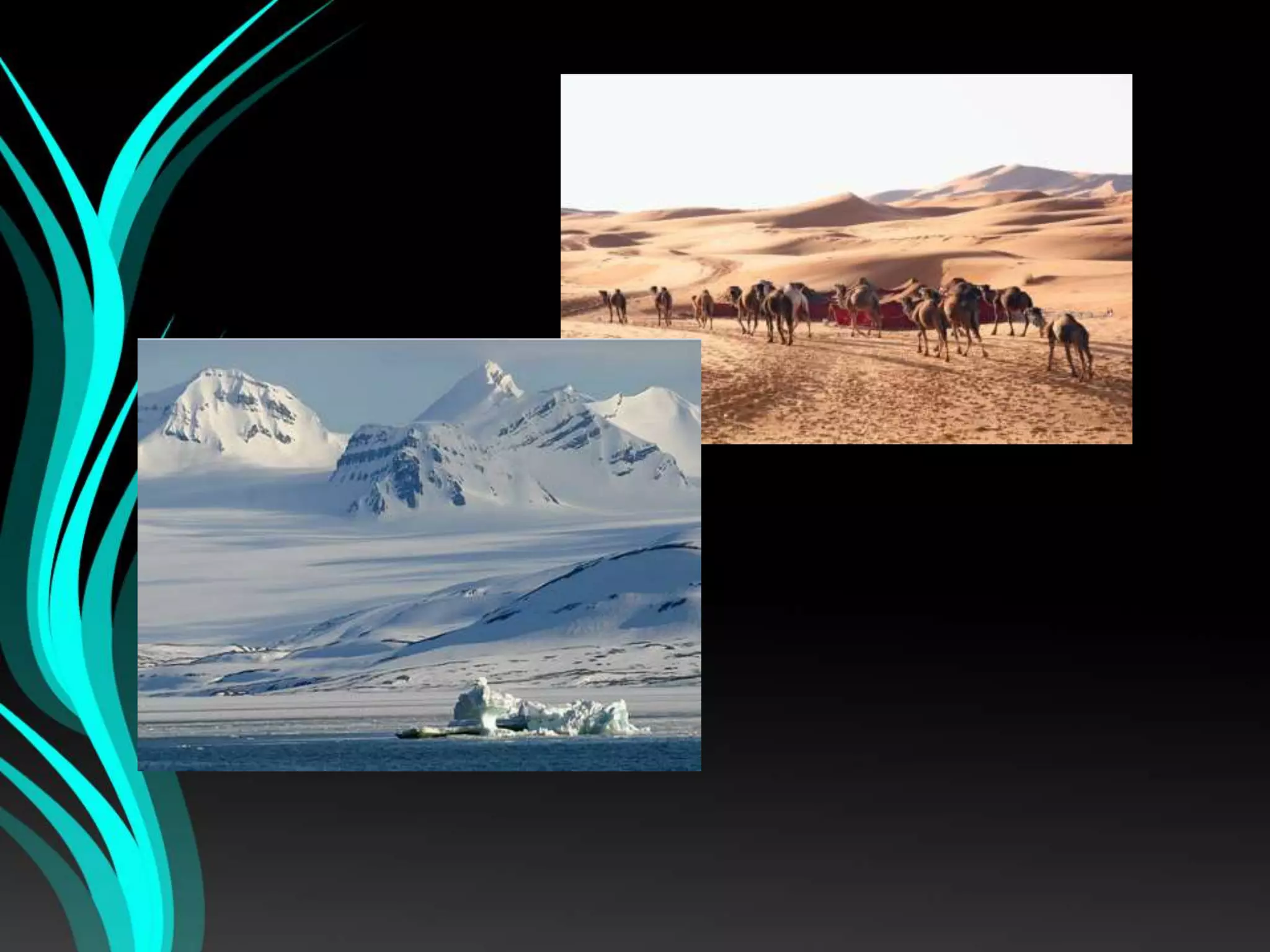
Types of desert
Hot Desert
eg. Thar, in
Rajasthan, India
Rub-ab-khali, Saudi
Arab
Cold Desert
eg. Gobi desert,
Mangolia Ica
desert, Peru
A Desert’s Characteristics
Climate Plants Seasons
Significance
to humans
Animals Adaptations
Climate
• The desert is the hottest biome on
Earth. It also has its extremes.
• It can be over 50 degrees during the
day and below 32 degrees at night.
• Less than 25 cm or rainfall every
year.
• The amount of rainfall varies, but
when it rains…it POURS!!!!
• After a storm, the desert may not see
any rain for weeks or months
Animals
• The animals include snakes, owls,
mice, armadillo lizards, fennec
foxes, gila monsters, bats, and
vultures.
Endangered Animals
• Black Rhino
• Grevy’s
• Zebra
• King Cheetah
The major causes
of endangered
animals in the
desert are mainly
poachers and
unexpected
drought.
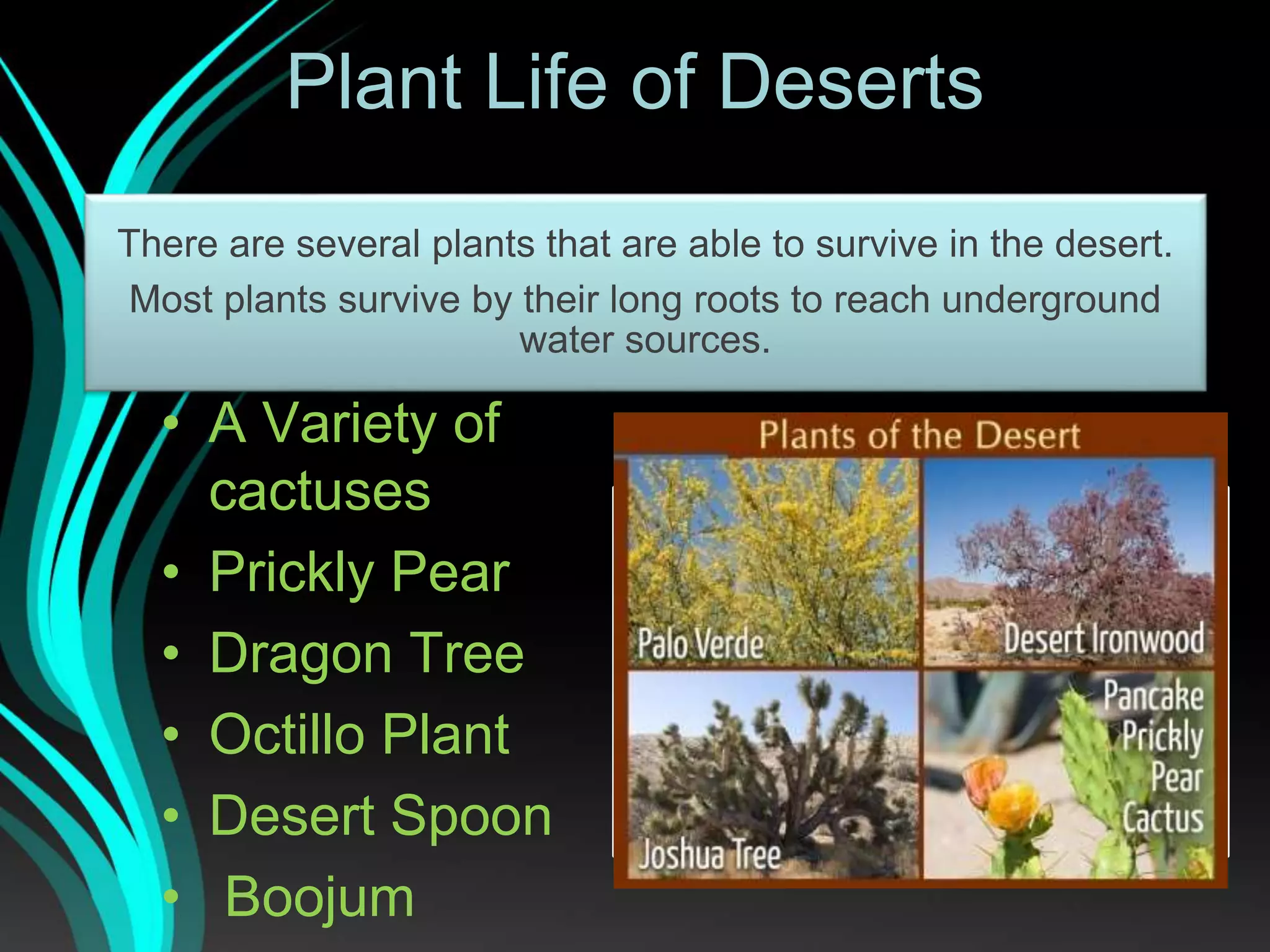
Plant Life of Deserts
• A Variety of
cactuses
• Prickly Pear
• Dragon Tree
• Octillo Plant
• Desert Spoon
• Boojum
There are several plants that are able to survive in the desert.
Most plants survive by their long roots to reach underground
water sources.
seasons
• The seasons are generally warm
throughout the year and very hot in the
summer.
• The winters usually bring little rainfall.
• Temperatures exhibit daily extremes
because the atmosphere contains little
humidity to block the Sun’s rays.
Adaptations
• Many of the animals
in the desert have
become nocturnal.
• Both plants and
animals have
learned to store
water.
• Tolerate
Hyperthermia
Human effects
• Poachers are a main cause of dying
animals. Poachers catch animals of all
kinds to make money for usually just one
part, like the elephant tusk.
• With the growing popularity of
transportation, many roads are being built
in not only the desert, but all the other
biomes.
Cont………
• The main problem with these roads are
the fact that they destroy habitats and
endanger animals. Road kill is also a
main factor in these dying animals.
• These problems can be easily taken care
of if other means of transportation were
encouraged.
Structure & Functions
• It includes the flora and fauna.
• Deserts typically have a plant cover that is
sparse but enormously diverse.
• Almost all of the animals living in the
desert have adapted to be able to better
survive in the desert.
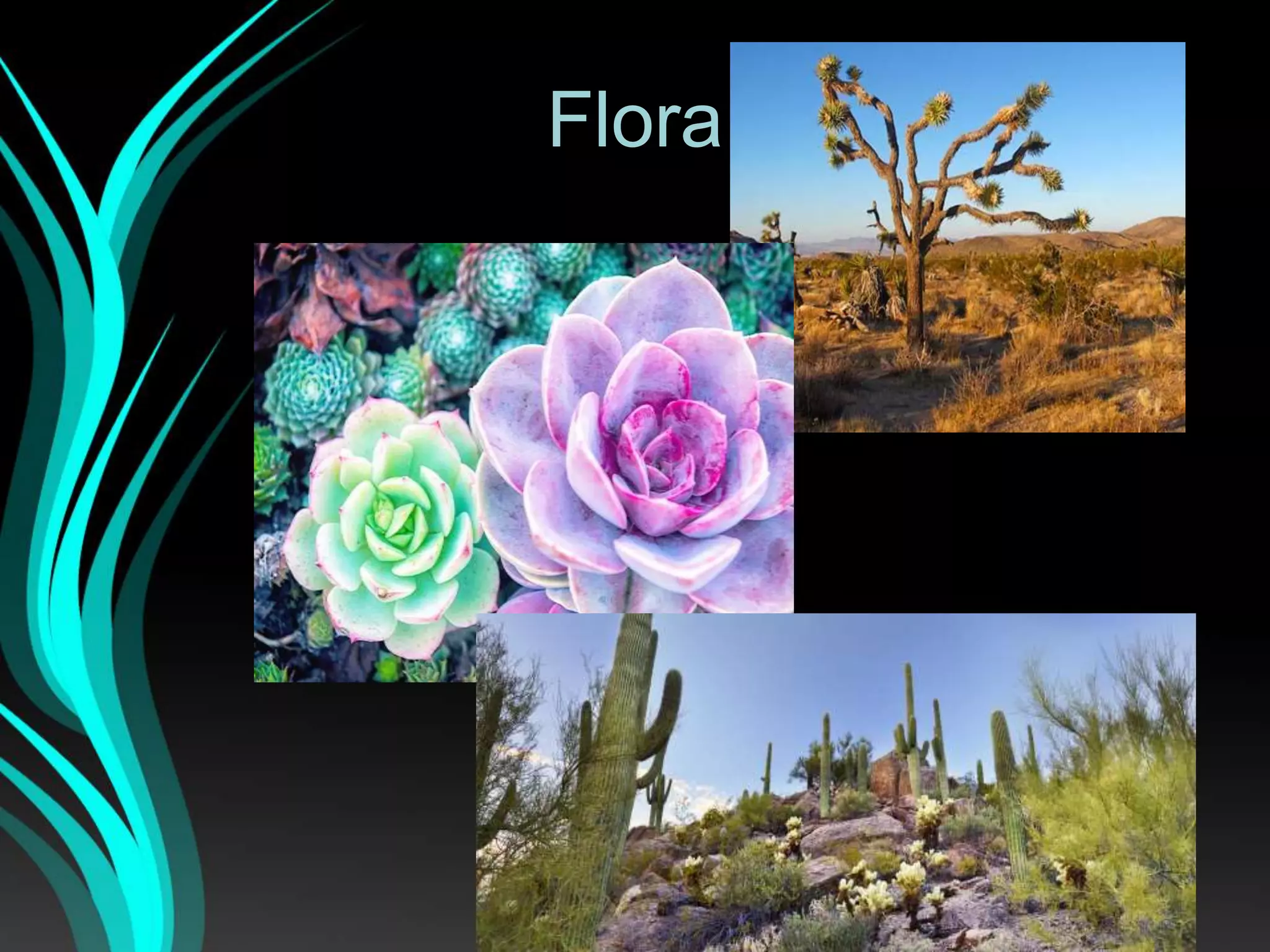
Flora
Flora
• Some desert flora include shrubs eg.
Prickly Pearls, Desert Holly and the
Brittlebush.
• Most desert plants are drought- or salt-
tolerant eg. Xerophites
• Other desert plants have long Taproots
eg. Turnip
Fauna
Fauna
• Includes animals that remain hidden
during daylight hours.
• As to control body temperature or to limit
moisture needs.
• These animals adapted to live in deserts
are called Xerocoles
• eg. Jack Rabbit, Kangaroo Rat, Coyote,
etc.
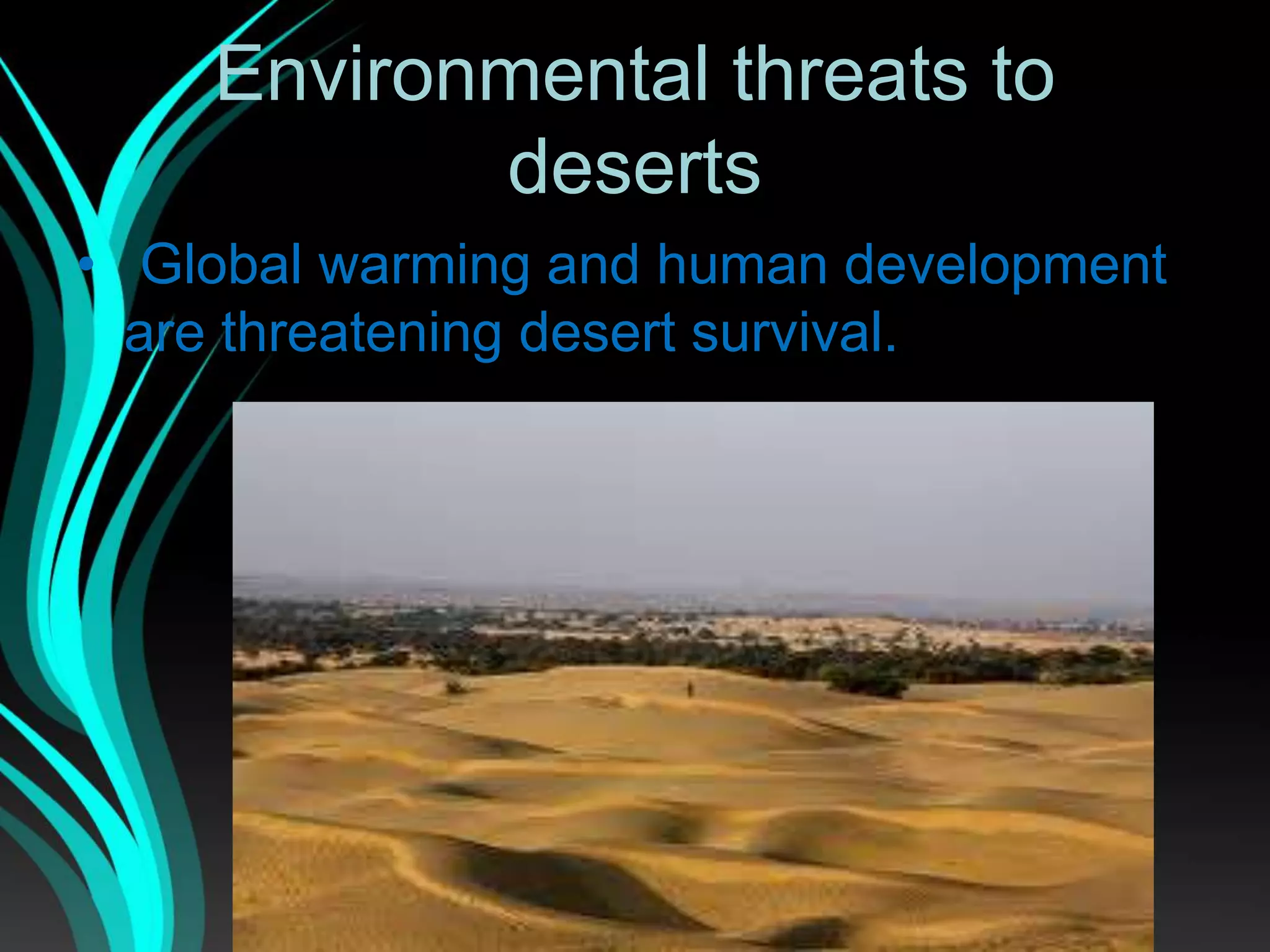
Environmental threats to
deserts
• Global warming and human development
are threatening desert survival.
Global warming: Droughts
• Droughts directly affect the growth
of vegetation.
• Global warming is raising Earth's
temperature, increasing the
chances of severe drought
Global warming: Wild Fires
• Wild Fires will burn away the slow-
growing fauna.
• Thereby drastically changing the
landscape
Development :Irrigation
• The long-term ramifications are the
problem:
• deserts experience very little rainfall.
• Trees and plants will not be able to
live on the remaining water.
• the salt levels in the soil make the
soil unable to support life.
Development :Urbanization
• The simple act of gathering firewood is
destroying this fragile ecosystem.
• For example, in the Sahel countries of
Africa, firewood is being used up 30
percent faster than it is being replaced.
• Threatened species like the Bald
eagle,
major deserts
Some of the major deserts are:
• Sahara (Africa)
• Great Basin (North America)
• Atacama (South America)
• Mojave (North America)
• Great Victoria (Australia
The ten largest deserts
1 Antarctic Desert (Antarctica)
13,829,430 5,339,573
2 Arctic Desert (Arctic) 13,726,937
1,003,600+
3 Sahara Desert (Africa) 9,100,000+
3,320,000+
4 Arabian Desert (Middle East) 2,330,000
900,000
Cont….
5 Gobi Desert (Asia) 1,300,000 500,000
6 Kalahari Desert (Africa) 900,000
360,000
7 Patagonian Desert (South America)
670,000 260,000
8 Great Victoria Desert (Australia)
647,000 250,000
Cont….
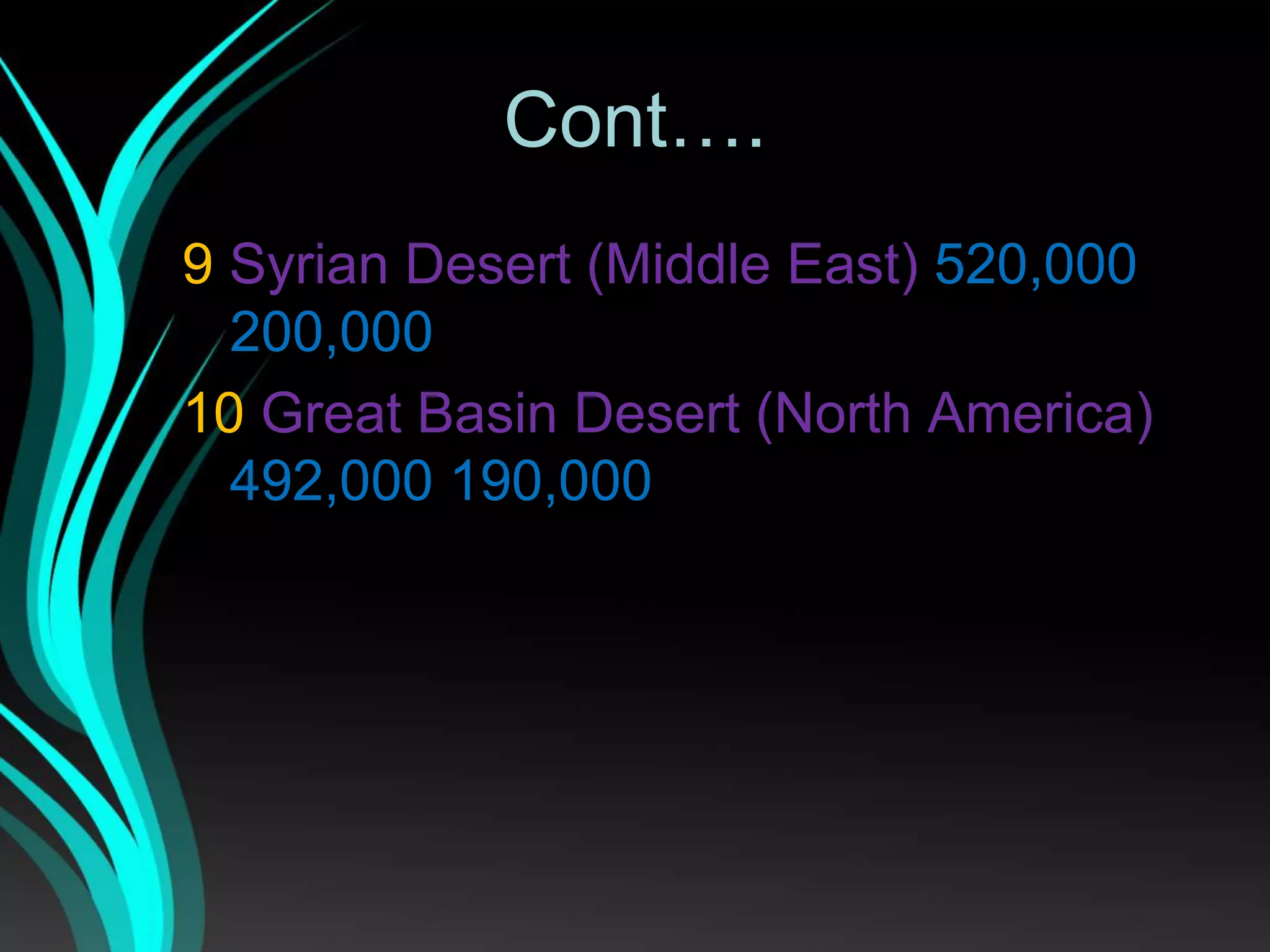
9 Syrian Desert (Middle East) 520,000
200,000
10 Great Basin Desert (North America)
492,000 190,000
Desert Ecosystem

Desert Ecosystem

  • 2.
    DESERT ECOSYSTEM By ;Mehwish Manzoor
  • 3.
    What is aDesert? • A desert is defined as a region which receives an annual precipitation of less than 250mm [10 inches] on an average. • Other than low precipitation,deserts are also characterized by scarce vegetation and extreme temperatures oscillating between 115F or more during daytime and 32F or less at night.
  • 4.
    Cont…… • Deserts havedry climate due to rain- blocking mountain ranges and remoteness from oceanic moisture.
  • 5.
    What is DesertEcosystem? • In an ecosystem,the biological community interacts with the abiological physical environment for its survival. The desert is characterized by extreme, specialized and very sensitive ecosystem.
  • 6.
    Types of desert HotDesert eg. Thar, in Rajasthan, India Rub-ab-khali, Saudi Arab Cold Desert eg. Gobi desert, Mangolia Ica desert, Peru
  • 8.
    A Desert’s Characteristics ClimatePlants Seasons Significance to humans Animals Adaptations
  • 9.
    Climate • The desertis the hottest biome on Earth. It also has its extremes. • It can be over 50 degrees during the day and below 32 degrees at night. • Less than 25 cm or rainfall every year. • The amount of rainfall varies, but when it rains…it POURS!!!! • After a storm, the desert may not see any rain for weeks or months
  • 10.
    Animals • The animalsinclude snakes, owls, mice, armadillo lizards, fennec foxes, gila monsters, bats, and vultures.
  • 11.
    Endangered Animals • BlackRhino • Grevy’s • Zebra • King Cheetah The major causes of endangered animals in the desert are mainly poachers and unexpected drought.
  • 12.
    Plant Life ofDeserts • A Variety of cactuses • Prickly Pear • Dragon Tree • Octillo Plant • Desert Spoon • Boojum There are several plants that are able to survive in the desert. Most plants survive by their long roots to reach underground water sources.
  • 13.
    seasons • The seasonsare generally warm throughout the year and very hot in the summer. • The winters usually bring little rainfall. • Temperatures exhibit daily extremes because the atmosphere contains little humidity to block the Sun’s rays.
  • 14.
    Adaptations • Many ofthe animals in the desert have become nocturnal. • Both plants and animals have learned to store water. • Tolerate Hyperthermia
  • 15.
    Human effects • Poachersare a main cause of dying animals. Poachers catch animals of all kinds to make money for usually just one part, like the elephant tusk. • With the growing popularity of transportation, many roads are being built in not only the desert, but all the other biomes.
  • 16.
    Cont……… • The mainproblem with these roads are the fact that they destroy habitats and endanger animals. Road kill is also a main factor in these dying animals. • These problems can be easily taken care of if other means of transportation were encouraged.
  • 17.
    Structure & Functions •It includes the flora and fauna. • Deserts typically have a plant cover that is sparse but enormously diverse. • Almost all of the animals living in the desert have adapted to be able to better survive in the desert.
  • 18.
  • 19.
    Flora • Some desertflora include shrubs eg. Prickly Pearls, Desert Holly and the Brittlebush. • Most desert plants are drought- or salt- tolerant eg. Xerophites • Other desert plants have long Taproots eg. Turnip
  • 20.
  • 21.
    Fauna • Includes animalsthat remain hidden during daylight hours. • As to control body temperature or to limit moisture needs. • These animals adapted to live in deserts are called Xerocoles • eg. Jack Rabbit, Kangaroo Rat, Coyote, etc.
  • 22.
    Environmental threats to deserts •Global warming and human development are threatening desert survival.
  • 23.
    Global warming: Droughts •Droughts directly affect the growth of vegetation. • Global warming is raising Earth's temperature, increasing the chances of severe drought
  • 24.
    Global warming: WildFires • Wild Fires will burn away the slow- growing fauna. • Thereby drastically changing the landscape
  • 25.
    Development :Irrigation • Thelong-term ramifications are the problem: • deserts experience very little rainfall. • Trees and plants will not be able to live on the remaining water. • the salt levels in the soil make the soil unable to support life.
  • 26.
    Development :Urbanization • Thesimple act of gathering firewood is destroying this fragile ecosystem. • For example, in the Sahel countries of Africa, firewood is being used up 30 percent faster than it is being replaced. • Threatened species like the Bald eagle,
  • 27.
    major deserts Some ofthe major deserts are: • Sahara (Africa) • Great Basin (North America) • Atacama (South America) • Mojave (North America) • Great Victoria (Australia
  • 29.
    The ten largestdeserts 1 Antarctic Desert (Antarctica) 13,829,430 5,339,573 2 Arctic Desert (Arctic) 13,726,937 1,003,600+ 3 Sahara Desert (Africa) 9,100,000+ 3,320,000+ 4 Arabian Desert (Middle East) 2,330,000 900,000
  • 30.
    Cont…. 5 Gobi Desert(Asia) 1,300,000 500,000 6 Kalahari Desert (Africa) 900,000 360,000 7 Patagonian Desert (South America) 670,000 260,000 8 Great Victoria Desert (Australia) 647,000 250,000
  • 31.
    Cont…. 9 Syrian Desert(Middle East) 520,000 200,000 10 Great Basin Desert (North America) 492,000 190,000