The Desert Alexandria Segovia Gilbert Soles Vanessa De La Cruz Belinda De La Torre
The Desert
Around the World Deserts
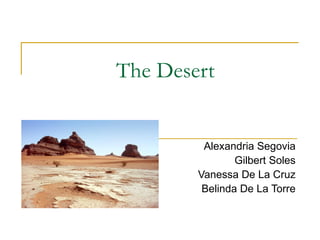
Deserts cover about one-fifth of the Earth’s land surface.  Most deserts are near the Tropic of Capricorn or the Tropic of Cancer. Deserts can be found all around the world, particularly in southwest United States, south America, northern Africa, central Australia, the middle east, and China.
Climate Deserts are areas of land that usually receive less than thirty centimeters of rain each year.  Deserts have cold nights, and extremely hot days.  Most deserts usually receive about fifteen centimeters of rain each year.
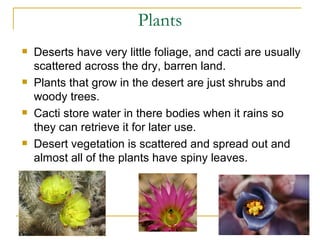
Plants Deserts have very little foliage, and cacti are usually scattered across the dry, barren land.  Plants that grow in the desert are just shrubs and woody trees.  Cacti store water in there bodies when it rains so they can retrieve it for later use.  Desert vegetation is scattered and spread out and almost all of the plants have spiny leaves.
Some Plants Include:  Barrel Cactus   Brittle Bush   Chainfruit   Cholla   Creosote Bush   Crimson Hedgehog Cactus   Desert Ironwood   Joshua Tree   Jumping  Cholla   Mojave Aster   Ocotillo   Palo Verde   Pancake Prickly Pear Cactus   Saguaro Cactus   Soaptree  Yucca   Triangle-leaf  Bursage
Animals Most of the animals that live in the desert have adapted to be able to live in the hot weather by burrowing underground during the day and only coming out at night.  Animals in the desert have also developed a unique ability to store water, which could come from the seeds they eat, or the animals they eat.  Animals are usually small nocturnal carnivores.
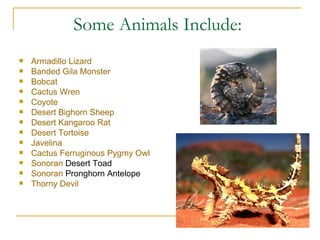
Some Animals Include:  Armadillo Lizard   Banded Gila Monster   Bobcat   Cactus Wren   Coyote   Desert Bighorn Sheep   Desert Kangaroo Rat   Desert Tortoise   Javelina   Cactus Ferruginous Pygmy Owl   Sonoran  Desert Toad   Sonoran  Pronghorn Antelope   Thorny Devil
References: http://www.blueplanetbiomes.org/desert.htm

The Desert Biome

  • 1.
    The Desert AlexandriaSegovia Gilbert Soles Vanessa De La Cruz Belinda De La Torre
  • 2.
  • 3.
  • 4.
    Deserts cover aboutone-fifth of the Earth’s land surface. Most deserts are near the Tropic of Capricorn or the Tropic of Cancer. Deserts can be found all around the world, particularly in southwest United States, south America, northern Africa, central Australia, the middle east, and China.
  • 5.
    Climate Deserts areareas of land that usually receive less than thirty centimeters of rain each year. Deserts have cold nights, and extremely hot days. Most deserts usually receive about fifteen centimeters of rain each year.
  • 6.
    Plants Deserts havevery little foliage, and cacti are usually scattered across the dry, barren land. Plants that grow in the desert are just shrubs and woody trees. Cacti store water in there bodies when it rains so they can retrieve it for later use. Desert vegetation is scattered and spread out and almost all of the plants have spiny leaves.
  • 7.
    Some Plants Include: Barrel Cactus Brittle Bush Chainfruit Cholla Creosote Bush Crimson Hedgehog Cactus Desert Ironwood Joshua Tree Jumping Cholla Mojave Aster Ocotillo Palo Verde Pancake Prickly Pear Cactus Saguaro Cactus Soaptree Yucca Triangle-leaf Bursage
  • 8.
    Animals Most ofthe animals that live in the desert have adapted to be able to live in the hot weather by burrowing underground during the day and only coming out at night. Animals in the desert have also developed a unique ability to store water, which could come from the seeds they eat, or the animals they eat. Animals are usually small nocturnal carnivores.
  • 9.
    Some Animals Include: Armadillo Lizard Banded Gila Monster Bobcat Cactus Wren Coyote Desert Bighorn Sheep Desert Kangaroo Rat Desert Tortoise Javelina Cactus Ferruginous Pygmy Owl Sonoran Desert Toad Sonoran Pronghorn Antelope Thorny Devil
  • 10.