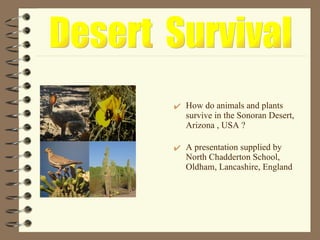
How do animals and plants survive in the Sonoran Desert, Arizona , USA ? A presentation supplied by North Chadderton School, Oldham, Lancashire, England Desert  Survival
Does a barrel cactus contain water ? Yes, the Barrel Cactus does store water, but it is not free flowing. The water is stored in special tissue.  Jackrabbits and other animals can survive in very hot conditions by eating this moist pulp. Desert  Survival
Some people have been known to survive by eating this moist pulp. However, certain species of cactus can contain toxins harmful to humans.  In addition, Arizona Native Plant Law prohibits damaging and destroying barrel cacti and other native plants Desert  Survival
The white-winged dove has a plump body which gives it  a high mass-to-surface area ratio, which minimises moisture loss .  The plump body also insulates them from extremes of temperature.  . Desert  Survival
The white-winged dove eats dry seeds, and the fruit provided by cacti.  They can go without water for four or five days, and fly up to 10 miles to find water.  Desert  Survival
The white-winged dove survive even if their body weight is reduced by 20% by dehydration, and they are able to drink salt water.  They are able to rehydrate quickly, and suck up water like a mammal, unlike most birds. Desert  Survival
Rodents can sometimes kill a Saguaro cactus , by chewing at its moist pulp.   The Red-Tailed Hawk helps to reduce the rodent population around the cactus, by killing the rodents for food . Desert  Survival
During the summer, temperatures can reach over 110   o F. The jackrabbit is able to release heat through its long ears and legs.
Following rain showers  the Ocotillo plant grows leaves along its thorny stems.  During a shortage of rain the leaves turn brown and fall. This conserves water, by reducing evaporation.  Desert  Survival
The green bark of the Ocotillo take over the functions of the leaves during heavy periods of drought.  The process of photosynthesis is able to continue. Desert  Survival
The Saguaro provides home and protection for  birds and other small animals. It provides food for its neighbours. It can store  large amounts of water in its fleshy tissue Desert  Survival
The Desert Mariposa unfolds its orange coloured blossoms only in the Spring.  During the rest of the year the foliage is dead.  It EVADES the action of the desert heat. Desert  Survival
The diet of the Peccary consists of shrubs, grass, mesquite beans , cacti and various roots and tubers.  They are able to eat cactus, with the prickly spines ! They also eat nuts and berries.  They are able to extract sufficient moisture from this diet for several days at a time.  Desert  Survival
The Peccary chooses its location carefully, for shelter.  They use twisting courses of desert washes with the shade provided by the trees.  Living in large cavities provided by erosion of the banks, also offers suitable hiding places. Desert  Survival
The signature plant of the Sonoron Desert : it does not exist anywhere else in the world  Tall column-shaped cactus with pleated stems. Can grow to 40' (12m) .  Produces white flowers in Spring. Has a shallow  root system, and can absorb gallons of water during a single rainfall.  Desert  Survival
The pleats in its trunk allow for expansion, so that it can hold tons of water , to last through the periods of low rainfall .  The waxy, tough coat minimises loss of water by evaporation.  Can live up to 200 years. Smaller saguaros live under 'nurse' plants, which provide shelter during the early years. Desert  Survival
Cavities in the stems are made by woodpeckers, and they use them as nests.  Once the woodpeckers move out these homes are soon adopted by other visitors, such as elf owls, flycatchers, purple martins, and brown bats. Damage can occur sometimes by sudden frosts, lightning, high winds. Desert  Survival
Seeds swallowed by animals and birds pass through their digestive system unharmed. When deposited under trees and shrubs they are given a chance to germinate. Harvester ants gather seeds by the million, and store them in an underground food reservoir, too deep for the seeds to sprout. Fortunately, the Saguaro produces enough seeds to more than compensate for this loss ! Desert  Survival

Survivaldesert2

  • 1.
    How do animalsand plants survive in the Sonoran Desert, Arizona , USA ? A presentation supplied by North Chadderton School, Oldham, Lancashire, England Desert Survival
  • 2.
    Does a barrelcactus contain water ? Yes, the Barrel Cactus does store water, but it is not free flowing. The water is stored in special tissue. Jackrabbits and other animals can survive in very hot conditions by eating this moist pulp. Desert Survival
  • 3.
    Some people havebeen known to survive by eating this moist pulp. However, certain species of cactus can contain toxins harmful to humans. In addition, Arizona Native Plant Law prohibits damaging and destroying barrel cacti and other native plants Desert Survival
  • 4.
    The white-winged dovehas a plump body which gives it a high mass-to-surface area ratio, which minimises moisture loss . The plump body also insulates them from extremes of temperature. . Desert Survival
  • 5.
    The white-winged doveeats dry seeds, and the fruit provided by cacti. They can go without water for four or five days, and fly up to 10 miles to find water. Desert Survival
  • 6.
    The white-winged dovesurvive even if their body weight is reduced by 20% by dehydration, and they are able to drink salt water. They are able to rehydrate quickly, and suck up water like a mammal, unlike most birds. Desert Survival
  • 7.
    Rodents can sometimeskill a Saguaro cactus , by chewing at its moist pulp. The Red-Tailed Hawk helps to reduce the rodent population around the cactus, by killing the rodents for food . Desert Survival
  • 8.
    During the summer,temperatures can reach over 110 o F. The jackrabbit is able to release heat through its long ears and legs.
  • 9.
    Following rain showers the Ocotillo plant grows leaves along its thorny stems. During a shortage of rain the leaves turn brown and fall. This conserves water, by reducing evaporation. Desert Survival
  • 10.
    The green barkof the Ocotillo take over the functions of the leaves during heavy periods of drought. The process of photosynthesis is able to continue. Desert Survival
  • 11.
    The Saguaro provideshome and protection for birds and other small animals. It provides food for its neighbours. It can store large amounts of water in its fleshy tissue Desert Survival
  • 12.
    The Desert Mariposaunfolds its orange coloured blossoms only in the Spring. During the rest of the year the foliage is dead. It EVADES the action of the desert heat. Desert Survival
  • 13.
    The diet ofthe Peccary consists of shrubs, grass, mesquite beans , cacti and various roots and tubers. They are able to eat cactus, with the prickly spines ! They also eat nuts and berries. They are able to extract sufficient moisture from this diet for several days at a time. Desert Survival
  • 14.
    The Peccary choosesits location carefully, for shelter. They use twisting courses of desert washes with the shade provided by the trees. Living in large cavities provided by erosion of the banks, also offers suitable hiding places. Desert Survival
  • 15.
    The signature plantof the Sonoron Desert : it does not exist anywhere else in the world Tall column-shaped cactus with pleated stems. Can grow to 40' (12m) . Produces white flowers in Spring. Has a shallow root system, and can absorb gallons of water during a single rainfall. Desert Survival
  • 16.
    The pleats inits trunk allow for expansion, so that it can hold tons of water , to last through the periods of low rainfall . The waxy, tough coat minimises loss of water by evaporation. Can live up to 200 years. Smaller saguaros live under 'nurse' plants, which provide shelter during the early years. Desert Survival
  • 17.
    Cavities in thestems are made by woodpeckers, and they use them as nests. Once the woodpeckers move out these homes are soon adopted by other visitors, such as elf owls, flycatchers, purple martins, and brown bats. Damage can occur sometimes by sudden frosts, lightning, high winds. Desert Survival
  • 18.
    Seeds swallowed byanimals and birds pass through their digestive system unharmed. When deposited under trees and shrubs they are given a chance to germinate. Harvester ants gather seeds by the million, and store them in an underground food reservoir, too deep for the seeds to sprout. Fortunately, the Saguaro produces enough seeds to more than compensate for this loss ! Desert Survival