1
ITCS4145/5145, Parallel Programming B. Wilkinson Fall 2010, Oct 27, 2010
Programming with Shared Memory
Part 2
Introduction to OpenMP
2
OpenMP
An accepted standard developed in the late 1990s by a
group of industry specialists.
Consists of a small set of compiler directives, augmented
with a small set of library routines and environment variables
using the base language Fortran and C/C++.
Several OpenMP compilers available.
3
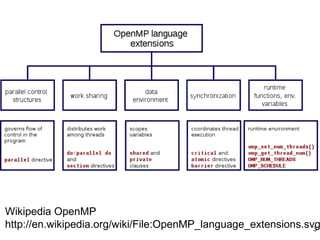
Wikipedia OpenMP
http://en.wikipedia.org/wiki/File:OpenMP_language_extensions.svg
4
OpenMP
• Uses a thread-based shared memory programming
model
• OpenMP programs will create multiple threads
• All threads have access to global memory
• Data can be shared among all threads or private to one
thread
• Synchronization occurs but often implicit
5
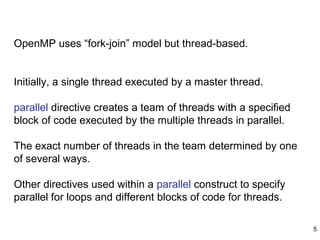
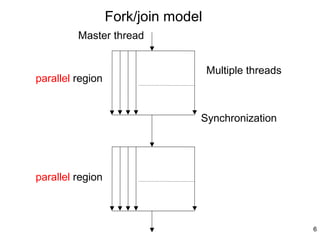
OpenMP uses “fork-join” model but thread-based.
Initially, a single thread executed by a master thread.
parallel directive creates a team of threads with a specified
block of code executed by the multiple threads in parallel.
The exact number of threads in the team determined by one
of several ways.
Other directives used within a parallel construct to specify
parallel for loops and different blocks of code for threads.
6
parallel region
Multiple threads
parallel region
Master thread
Fork/join model
Synchronization
7
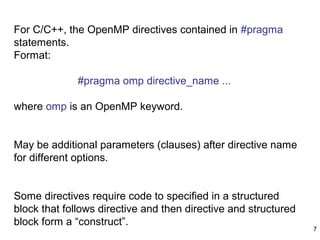
For C/C++, the OpenMP directives contained in #pragma
statements.
Format:
#pragma omp directive_name ...
where omp is an OpenMP keyword.
May be additional parameters (clauses) after directive name
for different options.
Some directives require code to specified in a structured
block that follows directive and then directive and structured
block form a “construct”.
8
Parallel Directive
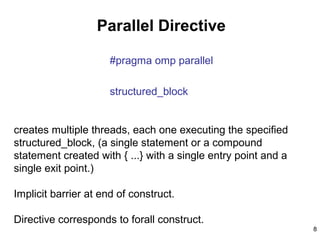
#pragma omp parallel
structured_block
creates multiple threads, each one executing the specified
structured_block, (a single statement or a compound
statement created with { ...} with a single entry point and a
single exit point.)
Implicit barrier at end of construct.
Directive corresponds to forall construct.
9
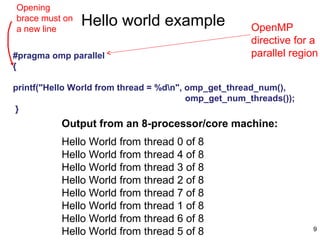
Hello world example
#pragma omp parallel
{
printf("Hello World from thread = %dn", omp_get_thread_num(),
omp_get_num_threads());
}
Output from an 8-processor/core machine:
Hello World from thread 0 of 8
Hello World from thread 4 of 8
Hello World from thread 3 of 8
Hello World from thread 2 of 8
Hello World from thread 7 of 8
Hello World from thread 1 of 8
Hello World from thread 6 of 8
Hello World from thread 5 of 8
OpenMP
directive for a
parallel region
Opening
brace must on
a new line
10
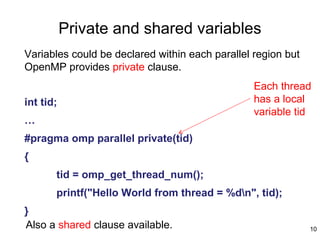
Private and shared variables
Variables could be declared within each parallel region but
OpenMP provides private clause.
int tid;
…
#pragma omp parallel private(tid)
{
tid = omp_get_thread_num();
printf("Hello World from thread = %dn", tid);
}
Each thread
has a local
variable tid
Also a shared clause available.
11
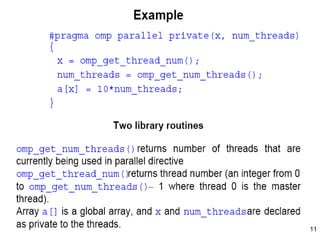
12
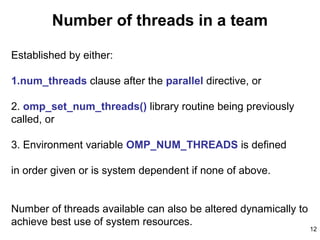
Number of threads in a team
Established by either:
1.num_threads clause after the parallel directive, or
2. omp_set_num_threads() library routine being previously
called, or
3. Environment variable OMP_NUM_THREADS is defined
in order given or is system dependent if none of above.
Number of threads available can also be altered dynamically to
achieve best use of system resources.
13
Work-Sharing
Three constructs in this classification:
sections
for
single
In all cases, there is an implicit barrier at end of construct
unless a nowait clause included, which overrides the barrier.
Note: These constructs do not start a new team of threads.
That done by an enclosing parallel construct.
14
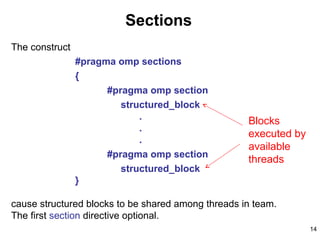
Sections
The construct
#pragma omp sections
{
#pragma omp section
structured_block
.
.
.
#pragma omp section
structured_block
}
cause structured blocks to be shared among threads in team.
The first section directive optional.
Blocks
executed by
available
threads
15
Example
#pragma omp parallel shared(a,b,c,d,nthreads) private(i,tid)
{
tid = omp_get_thread_num();
#pragma omp sections nowait
{
#pragma omp section
{
printf("Thread %d doing section 1n",tid);
for (i=0; i<N; i++) {
c[i] = a[i] + b[i];
printf("Thread %d: c[%d]= %fn",tid,i,c[i]);
}
}
#pragma omp section
{
printf("Thread %d doing section 2n",tid);
for (i=0; i<N; i++) {
d[i] = a[i] * b[i];
printf("Thread %d: d[%d]= %fn",tid,i,d[i]);
}
}
} /* end of sections */
} /* end of parallel section */
One
thread
does this
Another
thread
does this
16
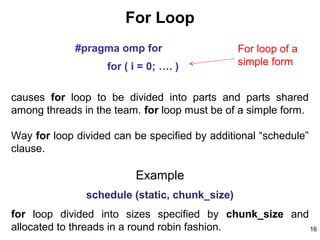
For Loop
#pragma omp for
for ( i = 0; …. )
causes for loop to be divided into parts and parts shared
among threads in the team. for loop must be of a simple form.
Way for loop divided can be specified by additional “schedule”
clause.
Example
schedule (static, chunk_size)
for loop divided into sizes specified by chunk_size and
allocated to threads in a round robin fashion.
For loop of a
simple form
17
Example
#pragma omp parallel shared(a,b,c,nthreads,chunk) private(i,tid)
{
tid = omp_get_thread_num();
if (tid == 0) {
nthreads = omp_get_num_threads();
printf("Number of threads = %dn", nthreads);
}
printf("Thread %d starting...n",tid);
#pragma omp for schedule(dynamic,chunk)
for (i=0; i<N; i++) {
c[i] = a[i] + b[i];
printf("Thread %d: c[%d]= %fn",tid,i,c[i]);
}
} /* end of parallel section */
For loop
Executed by
one thread
18
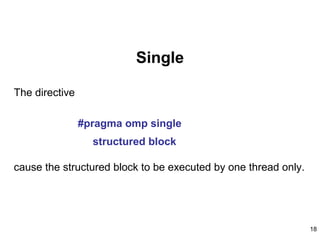
Single
The directive
#pragma omp single
structured block
cause the structured block to be executed by one thread only.
19
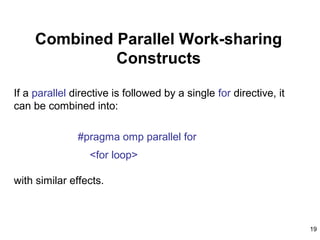
Combined Parallel Work-sharing
Constructs
If a parallel directive is followed by a single for directive, it
can be combined into:
#pragma omp parallel for
<for loop>
with similar effects.
20
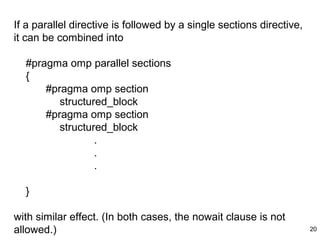
If a parallel directive is followed by a single sections directive,
it can be combined into
#pragma omp parallel sections
{
#pragma omp section
structured_block
#pragma omp section
structured_block
.
.
.
}
with similar effect. (In both cases, the nowait clause is not
allowed.)
21
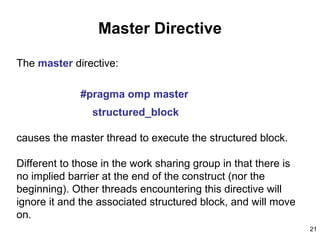
Master Directive
The master directive:
#pragma omp master
structured_block
causes the master thread to execute the structured block.
Different to those in the work sharing group in that there is
no implied barrier at the end of the construct (nor the
beginning). Other threads encountering this directive will
ignore it and the associated structured block, and will move
on.
22
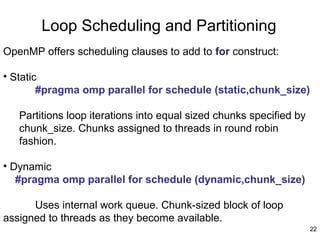
Loop Scheduling and Partitioning
OpenMP offers scheduling clauses to add to for construct:
• Static
#pragma omp parallel for schedule (static,chunk_size)
Partitions loop iterations into equal sized chunks specified by
chunk_size. Chunks assigned to threads in round robin
fashion.
• Dynamic
#pragma omp parallel for schedule (dynamic,chunk_size)
Uses internal work queue. Chunk-sized block of loop
assigned to threads as they become available.
23
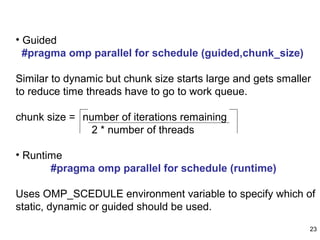
• Guided
#pragma omp parallel for schedule (guided,chunk_size)
Similar to dynamic but chunk size starts large and gets smaller
to reduce time threads have to go to work queue.
chunk size = number of iterations remaining
2 * number of threads
• Runtime
#pragma omp parallel for schedule (runtime)
Uses OMP_SCEDULE environment variable to specify which of
static, dynamic or guided should be used.
24
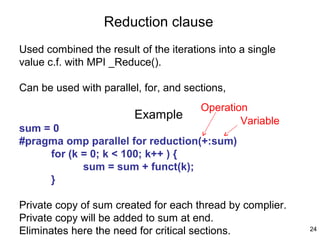
Reduction clause
Used combined the result of the iterations into a single
value c.f. with MPI _Reduce().
Can be used with parallel, for, and sections,
Example
sum = 0
#pragma omp parallel for reduction(+:sum)
for (k = 0; k < 100; k++ ) {
sum = sum + funct(k);
}
Private copy of sum created for each thread by complier.
Private copy will be added to sum at end.
Eliminates here the need for critical sections.
Operation
Variable
25
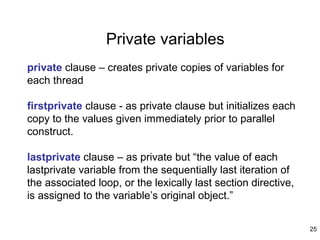
Private variables
private clause – creates private copies of variables for
each thread
firstprivate clause - as private clause but initializes each
copy to the values given immediately prior to parallel
construct.
lastprivate clause – as private but “the value of each
lastprivate variable from the sequentially last iteration of
the associated loop, or the lexically last section directive,
is assigned to the variable’s original object.”
26
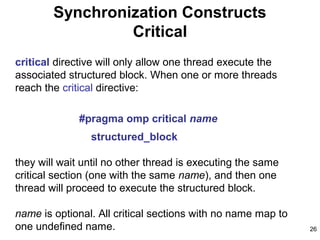
Synchronization Constructs
Critical
critical directive will only allow one thread execute the
associated structured block. When one or more threads
reach the critical directive:
#pragma omp critical name
structured_block
they will wait until no other thread is executing the same
critical section (one with the same name), and then one
thread will proceed to execute the structured block.
name is optional. All critical sections with no name map to
one undefined name.
27
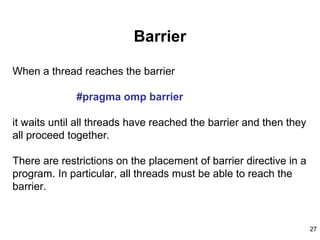
Barrier
When a thread reaches the barrier
#pragma omp barrier
it waits until all threads have reached the barrier and then they
all proceed together.
There are restrictions on the placement of barrier directive in a
program. In particular, all threads must be able to reach the
barrier.
28
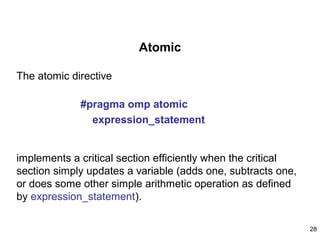
Atomic
The atomic directive
#pragma omp atomic
expression_statement
implements a critical section efficiently when the critical
section simply updates a variable (adds one, subtracts one,
or does some other simple arithmetic operation as defined
by expression_statement).
29
Flush
A synchronization point which causes thread to have a
“consistent” view of certain or all shared variables in memory.
All current read and write operations on variables allowed to
complete and values written back to memory but any memory
operations in code after flush are not started.
Format:
#pragma omp flush (variable_list)
Only applied to thread executing flush, not to all threads in team.
Flush occurs automatically at entry and exit of parallel and critical
directives, and at the exit of for, sections, and single (if a no-wait
clause is not present).
30
Ordered clause
Used in conjunction with for and parallel for directives to
cause an iteration to be executed in the order that it
would have occurred if written as a sequential loop.
31
More information
Full information on OpenMP at
http://openmp.org/wp/

Programming using Open Mp

  • 1.
    1 ITCS4145/5145, Parallel ProgrammingB. Wilkinson Fall 2010, Oct 27, 2010 Programming with Shared Memory Part 2 Introduction to OpenMP
  • 2.
    2 OpenMP An accepted standarddeveloped in the late 1990s by a group of industry specialists. Consists of a small set of compiler directives, augmented with a small set of library routines and environment variables using the base language Fortran and C/C++. Several OpenMP compilers available.
  • 3.
  • 4.
    4 OpenMP • Uses athread-based shared memory programming model • OpenMP programs will create multiple threads • All threads have access to global memory • Data can be shared among all threads or private to one thread • Synchronization occurs but often implicit
  • 5.
    5 OpenMP uses “fork-join”model but thread-based. Initially, a single thread executed by a master thread. parallel directive creates a team of threads with a specified block of code executed by the multiple threads in parallel. The exact number of threads in the team determined by one of several ways. Other directives used within a parallel construct to specify parallel for loops and different blocks of code for threads.
  • 6.
    6 parallel region Multiple threads parallelregion Master thread Fork/join model Synchronization
  • 7.
    7 For C/C++, theOpenMP directives contained in #pragma statements. Format: #pragma omp directive_name ... where omp is an OpenMP keyword. May be additional parameters (clauses) after directive name for different options. Some directives require code to specified in a structured block that follows directive and then directive and structured block form a “construct”.
  • 8.
    8 Parallel Directive #pragma ompparallel structured_block creates multiple threads, each one executing the specified structured_block, (a single statement or a compound statement created with { ...} with a single entry point and a single exit point.) Implicit barrier at end of construct. Directive corresponds to forall construct.
  • 9.
    9 Hello world example #pragmaomp parallel { printf("Hello World from thread = %dn", omp_get_thread_num(), omp_get_num_threads()); } Output from an 8-processor/core machine: Hello World from thread 0 of 8 Hello World from thread 4 of 8 Hello World from thread 3 of 8 Hello World from thread 2 of 8 Hello World from thread 7 of 8 Hello World from thread 1 of 8 Hello World from thread 6 of 8 Hello World from thread 5 of 8 OpenMP directive for a parallel region Opening brace must on a new line
  • 10.
    10 Private and sharedvariables Variables could be declared within each parallel region but OpenMP provides private clause. int tid; … #pragma omp parallel private(tid) { tid = omp_get_thread_num(); printf("Hello World from thread = %dn", tid); } Each thread has a local variable tid Also a shared clause available.
  • 11.
  • 12.
    12 Number of threadsin a team Established by either: 1.num_threads clause after the parallel directive, or 2. omp_set_num_threads() library routine being previously called, or 3. Environment variable OMP_NUM_THREADS is defined in order given or is system dependent if none of above. Number of threads available can also be altered dynamically to achieve best use of system resources.
  • 13.
    13 Work-Sharing Three constructs inthis classification: sections for single In all cases, there is an implicit barrier at end of construct unless a nowait clause included, which overrides the barrier. Note: These constructs do not start a new team of threads. That done by an enclosing parallel construct.
  • 14.
    14 Sections The construct #pragma ompsections { #pragma omp section structured_block . . . #pragma omp section structured_block } cause structured blocks to be shared among threads in team. The first section directive optional. Blocks executed by available threads
  • 15.
    15 Example #pragma omp parallelshared(a,b,c,d,nthreads) private(i,tid) { tid = omp_get_thread_num(); #pragma omp sections nowait { #pragma omp section { printf("Thread %d doing section 1n",tid); for (i=0; i<N; i++) { c[i] = a[i] + b[i]; printf("Thread %d: c[%d]= %fn",tid,i,c[i]); } } #pragma omp section { printf("Thread %d doing section 2n",tid); for (i=0; i<N; i++) { d[i] = a[i] * b[i]; printf("Thread %d: d[%d]= %fn",tid,i,d[i]); } } } /* end of sections */ } /* end of parallel section */ One thread does this Another thread does this
  • 16.
    16 For Loop #pragma ompfor for ( i = 0; …. ) causes for loop to be divided into parts and parts shared among threads in the team. for loop must be of a simple form. Way for loop divided can be specified by additional “schedule” clause. Example schedule (static, chunk_size) for loop divided into sizes specified by chunk_size and allocated to threads in a round robin fashion. For loop of a simple form
  • 17.
    17 Example #pragma omp parallelshared(a,b,c,nthreads,chunk) private(i,tid) { tid = omp_get_thread_num(); if (tid == 0) { nthreads = omp_get_num_threads(); printf("Number of threads = %dn", nthreads); } printf("Thread %d starting...n",tid); #pragma omp for schedule(dynamic,chunk) for (i=0; i<N; i++) { c[i] = a[i] + b[i]; printf("Thread %d: c[%d]= %fn",tid,i,c[i]); } } /* end of parallel section */ For loop Executed by one thread
  • 18.
    18 Single The directive #pragma ompsingle structured block cause the structured block to be executed by one thread only.
  • 19.
    19 Combined Parallel Work-sharing Constructs Ifa parallel directive is followed by a single for directive, it can be combined into: #pragma omp parallel for <for loop> with similar effects.
  • 20.
    20 If a paralleldirective is followed by a single sections directive, it can be combined into #pragma omp parallel sections { #pragma omp section structured_block #pragma omp section structured_block . . . } with similar effect. (In both cases, the nowait clause is not allowed.)
  • 21.
    21 Master Directive The masterdirective: #pragma omp master structured_block causes the master thread to execute the structured block. Different to those in the work sharing group in that there is no implied barrier at the end of the construct (nor the beginning). Other threads encountering this directive will ignore it and the associated structured block, and will move on.
  • 22.
    22 Loop Scheduling andPartitioning OpenMP offers scheduling clauses to add to for construct: • Static #pragma omp parallel for schedule (static,chunk_size) Partitions loop iterations into equal sized chunks specified by chunk_size. Chunks assigned to threads in round robin fashion. • Dynamic #pragma omp parallel for schedule (dynamic,chunk_size) Uses internal work queue. Chunk-sized block of loop assigned to threads as they become available.
  • 23.
    23 • Guided #pragma ompparallel for schedule (guided,chunk_size) Similar to dynamic but chunk size starts large and gets smaller to reduce time threads have to go to work queue. chunk size = number of iterations remaining 2 * number of threads • Runtime #pragma omp parallel for schedule (runtime) Uses OMP_SCEDULE environment variable to specify which of static, dynamic or guided should be used.
  • 24.
    24 Reduction clause Used combinedthe result of the iterations into a single value c.f. with MPI _Reduce(). Can be used with parallel, for, and sections, Example sum = 0 #pragma omp parallel for reduction(+:sum) for (k = 0; k < 100; k++ ) { sum = sum + funct(k); } Private copy of sum created for each thread by complier. Private copy will be added to sum at end. Eliminates here the need for critical sections. Operation Variable
  • 25.
    25 Private variables private clause– creates private copies of variables for each thread firstprivate clause - as private clause but initializes each copy to the values given immediately prior to parallel construct. lastprivate clause – as private but “the value of each lastprivate variable from the sequentially last iteration of the associated loop, or the lexically last section directive, is assigned to the variable’s original object.”
  • 26.
    26 Synchronization Constructs Critical critical directivewill only allow one thread execute the associated structured block. When one or more threads reach the critical directive: #pragma omp critical name structured_block they will wait until no other thread is executing the same critical section (one with the same name), and then one thread will proceed to execute the structured block. name is optional. All critical sections with no name map to one undefined name.
  • 27.
    27 Barrier When a threadreaches the barrier #pragma omp barrier it waits until all threads have reached the barrier and then they all proceed together. There are restrictions on the placement of barrier directive in a program. In particular, all threads must be able to reach the barrier.
  • 28.
    28 Atomic The atomic directive #pragmaomp atomic expression_statement implements a critical section efficiently when the critical section simply updates a variable (adds one, subtracts one, or does some other simple arithmetic operation as defined by expression_statement).
  • 29.
    29 Flush A synchronization pointwhich causes thread to have a “consistent” view of certain or all shared variables in memory. All current read and write operations on variables allowed to complete and values written back to memory but any memory operations in code after flush are not started. Format: #pragma omp flush (variable_list) Only applied to thread executing flush, not to all threads in team. Flush occurs automatically at entry and exit of parallel and critical directives, and at the exit of for, sections, and single (if a no-wait clause is not present).
  • 30.
    30 Ordered clause Used inconjunction with for and parallel for directives to cause an iteration to be executed in the order that it would have occurred if written as a sequential loop.
  • 31.
    31 More information Full informationon OpenMP at http://openmp.org/wp/