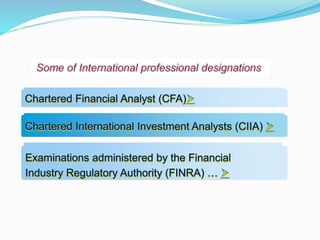
 Chartered Financial Analyst (CFA)
 Chartered International Investment Analysts (CIIA)
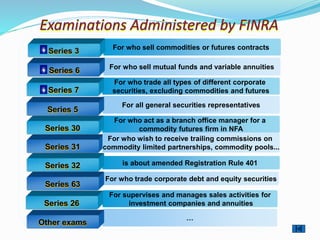
Series 31
For all general securities representatives
For who act as a branch office manager for a
commodity futures firm in NFA
For who wish to receive trailing commissions on
commodity limited partnerships, commodity pools...
is about amended Registration Rule 401
For who trade corporate debt and equity securities
Series 5
Series 30
Series 32
Series 63
For supervises and manages sales activities for
investment companies and annuitiesSeries 26
…
Other exams
For who sell mutual funds and variable annuities
For who trade all types of different corporate
securities, excluding commodities and futures
Series 6
Series 7
For who sell commodities or futures contracts
Advanced
License
Exam
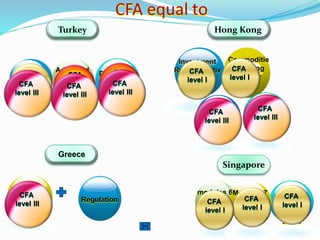
Turkey
Derivatives
License
Exam
modules 6
of the
CMFAS
Exam
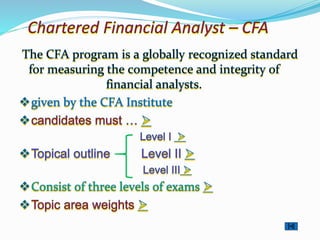
CFA
level I
Hong Kong
Investment
Advisers
Commoditie
s Trading
Adviser
Greece
Singapore
Regulation
CFA
level IICFA
level III
analyst
license module 8
of the
CMFAS
Exam
CFA
level I
Modules 7
of the
CMFAS
Exam
CFA
level I
CFA
level I
CFA
level III
Commoditie
s Trading
Advisers
CFA
level III
CFA
level III
CFA
level I
CFA
level I
CFA
level III
CFA
level IICFA
level III
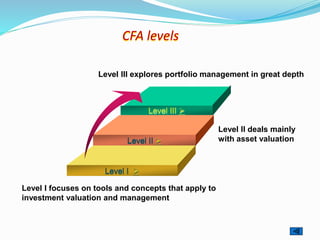
CFA levels
Level II 
Level III explores portfolio management in great depth
Level II deals mainly
with asset valuation
Level I focuses on tools and concepts that apply to
investment valuation and management
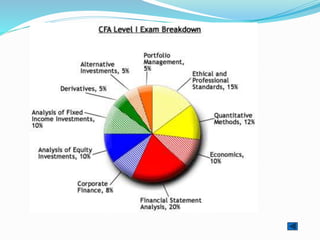
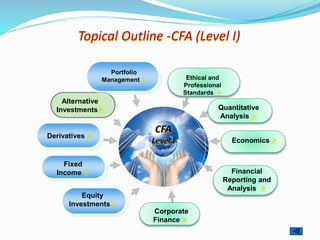
Topical Outline -CFA (Level I)
Derivatives 
Fixed
Income 
Equity
Investments
Ethical and
Professional
Standards 
Quantitative
Analysis 
Economics 
Financial
Reporting and
Analysis 
Alternative
Investments
Corporate
Finance 
Portfolio
Management 
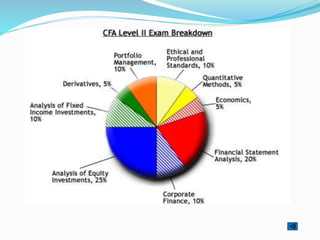
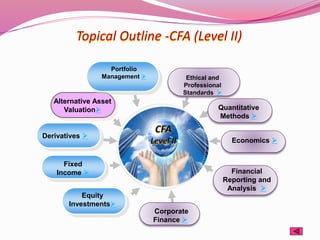
Topical Outline -CFA (Level II)
Derivatives 
Fixed
Income 
Equity
Investments
Ethical and
Professional
Standards 
Quantitative
Methods 
Economics 
Financial
Reporting and
Analysis 
Alternative Asset
Valuation
Corporate
Finance 
Portfolio
Management 
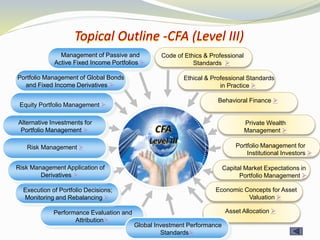
Topical Outline -CFA (Level III)
Code of Ethics & Professional
Standards 
Management of Passive and
Active Fixed Income Portfolios 
Ethical & Professional Standards
in Practice 
Behavioral Finance 
Private Wealth
Management 
Capital Market Expectations in
Portfolio Management 
Portfolio Management for
Institutional Investors 
Asset Allocation 
Economic Concepts for Asset
Valuation 
Portfolio Management of Global Bonds
and Fixed Income Derivatives 
Equity Portfolio Management 
Alternative Investments for
Portfolio Management 
Performance Evaluation and
Attribution
Execution of Portfolio Decisions;
Monitoring and Rebalancing 
Risk Management 
Risk Management Application of
Derivatives 
Global Investment Performance
Standards
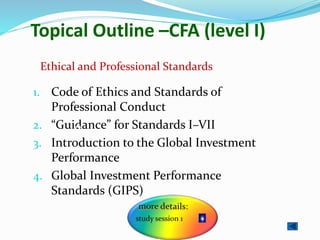
Topical Outline –CFA (level I)
1. Code of Ethics and Standards of
Professional Conduct
2. “Guidance” for Standards I–VII
3. Introduction to the Global Investment
Performance
4. Global Investment Performance
Standards (GIPS)
Ethical and Professional Standards
2
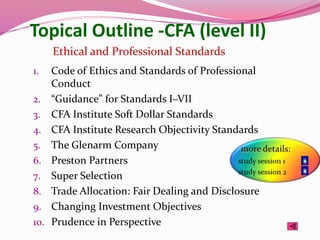
Topical Outline -CFA (level II)
1. Code of Ethics and Standards of Professional
Conduct
2. “Guidance” for Standards I–VII
3. CFA Institute Soft Dollar Standards
4. CFA Institute Research Objectivity Standards
5. The Glenarm Company
6. Preston Partners
7. Super Selection
8. Trade Allocation: Fair Dealing and Disclosure
9. Changing Investment Objectives
10. Prudence in Perspective
Ethical and Professional Standards
Topical Outline - CFA (level I)
1. The Time Value of Money
2. Discounted Cash Flow Applications
3. Statistical Concepts and Market Returns
4. Probability Concepts
5. Common Probability Distributions
6. Sampling and Estimation
7. Hypothesis Testing
8. Technical Analysis
Quantitative Methods
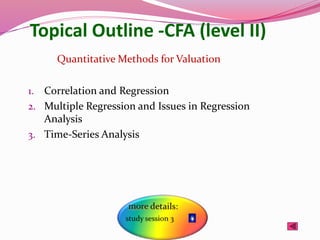
Topical Outline -CFA (level II)
1. Correlation and Regression
2. Multiple Regression and Issues in Regression
Analysis
3. Time-Series Analysis
Quantitative Methods for Valuation
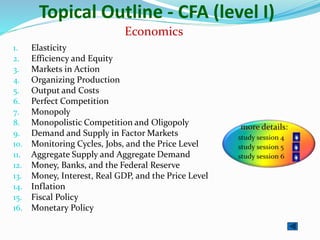
Topical Outline - CFA (level I)
1. Elasticity
2. Efficiency and Equity
3. Markets in Action
4. Organizing Production
5. Output and Costs
6. Perfect Competition
7. Monopoly
8. Monopolistic Competition and Oligopoly
9. Demand and Supply in Factor Markets
10. Monitoring Cycles, Jobs, and the Price Level
11. Aggregate Supply and Aggregate Demand
12. Money, Banks, and the Federal Reserve
13. Money, Interest, Real GDP, and the Price Level
14. Inflation
15. Fiscal Policy
16. Monetary Policy
Economics
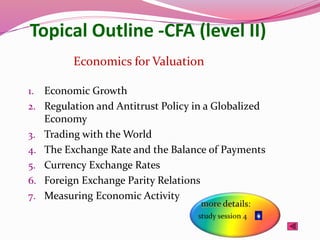
Topical Outline -CFA (level II)
1. Economic Growth
2. Regulation and Antitrust Policy in a Globalized
Economy
3. Trading with the World
4. The Exchange Rate and the Balance of Payments
5. Currency Exchange Rates
6. Foreign Exchange Parity Relations
7. Measuring Economic Activity
Economics for Valuation
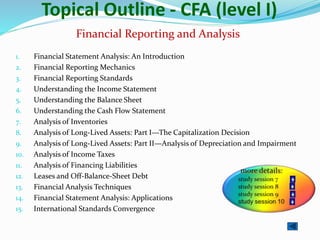
Topical Outline - CFA (level I)
1. Financial Statement Analysis: An Introduction
2. Financial Reporting Mechanics
3. Financial Reporting Standards
4. Understanding the Income Statement
5. Understanding the Balance Sheet
6. Understanding the Cash Flow Statement
7. Analysis of Inventories
8. Analysis of Long-Lived Assets: Part I—The Capitalization Decision
9. Analysis of Long-Lived Assets: Part II—Analysis of Depreciation and Impairment
10. Analysis of Income Taxes
11. Analysis of Financing Liabilities
12. Leases and Off-Balance-Sheet Debt
13. Financial Analysis Techniques
14. Financial Statement Analysis: Applications
15. International Standards Convergence
Financial Reporting and Analysis
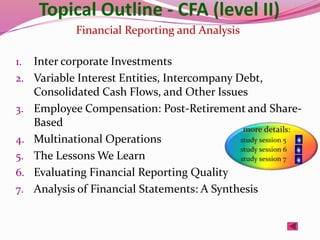
Topical Outline - CFA (level II)
1. Inter corporate Investments
2. Variable Interest Entities, Intercompany Debt,
Consolidated Cash Flows, and Other Issues
3. Employee Compensation: Post-Retirement and Share-
Based
4. Multinational Operations
5. The Lessons We Learn
6. Evaluating Financial Reporting Quality
7. Analysis of Financial Statements: A Synthesis
Financial Reporting and Analysis
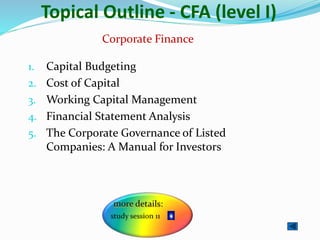
Topical Outline - CFA (level I)
1. Capital Budgeting
2. Cost of Capital
3. Working Capital Management
4. Financial Statement Analysis
5. The Corporate Governance of Listed
Companies: A Manual for Investors
Corporate Finance
Topical Outline - CFA (level II)
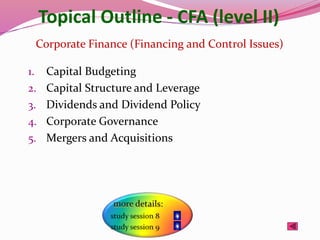
1. Capital Budgeting
2. Capital Structure and Leverage
3. Dividends and Dividend Policy
4. Corporate Governance
5. Mergers and Acquisitions
Corporate Finance (Financing and Control Issues)
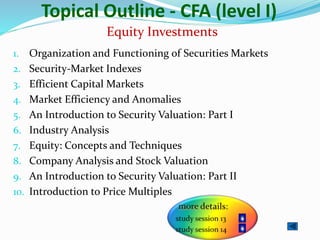
Topical Outline - CFA (level I)
1. Organization and Functioning of Securities Markets
2. Security-Market Indexes
3. Efficient Capital Markets
4. Market Efficiency and Anomalies
5. An Introduction to Security Valuation: Part I
6. Industry Analysis
7. Equity: Concepts and Techniques
8. Company Analysis and Stock Valuation
9. An Introduction to Security Valuation: Part II
10. Introduction to Price Multiples
Equity Investments
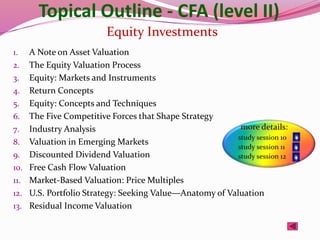
Topical Outline - CFA (level II)
1. A Note on Asset Valuation
2. The Equity Valuation Process
3. Equity: Markets and Instruments
4. Return Concepts
5. Equity: Concepts and Techniques
6. The Five Competitive Forces that Shape Strategy
7. Industry Analysis
8. Valuation in Emerging Markets
9. Discounted Dividend Valuation
10. Free Cash Flow Valuation
11. Market-Based Valuation: Price Multiples
12. U.S. Portfolio Strategy: Seeking Value—Anatomy of Valuation
13. Residual Income Valuation
Equity Investments
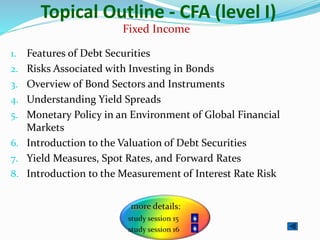
Topical Outline - CFA (level I)
1. Features of Debt Securities
2. Risks Associated with Investing in Bonds
3. Overview of Bond Sectors and Instruments
4. Understanding Yield Spreads
5. Monetary Policy in an Environment of Global Financial
Markets
6. Introduction to the Valuation of Debt Securities
7. Yield Measures, Spot Rates, and Forward Rates
8. Introduction to the Measurement of Interest Rate Risk
Fixed Income
Topical Outline - CFA (level II)
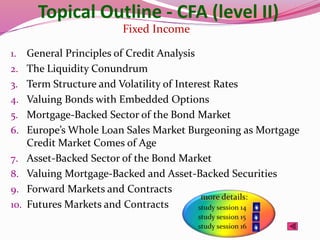
1. General Principles of Credit Analysis
2. The Liquidity Conundrum
3. Term Structure and Volatility of Interest Rates
4. Valuing Bonds with Embedded Options
5. Mortgage-Backed Sector of the Bond Market
6. Europe’s Whole Loan Sales Market Burgeoning as Mortgage
Credit Market Comes of Age
7. Asset-Backed Sector of the Bond Market
8. Valuing Mortgage-Backed and Asset-Backed Securities
9. Forward Markets and Contracts
10. Futures Markets and Contracts
Fixed Income
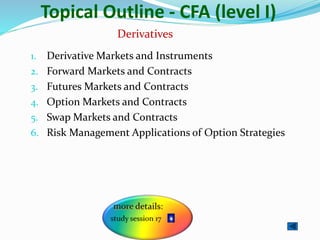
Topical Outline - CFA (level I)
1. Derivative Markets and Instruments
2. Forward Markets and Contracts
3. Futures Markets and Contracts
4. Option Markets and Contracts
5. Swap Markets and Contracts
6. Risk Management Applications of Option Strategies
Derivatives
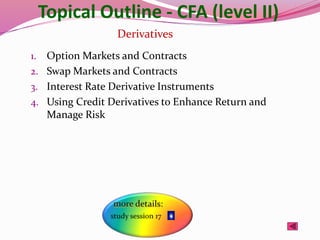
Topical Outline - CFA (level II)
1. Option Markets and Contracts
2. Swap Markets and Contracts
3. Interest Rate Derivative Instruments
4. Using Credit Derivatives to Enhance Return and
Manage Risk
Derivatives
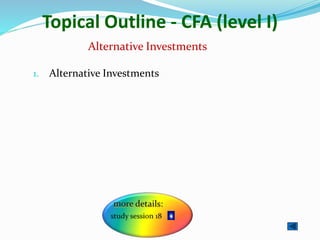
Topical Outline - CFA (level I)
1. Alternative Investments
Alternative Investments
Topical Outline - CFA (level II)
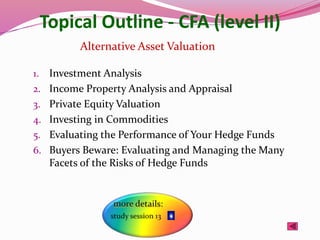
1. Investment Analysis
2. Income Property Analysis and Appraisal
3. Private Equity Valuation
4. Investing in Commodities
5. Evaluating the Performance of Your Hedge Funds
6. Buyers Beware: Evaluating and Managing the Many
Facets of the Risks of Hedge Funds
Alternative Asset Valuation
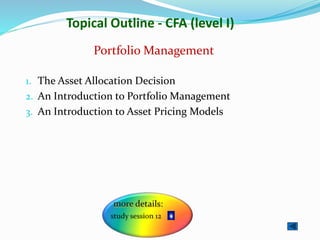
Topical Outline - CFA (level I)
1. The Asset Allocation Decision
2. An Introduction to Portfolio Management
3. An Introduction to Asset Pricing Models
Portfolio Management
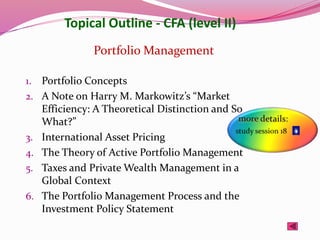
Topical Outline - CFA (level II)
1. Portfolio Concepts
2. A Note on Harry M. Markowitz’s “Market
Efficiency: A Theoretical Distinction and So
What?”
3. International Asset Pricing
4. The Theory of Active Portfolio Management
5. Taxes and Private Wealth Management in a
Global Context
6. The Portfolio Management Process and the
Investment Policy Statement
Portfolio Management
Topical Outline –CFA (level III)
1. Code of Ethics and Standards of
Professional Conduct
2. “Guidance” for Standards I–VII
Code of Ethics and Professional Standards
More
Details
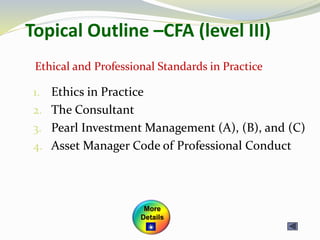
Topical Outline –CFA (level III)
1. Ethics in Practice
2. The Consultant
3. Pearl Investment Management (A), (B), and (C)
4. Asset Manager Code of Professional Conduct
Ethical and Professional Standards in Practice
More
Details
Topical Outline –CFA (level III)
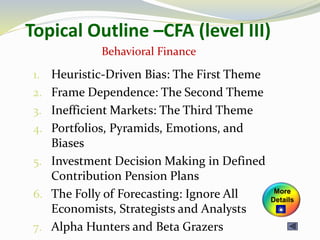
1. Heuristic-Driven Bias: The First Theme
2. Frame Dependence: The Second Theme
3. Inefficient Markets: The Third Theme
4. Portfolios, Pyramids, Emotions, and
Biases
5. Investment Decision Making in Defined
Contribution Pension Plans
6. The Folly of Forecasting: Ignore All
Economists, Strategists and Analysts
7. Alpha Hunters and Beta Grazers
Behavioral Finance
More
Details
Topical Outline –CFA (level III)
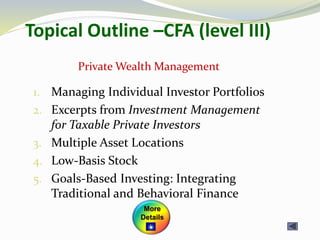
1. Managing Individual Investor Portfolios
2. Excerpts from Investment Management
for Taxable Private Investors
3. Multiple Asset Locations
4. Low-Basis Stock
5. Goals-Based Investing: Integrating
Traditional and Behavioral Finance
Private Wealth Management
More
Details
Topical Outline –CFA (level III)
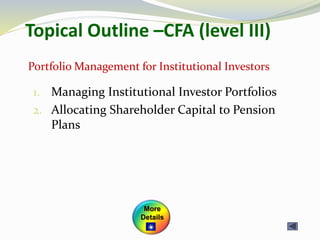
1. Managing Institutional Investor Portfolios
2. Allocating Shareholder Capital to Pension
Plans
Portfolio Management for Institutional Investors
More
Details
Topical Outline –CFA (level III)
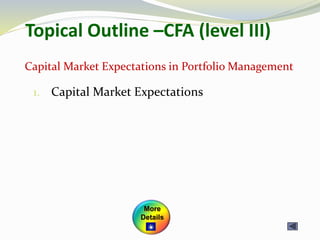
1. Capital Market Expectations
Capital Market Expectations in Portfolio Management
More
Details
Topical Outline –CFA (level III)
 Macro analysis and Micro valuation of the
Stock Market
 Dreaming with BRICs: The Path to 2050
Economic Concepts for Asset Valuation in Portfolio
Management
More
Details
Topical Outline –CFA (level III)
1. Asset Allocation
2. Linking Pension Liabilities to Assets
3. The Case for International Diversification
Asset Allocation
More
Details
Topical Outline –CFA (level III)
1. Fixed-Income Portfolio Management—Part I
2. Relative-Value Methodologies for Global Credit
Bond Portfolio Management
Management of Passive and Active Fixed Income
Portfolios
More
Details
Topical Outline –CFA (level III)
1. Fixed-Income Portfolio Management—Part II
2. Hedging Mortgage Securities to Capture
Relative Value
Portfolio Management of Global Bonds and Fixed
Income Derivatives
More
Details
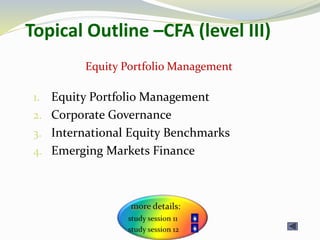
Topical Outline –CFA (level III)
1. Equity Portfolio Management
2. Corporate Governance
3. International Equity Benchmarks
4. Emerging Markets Finance
Equity Portfolio Management
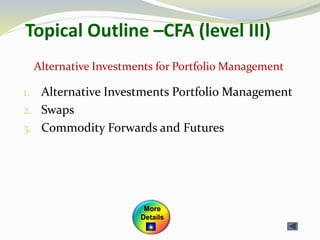
Topical Outline –CFA (level III)
1. Alternative Investments Portfolio Management
2. Swaps
3. Commodity Forwards and Futures
Alternative Investments for Portfolio Management
More
Details
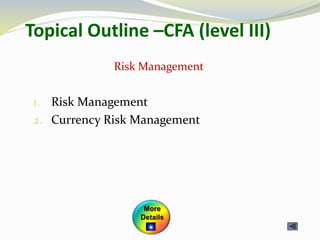
Topical Outline –CFA (level III)
1. Risk Management
2. Currency Risk Management
Risk Management
More
Details
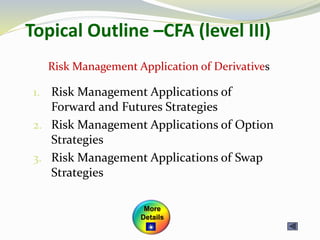
Topical Outline –CFA (level III)
1. Risk Management Applications of
Forward and Futures Strategies
2. Risk Management Applications of Option
Strategies
3. Risk Management Applications of Swap
Strategies
Risk Management Application of Derivatives
More
Details
Topical Outline –CFA (level III)
1. Execution of Portfolio Decisions
2. Monitoring and Rebalancing
Execution of Portfolio Decisions; Monitoring and
Rebalancing
More
Details
Topical Outline –CFA (level III)
 Evaluating Portfolio Performance
 Global Performance Evaluation
Performance Evaluation and Attribution
More
Details
Topical Outline –CFA (level III)
1. Global Investment Performance
Standards
Global Investment Performance Standards
More
Details
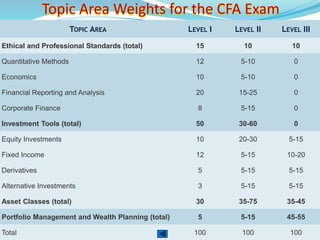
Topic Area Weights for the CFA Exam
TOPIC AREA LEVEL I LEVEL II LEVEL III
Ethical and Professional Standards (total) 15 10 10
Quantitative Methods 12 5-10 0
Economics 10 5-10 0
Financial Reporting and Analysis 20 15-25 0
Corporate Finance 8 5-15 0
Investment Tools (total) 50 30-60 0
Equity Investments 10 20-30 5-15
Fixed Income 12 5-15 10-20
Derivatives 5 5-15 5-15
Alternative Investments 3 5-15 5-15
Asset Classes (total) 30 35-75 35-45
Portfolio Management and Wealth Planning (total) 5 5-15 45-55
Total 100 100 100
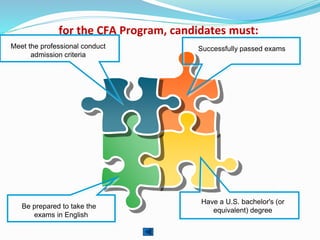
for the CFA Program, candidates must:
Successfully passed examsMeet the professional conduct
admission criteria
Have a U.S. bachelor's (or
equivalent) degree
Be prepared to take the
exams in English
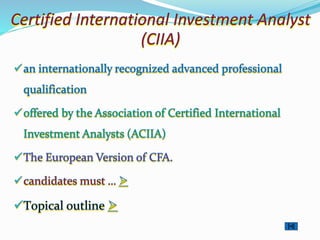
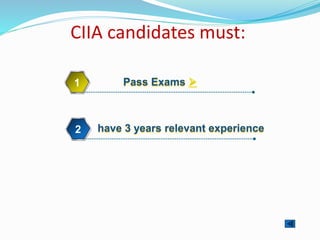
CIIA candidates must:
Pass Exams 1
have 3 years relevant experience2
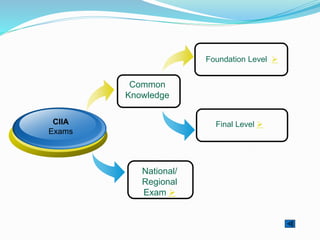
National/
Regional
Exam 
CIIA
Exams
Common
Knowledge
Foundation Level 
Final Level 
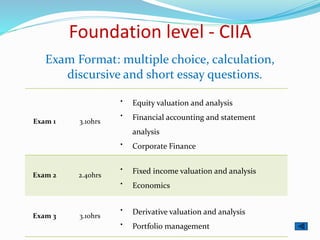
Foundation level - CIIA
Exam Format: multiple choice, calculation,
discursive and short essay questions.

Equity valuation and analysis

Financial accounting and statement
analysis

Corporate Finance
3.10hrsExam 1

Fixed income valuation and analysis

Economics
2.40hrsExam 2

Derivative valuation and analysis

Portfolio management
3.10hrsExam 3
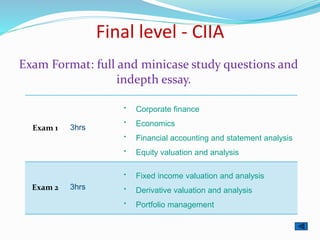
Final level - CIIA
Exam Format: full and minicase study questions and
indepth essay.

Corporate finance

Economics

Financial accounting and statement analysis

Equity valuation and analysis
3hrsExam 1

Fixed income valuation and analysis

Derivative valuation and analysis

Portfolio management
3hrsExam 2
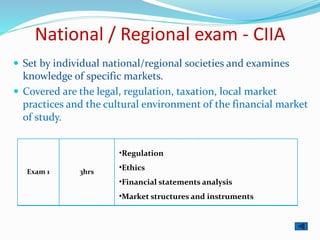
National / Regional exam - CIIA
 Set by individual national/regional societies and examines
knowledge of specific markets.
 Covered are the legal, regulation, taxation, local market
practices and the cultural environment of the financial market
of study.
•Regulation
•Ethics
•Financial statements analysis
•Market structures and instruments
3hrsExam 1
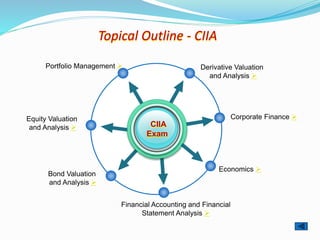
Topical Outline - CIIA
Derivative Valuation
and Analysis 
Portfolio Management 
Corporate Finance 
Economics 
Equity Valuation
and Analysis 
Bond Valuation
and Analysis 
CIIA
Exam
Financial Accounting and Financial
Statement Analysis 
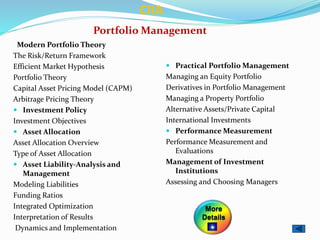
Portfolio Management
Modern Portfolio Theory
The Risk/Return Framework
Efficient Market Hypothesis
Portfolio Theory
Capital Asset Pricing Model (CAPM)
Arbitrage Pricing Theory
 Investment Policy
Investment Objectives
 Asset Allocation
Asset Allocation Overview
Type of Asset Allocation
 Asset Liability-Analysis and
Management
Modeling Liabilities
Funding Ratios
Integrated Optimization
Interpretation of Results
Dynamics and Implementation
 Practical Portfolio Management
Managing an Equity Portfolio
Derivatives in Portfolio Management
Managing a Property Portfolio
Alternative Assets/Private Capital
International Investments
 Performance Measurement
Performance Measurement and
Evaluations
Management of Investment
Institutions
Assessing and Choosing Managers
CIIA
More
Details
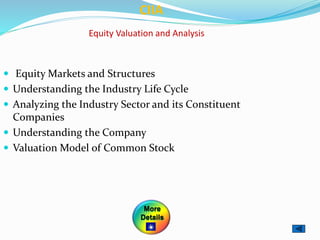
Equity Valuation and Analysis
 Equity Markets and Structures
 Understanding the Industry Life Cycle
 Analyzing the Industry Sector and its Constituent
Companies
 Understanding the Company
 Valuation Model of Common Stock
CIIA
More
Details
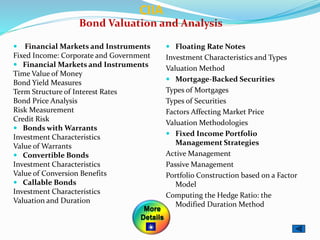
Bond Valuation and Analysis
 Financial Markets and Instruments
Fixed Income: Corporate and Government
 Financial Markets and Instruments
Time Value of Money
Bond Yield Measures
Term Structure of Interest Rates
Bond Price Analysis
Risk Measurement
Credit Risk
 Bonds with Warrants
Investment Characteristics
Value of Warrants
 Convertible Bonds
Investment Characteristics
Value of Conversion Benefits
 Callable Bonds
Investment Characteristics
Valuation and Duration
 Floating Rate Notes
Investment Characteristics and Types
Valuation Method
 Mortgage-Backed Securities
Types of Mortgages
Types of Securities
Factors Affecting Market Price
Valuation Methodologies
 Fixed Income Portfolio
Management Strategies
Active Management
Passive Management
Portfolio Construction based on a Factor
Model
Computing the Hedge Ratio: the
Modified Duration Method
CIIA
More
Details
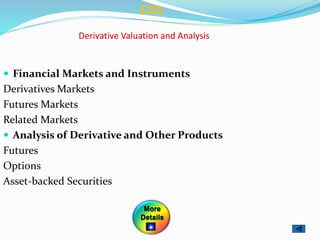
Derivative Valuation and Analysis
 Financial Markets and Instruments
Derivatives Markets
Futures Markets
Related Markets
 Analysis of Derivative and Other Products
Futures
Options
Asset-backed Securities
CIIA
More
Details
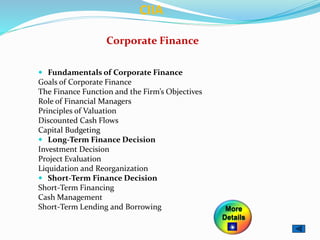
Corporate Finance
 Fundamentals of Corporate Finance
Goals of Corporate Finance
The Finance Function and the Firm’s Objectives
Role of Financial Managers
Principles of Valuation
Discounted Cash Flows
Capital Budgeting
 Long-Term Finance Decision
Investment Decision
Project Evaluation
Liquidation and Reorganization
 Short-Term Finance Decision
Short-Term Financing
Cash Management
Short-Term Lending and Borrowing
CIIA
More
Details
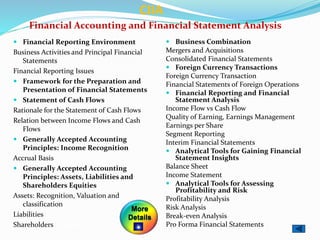
Financial Accounting and Financial Statement Analysis
 Financial Reporting Environment
Business Activities and Principal Financial
Statements
Financial Reporting Issues
 Framework for the Preparation and
Presentation of Financial Statements
 Statement of Cash Flows
Rationale for the Statement of Cash Flows
Relation between Income Flows and Cash
Flows
 Generally Accepted Accounting
Principles: Income Recognition
Accrual Basis
 Generally Accepted Accounting
Principles: Assets, Liabilities and
Shareholders Equities
Assets: Recognition, Valuation and
classification
Liabilities
Shareholders’ Equities
 Business Combination
Mergers and Acquisitions
Consolidated Financial Statements
 Foreign Currency Transactions
Foreign Currency Transaction
Financial Statements of Foreign Operations
 Financial Reporting and Financial
Statement Analysis
Income Flow vs Cash Flow
Quality of Earning, Earnings Management
Earnings per Share
Segment Reporting
Interim Financial Statements
 Analytical Tools for Gaining Financial
Statement Insights
Balance Sheet
Income Statement
 Analytical Tools for Assessing
Profitability and Risk
Profitability Analysis
Risk Analysis
Break-even Analysis
Pro Forma Financial Statements
CIIA
More
Details
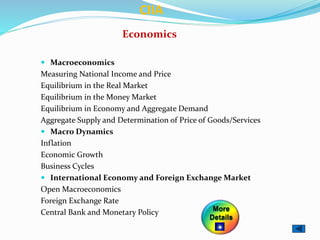
 Macroeconomics
Measuring National Income and Price
Equilibrium in the Real Market
Equilibrium in the Money Market
Equilibrium in Economy and Aggregate Demand
Aggregate Supply and Determination of Price of Goods/Services
 Macro Dynamics
Inflation
Economic Growth
Business Cycles
 International Economy and Foreign Exchange Market
Open Macroeconomics
Foreign Exchange Rate
Central Bank and Monetary Policy
Economics
CIIA
More
Details
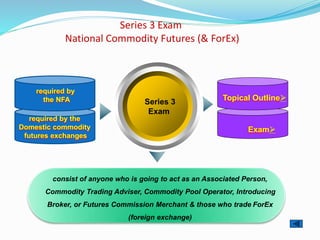
required by
the NFA
required by the
Domestic commodity
futures exchanges
Topical Outline
Exam
Series 3
Exam
consist of anyone who is going to act as an Associated Person,
Commodity Trading Adviser, Commodity Pool Operator, Introducing
Broker, or Futures Commission Merchant & those who trade ForEx
(foreign exchange)
Series 3 Exam
National Commodity Futures (& ForEx)
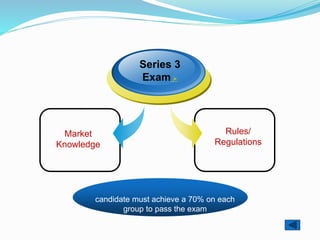
Market
Knowledge
Series 3
Exam 
Rules/
Regulations
candidate must achieve a 70% on each
group to pass the exam
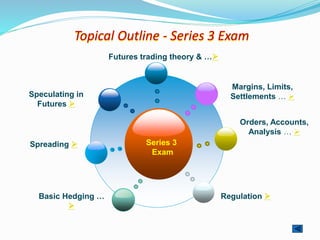
Topical Outline - Series 3 Exam
Series 3
Exam
Futures trading theory & …
Orders, Accounts,
Analysis … 
Basic Hedging …

Regulation 
Speculating in
Futures 
Spreading 
Margins, Limits,
Settlements … 
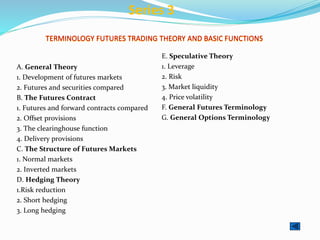
FUTURES TRADING THEORY AND BASIC FUNCTIONSTERMINOLOGY
E. Speculative Theory
1. Leverage
2. Risk
3. Market liquidity
4. Price volatility
F. General Futures Terminology
G. General Options Terminology
Series 3
A. General Theory
1. Development of futures markets
2. Futures and securities compared
B. The Futures Contract
1. Futures and forward contracts compared
2. Offset provisions
3. The clearinghouse function
4. Delivery provisions
C. The Structure of Futures Markets
1. Normal markets
2. Inverted markets
D. Hedging Theory
1.Risk reduction
2. Short hedging
3. Long hedging
A. Margin Requirements
1.The nature of futures margin
2. Margin calculations
3. Alternative calculations
B. Option Premiums
1. Intrinsic value
2. Time value
3. The delta
4. Premium quotations
C. Price Limits
1. Effect of limit-up/down price change
2. Expanded limits
3. Effects on margin of limit moves
4. Lock limit
5. Circuit breakers
D. Offsetting Contracts, Settlements,
Delivery
1. Liquidating long and short positions
2. First notice day
3. Trading in the spot month
4. The clearinghouse role in the delivery
5. Delivery notices
6. Retenders/stopped notices
7. Physical delivery, warehouse receipts
8. Cash settled contracts; how settlement is
Computed
E. Options Exercise, Assignment,
Settlement
1. Process of assignment
2. Margin requirements upon exercise
3. Final trading/exercise dates
Series 3
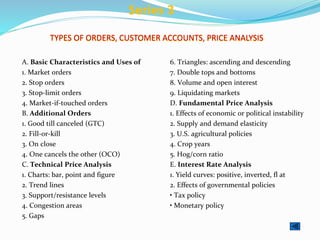
A. Basic Characteristics and Uses of
1. Market orders
2. Stop orders
3. Stop-limit orders
4. Market-if-touched orders
B. Additional Orders
1. Good till canceled (GTC)
2. Fill-or-kill
3. On close
4. One cancels the other (OCO)
C. Technical Price Analysis
1. Charts: bar, point and figure
2. Trend lines
3. Support/resistance levels
4. Congestion areas
5. Gaps
6. Triangles: ascending and descending
7. Double tops and bottoms
8. Volume and open interest
9. Liquidating markets
D. Fundamental Price Analysis
1. Effects of economic or political instability
2. Supply and demand elasticity
3. U.S. agricultural policies
4. Crop years
5. Hog/corn ratio
E. Interest Rate Analysis
1. Yield curves: positive, inverted, fl at
2. Effects of governmental policies
• Tax policy
• Monetary policy
Series 3
TYPES OF ORDERS, CUSTOMER ACCOUNTS, PRICE ANALYSIS
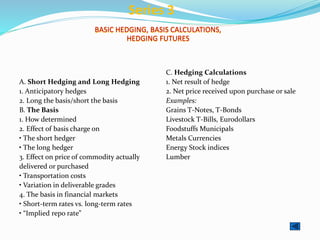
BASIC HEDGING, BASIS CALCULATIONS,
HEDGING FUTURES
A. Short Hedging and Long Hedging
1. Anticipatory hedges
2. Long the basis/short the basis
B. The Basis
1. How determined
2. Effect of basis charge on
• The short hedger
• The long hedger
3. Effect on price of commodity actually
delivered or purchased
• Transportation costs
• Variation in deliverable grades
4. The basis in financial markets
• Short-term rates vs. long-term rates
• “Implied repo rate”
C. Hedging Calculations
1. Net result of hedge
2. Net price received upon purchase or sale
Examples:
Grains T-Notes, T-Bonds
Livestock T-Bills, Eurodollars
Foodstuffs Municipals
Metals Currencies
Energy Stock indices
Lumber
Series 3
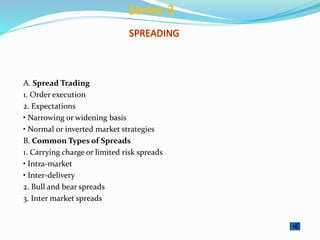
SPREADING
A. Spread Trading
1. Order execution
2. Expectations
• Narrowing or widening basis
• Normal or inverted market strategies
B. Common Types of Spreads
1. Carrying charge or limited risk spreads
• Intra-market
• Inter-delivery
2. Bull and bear spreads
3. Inter market spreads
Series 3
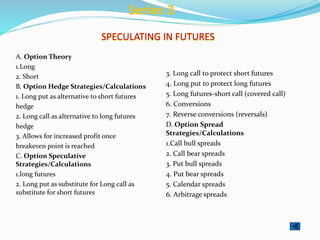
SPECULATING IN FUTURES
A. Option Theory
1.Long
2. Short
B. Option Hedge Strategies/Calculations
1. Long put as alternative to short futures
hedge
2. Long call as alternative to long futures
hedge
3. Allows for increased profit once
breakeven point is reached
C. Option Speculative
Strategies/Calculations
1.long futures
2. Long put as substitute for Long call as
substitute for short futures
3. Long call to protect short futures
4. Long put to protect long futures
5. Long futures-short call (covered call)
6. Conversions
7. Reverse conversions (reversals)
D. Option Spread
Strategies/Calculations
1.Call bull spreads
2. Call bear spreads
3. Put bull spreads
4. Put bear spreads
5. Calendar spreads
6. Arbitrage spreads
Series 3
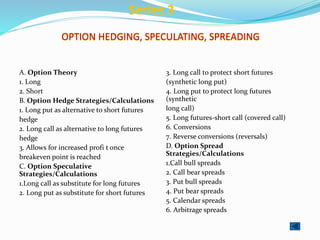
OPTION HEDGING, SPECULATING, SPREADING
A. Option Theory
1. Long
2. Short
B. Option Hedge Strategies/Calculations
1. Long put as alternative to short futures
hedge
2. Long call as alternative to long futures
hedge
3. Allows for increased profi t once
breakeven point is reached
C. Option Speculative
Strategies/Calculations
1.Long call as substitute for long futures
2. Long put as substitute for short futures
3. Long call to protect short futures
(synthetic long put)
4. Long put to protect long futures
(synthetic
long call)
5. Long futures-short call (covered call)
6. Conversions
7. Reverse conversions (reversals)
D. Option Spread
Strategies/Calculations
1.Call bull spreads
2. Call bear spreads
3. Put bull spreads
4. Put bear spreads
5. Calendar spreads
6. Arbitrage spreads
Series 3
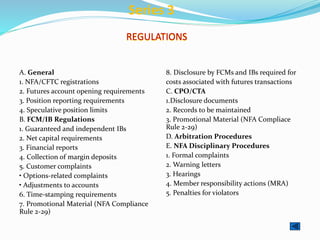
REGULATIONS
A. General
1. NFA/CFTC registrations
2. Futures account opening requirements
3. Position reporting requirements
4. Speculative position limits
B. FCM/IB Regulations
1. Guaranteed and independent IBs
2. Net capital requirements
3. Financial reports
4. Collection of margin deposits
5. Customer complaints
• Options-related complaints
• Adjustments to accounts
6. Time-stamping requirements
7. Promotional Material (NFA Compliance
Rule 2-29)
8. Disclosure by FCMs and IBs required for
costs associated with futures transactions
C. CPO/CTA
1.Disclosure documents
2. Records to be maintained
3. Promotional Material (NFA Compliace
Rule 2-29)
D. Arbitration Procedures
E. NFA Disciplinary Procedures
1. Formal complaints
2. Warning letters
3. Hearings
4. Member responsibility actions (MRA)
5. Penalties for violators
Series 3
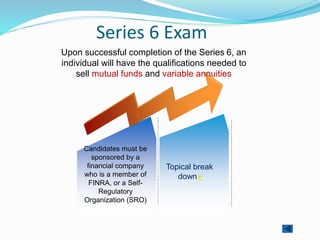
Series 6 Exam
Upon successful completion of the Series 6, an
individual will have the qualifications needed to
sell mutual funds and variable annuities
Candidates must be
sponsored by a
financial company
who is a member of
FINRA, or a Self-
Regulatory
Organization (SRO)
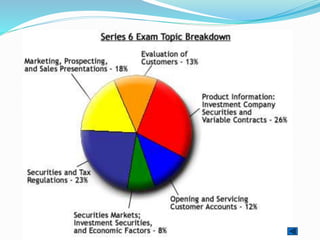
Topical break
down
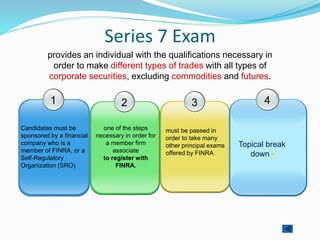
Series 7 Exam
1 2
one of the steps
necessary in order for
a member firm
associate
to register with
FINRA.
3
must be passed in
order to take many
other principal exams
offered by FINRA
provides an individual with the qualifications necessary in
order to make different types of trades with all types of
corporate securities, excluding commodities and futures.
4
Candidates must be
sponsored by a financial
company who is a
member of FINRA, or a
Self-Regulatory
Organization (SRO)
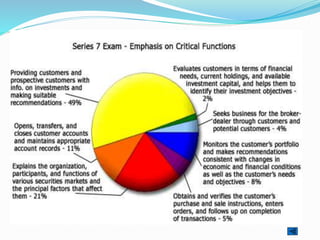
Topical break
down
professional_designations.pps

professional_designations.pps

  • 2.
     Chartered FinancialAnalyst (CFA)  Chartered International Investment Analysts (CIIA)
  • 8.
    Series 31 For allgeneral securities representatives For who act as a branch office manager for a commodity futures firm in NFA For who wish to receive trailing commissions on commodity limited partnerships, commodity pools... is about amended Registration Rule 401 For who trade corporate debt and equity securities Series 5 Series 30 Series 32 Series 63 For supervises and manages sales activities for investment companies and annuitiesSeries 26 … Other exams For who sell mutual funds and variable annuities For who trade all types of different corporate securities, excluding commodities and futures Series 6 Series 7 For who sell commodities or futures contracts
  • 9.
    Advanced License Exam Turkey Derivatives License Exam modules 6 of the CMFAS Exam CFA levelI Hong Kong Investment Advisers Commoditie s Trading Adviser Greece Singapore Regulation CFA level IICFA level III analyst license module 8 of the CMFAS Exam CFA level I Modules 7 of the CMFAS Exam CFA level I CFA level I CFA level III Commoditie s Trading Advisers CFA level III CFA level III CFA level I CFA level I CFA level III CFA level IICFA level III
  • 11.
    CFA levels Level II Level III explores portfolio management in great depth Level II deals mainly with asset valuation Level I focuses on tools and concepts that apply to investment valuation and management
  • 15.
    Topical Outline -CFA(Level I) Derivatives  Fixed Income  Equity Investments Ethical and Professional Standards  Quantitative Analysis  Economics  Financial Reporting and Analysis  Alternative Investments Corporate Finance  Portfolio Management 
  • 16.
    Topical Outline -CFA(Level II) Derivatives  Fixed Income  Equity Investments Ethical and Professional Standards  Quantitative Methods  Economics  Financial Reporting and Analysis  Alternative Asset Valuation Corporate Finance  Portfolio Management 
  • 17.
    Topical Outline -CFA(Level III) Code of Ethics & Professional Standards  Management of Passive and Active Fixed Income Portfolios  Ethical & Professional Standards in Practice  Behavioral Finance  Private Wealth Management  Capital Market Expectations in Portfolio Management  Portfolio Management for Institutional Investors  Asset Allocation  Economic Concepts for Asset Valuation  Portfolio Management of Global Bonds and Fixed Income Derivatives  Equity Portfolio Management  Alternative Investments for Portfolio Management  Performance Evaluation and Attribution Execution of Portfolio Decisions; Monitoring and Rebalancing  Risk Management  Risk Management Application of Derivatives  Global Investment Performance Standards
  • 18.
    Topical Outline –CFA(level I) 1. Code of Ethics and Standards of Professional Conduct 2. “Guidance” for Standards I–VII 3. Introduction to the Global Investment Performance 4. Global Investment Performance Standards (GIPS) Ethical and Professional Standards 2
  • 19.
    Topical Outline -CFA(level II) 1. Code of Ethics and Standards of Professional Conduct 2. “Guidance” for Standards I–VII 3. CFA Institute Soft Dollar Standards 4. CFA Institute Research Objectivity Standards 5. The Glenarm Company 6. Preston Partners 7. Super Selection 8. Trade Allocation: Fair Dealing and Disclosure 9. Changing Investment Objectives 10. Prudence in Perspective Ethical and Professional Standards
  • 20.
    Topical Outline -CFA (level I) 1. The Time Value of Money 2. Discounted Cash Flow Applications 3. Statistical Concepts and Market Returns 4. Probability Concepts 5. Common Probability Distributions 6. Sampling and Estimation 7. Hypothesis Testing 8. Technical Analysis Quantitative Methods
  • 21.
    Topical Outline -CFA(level II) 1. Correlation and Regression 2. Multiple Regression and Issues in Regression Analysis 3. Time-Series Analysis Quantitative Methods for Valuation
  • 22.
    Topical Outline -CFA (level I) 1. Elasticity 2. Efficiency and Equity 3. Markets in Action 4. Organizing Production 5. Output and Costs 6. Perfect Competition 7. Monopoly 8. Monopolistic Competition and Oligopoly 9. Demand and Supply in Factor Markets 10. Monitoring Cycles, Jobs, and the Price Level 11. Aggregate Supply and Aggregate Demand 12. Money, Banks, and the Federal Reserve 13. Money, Interest, Real GDP, and the Price Level 14. Inflation 15. Fiscal Policy 16. Monetary Policy Economics
  • 23.
    Topical Outline -CFA(level II) 1. Economic Growth 2. Regulation and Antitrust Policy in a Globalized Economy 3. Trading with the World 4. The Exchange Rate and the Balance of Payments 5. Currency Exchange Rates 6. Foreign Exchange Parity Relations 7. Measuring Economic Activity Economics for Valuation
  • 24.
    Topical Outline -CFA (level I) 1. Financial Statement Analysis: An Introduction 2. Financial Reporting Mechanics 3. Financial Reporting Standards 4. Understanding the Income Statement 5. Understanding the Balance Sheet 6. Understanding the Cash Flow Statement 7. Analysis of Inventories 8. Analysis of Long-Lived Assets: Part I—The Capitalization Decision 9. Analysis of Long-Lived Assets: Part II—Analysis of Depreciation and Impairment 10. Analysis of Income Taxes 11. Analysis of Financing Liabilities 12. Leases and Off-Balance-Sheet Debt 13. Financial Analysis Techniques 14. Financial Statement Analysis: Applications 15. International Standards Convergence Financial Reporting and Analysis
  • 25.
    Topical Outline -CFA (level II) 1. Inter corporate Investments 2. Variable Interest Entities, Intercompany Debt, Consolidated Cash Flows, and Other Issues 3. Employee Compensation: Post-Retirement and Share- Based 4. Multinational Operations 5. The Lessons We Learn 6. Evaluating Financial Reporting Quality 7. Analysis of Financial Statements: A Synthesis Financial Reporting and Analysis
  • 26.
    Topical Outline -CFA (level I) 1. Capital Budgeting 2. Cost of Capital 3. Working Capital Management 4. Financial Statement Analysis 5. The Corporate Governance of Listed Companies: A Manual for Investors Corporate Finance
  • 27.
    Topical Outline -CFA (level II) 1. Capital Budgeting 2. Capital Structure and Leverage 3. Dividends and Dividend Policy 4. Corporate Governance 5. Mergers and Acquisitions Corporate Finance (Financing and Control Issues)
  • 28.
    Topical Outline -CFA (level I) 1. Organization and Functioning of Securities Markets 2. Security-Market Indexes 3. Efficient Capital Markets 4. Market Efficiency and Anomalies 5. An Introduction to Security Valuation: Part I 6. Industry Analysis 7. Equity: Concepts and Techniques 8. Company Analysis and Stock Valuation 9. An Introduction to Security Valuation: Part II 10. Introduction to Price Multiples Equity Investments
  • 29.
    Topical Outline -CFA (level II) 1. A Note on Asset Valuation 2. The Equity Valuation Process 3. Equity: Markets and Instruments 4. Return Concepts 5. Equity: Concepts and Techniques 6. The Five Competitive Forces that Shape Strategy 7. Industry Analysis 8. Valuation in Emerging Markets 9. Discounted Dividend Valuation 10. Free Cash Flow Valuation 11. Market-Based Valuation: Price Multiples 12. U.S. Portfolio Strategy: Seeking Value—Anatomy of Valuation 13. Residual Income Valuation Equity Investments
  • 30.
    Topical Outline -CFA (level I) 1. Features of Debt Securities 2. Risks Associated with Investing in Bonds 3. Overview of Bond Sectors and Instruments 4. Understanding Yield Spreads 5. Monetary Policy in an Environment of Global Financial Markets 6. Introduction to the Valuation of Debt Securities 7. Yield Measures, Spot Rates, and Forward Rates 8. Introduction to the Measurement of Interest Rate Risk Fixed Income
  • 31.
    Topical Outline -CFA (level II) 1. General Principles of Credit Analysis 2. The Liquidity Conundrum 3. Term Structure and Volatility of Interest Rates 4. Valuing Bonds with Embedded Options 5. Mortgage-Backed Sector of the Bond Market 6. Europe’s Whole Loan Sales Market Burgeoning as Mortgage Credit Market Comes of Age 7. Asset-Backed Sector of the Bond Market 8. Valuing Mortgage-Backed and Asset-Backed Securities 9. Forward Markets and Contracts 10. Futures Markets and Contracts Fixed Income
  • 32.
    Topical Outline -CFA (level I) 1. Derivative Markets and Instruments 2. Forward Markets and Contracts 3. Futures Markets and Contracts 4. Option Markets and Contracts 5. Swap Markets and Contracts 6. Risk Management Applications of Option Strategies Derivatives
  • 33.
    Topical Outline -CFA (level II) 1. Option Markets and Contracts 2. Swap Markets and Contracts 3. Interest Rate Derivative Instruments 4. Using Credit Derivatives to Enhance Return and Manage Risk Derivatives
  • 34.
    Topical Outline -CFA (level I) 1. Alternative Investments Alternative Investments
  • 35.
    Topical Outline -CFA (level II) 1. Investment Analysis 2. Income Property Analysis and Appraisal 3. Private Equity Valuation 4. Investing in Commodities 5. Evaluating the Performance of Your Hedge Funds 6. Buyers Beware: Evaluating and Managing the Many Facets of the Risks of Hedge Funds Alternative Asset Valuation
  • 36.
    Topical Outline -CFA (level I) 1. The Asset Allocation Decision 2. An Introduction to Portfolio Management 3. An Introduction to Asset Pricing Models Portfolio Management
  • 37.
    Topical Outline -CFA (level II) 1. Portfolio Concepts 2. A Note on Harry M. Markowitz’s “Market Efficiency: A Theoretical Distinction and So What?” 3. International Asset Pricing 4. The Theory of Active Portfolio Management 5. Taxes and Private Wealth Management in a Global Context 6. The Portfolio Management Process and the Investment Policy Statement Portfolio Management
  • 38.
    Topical Outline –CFA(level III) 1. Code of Ethics and Standards of Professional Conduct 2. “Guidance” for Standards I–VII Code of Ethics and Professional Standards More Details
  • 39.
    Topical Outline –CFA(level III) 1. Ethics in Practice 2. The Consultant 3. Pearl Investment Management (A), (B), and (C) 4. Asset Manager Code of Professional Conduct Ethical and Professional Standards in Practice More Details
  • 40.
    Topical Outline –CFA(level III) 1. Heuristic-Driven Bias: The First Theme 2. Frame Dependence: The Second Theme 3. Inefficient Markets: The Third Theme 4. Portfolios, Pyramids, Emotions, and Biases 5. Investment Decision Making in Defined Contribution Pension Plans 6. The Folly of Forecasting: Ignore All Economists, Strategists and Analysts 7. Alpha Hunters and Beta Grazers Behavioral Finance More Details
  • 41.
    Topical Outline –CFA(level III) 1. Managing Individual Investor Portfolios 2. Excerpts from Investment Management for Taxable Private Investors 3. Multiple Asset Locations 4. Low-Basis Stock 5. Goals-Based Investing: Integrating Traditional and Behavioral Finance Private Wealth Management More Details
  • 42.
    Topical Outline –CFA(level III) 1. Managing Institutional Investor Portfolios 2. Allocating Shareholder Capital to Pension Plans Portfolio Management for Institutional Investors More Details
  • 43.
    Topical Outline –CFA(level III) 1. Capital Market Expectations Capital Market Expectations in Portfolio Management More Details
  • 44.
    Topical Outline –CFA(level III)  Macro analysis and Micro valuation of the Stock Market  Dreaming with BRICs: The Path to 2050 Economic Concepts for Asset Valuation in Portfolio Management More Details
  • 45.
    Topical Outline –CFA(level III) 1. Asset Allocation 2. Linking Pension Liabilities to Assets 3. The Case for International Diversification Asset Allocation More Details
  • 46.
    Topical Outline –CFA(level III) 1. Fixed-Income Portfolio Management—Part I 2. Relative-Value Methodologies for Global Credit Bond Portfolio Management Management of Passive and Active Fixed Income Portfolios More Details
  • 47.
    Topical Outline –CFA(level III) 1. Fixed-Income Portfolio Management—Part II 2. Hedging Mortgage Securities to Capture Relative Value Portfolio Management of Global Bonds and Fixed Income Derivatives More Details
  • 48.
    Topical Outline –CFA(level III) 1. Equity Portfolio Management 2. Corporate Governance 3. International Equity Benchmarks 4. Emerging Markets Finance Equity Portfolio Management
  • 49.
    Topical Outline –CFA(level III) 1. Alternative Investments Portfolio Management 2. Swaps 3. Commodity Forwards and Futures Alternative Investments for Portfolio Management More Details
  • 50.
    Topical Outline –CFA(level III) 1. Risk Management 2. Currency Risk Management Risk Management More Details
  • 51.
    Topical Outline –CFA(level III) 1. Risk Management Applications of Forward and Futures Strategies 2. Risk Management Applications of Option Strategies 3. Risk Management Applications of Swap Strategies Risk Management Application of Derivatives More Details
  • 52.
    Topical Outline –CFA(level III) 1. Execution of Portfolio Decisions 2. Monitoring and Rebalancing Execution of Portfolio Decisions; Monitoring and Rebalancing More Details
  • 53.
    Topical Outline –CFA(level III)  Evaluating Portfolio Performance  Global Performance Evaluation Performance Evaluation and Attribution More Details
  • 54.
    Topical Outline –CFA(level III) 1. Global Investment Performance Standards Global Investment Performance Standards More Details
  • 55.
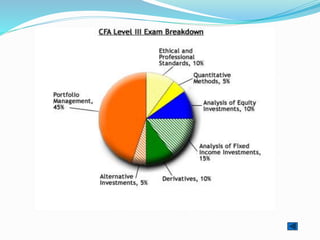
    Topic Area Weightsfor the CFA Exam TOPIC AREA LEVEL I LEVEL II LEVEL III Ethical and Professional Standards (total) 15 10 10 Quantitative Methods 12 5-10 0 Economics 10 5-10 0 Financial Reporting and Analysis 20 15-25 0 Corporate Finance 8 5-15 0 Investment Tools (total) 50 30-60 0 Equity Investments 10 20-30 5-15 Fixed Income 12 5-15 10-20 Derivatives 5 5-15 5-15 Alternative Investments 3 5-15 5-15 Asset Classes (total) 30 35-75 35-45 Portfolio Management and Wealth Planning (total) 5 5-15 45-55 Total 100 100 100
  • 56.
    for the CFAProgram, candidates must: Successfully passed examsMeet the professional conduct admission criteria Have a U.S. bachelor's (or equivalent) degree Be prepared to take the exams in English
  • 57.
    CIIA candidates must: PassExams 1 have 3 years relevant experience2
  • 58.
  • 59.
    Foundation level -CIIA Exam Format: multiple choice, calculation, discursive and short essay questions.  Equity valuation and analysis  Financial accounting and statement analysis  Corporate Finance 3.10hrsExam 1  Fixed income valuation and analysis  Economics 2.40hrsExam 2  Derivative valuation and analysis  Portfolio management 3.10hrsExam 3
  • 60.
    Final level -CIIA Exam Format: full and minicase study questions and indepth essay.  Corporate finance  Economics  Financial accounting and statement analysis  Equity valuation and analysis 3hrsExam 1  Fixed income valuation and analysis  Derivative valuation and analysis  Portfolio management 3hrsExam 2
  • 61.
    National / Regionalexam - CIIA  Set by individual national/regional societies and examines knowledge of specific markets.  Covered are the legal, regulation, taxation, local market practices and the cultural environment of the financial market of study. •Regulation •Ethics •Financial statements analysis •Market structures and instruments 3hrsExam 1
  • 62.
    Topical Outline -CIIA Derivative Valuation and Analysis  Portfolio Management  Corporate Finance  Economics  Equity Valuation and Analysis  Bond Valuation and Analysis  CIIA Exam Financial Accounting and Financial Statement Analysis 
  • 63.
    Portfolio Management Modern PortfolioTheory The Risk/Return Framework Efficient Market Hypothesis Portfolio Theory Capital Asset Pricing Model (CAPM) Arbitrage Pricing Theory  Investment Policy Investment Objectives  Asset Allocation Asset Allocation Overview Type of Asset Allocation  Asset Liability-Analysis and Management Modeling Liabilities Funding Ratios Integrated Optimization Interpretation of Results Dynamics and Implementation  Practical Portfolio Management Managing an Equity Portfolio Derivatives in Portfolio Management Managing a Property Portfolio Alternative Assets/Private Capital International Investments  Performance Measurement Performance Measurement and Evaluations Management of Investment Institutions Assessing and Choosing Managers CIIA More Details
  • 64.
    Equity Valuation andAnalysis  Equity Markets and Structures  Understanding the Industry Life Cycle  Analyzing the Industry Sector and its Constituent Companies  Understanding the Company  Valuation Model of Common Stock CIIA More Details
  • 65.
    Bond Valuation andAnalysis  Financial Markets and Instruments Fixed Income: Corporate and Government  Financial Markets and Instruments Time Value of Money Bond Yield Measures Term Structure of Interest Rates Bond Price Analysis Risk Measurement Credit Risk  Bonds with Warrants Investment Characteristics Value of Warrants  Convertible Bonds Investment Characteristics Value of Conversion Benefits  Callable Bonds Investment Characteristics Valuation and Duration  Floating Rate Notes Investment Characteristics and Types Valuation Method  Mortgage-Backed Securities Types of Mortgages Types of Securities Factors Affecting Market Price Valuation Methodologies  Fixed Income Portfolio Management Strategies Active Management Passive Management Portfolio Construction based on a Factor Model Computing the Hedge Ratio: the Modified Duration Method CIIA More Details
  • 66.
    Derivative Valuation andAnalysis  Financial Markets and Instruments Derivatives Markets Futures Markets Related Markets  Analysis of Derivative and Other Products Futures Options Asset-backed Securities CIIA More Details
  • 67.
    Corporate Finance  Fundamentalsof Corporate Finance Goals of Corporate Finance The Finance Function and the Firm’s Objectives Role of Financial Managers Principles of Valuation Discounted Cash Flows Capital Budgeting  Long-Term Finance Decision Investment Decision Project Evaluation Liquidation and Reorganization  Short-Term Finance Decision Short-Term Financing Cash Management Short-Term Lending and Borrowing CIIA More Details
  • 68.
    Financial Accounting andFinancial Statement Analysis  Financial Reporting Environment Business Activities and Principal Financial Statements Financial Reporting Issues  Framework for the Preparation and Presentation of Financial Statements  Statement of Cash Flows Rationale for the Statement of Cash Flows Relation between Income Flows and Cash Flows  Generally Accepted Accounting Principles: Income Recognition Accrual Basis  Generally Accepted Accounting Principles: Assets, Liabilities and Shareholders Equities Assets: Recognition, Valuation and classification Liabilities Shareholders’ Equities  Business Combination Mergers and Acquisitions Consolidated Financial Statements  Foreign Currency Transactions Foreign Currency Transaction Financial Statements of Foreign Operations  Financial Reporting and Financial Statement Analysis Income Flow vs Cash Flow Quality of Earning, Earnings Management Earnings per Share Segment Reporting Interim Financial Statements  Analytical Tools for Gaining Financial Statement Insights Balance Sheet Income Statement  Analytical Tools for Assessing Profitability and Risk Profitability Analysis Risk Analysis Break-even Analysis Pro Forma Financial Statements CIIA More Details
  • 69.
     Macroeconomics Measuring NationalIncome and Price Equilibrium in the Real Market Equilibrium in the Money Market Equilibrium in Economy and Aggregate Demand Aggregate Supply and Determination of Price of Goods/Services  Macro Dynamics Inflation Economic Growth Business Cycles  International Economy and Foreign Exchange Market Open Macroeconomics Foreign Exchange Rate Central Bank and Monetary Policy Economics CIIA More Details
  • 70.
    required by the NFA requiredby the Domestic commodity futures exchanges Topical Outline Exam Series 3 Exam consist of anyone who is going to act as an Associated Person, Commodity Trading Adviser, Commodity Pool Operator, Introducing Broker, or Futures Commission Merchant & those who trade ForEx (foreign exchange) Series 3 Exam National Commodity Futures (& ForEx)
  • 71.
    Market Knowledge Series 3 Exam  Rules/ Regulations candidatemust achieve a 70% on each group to pass the exam
  • 72.
    Topical Outline -Series 3 Exam Series 3 Exam Futures trading theory & … Orders, Accounts, Analysis …  Basic Hedging …  Regulation  Speculating in Futures  Spreading  Margins, Limits, Settlements … 
  • 73.
    FUTURES TRADING THEORYAND BASIC FUNCTIONSTERMINOLOGY E. Speculative Theory 1. Leverage 2. Risk 3. Market liquidity 4. Price volatility F. General Futures Terminology G. General Options Terminology Series 3 A. General Theory 1. Development of futures markets 2. Futures and securities compared B. The Futures Contract 1. Futures and forward contracts compared 2. Offset provisions 3. The clearinghouse function 4. Delivery provisions C. The Structure of Futures Markets 1. Normal markets 2. Inverted markets D. Hedging Theory 1.Risk reduction 2. Short hedging 3. Long hedging
  • 74.
    A. Margin Requirements 1.Thenature of futures margin 2. Margin calculations 3. Alternative calculations B. Option Premiums 1. Intrinsic value 2. Time value 3. The delta 4. Premium quotations C. Price Limits 1. Effect of limit-up/down price change 2. Expanded limits 3. Effects on margin of limit moves 4. Lock limit 5. Circuit breakers D. Offsetting Contracts, Settlements, Delivery 1. Liquidating long and short positions 2. First notice day 3. Trading in the spot month 4. The clearinghouse role in the delivery 5. Delivery notices 6. Retenders/stopped notices 7. Physical delivery, warehouse receipts 8. Cash settled contracts; how settlement is Computed E. Options Exercise, Assignment, Settlement 1. Process of assignment 2. Margin requirements upon exercise 3. Final trading/exercise dates Series 3
  • 75.
    A. Basic Characteristicsand Uses of 1. Market orders 2. Stop orders 3. Stop-limit orders 4. Market-if-touched orders B. Additional Orders 1. Good till canceled (GTC) 2. Fill-or-kill 3. On close 4. One cancels the other (OCO) C. Technical Price Analysis 1. Charts: bar, point and figure 2. Trend lines 3. Support/resistance levels 4. Congestion areas 5. Gaps 6. Triangles: ascending and descending 7. Double tops and bottoms 8. Volume and open interest 9. Liquidating markets D. Fundamental Price Analysis 1. Effects of economic or political instability 2. Supply and demand elasticity 3. U.S. agricultural policies 4. Crop years 5. Hog/corn ratio E. Interest Rate Analysis 1. Yield curves: positive, inverted, fl at 2. Effects of governmental policies • Tax policy • Monetary policy Series 3 TYPES OF ORDERS, CUSTOMER ACCOUNTS, PRICE ANALYSIS
  • 76.
    BASIC HEDGING, BASISCALCULATIONS, HEDGING FUTURES A. Short Hedging and Long Hedging 1. Anticipatory hedges 2. Long the basis/short the basis B. The Basis 1. How determined 2. Effect of basis charge on • The short hedger • The long hedger 3. Effect on price of commodity actually delivered or purchased • Transportation costs • Variation in deliverable grades 4. The basis in financial markets • Short-term rates vs. long-term rates • “Implied repo rate” C. Hedging Calculations 1. Net result of hedge 2. Net price received upon purchase or sale Examples: Grains T-Notes, T-Bonds Livestock T-Bills, Eurodollars Foodstuffs Municipals Metals Currencies Energy Stock indices Lumber Series 3
  • 77.
    SPREADING A. Spread Trading 1.Order execution 2. Expectations • Narrowing or widening basis • Normal or inverted market strategies B. Common Types of Spreads 1. Carrying charge or limited risk spreads • Intra-market • Inter-delivery 2. Bull and bear spreads 3. Inter market spreads Series 3
  • 78.
    SPECULATING IN FUTURES A.Option Theory 1.Long 2. Short B. Option Hedge Strategies/Calculations 1. Long put as alternative to short futures hedge 2. Long call as alternative to long futures hedge 3. Allows for increased profit once breakeven point is reached C. Option Speculative Strategies/Calculations 1.long futures 2. Long put as substitute for Long call as substitute for short futures 3. Long call to protect short futures 4. Long put to protect long futures 5. Long futures-short call (covered call) 6. Conversions 7. Reverse conversions (reversals) D. Option Spread Strategies/Calculations 1.Call bull spreads 2. Call bear spreads 3. Put bull spreads 4. Put bear spreads 5. Calendar spreads 6. Arbitrage spreads Series 3
  • 79.
    OPTION HEDGING, SPECULATING,SPREADING A. Option Theory 1. Long 2. Short B. Option Hedge Strategies/Calculations 1. Long put as alternative to short futures hedge 2. Long call as alternative to long futures hedge 3. Allows for increased profi t once breakeven point is reached C. Option Speculative Strategies/Calculations 1.Long call as substitute for long futures 2. Long put as substitute for short futures 3. Long call to protect short futures (synthetic long put) 4. Long put to protect long futures (synthetic long call) 5. Long futures-short call (covered call) 6. Conversions 7. Reverse conversions (reversals) D. Option Spread Strategies/Calculations 1.Call bull spreads 2. Call bear spreads 3. Put bull spreads 4. Put bear spreads 5. Calendar spreads 6. Arbitrage spreads Series 3
  • 80.
    REGULATIONS A. General 1. NFA/CFTCregistrations 2. Futures account opening requirements 3. Position reporting requirements 4. Speculative position limits B. FCM/IB Regulations 1. Guaranteed and independent IBs 2. Net capital requirements 3. Financial reports 4. Collection of margin deposits 5. Customer complaints • Options-related complaints • Adjustments to accounts 6. Time-stamping requirements 7. Promotional Material (NFA Compliance Rule 2-29) 8. Disclosure by FCMs and IBs required for costs associated with futures transactions C. CPO/CTA 1.Disclosure documents 2. Records to be maintained 3. Promotional Material (NFA Compliace Rule 2-29) D. Arbitration Procedures E. NFA Disciplinary Procedures 1. Formal complaints 2. Warning letters 3. Hearings 4. Member responsibility actions (MRA) 5. Penalties for violators Series 3
  • 81.
    Series 6 Exam Uponsuccessful completion of the Series 6, an individual will have the qualifications needed to sell mutual funds and variable annuities Candidates must be sponsored by a financial company who is a member of FINRA, or a Self- Regulatory Organization (SRO) Topical break down
  • 83.
    Series 7 Exam 12 one of the steps necessary in order for a member firm associate to register with FINRA. 3 must be passed in order to take many other principal exams offered by FINRA provides an individual with the qualifications necessary in order to make different types of trades with all types of corporate securities, excluding commodities and futures. 4 Candidates must be sponsored by a financial company who is a member of FINRA, or a Self-Regulatory Organization (SRO) Topical break down