DERIVATIONAL & INFLECTIONAL
MORPHOLOGY
Derivation Morphology
A derivational morpheme is the morpheme which produces
a new lexeme from a base. Derivational morphemes are
bound morphemes which derive (create) new words by
either changing the meaning or the part of speech or both.
In English, derivational morphemes can be prefixes or
suffixes.
Derivational Prefixes
All prefixes in English are derivational so that all the prefixes
create new meaning or create new words. The creation of
new meaning can be accompanied by the change part of
speech or not. Most prefixes do not change word classes.
The prefix which changes the part of speech, for example, is
the prefix en-. The prefix en- changes the bases into verbs.
The word enlarge for example, consists of the prefix en- and
the base large.The prefix en- changes the adjective large to the
new verb enlarge.
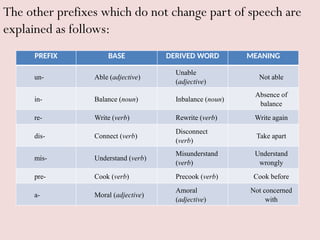
The other prefixes which do not change part of speech are
explained as follows:
PREFIX BASE DERIVED WORD MEANING
un- Able (adjective)
Unable
(adjective)
Not able
in- Balance (noun) Inbalance (noun)
Absence of
balance
re- Write (verb) Rewrite (verb) Write again
dis- Connect (verb)
Disconnect
(verb)
Take apart
mis- Understand (verb)
Misunderstand
(verb)
Understand
wrongly
pre- Cook (verb) Precook (verb) Cook before
a- Moral (adjective)
Amoral
(adjective)
Not concerned
with
Derivational Suffixes
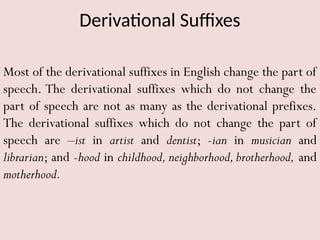
Most of the derivational suffixes in English change the part of
speech. The derivational suffixes which do not change the
part of speech are not as many as the derivational prefixes.
The derivational suffixes which do not change the part of
speech are –ist in artist and dentist; -ian in musician and
librarian; and -hood in childhood, neighborhood, brotherhood, and
motherhood.
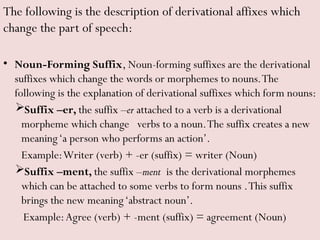
The following is the description of derivational affixes which
change the part of speech:
• Noun-Forming Suffix, Noun-forming suffixes are the derivational
suffixes which change the words or morphemes to nouns.The
following is the explanation of derivational suffixes which form nouns:
Suffix –er, the suffix –er attached to a verb is a derivational
morpheme which change verbs to a noun.The suffix creates a new
meaning‘a person who performs an action’.
Example:Writer (verb) + -er (suffix) = writer (Noun)
Suffix –ment, the suffix –ment is the derivational morphemes
which can be attached to some verbs to form nouns .This suffix
brings the new meaning‘abstract noun’.
Example:Agree (verb) + -ment (suffix) = agreement (Noun)
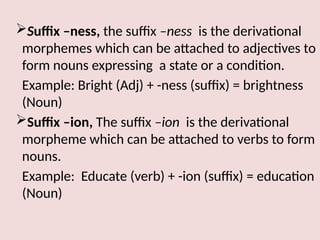
Suffix –ness, the suffix –ness is the derivational
morphemes which can be attached to adjectives to
form nouns expressing a state or a condition.
Example: Bright (Adj) + -ness (suffix) = brightness
(Noun)
Suffix –ion, The suffix –ion is the derivational
morpheme which can be attached to verbs to form
nouns.
Example: Educate (verb) + -ion (suffix) = education
(Noun)
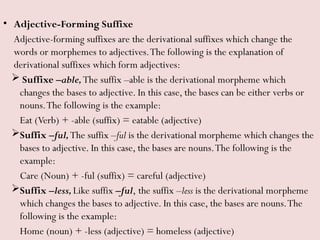
• Adjective-Forming Suffixe
Adjective-forming suffixes are the derivational suffixes which change the
words or morphemes to adjectives.The following is the explanation of
derivational suffixes which form adjectives:
 Suffixe –able,The suffix –able is the derivational morpheme which
changes the bases to adjective. In this case, the bases can be either verbs or
nouns.The following is the example:
Eat (Verb) + -able (suffix) = eatable (adjective)
Suffix –ful,The suffix –ful is the derivational morpheme which changes the
bases to adjective. In this case, the bases are nouns.The following is the
example:
Care (Noun) + -ful (suffix) = careful (adjective)
Suffix –less,Like suffix –ful, the suffix –less is the derivational morpheme
which changes the bases to adjective. In this case, the bases are nouns.The
following is the example:
Home (noun) + -less (adjective) = homeless (adjective)
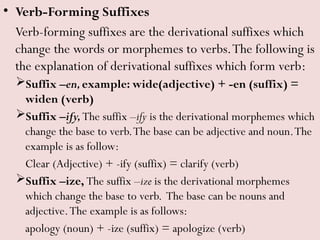
• Verb-Forming Suffixes
Verb-forming suffixes are the derivational suffixes which
change the words or morphemes to verbs.The following is
the explanation of derivational suffixes which form verb:
Suffix –en,example: wide(adjective) + -en (suffix) =
widen (verb)
Suffix –ify,The suffix –ify is the derivational morphemes which
change the base to verb.The base can be adjective and noun.The
example is as follow:
Clear (Adjective) + -ify (suffix) = clarify (verb)
Suffix –ize, The suffix –ize is the derivational morphemes
which change the base to verb. The base can be nouns and
adjective.The example is as follows:
apology (noun) + -ize (suffix) = apologize (verb)
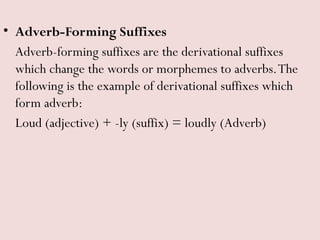
• Adverb-Forming Suffixes
Adverb-forming suffixes are the derivational suffixes
which change the words or morphemes to adverbs.The
following is the example of derivational suffixes which
form adverb:
Loud (adjective) + -ly (suffix) = loudly (Adverb)
Inflectional Morphology
Inflectional morphemes are bound morphemes that tell tense,
number, gender, possession, and so on. Unlike derivational
morphemes, inflectional morphemes don't change the grammar
category of the words they're attached to. An inflection is a change
that signals the grammatical function of nouns, verbs, adjectives,
adverbs, and pronouns (e.g., noun plurals, verb tenses). An
inflectional morpheme is used to create a variant form of a word in
order to signal grammatical information. For example, the suffix [-ed]
signals that a verb is past tense: walk-ed.
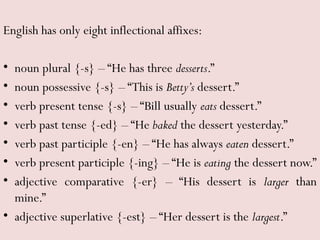
English has only eight inflectional affixes:
• noun plural {-s} – “He has three desserts.”
• noun possessive {-s} – “This is Betty’s dessert.”
• verb present tense {-s} – “Bill usually eats dessert.”
• verb past tense {-ed} – “He baked the dessert yesterday.”
• verb past participle {-en} – “He has always eaten dessert.”
• verb present participle {-ing} – “He is eating the dessert now.”
• adjective comparative {-er} – “His dessert is larger than
mine.”
• adjective superlative {-est} – “Her dessert is the largest.”
The Differences Between Derivation and Inflection
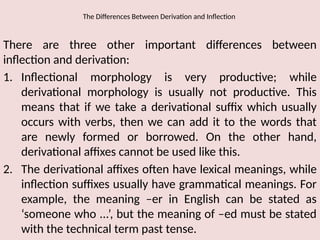
There are three other important differences between
inflection and derivation:
1. Inflectional morphology is very productive; while
derivational morphology is usually not productive. This
means that if we take a derivational suffix which usually
occurs with verbs, then we can add it to the words that
are newly formed or borrowed. On the other hand,
derivational affixes cannot be used like this.
2. The derivational affixes often have lexical meanings, while
inflection suffixes usually have grammatical meanings. For
example, the meaning –er in English can be stated as
‘someone who ...’, but the meaning of –ed must be stated
with the technical term past tense.
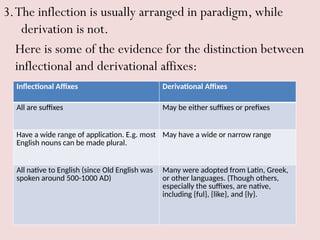
3.The inflection is usually arranged in paradigm, while
derivation is not.
Here is some of the evidence for the distinction between
inflectional and derivational affixes:
Inflectional Affixes Derivational Affixes
All are suffixes May be either suffixes or prefixes
Have a wide range of application. E.g. most
English nouns can be made plural.
May have a wide or narrow range
All native to English (since Old English was
spoken around 500-1000 AD)
Many were adopted from Latin, Greek,
or other languages. (Though others,
especially the suffixes, are native,
including {ful}, {like}, and {ly}.

Morphology: Derivation_and_Inflection_Morpheme.pptx

  • 1.
  • 2.
    Derivation Morphology A derivationalmorpheme is the morpheme which produces a new lexeme from a base. Derivational morphemes are bound morphemes which derive (create) new words by either changing the meaning or the part of speech or both. In English, derivational morphemes can be prefixes or suffixes.
  • 3.
    Derivational Prefixes All prefixesin English are derivational so that all the prefixes create new meaning or create new words. The creation of new meaning can be accompanied by the change part of speech or not. Most prefixes do not change word classes. The prefix which changes the part of speech, for example, is the prefix en-. The prefix en- changes the bases into verbs. The word enlarge for example, consists of the prefix en- and the base large.The prefix en- changes the adjective large to the new verb enlarge.
  • 4.
    The other prefixeswhich do not change part of speech are explained as follows: PREFIX BASE DERIVED WORD MEANING un- Able (adjective) Unable (adjective) Not able in- Balance (noun) Inbalance (noun) Absence of balance re- Write (verb) Rewrite (verb) Write again dis- Connect (verb) Disconnect (verb) Take apart mis- Understand (verb) Misunderstand (verb) Understand wrongly pre- Cook (verb) Precook (verb) Cook before a- Moral (adjective) Amoral (adjective) Not concerned with
  • 5.
    Derivational Suffixes Most ofthe derivational suffixes in English change the part of speech. The derivational suffixes which do not change the part of speech are not as many as the derivational prefixes. The derivational suffixes which do not change the part of speech are –ist in artist and dentist; -ian in musician and librarian; and -hood in childhood, neighborhood, brotherhood, and motherhood.
  • 6.
    The following isthe description of derivational affixes which change the part of speech: • Noun-Forming Suffix, Noun-forming suffixes are the derivational suffixes which change the words or morphemes to nouns.The following is the explanation of derivational suffixes which form nouns: Suffix –er, the suffix –er attached to a verb is a derivational morpheme which change verbs to a noun.The suffix creates a new meaning‘a person who performs an action’. Example:Writer (verb) + -er (suffix) = writer (Noun) Suffix –ment, the suffix –ment is the derivational morphemes which can be attached to some verbs to form nouns .This suffix brings the new meaning‘abstract noun’. Example:Agree (verb) + -ment (suffix) = agreement (Noun)
  • 7.
    Suffix –ness, thesuffix –ness is the derivational morphemes which can be attached to adjectives to form nouns expressing a state or a condition. Example: Bright (Adj) + -ness (suffix) = brightness (Noun) Suffix –ion, The suffix –ion is the derivational morpheme which can be attached to verbs to form nouns. Example: Educate (verb) + -ion (suffix) = education (Noun)
  • 8.
    • Adjective-Forming Suffixe Adjective-formingsuffixes are the derivational suffixes which change the words or morphemes to adjectives.The following is the explanation of derivational suffixes which form adjectives:  Suffixe –able,The suffix –able is the derivational morpheme which changes the bases to adjective. In this case, the bases can be either verbs or nouns.The following is the example: Eat (Verb) + -able (suffix) = eatable (adjective) Suffix –ful,The suffix –ful is the derivational morpheme which changes the bases to adjective. In this case, the bases are nouns.The following is the example: Care (Noun) + -ful (suffix) = careful (adjective) Suffix –less,Like suffix –ful, the suffix –less is the derivational morpheme which changes the bases to adjective. In this case, the bases are nouns.The following is the example: Home (noun) + -less (adjective) = homeless (adjective)
  • 9.
    • Verb-Forming Suffixes Verb-formingsuffixes are the derivational suffixes which change the words or morphemes to verbs.The following is the explanation of derivational suffixes which form verb: Suffix –en,example: wide(adjective) + -en (suffix) = widen (verb) Suffix –ify,The suffix –ify is the derivational morphemes which change the base to verb.The base can be adjective and noun.The example is as follow: Clear (Adjective) + -ify (suffix) = clarify (verb) Suffix –ize, The suffix –ize is the derivational morphemes which change the base to verb. The base can be nouns and adjective.The example is as follows: apology (noun) + -ize (suffix) = apologize (verb)
  • 10.
    • Adverb-Forming Suffixes Adverb-formingsuffixes are the derivational suffixes which change the words or morphemes to adverbs.The following is the example of derivational suffixes which form adverb: Loud (adjective) + -ly (suffix) = loudly (Adverb)
  • 11.
    Inflectional Morphology Inflectional morphemesare bound morphemes that tell tense, number, gender, possession, and so on. Unlike derivational morphemes, inflectional morphemes don't change the grammar category of the words they're attached to. An inflection is a change that signals the grammatical function of nouns, verbs, adjectives, adverbs, and pronouns (e.g., noun plurals, verb tenses). An inflectional morpheme is used to create a variant form of a word in order to signal grammatical information. For example, the suffix [-ed] signals that a verb is past tense: walk-ed.
  • 12.
    English has onlyeight inflectional affixes: • noun plural {-s} – “He has three desserts.” • noun possessive {-s} – “This is Betty’s dessert.” • verb present tense {-s} – “Bill usually eats dessert.” • verb past tense {-ed} – “He baked the dessert yesterday.” • verb past participle {-en} – “He has always eaten dessert.” • verb present participle {-ing} – “He is eating the dessert now.” • adjective comparative {-er} – “His dessert is larger than mine.” • adjective superlative {-est} – “Her dessert is the largest.”
  • 13.
    The Differences BetweenDerivation and Inflection There are three other important differences between inflection and derivation: 1. Inflectional morphology is very productive; while derivational morphology is usually not productive. This means that if we take a derivational suffix which usually occurs with verbs, then we can add it to the words that are newly formed or borrowed. On the other hand, derivational affixes cannot be used like this. 2. The derivational affixes often have lexical meanings, while inflection suffixes usually have grammatical meanings. For example, the meaning –er in English can be stated as ‘someone who ...’, but the meaning of –ed must be stated with the technical term past tense.
  • 14.
    3.The inflection isusually arranged in paradigm, while derivation is not. Here is some of the evidence for the distinction between inflectional and derivational affixes: Inflectional Affixes Derivational Affixes All are suffixes May be either suffixes or prefixes Have a wide range of application. E.g. most English nouns can be made plural. May have a wide or narrow range All native to English (since Old English was spoken around 500-1000 AD) Many were adopted from Latin, Greek, or other languages. (Though others, especially the suffixes, are native, including {ful}, {like}, and {ly}.