Affixes
ROOTS
•It is the main part of a word
•Must be at least one in one word.
•Word part from which other
words grow, through addition of
affixes.
Kinds of Roots
1.Free roots
• can stand alone to function as words.
Ex.: recollect, bilingual, international, attractive
2. Bound roots
• cannot stand alone to function as words because they
are no longer used in Modern English.
Ex. : receive, reduce, internet
Affixes
-subordinate part of a word
Prefix
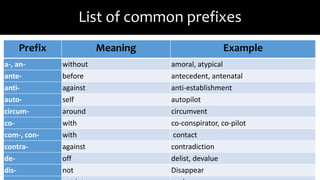
List of common prefixes
Prefix Meaning Example
a-, an- without amoral, atypical
ante- before antecedent, antenatal
anti- against anti-establishment
auto- self autopilot
circum- around circumvent
co- with co-conspirator, co-pilot
com-, con- with contact
contra- against contradiction
de- off delist, devalue
dis- not Disappear
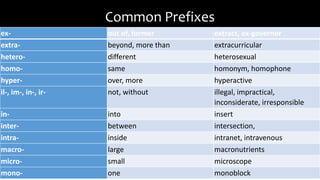
Common Prefixes
ex- out of, former extract, ex-governor
extra- beyond, more than extracurricular
hetero- different heterosexual
homo- same homonym, homophone
hyper- over, more hyperactive
il-, im-, in-, ir- not, without illegal, impractical,
inconsiderate, irresponsible
in- into insert
inter- between intersection,
intra- inside intranet, intravenous
macro- large macronutrients
micro- small microscope
mono- one monoblock
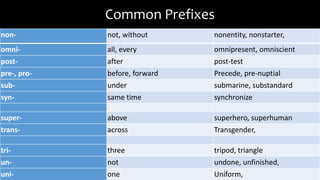
Common Prefixes
non- not, without nonentity, nonstarter,
omni- all, every omnipresent, omniscient
post- after post-test
pre-, pro- before, forward Precede, pre-nuptial
sub- under submarine, substandard
syn- same time synchronize
super- above superhero, superhuman
trans- across Transgender,
tri- three tripod, triangle
un- not undone, unfinished,
uni- one Uniform,
Suffix
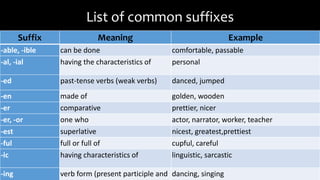
List of common suffixes
Suffix Meaning Example
-able, -ible can be done comfortable, passable
-al, -ial having the characteristics of personal
-ed past-tense verbs (weak verbs) danced, jumped
-en made of golden, wooden
-er comparative prettier, nicer
-er, -or one who actor, narrator, worker, teacher
-est superlative nicest, greatest,prettiest
-ful full or full of cupful, careful
-ic having characteristics of linguistic, sarcastic
-ing verb form (present participle and dancing, singing
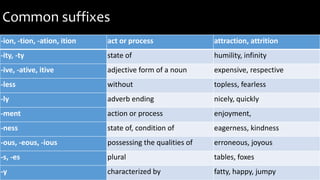
Common suffixes
-ion, -tion, -ation, ition act or process attraction, attrition
-ity, -ty state of humility, infinity
-ive, -ative, itive adjective form of a noun expensive, respective
-less without topless, fearless
-ly adverb ending nicely, quickly
-ment action or process enjoyment,
-ness state of, condition of eagerness, kindness
-ous, -eous, -ious possessing the qualities of erroneous, joyous
-s, -es plural tables, foxes
-y characterized by fatty, happy, jumpy
Kinds of Suffixes
Grammatical / Inflectional
Suffixes
Derivational Suffixes
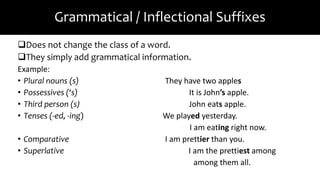
Grammatical / Inflectional Suffixes
Does not change the class of a word.
They simply add grammatical information.
Example:
• Plural nouns (s) They have two apples
• Possessives (‘s) It is John’s apple.
• Third person (s) John eats apple.
• Tenses (-ed, -ing) We played yesterday.
I am eating right now.
• Comparative I am prettier than you.
• Superlative I am the prettiest among
among them all.
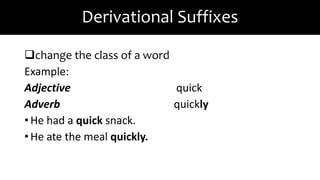
Derivational Suffixes
change the class of a word
Example:
Adjective quick
Adverb quickly
• He had a quick snack.
• He ate the meal quickly.
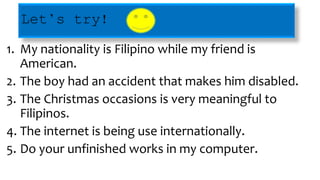
Let’s try!
1. My nationality is Filipino while my friend is
American.
2. The boy had an accident that makes him disabled.
3. The Christmas occasions is very meaningful to
Filipinos.
4. The internet is being use internationally.
5. Do your unfinished works in my computer.
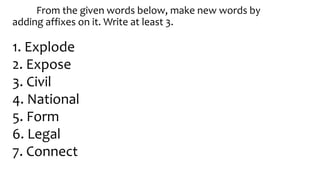
From the given words below, make new words by
adding affixes on it. Write at least 3.
1. Explode
2. Expose
3. Civil
4. National
5. Form
6. Legal
7. Connect
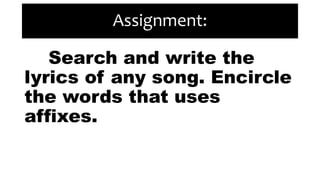
Assignment:
Search and write the
lyrics of any song. Encircle
the words that uses
affixes.
Affixes (prefixes and suffixes)

Affixes (prefixes and suffixes)

  • 4.
  • 5.
    ROOTS •It is themain part of a word •Must be at least one in one word. •Word part from which other words grow, through addition of affixes.
  • 7.
    Kinds of Roots 1.Freeroots • can stand alone to function as words. Ex.: recollect, bilingual, international, attractive 2. Bound roots • cannot stand alone to function as words because they are no longer used in Modern English. Ex. : receive, reduce, internet
  • 8.
  • 10.
  • 11.
    List of commonprefixes Prefix Meaning Example a-, an- without amoral, atypical ante- before antecedent, antenatal anti- against anti-establishment auto- self autopilot circum- around circumvent co- with co-conspirator, co-pilot com-, con- with contact contra- against contradiction de- off delist, devalue dis- not Disappear
  • 12.
    Common Prefixes ex- outof, former extract, ex-governor extra- beyond, more than extracurricular hetero- different heterosexual homo- same homonym, homophone hyper- over, more hyperactive il-, im-, in-, ir- not, without illegal, impractical, inconsiderate, irresponsible in- into insert inter- between intersection, intra- inside intranet, intravenous macro- large macronutrients micro- small microscope mono- one monoblock
  • 13.
    Common Prefixes non- not,without nonentity, nonstarter, omni- all, every omnipresent, omniscient post- after post-test pre-, pro- before, forward Precede, pre-nuptial sub- under submarine, substandard syn- same time synchronize super- above superhero, superhuman trans- across Transgender, tri- three tripod, triangle un- not undone, unfinished, uni- one Uniform,
  • 14.
  • 15.
    List of commonsuffixes Suffix Meaning Example -able, -ible can be done comfortable, passable -al, -ial having the characteristics of personal -ed past-tense verbs (weak verbs) danced, jumped -en made of golden, wooden -er comparative prettier, nicer -er, -or one who actor, narrator, worker, teacher -est superlative nicest, greatest,prettiest -ful full or full of cupful, careful -ic having characteristics of linguistic, sarcastic -ing verb form (present participle and dancing, singing
  • 16.
    Common suffixes -ion, -tion,-ation, ition act or process attraction, attrition -ity, -ty state of humility, infinity -ive, -ative, itive adjective form of a noun expensive, respective -less without topless, fearless -ly adverb ending nicely, quickly -ment action or process enjoyment, -ness state of, condition of eagerness, kindness -ous, -eous, -ious possessing the qualities of erroneous, joyous -s, -es plural tables, foxes -y characterized by fatty, happy, jumpy
  • 17.
    Kinds of Suffixes Grammatical/ Inflectional Suffixes Derivational Suffixes
  • 18.
    Grammatical / InflectionalSuffixes Does not change the class of a word. They simply add grammatical information. Example: • Plural nouns (s) They have two apples • Possessives (‘s) It is John’s apple. • Third person (s) John eats apple. • Tenses (-ed, -ing) We played yesterday. I am eating right now. • Comparative I am prettier than you. • Superlative I am the prettiest among among them all.
  • 19.
    Derivational Suffixes change theclass of a word Example: Adjective quick Adverb quickly • He had a quick snack. • He ate the meal quickly.
  • 20.
    Let’s try! 1. Mynationality is Filipino while my friend is American. 2. The boy had an accident that makes him disabled. 3. The Christmas occasions is very meaningful to Filipinos. 4. The internet is being use internationally. 5. Do your unfinished works in my computer.
  • 21.
    From the givenwords below, make new words by adding affixes on it. Write at least 3. 1. Explode 2. Expose 3. Civil 4. National 5. Form 6. Legal 7. Connect
  • 22.
    Assignment: Search and writethe lyrics of any song. Encircle the words that uses affixes.