ÑAÏI HOÏC QUOÁC GIA TP HOÀ CHÍ MINH
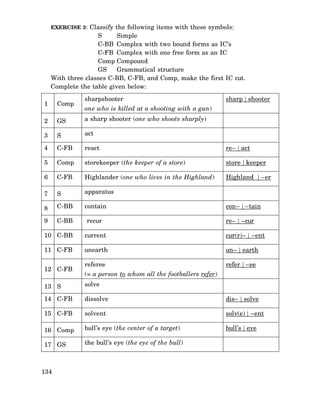
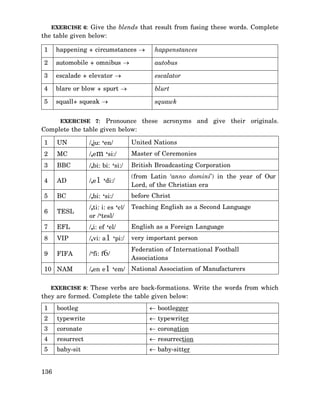
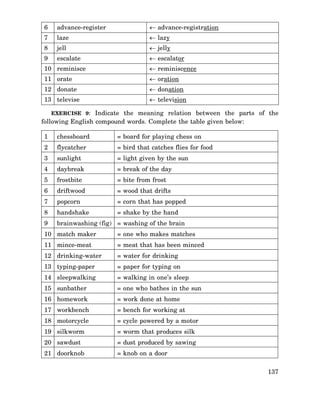
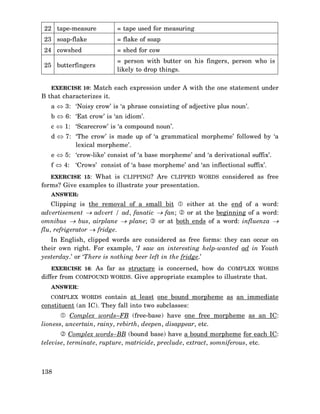
TRÖÔØNG ÑAÏI HOÏC KHOA HOÏC XAÕ HOÄI VAØ NHAÂN VAÊN

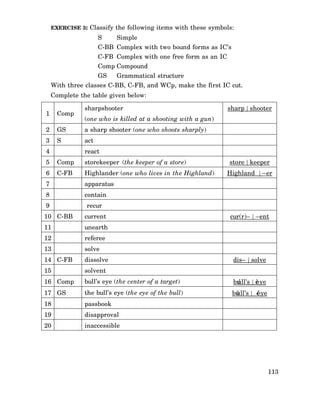
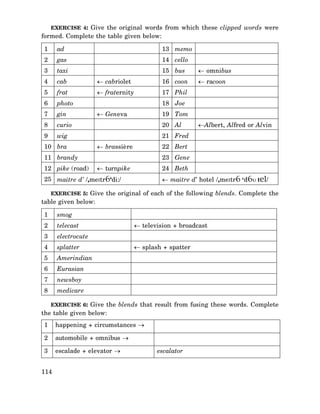
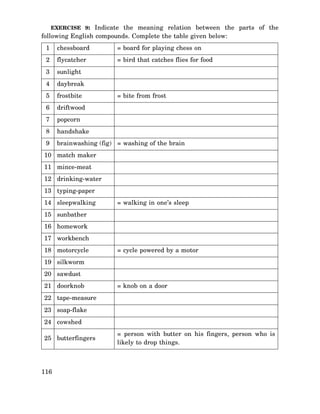
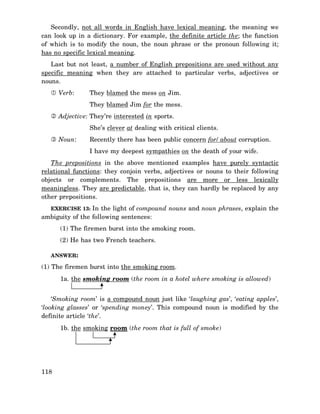
Giaùo trình

Toâ Minh Thanh

NHAØ XUAÁT BAÛN ÑAÏI HOÏC QUOÁC GIA TP HOÀ CHÍ MINH – 2003
1
2
LÔØI NOÙI ÑAÀU

Giaùo trình Hình thaùi hoïc tieáng Anh ñöôïc hình thaønh döïa treân tö lieäu
ñaõ ñöôïc giaûng daïy trong thôøi gian qua cho sinh vieân chuyeân ngöõ cuûa Khoa Ngöõ
vaên Anh, Tröôøng Ñaïi hoïc Khoa hoïc Xaõ hoäi vaø Nhaân vaên - Ñaïi hoïc Quoác gia
Thaønh phoá Hoà Chí Minh. Giaùo trình naøy ñöôïc bieân soaïn nhaèm trang bò cho
sinh vieân caùch tieáp caän mang tính thöïc haønh moân hoïc ñaày tính lyù thuyeát naøy.
Giaùo trình Hình thaùi hoïc tieáng Anh trình baøy moät caùch coù heä thoáng moät soá
khaùi nieäm cô baûn veà hình thaùi hoïc vaø nhieàu kieåu phaân tích töø vöïng tieáng Anh.
Beân caïnh ñoù, giaùo trình naøy cuõng chuù yù ñeán caû keát caáu noäi taïi laãn yù nghóa bieåu
ñaït cuûa chuùng. Noùi moät caùch khaùc, taøi lieäu naøy coù lieân quan tôùi:
Hình vò, tha hình vò, töø vöïng vaø caùc tieåu loaïi cuûa chuùng trong tieáng
Anh hieän ñaïi;
Caùc quy trình hình thaønh vaø caùc quy taéc phaân tích töø vöïng tieáng Anh.
Trong quaù trình bieân soaïn giaùo trình naøy chuùng toâi ñaõ tham khaûo vaø
trích daãn nhieàu tö lieäu ñaõ ñöôïc coâng boá, ñaëc bieät laø cuûa Arnold (1986), Jackson
(1980) vaø Stageberg (1965). Coù theå noùi, muïc tieâu duy nhaát cuûa chuùng toâi khi
bieân soaïn giaùo trình naøy laø nhaèm cung caáp cho sinh vieân moät löôïng thoâng tin
caàn thieát veà lónh vöïc thuù vò vaø thaät söï coù ích lôïi naøy döôùi söùc eùp cuûa moät thôøi
löôïng heát söùc khieâm toán vaãn thöôøng daønh cho moân Hình thaùi hoïc tieáng Anh.
Chuùng toâi xin ñöôïc theå hieän loøng bieát ôn chaân thaønh ñoái vôùi Tieán só
Nguyeãn Tieán Huøng veà nhöõng ñoùng goùp vaø pheâ bình phaûn bieän tích cöïc cuûa oâng
daønh cho giaùo trình naøy.
Ñaây laø laàn ñaàu tieân giaùo trình naøy ñöôïc xuaát baûn, haún khoâng traùnh khoûi
sai soùt. Chuùng toâi mong nhaän ñöôïc nhieàu yù kieán ñoùng goùp cuûa baïn ñoïc ñeå giaùo
trình ngaøy caøng hoaøn thieän hôn. YÙ kieán ñoùng goùp xin göûi veà: Hoäi ñoàng Khoa
hoïc vaø Ñaøo taïo Khoa Ngöõ vaên Anh, Tröôøng Ñaïi hoïc Khoa hoïc Xaõ hoäi vaø Nhaân
vaên – Ñaïi hoïc Quoác gia Thaønh phoá Hoà Chí Minh, 10-12 Ñinh Tieân Hoaøng, Q.1,
ñieän thoaïi: 8243328.

Thaønh phoá Hoà Chí Minh, ngaøy 30 thaùng 7 naêm 2003.
Toâ Minh Thanh

3
4
CONTENTS
Preface ................................................................................................................................3
Table of notational symbols...........................................................................................7
Unit one: MORPHEMES....................................................................................................9
1. Definition – Characteristics ............................................................................................9
2. How to distinguish Morphemes from Phonemes, Syllables and Words? .....................9
3. Classification of Morphemes .........................................................................................11
3.1. Free morphemes vs. Bound morphemes.................................................................11
3.2. Bases (also called Roots) vs. Affixes .......................................................................12
4. Variations of Morphemes — Allomorphs .....................................................................14
4.1. Definition .................................................................................................................14
4.2. Selection of Allomorphs: ..........................................................................................14
4.3. Types of Allomorphs ................................................................................................15
EXERCISES........................................................................................................................16
EXTRA READING .............................................................................................................36
Unit two: DERIVATION AND INFLECTION ..............................................................41
1. Derivation .......................................................................................................................41
1.1. Definition ..................................................................................................................41
1.2. Types of Derivational Affixes ..................................................................................41
1.3. Morphological rules..................................................................................................41
2. Inflection .......................................................................................................................45
2.1. Definition ..................................................................................................................45
2.2. Various Kinds of Inflection......................................................................................45
3. How to distinguish Derivation from Inflection ............................................................46
3.1. Derivation .................................................................................................................46
3.2. Inflection...................................................................................................................47
EXERCISES........................................................................................................................47
Unit three: IMMEDIATE CONSTITUENTS IN MORPHOLOGY.............................65
1. Definition........................................................................................................................65
2. Some Recommendations on IC division........................................................................66
3. Diagram ..........................................................................................................................66
EXERCISES........................................................................................................................67

5
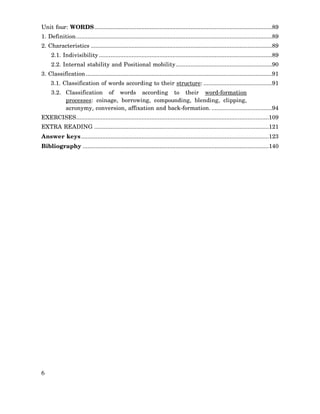
Unit four: WORDS.............................................................................................................89
1. Definition........................................................................................................................89
2. Characteristics ...............................................................................................................89
2.1. Indivisibility ..........................................................................................................89
2.2. Internal stability and Positional mobility...........................................................90
3. Classification ..................................................................................................................91
3.1. Classification of words according to their structure: ..........................................91
3.2. Classification of words according to their word-formation
processes: coinage, borrowing, compounding, blending, clipping,
acronymy, conversion, affixation and back-formation. .....................................94
EXERCISES......................................................................................................................109
EXTRA READING ...........................................................................................................121
Answer keys ...................................................................................................................123
Bibliography ..................................................................................................................140

6
NOTATIONAL SYMBOLS
Most of the symbols used in this text follow conventions, but since conventions
vary, the following list indicates the meanings assigned to them here.
n = noun
[U] = uncountable
[C] = countable
pl = plural
sing = singular
adj = adjective
adv = adverb
prep = preposition
v = verb
phr v = phrasal verb
sth = something
sb = somebody
mono-trans = mono-transitive verb
complex trans = complex transitive verb
etc = et cetera meaning “and other similar things” or “and so on”
fig = figurative
esp = especially
usu = usually
fml = formal
infml = informal
derog = derogatory, insulting
attrib = attributive
pred = predicative
Brit = British
abbr = abbreviated
I = intransitive verb
Ipr = intransitive verb + prepositional phrase
Ip = intransitive verb + adverbial particle
La = linking verb + adjective (phrase)
Tn = transitive verb + noun (phrase)
Tn.pr = transitive verb + noun (phrase) + prepositional phrase
Tn.p = transitive verb + noun (phrase) + adverbial particle
Cn.t = complex transitive verb + noun (phrase) + to-infinitive
phrase
7
8
UNIT ONE

MORPHEMES
1. DEFINITION – CHARACTERISTICS
What is a morpheme?
• ‘A morpheme is the smallest meaningful unit in a language.’
[Richards, Platt & Weber, 1987: 183]
• ‘A morpheme is a short segment of language that meets three criteria:
It is a word or part of a word that has meaning.
It cannot be divided into smaller meaningful parts without violation of
its meaning or without meaningless remainders.
It recurs in different verbal environments with a relatively stable meaning.’
[Stageberg, 1965: 85]
Ex.1: The English word unkind consists of two morphemes: the base kind
the lexical meaning of which is ‘friendly and thoughtful to others’ and the
prefix un– the lexical meaning of which is ‘not’; the English word talks
consists of two morphemes: the base talk the lexical meaning of which is ‘say
something’ and the suffix –s, which has no lexical meaning and which is used
to show that the verb talks is in the third person singular present-tense form.
In other words, we can recognize a morpheme by either its lexical or its
grammatical meaning.
Ex.2: Straight is an English adjective meaning ‘without a bend or curve’. By
dividing straight, we get smaller meaningful units of trait /tre1t/, rate
/re1t/and ate/e1t/; but their meanings violate the meaning of straight. We
also get the meaningless remainders: /s–/, /st–/ and /str–/. Therefore, straight
must be considered a morpheme, the smallest meaningful unit in English.
Ex.3: Bright means ‘light’, and brighten means ‘make light’. This leads us to
conclude that –en means ‘make’. We also know that –en recurs with a stable
meaning in words like cheapen, darken, deepen, soften, stiffen, etc. Therefore,
–en must be considered a morpheme.
2. HOW TO DISTINGUISH MORPHEMES FROM PHONEMES, SYLLABLES
AND WORDS?
2.1. MORPHEMES vs. PHONEMES
A morpheme differs from a phoneme in that the former has meaning
whereas the latter does not. Although phonemes have no meaning, they have
distinctive features that help to distinguish meaning.
9
Ex.1: The initial consonant of bitch is [− aspirated] while that of pitch is
[+ aspirated].
Ex.2: The vowel of pin is [+ close] and thus [− open] while that of pan is
[+ open] and thus [− close].
A morpheme may consist of only a single phoneme like the /–z/ in goes. But
the phoneme /z/ and this morpheme are by no means identical. The phoneme
/z/ occurs many times where it has nothing to do with this morpheme. For
example, zoo /zu:/ and rose /r6υz/ both contain /z/ but the /z/ here has nothing to
do with the morpheme realized as /–z/ in goes.
Morphemes are generally short sequences of phonemes: the morpheme {of}
consists of two phonemes — / 4 / and / v /.
Most English morphemes are intermediate in size between {of} and
{strange} and consist of about two to six phonemes.
2.2. MORPHEMES vs. SYLLABLES
A morpheme happens to be identical to a syllable, e.g. the morpheme
{strange} and the syllable /stre1nd2/; and so are many English morphemes.
However, any matches between morphemes and syllables are fortuitous. Many
poly-syllabic words are mono-morphemic.
lion /’laI6n/:

two syllables – one morpheme

crocodile /’kr4k6da1l/:

E.g.

three syllables – one morpheme

Connecticut /k6’net1k6t/: four syllables – one morpheme
On the contrary, both /g6υ/ and /–z/ in goes /g6υz/ are morphemes, though
altogether they are but a single syllable. That is, goes is mono-syllabic but
poly-morphemic.
Briefly, in some cases a morpheme may consist of one syllable or several
whole syllables. In other cases, it is only part of a syllable. In fact, to form a
morpheme, some phonemes are usually combined together without any regard
to their status as syllables.
In English, a morpheme is not identical with a syllable. The syllable is a
phonological unit whereas the morpheme is the basic unit in morphology.
2.3. MORPHEMES vs. WORDS
Words are made up of morphemes. In other words, morphemes are the
constituents of words.
A word may be composed of one or more morphemes:
One morpheme: boy, desire
10
Two morphemes: boy + –ish, desir(e) + –able
Three morphemes: boy + –ish + –ness, desir(e) + –abil + –ity
Four morphemes: gentle + man + –li + –ness
un– + desir(e) + –abil– + –ity
More than four morphemes: un– + gentle + man + –li + –ness
anti– + dis– + establish + –ment + –ari + –an + –ism
3. CLASSIFICATION OF MORPHEMES
It is always found that morphemes can be grouped into certain classes, each
with a characteristic distribution. There are two basic classes of morphemes:
free morphemes and bound morphemes. Affixes are almost always bound
whereas bases can be either free or bound.
3.1. BOUND MORPHEMES vs. FREE MORPHEMES
3.1.1. FREE MORPHEMES
• A free morpheme is ‘one that can be uttered alone with meaning’.
[Stageberg, 1965: 87]
• A free morpheme ‘can be used on its own’.
[Richards, Platt & Weber, 1987: 31]
• Free morphemes ‘may stand alone as words in their own right, as well as
enter into the structure of other words’.
[Jackson, 1980: 53]
E.g. Drink is a free morpheme which occurs as a word on its own and as a
free base in drinkable, undrinkable, drinking-water, drinking-fountain, etc.
3.1.2. BOUND MORPHEMES
• A bound morpheme ‘cannot be uttered alone with meaning. It is always
annexed to one or more morphemes to form a word’.
[Stageberg, 1965: 87]
• A bound morpheme ‘is never used alone but must be used with another
morpheme’.
[Richards, Platt & Weber, 1987: 31]
• Bound morphemes ‘may occur only if they combine with another
morpheme’.
[Jackson, 1980: 53]
E.g. the English suffix –ing /–17/ must be used after a verb form: writing,
living, driving, etc.
11
3.2. BASES (or ROOTS) vs. AFFIXES
3.2.1. A BASE (also called A ROOT) is ‘that morpheme in a word that has
the principal meaning’ [Stageberg, 1965: 87-88]. It is the central morpheme,
the basic part of a word. There are two kinds of bases:
A FREE BASE is a base ‘which may be a word on its own right once the other
morphemes have been stripped away’ [Jackson, 1980: 53].
E.g. break in unbreakable, act in deactivated, friend in friendship, etc.
A BOUND BASE is a base (i.e. it is the basic part of a word and has the

principal meaning) which can never occur on its own but can only be joined to
other bound morphemes.
E.g. The bound base of audience, audible, audition, auditory, auditorium,
etc. is audi–; that of suicide, patricide, matricide, infanticide, etc. is –cide; and
that of suspender, pendant, pendulum, etc. is –pend or pend–.
3.2.2. AN AFFIX is a morpheme (usually a bound morpheme) ‘that occurs
before or behind a base’ [Stageberg, 1965: 87].
3.2.2.1. Classified according to their POSITION in words, affixes have
three main subclasses:
• PREFIXES ‘occur before a base’ [Stageberg, 1965: 91] as in import,
prefix, reconsider, unkind, understate, over-react, etc.
• SUFFIXES ‘occur after a base’ [Stageberg, 1965: 92] as in shrinkage,
noisy, quickly, nails, dreamed, mouse-like, etc.
• INFIXES are inserted within words, e.g. the infix –um–in Tagalog,
which shows that a verb is in the past tense: sulat (to write)
sumulat (wrote).
Affixes may be added directly to bases or to constructions consisting of a
base plus one or more (either free or bound) morphemes. Thus we have:
work

+ –s = works

worker

+ –s = workers

workshop + –s = workshops
3.2.2.2. Classified according to their FUNCTION in words, affixes have
two main subclasses:
• INFLECTIONAL AFFIXES, ‘which are always suffixes in English, perform
a grammatical function; they are representatives of grammatical categories’.
[Jackson, 1980: 53]
The only eight inflectional suffixes in English are:
12
the noun plural morpheme {–S1}: book–s, apple–s, box–es, etc.
the noun possessive morpheme {–S2}: man–‘s, girl–‘s, students–‘,
Alice–‘s, etc.
the verb third person singular present tense morpheme {–S3}: walk–s,
find–s, mix–es, etc.
the verb present participle morpheme {–ing1}: play–ing, typ(e)–ing,
dig(g)–ing, etc.
the verb past simple morpheme {–D1}: flow–ed, work–ed, creat(e)–ed,
drank, broke, thought, show–ed, etc.
the verb past participle morpheme{–D2}: flow–ed, work–ed, creat(e)–ed,
drunk, broken, thought, show–n, etc.
the adjective or adverb comparative morpheme {–er1}: small–er, saf(e)–er,
thinn–er, long–er, fast–er, hard–er, etc.
the adjective or adverb superlative morpheme {–est1}: small–est, saf(e)–
est, thinn–est, long–est, fast–est, hard–est, etc.
• DERIVATIONAL AFFIXES, ‘which may be prefixes or suffixes in English,
have a lexical function; they create new words out of existing words or
morphemes by their addition’.
[Jackson, 1980: 53]
Derivational affixes may be of two kinds:
Class-changing derivational affixes change the word class of the word to
which they are attached: –al added to nation makes an adjective out of a
noun.
Class-maintaining derivational affixes do not change the word class of
the word to which they are attached. Derivational prefixes are usually
class-maintaining: re–mark, dis–enthrone, un–refined, etc.
There is not usually more than one prefix in a word in English and from
what was said in the previous paragraphs, it is clear that English prefixes are
always derivational. There is never more than one inflectional suffix in
English words and it always comes last. A number of derivational suffixes may,
however, occur. Derivational suffixes need not close off a word; that is, after a
derivational suffix one can sometimes add another derivational suffix and can
frequently add an inflectional suffix. The relative order of morphemes in the
English word is, then, as follows:

13
derivational prefix – base – derivational suffix(es) – inflectional suffix
Generally speaking, bases are central and affixes are peripheral. In
English, affixes are almost always bound morphemes and bases are nearly
always free.
4. VARIATIONS OF MORPHEMES — ALLOMORPHS
4.1. DEFINITION:
An allomorph is ‘any of the different forms of a morpheme’.
[Richards, Platt & Weber, 1987: 9]
E.g. In English, the inflectional noun plural morpheme {–S1} is often shown
in writing by adding –(e)s to the end of a singular noun, e.g. cat /k`t/ → cats
/k`ts/. Sometimes this morpheme is pronounced /–z/, e.g. dog /d49/ → dogs
/d49z/, and sometimes it is pronounced /–Iz/, e.g. box /b4ks / → box /’b4ks1z/.
It is believed that /–s/, /–z/, /–Iz/ are three allomorphs of the inflectional noun
plural morpheme {–S1} because:
They are in complementary distribution:
/–s / occurs only after the voiceless consonants /p, t, k, f, θ/;
/–Iz / occurs only after the sibilant consonants /s, Z, ∫, 2, t∫, d2/;
/–z/ occurs after voiced sounds, including all vowels and voiced
consonants except /z/, /2/, and /d2/.
They all have the same meaning, either lexical or grammatical:
/–s/, /–z/, /–Iz/ all refer to ‘plurality’ and all mean ‘more than one’.
Thus, an allomorph can also be defined as a variant of a morpheme which
occurs in a certain definable environment. And a morpheme is a group of two
or more allomorphs which conform to certain, usually rather clearly definable,
criteria of distribution and meaning. The concept of morphemes and
allomorphs is one of the most basic in descriptive linguistics. Its importance
both as a tool and as an insight into the operation of language can hardly be
underestimated.
4.2. SELECTION OF ALLOMORPHS:
The three allomorphs /–z/, /–s/ and /–Iz/ of the inflectional noun plural
morpheme {–S1} are phonologically conditioned since each can occur only when
a certain clearly defined condition occurs. In this case, the conditioning factor
is the phonetic nature of their preceding phoneme: /–s/ occurs only after the
voiceless consonants /p, t, k, f, θ/; /–Iz/ occurs only after the groove fricatives and
14
affricates /s, z, ∫, 2, t∫, d2/; and /–z/ occurs only after voiced sounds, except the
three voiced sibilants /z, 2, d2/:
cat /k`t/

+ –s /–s/ → cats /k`ts/
voiceless

dog /d49/
box /b4ks/

+ –s /–z/ → dogs /d49z/
voiced
+ –es

/–1z / → box /’b4ks1z/

sibilant
We may, therefore, say that /–s/, /–Iz/, and /–z/ are three phonologically
conditioned allomorphs of the inflectional noun plural morpheme {–S1}. This
means that, if we understand the facts of distribution, we can accurately
predict which of the three will occur in any place where any one of them could
occur.
The selection of allomorphs may also be morphologically conditioned. In
this case, the selection is determined by the specific morpheme or morphemes
forming the context, rather than by any phonologic feature: the plural of ox
/4ks/ is oxen /‘4ks6n/; /–6n/ is a morphologically conditioned allomorph of
the inflectional noun plural morpheme {–S1} which is used with this stem /4ks/:
ox /4ks/ + –en

/−6n/ → oxen /‘4ks6n/

sibilant
If a morpheme has numerous allomorphs, as many do, it is awkward to
have a list of all of them every time the morpheme is mentioned. Instead, it is
desirable to have a single symbol to indicate a morpheme, comprehending all
the variant forms in which it can appear. For this purpose we use braces {}.
The braces {} indicate a morphemic representative in which one arbitrarily
selected symbol is used to represent each morpheme and comprehend all its
allomorphs. It does not directly give any information about pronunciation. For
instance, {–S1} can be used to refer to the inflectional noun plural morpheme
and all of its allomorphs.
4.3. TYPES OF ALLOMORPHS
ADDITIVE ALLOMORPHS:

To signify some difference in meaning, something is added to a word. For
example, the past tense form of most English verbs is formed by adding the

15
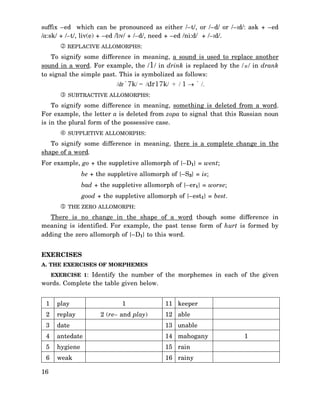
suffix –ed which can be pronounced as either /–t/, or /–d/ or /–Id/: ask + –ed
/a:sk/ + /–t/, liv(e) + –ed /lIv/ + /–d/, need + –ed /ni:d/ + /–Id/.
REPLACIVE ALLOMORPHS:

To signify some difference in meaning, a sound is used to replace another
sound in a word. For example, the /1/ in drink is replaced by the /æ/ in drank
to signal the simple past. This is symbolized as follows:
/dr`7k/ = /dr17k/ + / 1 → ` /.
SUBTRACTIVE ALLOMORPHS:

To signify some difference in meaning, something is deleted from a word.
For example, the letter a is deleted from zopa to signal that this Russian noun
is in the plural form of the possessive case.
SUPPLETIVE ALLOMORPHS:

To signify some difference in meaning, there is a complete change in the
shape of a word.
For example, go + the suppletive allomorph of {–D1} = went;
be + the suppletive allomorph of {–S3} = is;
bad + the suppletive allomorph of {–er1} = worse;
good + the suppletive allomorph of {–est1} = best.
THE ZERO ALLOMORPH:

There is no change in the shape of a word though some difference in
meaning is identified. For example, the past tense form of hurt is formed by
adding the zero allomorph of {–D1} to this word.
EXERCISES
A. THE EXERCISES OF MORPHEMES
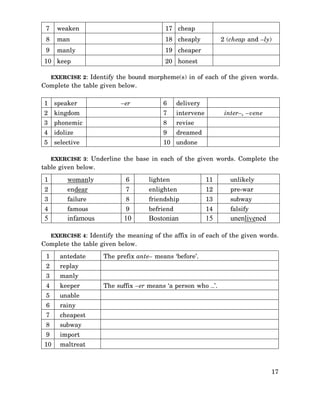
EXERCISE 1: Identify the number of the morphemes in each of the given

words. Complete the table given below.
1

play

2

replay

3

date

13 unable

4

antedate

14 mahogany

5

hygiene

15 rain

6

weak

16 rainy

16

1
2 (re– and play)

11 keeper
12 able
1
7

weaken

17 cheap

8

man

18 cheaply

9

manly

19 cheaper

10 keep

2 (cheap and –ly)

20 honest

EXERCISE 2: Identify the bound morpheme(s) in of each of the given words.

Complete the table given below.
1

speaker

2

–er

6

delivery

kingdom

7

intervene

3

phonemic

8

revise

4

idolize

9

dreamed

5

selective

10 undone

inter–, –vene

EXERCISE 3: Underline the base in each of the given words. Complete the

table given below.
1

womanly

6

lighten

11

unlikely

2

endear

7

enlighten

12

pre-war

3

failure

8

friendship

13

subway

4

famous

9

befriend

14

falsify

5

infamous

Bostonian

15

unenlivened

10

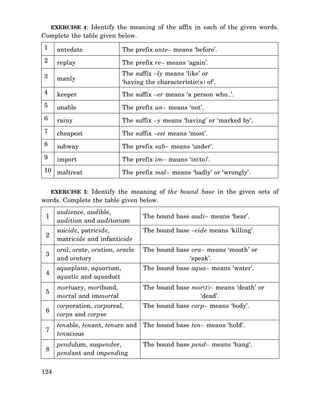
EXERCISE 4: Identify the meaning of the affix in of each of the given words.

Complete the table given below.
1

antedate

2

replay

3

manly

4

keeper

5

unable

6

rainy

7

cheapest

8

subway

9

import

10

The prefix ante– means ‘before’.

maltreat

The suffix –er means ‘a person who …’.

17
EXERCISE 5: Identify the meaning of the bound base in the given sets of

words. Complete the table given below.
audience, audible, audition
and auditorium
suicide, patricide, matricide
2
and infanticide
oral, orate, oration, oracle
3
and oratory
aquaplane, aquarium,
4
aquatic and aquaduct
mortuary, moribund, mortal
5
and immortal
corporation, corporeal,
6
corps and corpse
tenable, tenant, tenure and
7
tenacious
pendulum, suspender,
8
pendant and impending
manuscript, manacle,
9
manual and manicure
eject, inject, inject, reject
10
and projectile
1

The bound base audi– means ‘hear’.
The bound base –cide means ‘killing’.

NOTES:

1. The bound base audi– means ‘hear’.
- audible /‘0:d6bl/ adj

- audibility /,0:d6‘b1l6t1/ n

[U] capability of being heard clearly.

- audition /0:‘d1~n/ n

[C] trial hearing of a person who wants
to perform as an actor, a singer, a
musician, etc.: I’m going to the audition
but I don’t expect I’ll get a part.

- audition v

18

that can be heard clearly: Her voice is
scarcely audible above the noise of the
wind.

1. [I] take part in an audition: Which
part are you auditioning for? 2. [Tn]
give an audition to sb: None of the
actresses we auditioned is suitable.
- auditory /‘0:d6tr1/ adj

of or concerned with hearing: the
auditory nerve.

- auditorium /,0:d1‘t0:r16m/ n

(pl~s) part of a theatre, concert hall,
etc. in which an audience sits.

2. The bound base –cide means ‘killing’.
- suicide /‘sju:sa1d/ n

1. [U] killing oneself intentionally: to
commit suicide; 2. [C] act of this: There
have been three suicides this week.

- patricide /‘p`tr1sa1d/ n

1. [U, C] (act of) killing one’s own
father: to commit patricide; 2. [C]
person who guilty of this.

- matricide /‘m`tr1sa1d/ n

1. [C, U] (act of) killing one’s own
mother: to commit matricide; 2. [C]
person who does this.

- infanticide /1n‘f`nt1sa1d/ n

1. [U] crime of killing an infant: to
commit infanticide; 2. [C] person who
kills an infant.

3. The bound base ora– means ‘mouth’ or ‘speak’.
- oration /4‘re1~n/ n

[C] formal speech made on a public
occasion esp as part of a ceremony: a
funeral oration.

- oracle /‘4r6kl/ n

[C] priest(ess) giving the answers: to
consult the oracle.

- oratory /‘4r6tr1/ n

[U] (art of) public speaking, esp when
used skilfully to affect an audience:
Some politicians are famous for their
oratory.

- orator /‘4r6t6/ n

(fml) (a) person who makes formal
speeches in public;
(b) person who is good at public
speaking.

4. The bound base aqua– or aque–means ‘water’.
- aquaplane /‘`kw6ple1n/ n

[C] board on which a person stands
while being towed across water by a
ship or boat.

19
- aqueduct /‘`kw1d∧kt/ n

[C] structure for carrying water across
country, esp one built like a bridge over
a valley or low ground.

- aqueous /‘e1kw16s/ adj

of or like water, produced by water:
chemicals dissolved in an aqueous
solution.

- aquarium /6‘kwe6r16m/ n

[C] (building containing an) artificial
pond or glass where live fish and other
water creatures and plants are kept.

- aquatic /6‘kw`t1k/ adj

[usu attrib] 1. (of plants, animals, etc.)
growing or living in or near water:
Many forms of aquatic life inhabit
ponds. 2. (of sports) taking place on or
in water: Swimming and water-skiing
are both aquatic sports.

5. The bound base mor(t)– means ‘death’ or ‘dead’.
- mortuary /‘m0:t~6r1/ n

adj
- mortal adj

[C] room or building (e.g. part of a
hospital) in which dead bodies are kept
before being buried or cremated.
[attrib] (fml) of
mortuary rites.

death

or

burial:

that must be die; fatal; causing death: a
mortal wound/ injury.
n

- immortal /‘m0:tl/ adj
n
- moribund /‘m4r1b∧nd/ adj

[C] human being: ordinary mortals.
living for ever, that will not be dead.
[C] immortal being, god.
at the point of death; about to come to
an end: a moribund civilization,
industry or custom.

6. The bound base corp– means either ‘the whole physical body of a
human being or an animal’ or ‘group of people working or acting as
a unit’.
- corps /k0:(r)/ n

20

(pl unchanged /k0:(r)z/) [CGp] 1. (a)
military force made up of two or more
divisions: the 6th Army Corps (b) one of
the technical branches of an army: the
Royal Army Medical Corps; 2. a group
of people involved in a particular
activity: the Diplomatic Corps, the
press corps.
- corpse /k0:ps/ n

[C] dead body esp of a human being.

- corporation /,k0:p6‘re1~n/ n

[CGp] 1. group of people authorised to
act as an individual, e.g. for business
purposes. 2. group of people elected to
govern a town; council.

- corporeal /k0:‘p0:r16l/ adj

of or for the body; material; bodily.

7. The bound base ten– means ‘hold’.
- tenable (for…) adj

[pred] (of an office or position) that can
be held for a certain time: The
lectureship is tenable for a period of
three years.

- tenant n

[C] 1. person who pays rent to a
landlord/ landlady for the use of a
room, a piece of land, etc.; 2. person
who occupies a particular building or
piece of land but does not own it.

- tenure /‘tenjυ6/ n

[U] holding of an office, a piece of land
or other property.

- tenacious /te‘ne1~6s/ adj

resolute; keeping a firm hold on
property, principles, life, etc: She’s
tenacious in defence of her rights.

8. The bound base pend– means ‘hang’.
- pendulum /‘pendjυl6m/ n

[C] weight hung on a cord from a fixed
point so that it can swing freely.

- pendant /‘pend6nt/ n

[C] ornament that hangs from a chain
worn round the neck.

- suspender /s6s‘pend6(r)/ n

1. [C esp pl] (Brit) short elastic strap
for holding up a sock or stocking by its
top; 2. suspenders [pl] (US) = braces.

- impending /1m‘pend17/ adj

about to happen: his impending
retirement, visit, arrival, departure, etc.

21
9. The bound base man– means ‘hand’.
- manicure /‘m`n1kjυ6(r)/ n

[U, C] treatment for the hands and
finger nails: have a manicure once a
week; do a course in manicure.

- manuscript /‘m`njυskr1p/ n

(abbr MS) 1. thing written by hand:
[attrib] a manuscript copy of a typed
letter; 2. author’s written or typed work
which has not been printed yet: submit
a manuscript to an editor.

- manacle /‘m`n6kl/ n

(usu pl) one of a pair of chains or metal
bands for binding the hands or feet.

- manual /‘m`nυj6l/ adj

done with or controlled by the hands:
manual labor; n [C] keyboard of an
organ, played with the hands.

10. The bound base ject– means ‘throw’ or ‘shoot’.
10.1. The prefix e− means ‘out(ward)’:
- eject (from sth) v

1. [Tn, Tn.pr] ∼ sb/sth (from sth) (fml)
force sb/sth out, expel sb/sth: The noisy
youths were ejected from the cenima; 2
[Tn] send (sth) out, usu violently or
suddenly: lava ejected from a volcano; 3
[I, Ipr] ∼ (from sth) be thrown quickly
from an aircraft in an emergency, so
that one can descend by parachute: As
the plane fell quickly toward the
ground, the pilot had to eject.

10.2. The prefix in− means ‘in(ward)’ or ‘into’:
- inject v

[Tn, Tn.pr] ∼ sth (into sb/sth); ∼
sb/sth (with sth) force (a drug or other
liquid) into sb/sth with a syringe or
similar implement: inject peniciline
into sb’s arm, leg, etc.

10.3. The prefix pro− means ‘forward’:
- project v

22

1. [I, Tn, Tn.pr] ∼ sth (into sth); send
or throw sth outward or forward: an
apparatus to project missiles into space.
- projectile /pr6‘d2ekta1l/ n
adj

[C] object to be shot forward, esp from
a gun;
1. that can be sent forward through the
air, water: projectile missiles; 2. that
can send objects: projectile force.

10.4. The prefix re− means ‘back(ward)’:
1. [Tn] refuse to accept (sb/sth): He
rejected my job; 2. [Tn] put (sth) aside,
throw (sth) away as not to be used,
chosen, done, etc: reject over-ripe fruit.

- reject v

EXERCISE 6: Identify the meaning of the bound base in each of the given

words and then give as many words with the same bound base as you can.
Complete the table given below.

1
2

revise
contradict

3

recur

6

inspect

7

oppose

8

–dict = ‘say’

dictate, dictator, dictation, diction, dictum,
contradict, contradiction, contradictory,
contradictorily, etc.

intervene

5

devise, visible, visionary, (tele)vision,
visibility, (audio-)visual, supervise, etc.

regress

4

–vise = ‘see’

rodent

23
9

portable

10

rupture

11

annual

12

bigamy

NOTES:

1. The bound base –vise/ vis– means ‘see’.
- revise v

[Tn] re-examine sth in order to
improve or correct it: revise a
manuscript before publication.

- devise v

[Tn] think out (a plan, a system, a tool,
etc); invent: devise a scheme for
redeveloping the city center.

- vision n

[U] power of seeing, sight: have a
perfect vision, poor, blurred, etc. vision.

- visionary adj

having or showing foresight or wisdom:
visionary leaders, writers, paintings,
ideals, etc.

- visible adj

∼ (to sb/sth) that can be seen, in sight:
The hills were barely visible through
the mist.

- visibility n

[U] fact or state of being seen.

- visual adj

concerned with or used in seeing:
visual images, effects, etc.

- audio-visual adj

using both sight and sound: audiovisual centers.

2. The bound base –dict/ dict– means ‘say’.
- contradict /,k4ntr6‘d1kt/ v

24

1. [I, Tn] say sth that conflicts with
(sth said or written) by (sb): That is
true but don’t you dare contradict
(me)?; 2. [Tn] (of facts, evidence, etc) be
contrary to sth; conflict with: The two
statements contradict each other.
- dictate sth v

[I, Ipr, Tn, Tn.pr] ∼ (sth) to (sb) say or
read aloud (words to be typed, written
down or recorded on tape): The teacher
dictate a letter the class.

- diction n

[U] style or manner of speaking or
(sometimes) writing: Clarity of diction
is visual for a public speaker.

- dictum n (pl ∼s or –ta /–t6/)

saying; maxim: ‘Knowledge is power’ is
a well-known dictum.

- dictionary n

[C] book the lists and explains the
words of a language: an English
dictionary.

3. The bound base –gress means ‘go’.
- regress v

[I, Ipr] ∼ (sth) (fml) return to/ cause
(sth) to go back to an earlier or more
primitive state or form.

- regressive adj

making a continuous backward movement.

- regression n

[U] moving backward.

- progress /’pr6υgres/n

[U] onward or forward movement: The
walkers were making slow progress up
the rocky path.

- progress /pr6’gres/ v

[I] cause (sth) to move forward: The
work is progressing steadily.

- progressive /pr6’gres1v/ adj

making a continuous forward movement:
a progressive step.

- progression /pr6’gre∫n/n

[U] ∼ (from sth) ∼ (to sth) moving
forward, developing.

- egress /’1: gres/ n

1. [U] (law) (right of) going out; 2. [C]
(dated fml) way out, exit: a means of
egress.
25
- ingress /’17gres/ n

[U] (fml) going in; (right of) entrance: a
means of ingress

4. The bound base –vene means ‘come’.
- intervene /,1nt6’vi:n/ v

[I] come between others in
during the years that intervene.

- intervening adj

coming between: when she came back,
she found that much had changed in
the intervening years.

- convene /k6n’vi:n/ v

1. [Tn] summon (people) to come
together: convene the members; 2. [I]
come together (for a meeting, etc): The
tribunal will convene tomorrow.

- contravene /,k4ntr6’vi:n/ v

[Tn] act or be contrary to (a law, etc),
break (a law, etc): You are contravening
the regulations.

- supervene /,sju:p6’vi:n/ v

[I] (fml) occur as an interruption or
change: She was working well until
illness supervened.

time:

5. The bound base –cur means ‘run’.
- recur /r1‘k3:(r)/ v

[I] occur again, happen repeatedly: a
recurring problem, error, illness.

- recurrence /r1‘k3:r6ns/ n

[C, N] (instance of) recurring; repetition:
the recurrence of an illness, problem,
error.

- current /‘k∧r6nt/ adj

happening now, of the present time:
current issues, problems, prices.

- current /‘k∧r6nt/ n

[C] movement of water, air, etc flowing
in a certain direction:

- currency /‘k∧r6ns1/ n

[U, C] money system in use in a
country: gold, paper currency; trading
in foreign currencies; a strong currency.

6. The bound base –spect means ‘look’.
- inspect /in‘spekt/ v

26

[Tn] examine (sth) closely: The customs
officer inspected my passport suspiciously.
- spectacles /‘spekt6klz/ n [pl]

(usu fml) specs = glasses = a pair of
lenses in a frame used to help a person
eyesight.

- spectacle n

[C] impressive, remarkable or interesting
sight: The sunrise seen from high in the
mountains was a tremendous spectacle.

- prospect /‘pr4spekt/ n

[C] 1. (dated) wide view of a landscape: a
magnificent prospect of mountain peaks
and lakes;
2. picture in the mind or imagination,
esp. of a future event: She viewed the
prospect of a week alone in the house
without much enthusiasm.

- prospect /pr6‘spekt/ v

[I, Ipr] ∼ (for sth) search for mineral,
oil, etc: a licence to prospect in the
northern territory; The company are
prospecting for gold in that area.

- perspective /p6‘spekt1v/ n

[C] view, esp. one stretching into the
distance: get a perspective of the whole
valley.

- prospectus /pr4‘spekt6s/ n

[C] printed document, leaflet, etc.
giving details of and advertising sth:
prospectus from several universities.

7. The bound base –pose means ‘place’ or ‘put’.
- oppose v

[Tn.pr] ∼ sth to/ against sth put
forward as a contrast or opposite to sth
else: Do not oppose your will against
mine.

- depose v

[Tn] = dethrone = remove a ruler, a
king, etc from power.

- propose v

[Tn] put forward sth for consideration:
The committee proposed that new
legislation should be drafted.

- deposit v

[Tn] put money into a bank, esp to
earn interest: The cheque was only
deposited yesterday, so it hasn’t been
cleared yet.
27
- impose v

[Tn] place (sth unwelcome or unpleasant)
on sb/sth: impose restriction, limitations,
restraints, etc (on trade).

8. The bound base –rod/ rod– means ‘gnaw’.
- rodent /‘r6υdnt/ n

[C] animal which gnaws things with
strong teeth.

- erode v

[Tn esp passive] (of acids, rain, wind,
etc) destroy or wear (sth) away
gradually: Metals are eroded by acids.

- erosion n

[U] process of eroding or being eroded:
the erosion of the coastline by the sea.

- erosive adj

having a tendency to be eroded.

9. The bound base –port/ port– means ‘carry’.
- portable adj

that can be carried by hand: a portable
television set.

- deport /d1‘p0:t/ v

[Tn, Tn.pr] ∼ sb (from …) legally force
(a foreigner, criminal, etc) to leave a
country: He was convicted of drug
offences and deported.

- transport v

[Tn, Tn.pr] ∼ sb/sth (from …) (to …)
carry or take sth/sb from one place to
another in a vehicle: transport goods by
lorry.

- portage n

[U] (cost of) carrying goods.

10. The bound base –rupt/ rupt– means ‘break’.
- rupture n

- erupt v

[I] (of a volcano) break out: This
volcano has erupted twice this year.

- abrupt adj

(of speech) not smooth, disconnected,
disjoined: short and abrupt sentences.

- corrupt adj

28

[U, C] (fml) (instance of) breaking
apart: the rupture of a blood-vessel,
seed-pod, membrane.

(of languages, texts, etc) containing errors
or changes: a corrupt manuscript.
- interrupt v

[Tn] break the continuity of sth
temporarily: Trade between the two
countries was interrupted by the war.

11. The bound base ann– means ‘year’.
- annual adj

yearly.

- annuity /6‘nju:6t1/ n

[C] fixed sum of money paid to sb
yearly.

- annuitant /6‘nju:6t6nt/ n

[C] person who receives an annuity.

- anniversary n

[C] yearly return of the date of an
event; celebration of this.

12. The bound base –gamy means ‘marriage’.
- bigamy / ‘b1g6m1/ n

[U] custom of having two wives or
husbands living.

- polygamy /p6‘l1g6m1/ n

[U] custom of having more than one
wife at the same time.

EXERCISE 7: Which of the following items is an English word? Support your

choice?
(1) ationizealnationde (ation–ize–al–nation–de)
(2) alizedeationnation (al–ize–de–ation–nation)
(3) denationalization (de–nation–al–ize–ation)
ANSWER:

Among the three items mentioned above, only (3) is an English word.
The order of morphemes in English words is:
derivational prefix − base − derivational suffix(es) − inflectional suffix
Analysing (3) we find out that the following morphemes are in correct
order:
‘de−’ is a prefix meaning ‘doing the opposite of’
‘nation’ is the free base, which is a noun.
‘−al’ is a derivational class-changing adjective-forming suffix
‘−ize’ is a derivational class-changing verb-forming suffix
‘−ation’ is a derivational class-changing noun-forming suffix
This morphemic analysis proves that (3) is an English word. The items
numbered (1) and (2) are not because their constituents are not arranged in the
above-mentioned order. The arrangements of the constituents in (1) and (2)
29
break all the rules concerning the internal stability and uninterruptability of
English words.
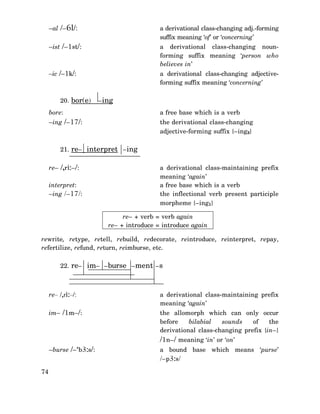
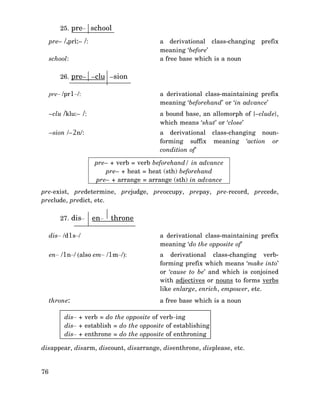
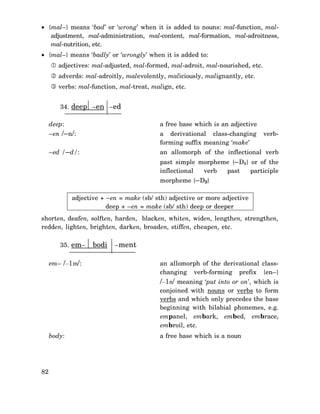
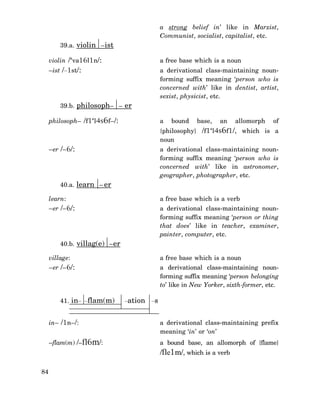
In other words, it is impossible to divide English words by the insertion of
any other elements. Also, English word formation does not enable us to move a
certain morpheme in a word to any position we like.
In conclusion, our conscious knowledge of the English language allows us to
identify (3), not (1) or (2), as an English word.
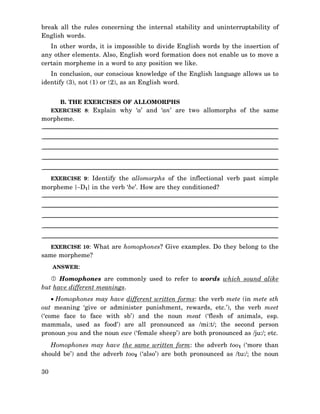
B. THE EXERCISES OF ALLOMORPHS
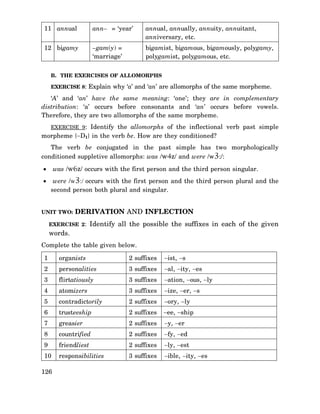
EXERCISE 8: Explain why ‘a’ and ‘an’ are two allomorphs of the same

morpheme.

________________________________________________________________________________________
________________________________________________________________________________________
________________________________________________________________________________________
________________________________________________________________________________________
________________________________________________________________________________________
EXERCISE 9: Identify the allomorphs of the inflectional verb past simple

morpheme {−D1} in the verb ‘be’. How are they conditioned?

________________________________________________________________________________________
________________________________________________________________________________________
________________________________________________________________________________________
________________________________________________________________________________________
________________________________________________________________________________________
EXERCISE 10: What are homophones? Give examples. Do they belong to the

same morpheme?
ANSWER:

Homophones are commonly used to refer to words which sound alike
but have different meanings.
• Homophones may have different written forms: the verb mete (in mete sth
out meaning ‘give or administer punishment, rewards, etc.’), the verb meet
(‘come face to face with sb’) and the noun meat (‘flesh of animals, esp.
mammals, used as food’) are all pronounced as /mi:t/; the second person
pronoun you and the noun ewe (‘female sheep’) are both pronounced as /ju:/; etc.
Homophones may have the same written form: the adverb too1 (‘more than
should be’) and the adverb too2 (‘also’) are both pronounced as /tu:/; the noun
30
bear (‘large heavy animal with thick fur’), the verb bear1 (‘give birth to’) and
the verb bear2 (‘tolerate’) are all pronounced as /be6(r)/; etc.
Homophones may also be allomorphs of different morphemes. Compare
the allomorph /−z/ of the noun plural inflectional suffix {−S1} like in those
frogs (1) with that of the noun possessive inflectional suffix {−S2} like in John’s
book (2) and with that of the verb inflectional suffix {−S3} like in It feels good
(3).
The two above illustrations show that homophones can never belong to the
same morpheme.
EXERCISE 11: Identify the following homophones and try to look for a few

more appropriate examples to illustrate their distinction.

(1)a. The inflectional verb past participle morpheme {−D2}: the departed
guests, edited manuscripts.
(1)b. The derivational class-changing adjective-forming morpheme {−D3}: a
very devoted wife; a rather neglected girl; he was even more excited
than I (was).
(2)a. The inflectional verb present participle morpheme {−ing1}: I saw a
house burning; I saw a burning house.
(2)b. The derivational class-changing noun-forming morpheme {−ing2}:
droppings (n., pl) = excrement of birds or animals; findings (n., pl) =
things that are discovered as the result of an (official) inquiry; He
attended the meeting; I make my living by teaching.
(2)c. The derivational class-changing adjective-forming morpheme {−ing3}: a
very exciting film; you can’t expect a more charming companion than
he.
(3)a. The derivational class-changing adverb-forming morpheme {−ly1}:
complete (adj.) + −ly
→ completely (adv.);
happy (adj.) + −ly
→ happily (adv.).
(3)b. The derivational class-changing adjective-forming morpheme {−ly2}:
coward (n.) + −ly
→ cowardly (adj.);
gentleman (n.) + −ly
→ gentlemanly (adj.).
(4)a. The inflectional adjective comparative morpheme {−er1}:
tall (positive adj.) + −er
→ taller (comparative adj.);
happy (positive adj.) + −er → happier (comparative adj.).
31
(4)b. The derivational class-changing noun-forming morpheme {−er2}:
read (verb) + −er → reader (noun);
teach (verb) + −er → teacher (noun).
(4)c. The derivational class-changing verb-forming morpheme {−er3}:
chat (noun) + −er → chatter (verb);
wit (noun) + −er → witter (verb).
NOTES:
chat /t∫`t/ n

[C, U] friendly informal conversation:
I had a long chat with her (about her
job); That’s enough chat — get back to
work.

chatter /‘t∫`t6(r)/ v

[I, Ipr, Ip] (away/on) (about sth) talk
quickly, continuously or foolishly about
unimportant matters: Do stop chattering
on about the weather while I’m trying to
read.

wit /w1t/ n

[U] ability to combine words, ideas, etc.
so as to produce a clever type of humor:
I admire her for her wit;
[C] person who has or is famous for
this, witty person: a well-known wit.
[I, Ipr, Ip] (on) (about sth) (infml, usu
derog) speak in a lenthy and annoying
way about sth unimportant: What are
you wittering (on) about?

witter /‘w1t6(r)/ v

EXERCISE 12: Give the morphemic structure of each of the following words.

Identify the allomorph of the inflectional suffix in each word. How are the
allomorphs involved conditioned? (morphologically or phonologically?)
1. ox → oxen

/‘4ks6n/ = /4ks/ + /−6n/
/‘4ksn/ = /4ks/ + /−n/

/−6n/ or /−n/ is a morphologically conditioned additive allomorph of the
inflectional noun plural morpheme {−S1}.
2. brother → brethren
/−6n/

32

/‘bre5r6n/ =

/‘br∧5r6

→ ‘bre5r−/ +
child → children

/‘t~1ldr6n/ = /t~a1ld

→

/−6n/

‘t~1ldr−/ +

/−6n/ is a morphologically conditioned additive allomorph of the inflectional
noun plural morpheme {−S1}. It is added to a stem which has previously
undergone some change in form: from /‘br∧56/ to /bre5r−/ or from /t~a1ld/ to
/t~1ldr−/.
In other words, /−6n/ is added to the allomorph /t~1ldr−/ of the morpheme
{child} or the allomorph /bre5r−/ of the morpheme {brother}.
3. deer → deer

/d16/

sheep → sheep

= /d16/ + / - /

/~i:p / = /~i:p/ + / - /

/-/ is the morphologically conditioned zero allomorph of the inflectional noun
plural morpheme {−S1}.
The following group of names of edible animals, game animals, fish and
birds also takes the zero allomorph of {−S1}: SWINE, BEAR, ANTELOPE, BASS,
PIKE, CARP, PERCH, PICKEREL, QUAIL and GROUSE.
4. man → men
goose → geese

/men/ = /m`n/ + / ` → e /
/gi:s/ = /gu:s/ + /u: → i:/

/` → e/ and /u:→
i:/ are two morphologically conditioned replacive
allomorphs of the inflectional noun plural morpheme {−S1}.
The following limited group of nouns also takes a replacive allomorph:
WOMAN → WOMEN, TOOTH → TEETH, FOOT → FEET, LOUSE → LICE and MOUSE →

MICE.

5. wolf → wolves

/wυlvz/ = / wυlf → wυlv−/ + /−z/

calf → calves

/ka:vz/

= / ka:f → ka:v−/

mouth → mouths

/maυ5z/ = /maυθ → maυ5−/ + /−z/

path → paths

/pa:5z/

= / pa:θ → pa:5−/

+ /−z/
+ /−z/

In the above cases, before the phonologically conditioned additive allomorph
/−z/ of the inflectional noun plural morpheme {−S1} is added to change a
singular noun to a plural noun, that singular noun has previously undergone
some change in form: from /wυlf/ to /wυlv−/, from /ka:f/ to /ka:v−/, from /maυθ/
to /maυ5−/ or from /pa:θ/ to /pa:5−/.
In other words, /−z/ is added to the second allomorph of the stem: /wυlv−/,
/ka:v−/, /maυ5−/ and /pa:5−/. Some common nouns that may have the same
analysis are: WIFE − WIVES, KNIFE− KNIVES, HALF − HALVES, SHELF − SHELVES,
33
SCARF − SCARVES, BATH − BATHS, LOAF − LOAVES, SELF − SELVES, OATH −
OATHS, etc.

6. house → houses /haυz1z/ = /haυs → haυz−/ + /−1z/
/−Iz/ is a phonologically conditioned additive allomorph of {−S1} which occurs
after one of the sibilant consonants /s/, /z/, /~/, /2/, /t~/, or /d2/.
7. hurt → hurt
put → put

/h3:t/ = /h3:t/ + / - /
/pυt/

= /pυt/ + / - /

/-/ is the morphologically conditioned zero allomorph of either the
inflectional verb past simple morpheme {−D1} or the inflectional verb past
participle morpheme {−D2}.
8. drink → drunk

/dr∧7k/ = /dr17k / + /1 → ∧/

/1 → ∧/ is a morphologically conditioned replactive allomorph of the
inflectional verb past participle morpheme {−D2}.
9. break → broken

/‘br6υk6n/ = /bre1k → br6υk−/ + /−6n/
/‘br6υkn/ = /bre1k → br6υk−/ + /−n/

speak → spoken

/‘sp6υk6n/ = /spi:k → sp6υk−/ + /−6n/
/‘sp6υkn/ = /spi:k → sp6υk−/ + /−n/

/−6n/ or /−n/ is a morphologically conditioned additive allomorph of the
inflectional verb past participle morpheme {−D2}. It is added to a stem which
has previously undergone some change in form from /bre1k/ to /br6υk−/ or
from /spi:k/ to /sp6υk−/.
10. go → went
/went/ = /g6υ/ + the morphologically conditioned suppletive allomorph of the
inflectional verb past tense morpheme {−D1}.
11. wash → washes /‘w4~1z/

= /w4~/

+ /−1z/

switch → switches /‘sw1t~1z/ = /sw1t~/ + /−1z/
/−1z/ is a phonologically conditioned additive allomorph of either the
inflectional noun plural morpheme {−S1} or the inflectional verb present tense
third person singular morpheme {−S3}. The allomorph /−1z/ only occurs after
one of the sibilant consonants /s/, /z/, /~/, /2/, /t~/ or /d2/.
12. see → saw

/s0:/

= /si:/

+ /i: → 0:/

begin → began /b6‘9`n/ = /b6‘91n/ + /1 → `/
bite → bit
give → gave
34

/b1t/
/9e1v/

= /ba1t/

+ /a1 → 1/

= /91v/

+ /1 → e1/
/i:→ 0:/, /1 → `/, /a1 → 1/ and /1 → e1/ are morphologically conditioned
replacive allomorphs of the inflectional verb past tense morpheme {−D1}.
EXERCISE 13: Write the base morpheme and its allomorphs in each case.

How are the allomorphs conditioned?

1. house /haυs/, houses /haυz−/ + /−1z/
The base morpheme {house} has two morphologically conditioned
allomorphs, /haυs/ and /haυz−/, according to context: /haυs/ occurs when there
is no other morpheme occurring; /haυz−/ occurs in combination with /−1z/, a
phonologically conditioned additive allomorph of the inflectional noun plural
morpheme {−S1}.
2. child /t~a1ld/, children /‘t~1ldr−/ + /−6n/
The base morpheme {child} has two morphologically conditioned
allomorphs, /t~a1ld/ and /‘t~1ldr−/, according to context: /t~a1ld/ occurs when
there is no other morpheme occurring; /‘t~1ldr−/ occurs in combination with
/−6n/, a morphologically conditioned additive allomorph of {−S1}.
3. strong /str47/, strength /stre7−/ + /−θ/
The base morpheme {strong} has two morphologically conditioned
allomorphs, /str47/ and /stre7−/, according to context: /str47/ occurs when there
is no other morpheme occurring; /stre7−/ occurs in combination with −th /−θ/, a
derivational class-changing noun-forming suffix.
wide /wa1d/

width

/w1t−/ + /−θ/

broad /br4:d/

breadth

/bret−/ + /−θ/

able /‘e1bl/

ability

/6‘b1l−/ + /−6t1/

divine /d6‘va1n/

divinity

/d6‘v1n−/ + /−6t1/

supreme /s6‘pri:m/

supremacy

/s6‘prem6−/ + /−s1/

4. atom /‘`t6m/, atomic /6‘t4m−/ + /−1k/
The base morpheme {atom} has two morphologically conditioned
allomorphs, /‘`t6m/ and /6‘t4m−/, according to context: /‘`t∂m/ occurs when
there is no other morpheme occurring; /6‘t4m−/ occurs in combination with −ic
/−1k/, a derivational class-changing adjective-forming suffix.
feast /fi:st/

festive

/fest−/ + /−1v/

destroy /d6‘str01/

destructive /d6‘str∧kt −/ + /−1v/

offend /6‘fend/

offensive

/6‘fens−/ + /−1v/

repeat /r6‘pi:t/

repetitive

/r6‘pet6t−/ + /−1v/
35
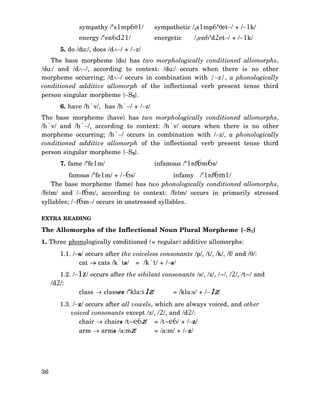
sympathy /‘s1mp6θ1/

sympathetic /,s1mp6‘θet−/ + /−1k/

energy /‘en6d21/

energetic

/,en6‘d2et−/ + /−1k/

5. do /du:/, does /d∧−/ + /−z/
The base morpheme {do} has two morphologically conditioned allomorphs,
/du:/ and /d∧−/, according to context: /du:/ occurs when there is no other
morpheme occurring; /d∧−/ occurs in combination with /−z/, a phonologically
conditioned additive allomorph of the inflectional verb present tense third
person singular morpheme {−S3}.
6. have /h`v/, has /h`−/ + /−z/
The base morpheme {have} has two morphologically conditioned allomorphs,
/h`v/ and /h`−/, according to context: /h`v/ occurs when there is no other
morpheme occurring; /h`−/ occurs in combination with /−z/, a phonologically
conditioned additive allomorph of the inflectional verb present tense third
person singular morpheme {−S3}.
7. fame /‘fe1m/

infamous /‘1nf6m6s/

famous /‘fe1m/ + /−6s/
infamy /‘1nf6m1/
The base morpheme {fame} has two phonologically conditioned allomorphs,
/feIm/ and /−f6m/, according to context: /feIm/ occurs in primarily stressed
syllables; /−f6m−/ occurs in unstressed syllables.
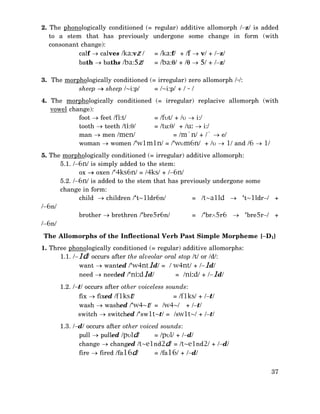
EXTRA READING

The Allomorphs of the Inflectional Noun Plural Morpheme {−S1}
1. Three phonologically conditioned (= regular) additive allomorphs:
1.1. /−s/ occurs after the voiceless consonants /p/, /t/, /k/, /f/ and /θ/:
cat → cats /k`ts/ = /k`t/ + /−s/
1.2. /−1z/ occurs after the sibilant consonants /s/, /z/, /~/, /2/, /t~/ and
/d2/:
= /kla:s/ + /−1z/
class → classes /‘kla:s1z/
1.3. /−z/ occurs after all vowels, which are always voiced, and other
voiced consonants except /z/, /2/, and /d2/:
chair → chairs /t~e6z/ = /t~e6/ + /−z/
arm → arms /a:mz/
= /a:m/ + /−z/

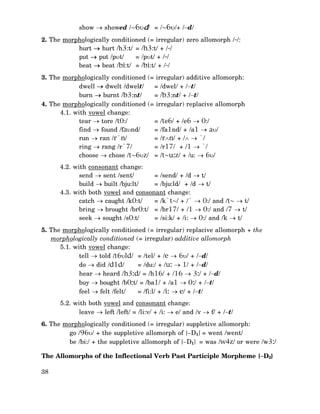
36
2. The phonologically conditioned (= regular) additive allomorph /−z/ is added
to a stem that has previously undergone some change in form (with
consonant change):
calf → calves /ka:vz /
= /ka:f/ + /f → v/ + /−z/
= /ba:θ/ + /θ → 5/ + /−z/
bath → baths /ba:5z/
3. The morphologically conditioned (= irregular) zero allomorph /-/:
sheep → sheep /~i:p/
= /~i:p/ + / - /
4. The morphologically conditioned (= irregular) replacive allomorph (with
vowel change):
foot → feet /fi:t/
= /fυt/ + /υ → i:/
tooth → teeth /ti:θ/
= /tu:θ/ + /u: → i:/
man → men /men/
= /m`n/ + /` → e/
woman → women /‘w1m1n/ = /‘wυm6n/ + /υ → 1/ and /6 → 1/
5. The morphologically conditioned (= irregular) additive allomorph:
5.1. /−6n/ is simply added to the stem:
ox → oxen /‘4ks6n/ = /4ks/ + /−6n/
5.2. /−6n/ is added to the stem that has previously undergone some
change in form:
child → children /‘t~1ldr6n/
= /t~a1ld → ‘t~1ldr−/ +
/−6n/
brother → brethren /‘bre5r6n/
= /‘br∧5r6 → ‘bre5r−/ +
/−6n/
The Allomorphs of the Inflectional Verb Past Simple Morpheme {−D1}
1. Three phonologically conditioned (= regular) additive allomorphs:
1.1. /−1d/ occurs after the alveolar oral stop /t/ or /d/:
want → wanted /‘w4nt1d/ = / w4nt/ + /−1d/
need → needed /‘ni:d1d/
= /ni:d/ + /−1d/
1.2. /−t/ occurs after other voiceless sounds:

= /f1ks/ + /−t/
fix → fixed /f1kst/
wash → washed /‘w4~t/ = /w4~/ + /−t/
switch → switched /‘sw1t~t/ = /sw1t~/ + /−t/

1.3. /−d/ occurs after other voiced sounds:
pull → pulled /pυld/
= /pυl/ + /−d/
change → changed /t~e1nd2d/ = /t~e1nd2/ + /−d/
= /fa16/ + /−d/
fire → fired /fa16d/
37
show → showed /~6υd/ = /~6υ/+ /−d/
2. The morphologically conditioned (= irregular) zero allomorph /-/:
hurt → hurt /h3:t/ = /h3:t/ + /-/
put → put /pυt/
= /pυt/ + /-/
beat → beat /bi:t/ = /bi:t/ + /-/
3. The morphologically conditioned (= irregular) additive allomorph:
dwell → dwelt /dwelt/
= /dwel/ + /−t/
burn → burnt /b3:nt/
= /b3:nt/ + /−t/
4. The morphologically conditioned (= irregular) replacive allomorph
4.1. with vowel change:
tear → tore /t0:/
= /te6/ + /e6 → 0:/
find → found /faυnd/
= /fa1nd/ + /a1 → aυ/
run → ran /r`n/
= /r∧n/ + /∧ → `/
ring → rang /r`7/
= /r17/ + /1 → `/
choose → chose /t~6υz/ = /t~u:z/ + /u: → 6υ/
4.2. with consonant change:
send → sent /sent/
= /send/ + /d → t/
build → built /bju:lt/
= /bju:ld/ + /d → t/
4.3. with both vowel and consonant change:
catch → caught /k0:t/
= /k`t~/ + /` → 0:/ and /t~ → t/
bring → brought /br0:t/ = /br17/ + /1 → 0:/ and /7 → t/
seek → sought /s0:t/
= /si:k/ + /i: → 0:/ and /k → t/
5. The morphologically conditioned (= irregular) replacive allomorph + the
morphologically conditioned (= irregular) additive allomorph
5.1. with vowel change:
tell → told /t6υld/ = /tel/ + /e → 6υ/ + /−d/
do → did /d1d/
= /du:/ + /u: → 1/ + /−d/
hear → heard /h3:d/ = /h16/ + /16 → 3:/ + /−d/
buy → bought /b0:t/ = /ba1/ + /a1 → 0:/ + /−t/
feel → felt /felt/
= /fi:l/ + /i: → e/ + /−t/
5.2. with both vowel and consonant change:
leave → left /left/ = /li:v/ + /i: → e/ and /v → f/ + /−t/
6. The morphologically conditioned (= irregular) suppletive allomorph:
go /96υ/ + the suppletive allomorph of {−D1} = went /went/
be /bi:/ + the suppletive allomorph of {−D1} = was /w4z/ or were /w3:/
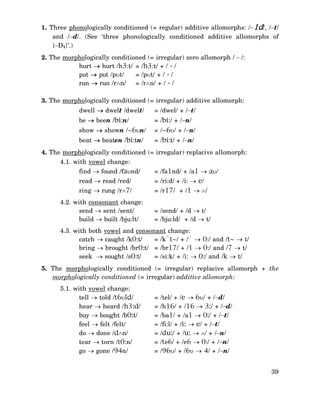
The Allomorphs of the Inflectional Verb Past Participle Morpheme {−D2}
38
1. Three phonologically conditioned (= regular) additive allomorphs: /−1d/, /−t/
and /−d/. (See ‘three phonologically conditioned additive allomorphs of
{−D1}’.)
2. The morphologically conditioned (= irregular) zero allomorph / - /:
hurt → hurt /h3:t/ = /h3:t/ + / - /
put → put /pυt/
= /pυt/ + / - /
run → run /r∧n/
= /r∧n/ + / - /
3. The morphologically conditioned (= irregular) additive allomorph:
dwell → dwelt /dwelt/

= /dwel/ + /−t/

be → been /bi:n/

= /bi:/ + /−n/

show → shown /~6υn/

= /~6υ/ + /−n/

beat → beaten /bi:tn/

= /bi:t/ + /−n/

4. The morphologically conditioned (= irregular) replacive allomorph:
4.1. with vowel change:
find → found /faυnd/

= /fa1nd/ + /a1 → aυ/

read → read /red/

= /ri:d/ + /i: → e/

ring → rung /r∧7/

= /r17/ + /1 → ∧/

4.2. with consonant change:
send → sent /sent/
build → built /bju:lt/

= /send/ + /d → t/
= /bju:ld/ + /d → t/

4.3. with both vowel and consonant change:
catch → caught /k0:t/
= /k`t~/ + /` → 0:/ and /t~ → t/
bring → brought /br0:t/ = /br17/ + /1 → 0:/ and /7 → t/
seek → sought /s0:t/
= /si:k/ + /i: → 0:/ and /k → t/
5. The morphologically conditioned (= irregular) replacive allomorph + the
morphologically conditioned (= irregular) additive allomorph:
5.1. with vowel change:
tell → told /t6υld/
hear → heard /h3:d/
buy → bought /b0:t/
feel → felt /felt/
do → done /d∧n/
tear → torn /t0:n/
go → gone /94n/

=
=
=
=
=
=
=

/tel/ + /e → 6υ/ + /−d/
/h16/ + /16 → 3:/ + /−d/
/ba1/ + /a1 → 0:/ + /−t/
/fi:l/ + /i: → e/ + /−t/
/du:/ + /u: → ∧/ + /−n/
/te6/ + /e6 → 0:/ + /−n/
/96υ/ + /6υ → 4/ + /−n/
39
choose → chosen /‘t~6υzn/ = /t~u:z/ + /u: → 6υ/ + /−n/
5.2. with both vowel and consonant change:
leave → left /left/ = /li:v/ + /i: → e/ and /v → f/ + /−t/
NOTES:
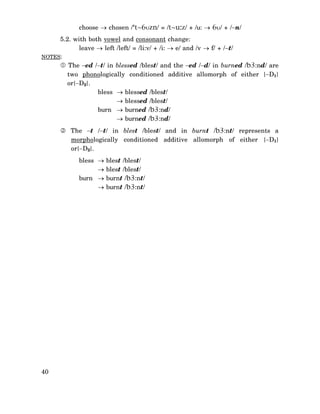
The −ed /−t/ in blessed /blest/ and the −ed /−d/ in burned /b3:nd/ are
two phonologically conditioned additive allomorph of either {−D1}
or{−D2}.
bless → blessed /blest/
→ blessed /blest/
burn → burned /b3:nd/
→ burned /b3:nd/
The −t /−t/ in blest /blest/ and in burnt /b3:nt/ represents a
morphologically conditioned additive allomorph of either {−D1}
or{−D2}.
bless →
→
burn →
→

40

blest /blest/
blest /blest/
burnt /b3:nt/
burnt /b3:nt/
UNIT TWO

DERIVATION AND INFLECTION
1. DERIVATION
1.1. DEFINITION: Derivation is ‘the formation of new words by adding
affixes to other words or morphemes. For example, the noun insanity is derived
from the adjective sane by addition of the negative prefix in− and the nounforming suffix −ity’ [Richards, Platt & Weber, 1987: 77].
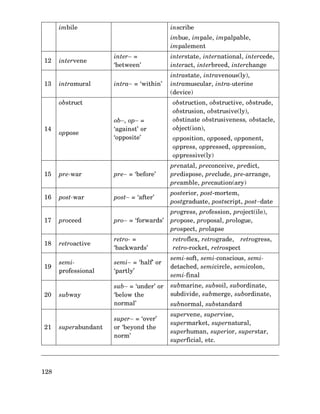
1.2. TYPES OF DERIVATIONAL AFFIXES: There are two subgroups:
• Class-changing derivational affixes change the word class, (also called the
grammatical category or the part of speech) of the words to which they are
attached.
Thus, when a verb is conjoined with the suffix −able, the result is an
adjective, as in desire + −able or adore + −able.
A few other examples are:
noun to adjective
boy + −ish
virtu(e) + −ous
Elizabeth + −an

verb to noun

adjective to adverb noun to verb

acquit(t) + −al
clear + −ance
accus(e) + −ation

exact + −ly
quiet + −ly

mortal + −ise
vaccin(e) + −ate
beauty + −fy

• Class-maintaining derivational affixes do not change the word class of the
words to which they are attached.
Many prefixes fall into this category:
a−
+ mortal
auto− + biography
ex−
+ wife
super− + human

mono−
re−
semi−
sub−

+ theism
+ print
+ annual
+ minimal

There are also suffixes of this type:
vicar + −age
Americ(a) + −an

New Jersey + −ite
pun + −ster

1.3. MORPHOLOGICAL RULES: New words may enter the dictionary in this
fashion, created by the application of morphological rules. A few of them are:
(1) VERB + −able = ‘able to be VERB-ed’
ACCEPT + −able = ‘able to be ACCEPTed’

41
The derivational class-changing adjective-forming suffix {−able} has three
allomorphs:
(i) /−6bl/, which occurs at the end of English words: visible
/‘v1z6bl/, desirable /d6‘za16r6bl /;
(ii) /−6b/, which occurs before the adverb-forming suffix {−ly1}:
visibly /‘v1z6bl1/, desirably /d6‘za16r6bl1/;
(iii) /−6‘b1l/, which occurs before the noun-forming suffix {−ity}:
visibility /,v1z6‘b1l 6t1/, desirability /d6,za16r6‘b1l 6t1/.
(2) un− + ADJECTIVE = ‘not + ADJECTIVE’
= ‘not + TRUE’
un− + TRUE
Among the words which have been derived from this morphological rule are
unjust, unkind, unfair, unfit, unavoidable, unrelieved, unscientific,
unshrinking, unskilled, etc.
= ‘do the opposite of + VERB+ −ING’
= ‘reverse + VERB+ −ING’
un− + LOCK = ‘do the opposite of + LOCKING’
= ‘reverse + LOCKING’

(3) un− + VERB

Among the words which have been derived from the this morphological rule
are unnerve, unlock, untie, undo, untread, unzip, unfasten, undress, uncurl,
unfold, etc.
NOTES:

Added to a verb base, the prefix ‘un−’ meaning ‘reverse’ or ‘do the opposite
of’ is not too difficult to be identified:
1. nerve /n3:v/ v

unnerve /,∧n‘n3:v/ v

42

[Tn.pr, Cn.t] ∼ sb/oneself for sth give
sb/ oneself the courage, strength, selfcontrol, confidence, or determination to
do sth: Her support nerve her for the
fight. I nerved myself to face my
accusers.
[Tn] cause sb to lose courage, strength,
self-control, confidence, or determination:
His encounter with the guard dog had
completely unnerved him.
2. lock /l4k/ v
unlock /,∧n‘l4k/ v

3. tie /ta1/ v

untie /,∧n‘ta1/ v

[Tn] fasten (a gate, door, lid, etc.) with
a lock: Be sure to lock your bicycle.
[Tn] unfasten the lock (of a door, gate,
lid, etc.) using a key: He failed to
unlock the gate.
[Tn] fasten or bind (sth) with rope,
string, etc.: Shall I tie the parcel or use
sticky tape?
[Tn] unfasten knots, buttons, a parcel,
an envelope, etc.: Could you untie this
apron for me?

4. undo /,∧n‘du:/ v

[Tn] 1. reverse doing; untie or unfasten
knots, buttons, etc.: I can’t undo my
shoelaces; 2. reverse doing; destroy the
effect of sth: He undid most of the good
work of his predecessor.

5. tread /tri:d/ v

[I] set one’s foot down; walk or step:
Explorers were going where no man
had trod before.

untread /,∧n‘tri:d/ v

[I] go back through in the same steps:
She trod and untrod lightly so as not to
wake the baby.

Also added to a verb base, the prefix ‘un−’ may have another meaning:
‘remove from’ or ‘deprive of’:
1. earth /3:8/ sth up

unearth /,∧n‘3:8/ v

2. mask /ma:sk/ v

unmask /,∧n‘ma:sk/ v

[phr v] cover sth (the roots of a plant,
etc.) with earth: He earthed up the
celery.
[Tn, Tn.pr] ∼ sth (from sth) dig up,
uncover sth from the ground by
digging: The dog has unearthed some
bones.
[Tn] cover the face (of sb) with a mask;
(fig.) conceal sth: The thief masked his
face with a stocking. She masked her
fear by a show of confidence.
[Tn] remove a mask from (sb); (fig.)
reveal the true character of (sb/sth):
Who will unmask his plot?
43
3. load /l6υd/ v
unload /,∧n‘l6υd/ v
4. plug /pl∧9/ phr v

unplug /,∧n‘pl∧9/ v

5. unfrock /,∧n‘fr4k/ v

[Tn] put a load in or on sth: They
loaded bricks onto the lorry.
[Tn] remove a load from sth: Dockers
started unloading the ship.
[Tn] sth in connect (sth) to the electricity
supply with a plug: Plug in the radio,
please. The recorder wasn’t plugged in.
[Tn] disconnect (an electrical appliance)
by removing its plug from the socket:
Please unplug the TV before you go to
bed.
[Tn esp. passive] deprive (a cleric) of
ecclesiastic rank, dismiss (a priest
guilty of bad conduct) from the
priesthood: The vicar of the church has
been unfrocked.
(Notice that ‘frock’ as a verb does not
really exist in English.)

Unfortunately, it is not always easy to identify the meaning of the prefix
‘un−’: if the suffix ‘−en’ in ‘unloosen’ means ‘make’, then what does the
prefix ‘un−’ mean? Compare:
Can you loosen the lid of the jar?
Can you unloose the rope around the victim’s waist?
Can you unloosen his collar?
loosen /‘lu:sn/ v

1. [I] become loose or looser: This knot
keeps loosening; 2. [Tn] make (sth) loose
or looser: medicine to loosen a cough.

unloose /,∧n‘lu:s/ v

[Tn] make (sth) loose: After the huge
meal, he unloosed his belt and go to
sleep.

unloosen /,∧n‘lu:sn/ v

[Tn] make (sth) loose: After the huge
meal, he unloosened his belt and go to
sleep.

This phenomenon can be used to support Fromkin‘s and Rodman‘s following
statement [1993: 50-51]: ‘It is true, however, that one cannot always know the
meaning of the words derived from free and derivational morphemes from the
morphemes themselves … Therefore, although the words in a language are not
44
the most elemental sound-meaning units, they (plus the morphemes) must be listed
in our dictionaries. The morphological rules also are in the grammar, revealing the
relation between words and providing the means for forming new words.’
2. INFLECTION
2.1. DEFINITION: Inflection is ‘the process of adding an affix to a word or
changing it in some other way according to the rules of the grammar of a
language. For example, English verbs are inflected for 3rd-person singular: I
work, he works and for past tense: I worked. Most nouns may be inflected for
plural: horse – horses, flower – flowers, man – men’ [Richards, Platt & Weber,
1987: 77].
2.2. VARIOUS KINDS OF INFLECTION
2.2.1. NOUN INFLECTION
Almost all English nouns have two forms: the plain form (also called the
unmarked form) used in the constructions like ‘a book’ or ‘the book’ and the
inflected form (also called the marked form) which is formed by adding
inflectional suffixes to the plain form. The plain form and its three inflected
forms together make up a four-form inflectional noun paradigm, which is a set
of relative forms of a noun. Not all nouns have three inflected forms:
one plain form
(= the stem)
mother (singular noun)

three inflected forms
(= the stem + inflectional suffixes)
mothers
(plural noun)
mother ‘s (singular-possessive noun)
mothers’ (plural-possessive noun)

2.2.2. VERB INFLECTION
The inflections of a verb are more complicated than those of a noun. The
paradigm of an irregular verb has four inflected forms: breaks, breaking,
broke, and broken.
Although the past simple and the past participle inflected forms of a regular
verb are just the same, they carry quite different meanings.
Therefore, it is much more convenient to assign all English verbs to a fiveform inflectional paradigm.
one plain form
(= the stem)
work

four inflected forms
(= the stem + inflectional suffixes)
works, working, worked, worked
45
break

breaks, breaking, broke, broken

2.2.3. ADJECTIVE INFLECTION and ADVERB INFLECTION
There is a three-form inflectional paradigm for adjectives of one or two
syllables and for monosyllabic adverbs though it does not apply to all
members of either the adjective or the adverb class.
Most one-syllable adjectives and adverbs and many two-syllable adjectives
have a comparative form with an ‘−er’ inflection and a superlative form with
an ‘−est’ inflection.
one plain form

two inflected forms

(= the stem)

(= the stem + inflectional suffixes)

POSITIVE

shorter

shortest

big

bigger

biggest

happy

happier

happiest

pure
ADVERBS

SUPERLATIVE

short
ADJECTIVES

COMPARATIVE

purer

purest

fast

faster

fastest

hard

harder

hardest

3. HOW TO DISTINGUISH DERIVATION FROM INFLECTION
3.1. DERIVATION

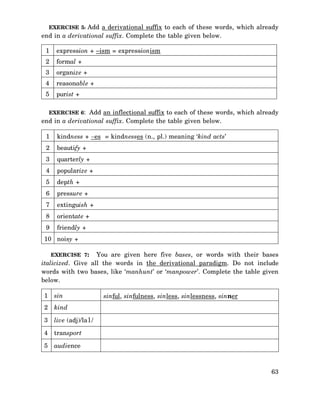
3.1.1. Derivation can be observed in the following formula:
A BASE (also called A ROOT) + DERIVATIONAL AFFIXES → NEW DERIVED WORDS

3.1.2. DERIVATIONAL AFFIXES serve to supply the base with ‘components
of lexical and lexico-grammatical meanings, thus form different words’ [Arnold,
1986: 87]. Adding derivational affixes to English base morphemes (which are
of various grammatical categories/ word classes/ parts of speech), we have
various DERIVATIONAL PARADIGMS: mother, motherhood, motherly, motherli
ness, motherless and motherlike form a derivational paradigm; break,
breakable, unbreakable, breakabil ity, unbreak abil ity, breakage and breaker
form another derivational paradigm; pure, purely, purist, purism, purify, puri
fic ation, pureness (= purity), impure, and impurity form still another
derivational paradigm.
46
3.1.3. THE BASE (also called THE ROOT) of a derivational paradigm is ‘the
ultimate constituent element which remains after the removal of all functional
and derivational affixes and does not admit any further analysis’ [Arnold, 1986:
78]. Thus, HEARTen, HEARTen ed, disHEARTen, disHEARTen ed, HEARTy,
HEARTi ly, HEARTi ness HEARTless, HEARTless ly, and HEARTless ness, all
share the same base: HEART.
3.1.4. A DERIVATIONAL PARADIGM is ‘a set of related words composed of
the same base morpheme and all the derivational affixes that can go with this
base’ [Stageberg, 1965: 97].
3.2. INFLECTION

3.2.1. Inflection can be observed in the following formula:
A STEM + INFLECTIONAL SUFFIXES →

INFLECTED FORMS OF

ONE AND THE SAME WORD

3.2.2. INFLECTIONAL (also called GRAMMATICAL or FUNCTIONAL)
SUFFIXES ‘serve to convey grammatical meaning. They build different forms of
one and the same word’ [Arnold, 1986: 87]. Adding inflectional suffixes to
English stems (which are only nouns, verbs, adjectives and adverbs), we have
INLECTIONAL PARADIGMS: mother, mothers, mother’s and mothers’ form an
inflectional noun paradigm; break, breaking, breaks, broke and broken form
an inflectional verb paradigm; long, longer and longest form an inflectional
adjective or adverb paradigm.
3.2.3. THE STEM (of an inflectional paradigm) is the part of a word that
remains after the removal of all inflectional suffixes. In other words, the stem
is that part of a word that is in existence before any inflectional suffixes. The
stem of the inflectional adjective paradigm HEARTy–HEARTier–(the) HEARTiest
is HEARTy. It is a free stem, but it consists of A BASE and an affix; it is not
simple but derived. Thus, a stem containing one or more affixes is ‘a derived
stem’ [Arnold, 1986: 78].
3.2.4. AN INFLECTIONAL PARADIGM is a set of related words composed of
the same stem and all the inflectional suffixes that can go with this stem.
EXERICES
EXERCISE 1: Give as many words with the same bound base as you can,

using the given prefixes and bound bases.

47
Prefixes
ad− (ac−, at−):
com− (con−):
de−:
dis− (dif−):
ex−:
in− (im−):
per−:
pre−:
inter−:
pro−:
re−:
sub− (sup−):
trans−:

Bound bases
to, toward
with, together, jointly, in
from, down, away
apart
from, out from, out of
in, into, within, toward, on
through, thoroughly
before, in advance
between
forward, before, forth, for
back, again
under
across, beyond, through

1. −tain
2. −ceive
−cept
−ceit
3. −fer
4. −clude
5. −port

hold
take
carry, bear
shut, close
carry

ANSWER:

1. Words with the bound base –tain meaning ‘hold’:
contain, containment, container, containable
detain, detainer, detainee, detainment, detainingly
entertain, entertainment, entertainer
pertain
retain, retainer

2. Words with the bound base –ceive, –cept, –ceit meaning ‘take’:
accept, acceptance, acceptable, acceptability, acceptableness, accepter
conceive, conceivable, conception, conceit, conceiver
deceive, deceivable, deception, deceiver, deceptive,
perceive, perceivable, perception, perceiver, perceptive,
receive, receivable, reception, receiver,
receptive
3. Words with the bound base –fer meaning ‘carry’ or ‘bear’:
confer, conferee, conferment, conferable, conference, conferal, conferer
defer, deference, deferent, deferential, deferentially, defer, deferment,
deferable
infer, inferable, inferer, inference, inferential, inferentially
prefer, preferer, preferable, preferability, preferably, preference,
preferential, preferentially, preferment
refer, referable, referer, referee, reference, referendum, referent,
referential, referentially, referal
transfer, transferable, transfererer, transfereree, transferase,
transference, transferential, transferentially, transferal
48
4. Words with the bound base –clude meaning ‘shut’ or ‘close’:
conclude, concluder
exclude, excludable, excluder, excludability
include, includable
preclude
5. Words with the bound base –port meaning ‘carry’:
comport, comportment
deport, deportable, deportation, deportee, deportment
disport
export, exportable, exportation, exporter
import, importable, importation, importer, important, importance,
importancy, importantly
report, reportable, reportage, reporter
support, supportable, supportableness, supportably, supporter, supportive
transport, transportable, transportability, transporter, transportation,
transportational
EXERCISE 2: Identify all the possible the suffixes in each of the given

words. Complete the table given below.
1

organists

2

personalities

3

flirtatiously

4

atomizers

5

contradictorily

6

trusteeship

7

greasier

8

countrified

9

friendliest

3 suffixes

−ation, −ous, −ly

10 responsibilities

49
EXERCISE 3: Identify the meaning of the prefix in each of the given words

and then give as many words with the same prefix as you can. Complete the
table given below.
1
2

antidote
circumvent

co-pilot
3

collapse
compact
convene

anti− = ‘against’
circum− =
‘around’

circum-navigate, circumference,
circumlocution, circumspect

co−, col−,

co-curriculum, co-operate, coordinate

com−, con−,

collide, collision, collect

cor− = ‘with’

comply
consonant, convoke

corrode
4

anti-aircraft, antibody,
antipersonnel, antihero

correlate

contradict
de− =

deactivate, decentralize,
dehumanize, deform,
denationalize, decolonize, decode

5

devitalized

6

delouse

de− = ‘remove’

dehorn, defrost, deice, deflower,
deforest

7

devalue

de− = ‘reduce’:

degrade, debase, decline, decrease

8

disunion

9

disagreeable

‘do the opposite’

insecure
10

imperfect
illegible
irreverent
inspire

11

50

imbibe

in−, im− = ‘in’ or
‘on’

inspiration, inspirational,
inspiring, inspired, inspect,
install, inscribe
imbue, impale, impalpable,
impalement
12

intervene

13

intramural
obstruct

14

oppose

15

post-war

17

proceed

18

retroactive

19

semi-professional

20

subway

21

superabundant

22

unlikely

23

opposition, opposed, opponent,
oppress, oppressed, oppression,
oppressive(ly),

pre-war

16

ob−, op− =
‘against’ or
‘opposite’

obstruction, obstructive, obstrude,
obstrusion, obstrusive(ly),
obstinate obstrusiveness,
obstacle, object(ion),

undress

retro− =
‘backward’

retroflex, retrograde, retrogress,
retro-rocket, retrospect

NOTES:

1. The prefix anti– means ‘against’.
- antidote /‘`nt1d6υt/ n

[C] substance that acts against the
effect of poison: an antidote against
51
snake bites, food poisoning, malaria,
etc.
- anti-aircraft adj

designed to destroy enemy aircrafts:
anti-aircraft guns.

- anti-personnel adj

designed to kill or injure people: antipersonnel explosives.

- anti-hero n

[C] central character in a story or
drama who lacks the qualities usually
associated with a hero, such as courage
and dignity.

- antibody n

[C] protein formed in the blood in
response to harmful bacteria, etc.
which it then attacks and destroys.

2. The prefix circum– means ‘around’.
- circumvent /s6k∧m‘vent/ v

[Tn] find a way of overcoming or
avoiding sth: circumvent a law, rule,
problem, difficulty, etc.

- ,circum‘navigate v

[Tn] sail around (esp. the world):
Magellan was the first person to
circumnavigate the globe.

- circumference/s6‘k∧mf6r6ns/ n [C] line that marks out a circle or other
curved figures.
- circumlocution n

[U, C] (instance of the) use of many
words to say sth that could be said in a
few words.

- circumspect adj

considering everything carefully before
action; cautious:

- circumspection n

[N] caution:
circumspect.

proceeding

with

great

3. The prefixes co–, col–, com–, con– and cor– all mean ‘with’, ‘together’
or ‘jointly’.
- co-pilot n
- co-operate v

52

[C] assistant pilot in an aircraft.
[I, Ipr] ∼(with sb) work or act together
with another or others:
He co-operated with his friend in raising money.
- co-ordinate v

[Tn, Tn.pr] ∼ sth (with sth) cause
(different parts, limbs, etc.) to function
together efficiently: We must coordinate our efforts to help flood
victims.

- collaborate v

[I, Ipr] ∼ (with sb) work together (with
sb), esp. to create or produce sth: She
collaborated with her sister on a
biography of their father.

- collide v

[I, Ipr] ∼ (with sb/ sth) strike violently
against sth or each other.

- collect v

[Tn, Tn.p] ∼ sth (up/ together) bring
or gather sth together: collect up the
empty glasses, collect together one’s
belongings.

- compact /k6m‘p`kt/ adj

closely packed together: a compact disc;

v

[Tn usu passive] press sth firmly
together: the compacted snow on the
pavement.

- comply v

[I, I.pr] ∼ (with sth) do as one is
requested or commanded: Rules must
be complied with.

- convene /k6n‘vi:n/ v

[Tn] summon people to come together:
convene the members, a committee, etc.

- convoke /k6n‘v6υk/ v

[Tn] call together, summon a meeting,
etc: convoke the Parliament.

- consonant n

[C] sound that has no voice and thus
has to go with a vowel: Vietnamese b
/be1/, c /se1/ and d /de1/ vs. English b
/bi:/ , c /si/ and d /di:/

- corrode /k6‘r6υd/ v

[I,Ip,Tn,Tn.p] ∼ (sth) (away) destroy or
be destroyed slowly, esp with chemical
action: The metal has corroded away
because of rust/ acid. There exists a
53
bitter envy that has corroded their
friendship.
- correlate /‘k4r6le1t/ v

[I,Ipr,Tn,Tn.pr] ∼(with sth), (A with/
and B) have a mutual relation with
sth: We can often correlate age with
frequency of illness.

4. The prefix contra– means ‘against’.
- contradict v

[I, Tn] say sth that conflicts with sth
said or written: That’s true, but don’t
you dare contradict (him)? The speaker
got confused and started contradicting
himself.

- contravene v

[Tn] act/ be contrary to (a law, etc.);
break: Her actions contravene the rules.

- contraception n

[U] preventing of conception.

- contraceptive n

[C] device
conception;

adj
- contra-indication n

or

drug

for

preventing

preventing conception: a contraceptive
pill, device, drug, etc.
[C] (medical) sign that a particular
drug may be harmful: The contraindications listed for the pills meant
that she could not take them.

5. The prefix de– means ‘do the opposite of’.
- vitalize v
- devitalize /,di:‘va1tla1z/ v

[Tn] take strength and vigour away
from sb/sth: a nation devitalized by a
sustained war effort.

- activate v

[Tn] make sth active.

- deactivate /,di:‘`kt1veù1t/ v

[Tn] make (sth dangerous, e.g. a bomb
or a nuclear reactor) harmless or less
active by removing its source of power:
deactivate the fuse mechanism.

- code v
54

[Tn] provide sb/ sth with strength and
vigour.

[Tn] put or write sth in code.
- decode /,di:‘k6υd/ v

[Tn] find the meaning of sth written in
code.

- colonize v

[Tn] establish a colony (in an area),
establish an area as a colony.

- decolonize /,di:‘k4l6naù1z/ v

[Tn] give independent status to a
colony.

6. The prefix de– means ‘remove … from’ or ‘deprive … of’.
- delouse /d1‘laυs/ v

[Tn] remove the lice from sb/ sth.

- dehorn /d1‘h0:n/ v

[Tn] remove the horn from an animal.

- deflower /,di:‘flaυ6/ v

[Tn] deprive a woman of her virginity,
usually by sexual intercourse.

defrost /,di:‘fr4st/ v

[Tn] remove ice or frost from sth.

7. The prefix de– means ‘reduce’.
- devalue /,di:‘v`lju:/ v

[Tn] reduce the value of a currency in
relation to other currencies/ gold.

- decline /d1‘kla1n/ v

[I] become smaller, weaker, fewer, etc.

- decrease /d1‘kri:z/ v

[I, Tn] (cause sth to) become smaller,
weaker, fewer, etc.

- degrade v

[Tn] cause sb to be less moral/
deserving of respect: I felt degraded by
having to ask for money.

- debase v

[Tn] lower the quality, status or value
of sth: Sport is being debased by
commercialism. You debased yourself
by telling such lies.

8. The prefix dis– means ‘absence of’, ‘opposite to’ or ‘do the opposite of’.
- union n

[U] uniting or being united: the Soviet
Union.

- disunion n

[U] separating or being separated.

- appear v

[I] come into view, become visible.

- disappear v

[I] no longer be visible.

- count v

[I] ∼(for sth) be of value or important:
Knowledge without common senses
counts for little.

55
- discount v

[Tn] regard sth as unimportant: You
can discount what Jack said: he’s a
dreadful liar.

- arm v

[Tn] supply or equip oneself/ sb with
weapons.

- disarm v

[Tn] take weapon away from (sb),
reduce the size of the armed forces (of
a nation).

9. The prefix dis– means ‘not’ or ‘lack of’
- disagreeable adj

not agreeable.

- dishonest adj

not honest.

- disadvantage n

[C] unfavorable condition, thing that
tends to prevent sb from succeeding,
making progress.

- discomfort n

[U] lack of comfort; n [C] thing that
cause this.

- disapprove v

[I, Ipr] consider (sb/sth) bad (= not
good), immoral (= not moral), etc: She
wants to be an actress, but her parents
disapprove (of her intentions.).

- disbelieve v

[Tn] refuse to believe (sb/sth): I disbelieve
every word you say.

10. The prefixes in–, im–, il– and ir– all mean ‘not’.
- insecure adj
- incompetent adj

not showing the necessary skills to do
sth successfully.

- inefficient adj

not producing adequate results.

- immoderate adj

too extreme or excessive; not moderate.

- impolite adj

rude; not polite.

- illegal adj

against the law; not legal.

- illiterate adj

not able to read or write.

- irregular adj

not regular in shape, arrangement, etc.

- irrespective adj

56

not secure or lack of safety.

not taking account of or considering
(sth/sb).
11. The prefixes in– and im– both mean ‘in’ or ‘on’.
- inspire v

[Tn, Tn.pr] ∼ sth (in sb)/ sb (to sth)
fill sb with thoughts, feelings, aims,
etc: His noble example inspired the rest
of us to greater efforts.

- inscribe v

[Tn, Tn.pr] ∼ A (on/in B), B (with A)
write words, names, etc on or in
something: inscribe one’s name in a
book; inscribe a book with one’s name.

- inspect v

[Tn] examine (sth) closely: inspect a
school, factory, regiment, etc.

- install v

[Tn, Tn.pr] ∼ sth (in sth) fix equipment,
furniture, etc in position for use: install
a heating or lighting system in a
building.

- imbile v

[Tn] take in or absorb sth (fig): imbile
fresh air, knowledge, etc.

- impale v

[Tn, Tn.pr] ∼ sb/sth (on sth) pierce sb/
sth with a sharp-pointed subjec: In
former times, prisoners’ heads were
impaled on pointed stakes.

- impose v

[Tn, Tn.pr] ∼ sth (on sb/ sth) place (a
penalty, tax, etc.) officially (on sb/ sth):
impose a further tax on wines.

- impress v

[Tn, Tn.pr] ∼ sb (with sth) have a
favourable effect on sb: The sights of
the city never fail to impress foreign
tourists.

- implant v

[Tn, Tn.pr] ∼ sth (in sth) deliberately
introduce or fix (ideas, etc.) into a
person’s mind: implant religious beliefs
in young children.

12. The prefix inter– means ‘between’ or ‘each other’.
- intervene v

[I] be or come between two points of
time: during the years that intervened.
57
- international adj

of, carried on by or existing between
two or more nations.

- interstate adj

between states, esp.
interstate highways.

- intercede v

[I, Ipr] ∼ (with sb) (for/ on behalf of
sb) act as an intermediary (between
two people, groups, countries, etc that
cannot agree), trying to help them
settle their differences: We have to
intercede with the authorities on behalf
of people unfairly imprisoned there.

- interact v

[I, Ipr] ∼ (with sth) act or have an
effect on each other: chemicals that
interact to form new compounds.

- interchange v

[Tn, Tn.pr] ∼ sth (with sb) give sth to
and receive sth from each other: We
interchanged partners: he danced with
mine, and I danced with his.

of

the

USA:

13. The prefix intra– means ‘within’.
- intramural adj

intended for full-time students living
within a college: intramural courses,
studies, staff, etc.

- intravenous adj

within a vein or veins: intravenous
injections.

- intramuscular adj

within a muscle or muscles.

- intra-uterine adj

within the uterus.

- intrastate adj

(existing) within one state, esp. of the
USA: intrastate highways.

14. The prefixes ob– and op– both mean ‘against’ or ‘opposite (to)’.
- obstruct v

- obtrude v

[I, Tn, Tn.pr] force (oneself, one’s
opinions, ideas, etc.) upon sb/ sth, esp.
when unwanted: obtrude on sb’s grief.

- obstacle n
58

[Tn] be or get in the way of sb/ sth;
block a road/ the passage of sth: Tall
trees obstructed his view of the road.

[C] thing in the way that either stops
progress or makes it difficult.
- objection n

[C,U] (expression of a) feeling
dislike, disapproval or opposition.

- obstinate adj

refusing to change one’s opinion or
chosen course of action.

- oppose v

[Tn]
express
strong
disapproval/
disagreement with sb/ sth.

- opponent n

[C] person who is against another
person in a fight, a struggle, a game or
an argument.

- oppress v

[Tn] rule or treat sb with continual
injustice or cruelty.

of

15. The prefix pre–/pr1–/means ‘before’.
- pre-war adj

existing or happening (in the period)
before a war: in the pre-war period.

- pre-natal /,pri:‘ne1tl/ adj

of the period before giving birth: prenatal check-ups, exercises, classes, etc.

- preconceived /,pri:k6n‘si:vd/ adj

formed in advance, not basing on
knowledge or experience: preconceived
ideas, opinions, etc.

- precede v

[I, Tn] come or go before (sth) in time,
order, rank, etc.

- preamble (to sth) n

[C, U] opening that explains the
purpose of the book, document, lecture,
etc. that follows: He launched into his
statement without any preamble.

- precaution /pr1‘k0:~n/ n

[C] thing done in advance to avoid
danger, prevent problems, etc.: take an
umbrella just as a precaution

- precautionary adj

done as a precaution: precautionary
measures.

16. The prefix post– means ‘after’.
- post-war adj

existing or happening (in the period)
after a war: in the post-war period.

- post-mortem /,p6υst‘m0:t6m/ adj made or occurring after death: a postmortem examination.
59
- posterior adj

later (than sth) in time or in a series.

- post-date v

[Tn] put a date (on a document, etc.)
that is later than the actual date.

- postgraduate adj

done after the first degree;

n
- postscript (abbr PS) n

[C] person doing postgraduate studies.
[C] extra message added at the end of a

letter after the signature

17. The prefix pro– /pr6–/means ‘forward’.
- proceed v

[I] go to a further or next stage.

- progress v

[I] go or move forward.

- project v

[Tn.pr] ∼sth (into sth) send or throw
sth outward or forward.

- propose v

[Tn] offer or put forward (sth) for
consideration; suggest.

- proposal n

[U] action of suggesting or putting
forward; [C] thing that is suggested.

- prolapse v

[I] (of an organ in the body, esp. the
bowel or uterus) slip forward or down
so that it is out of place.

- prologue n

[C] introductory part of a poem or play.

- prospect n

[C] picture in the mind or imagination,
esp. of a future event.

18. The prefix retro– means ‘backward’.
- retroactive adj
- retrogress v

[I] go or move backward.

- retrorocket n

[C] rocket engine providing power in
the opposite direction to the path of
flight.

- retroflex n

[C] sound made by bending the tip of
the tongue upward and backward.

- retrograde adj

going backward, getting worse.

- retrospect n

60

affective from a past date.

[U] looking back on a past event or
situation.
19. The prefix semi– means ‘half’ or ‘partly’.
- semi-detached adj

joined to another house by one shared
wall.

- semi-conscious adj

partly conscious.

- semicircle n

[C] half of a circle or of its circumference.

- semi-final n

[C] match or round preceding the final,
e.g. in football.

- semicolon n

[C] the punctuation mark (;) between a
comma and a full stop.

20. The prefix sub– means ‘under’ or ‘below the normal’
- subway n

[C] underground pedestrian tunnel,
esp. one beneath a road or railroad;
underground railway in a city.

- submarine n

[C] naval vessel that can operate
underwater as well as on the surface.

- submerge v

[I] go under the surface of a liquid.

- subdivide v

[I, Ipr, Tn] (cause things to) be divided
again into smaller divisions.

- subnormal adj

below normal, less than normal.

- subordinate adj

lower in rank or position.

- substandard adj

below the usual or required standard.

21. The prefix super– means ‘over’ or ‘beyond the norm’
- superabundant adj

very abundant.

- superhuman adj

exceeding normal human power, size,
knowledge, etc.

- superior adj

better than average.

- superficial adj

of or on the surface only.

- superpower n

[C] any of the most powerful nations in
the world.

- supervise v

[I, Tn] watch or keep a check on (sb
doing sth or sth being done) to make
sure it is done properly.

61
22. The prefix un– means ‘not’.
- unlikely adj

not likely, impossible.

- unattractive adj

not attractive.

- untrue adj

not true.

- unwilling adj

not willing.

23. The prefix un– means ‘reverse of’ or ‘do the opposite of’.
- undress v

[I] take off one’s clothes, (Tn) remove
the clothes of (sb/sth).

- unfold v

[I, Tn] (cause sth to) open or spread out
from a folded state.

- uncurl v

[I,Tn] (cause sth/oneself) become
straightened from a curled position.

- unlock v

[Tn] unfasten the lock of the door, gate,
etc. using a key.

- untie v

[Tn] unfasten or undo (a knot, a button,
a parcle, an envelop, etc.).

- unfreeze v

1. [I, Tn] (cause sth to) thaw; 2. [Tn]
remove official controls on (the
economy, etc): unfreeze (i.e. defrost)
some chops; unfreeze trade restrictions.

EXERCISE 4: Each group contains a base and a few suffixes. Make each into

a word. Complete the table given below.
1

−ed, live, −en

2

−ing, −ate, termin−

3

−er, −s, mor, −al, −ize

4

province, −s, −ism, −al

5

−ly, −some, grue

6

−ity, work, −able

7

in, −most, −er

8

marry, −age, −ity, −able

9

−dom, −ster, gang

10

−ly, −tion, −ate, affect

62

livened
EXERCISE 5: Add a derivational suffix to each of these words, which already

end in a derivational suffix. Complete the table given below.
1

expression + −ism = expressionism

2

formal +

3

organize +

4

reasonable +

5

purist +

EXERCISE 6: Add an inflectional suffix to each of these words, which already

end in a derivational suffix. Complete the table given below.
1

kindness + −es = kindnesses (n., pl.) meaning ‘kind acts’

2

beautify +

3

quarterly +

4

popularize +

5

depth +

6

pressure +

7

extinguish +

8

orientate +

9

friendly +

10 noisy +
EXERCISE 7:

You are given here five bases, or words with their bases
italicized. Give all the words in the derivational paradigm. Do not include
words with two bases, like ‘manhunt’ or ‘manpower’. Complete the table given
below.
1

sin

2

kind

3

live (adj)/la1/

4

transport

5

audience

sinful, sinfulness, sinless, sinlessness, sinner

63
EXERCISE 8: The left-hand column contains ten words. The right-hand

column contains thirteen derivational suffixes used to make nouns and having
the general meanings of ‘state, condition, quality, or act of’. By combining these
suffixes with the words listed, make as many nouns as you can. Fill in the
given blanks.
Words

Derived Words

Noun-forming Derivational Suffixes

1. happy

________________________

1. –hood

8. –ance/ –ence

2. friend

________________________

2. –acy

9. –th

3. girl

________________________

3. –ism

10. –ure

4. compose

composure, composition

4. –ness

11. –ment

5. shrink

________________________

5. –age

12. –y

6. discover

________________________

6. –ity

13. –ship

7. supreme

________________________

7. –ation/ –ition

8. true

truth, truism

9. pagan

________________________

10. active

________________________

EXERCISE 9: Why is it said that inflectional suffixes are part of the syntax

of the English language?
ANSWER:

Inflectional affixes, which are always suffixes in English, perform
grammatical functions. They are representatives of the four grammatical
categories in English: noun, verb, adjective and adverb.
In English, inflectional suffixes typically indicate the syntactic relations
between different words in English sentences: the inflectional suffix –s
indicates the agreement between the subject he and the verb works in ‘He
works hard’; the inflectional noun possessive morpheme –’s shows the
relationship between Tom and another person — his father, in ‘Tom’s father’.
Therefore, it is quite true to state that inflectional suffixes are part of the
English syntax. To master this subject, we have to learn the rules regulating
the ways in which words are arranged to form larger linguistic units such as
phrases, clauses and sentences.
This phenomenon is not only true in English. It is also common in many
other languages in the world.

64
UNIT THREE

IMMEDIATE CONSTITUENTS IN MORPHOLOGY
1. DEFINITION
‘IMMEDIATE CONSTITUENTS are any of the two meaningful parts forming a
larger linguistic unit’ [Arnold, 1986: 83].
Let’s consider Bloomfield’s analysis of the word ungentlemanly [1935: 210].
Comparing this word with other words, we recognize the morpheme un– as a
negative prefix because we have often come across words built on the pattern
un– + adjective base: uncertain, unconscious, uneasy, unfortunate,
unmistakable, unnatural, unearthly, unsightly, untimely, unwomanly, etc.
Thus, at the first cut we obtain the two following immediate constituents: un–
and gentlemanly: un– gentlemanly
Continuing our analysis, we see that there are many adjectives following
the pattern noun base + –ly, such as womanly, masterly, scholarly, soldierly,
manly, etc. with the same semantic relationship of ‘having the quality of the
person denoted by the base’. Thus, at the second cut we obtain the two
following immediate constituents: gentleman and –ly:
gentleman

–ly

There are compound nouns following the pattern adjective + noun, such as
nobleman, highbrow, middlebrow, lowbrow, lazysusan, flatfoot, etc. Thus,
the third cut separates the two free bases of the compound noun gentleman,
resulting in the two immediate constituents: gentle and man:
gentle

man

We have now shown the layers of structure by which the word has been
composed, down to its ultimate constituents: un–, gentle, man, and –ly.
un–

gentle man –ly

Doing word diagrams, like the one right above, to show layers of structure,
we make successive divisions into two parts, each of which is called AN
IMMEDIATE CONSTITUENT, abbreviated IC. The process is continued until all the
component morphemes of a word, the morphemes of which the word is
composed, have been isolated.
65
2. SOME RECOMMENDATIONS ON IC DIVISION
Here are three recommendations on IC division that will assist in the
exercise to follow:
If a word ends in an inflectional suffix, the first cut is between this suffix
and the rest of the word.
pre– + conceiv(e)⎪ –ed

mal– + formation⎪–s

One of the IC‘s should be, if possible, a free form. A free form is one that
can be uttered alone with meaning: egg, doing, enlarge, supportable, etc. Here
are examples of wrong and right first cuts:
Wrong: en– ⎪ large + –ment
in– + depend ⎪ –ent
un– + law ⎪ –ful

Right: en– + large ⎪ –ment
in– ⎪ depend + –ent
un– ⎪ law + –ful

The meanings of the IC’s should be related to the meaning of the word. It
would be wrong to cut restrain like this:
rest ⎪ rain
because neither rest nor rain has a semantic connection with restrain. Nor
would a division of starchy as:
star ⎪ chy
be right because this would give an unrelated morpheme {star} and a
meaningless fragment chy. The two examples are properly cut in this way:
re– ⎪ strain
starch ⎪–y
3. DIAGRAM
When we analyse a word, we show the process of word formation in reverse.
First, we divide the word into two parts. We continue this way cutting every
parts into two more until we can reduce the word to its ultimate constituents,
that is to the morphemes of which the word is composed — those which cannot
be divided any more:
Ungentlemanly
un–

gentlemanly
gentleman
gentle

66

un–

–ly
man

gentle

man

–ly
The two IC’s of the first layer of construction are un– and gentlemanly.
The two IC’s of the second layer of construction are gentleman and –ly.
The two IC’s of the third layer of construction are gentle and man.
EXERCISES
EXERCISE 1: Give the IC cuts of each of the following words. Identify all the

possible morphemes in each of the following words:
1. arriv(e) –al
arrive:

a free base which is a verb

–al /–l/:

a Derivational class-changing noun-forming
suffix meaning ‘process or state of’
verb + –al = noun meaning process or state of verb-ing
arrive + –al = arrival meaning ‘process or state of arriving’

survival, recital, removal, (dis)approval, proposal, refusal, acquittal, etc.
2. build

–s

build:
–s /–z/:

3. wall

a free base which is a verb
an allomorph of the inflectional verb
present tense third person singular
morpheme {–S3}

flower –s

wall and flower:
–s /–z/:
4. sin
sin:
–ful /–fl/:

–ful

two free bases which are nouns
an allomorph of the inflectional noun
plural morpheme {–S1}

a free base which is a noun
a derivational class-changing adjectiveforming suffix meaning ‘full of’
noun + –ful = full of noun
sin + –ful = full of sin

powerful, meaningful, plentiful, hopeful, trustful, useful, helpful, scornful, etc.

67
5. sin

–less

sin:

a free base which is a noun

–less /–l6s/:

a derivational class-changing adjectiveforming suffix meaning ‘without any’,
‘lacking in’ or ‘absence of’
noun + –less = without any noun
sin + –less = without any sin

powerless, meaningless, penniless, hopeless, useless, helpless, lifeless, etc.
6. hope

–ful

–ly

adjective + {–ly1} = adverb
hopeful + {–ly1} = hopefully

hope:

a free base which is a noun

–ful /–fl/:

a derivational class-changing adjectiveforming suffix meaning ‘full of’

–ly /–l1/:

the derivational class-changing adverbforming suffix {–ly1} meaning ‘in the
specified manner’

7. life

–less –ness

adjective + –ness = noun
lifeless + –ness = lifelessness

life:

a free base which is a noun

–less /–l6s/:

a derivational class-changing adjectiveforming suffix meaning ‘without any’,
‘lacking in’ or ‘absence of’

–ness /–n6s/:

a derivational class-changing nounforming suffix meaning ‘quality, state
or character of’

8.

un– graci– –ous

un– /∧n–/:

68

a derivational class-maintaining prefix
meaning ‘not’
graci– /‘gre1~–/:

a bound base, an allomorph of {grace}

/gre1s/, which is a noun
–ous /–6s/:

a derivational class-changing adjectiveforming suffix meaning ‘having the
qualities or character of’
un– + adjective = not adjective
un– + gracious = not gracious
un– + true = not true

un– + base adjective :

untrue,
unjust,
unkind,
unfair,
uncertain, unreal, unfit, unhappy,
uncommon, undue, uneven, unclean,
unwise, etc.

un– + derived adjective:

unavoidable, unbelievable, undeclared,
unequal,
unfriendly,
ungrateful,
unhealthy, unintelligible, unlawful,
unscientific,
unmanly, unnatural,
unofficial,
unpleasant,
unusual,
unwilling, unwanted, etc.

9. un–

true

–ly

un– /∧n–/:

a derivational class-maintaining prefix
meaning ‘not’

true:

a free base which is an adjective

–ly /–l1/:

the derivational class-changing adverbforming suffix {–ly1} meaning ‘in the
specified manner’

10. un–

law

–ful

un– /∧n–/:

a derivational class-maintaining prefix
meaning ‘not’

law:

a free base which is a noun

–ful /–fl/:

a derivational class-changing adjectiveforming suffix meaning ‘full of’
69
11. un–

in–

–spire

–ed

un– /∧n–/:

a derivational class-maintaining prefix
meaning ‘not’

in– /1n–/:

a derivational class-maintaining prefix
meaning ‘in’ or ‘on’

–spire /–‘spa16/:

a bound base either meaning ‘breathe’,
just like in re–⏐–spire, or meaning ‘act’,
just like in con–⏐–spire

–ed /–d/:

an allomorph of the d. class-changing
adjective-forming suffix {–D3}

• inspired adj

1. filled with creative power: an
inspired poet, artist, etc; 2. full of a
spirit that leads to outstanding
achievements: act like a man inspired;
3. produced (as if) by or with the help
of inspiration: an inspired work.

uninspired adj

12. live

without imagination or inspiration:
an uninspired speech, performance,
painting, etc.

– ed

live:

a free base which is a verb

–ed /–d/:

13. un–

an allomorph of the inflectional verb
past simple morpheme {–D1} or of the
inflectional
verb
past
participle
morpheme {–D2}

employ

un– /∧n–/:
employ:
–ment /–m6nt/:

70

–ment
a derivational class-maintaining prefix
meaning ‘lack of’ or ‘without’
a free base which is a verb
a derivational class-changing nounforming suffix meaning ‘result or means
of’
un– + noun = without any noun, lack of (the quality denoted by) the noun
un– + employment = without any employment, lack of employment
14. un–

verb –al –ize –ed

un– /∧n–/:
verb:
–al /–l/:

a derivational class-maintaining prefix
meaning ‘not’
a free base which is a noun
a derivational class-changing adj.-forming
suffix meaning ‘of’ or ‘concerning’

–ize /–a1z/:

a derivational class-changing verbforming suffix meaning ‘act or treat
with the qualities of’

–ed /–d/:

an allomorph of the inflectional verb
past participle morpheme {–D2}
un– + verb past participle = not verb past participle
un– + verbalized = not verbalized

adjective + –ize = verb
verbal + –ize = verbalize meaning ‘act with the help/ qualities of words’
socialize, regionalize, internationalize, (de)nationalize, (re)fertilize, (de)humanize,
etc.
• verbal adj

verbalize v

1. of or in words: verbal skills;
2. spoken, not written: a verbal
explanation, agreement, warning, etc;
3. word for word, literal: a verbal
translation.
[I, Tn] put (ideas, feelings, etc.) in
words: I sometimes find it difficult to
verbalize.

15. fals(e) –ify
false/f0:s/:

a free base, which is an adjective

71
–ify /1fa1/:
16. vis–

a d. class-changing verb-forming suffix
meaning ‘make’ or ‘become’
–ib

–ly

vis– /–v1z/:

a bound base, an allomorph of {–vise} /–
va1z/ meaning ‘see’

–ib /–6b/:

the allomorph which can only occur
before {–ly1} of the d. class-changing
adjective-forming suffix {–ible} meaning
‘that may or must be’

–ly /–l1/:

the d. class-changing adjective-forming
suffix {–ly1} meaning ‘in the specified
manner’
VERB + –able = able to be VERB–ed
RECOVER + –able = able to be RECOVER–ed

PENETR– + –able = able to be PENETRATE–ed
VIS– + –ible = able to be SEEN

desirable, (un)drinkable, changeable, (un)acceptable, blamable, (un)avoidable,
(ir)resistable, edible, (in)visible, (in)corruptible, (ir)reducible, etc.
17. im– penetr– –abil

im– /1m–/:

–ity

the allomorph which can only occur
before
bilabial
sounds
of
the
derivational class-maintaining prefix
{in–}/1n–/meaning ‘not’

penetr– /‘pen6tr–/:

a bound base which can only occur in
combination
with
either
the
derivational
class-changing
verbforming suffix {–ate} resulting in the
verb penetrate /‘pen6tre1t/ or the
derivational class-changing adjectiveforming suffix {–able} resulting in the
adjective penetrable /‘pen6tr6bl/

72
–a‘bil /–6‘b1l/:

the allomorph which can only occur
before {–ity} of the derivational classchanging adjective-forming suffix {–able}
meaning ‘that may or must be’

–ity /–6t1/:

a derivational class-changing nounforming suffix meaning ‘state or quality
of’
adjective + –ity = noun
impenetrable + –ity = impenetrability

immaturity, immobility, immensity, immorality, impartiality, imbecility, etc.
im– + adjective = not adjective
im– + penetrable = not penetrable
impersonal, improbable, impassive, immature, immeasurable, immemorial, etc.
18. ir– re–

cover –able

ir– /1r–/:

an allomorph which can only occurs
before
the
retroflex
/r/of
the
derivational class-maintaining prefix
{in–} meaning ‘not’

re– /,ri:– /:

a derivational class-maintaining prefix
meaning ‘again’
a free base which is a verb

cover:
–able /–6bl/:

a derivational class-changing adjectiveforming suffix meaning ‘that may or
must be’
ir– + adjective = not adjective
ir– + resistable = not resistable

irrational, irreplaceable, irreducible, irrespective, irrelevant, irreligious, etc.
19. fat(e)
fat(e) /fe1t/:

–al –ist –ic
a free base, which is a noun

73
–al /–6l/:

a derivational class-changing adj.-forming
suffix meaning ‘of’ or ‘concerning’

–ist /–1st/:

a derivational class-changing nounforming suffix meaning ‘person who
believes in’

–ic /–1k/:

a derivational class-changing adjectiveforming suffix meaning ‘concerning’

20. bor(e)

–ing

bore:

a free base which is a verb

–ing /–17/:

the derivational class-changing
adjective-forming suffix {–ing3}

21. re– interpret –ing
re– /,ri:–/:
interpret:
–ing /–17/:

a derivational class-maintaining prefix
meaning ‘again’
a free base which is a verb
the inflectional verb present participle
morpheme {–ing1}
re– + verb = verb again
re– + introduce = introduce again

rewrite, retype, retell, rebuild, redecorate, reintroduce, reinterpret, repay,
refertilize, refund, return, reimburse, etc.
22. re– im– –burse –ment –s

re– /,ri:–/:

a derivational class-maintaining prefix
meaning ‘again’

im– /1m–/:

the allomorph which can only occur
before
bilabial
sounds
of
the
derivational class-changing prefix {in–}

/1n–/ meaning ‘in’ or ‘on’

–burse /–‘b3:s/:
74

a bound base which means ‘purse’
/–p3:s/
–ment /–m6nt/:

a derivational class-changing nounforming suffix meaning ‘result or means
of’
an allomorph of the inflectional noun
plural morpheme {–S1}

–s /–s/:

[Tn, Tn.pr esp passive] ∼ sth (to sb), sb
(for sth) (usu fml) refund sth, pay back
to sb (money that has spent or lost):
We reimburse the passengers for any
loss or damage; I was reimbursed in
full.

• reimburse v

• –imburse is from the medieval Latin imbursarge meaning ‘put in the purse’
23. re– fertil– –iz(e) –ed
re– /,ri:– /:

a derivational class-maintaining prefix
meaning ‘again’

fertil– /‘f3:t6l–/:

a bound base, an allomorph of {fertile}

/f6‘ta1l/, which is an adjective
–ize /–a1z/:

a derivational class-changing verbforming suffix meaning ‘become’ or
‘make like’

–ed /–d/:

an allomorph of the inflectional verb
past simple morpheme {–D1} or of the
inflectional
verb
past
participle
morpheme {–D2}

24. pre– histor(y)

–ic

pre– /,pri:– /:

a derivational class-maintaining prefix
meaning ‘before’

histor– /h1‘st4r–/:

a bound base, an allomorph of {history}

/‘h1str1/, which is a noun
–ic /1k–/:

a derivational class-changing adjectiveforming suffix meaning 'concerning’

75
25. pre– school
pre– /,pri:– /:

a derivational class-changing prefix
meaning ‘before’
a free base which is a noun

school:
26. pre– –clu –sion
pre– /pr1–/:

a derivational class-maintaining prefix
meaning ‘beforehand’ or ‘in advance’

–clu /klu:– /:

a bound base, an allomorph of {–clude},
which means ‘shut’ or ‘close’

–sion /–2n/:

a derivational class-changing nounforming suffix meaning ‘action or
condition of’
pre– + verb = verb beforehand/ in advance
pre– + heat = heat (sth) beforehand
pre– + arrange = arrange (sth) in advance

pre-exist, predetermine, prejudge, preoccupy, prepay, pre-record, precede,
preclude, predict, etc.
27. dis–

en–

throne

dis– /d1s–/

a derivational class-maintaining prefix
meaning ‘do the opposite of’

en– /1n–/ (also em– /1m–/):

a derivational class-changing verbforming prefix which means ‘make into’
or ‘cause to be’ and which is conjoined
with adjectives or nouns to forms verbs
like enlarge, enrich, empower, etc.

throne:

a free base which is a noun

dis– + verb = do the opposite of verb–ing
dis– + establish = do the opposite of establishing
dis– + enthrone = do the opposite of enthroning
disappear, disarm, discount, disarrange, disenthrone, displease, etc.
76
28. anti–

cler– –ic

–al

anti– /,`nt1–/:
cler– /kle(r)–/:

a derivational class-maintaining prefix
meaning ‘against’
a bound base, an allomorph of {clerk}
/kla:k; US kl3:k/, which is a noun

–ic /1k–/:

a derivational class-maintaining nounforming suffix meaning ‘person who
performs a specific action’ like in critic,
comic, cleric, etc.

–al /–l/:

a derivational class-changing adjectiveforming suffix meaning ‘concerning’

• {ant(i)–} 1. against, opposed to, opposite to, counteracting
anti-aircraft /,`nt1‘e6kra:ft/ adj

designed to destroy enemy aircrafts:
anti-aircraft guns

anti-personnel /‘`nt1 ,p3:s‘nel/ adj designed to kill or injure people: antipersonnel
bombs,
anti-personnel
explosives
2. spurious, not genuine or authentic
anti-hero /‘`nt1 h16r6υ/ n

[C] central character in a story or
drama who lacks the qualities usually
associated with a hero, such as courage
and dignity.

Antichrist /‘`nt1kra1st/

great enemy of Christ, who was
expected by early Christians just before
the end of the world, and to be
defeated by Christ.

3. preventing
anti-freeze /‘`nt1 fri:z/ n

[U] substance added to water to lower
its freezing point.

antacid /`n‘t`s1d/ n

[U, C] (substance) that prevents or
reduces acidity in the stomach: I need
an/some antacid to cure my indigestion.

77
• clerk /‘kla:k; US ‘kl3:rk/ n

[C] 1. person employed in an office, a
shop, etc to keep records, account, etc:
a bank clerk, a filing clerk, a desk
clerk, etc; 2. cleric /‘kler1k/ n (dated)
clergyman /‘kl3:d21m6n/; priest or
minister of the Christian, esp. the
Church of England.

clerical /‘kler1kl/ adj

1. for, made by a clerk or clerks:
clerical work, a clerical error, etc.;
2. of or for the clergy /‘kl3:d21/, i.e.
the people who have been ordained as
priests or ministers of esp. the Church
of England: a clerical collar.

29. anti–

provinci–

–al

–ism –s

anti– /,`nt1–/:

a derivational class-maintaining prefix
meaning ‘against’

provinci– /pr6‘v1n~–/:

a bound base, an allomorph of {province}

/‘pr4v1ns/, which is a noun
–al /–l/:

a derivational class-changing adj.forming suffix meaning ‘of’ or ‘concerning’

–ism /–1z(6)m/:

a derivational class-changing nounforming suffix meaning ‘showing qualities
typical of (provincials)’

–s /–z/:

an allomorph of the inflectional noun
plural morpheme {–S1}

• provincial /pr6‘v1n~l/ adj

1. of a province; 2. narrow-minded.

provincial /pr6‘v1n~l/ n

[C] native
provinces.

provincialism /pr6‘v1n~l1zm/

1. n [U] narrow-minded attitude or
look; 2. n [C] example of narrow-minded
behaviour, manner, speech, etc.

• verbs ending in –ize + –-ism:
78

or

inhabitant

of

the

baptism, criticism, etc.; common nouns or
adjectives + –ism (meaning ‘showing
qualities typical of’): heroism, favouritism,
socialism, capitalism, etc.; proper nouns +
–ism (meaning ‘doctrine, system or
movement’):
Buddhism,
Marxism,
Leninism, Americanism, etc.
30a. counter–

de– –clar

–ation

30b. counter–

de– –clar –ation

counter– /,kaυnt6–/:

a derivational class-maintaining prefix
meaning ‘opposite in direction or effect’,
‘made in response to’ or ‘opposed to’

de– /d1–/:

a derivational class-maintaining prefix
meaning ‘completely’

–clar(e) /–kle6(r)/:

a bound base, an allomorph of {clear},
which is an adj.

–ation /–‘e1~n/:

a derivational
forming suffix
condition of’

class-changing nounmeaning ‘action or

• {counter–} + verbs, nouns, adjectives and adverbs:
1 opposed to:
- counteract v

[Tn] act against and reduce the force or
effect of (sth): counteract (the effect of)
a poison.

- counter-attack n

[C] attack made in response to an
enemy’s attack.

- counter-intuitive adj

contrary to what one would naturally
expect: His solution to the problem is
counter-intuitive.

- counter-clockwise adv

anti-clockwise: Turn the key counterclockwise.

2 corresponding, duplicating:
counterpart n

[C] person or thing that corresponds to
or has the same function as sb or sth
else: The sales director phoned her
counterpart in a competing firm.
79
counter-foil n

[C] part of a cheque, ticket, etc which
can be detached and kept as a record.

countersign n

[C] secret word which must be spoken
to a guard, etc before one is allowed to
pass.

31.a. re–

–ac

–tion –ary

re– /r1–/:

a derivational class-maintaining prefix
meaning ‘backwards’ or ‘in response to’

–ac /–‘`k/:

a bound base, an allomorph of {act}

/`kt/, which is a verb
–tion /–~n/:

a derivational class-changing nounforming suffix meaning ‘action or
condition of’

–ary /–6r1/:

a derivational class-changing adjectiveforming suffix meaning ‘of’ or ‘concerned
with’

31.b. contra–

–dic –tion –ory

contra– /‘k4ntr6–/:

a derivational class-maintaining prefix
meaning ‘against’ or ‘opposite to’

–dic /–‘d1k/:

a bound base, an allomorph of {–dict}

/–‘d1kt/ meaning ‘say’
–tion /–~n/:

a derivational class-changing nounforming suffix meaning ‘action or
condition of’

–ory /–6r1/:

a derivational class-changing adjectiveforming suffix meaning ‘of’ or ‘concerned
with’

• {contra–}+ verbs and nouns:
contraflow n

80

[C, U] travelling of traffic from its
usual half of the road to the other half,
so that it shares the lane with traffic
coming in the other direction.
contravene v

32a. mis–

[Tn] act or be contrary to (a law, etc):
You are contravening the regulations.

judge –ment

mis– + verb = verb wrongly
mis– + judge = judge wrongly
mis– + apply = apply wrongly

32.b. mis– judge

–ment

mis– + noun = wrong noun;
lack of or absence of noun
mis–+ judgement = wrong judgement
mis– + fortune = lack of fortune

mis– /,m1s–/:

a derivational class-maintaining prefix
meaning ‘wrong’ or ‘wrongly’

judge:

a free base which is a verb

–ment /–m6nt/:

a derivational class-changing nounforming suffix meaning ‘result or means
of’

• {mis–} means ‘wrong’ when it is added to a noun, and {mis–} means
‘wrongly’ when it is added to a verb. The two above-mentioned IC cuts are
possible because {mis–} is added to both verbs and nouns in English.
33. mal–

con–

–struc

–tion

–s

mal– /,m`l–/:

a derivational class-maintaining prefix
meaning ‘bad’ or ‘wrong’

con– /k6n–/:

a derivational class-maintaining prefix
meaning ‘with’

–struc /–‘str∧k/:

a bound base, an allomorph of –struct

/–str∧kt/ meaning ‘build’
–tion /–~n/:

a derivational class-changing nounforming suffix meaning ‘action or
condition of’

–s /–z/:

an allomorph of the inflectional noun
plural morpheme {–S1}

81
• {mal–} means ‘bad’ or ‘wrong’ when it is added to nouns: mal-function, maladjustment, mal-administration, mal-content, mal-formation, mal-adroitness,
mal-nutrition, etc.
• {mal–} means ‘badly’ or ‘wrongly’ when it is added to:
adjectives: mal-adjusted, mal-formed, mal-adroit, mal-nourished, etc.
adverds: mal-adroitly, malevolently, maliciously, malignantly, etc.
verbs: mal-function, mal-treat, malign, etc.
34. deep –en –ed
deep:

a free base which is an adjective

–en /–n/:

a derivational class-changing
forming suffix meaning ‘make’

–ed /–d/:

verb-

an allomorph of the inflectional verb
past simple morpheme {–D1} or of the
inflectional
verb
past
participle
morpheme {–D2}

adjective + –en = make (sb/ sth) adjective or more adjective
deep + –en = make (sb/ sth) deep or deeper
shorten, deafen, solften, harden, blacken, whiten, widen, lengthen, strengthen,
redden, lighten, brighten, darken, broaden, stiffen, cheapen, etc.
35. em–
em– /–1m/:

bodi

–ment
an allomorph of the derivational classchanging verb-forming prefix {en–}

/–1n/ meaning ‘put into or on’, which is

conjoined with nouns or verbs to form
verbs and which only precedes the base
beginning with bilabial phonemes, e.g.
empanel, embark, embed, embrace,
embroil, etc.
body:

82

a free base which is a noun
–ment /–m6nt/:

36. news

a derivational class-changing nounforming suffix meaning ‘result or means
of’

paper

–dom

news and paper:

two free bases which are nouns

–dom /–d6m/:

37. favour

a derivational class-maintaining nounforming suffix meaning ‘group of’ like
in officialdom, gangsterdom, etc
–it(e)

–ism

favour:

a free base which is a noun

–ite /–1t/:

a derivational class-maintaining nounforming suffix derogatorily used to
mean ‘a person who is a member of
a group or who follows someone’ like in
socialites
/–a1t/,
Labourites,
Thatcherites, Trotskyites, etc.

–ism /–1z(6)m/:

a derivational class-maintaining nounforming
suffix
meaning
‘showing
qualities typical of’ like in heroism,
socialism, capitalism, Americanism, etc.

• favourite n [C]

person or thing liked more than others:
These books are great favourites of
mine.

favouritism n [U]

38. Buddh–
Buddh– /bυd/:

practice of giving unfair advantages to
the people that one likes best: Our
teacher is guilty of blatant favouritism.
–ist
a bound base, an allomorph {Buddha}

/‘bυd6/, which is the name of an
Indian philosopher

–ist /–1st/:

a derivational class-maintaining nounforming suffix meaning ‘person who has
83
a strong belief in’ like in Marxist,
Communist, socialist, capitalist, etc.

39.a. violin –ist
violin /‘va16l1n/:

a free base which is a noun

–ist /–1st/:

a derivational class-maintaining nounforming suffix meaning ‘person who is
concerned with’ like in dentist, artist,
sexist, physicist, etc.

39.b. philosoph– – er
philosoph– /f1‘l4s6f–/:

a

bound

base,

an

allomorph

of

{philosophy} /f1‘l4s6f1/, which is a
noun

–er /–6/:

a derivational class-maintaining nounforming suffix meaning ‘person who is
concerned with’ like in astronomer,
geographer, photographer, etc.

40.a. learn – er
learn:

a free base which is a verb

–er /–6/:

a derivational class-maintaining nounforming suffix meaning ‘person or thing
that does’ like in teacher, examiner,
painter, computer, etc.

40.b. villag(e) –er
village:

a free base which is a noun

–er /–6/:

41. in– –flam(m)

a derivational class-maintaining nounforming suffix meaning ‘person belonging
to’ like in New Yorker, sixth-former, etc.
–ation

–s

in– /1n–/:

a derivational class-maintaining prefix
meaning ‘in’ or ‘on’

–flam(m) /–fl6m/:

a bound base, an allomorph of {flame}

/fle1m/, which is a verb
84
–ation /–‘e1~n/:

a derivational class-changing nounforming suffix meaning ‘action or
condition of’

–s /–z/:

an allomorph of the inflectional noun
plural morpheme {–S1}

• flame n

[C, U] hot glowing portion of burning
gas that comes from something on fire:
The house was in flame.

flame v

[La, I] burn with a brighter flame: The
burning coals started to flame yellow
and orange.

inflame v

[Tn, Tn.pr] ∼ sb/sth (with/to sth)
cause sb/sth to become angry or overexcited: a speech that inflamed the
crowd with anger/to a high pitch of
fury.

inflammation n

[C, U] condition in which a part of the
body is red, swollen and sore or
itchy, esp. because of infection: (an)
inflammation of the lungs, liver, etc.

42. confid– – enti

–al

– /,k4n–/:

a derivational prefix an allomorph of
con– /k6n–/ meaning ‘with’

–fid /–f1d/:

a bound base, an allomorph of {fide}

/–‘fa1d/ meaning ‘trust’ like in confide
/k6n‘fa1d/, confidant /,k4nf1‘d`nt/
or fidelity /f1‘del6t1/, etc.
–enti /–‘en~/:

a derivational class-changing adjectiveforming suffix {–ent} /–(6)nt/

–al /–l/:
43. logan–

berri –es

a derivational class-maintaining adj.forming suffix meaning ‘of’ or ‘concerning’

85
logan–:

a special kind of bound morphemes
that has no meaning in isolation but
acquires some meaning when attached
to {berry}, indicating a certain kind of
berry

berry:

a free base which is a noun

–es /–z/:

an allomorph of the inflectional noun
plural morpheme {–S1}.

44. iron

monger–

iron:
monger–:

a free base which is a noun.
a bound base meaning ‘trader’ or
‘dealer’
a derivational class-maintaining nounforming suffix meaning ‘action or
process of’

–y:

45. fest–
fest– /fest–/:

–y

–iv(e) –al
a bound base, an allomorph of {feast}

/fi:st/, which is a noun
–ive /–1v/:

a derivational class-changing adjectiveforming suffix meaning ‘having the
tendency to or the quality of’

–al /–l/:

a derivational class-changing nounforming suffix meaning ‘process or state
of’.

• feast n [C]

1. unusually large or elaborate meal;
2. religious festival celebrated with
rejoicing: the feast of Christmas.

festive adj

of or suitable for a feast or festival: the
festive season.

festival n

[C] (day or time of) religious or other
celebration: Christmas and Easter are
Christian festivals.

86
46. Ice

land –ic

Ice and land:

two free bases which are nouns

–ic /–1k/:

a derivational class-changing adj.forming suffix meaning ‘of or ‘concerning’

47. mid–

after

noon

mid– /m1d–/:

a derivational class-maintaining prefix
meaning ‘in the middle of’
after (preposition) and noon (noun) are two free bases
48. super–

natur(e)

–al

super– /,sju:p6–/:

a derivational class-maintaining prefix
meaning ‘beyond the norm’
a free base which is a noun

nature:
–al /–l/:

49. ob–

a derivational class-changing adj.forming
suffix
meaning
‘of’
or
‘concerning’
–struc –tion

–ist

ob– /6b–/:

–s

a derivational class-maintaining prefix
meaning ‘against’

–struct /–str∧kt/:

a bound base meaning ‘build’

–tion /–~n/:

a derivational class-changing nounforming suffix meaning ‘action or
condition of’

–ist /–1st/:

a derivational class-maintaining nounforming suffix meaning ‘person who is
concerned with’
an allomorph of the inflectional noun
plural morpheme {–S1}

–s /–s/:

50. op–

–pos(e)

–ition
87
op– /6p–/:

the allomorph which can only occur
before the voiceless bilabial plosive /p/
of the d. class-maintaining prefix {ob–}

/6b–/ meaning ‘against’
–pos(e) /–p6υz/:

a bound base meaning ‘put’ or ‘place’.

–ition /–‘1~n/:

a derivational class-changing nounforming suffix meaning ‘action or
condition of’
EXERCISE 2: Analyse all the words given in EXERCISE 1 again, using treediagrams.
EXERCISE 3: Give the IC divisions of each of the following words. Support

the division you think is correct: (a) unlovable and (b)
reappearance.

88
UNIT FOUR

WORDS
1. DEFINITION
‘The word may be described as the basic unit of language. Uniting meaning
and form, it is composed of one or more morphemes, each consisting of one or
more spoken sounds or their written representatives.’ [Arnold, 1986: 27]
A word is ‘the smallest linguistic unit which can occur on its own in speech
or writing.
It is difficult to apply this criterion consistently. For example, can a
function word like the ‘occur on its own’? Is a contraction like can’t (cannot)
one word or two? Nevertheless, there is evidence that native speakers of a
language tend to agree on what are the words of their language.
In writing, word boundaries are usually recognised by spaces between
words. In speech, word boundaries may be recognised by slight pauses.’
[Richards, Platt & Weber, 1987: 311]
‘The definition of a word is one of the most difficult in linguistics because
the simplest word has many aspects. It has a sound form because it is a
certain arrangement of phonemes; it has its morphological structure, being
also a certain arrangement of morphemes; when used in actual speech, it
may occur in different word forms, have different syntactic functions and
signal various meanings.’ [Arnold, 1986: 28] For example,
the sound form of sleep is /sli:p/;
there is only one free morpheme (also called a free base) in sleep;
the plain form sleep has four inflected forms: sleeps, sleeping, slept (the
past simple form) and slept (the past participle form);
the present participle form sleeping can be used either as a verbal,
which is part of the finite verb was sleeping in ‘The child was sleeping
soundly’; or as an adverbial, which is the adjunct of manner of stood in ‘He
stood sleeping’; or as an adjectival, which is the pre-nominal modifier of child
in ‘a sleeping child’.
2. CHARACTERISTICS
2.1. INDIVISIBILITY

Sapir [1921: 35] points out one important characteristic of the word, its
indivisibility: ‘It cannot be cut into without a disturbance of meaning, one or
89
two other or both of the several parts remaining as a helpless waif on your
hands.’ For Example, a lion is a word group because we can separate its
elements and insert other words between them: a living lion, a dead lion. Alive
is a word: it is indivisible, i.e. structurally impermeable: nothing can be
inserted between its elements.
2.2. INTERNAL STABILITY (also called INTERNAL COHESION or
UNINTERRUPTABILITY) and POSITIONAL MOBILITY

And according to Lyons [1969: 203], ‘one of the characteristics of the word
is that it tends to be internally stable (in terms of the order of the component
morphemes), but positionally mobile (permutable with other words in the same
sentence).’ To illustrate the first Lyons segments into morphemes the following
sentence:
the – boy – s – walk – ed – slow – ly – up – the – hill
The sentence may be regarded as a sequence of ten morphemes, which
occur in a particular order relative to one another. There are several possible
changes in this order which yield an acceptable English sentence:
slow – ly – the – boy – s – walk – ed– up – the – hill
up – the – hill – slow – ly – walk – ed – the – boy – s
Yet under all the permutations certain groups of morphemes behaves as
‘blocks’ — they occur always together, and in the same order relative to one
another. There is no possibility of the sequence s – the – boy, ly – slow or ed –
walk because boys, slowly, walked are three two-morpheme words in which the
suffixes –s, –ly and –ed must follow the base.
To illustrate the second, let’s consider the following sentences:
E.g.: Slowly, he walked down the street.
He slowly walked down the street.
He walked slowly down the street.
He walked down the street slowly.
Unlike small linguistic units such as phonemes and morphemes, words have
some freedom to move within a sentence without destroying their meaning.
Therefore, a word can be regarded as a minimal linguistic unit which is freely
movable with a meaning.

90
3. CLASSIFICATION
3.1. THE CLASSIFICATION OF WORDS ACCORDING TO THEIR STRUCTURE

English words may be classified on the basis of the kinds (free vs. bound
morphemes) and the combinations of morphemes (free + free, or free + bound,
or bound + bound) of which they are composed.
3.1.1. SIMPLE WORDS consist of a single free base (= a free morpheme):
stay, flea, long, spirit, eucalyptus, Connecticut, etc.
3.1.2. COMPLEX WORDS contain at least one bound morpheme as an
immediate constituent. They fall into two subclasses:
3.1.2.1. Complex words–FB (free-base) have one free morpheme as an
IC: lion ⏐ –ess ‘female’
un– ‘not’ ⏐certain
rain ⏐ –y ‘having’ or ‘marked by’
re– ‘again’⏐birth
deep ⏐ –en ‘make’
dis– ‘do the opposite of’⏐appear
3.1.2.2. Complex words–BB (bound base) have a bound morpheme for
each IC: tele– ‘far’⏐ –vise ‘see’
matri– ‘mother’⏐ –cide ‘killing’
pre– ‘beforehand, in advance’⏐ –clude ‘shut, close’
ex– ‘out of, out from’⏐ –tract ‘take, get’
termin– ‘end’⏐ –ate ‘giving (to sth) a specified quality’
rupt– ‘break’⏐ –ure ‘action of…, process of…’
somnifer– ‘sleep’⏐ –ous ‘having the quality or characteristic of’
3.1.3. COMPOUND WORDS (also called COMPOUNDS) have at least two free
bases (free morphemes) with or without bound morphemes.
E.g.: high ⏐ born
north ⏐ east
desk ⏐ lamp (–s)
ill ⏐ treat (–ed)
3.1.3.1. THE FEATURES OF COMPOUNDS
3.1.3.1.1. The phonological feature:
The elements of a compound word are stressed. Some compounds are
differentiated from grammatical structures by their patterns of stress. The
primary-secondary pattern enables us to contrast compound nouns like
bluebell, redcoat and greenhouse with the grammatical structures of a modifier
plus a noun, as in blue bell, red coat and green house.

91
3.1.3.1.2. The syntactic feature:
Order: the arrangement of the elements in a compound may differ
from that of a grammatical structure in order.
Compounds

Verbs + Adverbial Particles
collapse = fall down

downfall = a fall from a position of prosperity or power

start suddenly = break out

outbreak = a sudden appearance or start

Indivisibility: Compound words are considered as solid blocks. They
cannot be divided by the insertion of any other elements. But grammatical
structures can be so divided. As illustration, let us compare two sentences:
(1) She is a sweetheart.

(a compound noun).

(2) She has a sweet heart. (a grammatical structure).
In sentence (1), the compound word sweetheart is indivisible: you cannot
insert anything between sweet and heart. But in sentence (2), you could:
- She has a sweeter heart than her sister.
- She has a sweet, kind heart.
- She has a very sweet heart.
3.1.3.1.3. The semantic feature:
Compound words have specialised meanings. Therefore, knowing the
meaning of each element of a compound word does not make it possible to
figure out the meaning of the whole combination. It is said that compound
words have idiomatic status. E.g. The meaning of an ‘egghead’ is by no means
closely related to that of ‘egg’ and ‘head’.
3.1.3.2. THE TYPES OF COMPOUNDS
3.1.3.2.1. Derivational compounds are the compounds in which
the derivational suffix is attached to ‘the combination as a whole, not to one of
its elements: kind-hearted, old-timer, schoolboyishness, teen-ager’ [Arnold,
1986: 128]. Coining derivational compounds, we apply one of the following
patterns:
noun base + noun base + –er: footballer ‘one who plays football’,
honeymooner ‘one who is enjoying his or her honeymoon’, mill-owner ‘one who
owns a mill’, backbencher ‘an M.P. occupying the back bench’, eye-opener
‘enlightening circumstance’, first-nighter ‘habitual frequenter of the first
performance of plays’, left-hander ‘left-handed person or blow’, etc.

92
adjective base + noun base + –ed: absent-minded, light-hearted, barelegged, black-haired, blue-eyed, ill-mannered, many-sided, short-sighted, farsighted etc.
noun base + noun base + –ed: bow-legged, war-minded, heart-shaped,
moon-shaped, etc.
number base + noun base + –ed: five-coloured, three-fingered, oneeyed, two-headed, etc.
3.1.3.2.2. Repetitive compounds can be subcategorized into:
Reduplicative compounds are the compounds in which the second
element is the proper repetition of the first element ‘with intensifying effect’
[Arnold, 1986: 130]. They are usually, but not always, onomatopoeic words (i.e.
imitations of natural sounds): drip-drip ‘sound of rain drops dripping down
from a tree, the roof of a house, etc.’, tap-tap ‘sound of quick light blows e.g. at
the door, on one’s shoulder, etc.’, hush-hush ‘very secret or confidential’, fiftyfifty ‘shared or sharing between two equally’, pooh-pooh ‘sound to express
contempt’, blah-blah ‘nonsense’ or ‘idle talk’, murmur (a borrowing from
French meaning) ‘low continuous indistinct sound’, quack-quack ‘duck’, Popspops ‘father’, pretty-pretty ‘affectedly pretty’, goody-goody ‘behaving so as to
appear very virtuous and respected’, never-never (an ellipsis of ‘the never-never
system’ meaning) ‘a hire-purchase system in which the consumer may never be
able to become the owner of the thing purchased’, etc.
Ex1 Should he give them half a minute of blah-blah or tell them what has
been passing through his mind?
Ex2 Jim: They’ve got a smashing telly, a fridge and another set of bedroom
furniture in silver-grey.
Alice: All on the never-never, what’ll happen if he loses his job?
Ablaut compounds are ‘twin forms consisting of one basic morpheme
(usually the second), sometimes a pseudo-morpheme which is repeated in the
other constituent with a different vowel’ [Arnold, 1986: 130]. The typical
changes are:
[1] _ [`]: chit-chat n
tittle-tattle n
v

[U] (infml) chat, gossip, easy familiar
talk
[C] (infml) silly or trivial talk; petty
gossip;
[I] gossip,
things

talk

about

unimportant

93
shilly-shally v
dilly-dally v

[I] hesitate, unable to make up one’s
mind
[I] waste time, dawdle

knick-knack n

(esp pl) small articles of ornament, usu
of little value

zigzag adj

[attrib] (of a line, path, etc) turning
right and left alternatively at a sharp
angles

riff-raff n

[U] (esp the riff-raff) ill-behaved people
of the lowest social class, the rabble

[1] _ [4]: tip-top adj
ping-pong n
sing-song adj
see-saw n
v

(infml) excellent, first rate
[U] table-tennis
(of a voice or way of speaking) having a
rising and falling rhythm
[sing] up-and-down or to-and-fro motion
[I] move up-and-down or to-and-fro

Rhyme compounds are ‘twin forms consisting of two elements (most
often two pseudo-morphemes), which are conjoined to rhyme’ [Arnold, 1986:
130]: boogie-woogie ‘type of blues music’, harum-scarum ‘disorganized’, helterskelter ‘in disorderly haste’, hoity-toity ‘snobbish’, humdrum ‘bored’, hurryscurry ‘great hurry’, hurdy-gurdy ‘a small organ’, lovey-dovey ‘darling’, mumbojumbo ‘deliberate mystification, fetish’, namby-pamby ‘weakly sentimental’,
titbit ‘an especially attractive bit of food’, willy-nilly ‘compulsorily’, pell-mell ‘in
disorder, untidy’, hurly-burly ‘noisy and energetic activity, esp. of many people
together’, etc.
3.2. THE CLASSIFICATION OF WORDS ACCORDING TO THEIR WORD-FORMATION
PROCESSES

3.2.1. COINAGE is the creation of totally new words by:
inventing names for new products: nylon, aspirin, etc.
using specific brand names such as Vaseline or Frigidaire as the generic
name for different brands of these types of products.
changing proper names of individuals or places to common nouns:
sandwich was named for the fourth Earl of Sandwich, who put his food
between two slices of bread so that he could eat while he gambled; robot was
named after the mechanical creature in the Czech writer Karel Capek’s play
94
R.U.R., the initials standing for ‘Rossum’s Universal Robot’; gargantuan was
named for the creature with a huge appetite created by Rabelais; jumbo was
named after an elephant brought to the U.S by P.T. Barnum; lazy Susan was
derived from the Susan, an unknown servant; denim was originally borrowed
form de Nimes (meaning ‘from Nimes’) in France.
Interestingly, COINAGE is one of the most uncommon processes of word
formation in English.
3.2.2. BORROWING is the process by which words in a language are
borrowed from another. It is one of the most common processes in word
formation. English words have been borrowed:
•

from French: champagne, garage, beige, rouge, couchette, etc.;

•

from German: rucksack, kindergarten, etc.;

•

from Italian: cantata, opera, concerto, etc.;

•

from American Indian languages: shampoo, cot, etc.

3.2.3. BLENDING is the fusion of two words into one, usually the first part
of one word with the last part of another.
For example, ‘sm− ’ in smoke has been combined with ‘−og’ in fog to create a
new word for the blend smog, which refers to a type of air pollution. Another
recent example is chunnel, which is the blend of tunnel and the English
channel.
Some other blends (also called blendings, fusions or portmanteau words) are
smaze, from smoke and haze; motel, from motor (or motorist’s) and hotel;
slimnastics, from slim and gymnastics; breathalyzer/bloodalyzer, from
breath/blood and analyzer; brunch, from breakfast and lunch; Frenglish, from
French and English; slanguage, from slang and language; transceiver, from
transmitter and receiver; bit, from binary digit; positron, from positive electron;
spam, from spiced ham; etc,
Lewis Carroll, the author of ‘Alice in Wonderland’ and ‘Through the looking
glass’ made a special technique of using blends coined by himself such as
chortle, from chuckle and snort; galumph, from gallop and triumph; slithy,
from lithe and slimy; mimsy, from flimsy and miserable, etc.
‘Blends, although not very numerous altogether, seem to be on the rise,
especially in terminology and also in trade advertisements.’ [Arnold, 1986:
142]

95
3.2.4. CLIPPING is the process of cutting off the beginning or the end of a
word, or both, leaving a part (the abbreviation or the clipped word) to stand for
the whole (the full form).
3.2.4.1. The end of the word is deleted in exam (from examination),
ad or advert (from advertisement), fan (from fanatic), lab (from laboratory),
dorm (from dormitory), prof (from professor), bike (from bicycle), gym (from
gymnasium), nark (from narcotics agent), demo (from demonstration), mike
(from microphone), telly (from television set), tec or dick (from detective), trank
(from tranquilizer), vac (from vacuum cleaner), etc.
3.2.4.2. The beginning part of the word is removed in bus (from
omnibus), plane (from airplane), phone (from telephone), etc.
3.2.4.3. Influenza and refrigerator have been clipped at both ends,
producing flu and fridge (with a slight change of spelling in the latter
example).
These clipped words are usually used in casual speech rather than in
writing or formal speech.
3.2.5. ACRONYMY is the process whereby a word is formed from the
initials or beginning segments of a succession of words.
Acronyms can occur in capital or small letters. Sometimes the initials are
pronounced; in other cases, the initials and/or beginning segments are
pronounced as a commonly spelled word would be. In the case of proper nouns,
the resulting word is usually written in capital letter.
NATO / ‘ne1t6υ/
UNESCO /ju:’nesk6υ/
NASA / ‘n`s6/
UNO / ’ju: n6υ/

‘North Atlantic Treaty Organization’
‘United Nations Educational, Scientific and Cultural
Organization’
‘National Aeronautics and Space Administration’

‘United Nations Organization’

WHO /,d/blju: e1t∫ ‘6υ/
G.I. /,d2i: ‘a1/
M.P. /,em ‘pi:/
P.M. /,pi: ‘em/
S.O.S /,es 6υ ‘es /
TV or T.V. /,ti: ‘vi:/

‘World Health Organization’
‘Government Issue’
‘Member of Parliament’, also ‘military police’
‘Prime Minister’
‘Save Our Souls’
‘television’

But in other cases, we have what looks like a common noun.
laser /‘le1z6/
scuba /‘sku:b6/
96

‘light amplification by stimulated emission of radiation’

‘self-contained underwater breathing apparatus’
radar /‘re1d6/

‘radio detecting and ranging’

snafu /‘sn`fυ/

‘situation normal; all fucked up’

3.2.6. CONVERSION consists of two subcategories:
3.2.6.1. COMPLETE CONVERSION is the process of shifting a word from
one word class to another without adding an affix. In other words, a word
which previously could only be used in a certain way to make sentences begins
to be used in another way though no change in form takes place. Most
instances involve the conversion of nouns to verbs or of verbs to nouns. The
following examples are basically based on Quirk at al [1973: 441-444]:
3.2.6.1.1. Major categories of complete conversion:
Lexical Verb → noun:
- ‘State’ (from stative verbs to nouns): doubt, love
- ‘Event/ activity’ (from dynamic verbs to nouns): laugh, walk
- ‘Object of V’:

answer (‘that would be answered’), catch, buy

- ‘Subject of V’:

bore (‘someone who bores/ is boring’), cheat

- ‘Instrument of V’: cover (‘something that covers things’), wrap
- ‘Manner of V-ing’: throw, walk
- ‘Place of V’:

retreat, turn

act of buying;
thing bought: Best buys of the week are carrots
buy n [C]
and cabbages, which are plentiful and cheap.
Adjective → noun:
Miscellaneous examples are daily (‘daily newspaper’), comic (‘comic actor’),
(young) marrieds (‘young married people’; informal). The adjective noun can
be explained in terms of a well-established adjective + noun phrase from
which the noun has been ellipted.
comic adj [usu attrib]
funny, causing people to laugh: a comic song,
performance, etc;
of, containing or using comedy: comic opera, a comic actor.
comic n [C] comedian: a popular TV comic.
Noun → lexical verb
- ‘Put in/on N’:

bottle, corner

- ‘Deprive of N’:

peel (‘remove the peel from’), skin

- ‘To … with N as instrument’:

brake, knife
campaign

- ‘Be/ Act as N with respect to …’:

nurse, referee

- ‘Make/ change … into N’:

cash, cripple, silence

(stab

with

a

knife),

97
- ‘(a) Send/ (b) Go by N’:

(a) mail, ship; (b) bicycle, motor

- ‘Give N, to provide N with’:

coat (give a coat of paint, etc to’), mask,
carpet

silence v

[Tn] cause (sb/sth) to be silent or
quiet(er): His voice silenced everyone
else.

campaign v

[Tn] organize a campaign: Communists
in Newcastle are campaigning against
rent increase.

carpet v

[Tn] cover (sth) with a carpet: We are
going to have the hallway carpeted.

Adjective → lexical verb
- Transitive verbs meaning ‘make (more) Adj’: calm, dirty, wet
- Intransitive verbs meaning ‘become Adj’: dry, empty
wet adj

covered, soaked or moistened with
liquid, esp. water: wet roads, grass,
clothes, etc.

wet v

[Tn] make (sth) wet: Wet the clay a bit
more before you start to mould it.

Sometimes a phrasal verb is derived from an adjective by the addition of a
particle: He calmed himself down (‘made himself calm’). He calmed down
(‘became calm’).
This category of conversion competes with –en suffixation, and sometimes
both derivations are available for the same adjective: He blacked/ blackened
his face with soot.
3.2.6.1.2. Minor categories of complete conversion
Auxiliary Verb → noun:
must n

[C] thing that must be done, seen,
heard, etc: This novel is a must for all
lovers of crime fiction.

Phrase → noun: When I gamble, my horse is one of the also-rans (i.e.
one of the horses which ‘also ran’ but was not among
the winners)
98
Phrase → adjective: I feel very under-the-weather (i.e. indisposed),
Have you ever experienced such an under-theweather feeling?
Affix → noun:
Ism [noun-forming suffix → countable noun] theory, doctrine, movement:
Patriotism and any other isms you’d like to name.
Non-count noun → count noun:
-

‘A unit of N’: two coffees (‘cups of coffee’)

-

‘A kind of N’: Some paints are more lasting than others

-

‘A instance of N’ (with abstract nouns): a difficulty
Count noun → non-count noun:

‘N viewed in terms of a measurable extent’ (normally only after
expressions of amount): a few square feet of floor.
floor n

[C, usu singular] surface of a room on
which one stands, walks, etc: The bare
concrete floor was cold on my feet.

floor n

[U] extent, range, area, length

Proper noun → common noun (initial capital usually retained):
-

‘A member of the class typified by N’: a Jeremiah (‘a gloomy prophet)

-

‘A person or place called N’: There are several Cambridges
called Cambridge’) in the world.

-

‘A product of N or a sample or collection of N’s work’: a Rolls Royce (‘a
car manufactured by Rolls Royce’), a Sony, a complete Shakespeare

-

‘Something associate with N’: Wellingtons

(‘places

Stative noun → dynamic noun
fool n

[stative] person who lack in good sense
or judgement; idiot: Remember that
she’s not a fool.

fool n

[dynamic] (formerly) man employed by
a king, noble, etc. to amuse others with
jokes and tricks; clown or jester: He’s
being a fool. (‘He’s behaving like a
fool.’)

99
Intransitive Verb → transitive verb
run v

[I] move at a speed faster than a walk,
never having both or all the feet on the
ground at the same time: She ran out
of the house to see what was
happening.

run v

[Tn] ‘cause to V’: London Transport run
extra trains during the rush-hour.

Transitive Verb → intransitive verb
-

‘Can be V-ed’ (often followed by an adverb such as well or badly): Your
book reads well.

-

‘V oneself’: Have you washed yet? (washed yourself’)

-

‘V someone/something/etc’: We have eaten already.

-

‘Be V-ed’: The door opened.

Intransitive Verb → intensive verb
- ‘Current meaning’:
lie v

lie v

[I] have or put one’s body in a flat or
resting position on a horizontal surface:
He was lying on his front/side/back.
[intensive] be, remain or be kept in a
certain state: He lay flat.

- ‘Resulting meaning’:
fall v

fall v

[I] come or go down from force of
weight, loss of balance, etc.; descend or
drop: The rain was falling steadily.
[intensive] become; pass into a specified
state: He fell flat/silent/ill/asleep. She
fell an easy prey to his charm.

Intensive verb → intransitive verb
turn v
[I] become; pass into a specified state:
The milk turned sour in the heat.
turn v
[I] become sour: The milk turned.
Mono-transitive Verb → complex transitive verb
- ‘Current meaning’:
100
catch v

catch v

[mono-trans] stop and hold (a moving
object) esp in hands: The dog caught
the biscuit in his mouth.
[complex trans] find, discover (sb doing
sth or sb in a certain state): We caught
them young.

- ‘Resulting meaning’:
wipe v

[mono-trans] clean or dry sth by
rubbing its surface with a cloth, a piece
of paper, etc.: Please wipe your feet
before entering this room.

wipe v

[complex trans] make sth clean, flat,
smooth, etc. by wiping it: I wiped it
clean.

Non-gradable adjective → gradable adjective
legal adj

[non-gradable] of or based on law: my
legal adviser/ representative.

legal adj

[gradable] allowed or required by the
law: I have a very legal turn of mind.
Why shouldn’t I take a holiday? It’s
perfectly legal.

Stative adjective → dynamic adjective
friendly adj

[stative]
showing
or
expressing
kindness: a friendly smile, manner,
welcome, gesture, etc.

friendly adj

[dynamic] behaving in a kind and
pleasant way; acting like a friend: He’s
just being friendly (‘acting in a friendly
manner’). The children here are quite
friendly with one another.

Adverb or a preposition → verb
up prep

to or in a higher position: She ran up
the stairs.

up adv

to or in an upright position; to or
in an higher place, position, condition,
101
degree, etc.: Stand up! Pull your socks
up! Lift your head up!
up v

[I] (infml) get or jump up; rouse oneself:
She upped and left without a word.

up v

[Tn] (infml) increase (sth): They upped
the price.

down prep

from a high(er) point on sth to a lower
one: The stone rolled down the hill.

down adv

from a higher to a lower level: The icecream slipped down easily — it was
cold and delicious.

down v

[Tn] knock (sb) to the ground: He
suddenly downed his wife.

down v

[Tn] (infml) finish (a drink) quickly: We
downed our beer and left.

3.2.6.2. APPROXIMATE CONVERSION is the process by which ‘a word, in
the course of changing its grammatical function, may undergo a slight change
of pronunciation or spelling …:
- Voicing of final consonants (noun → verb): advice → advise, thief → thieve,
sheath → sheathe, and (not shown in spelling) house → house.
- Shift of stress: when verbs of two syllables are converted into nouns, the
stress is sometimes shifted from the second to the first syllable: conduct,
conflict, contrast, convert, convict, export, extract, import, insult, permit,
present, produce, rebel, record.
3.2.7. AFFIXATION is the process by which an affix is added to a base to
form a new word.
This process can be subdivided into prefixation and suffixation.
3.2.7.1. PREFIXATION is the addition of a prefix in front of a base like
in pro-life, recycle, deselect, etc.
Below are a number of prefixes, including some initial combining forms and
initial segments that appropriately belong with them even if by some criteria
they are more properly analysed as initial bases in compounds. The following
list is basically based on Greenbaum [1996: 444-452]:
pro– meaning ‘on the other side of’: pro-choice, pro-life, pro-market, etc
102
anti–

meaning

‘against’ or ‘opposed
anticoagulant, etc;

to’:

antibody,

anti-abortion,

‘spurious’: anti-hero, antichrist, anticlimax, etc;
‘preventing’: antiseptic, antifreeze, antacid, etc.
contra– meaning

‘against’: contraception, contra-indicate, etc;
‘contrasting’: contra-flow, contradistinction, etc.

counter– meaning ‘in opposition to’: counterespionage, counter-example, etc
de– meaning
‘reverse of ’ or ‘do the opposite of’: decriminalize,
deselect, decontaminate, etc;
‘remove from’: debug, defrost, delouse, etc;
‘(cause to) depart from’: deplane, detrain, decamp, etc.
dis– meaning

‘reverse of ’ or ‘do the opposite of’: disqualify, disinvite,
disenfranchise, etc;
‘remove from’: disillusion, disambiguate, disarm, etc;
‘not’: disloyal, distrust, disagree, etc.

un– meaning

‘reverse of ’ or ‘do the opposite of’: unscramble, untie,
unlock, etc;
‘remove from’: unleaded, unmask, unfrock, etc;
‘not’: uninviting, unknown, unhappily, etc.

a– meaning

‘not’: atheist, asymmetric, etc;
‘not affected by’: amoral, apolitical, asexual, etc.

crypto– meaning ‘concealed’: crypto-fascist, crypto-Catholic, cryptography, etc
mal– meaning
‘bad’ or ‘wrong’: mal-practice, mal-formation, malnutrition, etc;
‘badly’ or ‘wrongly’: mal-function, mal-treat, maladjusted, etc.
mis– meaning

‘wrong’: mismanagement, misinformation, mismarriage,
etc;
‘wrongly’: miscalculate, misgovern, mishandle, etc.

pseudo– meaning

‘false’: pseudo-education, pseudo-intellectual, pseudoscience, etc;
‘imitation’: pseudo-Elizabethan, pseudo-Gothic, etc.

ante– meaning

‘before’ (place): ante-chamber, ante-room, etc;
‘before’ (time): antenatal, antedate, etc.

103
circum– meaning

‘around’: circumlocution, circumcision, circumnavigate,
etc

extra– meaning

‘outside’ or ‘beyond’: extramaterial, extracurricular,
extrasensory, etc

fore– meaning

‘in front’ (place): forefinger, forecount, foreskin, etc;
‘front part of’ (place): forehead, forefront, foreground,
etc;
‘before’ (time): foresee, foretell, foreplay, etc.

in– (and also il–, im– and ir–) meaning
‘in’: ingathering, indoors, in-patient, etc;
‘into’: ingrown, immigrate, import, etc.
inter– meaning

‘between’: interratial, international, interdiscilinary, etc

intra– meaning

‘inside’: intramural, intra-uterine, intravenous, etc

mid– meaning

‘middle’ (place): midfield, mid-point, midway, etc;
‘middle’ (time): mid-afternoon, midwinter, midnight,
etc.

out– meaning

‘out of’ or ‘outside’: outdoor, out-patient, outlook, etc;
‘surpass’: outdistance, outbid, outnumber, etc.

over– meaning

‘from above’ or ‘outer’: overthrow, overshadow, overcoat,
etc;
‘excessive’: overemphasis, over-enthusiasm, etc.

retro– meaning

‘backwards’: retroflex, retrorocket, retroject, etc.

sub– meaning

‘under’ or ‘below’: subway, subsoil, sub-conscious, etc;
‘secondary’: sub-editor, sub-dean, etc;
‘below the normal’: subhuman, substandard, subzero,
etc;
‘subordinate part (of)’: subcommittee, sub-pilot, sublet,
subtitle, etc.

super– meaning

‘above’ or ‘over’: superstructure, superimpose, superior,
etc;
‘excessive’: superconformity, superconfidence,
superterestrial, etc;
‘excessively’: supersensitive, superubundant,
supercritical, etc;
‘beyond the norm’: superhuman, supergun, superstar,
etc.

104
supra– meaning

‘above’: supranational, supramundance, etc

sur– meaning

‘above’: surtax, surcharge, surtitle, etc

tele– meaning

‘at a distance’: telecommunication, telephoto, television,
etc

trans– meaning

‘across’: transatlantic, transnational, transsexual, etc

ultra– meaning

‘beyond’: ultraviolet, ultrasonic, etc;
‘excessively’ or ‘extremely’: ultramodest, ultra-thin,
ultra-modern, etc.

under– meaning

‘below’: underground, undercarriage, underclothes, etc;
‘too litle’: under-charge, underpay, undercook, etc;
‘subodinate’: under-secretary, underclass, etc.

micro– meaning

‘small’: microtransmitter, micro-computer,

microsurgery, etc;

‘minute’: micro-organism, microgram, microscope, etc.

macro– meaning

‘large’: macrocosm, macro-organism, macro-economics,
etc

mini– meaning

‘small’: miniseries, minibreak, minicab, etc

midi– meaning

‘medium’: midibus, midicomputer, etc

maxi– meaning

‘maximum’: maxiskirt, maximize, maximal, etc

mega– meaning

‘very large’: megastar, megastore, megawatt, etc

hyper– meaning

‘huge and complex’: hypersensitive, hypercritical,
hypertension, etc

ex– meaning

‘former’: ex-wife, ex-president, ex-colony, etc

neo– meaning

‘new’ or ‘reform of’: neo-colonialism, neo-conservative,
neo-imperialist, etc

post– meaning

‘after’ (time): post-modernism, post-structuralist, etc

pre– meaning

‘before’ (time): prepay, pre-existing, predate, preview,
etc

re– meaning

‘again’: reprint, reapply, renew, etc

arch– meaning

‘chief’: archbishop, archangel, arch-rival, etc

co– meaning

‘joint’: co-author, co-founder, co-presenter, etc

pro– meaning

‘deputy’: proconsul, pro-vice-chancellor, etc
105
vice– meaning

‘deputy’: vice-president, vice-chancellor, vice-admiral,
etc

mono– meaning

‘single’ or ‘one’: monotheism, monorail, monoplane, etc

uni– meaning

‘one’: unidirectional, unidimentional, unilateral, etc

poly– meaning

‘many’: polysyllabic, polytheism, polygraph, etc

multi– meaning

‘many’: multi-faith, multinational, multimillionaire, etc

semi– meaning

‘half’: semi-circle, semi-final, etc;
‘partly’: semiautomatic, semi-conscious, semi-official, etc.

hemi– meaning

‘half’: hemisphere, hemistich, etc.

bi– meaning

‘two’: bi-focal, bilingual, bilateral, etc

di– meaning

‘two’: dioxide, di-gragh, etc

du(o)– meaning

‘two’: duologue, duplex, etc

tri– meaning

‘three’: tri-partite, triangle, triennial, etc

en– (also em–)

[for transitive verbs from nouns] meaning ‘put in’:
encode, endanger, ensure, etc;
[for intransitive verbs from nouns] meaning ‘put oneself
into or onto’: enlist, enrol, embark, etc;
[for transitive verbs from nouns] meaning ‘make into’:
enslave, ennoble, etc;
[for transitive verbs from adjectives] meaning ‘make’:
enlarge, enrich, ensure, embitter, etc.

auto– meaning

‘self’: auto-graph, auto-pilot, auto-suggestion, etc.

para– meaning

‘ancillary’: paramilitary, paralegal, paramilitary, etc;
‘beyond the scope of’: paranormal, parapsychology, etc.

3.2.7.2. SUFFIXATION is the addition of a suffix at the end of a base
like in ageism, marginalize, additive, etc.
Below are suffixes that continue to be productive in English. The following
list is basically based on Greenbaum [1996: 454-457]:
• verb-forming suffixes:
–fy,–ify:

beautify, countrify, purify, classify, personify, etc

–ise, – ize:

capitalize, modernize, popularize, terrorize, etc

106
• adjective-forming suffixes:
–able, –ible: readable, profitable, edible, visible, etc
–al, –ial:

capital, national, managerial, editorial, etc

–ed:

bored, cultured, heavy-handed, etc

–ing:

boring, interesting, charming, etc

–ful:

powerful, careful, resentful, etc

–less:

careless, harmless, restless, etc

–ic:

Arabic, aristocratic, dramatic, Arabic, etc

–ish:

Swedish, feverish, youngish, moreish (or morish), etc

–like:

childlike, godlike, statementlike, etc

–y:

funny, sleepy, choosy, etc

• the adverb-forming suffix {–ly1}: candidly, surprisingly, amiably, etc
• suffixes of concrete nouns:
–ant, –ent:

informant, claimant, solvent, etc

–ee:

trainee, mortgagee, absentee, etc

–er:

teacher, carer, toaster, etc

–ery, –ry:

brewery, machinery, weaponry, etc

–ing:

clothing, flooring, drawing, etc

–ist:

socialist, novelist, sexist, etc

• suffixes of abstract nouns:
–age:

postage, spillage, drainage, etc

–al:

betrayal, dismissal, deferral, etc

–dom:

freedom, martyrdom, officialdom, etc

–ery, –ry:

snobbery, chemistry, summitry, etc

–ing:

cleaning, gardening, manufacturing, etc

–ism:

idealism, favoritism, ageism, etc

–ity:

responsibility, technicality, publicity, etc

–ment:

arrangement, embarrassment, bewilderment, etc

–ness:

usefulness, carelessness, willingness, etc

–ship:

dictatorship, editorship, scholarship, etc

–ion (also –tion, –sion, –xion, –ation and –ition): confession, objection,
explosion, collaboration, competition, etc

107
Affixation resembles conversion in that they may change the grammatical
potential of a word, but unlike conversion, affixation involves a change of form.
3.2.8. BACK-FORMATION is the process of deriving words by removing
what is thought to be a suffix from an existing word. This is just the reverse of
the customary process of suffixation.
3.2.8.1. Back-formation applies chiefly to the coining of verbs from
nouns:
Ex.1: The three verbs emote, enthuse, televise were back-formed from the
nouns emotion, enthusiasm and television.
Ex.2: The verbs peddle, hawk, stoke, swindle, edit, baby-sit, and team-teach
all came into the language as back-formations — of peddler, hawker, stoker,
swindler, editor, baby-sitter (or baby-sitting), and team-teacher (or teamteaching).
Ex.3: Recent back-formations include the adjective abled from disabled and
the verb explete from expletive.
3.2.8.2. Two major sources of backformation are (1) nouns (including
compounds nouns) ending in –er/–or/ –ar or –ing, and (2) nouns ending in
–tion or –ion. It is not always possible to determine for the first group whether
the source is the agent suffix or the –ing suffix. Examples of theses two groups
are given below, followed by a miscellaneous group (3):
(1a) peddle, hawk, stoke, swindle, burgle, edit, commentate, scavenge,
sculpt baby-sit, and team-teach.
(1b) air-condition, brainstorm, brainwash, browbeat, dry-clean, househunt, housekeep, sightsee and tape-record.
(2)

articulate, assassinate, co-educate,
legislator, marinate and orate

demarcate,

emote,

intuit,

(3)

diagnose (from diagnosis), enthuse (from enthusiasm), laze (from
lazy), liaise (from liaison), reminisce (from reminiscence), statistic
(from statistics) and televise (from television)

In all the above cases, one form of the words enters the language first, and
another form is created afterwards.
3.2.9. COMPOUNDING is the process of combining two or more existing
words to form a new one.
3.2.9.1. Compounds contrast with phrases, which consist of two or
more words that are grammatically related: a large card, beautiful pictures.
108
3.2.9.2. Compounds are found in all word classes:
Nouns:

pop group, whistle-blower, date-rape

Adjectives:

class-ridden, heart-breaking, homesick

Verbs:

cold-shoulder, highlight, babysit

Adverbs:

good-naturedly, however, nowadays

Pronouns :

anyone, everything, nobody

Numerals:

sixty-three, nine-tenths

Prepositions:

as for, because of, next to

Semi-auxiliaries:

be going to, had better, have got to

Conjunctions:

except that, rather than, whenever

3.2.9.3. Historically, compound verbs are derived chiefly from nouns.
They may be derived by conversion, simply a shift in word class from a
compound noun without any other change: black-mail, cold-shoulder,
daydream. Or they may be derived by back-formation, the removal of a suffix:
babysit (from babysitting or babysitter), double-park (from double-parking),
shoplift (from shoplifting or shoplifter).
3.2.9.4. New coinages are mainly compound nouns and adjectives.
Nouns: heartache, bigwig, highbrow, flatfoot, bedclothes, houseboat,
turncoat, footballer, speedometer, teach-in, space-walk, heartburn, son-in-law,
sergeant-at-arms, smoke screen, mother-of-pearl, chain-smoker, wastepaperbasket, lighthouse-keeper, man about town, eating apples, spending money,
falling stars, laughing gas, etc.
Adjectives: up-and-coming, up-to-date, out-of-date,
detached, heart-broken, worldly-wise, Afro-Asian, etc.

dim-witted,

semi-

EXERCISES
EXERCISE 1: Make the first IC cut in the words below which permit such

cutting. Then classify each word as:
S

simple;

C-BB

complex with two bound forms as IC’s;

C-FB

complex with one free form as an IC.

Complete the table given below:

109
1

knave

S

2

knav(e) | –ish

C-FB

3

n [C] a dishonest man
adj deceitful, dishonest; –ish (adj-forming
suffix) = ‘of the nature of’, ‘resembling’
n [C] diagram consisting of a) line or lines
(often curved) showing the variation of two
quantities;

graph

v [Tn] write, record or draw using graphs
4

5

v [Tn] send a message in printed form;

telegraph

tele– = ‘far’
v [I, Ipr, Ip, Tn, Tn.pr, Tn.p] ∼(with/into sth);
∼ (together); (∼A with B/ ∼A and B) (cause
two things to) come together and combine

merge

6

emerge

7

v [I, Ipr] ∼ (from sth) come out or up (from
water, etc)

moron

e– = out(ward) + merge (from Latin ‘merger’
meaning ‘dip’, ‘sink’, ‘plunge’ or ‘immerge’)
n [C] feeble-minded
subnormal intelligence

man,

person

with

v [Tn] say in advance that (sth) will happen;
8

9

predict

pre– = ‘beforehand’ or ‘in advance’; –dict =
‘say’
n [C] person who pays great attention to
correctness, especially in the use of language
or in the arts;

purist

–ist (noun-forming suffix) = ‘a person who…’
10
11

carn– | –al

12

sophistic

adj of or concerning a comic; amusing and odd;

comical

110

–al (adj-forming suffix) = ‘of’ or ‘concerning’
C-BB

adj of the flesh or the body; carn– = flesh
adj of or concerning a sophist;
–ic (adj-forming suffix) = ‘of’ or ‘concerning’
n [C] one who hates women;
misogyn– | –ist
13 /m6‘s4d26n1st/

14

refusal

C-BB

mis(o)– = hating or hatred of: misogyn– | –y
/m6‘s4d26n1/ n [U] hatred of women;
misanthropist /m6‘s`n8r6p1st/ n [C] one who
hates mankind and avoid human society
n [U] refusing or being refused; n [C] act of
refusing;
–al (noun-forming suffix)=‘process or state of ‘

15

porter

n [C] one who carries luggage for payment at a
station, an airport, etc.; port– = ‘carry’

16

enable

v [Cnt] make (sb) able to do sth by giving him
the necessary authority or means; en– = ‘make’

17

mete

v [Tn] measure

18

meter

n [C] device that measures the volume of gas,
water, time, electric current, distance, etc

19

chronometer

n [C] device that keeps very accurate time,
used especially for navigating at sea;
chron(o)– = ‘of or relating to time’
n [U] system of government by the whole
people of a country, especially through
representatives whom they elect

20

democracy

dem(o)– = ‘of population’, ‘of people’:
demagogue /‘dem6949/ n [C] political leader
who tries to win people’s support by using
emotional and often unreasonable arguments;
demography /d6‘m49r6f1/ n [U] study of
statistics of birth , deaths, disease, etc in
order to show the state of a community
–cracy = ‘government or rule of’: technolcracy n
[U] control or management of a country’s
industrial resources by technical experts;
bureaucracy n [U] system government through
departments managed by State officials, not by
elected representatives
111
EXERCISE 2: Indicate whether

each italicized and underlined

expression is a compound (Comp) or a grammatical structure (GS). Pay no
attention to hyphens or spaces, for these are deceptive. Complete the table
given below:
1
2

Comp Jim’s car is a hardtop. (= a car with a metal roof)
GS

This jar has a rather hard top.
(= The jar has a top which is rather hard.)

3

It was a jack-in-the-box.

4

The plant in the box is rare.
A ‘hot ,dog (= a hot sausage served in hot bread roll, often with

5
6

onions and mustard) is not a ,hot ‘dog.
GS

A ‘hot ,dog is not a ,hot ‘dog. (= a dog which is hot)

7

He has a dog in the manger attitude.

8

He has a dog in the manger attitude.

9

She has a ,strong ‘hold on him.

10

She has a ‘stronghold on him.

11

George found his father-in-law.

12

George found his father in trouble.

13

They bought it in the ‘black ,market.
The electricity went off, and we caught in

14

a black, completely lightless, market.

15 Comp

His spending money was a source of annoyance to his father.
(= the money spent by him)

16

His spending money was a source of annoyance to his father.
(= the way according to which he spends his money)

112

GS
EXERCISE 3: Classify the following items with these symbols:

S

Simple

C-BB Complex with two bound forms as IC’s
C-FB Complex with one free form as an IC
Comp Compound
GS

Grammatical structure

With three classes C-BB, C-FB, and WCp, make the first IC cut.
Complete the table given below:
sharpshooter

1

Comp

2

GS

a sharp shooter (one who shoots sharply)

3

S

sharp | shooter

act

4

(one who is killed at a shooting with a gun)

react

5

Comp

storekeeper (the keeper of a store)

6

C-FB

Highlander (one who lives in the Highland)

7

contain

9

Highland | –er

apparatus

8

store | keeper

recur

10 C-BB

current

cur(r)– | –ent

11

unearth

12

referee

13

solve

14 C-FB

dissolve

15

solvent

16 Comp

bull’s eye (the center of a target)

buùll’s | eøye

17 GS

the bull’s eye (the eye of the bull)

buøll’s | eùye

18

passbook

19

disapproval

20

inaccessible

dis– | solve

113
EXERCISE 4: Give the original words from which these clipped words were

formed. Complete the table given below:
1

ad

13 memo

2

gas

14 cello

3

taxi

15 bus

← omnibus

4

cab

← cabriolet

16 coon

← racoon

5

frat

← fraternity

17 Phil

6

photo

7

gin

8

curio

20 Al

9

wig

21 Fred

10 bra

18 Joe
19 Tom

← Geneva

22 Bert

← brassieøre

11 brandy
12 pike (road)

←Albert, Alfred or Alvin

23 Gene
24 Beth

← turnpike

25 maitre d’ /,meItr6‘di:/

← maitre d’ hotel /,meItr6 ‘d6υ tel/

EXERCISE 5: Give the original of each of the following blends. Complete the

table given below:
1

smog

2

telecast

3

electrocute

4

splatter

5

Amerindian

6

Eurasian

7

newsboy

8

medicare

← television + broadcast
← splash + spatter

EXERCISE 6: Give the blends that result from fusing these words. Complete

the table given below:
1

happening + circumstances →

2

automobile + omnibus →

3

escalade + elevator →

114

escalator
4

blare or blow + spurt →

5

squall+ squeak →

squawk

EXERCISE 7: Pronounce these acronyms and give their originals. Complete

the table given below:
1

UN

2

BBC

4

AD

5

United Nations

MC

3

/,ju: ‘en/

BC
TESL /,ti: i: es ‘el/ or /‘tesl/

6
7

EFL

8

VIP

9

FIFA

10

NAM

Teaching English as a Second Language

/,en e1 ‘em/

National Association of Manufacturers

EXERCISE 8: These verbs are back-formations. Write the words from which

they are formed. Complete the table given below:
1

bootleg

2

typewrite

3

coronate

4

resurrect

5

baby-sit

6

advance-register

7

laze

8

jell

9

escalate

← bootlegger

← resurrection
← advance-registration

10 reminisce

← reminiscence

11 orate

← oration

12 donate
13 televise

115
EXERCISE 9: Indicate the meaning relation between the parts of the

following English compounds. Complete the table given below:
1

chessboard

= board for playing chess on

2

flycatcher

= bird that catches flies for food

3

sunlight

4

daybreak

5

frostbite

6

driftwood

7

popcorn

8

handshake

9

brainwashing (fig) = washing of the brain

= bite from frost

10 match maker
11 mince-meat
12 drinking-water
13 typing-paper
14 sleepwalking

= walking in one’s sleep

15 sunbather
16 homework
17 workbench
18 motorcycle

= cycle powered by a motor

19 silkworm
20 sawdust
21 doorknob

= knob on a door

22 tape-measure
23 soap-flake
24 cowshed
25 butterfingers

116

= person with butter on his fingers, person who is
likely to drop things.
EXERCISE 10: Match each expression under A with the one statement under

B that characterizes it.
A

B

a. noisy crow

1. compound noun

b. eat crow

2. base morpheme plus derivational prefix

c. scarecrow

3. phrase consisting of adjective plus noun

d. the crow

4. base morpheme plus inflectional suffix

e. crow-like

5. base morpheme plus derivational suffix

f. crows

6. idiom
7. grammatical morpheme followed by lexical morpheme

EXERCISE 11: Is long-eared a compound word? How is it different from

other compounds like teacup or greenhouse?
ANSWER:

First, as far as their STRUCTURE is concerned, long-eared is a derivational
compound: it consists of three morphemes: the two free bases ‘long’ and ‘ear’
and one bound morpheme is ‘−ed’ whereas teacup or greenhouse are made up of
only two free bases.
Second, as far as their SPELLING is concerned, there is a hyphen between
the two free bases of the derivational compound ‘long−eared’ while there is no
space between those of the common compounds ‘teacup’ and ‘greenhouse’.
Finally, as far as their PART OF SPEECH is concerned, ‘long−eared’ is a
compound adjective whereas ‘teacup’ and ‘greenhouse’ are two compound nouns.
EXERCISE 12: Comment on the following definition of words: ‘A word is a

group of morphemes that have meaning.’
ANSWER:

Generally speaking, it is acceptable to define a word as a group of
morphemes that have meaning because there are many English words of two or
more morphemes: decentralization, undoubtedly, irresistible, etc. However, this
definition of words is not always true. In other words, it does not hold for all of
the words in the English language.
Firstly, many English words consist of only one morpheme such as doubt,
lion, narrow, crocodile, Connecticut, etc.

117
Secondly, not all words in English have lexical meaning, the meaning we
can look up in a dictionary. For example, the definite article the; the function
of which is to modify the noun, the noun phrase or the pronoun following it;
has no specific lexical meaning.
Last but not least, a number of English prepositions are used without any
specific meaning when they are attached to particular verbs, adjectives or
nouns.
Verb:

They blamed the mess on Jim.
They blamed Jim for the mess.

Adjective: They’re interested in sports.
She’s clever at dealing with critical clients.
Noun:

Recently there has been public concern for/ about corruption.
I have my deepest sympathies on the death of your wife.

The prepositions in the above mentioned examples have purely syntactic
relational functions: they conjoin verbs, adjectives or nouns to their following
objects or complements. The prepositions are more or less lexically
meaningless. They are predictable, that is, they can hardly be replaced by any
other prepositions.
EXERCISE 13: In the light of compound nouns and noun phrases, explain the

ambiguity of the following sentences:
(1) The firemen burst into the smoking room.
(2) He has two French teachers.
ANSWER:

(1) The firemen burst into the smoking room.
1a. the smoking room (the room in a hotel where smoking is allowed)
‘Smoking room’ is a compound noun just like ‘laughing gas’, ‘eating apples’,
‘looking glasses’ or ‘spending money’. This compound noun is modified by the
definite article ‘the’.
1b. the smoking room (the room that is full of smoke)

118
‘The smoking room’ is a noun phrase in which the noun head ‘room’ is
modified by the present participle ‘smoking’ and the definite article ‘the’.
(2) He has two French teachers.
2a. French teachers (teachers who come from France)
‘French teachers’ is a noun phrase in which the noun head teachers is
modified by the adjective of nationality ‘French’.
2b. French teachers (teachers whose subject is French)
‘French’ here is a noun meaning ‘the language spoken by the French’. It is
one of the two free bases which are combined together to form a compound
noun ‘French teachers’.
EXERCISE 14: Consider the underlined utterances. Are they of the same

value? Explain.
(1)a. There was a plant in the box.
(1)b. There was a Jack−in−the−box.
(2)a. He found his father in trouble.
(2)b. He found his father−in−law
ANSWER:

In (1)a, ‘a plant

In (1)b, ( a )

in the box’

is a noun phrase.

‘jack−in−the−box’ is a compound noun.

The same analysis can be applied to (2)a and (2)b.
In (2)a, ‘his father

In (2)b, ( his )

in trouble’

is a noun phrase.

‘father−in−law’ is a compound noun.

119
EXERCISE 15: What is CLIPPING? Are CLIPPED WORDS considered as free

forms? Give examples to illustrate your presentation.

________________________________________________________________________________________
________________________________________________________________________________________
________________________________________________________________________________________
________________________________________________________________________________________
________________________________________________________________________________________
________________________________________________________________________________________
________________________________________________________________________________________
EXERCISE 16: As far as structure is concerned, how do COMPLEX WORDS

differ from COMPOUND WORDS. Give appropriate examples to illustrate that.
EXERCISE 17: Why is it said that A WORD COMPOUND is a solid block?

________________________________________________________________________________________
________________________________________________________________________________________
________________________________________________________________________________________
________________________________________________________________________________________
________________________________________________________________________________________
________________________________________________________________________________________
________________________________________________________________________________________
________________________________________________________________________________________
________________________________________________________________________________________
________________________________________________________________________________________

EXERCISE 18: Name the word formation process of each of the following

words:

1. doorknob: ____________________
2. telly: _________________________

7. chunnel: __________________

3. nylon: ________________________

8. cantata: __________________

4. porter: _______________________

9. ESL: _____________________

5. silence v (Tn): ________________

120

6. radar: ____________________

10. televise: _________________
EXTRA READING [Fromkin and Rodman, 1993: 53-55]

Compounds
New words may be formed by stringing together other words to create
compound words. There is almost no limit on the kinds of combinations that
occur in English, as the following list of compounds shows:
−ADJECTIVE

−NOUN

−VERB

ADJECTIVE−

bittersweet

poorhouse

highborn

NOUN−

headstrong

rainbow

spoonfeed

VERB−

carryall

pickpocket

sleepwalk

Frigidaire is a compound formed by combining the adjective frigid with the
noun air.
When the two words are in the same grammatical category, the compound
will be in this category: noun + noun — girlfriend, fighter−bomber, paper clip,
elevator−operator, landlord, milkman; adjective + adjective — icy−cold,
red−hot, worldly−wise. In many cases, when the two words fall into different
categories the class of the second or final word will be the grammatical
category of the compound: noun + adjective — headstrong, watertight, lifelong;
verb + noun — pickpocket, pinchpenny, daredevil, sawbones. On the other
hand, compounds formed with a preposition are in the category of the nonprepositional part of the compound: overtake, hanger−on, undertake, sundown,
afterbirth, downfall, uplift.
Though two-word compounds are the most common in English, it would be
difficult to state an upper limit: three−time loser, four−dimensional space−time,
sergeant−at−arms, mother−of−pearl, man about town, master of ceremonies and
daughter−in−law.
Spelling does not tell us what sequence of words constitutes a compound;
since some compounds are spelled with a space between the two words, with a
hyphen or with no separation at all is idiosyncratic, as shown, for example, in
blackbird, gold−tail and smoke screen.

Meaning of Compounds
One of the interesting things about a compound is that you cannot always
tell by the words it contains what the compound means. The meaning of a
compound is not always the sum of the meaning of its parts; a blackboard may
be green or white. Everyone who wears a red coat is not a Redcoat either. The
difference between the sentences She has a red coat in her closet and She has
a Redcoat in her closet could be highly significant under certain circumstances.
121
Other similarly constructed compounds show that underlying the
juxtaposition of words, different grammatical relations are expressed. A
boathouse is a house for boats, but a cathouse is not a house for cats. A
jumping bean is a bean that jumps, a falling star is a ‘star’ that falls, and a
magnifying glass is a glass that magnifies; but a looking glass is not a glass
that looks, nor is an eating apple an apple that eats, and laughing gas does not
laugh.
In all the examples given, the meaning of each compound includes at least
to some extent the meanings of the individual parts. But there are other
compounds that do not seem to relate to the meanings of the individual parts
at all. A jack−in−a−box is a tropical tree, and a turncoat is a traitor. A
highbrow does not necessarily have a high brow, nor does a bigwig have a big
wig, nor does an egghead have an egg-shaped head.
As we pointed out earlier in the discussion of the prefix un−, the meaning of
many compounds must be learned as if they were individual simple words.
Some of the meanings may be figured out, but not all. Thus, if you had never
heard the word hunchback, it might be possible to infer the meaning. But if
you had never heard the word flatfoot it is doubtful you would know it was a
word meaning ‘detective’ or ‘policeman’, even though the origin of the word,
once you know the meaning, can be figured out.
Therefore, the words as well as the morphemes must be listed in our
dictionaries. The morphological rules also are in the grammar, revealing the
relations between words and providing the means for forming new words. Dr.
Seuss uses the rules of compounding when he explained that ‘when tweetle
beetles battle with paddles in a puddle, they call it ‘a tweetle beetle puddle
paddle battle.’1
1

Dr. Seuss, Fox in Sox, New York: Random House, 1965, p.51

122
ANSWER KEYS
UNIT ONE:

MORPHEMES

A. THE EXERCISES OF MORPHEMES
EXERCISE 1: Identify the number of the morphemes in each of the given

words. Complete the table given below.
1

play

1

11 keeper

2 (keep and –er)

2

replay

2 (re– and play)

12 able

1

3

date

1

13 unable

2 (un– and able)

4

antedate

2 (ante– and date)

14 mahogany

1

5

hygiene

1

15 rain

1

6

weak

1

16 rainy

2 (rain and –y)

7

weaken

2 (weak and –en)

17 cheap

1

8

man

1

18 cheaply

2 (cheap and –ly)

9

manly

2 (man and –ly)

19 cheaper

2 (cheap and –er)

1

20 honest

1

10 keep

EXERCISE 2: Identify the bound morpheme(s) in of each of the given words.

Complete the table given below.
1

speaker

–er

6

delivery

–y

2

kingdom

–dom

7

intervene inter–, –vene

3

phonemic

–ic

8

revise

re–, –vise

4

idolize

–ize

9

dreamed

–ed

5

selective

–ive

10 undone

un–

EXERCISE 3: Underline the base in each the given words. Complete the

table given below.
1

womanly

6

lighten

11 unlikely

2

endear

7

enlighten

12 prewar

3

failure

8

friendship

13 subway

4

famous

9

befriend

14 falsify

5

infamous

10 Bostonian

15 unenlivened
123
EXERCISE 4: Identify the meaning of the affix in each of the given words.

Complete the table given below.
1

antedate

The prefix ante– means ‘before’.

2

replay

The prefix re– means ‘again’.

3

manly

The suffix –ly means ‘like’ or
‘having the characteristic(s) of’.

4

keeper

The suffix –er means ‘a person who…’.

5

unable

The prefix un– means ‘not’.

6

rainy

The suffix –y means ‘having’ or ‘marked by’.

7

cheapest

The suffix –est means ‘most’.

8

subway

The prefix sub– means ‘under’.

9

import

The prefix im– means ‘in(to)’.

10 maltreat

The prefix mal– means ‘badly’ or ‘wrongly’.

EXERCISE 5: Identify the meaning of the bound base in the given sets of

words. Complete the table given below.
1

audience, audible,
audition and auditorium

2

suicide, patricide,
matricide and infanticide

The bound base –cide means ‘killing’.

3

oral, orate, oration, oracle
and oratory

The bound base ora– means ‘mouth’ or
‘speak’.

4

aquaplane, aquarium,
aquatic and aquaduct

The bound base aqua– means ‘water’.

5

mortuary, moribund,
mortal and immortal

The bound base mor(t)– means ‘death’ or
‘dead’.

6

corporation, corporeal,
corps and corpse

The bound base corp– means ‘body’.

7

tenable, tenant, tenure and The bound base ten– means ‘hold’.
tenacious

8

pendulum, suspender,
pendant and impending

124

The bound base audi– means ‘hear’.

The bound base pend– means ‘hang’.
9

manuscript, manacle,
manual and manicure

The bound base man– means ‘hand’.

10

eject, inject, inject, reject The bound base ject– means ‘throw’ or
‘shoot’.
and projectile

EXERCISE 6: Identify the meaning of the bound base in each of the given

words and then give as many words with the same bound base as you can.
Complete the table given below.
–vise = ‘see’

devise, visible, visionary, (tele)vision,
visibility, (audio-)visual, supervise, etc.

1

revise

2

contradict –dict = ‘say’

3

regress

–gress = ‘go’

regress, regression, regressive, progress,
progression, progressive, etc.

4

intervene

–vene = ‘come’

convene, convenor, intervening,
intervention, interventionist, supervene,
contravene, etc.

5

recur

–cur = ‘run’

current, currently, currency, occur,
occurrence, etc.

6

inspect

–spect = ‘look’

inspector, inspectorate, inspection,
spectacles, prospect, prospector, prospective,
prospectus, perspective, etc.

7

oppose

–pose = ‘put’ or depose, deposition, propose, proposal,
‘place’
proposition, position(al), deposit,
deposition, depositor, depository, impose,
imposition, imposing, imposingly,
superimpose, etc.

8

rodent

rod– = ‘gnaw’

erode, erosion, erosive, etc.

9

portable

–port = ‘carry’

porter, portability, portage, comport,
deport, export, import, report, support,
transport, etc.

rupt– = ‘break’

erupt, eruption, abrupt, abruptly,
abruptness, corrupt, (in)corruptible,
(in)corruptibility, etc

10 rupture

dictate, dictator, dictation, diction, dictum,
contradict, contradiction, contradictory,
contradictorily, etc.

125
11 annual

ann– = ‘year’

annual, annually, annuity, annuitant,
anniversary, etc.

12 bigamy

–gam(y) =
‘marriage’

bigamist, bigamous, bigamously, polygamy,
polygamist, polygamous, etc.

B. THE EXERCISES OF ALLOMORPHS
EXERCISE 8: Explain why ‘a’ and ‘an’ are allomorphs of the same morpheme.

‘A’ and ‘an’ have the same meaning: ‘one’; they are in complementary
distribution: ‘a’ occurs before consonants and ‘an’ occurs before vowels.
Therefore, they are two allomorphs of the same morpheme.
EXERCISE 9: Identify the allomorphs of the inflectional verb past simple

morpheme {−D1} in the verb be. How are they conditioned?
The verb be conjugated in the past simple has two morphologically
conditioned suppletive allomorphs: was /w4z/ and were /w3:/:
was /w6z/ occurs with the first person and the third person singular.

•
•

were /w3:/ occurs with the first person and the third person plural and the
second person both plural and singular.

UNIT TWO:

DERIVATION AND INFLECTION

EXERCISE 2:

words.

Identify all the possible the suffixes in each of the given

Complete the table given below.
1

organists

2 suffixes

−ist, −s

2

personalities

3 suffixes

−al, −ity, −es

3

flirtatiously

3 suffixes

−ation, −ous, −ly

4

atomizers

3 suffixes

−ize, −er, −s

5

contradictorily

2 suffixes

−ory, −ly

6

trusteeship

2 suffixes

−ee, −ship

7

greasier

2 suffixes

−y, −er

8

countrified

2 suffixes

−fy, −ed

9

friendliest

2 suffixes

−ly, −est

10

responsibilities

3 suffixes

−ible, −ity, −es

126
EXERCISE 3: Identify the meaning of the prefix in each of the given words

and then give as many words with the same prefix as you can. Complete the
table given below.
1

antidote

2

circumvent
co-pilot

3

collaborate
compact
convene

anti− = ‘against’

anti-aircraft, antibody,
antipersonnel antihero

circum− =
‘around’

circum-navigate, circumference,
circumlocution, circumspect

co−, col−,

co-curriculum, co-operate, coordinate

com−, con−,

collide, collision, collect

cor− = ‘with’

comply
consonant, convoke

corrode
4

contradict

correlate
contra− =
‘against’

contravene, contra-indicative,
contra-indication, contra-flow,
contraceptive, contra-distinction

deactivate, decentralize,
dehumanize, deform, denationalize,
‘do the opposite of’
decolonize, decode

de− =

5

devitalized

6

delouse

de− = ‘remove’

dehorn, defrost, deice, deflower,
deforest

7

devalue

de− = ‘reduce’:

degrade, debase, decline, decrease

8

disunion

dis− = ‘opposite’
or ‘absence of’

disappear, discount, disarm

9

disagreeable

dis− = ‘not’

dishonest, dissatisfy

insecure
imperfect
10

illegible

incompetent, inefficient, infertile,
inorganic, insensible
in−, im−,
il−, ir− = ‘not’

inspire

illegal, illicit, illiterate, illogical,
illiberal, illegitimate
irregular, irreplaceable, irrelevant,
irrespective, irreducible

irreverent
11

immature, immeasurable, impolite,
impossible, imbalance, imbecile

in−, im− = ‘in’ or
‘on’

inspiration, inspirational,
inspiring, inspired, inspect, install,
127
imbile

inscribe
imbue, impale, impalpable,
impalement

12
13

intervene
intramural

inter− =
‘between’

interstate, international, intercede,
interact, interbreed, interchange

intra− = ‘within’

intrastate, intravenous(ly),
intramuscular, intra-uterine
(device)

obstruct

14

oppose

ob−, op− =
‘against’ or
‘opposite’

obstruction, obstructive, obstrude,
obstrusion, obstrusive(ly),
obstinate obstrusiveness, obstacle,
object(ion),
opposition, opposed, opponent,
oppress, oppressed, oppression,
oppressive(ly)

15

pre-war

pre− = ‘before’

prenatal, preconceive, predict,
predispose, preclude, pre-arrange,
preamble, precaution(ary)

16

post-war

post− = ‘after’

posterior, post-mortem,
postgraduate, postscript, post−date
progress, profession, project(ile),
propose, proposal, prologue,
prospect, prolapse

17

proceed

pro− = ‘forwards’

18

retroactive

retro- =
‘backwards’

19

semiprofessional

semi− = ‘half’ or
‘partly’

subway

sub− = ‘under’ or
‘below the
normal’

20

21

128

superabundant

super− = ‘over’
or ‘beyond the
norm’

retroflex, retrograde, retrogress,
retro-rocket, retrospect
semi-soft, semi-conscious, semidetached, semicircle, semicolon,
semi-final
submarine, subsoil, subordinate,
subdivide, submerge, subordinate,
subnormal, substandard
supervene, supervise,
supermarket, supernatural,
superhuman, superior, superstar,
superficial, etc.
22

unlikely

un− = ‘not’

23

undress

un− = ‘do the
opposite of’

untrue, unjust, unkind, unfair,
unfit, unavoidable, unrelieved,
unscientific, unshrinking,
unskilled, etc.
undress, uncurl, unfold, unlock,
untie, unfreeze

EXERCISE 4: Each group contains a base and a few suffixes. Make each into

a word. Complete the table given below.
1

−ed, live, −en

livened (sb/ sth) up = caused sb/ sth to become
lively

2

−ing, −ate, termin−

terminating = coming or bringing sth to an end

3

−er, −s, mor, −al, −ize

moralizers = ones who talk or write critically
about right or wrong behaviour

4

province, −s, −ism, −al

provincialisms = provincial acts or manners

5

−ly, −some, grue

gruesomely = frightful, in a horrid and
disgusted way of life

6

−ity, work, −able

workability = ability to work

7

in, −most, −er

innermost = inmost = most inward

8

marry, −age, −ity, −able

marriageability = state of being old enough to
marry or being suitable enough for marriage

9

−dom, −ster, gang

gangsterdom = group of gangsters

10 −ly, −tion, −ate, affect

affectionately = in a loving or affectionate way

EXERCISE 5: Add a derivational suffix to each of these words, which already

end in a derivational suffix. Complete the table given below.
1

expression + −ism = expressionism

2

formal + −ly = formally; formal + −ity = formality

3

organize + −ation = organization

4

reasonable + −ness = reasonableness

5

purist + −ic = puristic

129
EXERCISE 6: Add an inflectional suffix to each of these words, which already

end in a derivational suffix. Complete the table given below.
kindness + −es = kindnesses (n., pl.)

1

beautify + −es = beautifies; beautify + −ed = beautified;

2

beautify + −ing = beautifying
quarterly + −es = quarterlies (n., pl.)

3

popularize + −es = popularizes; popularize + −ed = popularized;

4

popularize + −ing = popularizing

5

depth + −s = depths (n., pl.)

6

pressure + −s = pressures (n., pl.)
extinguish + −es = extinguishes; extinguish + −ed = extinguished;

7

extinguish + −ing = extinguishing
orientate + −es = orientates; orientate + −ed = orientated

8

orientate + −ing = orientating

9

friendly + −er = friendlier; friendly + −est = friendliest

10

noisy + −er = noisier; noisy + −est = noisiest

EXERCISE 7: You are given here five bases, or words with their bases

italicized. Give all the words in the derivational paradigm. Do not include
words with two bases, like ‘manhunt’ or ‘manpower’. Complete the table given
below.
1

sin

2

kind

kindly, kindliness, kindless, kindlessness, kindness

3

live

lively, liveliness, livelihood, liven, enliven, alive, aliveness,
unlive, unlively, unliveliness

4

transport

transportable, transportability, transporter, transportation,
transportational

5

audience

audible, audibly, audition, audial, auditory, auditorium

130

sinful, sinfulness, sinless, sinlessness, sinner
EXERCISE 8: The left-hand column contains ten words. The right-hand

column contains thirteen derivational suffixes used to make nouns and having
the general meanings of ‘state, condition, quality, or act of’. By combining these
suffixes with the words listed, make as many nouns as you can. Fill in the
given blanks.
Words
1. happy
2. friend

Derived Words
happiness
friendship

3. girl

girlhood

3. –ism

10. –ure

4. compose

composure, composition

4. –ness

11. –ment

5. shrink

shrinkage

5. –age

12. –y

6. discover

discovery

6. –ity

13. –ship

7. supreme

supremeness, supremacy

7. –ation/ –ition

8. true

truth, truism

9. pagan

paganism

10. active

activeness, activity, activation, activism

UNIT THREE:

Noun-forming Derivational Suffixes
1. –hood
8. –ance/ –ence
2. –acy
9. –th

IMMEDIATE CONSTITUENTS IN MORPHOLOGY

EXERCISE 2: Give the IC divisions of each of the following words. Support

the division you think is correct: (a) unlovable and (b) reappearance.
ANSWER:

a) ‘Unlovable’ is made up of:
un–

: the derivational class-maintaining negative prefix

love

: the free base, which is a verb

–able : the derivational class-changing adjective-forming suffix
un–

lov(e)

–able

is the only correct way to analyse this word. When the negative prefix un– is
stripped away, the remainder ‘lovable’ is an adjective meaning able to be loved.
This construction, in turn, can be further divided into two morphemes: the free
base ‘love’ and the suffix ‘–able’.
un–

lov(e)

–able

131
is an unacceptable IC division because ‘unlove’ is not a free form in English.
b) ‘Reappearrance’ is made up of:
re–

: the derivational class-maintaining prefix meaning ‘again’

appear : the free base, which is a verb
–ance : derivational class-changing noun-forming suffix

re–

is the correct IC division because it follows the
morphological rule: re– + verb = verb again

appear –ance

Then, –ance is added to the verb reappear to form a noun. This division
suggests the meaning ‘the act of appearing again’.
re–

appear

UNIT FOUR:

–ance

is an incorrect IC division because the prefix re– is
added to English verbs, not nouns.

WORDS

EXERCISE 1: Make the first IC cut in the words below which permit such

cutting. Then classify each word as:
S
simple;
C-BB complex with two bound forms as IC’s;
C-FB complex with one free form as an IC.
Complete the table given below:
1

knave

S

11 carn– | –al

C-BB

2

knave | –ish

C-FB

12 sophist | –ic

C-FB

3

graph

S

13 misogyn– | –ist

C-BB

4

tele– | graph

C-FB

14 refus(e) | –al

C-FB

5

merge

S

15 port– | –er

C-BB

6

e– | merge

C-FB

16 en– | able

C-FB

7

moron

S

17 mete

S

8

pre– | –dict

C-BB

18 met(e) | –er

C-FB

9

pur(e) | –ist

C-FB

19 chrono–| meter

C-FB

C-FB

20 demo– |–cracy

C-BB

10 comic | –al

132
EXERCISE 2: Indicate whether each italicized and underlined expression is

compound (Comp) or a grammatical structure (GS). Pay no attention to
hyphens or spaces, for these are deceptive. Complete the table given below:
Jim’s car is a hardtop. (= a car with a metal roof)

1

Comp

2

GS

3

Comp

It was a jack-in-the-box. (= a toy in the form of a box with a
figure inside that springs up when the lid is opened)

4

GS

The plant in the box is rare.

This jar has a rather hard top.
(= The jar has a top which is rather hard.)

A ‘hot ,dog is not a ,hot ‘dog.
5

Comp

(= a hot sausage served in hot bread roll, often with onions and
mustard)

6

GS

A ‘hot ,dog is not a ,hot ‘dog. (= a dog which is hot)

7

Comp

He has a dog in the manger attitude. (= a person who stops
others enjoy something he cannot use or does not want)

8

GS

9

GS

He has a dog in the manger attitude.
(= an annoying attitude)
She has a ,strong ‘hold on him. (= a hold which is strong)

10 Comp

She has a ‘stronghold on him. (= support)

11 Comp

George found his father-in-law.

12 GS

George found his father in trouble.

13 Comp

They bought it on the ‘black ,market.

14 GS

The electricity went off, and we caught in a black, completely
lightless, market.

15 Comp
16 GS

His spending money was a source of annoyance to his father.
(= the money spent by him)
His spending money was a source of annoyance to his father.
(= the way according to which he spends his money)

133
EXERCISE 3: Classify the following items with these symbols:

S
Simple
C-BB Complex with two bound forms as IC’s
C-FB Complex with one free form as an IC
Comp Compound
GS
Grammatical structure
With three classes C-BB, C-FB, and Comp, make the first IC cut.
Complete the table given below:
sharpshooter

sharp | shooter

1

Comp

2

GS

a sharp shooter (one who shoots sharply)

3

S

act

4

C-FB

react

re– | act

5

Comp

storekeeper (the keeper of a store)

store | keeper

6

C-FB

Highlander (one who lives in the Highland)

Highland | –er

7

S

apparatus

8

C-BB

contain

9

C-BB

recur

one who is killed at a shooting with a gun)

con– | –tain
re– | –cur

10 C-BB

current

cur(r)– | –ent

11 C-FB

unearth

un– | earth

referee

refer | –ee

12 C-FB

(= a person to whom all the footballers refer)

13 S

solve

14 C-FB

dissolve

dis– | solve

15 C-FB

solvent

solv(e) | –ent

16 Comp

bull’s eye (the center of a target)

bull’s | eye

17 GS

the bull’s eye (the eye of the bull)

134
18 Comp

passbook

pass | book

19 C-FB

disapproval

disapprove | –al

20 C-FB

inaccessible

in– | accessible

EXERCISE 4: Give the original words from which these clipped words were

formed. Complete the table given below:
1

ad

← advertisement

13 memo ← memorandum

2

gas

← gasoline

14 cello

← violoncello

3

taxi

← taximeter

15 bus

← omnibus

4

cab

← cabriolet

16 coon

← racoon

5

frat

← fraternity

17 Phil

← Philip

6

photo

← photograph

18 Joe

← Joseph

7

gin

← Geneva

19 Tom

← Thomas

8

curio

← curiosity

20 Al

←Albert, Alfred or Alvin

9

wig

← periwig

21 Fred

← Frederick

10 bra

← brassieøre

22 Bert

← Albert

11 brandy

← brandy wine

23 Gene

← Eugene

12 pike (road)

← turnpike

24 Beth

← Elizabeth

25 maitre d’ /,meItr6‘di:/

← maitre d’ hotel /,meItr6 ‘d6υ tel/

EXERCISE 5: Give the original of each of the following blends. Complete the

table given below:
1

smog

← smoke + fog

2

telecast

← television + broadcast

3

electrocute

← electricity + execute

4

splatter

← splash + spatter

5

Amerindian

← American + Indian

6

Eurasian

← European + Asian

7

newsboy

← newspaper boy

8

medicare

← medical care
135
EXERCISE 6: Give the blends that result from fusing these words. Complete

the table given below:
1

happening + circumstances →

happenstances

2

automobile + omnibus →

autobus

3

escalade + elevator →

escalator

4

blare or blow + spurt →

blurt

5

squall+ squeak →

squawk

EXERCISE 7:

Pronounce these acronyms and give their originals.
Complete the table given below:
1

UN

/,ju: ‘en/

United Nations

2

MC

/,em ‘si:/

Master of Ceremonies

3

BBC

/,bi: bi: ‘si:/

British Broadcasting Corporation

4

AD

/,e1 ‘di:/

(from Latin ‘anno domini’) in the year of Our
Lord, of the Christian era

5

BC

/,bi: ‘si:/

before Christ

6

TESL

/,ti: i: es ‘el/
or /‘tesl/

Teaching English as a Second Language

7

EFL

/,i: ef ‘el/

English as a Foreign Language

8

VIP

/,vi: a1 ‘pi:/

very important person

9

FIFA

/‘fi: f6/

Federation of International Football
Associations

/,en e1 ‘em/

National Association of Manufacturers

10 NAM

EXERCISE 8: These verbs are back-formations. Write the words from which

they are formed. Complete the table given below:
1

bootleg

← bootlegger

2

typewrite

← typewriter

3

coronate

← coronation

4

resurrect

← resurrection

5

baby-sit

← baby-sitter

136
6

advance-register

← advance-registration

7

laze

← lazy

8

jell

← jelly

9

escalate

← escalator

10 reminisce

← reminiscence

11 orate

← oration

12 donate

← donation

13 televise

← television

EXERCISE 9: Indicate the meaning relation between the parts of the

following English compound words. Complete the table given below:
1

chessboard

= board for playing chess on

2

flycatcher

= bird that catches flies for food

3

sunlight

= light given by the sun

4

daybreak

= break of the day

5

frostbite

= bite from frost

6

driftwood

= wood that drifts

7

popcorn

= corn that has popped

8

handshake

= shake by the hand

9

brainwashing (fig) = washing of the brain

10 match maker

= one who makes matches

11 mince-meat

= meat that has been minced

12 drinking-water

= water for drinking

13 typing-paper

= paper for typing on

14 sleepwalking

= walking in one’s sleep

15 sunbather

= one who bathes in the sun

16 homework

= work done at home

17 workbench

= bench for working at

18 motorcycle

= cycle powered by a motor

19 silkworm

= worm that produces silk

20 sawdust

= dust produced by sawing

21 doorknob

= knob on a door
137
22 tape-measure

= tape used for measuring

23 soap-flake

= flake of soap

24 cowshed

= shed for cow

25 butterfingers

= person with butter on his fingers, person who is
likely to drop things.

EXERCISE 10: Match each expression under A with the one statement under

B that characterizes it.

a ⇔ 3: ‘Noisy crow’ is ‘a phrase consisting of adjective plus noun’.
b ⇔ 6: ‘Eat crow’ is ‘an idiom’.
c ⇔ 1: ‘Scarecrow’ is ‘a compound noun’.
d ⇔ 7: ‘The crow’ is made up of ‘a grammatical morpheme’ followed by ‘a
lexical morpheme’.
e ⇔ 5: ‘crow-like’ consist of ‘a base morpheme’ and ‘a derivational suffix’.
f ⇔ 4: ‘Crows’ consist of ‘a base morpheme’ and ‘an inflectional suffix’.
EXERCISE 15: What is CLIPPING? Are CLIPPED WORDS considered as free

forms? Give examples to illustrate your presentation.
ANSWER:

Clipping is the removal of a small bit
either at the end of a word:
advertisement → advert / ad, fanatic → fan;
or at the beginning of a word:
or at both ends of a word: influenza →
omnibus → bus, airplane → plane;
flu, refrigerator → fridge.
In English, clipped words are considered as free forms: they can occur on
their own right. For example, ‘I saw an interesting help-wanted ad in Youth
yesterday.’ or ‘There is nothing beer left in the fridge.’
EXERCISE 16: As far as structure is concerned, how do COMPLEX WORDS

differ from COMPOUND WORDS. Give appropriate examples to illustrate that.
ANSWER:

COMPLEX WORDS contain at least one bound morpheme as an immediate

constituent (an IC). They fall into two subclasses:
Complex words–FB (free-base) have one free morpheme as an IC:
lioness, uncertain, rainy, rebirth, deepen, disappear, etc.
Complex words–BB (bound base) have a bound morpheme for each IC:
televise, terminate, rupture, matricide, preclude, extract, somniferous, etc.

138
COMPOUND WORDS have at least two free bases (free morphemes) with or

without bound morphemes: high-born, northeast, desk-lamp(s), ill-treat(ed),
mother-in-law, smoke screen, worldly-wise, etc.
EXERCISE 17: Why is it said that A WORD COMPOUND is a solid block?
ANSWER:

Compound words are considered as solid blocks because they cannot be
divided by the insertion of any other elements: the compound word ‘sweetheart’
is indivisible: you cannot insert anything between ‘sweet’ and ‘heart’.
She is a sweetheart. (a compound noun)
*She is a sweeterheart.
*She is a sweetkindheart.
On the contrary, grammatical structures can be so divided:
She has a sweet heart. (a noun phrase)
She has a sweeter heart than her sister.
She has a sweet, kind heart.
She has a very sweet heart.
EXERCISE 18: Name the word formation process of each of the following words:

1. doorknob: compounding

6. radar: acronymy

2. telly: clipping

7. chunnel: blending

3. nylon: coinage

8. cantata: borrowing

4. porter: suffixation

9. ESL: acronymy

5. silence (v.): conversion

10. televise: back-formation

139
BIBLIOGRAPHY:
1.

Arnold, I. V. (1986) The English Word. Moscow.

2.

Bloomfield, L. (1935) Language. London.

3.

Fromkin, V. and Rodman, R. (1993) An Introduction to Language. Fifth
Edition. Harcourt Brace Jovanovich College Publishers.

4.

Greenbaum, S. (1996) The Oxford English Grammar. Oxford University
Press.

5.

Jackson, H. (1980) Analyzing English. Pergamon Institute of English.

6.

Lyons, J. (1969) Introduction to Theoretical Linguistics. Cambridge
University Press.

7.

Quirk, R. et al (1973) A University Grammar of English. Longman Group
Ltd.

8.

Richards, J.; Platt, J. and Weber, H. (1987) Longman Dictionary of Applied
Linguistics. Longman.

9.

Sapir, E. (1925) Language − An Introduction to the Study of Speech.
London.

10. Stageberg, N. C. (1965) An Introductory English Grammar. Holt, Rinehart
and Winston, Inc.

140

Morphology by To Minh Thanh

  • 1.
    ÑAÏI HOÏC QUOÁCGIA TP HOÀ CHÍ MINH TRÖÔØNG ÑAÏI HOÏC KHOA HOÏC XAÕ HOÄI VAØ NHAÂN VAÊN Giaùo trình Toâ Minh Thanh NHAØ XUAÁT BAÛN ÑAÏI HOÏC QUOÁC GIA TP HOÀ CHÍ MINH – 2003 1
  • 2.
  • 3.
    LÔØI NOÙI ÑAÀU Giaùotrình Hình thaùi hoïc tieáng Anh ñöôïc hình thaønh döïa treân tö lieäu ñaõ ñöôïc giaûng daïy trong thôøi gian qua cho sinh vieân chuyeân ngöõ cuûa Khoa Ngöõ vaên Anh, Tröôøng Ñaïi hoïc Khoa hoïc Xaõ hoäi vaø Nhaân vaên - Ñaïi hoïc Quoác gia Thaønh phoá Hoà Chí Minh. Giaùo trình naøy ñöôïc bieân soaïn nhaèm trang bò cho sinh vieân caùch tieáp caän mang tính thöïc haønh moân hoïc ñaày tính lyù thuyeát naøy. Giaùo trình Hình thaùi hoïc tieáng Anh trình baøy moät caùch coù heä thoáng moät soá khaùi nieäm cô baûn veà hình thaùi hoïc vaø nhieàu kieåu phaân tích töø vöïng tieáng Anh. Beân caïnh ñoù, giaùo trình naøy cuõng chuù yù ñeán caû keát caáu noäi taïi laãn yù nghóa bieåu ñaït cuûa chuùng. Noùi moät caùch khaùc, taøi lieäu naøy coù lieân quan tôùi: Hình vò, tha hình vò, töø vöïng vaø caùc tieåu loaïi cuûa chuùng trong tieáng Anh hieän ñaïi; Caùc quy trình hình thaønh vaø caùc quy taéc phaân tích töø vöïng tieáng Anh. Trong quaù trình bieân soaïn giaùo trình naøy chuùng toâi ñaõ tham khaûo vaø trích daãn nhieàu tö lieäu ñaõ ñöôïc coâng boá, ñaëc bieät laø cuûa Arnold (1986), Jackson (1980) vaø Stageberg (1965). Coù theå noùi, muïc tieâu duy nhaát cuûa chuùng toâi khi bieân soaïn giaùo trình naøy laø nhaèm cung caáp cho sinh vieân moät löôïng thoâng tin caàn thieát veà lónh vöïc thuù vò vaø thaät söï coù ích lôïi naøy döôùi söùc eùp cuûa moät thôøi löôïng heát söùc khieâm toán vaãn thöôøng daønh cho moân Hình thaùi hoïc tieáng Anh. Chuùng toâi xin ñöôïc theå hieän loøng bieát ôn chaân thaønh ñoái vôùi Tieán só Nguyeãn Tieán Huøng veà nhöõng ñoùng goùp vaø pheâ bình phaûn bieän tích cöïc cuûa oâng daønh cho giaùo trình naøy. Ñaây laø laàn ñaàu tieân giaùo trình naøy ñöôïc xuaát baûn, haún khoâng traùnh khoûi sai soùt. Chuùng toâi mong nhaän ñöôïc nhieàu yù kieán ñoùng goùp cuûa baïn ñoïc ñeå giaùo trình ngaøy caøng hoaøn thieän hôn. YÙ kieán ñoùng goùp xin göûi veà: Hoäi ñoàng Khoa hoïc vaø Ñaøo taïo Khoa Ngöõ vaên Anh, Tröôøng Ñaïi hoïc Khoa hoïc Xaõ hoäi vaø Nhaân vaên – Ñaïi hoïc Quoác gia Thaønh phoá Hoà Chí Minh, 10-12 Ñinh Tieân Hoaøng, Q.1, ñieän thoaïi: 8243328. Thaønh phoá Hoà Chí Minh, ngaøy 30 thaùng 7 naêm 2003. Toâ Minh Thanh 3
  • 4.
  • 5.
    CONTENTS Preface ................................................................................................................................3 Table ofnotational symbols...........................................................................................7 Unit one: MORPHEMES....................................................................................................9 1. Definition – Characteristics ............................................................................................9 2. How to distinguish Morphemes from Phonemes, Syllables and Words? .....................9 3. Classification of Morphemes .........................................................................................11 3.1. Free morphemes vs. Bound morphemes.................................................................11 3.2. Bases (also called Roots) vs. Affixes .......................................................................12 4. Variations of Morphemes — Allomorphs .....................................................................14 4.1. Definition .................................................................................................................14 4.2. Selection of Allomorphs: ..........................................................................................14 4.3. Types of Allomorphs ................................................................................................15 EXERCISES........................................................................................................................16 EXTRA READING .............................................................................................................36 Unit two: DERIVATION AND INFLECTION ..............................................................41 1. Derivation .......................................................................................................................41 1.1. Definition ..................................................................................................................41 1.2. Types of Derivational Affixes ..................................................................................41 1.3. Morphological rules..................................................................................................41 2. Inflection .......................................................................................................................45 2.1. Definition ..................................................................................................................45 2.2. Various Kinds of Inflection......................................................................................45 3. How to distinguish Derivation from Inflection ............................................................46 3.1. Derivation .................................................................................................................46 3.2. Inflection...................................................................................................................47 EXERCISES........................................................................................................................47 Unit three: IMMEDIATE CONSTITUENTS IN MORPHOLOGY.............................65 1. Definition........................................................................................................................65 2. Some Recommendations on IC division........................................................................66 3. Diagram ..........................................................................................................................66 EXERCISES........................................................................................................................67 5
  • 6.
    Unit four: WORDS.............................................................................................................89 1.Definition........................................................................................................................89 2. Characteristics ...............................................................................................................89 2.1. Indivisibility ..........................................................................................................89 2.2. Internal stability and Positional mobility...........................................................90 3. Classification ..................................................................................................................91 3.1. Classification of words according to their structure: ..........................................91 3.2. Classification of words according to their word-formation processes: coinage, borrowing, compounding, blending, clipping, acronymy, conversion, affixation and back-formation. .....................................94 EXERCISES......................................................................................................................109 EXTRA READING ...........................................................................................................121 Answer keys ...................................................................................................................123 Bibliography ..................................................................................................................140 6
  • 7.
    NOTATIONAL SYMBOLS Most ofthe symbols used in this text follow conventions, but since conventions vary, the following list indicates the meanings assigned to them here. n = noun [U] = uncountable [C] = countable pl = plural sing = singular adj = adjective adv = adverb prep = preposition v = verb phr v = phrasal verb sth = something sb = somebody mono-trans = mono-transitive verb complex trans = complex transitive verb etc = et cetera meaning “and other similar things” or “and so on” fig = figurative esp = especially usu = usually fml = formal infml = informal derog = derogatory, insulting attrib = attributive pred = predicative Brit = British abbr = abbreviated I = intransitive verb Ipr = intransitive verb + prepositional phrase Ip = intransitive verb + adverbial particle La = linking verb + adjective (phrase) Tn = transitive verb + noun (phrase) Tn.pr = transitive verb + noun (phrase) + prepositional phrase Tn.p = transitive verb + noun (phrase) + adverbial particle Cn.t = complex transitive verb + noun (phrase) + to-infinitive phrase 7
  • 8.
  • 9.
    UNIT ONE MORPHEMES 1. DEFINITION– CHARACTERISTICS What is a morpheme? • ‘A morpheme is the smallest meaningful unit in a language.’ [Richards, Platt & Weber, 1987: 183] • ‘A morpheme is a short segment of language that meets three criteria: It is a word or part of a word that has meaning. It cannot be divided into smaller meaningful parts without violation of its meaning or without meaningless remainders. It recurs in different verbal environments with a relatively stable meaning.’ [Stageberg, 1965: 85] Ex.1: The English word unkind consists of two morphemes: the base kind the lexical meaning of which is ‘friendly and thoughtful to others’ and the prefix un– the lexical meaning of which is ‘not’; the English word talks consists of two morphemes: the base talk the lexical meaning of which is ‘say something’ and the suffix –s, which has no lexical meaning and which is used to show that the verb talks is in the third person singular present-tense form. In other words, we can recognize a morpheme by either its lexical or its grammatical meaning. Ex.2: Straight is an English adjective meaning ‘without a bend or curve’. By dividing straight, we get smaller meaningful units of trait /tre1t/, rate /re1t/and ate/e1t/; but their meanings violate the meaning of straight. We also get the meaningless remainders: /s–/, /st–/ and /str–/. Therefore, straight must be considered a morpheme, the smallest meaningful unit in English. Ex.3: Bright means ‘light’, and brighten means ‘make light’. This leads us to conclude that –en means ‘make’. We also know that –en recurs with a stable meaning in words like cheapen, darken, deepen, soften, stiffen, etc. Therefore, –en must be considered a morpheme. 2. HOW TO DISTINGUISH MORPHEMES FROM PHONEMES, SYLLABLES AND WORDS? 2.1. MORPHEMES vs. PHONEMES A morpheme differs from a phoneme in that the former has meaning whereas the latter does not. Although phonemes have no meaning, they have distinctive features that help to distinguish meaning. 9
  • 10.
    Ex.1: The initialconsonant of bitch is [− aspirated] while that of pitch is [+ aspirated]. Ex.2: The vowel of pin is [+ close] and thus [− open] while that of pan is [+ open] and thus [− close]. A morpheme may consist of only a single phoneme like the /–z/ in goes. But the phoneme /z/ and this morpheme are by no means identical. The phoneme /z/ occurs many times where it has nothing to do with this morpheme. For example, zoo /zu:/ and rose /r6υz/ both contain /z/ but the /z/ here has nothing to do with the morpheme realized as /–z/ in goes. Morphemes are generally short sequences of phonemes: the morpheme {of} consists of two phonemes — / 4 / and / v /. Most English morphemes are intermediate in size between {of} and {strange} and consist of about two to six phonemes. 2.2. MORPHEMES vs. SYLLABLES A morpheme happens to be identical to a syllable, e.g. the morpheme {strange} and the syllable /stre1nd2/; and so are many English morphemes. However, any matches between morphemes and syllables are fortuitous. Many poly-syllabic words are mono-morphemic. lion /’laI6n/: two syllables – one morpheme crocodile /’kr4k6da1l/: E.g. three syllables – one morpheme Connecticut /k6’net1k6t/: four syllables – one morpheme On the contrary, both /g6υ/ and /–z/ in goes /g6υz/ are morphemes, though altogether they are but a single syllable. That is, goes is mono-syllabic but poly-morphemic. Briefly, in some cases a morpheme may consist of one syllable or several whole syllables. In other cases, it is only part of a syllable. In fact, to form a morpheme, some phonemes are usually combined together without any regard to their status as syllables. In English, a morpheme is not identical with a syllable. The syllable is a phonological unit whereas the morpheme is the basic unit in morphology. 2.3. MORPHEMES vs. WORDS Words are made up of morphemes. In other words, morphemes are the constituents of words. A word may be composed of one or more morphemes: One morpheme: boy, desire 10
  • 11.
    Two morphemes: boy+ –ish, desir(e) + –able Three morphemes: boy + –ish + –ness, desir(e) + –abil + –ity Four morphemes: gentle + man + –li + –ness un– + desir(e) + –abil– + –ity More than four morphemes: un– + gentle + man + –li + –ness anti– + dis– + establish + –ment + –ari + –an + –ism 3. CLASSIFICATION OF MORPHEMES It is always found that morphemes can be grouped into certain classes, each with a characteristic distribution. There are two basic classes of morphemes: free morphemes and bound morphemes. Affixes are almost always bound whereas bases can be either free or bound. 3.1. BOUND MORPHEMES vs. FREE MORPHEMES 3.1.1. FREE MORPHEMES • A free morpheme is ‘one that can be uttered alone with meaning’. [Stageberg, 1965: 87] • A free morpheme ‘can be used on its own’. [Richards, Platt & Weber, 1987: 31] • Free morphemes ‘may stand alone as words in their own right, as well as enter into the structure of other words’. [Jackson, 1980: 53] E.g. Drink is a free morpheme which occurs as a word on its own and as a free base in drinkable, undrinkable, drinking-water, drinking-fountain, etc. 3.1.2. BOUND MORPHEMES • A bound morpheme ‘cannot be uttered alone with meaning. It is always annexed to one or more morphemes to form a word’. [Stageberg, 1965: 87] • A bound morpheme ‘is never used alone but must be used with another morpheme’. [Richards, Platt & Weber, 1987: 31] • Bound morphemes ‘may occur only if they combine with another morpheme’. [Jackson, 1980: 53] E.g. the English suffix –ing /–17/ must be used after a verb form: writing, living, driving, etc. 11
  • 12.
    3.2. BASES (orROOTS) vs. AFFIXES 3.2.1. A BASE (also called A ROOT) is ‘that morpheme in a word that has the principal meaning’ [Stageberg, 1965: 87-88]. It is the central morpheme, the basic part of a word. There are two kinds of bases: A FREE BASE is a base ‘which may be a word on its own right once the other morphemes have been stripped away’ [Jackson, 1980: 53]. E.g. break in unbreakable, act in deactivated, friend in friendship, etc. A BOUND BASE is a base (i.e. it is the basic part of a word and has the principal meaning) which can never occur on its own but can only be joined to other bound morphemes. E.g. The bound base of audience, audible, audition, auditory, auditorium, etc. is audi–; that of suicide, patricide, matricide, infanticide, etc. is –cide; and that of suspender, pendant, pendulum, etc. is –pend or pend–. 3.2.2. AN AFFIX is a morpheme (usually a bound morpheme) ‘that occurs before or behind a base’ [Stageberg, 1965: 87]. 3.2.2.1. Classified according to their POSITION in words, affixes have three main subclasses: • PREFIXES ‘occur before a base’ [Stageberg, 1965: 91] as in import, prefix, reconsider, unkind, understate, over-react, etc. • SUFFIXES ‘occur after a base’ [Stageberg, 1965: 92] as in shrinkage, noisy, quickly, nails, dreamed, mouse-like, etc. • INFIXES are inserted within words, e.g. the infix –um–in Tagalog, which shows that a verb is in the past tense: sulat (to write) sumulat (wrote). Affixes may be added directly to bases or to constructions consisting of a base plus one or more (either free or bound) morphemes. Thus we have: work + –s = works worker + –s = workers workshop + –s = workshops 3.2.2.2. Classified according to their FUNCTION in words, affixes have two main subclasses: • INFLECTIONAL AFFIXES, ‘which are always suffixes in English, perform a grammatical function; they are representatives of grammatical categories’. [Jackson, 1980: 53] The only eight inflectional suffixes in English are: 12
  • 13.
    the noun pluralmorpheme {–S1}: book–s, apple–s, box–es, etc. the noun possessive morpheme {–S2}: man–‘s, girl–‘s, students–‘, Alice–‘s, etc. the verb third person singular present tense morpheme {–S3}: walk–s, find–s, mix–es, etc. the verb present participle morpheme {–ing1}: play–ing, typ(e)–ing, dig(g)–ing, etc. the verb past simple morpheme {–D1}: flow–ed, work–ed, creat(e)–ed, drank, broke, thought, show–ed, etc. the verb past participle morpheme{–D2}: flow–ed, work–ed, creat(e)–ed, drunk, broken, thought, show–n, etc. the adjective or adverb comparative morpheme {–er1}: small–er, saf(e)–er, thinn–er, long–er, fast–er, hard–er, etc. the adjective or adverb superlative morpheme {–est1}: small–est, saf(e)– est, thinn–est, long–est, fast–est, hard–est, etc. • DERIVATIONAL AFFIXES, ‘which may be prefixes or suffixes in English, have a lexical function; they create new words out of existing words or morphemes by their addition’. [Jackson, 1980: 53] Derivational affixes may be of two kinds: Class-changing derivational affixes change the word class of the word to which they are attached: –al added to nation makes an adjective out of a noun. Class-maintaining derivational affixes do not change the word class of the word to which they are attached. Derivational prefixes are usually class-maintaining: re–mark, dis–enthrone, un–refined, etc. There is not usually more than one prefix in a word in English and from what was said in the previous paragraphs, it is clear that English prefixes are always derivational. There is never more than one inflectional suffix in English words and it always comes last. A number of derivational suffixes may, however, occur. Derivational suffixes need not close off a word; that is, after a derivational suffix one can sometimes add another derivational suffix and can frequently add an inflectional suffix. The relative order of morphemes in the English word is, then, as follows: 13
  • 14.
    derivational prefix –base – derivational suffix(es) – inflectional suffix Generally speaking, bases are central and affixes are peripheral. In English, affixes are almost always bound morphemes and bases are nearly always free. 4. VARIATIONS OF MORPHEMES — ALLOMORPHS 4.1. DEFINITION: An allomorph is ‘any of the different forms of a morpheme’. [Richards, Platt & Weber, 1987: 9] E.g. In English, the inflectional noun plural morpheme {–S1} is often shown in writing by adding –(e)s to the end of a singular noun, e.g. cat /k`t/ → cats /k`ts/. Sometimes this morpheme is pronounced /–z/, e.g. dog /d49/ → dogs /d49z/, and sometimes it is pronounced /–Iz/, e.g. box /b4ks / → box /’b4ks1z/. It is believed that /–s/, /–z/, /–Iz/ are three allomorphs of the inflectional noun plural morpheme {–S1} because: They are in complementary distribution: /–s / occurs only after the voiceless consonants /p, t, k, f, θ/; /–Iz / occurs only after the sibilant consonants /s, Z, ∫, 2, t∫, d2/; /–z/ occurs after voiced sounds, including all vowels and voiced consonants except /z/, /2/, and /d2/. They all have the same meaning, either lexical or grammatical: /–s/, /–z/, /–Iz/ all refer to ‘plurality’ and all mean ‘more than one’. Thus, an allomorph can also be defined as a variant of a morpheme which occurs in a certain definable environment. And a morpheme is a group of two or more allomorphs which conform to certain, usually rather clearly definable, criteria of distribution and meaning. The concept of morphemes and allomorphs is one of the most basic in descriptive linguistics. Its importance both as a tool and as an insight into the operation of language can hardly be underestimated. 4.2. SELECTION OF ALLOMORPHS: The three allomorphs /–z/, /–s/ and /–Iz/ of the inflectional noun plural morpheme {–S1} are phonologically conditioned since each can occur only when a certain clearly defined condition occurs. In this case, the conditioning factor is the phonetic nature of their preceding phoneme: /–s/ occurs only after the voiceless consonants /p, t, k, f, θ/; /–Iz/ occurs only after the groove fricatives and 14
  • 15.
    affricates /s, z,∫, 2, t∫, d2/; and /–z/ occurs only after voiced sounds, except the three voiced sibilants /z, 2, d2/: cat /k`t/ + –s /–s/ → cats /k`ts/ voiceless dog /d49/ box /b4ks/ + –s /–z/ → dogs /d49z/ voiced + –es /–1z / → box /’b4ks1z/ sibilant We may, therefore, say that /–s/, /–Iz/, and /–z/ are three phonologically conditioned allomorphs of the inflectional noun plural morpheme {–S1}. This means that, if we understand the facts of distribution, we can accurately predict which of the three will occur in any place where any one of them could occur. The selection of allomorphs may also be morphologically conditioned. In this case, the selection is determined by the specific morpheme or morphemes forming the context, rather than by any phonologic feature: the plural of ox /4ks/ is oxen /‘4ks6n/; /–6n/ is a morphologically conditioned allomorph of the inflectional noun plural morpheme {–S1} which is used with this stem /4ks/: ox /4ks/ + –en /−6n/ → oxen /‘4ks6n/ sibilant If a morpheme has numerous allomorphs, as many do, it is awkward to have a list of all of them every time the morpheme is mentioned. Instead, it is desirable to have a single symbol to indicate a morpheme, comprehending all the variant forms in which it can appear. For this purpose we use braces {}. The braces {} indicate a morphemic representative in which one arbitrarily selected symbol is used to represent each morpheme and comprehend all its allomorphs. It does not directly give any information about pronunciation. For instance, {–S1} can be used to refer to the inflectional noun plural morpheme and all of its allomorphs. 4.3. TYPES OF ALLOMORPHS ADDITIVE ALLOMORPHS: To signify some difference in meaning, something is added to a word. For example, the past tense form of most English verbs is formed by adding the 15
  • 16.
    suffix –ed whichcan be pronounced as either /–t/, or /–d/ or /–Id/: ask + –ed /a:sk/ + /–t/, liv(e) + –ed /lIv/ + /–d/, need + –ed /ni:d/ + /–Id/. REPLACIVE ALLOMORPHS: To signify some difference in meaning, a sound is used to replace another sound in a word. For example, the /1/ in drink is replaced by the /æ/ in drank to signal the simple past. This is symbolized as follows: /dr`7k/ = /dr17k/ + / 1 → ` /. SUBTRACTIVE ALLOMORPHS: To signify some difference in meaning, something is deleted from a word. For example, the letter a is deleted from zopa to signal that this Russian noun is in the plural form of the possessive case. SUPPLETIVE ALLOMORPHS: To signify some difference in meaning, there is a complete change in the shape of a word. For example, go + the suppletive allomorph of {–D1} = went; be + the suppletive allomorph of {–S3} = is; bad + the suppletive allomorph of {–er1} = worse; good + the suppletive allomorph of {–est1} = best. THE ZERO ALLOMORPH: There is no change in the shape of a word though some difference in meaning is identified. For example, the past tense form of hurt is formed by adding the zero allomorph of {–D1} to this word. EXERCISES A. THE EXERCISES OF MORPHEMES EXERCISE 1: Identify the number of the morphemes in each of the given words. Complete the table given below. 1 play 2 replay 3 date 13 unable 4 antedate 14 mahogany 5 hygiene 15 rain 6 weak 16 rainy 16 1 2 (re– and play) 11 keeper 12 able 1
  • 17.
    7 weaken 17 cheap 8 man 18 cheaply 9 manly 19cheaper 10 keep 2 (cheap and –ly) 20 honest EXERCISE 2: Identify the bound morpheme(s) in of each of the given words. Complete the table given below. 1 speaker 2 –er 6 delivery kingdom 7 intervene 3 phonemic 8 revise 4 idolize 9 dreamed 5 selective 10 undone inter–, –vene EXERCISE 3: Underline the base in each of the given words. Complete the table given below. 1 womanly 6 lighten 11 unlikely 2 endear 7 enlighten 12 pre-war 3 failure 8 friendship 13 subway 4 famous 9 befriend 14 falsify 5 infamous Bostonian 15 unenlivened 10 EXERCISE 4: Identify the meaning of the affix in of each of the given words. Complete the table given below. 1 antedate 2 replay 3 manly 4 keeper 5 unable 6 rainy 7 cheapest 8 subway 9 import 10 The prefix ante– means ‘before’. maltreat The suffix –er means ‘a person who …’. 17
  • 18.
    EXERCISE 5: Identifythe meaning of the bound base in the given sets of words. Complete the table given below. audience, audible, audition and auditorium suicide, patricide, matricide 2 and infanticide oral, orate, oration, oracle 3 and oratory aquaplane, aquarium, 4 aquatic and aquaduct mortuary, moribund, mortal 5 and immortal corporation, corporeal, 6 corps and corpse tenable, tenant, tenure and 7 tenacious pendulum, suspender, 8 pendant and impending manuscript, manacle, 9 manual and manicure eject, inject, inject, reject 10 and projectile 1 The bound base audi– means ‘hear’. The bound base –cide means ‘killing’. NOTES: 1. The bound base audi– means ‘hear’. - audible /‘0:d6bl/ adj - audibility /,0:d6‘b1l6t1/ n [U] capability of being heard clearly. - audition /0:‘d1~n/ n [C] trial hearing of a person who wants to perform as an actor, a singer, a musician, etc.: I’m going to the audition but I don’t expect I’ll get a part. - audition v 18 that can be heard clearly: Her voice is scarcely audible above the noise of the wind. 1. [I] take part in an audition: Which part are you auditioning for? 2. [Tn] give an audition to sb: None of the actresses we auditioned is suitable.
  • 19.
    - auditory /‘0:d6tr1/adj of or concerned with hearing: the auditory nerve. - auditorium /,0:d1‘t0:r16m/ n (pl~s) part of a theatre, concert hall, etc. in which an audience sits. 2. The bound base –cide means ‘killing’. - suicide /‘sju:sa1d/ n 1. [U] killing oneself intentionally: to commit suicide; 2. [C] act of this: There have been three suicides this week. - patricide /‘p`tr1sa1d/ n 1. [U, C] (act of) killing one’s own father: to commit patricide; 2. [C] person who guilty of this. - matricide /‘m`tr1sa1d/ n 1. [C, U] (act of) killing one’s own mother: to commit matricide; 2. [C] person who does this. - infanticide /1n‘f`nt1sa1d/ n 1. [U] crime of killing an infant: to commit infanticide; 2. [C] person who kills an infant. 3. The bound base ora– means ‘mouth’ or ‘speak’. - oration /4‘re1~n/ n [C] formal speech made on a public occasion esp as part of a ceremony: a funeral oration. - oracle /‘4r6kl/ n [C] priest(ess) giving the answers: to consult the oracle. - oratory /‘4r6tr1/ n [U] (art of) public speaking, esp when used skilfully to affect an audience: Some politicians are famous for their oratory. - orator /‘4r6t6/ n (fml) (a) person who makes formal speeches in public; (b) person who is good at public speaking. 4. The bound base aqua– or aque–means ‘water’. - aquaplane /‘`kw6ple1n/ n [C] board on which a person stands while being towed across water by a ship or boat. 19
  • 20.
    - aqueduct /‘`kw1d∧kt/n [C] structure for carrying water across country, esp one built like a bridge over a valley or low ground. - aqueous /‘e1kw16s/ adj of or like water, produced by water: chemicals dissolved in an aqueous solution. - aquarium /6‘kwe6r16m/ n [C] (building containing an) artificial pond or glass where live fish and other water creatures and plants are kept. - aquatic /6‘kw`t1k/ adj [usu attrib] 1. (of plants, animals, etc.) growing or living in or near water: Many forms of aquatic life inhabit ponds. 2. (of sports) taking place on or in water: Swimming and water-skiing are both aquatic sports. 5. The bound base mor(t)– means ‘death’ or ‘dead’. - mortuary /‘m0:t~6r1/ n adj - mortal adj [C] room or building (e.g. part of a hospital) in which dead bodies are kept before being buried or cremated. [attrib] (fml) of mortuary rites. death or burial: that must be die; fatal; causing death: a mortal wound/ injury. n - immortal /‘m0:tl/ adj n - moribund /‘m4r1b∧nd/ adj [C] human being: ordinary mortals. living for ever, that will not be dead. [C] immortal being, god. at the point of death; about to come to an end: a moribund civilization, industry or custom. 6. The bound base corp– means either ‘the whole physical body of a human being or an animal’ or ‘group of people working or acting as a unit’. - corps /k0:(r)/ n 20 (pl unchanged /k0:(r)z/) [CGp] 1. (a) military force made up of two or more divisions: the 6th Army Corps (b) one of the technical branches of an army: the
  • 21.
    Royal Army MedicalCorps; 2. a group of people involved in a particular activity: the Diplomatic Corps, the press corps. - corpse /k0:ps/ n [C] dead body esp of a human being. - corporation /,k0:p6‘re1~n/ n [CGp] 1. group of people authorised to act as an individual, e.g. for business purposes. 2. group of people elected to govern a town; council. - corporeal /k0:‘p0:r16l/ adj of or for the body; material; bodily. 7. The bound base ten– means ‘hold’. - tenable (for…) adj [pred] (of an office or position) that can be held for a certain time: The lectureship is tenable for a period of three years. - tenant n [C] 1. person who pays rent to a landlord/ landlady for the use of a room, a piece of land, etc.; 2. person who occupies a particular building or piece of land but does not own it. - tenure /‘tenjυ6/ n [U] holding of an office, a piece of land or other property. - tenacious /te‘ne1~6s/ adj resolute; keeping a firm hold on property, principles, life, etc: She’s tenacious in defence of her rights. 8. The bound base pend– means ‘hang’. - pendulum /‘pendjυl6m/ n [C] weight hung on a cord from a fixed point so that it can swing freely. - pendant /‘pend6nt/ n [C] ornament that hangs from a chain worn round the neck. - suspender /s6s‘pend6(r)/ n 1. [C esp pl] (Brit) short elastic strap for holding up a sock or stocking by its top; 2. suspenders [pl] (US) = braces. - impending /1m‘pend17/ adj about to happen: his impending retirement, visit, arrival, departure, etc. 21
  • 22.
    9. The boundbase man– means ‘hand’. - manicure /‘m`n1kjυ6(r)/ n [U, C] treatment for the hands and finger nails: have a manicure once a week; do a course in manicure. - manuscript /‘m`njυskr1p/ n (abbr MS) 1. thing written by hand: [attrib] a manuscript copy of a typed letter; 2. author’s written or typed work which has not been printed yet: submit a manuscript to an editor. - manacle /‘m`n6kl/ n (usu pl) one of a pair of chains or metal bands for binding the hands or feet. - manual /‘m`nυj6l/ adj done with or controlled by the hands: manual labor; n [C] keyboard of an organ, played with the hands. 10. The bound base ject– means ‘throw’ or ‘shoot’. 10.1. The prefix e− means ‘out(ward)’: - eject (from sth) v 1. [Tn, Tn.pr] ∼ sb/sth (from sth) (fml) force sb/sth out, expel sb/sth: The noisy youths were ejected from the cenima; 2 [Tn] send (sth) out, usu violently or suddenly: lava ejected from a volcano; 3 [I, Ipr] ∼ (from sth) be thrown quickly from an aircraft in an emergency, so that one can descend by parachute: As the plane fell quickly toward the ground, the pilot had to eject. 10.2. The prefix in− means ‘in(ward)’ or ‘into’: - inject v [Tn, Tn.pr] ∼ sth (into sb/sth); ∼ sb/sth (with sth) force (a drug or other liquid) into sb/sth with a syringe or similar implement: inject peniciline into sb’s arm, leg, etc. 10.3. The prefix pro− means ‘forward’: - project v 22 1. [I, Tn, Tn.pr] ∼ sth (into sth); send or throw sth outward or forward: an apparatus to project missiles into space.
  • 23.
    - projectile /pr6‘d2ekta1l/n adj [C] object to be shot forward, esp from a gun; 1. that can be sent forward through the air, water: projectile missiles; 2. that can send objects: projectile force. 10.4. The prefix re− means ‘back(ward)’: 1. [Tn] refuse to accept (sb/sth): He rejected my job; 2. [Tn] put (sth) aside, throw (sth) away as not to be used, chosen, done, etc: reject over-ripe fruit. - reject v EXERCISE 6: Identify the meaning of the bound base in each of the given words and then give as many words with the same bound base as you can. Complete the table given below. 1 2 revise contradict 3 recur 6 inspect 7 oppose 8 –dict = ‘say’ dictate, dictator, dictation, diction, dictum, contradict, contradiction, contradictory, contradictorily, etc. intervene 5 devise, visible, visionary, (tele)vision, visibility, (audio-)visual, supervise, etc. regress 4 –vise = ‘see’ rodent 23
  • 24.
    9 portable 10 rupture 11 annual 12 bigamy NOTES: 1. The boundbase –vise/ vis– means ‘see’. - revise v [Tn] re-examine sth in order to improve or correct it: revise a manuscript before publication. - devise v [Tn] think out (a plan, a system, a tool, etc); invent: devise a scheme for redeveloping the city center. - vision n [U] power of seeing, sight: have a perfect vision, poor, blurred, etc. vision. - visionary adj having or showing foresight or wisdom: visionary leaders, writers, paintings, ideals, etc. - visible adj ∼ (to sb/sth) that can be seen, in sight: The hills were barely visible through the mist. - visibility n [U] fact or state of being seen. - visual adj concerned with or used in seeing: visual images, effects, etc. - audio-visual adj using both sight and sound: audiovisual centers. 2. The bound base –dict/ dict– means ‘say’. - contradict /,k4ntr6‘d1kt/ v 24 1. [I, Tn] say sth that conflicts with (sth said or written) by (sb): That is
  • 25.
    true but don’tyou dare contradict (me)?; 2. [Tn] (of facts, evidence, etc) be contrary to sth; conflict with: The two statements contradict each other. - dictate sth v [I, Ipr, Tn, Tn.pr] ∼ (sth) to (sb) say or read aloud (words to be typed, written down or recorded on tape): The teacher dictate a letter the class. - diction n [U] style or manner of speaking or (sometimes) writing: Clarity of diction is visual for a public speaker. - dictum n (pl ∼s or –ta /–t6/) saying; maxim: ‘Knowledge is power’ is a well-known dictum. - dictionary n [C] book the lists and explains the words of a language: an English dictionary. 3. The bound base –gress means ‘go’. - regress v [I, Ipr] ∼ (sth) (fml) return to/ cause (sth) to go back to an earlier or more primitive state or form. - regressive adj making a continuous backward movement. - regression n [U] moving backward. - progress /’pr6υgres/n [U] onward or forward movement: The walkers were making slow progress up the rocky path. - progress /pr6’gres/ v [I] cause (sth) to move forward: The work is progressing steadily. - progressive /pr6’gres1v/ adj making a continuous forward movement: a progressive step. - progression /pr6’gre∫n/n [U] ∼ (from sth) ∼ (to sth) moving forward, developing. - egress /’1: gres/ n 1. [U] (law) (right of) going out; 2. [C] (dated fml) way out, exit: a means of egress. 25
  • 26.
    - ingress /’17gres/n [U] (fml) going in; (right of) entrance: a means of ingress 4. The bound base –vene means ‘come’. - intervene /,1nt6’vi:n/ v [I] come between others in during the years that intervene. - intervening adj coming between: when she came back, she found that much had changed in the intervening years. - convene /k6n’vi:n/ v 1. [Tn] summon (people) to come together: convene the members; 2. [I] come together (for a meeting, etc): The tribunal will convene tomorrow. - contravene /,k4ntr6’vi:n/ v [Tn] act or be contrary to (a law, etc), break (a law, etc): You are contravening the regulations. - supervene /,sju:p6’vi:n/ v [I] (fml) occur as an interruption or change: She was working well until illness supervened. time: 5. The bound base –cur means ‘run’. - recur /r1‘k3:(r)/ v [I] occur again, happen repeatedly: a recurring problem, error, illness. - recurrence /r1‘k3:r6ns/ n [C, N] (instance of) recurring; repetition: the recurrence of an illness, problem, error. - current /‘k∧r6nt/ adj happening now, of the present time: current issues, problems, prices. - current /‘k∧r6nt/ n [C] movement of water, air, etc flowing in a certain direction: - currency /‘k∧r6ns1/ n [U, C] money system in use in a country: gold, paper currency; trading in foreign currencies; a strong currency. 6. The bound base –spect means ‘look’. - inspect /in‘spekt/ v 26 [Tn] examine (sth) closely: The customs officer inspected my passport suspiciously.
  • 27.
    - spectacles /‘spekt6klz/n [pl] (usu fml) specs = glasses = a pair of lenses in a frame used to help a person eyesight. - spectacle n [C] impressive, remarkable or interesting sight: The sunrise seen from high in the mountains was a tremendous spectacle. - prospect /‘pr4spekt/ n [C] 1. (dated) wide view of a landscape: a magnificent prospect of mountain peaks and lakes; 2. picture in the mind or imagination, esp. of a future event: She viewed the prospect of a week alone in the house without much enthusiasm. - prospect /pr6‘spekt/ v [I, Ipr] ∼ (for sth) search for mineral, oil, etc: a licence to prospect in the northern territory; The company are prospecting for gold in that area. - perspective /p6‘spekt1v/ n [C] view, esp. one stretching into the distance: get a perspective of the whole valley. - prospectus /pr4‘spekt6s/ n [C] printed document, leaflet, etc. giving details of and advertising sth: prospectus from several universities. 7. The bound base –pose means ‘place’ or ‘put’. - oppose v [Tn.pr] ∼ sth to/ against sth put forward as a contrast or opposite to sth else: Do not oppose your will against mine. - depose v [Tn] = dethrone = remove a ruler, a king, etc from power. - propose v [Tn] put forward sth for consideration: The committee proposed that new legislation should be drafted. - deposit v [Tn] put money into a bank, esp to earn interest: The cheque was only deposited yesterday, so it hasn’t been cleared yet. 27
  • 28.
    - impose v [Tn]place (sth unwelcome or unpleasant) on sb/sth: impose restriction, limitations, restraints, etc (on trade). 8. The bound base –rod/ rod– means ‘gnaw’. - rodent /‘r6υdnt/ n [C] animal which gnaws things with strong teeth. - erode v [Tn esp passive] (of acids, rain, wind, etc) destroy or wear (sth) away gradually: Metals are eroded by acids. - erosion n [U] process of eroding or being eroded: the erosion of the coastline by the sea. - erosive adj having a tendency to be eroded. 9. The bound base –port/ port– means ‘carry’. - portable adj that can be carried by hand: a portable television set. - deport /d1‘p0:t/ v [Tn, Tn.pr] ∼ sb (from …) legally force (a foreigner, criminal, etc) to leave a country: He was convicted of drug offences and deported. - transport v [Tn, Tn.pr] ∼ sb/sth (from …) (to …) carry or take sth/sb from one place to another in a vehicle: transport goods by lorry. - portage n [U] (cost of) carrying goods. 10. The bound base –rupt/ rupt– means ‘break’. - rupture n - erupt v [I] (of a volcano) break out: This volcano has erupted twice this year. - abrupt adj (of speech) not smooth, disconnected, disjoined: short and abrupt sentences. - corrupt adj 28 [U, C] (fml) (instance of) breaking apart: the rupture of a blood-vessel, seed-pod, membrane. (of languages, texts, etc) containing errors or changes: a corrupt manuscript.
  • 29.
    - interrupt v [Tn]break the continuity of sth temporarily: Trade between the two countries was interrupted by the war. 11. The bound base ann– means ‘year’. - annual adj yearly. - annuity /6‘nju:6t1/ n [C] fixed sum of money paid to sb yearly. - annuitant /6‘nju:6t6nt/ n [C] person who receives an annuity. - anniversary n [C] yearly return of the date of an event; celebration of this. 12. The bound base –gamy means ‘marriage’. - bigamy / ‘b1g6m1/ n [U] custom of having two wives or husbands living. - polygamy /p6‘l1g6m1/ n [U] custom of having more than one wife at the same time. EXERCISE 7: Which of the following items is an English word? Support your choice? (1) ationizealnationde (ation–ize–al–nation–de) (2) alizedeationnation (al–ize–de–ation–nation) (3) denationalization (de–nation–al–ize–ation) ANSWER: Among the three items mentioned above, only (3) is an English word. The order of morphemes in English words is: derivational prefix − base − derivational suffix(es) − inflectional suffix Analysing (3) we find out that the following morphemes are in correct order: ‘de−’ is a prefix meaning ‘doing the opposite of’ ‘nation’ is the free base, which is a noun. ‘−al’ is a derivational class-changing adjective-forming suffix ‘−ize’ is a derivational class-changing verb-forming suffix ‘−ation’ is a derivational class-changing noun-forming suffix This morphemic analysis proves that (3) is an English word. The items numbered (1) and (2) are not because their constituents are not arranged in the above-mentioned order. The arrangements of the constituents in (1) and (2) 29
  • 30.
    break all therules concerning the internal stability and uninterruptability of English words. In other words, it is impossible to divide English words by the insertion of any other elements. Also, English word formation does not enable us to move a certain morpheme in a word to any position we like. In conclusion, our conscious knowledge of the English language allows us to identify (3), not (1) or (2), as an English word. B. THE EXERCISES OF ALLOMORPHS EXERCISE 8: Explain why ‘a’ and ‘an’ are two allomorphs of the same morpheme. ________________________________________________________________________________________ ________________________________________________________________________________________ ________________________________________________________________________________________ ________________________________________________________________________________________ ________________________________________________________________________________________ EXERCISE 9: Identify the allomorphs of the inflectional verb past simple morpheme {−D1} in the verb ‘be’. How are they conditioned? ________________________________________________________________________________________ ________________________________________________________________________________________ ________________________________________________________________________________________ ________________________________________________________________________________________ ________________________________________________________________________________________ EXERCISE 10: What are homophones? Give examples. Do they belong to the same morpheme? ANSWER: Homophones are commonly used to refer to words which sound alike but have different meanings. • Homophones may have different written forms: the verb mete (in mete sth out meaning ‘give or administer punishment, rewards, etc.’), the verb meet (‘come face to face with sb’) and the noun meat (‘flesh of animals, esp. mammals, used as food’) are all pronounced as /mi:t/; the second person pronoun you and the noun ewe (‘female sheep’) are both pronounced as /ju:/; etc. Homophones may have the same written form: the adverb too1 (‘more than should be’) and the adverb too2 (‘also’) are both pronounced as /tu:/; the noun 30
  • 31.
    bear (‘large heavyanimal with thick fur’), the verb bear1 (‘give birth to’) and the verb bear2 (‘tolerate’) are all pronounced as /be6(r)/; etc. Homophones may also be allomorphs of different morphemes. Compare the allomorph /−z/ of the noun plural inflectional suffix {−S1} like in those frogs (1) with that of the noun possessive inflectional suffix {−S2} like in John’s book (2) and with that of the verb inflectional suffix {−S3} like in It feels good (3). The two above illustrations show that homophones can never belong to the same morpheme. EXERCISE 11: Identify the following homophones and try to look for a few more appropriate examples to illustrate their distinction. (1)a. The inflectional verb past participle morpheme {−D2}: the departed guests, edited manuscripts. (1)b. The derivational class-changing adjective-forming morpheme {−D3}: a very devoted wife; a rather neglected girl; he was even more excited than I (was). (2)a. The inflectional verb present participle morpheme {−ing1}: I saw a house burning; I saw a burning house. (2)b. The derivational class-changing noun-forming morpheme {−ing2}: droppings (n., pl) = excrement of birds or animals; findings (n., pl) = things that are discovered as the result of an (official) inquiry; He attended the meeting; I make my living by teaching. (2)c. The derivational class-changing adjective-forming morpheme {−ing3}: a very exciting film; you can’t expect a more charming companion than he. (3)a. The derivational class-changing adverb-forming morpheme {−ly1}: complete (adj.) + −ly → completely (adv.); happy (adj.) + −ly → happily (adv.). (3)b. The derivational class-changing adjective-forming morpheme {−ly2}: coward (n.) + −ly → cowardly (adj.); gentleman (n.) + −ly → gentlemanly (adj.). (4)a. The inflectional adjective comparative morpheme {−er1}: tall (positive adj.) + −er → taller (comparative adj.); happy (positive adj.) + −er → happier (comparative adj.). 31
  • 32.
    (4)b. The derivationalclass-changing noun-forming morpheme {−er2}: read (verb) + −er → reader (noun); teach (verb) + −er → teacher (noun). (4)c. The derivational class-changing verb-forming morpheme {−er3}: chat (noun) + −er → chatter (verb); wit (noun) + −er → witter (verb). NOTES: chat /t∫`t/ n [C, U] friendly informal conversation: I had a long chat with her (about her job); That’s enough chat — get back to work. chatter /‘t∫`t6(r)/ v [I, Ipr, Ip] (away/on) (about sth) talk quickly, continuously or foolishly about unimportant matters: Do stop chattering on about the weather while I’m trying to read. wit /w1t/ n [U] ability to combine words, ideas, etc. so as to produce a clever type of humor: I admire her for her wit; [C] person who has or is famous for this, witty person: a well-known wit. [I, Ipr, Ip] (on) (about sth) (infml, usu derog) speak in a lenthy and annoying way about sth unimportant: What are you wittering (on) about? witter /‘w1t6(r)/ v EXERCISE 12: Give the morphemic structure of each of the following words. Identify the allomorph of the inflectional suffix in each word. How are the allomorphs involved conditioned? (morphologically or phonologically?) 1. ox → oxen /‘4ks6n/ = /4ks/ + /−6n/ /‘4ksn/ = /4ks/ + /−n/ /−6n/ or /−n/ is a morphologically conditioned additive allomorph of the inflectional noun plural morpheme {−S1}. 2. brother → brethren /−6n/ 32 /‘bre5r6n/ = /‘br∧5r6 → ‘bre5r−/ +
  • 33.
    child → children /‘t~1ldr6n/= /t~a1ld → /−6n/ ‘t~1ldr−/ + /−6n/ is a morphologically conditioned additive allomorph of the inflectional noun plural morpheme {−S1}. It is added to a stem which has previously undergone some change in form: from /‘br∧56/ to /bre5r−/ or from /t~a1ld/ to /t~1ldr−/. In other words, /−6n/ is added to the allomorph /t~1ldr−/ of the morpheme {child} or the allomorph /bre5r−/ of the morpheme {brother}. 3. deer → deer /d16/ sheep → sheep = /d16/ + / - / /~i:p / = /~i:p/ + / - / /-/ is the morphologically conditioned zero allomorph of the inflectional noun plural morpheme {−S1}. The following group of names of edible animals, game animals, fish and birds also takes the zero allomorph of {−S1}: SWINE, BEAR, ANTELOPE, BASS, PIKE, CARP, PERCH, PICKEREL, QUAIL and GROUSE. 4. man → men goose → geese /men/ = /m`n/ + / ` → e / /gi:s/ = /gu:s/ + /u: → i:/ /` → e/ and /u:→ i:/ are two morphologically conditioned replacive allomorphs of the inflectional noun plural morpheme {−S1}. The following limited group of nouns also takes a replacive allomorph: WOMAN → WOMEN, TOOTH → TEETH, FOOT → FEET, LOUSE → LICE and MOUSE → MICE. 5. wolf → wolves /wυlvz/ = / wυlf → wυlv−/ + /−z/ calf → calves /ka:vz/ = / ka:f → ka:v−/ mouth → mouths /maυ5z/ = /maυθ → maυ5−/ + /−z/ path → paths /pa:5z/ = / pa:θ → pa:5−/ + /−z/ + /−z/ In the above cases, before the phonologically conditioned additive allomorph /−z/ of the inflectional noun plural morpheme {−S1} is added to change a singular noun to a plural noun, that singular noun has previously undergone some change in form: from /wυlf/ to /wυlv−/, from /ka:f/ to /ka:v−/, from /maυθ/ to /maυ5−/ or from /pa:θ/ to /pa:5−/. In other words, /−z/ is added to the second allomorph of the stem: /wυlv−/, /ka:v−/, /maυ5−/ and /pa:5−/. Some common nouns that may have the same analysis are: WIFE − WIVES, KNIFE− KNIVES, HALF − HALVES, SHELF − SHELVES, 33
  • 34.
    SCARF − SCARVES,BATH − BATHS, LOAF − LOAVES, SELF − SELVES, OATH − OATHS, etc. 6. house → houses /haυz1z/ = /haυs → haυz−/ + /−1z/ /−Iz/ is a phonologically conditioned additive allomorph of {−S1} which occurs after one of the sibilant consonants /s/, /z/, /~/, /2/, /t~/, or /d2/. 7. hurt → hurt put → put /h3:t/ = /h3:t/ + / - / /pυt/ = /pυt/ + / - / /-/ is the morphologically conditioned zero allomorph of either the inflectional verb past simple morpheme {−D1} or the inflectional verb past participle morpheme {−D2}. 8. drink → drunk /dr∧7k/ = /dr17k / + /1 → ∧/ /1 → ∧/ is a morphologically conditioned replactive allomorph of the inflectional verb past participle morpheme {−D2}. 9. break → broken /‘br6υk6n/ = /bre1k → br6υk−/ + /−6n/ /‘br6υkn/ = /bre1k → br6υk−/ + /−n/ speak → spoken /‘sp6υk6n/ = /spi:k → sp6υk−/ + /−6n/ /‘sp6υkn/ = /spi:k → sp6υk−/ + /−n/ /−6n/ or /−n/ is a morphologically conditioned additive allomorph of the inflectional verb past participle morpheme {−D2}. It is added to a stem which has previously undergone some change in form from /bre1k/ to /br6υk−/ or from /spi:k/ to /sp6υk−/. 10. go → went /went/ = /g6υ/ + the morphologically conditioned suppletive allomorph of the inflectional verb past tense morpheme {−D1}. 11. wash → washes /‘w4~1z/ = /w4~/ + /−1z/ switch → switches /‘sw1t~1z/ = /sw1t~/ + /−1z/ /−1z/ is a phonologically conditioned additive allomorph of either the inflectional noun plural morpheme {−S1} or the inflectional verb present tense third person singular morpheme {−S3}. The allomorph /−1z/ only occurs after one of the sibilant consonants /s/, /z/, /~/, /2/, /t~/ or /d2/. 12. see → saw /s0:/ = /si:/ + /i: → 0:/ begin → began /b6‘9`n/ = /b6‘91n/ + /1 → `/ bite → bit give → gave 34 /b1t/ /9e1v/ = /ba1t/ + /a1 → 1/ = /91v/ + /1 → e1/
  • 35.
    /i:→ 0:/, /1→ `/, /a1 → 1/ and /1 → e1/ are morphologically conditioned replacive allomorphs of the inflectional verb past tense morpheme {−D1}. EXERCISE 13: Write the base morpheme and its allomorphs in each case. How are the allomorphs conditioned? 1. house /haυs/, houses /haυz−/ + /−1z/ The base morpheme {house} has two morphologically conditioned allomorphs, /haυs/ and /haυz−/, according to context: /haυs/ occurs when there is no other morpheme occurring; /haυz−/ occurs in combination with /−1z/, a phonologically conditioned additive allomorph of the inflectional noun plural morpheme {−S1}. 2. child /t~a1ld/, children /‘t~1ldr−/ + /−6n/ The base morpheme {child} has two morphologically conditioned allomorphs, /t~a1ld/ and /‘t~1ldr−/, according to context: /t~a1ld/ occurs when there is no other morpheme occurring; /‘t~1ldr−/ occurs in combination with /−6n/, a morphologically conditioned additive allomorph of {−S1}. 3. strong /str47/, strength /stre7−/ + /−θ/ The base morpheme {strong} has two morphologically conditioned allomorphs, /str47/ and /stre7−/, according to context: /str47/ occurs when there is no other morpheme occurring; /stre7−/ occurs in combination with −th /−θ/, a derivational class-changing noun-forming suffix. wide /wa1d/ width /w1t−/ + /−θ/ broad /br4:d/ breadth /bret−/ + /−θ/ able /‘e1bl/ ability /6‘b1l−/ + /−6t1/ divine /d6‘va1n/ divinity /d6‘v1n−/ + /−6t1/ supreme /s6‘pri:m/ supremacy /s6‘prem6−/ + /−s1/ 4. atom /‘`t6m/, atomic /6‘t4m−/ + /−1k/ The base morpheme {atom} has two morphologically conditioned allomorphs, /‘`t6m/ and /6‘t4m−/, according to context: /‘`t∂m/ occurs when there is no other morpheme occurring; /6‘t4m−/ occurs in combination with −ic /−1k/, a derivational class-changing adjective-forming suffix. feast /fi:st/ festive /fest−/ + /−1v/ destroy /d6‘str01/ destructive /d6‘str∧kt −/ + /−1v/ offend /6‘fend/ offensive /6‘fens−/ + /−1v/ repeat /r6‘pi:t/ repetitive /r6‘pet6t−/ + /−1v/ 35
  • 36.
    sympathy /‘s1mp6θ1/ sympathetic /,s1mp6‘θet−/+ /−1k/ energy /‘en6d21/ energetic /,en6‘d2et−/ + /−1k/ 5. do /du:/, does /d∧−/ + /−z/ The base morpheme {do} has two morphologically conditioned allomorphs, /du:/ and /d∧−/, according to context: /du:/ occurs when there is no other morpheme occurring; /d∧−/ occurs in combination with /−z/, a phonologically conditioned additive allomorph of the inflectional verb present tense third person singular morpheme {−S3}. 6. have /h`v/, has /h`−/ + /−z/ The base morpheme {have} has two morphologically conditioned allomorphs, /h`v/ and /h`−/, according to context: /h`v/ occurs when there is no other morpheme occurring; /h`−/ occurs in combination with /−z/, a phonologically conditioned additive allomorph of the inflectional verb present tense third person singular morpheme {−S3}. 7. fame /‘fe1m/ infamous /‘1nf6m6s/ famous /‘fe1m/ + /−6s/ infamy /‘1nf6m1/ The base morpheme {fame} has two phonologically conditioned allomorphs, /feIm/ and /−f6m/, according to context: /feIm/ occurs in primarily stressed syllables; /−f6m−/ occurs in unstressed syllables. EXTRA READING The Allomorphs of the Inflectional Noun Plural Morpheme {−S1} 1. Three phonologically conditioned (= regular) additive allomorphs: 1.1. /−s/ occurs after the voiceless consonants /p/, /t/, /k/, /f/ and /θ/: cat → cats /k`ts/ = /k`t/ + /−s/ 1.2. /−1z/ occurs after the sibilant consonants /s/, /z/, /~/, /2/, /t~/ and /d2/: = /kla:s/ + /−1z/ class → classes /‘kla:s1z/ 1.3. /−z/ occurs after all vowels, which are always voiced, and other voiced consonants except /z/, /2/, and /d2/: chair → chairs /t~e6z/ = /t~e6/ + /−z/ arm → arms /a:mz/ = /a:m/ + /−z/ 36
  • 37.
    2. The phonologicallyconditioned (= regular) additive allomorph /−z/ is added to a stem that has previously undergone some change in form (with consonant change): calf → calves /ka:vz / = /ka:f/ + /f → v/ + /−z/ = /ba:θ/ + /θ → 5/ + /−z/ bath → baths /ba:5z/ 3. The morphologically conditioned (= irregular) zero allomorph /-/: sheep → sheep /~i:p/ = /~i:p/ + / - / 4. The morphologically conditioned (= irregular) replacive allomorph (with vowel change): foot → feet /fi:t/ = /fυt/ + /υ → i:/ tooth → teeth /ti:θ/ = /tu:θ/ + /u: → i:/ man → men /men/ = /m`n/ + /` → e/ woman → women /‘w1m1n/ = /‘wυm6n/ + /υ → 1/ and /6 → 1/ 5. The morphologically conditioned (= irregular) additive allomorph: 5.1. /−6n/ is simply added to the stem: ox → oxen /‘4ks6n/ = /4ks/ + /−6n/ 5.2. /−6n/ is added to the stem that has previously undergone some change in form: child → children /‘t~1ldr6n/ = /t~a1ld → ‘t~1ldr−/ + /−6n/ brother → brethren /‘bre5r6n/ = /‘br∧5r6 → ‘bre5r−/ + /−6n/ The Allomorphs of the Inflectional Verb Past Simple Morpheme {−D1} 1. Three phonologically conditioned (= regular) additive allomorphs: 1.1. /−1d/ occurs after the alveolar oral stop /t/ or /d/: want → wanted /‘w4nt1d/ = / w4nt/ + /−1d/ need → needed /‘ni:d1d/ = /ni:d/ + /−1d/ 1.2. /−t/ occurs after other voiceless sounds: = /f1ks/ + /−t/ fix → fixed /f1kst/ wash → washed /‘w4~t/ = /w4~/ + /−t/ switch → switched /‘sw1t~t/ = /sw1t~/ + /−t/ 1.3. /−d/ occurs after other voiced sounds: pull → pulled /pυld/ = /pυl/ + /−d/ change → changed /t~e1nd2d/ = /t~e1nd2/ + /−d/ = /fa16/ + /−d/ fire → fired /fa16d/ 37
  • 38.
    show → showed/~6υd/ = /~6υ/+ /−d/ 2. The morphologically conditioned (= irregular) zero allomorph /-/: hurt → hurt /h3:t/ = /h3:t/ + /-/ put → put /pυt/ = /pυt/ + /-/ beat → beat /bi:t/ = /bi:t/ + /-/ 3. The morphologically conditioned (= irregular) additive allomorph: dwell → dwelt /dwelt/ = /dwel/ + /−t/ burn → burnt /b3:nt/ = /b3:nt/ + /−t/ 4. The morphologically conditioned (= irregular) replacive allomorph 4.1. with vowel change: tear → tore /t0:/ = /te6/ + /e6 → 0:/ find → found /faυnd/ = /fa1nd/ + /a1 → aυ/ run → ran /r`n/ = /r∧n/ + /∧ → `/ ring → rang /r`7/ = /r17/ + /1 → `/ choose → chose /t~6υz/ = /t~u:z/ + /u: → 6υ/ 4.2. with consonant change: send → sent /sent/ = /send/ + /d → t/ build → built /bju:lt/ = /bju:ld/ + /d → t/ 4.3. with both vowel and consonant change: catch → caught /k0:t/ = /k`t~/ + /` → 0:/ and /t~ → t/ bring → brought /br0:t/ = /br17/ + /1 → 0:/ and /7 → t/ seek → sought /s0:t/ = /si:k/ + /i: → 0:/ and /k → t/ 5. The morphologically conditioned (= irregular) replacive allomorph + the morphologically conditioned (= irregular) additive allomorph 5.1. with vowel change: tell → told /t6υld/ = /tel/ + /e → 6υ/ + /−d/ do → did /d1d/ = /du:/ + /u: → 1/ + /−d/ hear → heard /h3:d/ = /h16/ + /16 → 3:/ + /−d/ buy → bought /b0:t/ = /ba1/ + /a1 → 0:/ + /−t/ feel → felt /felt/ = /fi:l/ + /i: → e/ + /−t/ 5.2. with both vowel and consonant change: leave → left /left/ = /li:v/ + /i: → e/ and /v → f/ + /−t/ 6. The morphologically conditioned (= irregular) suppletive allomorph: go /96υ/ + the suppletive allomorph of {−D1} = went /went/ be /bi:/ + the suppletive allomorph of {−D1} = was /w4z/ or were /w3:/ The Allomorphs of the Inflectional Verb Past Participle Morpheme {−D2} 38
  • 39.
    1. Three phonologicallyconditioned (= regular) additive allomorphs: /−1d/, /−t/ and /−d/. (See ‘three phonologically conditioned additive allomorphs of {−D1}’.) 2. The morphologically conditioned (= irregular) zero allomorph / - /: hurt → hurt /h3:t/ = /h3:t/ + / - / put → put /pυt/ = /pυt/ + / - / run → run /r∧n/ = /r∧n/ + / - / 3. The morphologically conditioned (= irregular) additive allomorph: dwell → dwelt /dwelt/ = /dwel/ + /−t/ be → been /bi:n/ = /bi:/ + /−n/ show → shown /~6υn/ = /~6υ/ + /−n/ beat → beaten /bi:tn/ = /bi:t/ + /−n/ 4. The morphologically conditioned (= irregular) replacive allomorph: 4.1. with vowel change: find → found /faυnd/ = /fa1nd/ + /a1 → aυ/ read → read /red/ = /ri:d/ + /i: → e/ ring → rung /r∧7/ = /r17/ + /1 → ∧/ 4.2. with consonant change: send → sent /sent/ build → built /bju:lt/ = /send/ + /d → t/ = /bju:ld/ + /d → t/ 4.3. with both vowel and consonant change: catch → caught /k0:t/ = /k`t~/ + /` → 0:/ and /t~ → t/ bring → brought /br0:t/ = /br17/ + /1 → 0:/ and /7 → t/ seek → sought /s0:t/ = /si:k/ + /i: → 0:/ and /k → t/ 5. The morphologically conditioned (= irregular) replacive allomorph + the morphologically conditioned (= irregular) additive allomorph: 5.1. with vowel change: tell → told /t6υld/ hear → heard /h3:d/ buy → bought /b0:t/ feel → felt /felt/ do → done /d∧n/ tear → torn /t0:n/ go → gone /94n/ = = = = = = = /tel/ + /e → 6υ/ + /−d/ /h16/ + /16 → 3:/ + /−d/ /ba1/ + /a1 → 0:/ + /−t/ /fi:l/ + /i: → e/ + /−t/ /du:/ + /u: → ∧/ + /−n/ /te6/ + /e6 → 0:/ + /−n/ /96υ/ + /6υ → 4/ + /−n/ 39
  • 40.
    choose → chosen/‘t~6υzn/ = /t~u:z/ + /u: → 6υ/ + /−n/ 5.2. with both vowel and consonant change: leave → left /left/ = /li:v/ + /i: → e/ and /v → f/ + /−t/ NOTES: The −ed /−t/ in blessed /blest/ and the −ed /−d/ in burned /b3:nd/ are two phonologically conditioned additive allomorph of either {−D1} or{−D2}. bless → blessed /blest/ → blessed /blest/ burn → burned /b3:nd/ → burned /b3:nd/ The −t /−t/ in blest /blest/ and in burnt /b3:nt/ represents a morphologically conditioned additive allomorph of either {−D1} or{−D2}. bless → → burn → → 40 blest /blest/ blest /blest/ burnt /b3:nt/ burnt /b3:nt/
  • 41.
    UNIT TWO DERIVATION ANDINFLECTION 1. DERIVATION 1.1. DEFINITION: Derivation is ‘the formation of new words by adding affixes to other words or morphemes. For example, the noun insanity is derived from the adjective sane by addition of the negative prefix in− and the nounforming suffix −ity’ [Richards, Platt & Weber, 1987: 77]. 1.2. TYPES OF DERIVATIONAL AFFIXES: There are two subgroups: • Class-changing derivational affixes change the word class, (also called the grammatical category or the part of speech) of the words to which they are attached. Thus, when a verb is conjoined with the suffix −able, the result is an adjective, as in desire + −able or adore + −able. A few other examples are: noun to adjective boy + −ish virtu(e) + −ous Elizabeth + −an verb to noun adjective to adverb noun to verb acquit(t) + −al clear + −ance accus(e) + −ation exact + −ly quiet + −ly mortal + −ise vaccin(e) + −ate beauty + −fy • Class-maintaining derivational affixes do not change the word class of the words to which they are attached. Many prefixes fall into this category: a− + mortal auto− + biography ex− + wife super− + human mono− re− semi− sub− + theism + print + annual + minimal There are also suffixes of this type: vicar + −age Americ(a) + −an New Jersey + −ite pun + −ster 1.3. MORPHOLOGICAL RULES: New words may enter the dictionary in this fashion, created by the application of morphological rules. A few of them are: (1) VERB + −able = ‘able to be VERB-ed’ ACCEPT + −able = ‘able to be ACCEPTed’ 41
  • 42.
    The derivational class-changingadjective-forming suffix {−able} has three allomorphs: (i) /−6bl/, which occurs at the end of English words: visible /‘v1z6bl/, desirable /d6‘za16r6bl /; (ii) /−6b/, which occurs before the adverb-forming suffix {−ly1}: visibly /‘v1z6bl1/, desirably /d6‘za16r6bl1/; (iii) /−6‘b1l/, which occurs before the noun-forming suffix {−ity}: visibility /,v1z6‘b1l 6t1/, desirability /d6,za16r6‘b1l 6t1/. (2) un− + ADJECTIVE = ‘not + ADJECTIVE’ = ‘not + TRUE’ un− + TRUE Among the words which have been derived from this morphological rule are unjust, unkind, unfair, unfit, unavoidable, unrelieved, unscientific, unshrinking, unskilled, etc. = ‘do the opposite of + VERB+ −ING’ = ‘reverse + VERB+ −ING’ un− + LOCK = ‘do the opposite of + LOCKING’ = ‘reverse + LOCKING’ (3) un− + VERB Among the words which have been derived from the this morphological rule are unnerve, unlock, untie, undo, untread, unzip, unfasten, undress, uncurl, unfold, etc. NOTES: Added to a verb base, the prefix ‘un−’ meaning ‘reverse’ or ‘do the opposite of’ is not too difficult to be identified: 1. nerve /n3:v/ v unnerve /,∧n‘n3:v/ v 42 [Tn.pr, Cn.t] ∼ sb/oneself for sth give sb/ oneself the courage, strength, selfcontrol, confidence, or determination to do sth: Her support nerve her for the fight. I nerved myself to face my accusers. [Tn] cause sb to lose courage, strength, self-control, confidence, or determination: His encounter with the guard dog had completely unnerved him.
  • 43.
    2. lock /l4k/v unlock /,∧n‘l4k/ v 3. tie /ta1/ v untie /,∧n‘ta1/ v [Tn] fasten (a gate, door, lid, etc.) with a lock: Be sure to lock your bicycle. [Tn] unfasten the lock (of a door, gate, lid, etc.) using a key: He failed to unlock the gate. [Tn] fasten or bind (sth) with rope, string, etc.: Shall I tie the parcel or use sticky tape? [Tn] unfasten knots, buttons, a parcel, an envelope, etc.: Could you untie this apron for me? 4. undo /,∧n‘du:/ v [Tn] 1. reverse doing; untie or unfasten knots, buttons, etc.: I can’t undo my shoelaces; 2. reverse doing; destroy the effect of sth: He undid most of the good work of his predecessor. 5. tread /tri:d/ v [I] set one’s foot down; walk or step: Explorers were going where no man had trod before. untread /,∧n‘tri:d/ v [I] go back through in the same steps: She trod and untrod lightly so as not to wake the baby. Also added to a verb base, the prefix ‘un−’ may have another meaning: ‘remove from’ or ‘deprive of’: 1. earth /3:8/ sth up unearth /,∧n‘3:8/ v 2. mask /ma:sk/ v unmask /,∧n‘ma:sk/ v [phr v] cover sth (the roots of a plant, etc.) with earth: He earthed up the celery. [Tn, Tn.pr] ∼ sth (from sth) dig up, uncover sth from the ground by digging: The dog has unearthed some bones. [Tn] cover the face (of sb) with a mask; (fig.) conceal sth: The thief masked his face with a stocking. She masked her fear by a show of confidence. [Tn] remove a mask from (sb); (fig.) reveal the true character of (sb/sth): Who will unmask his plot? 43
  • 44.
    3. load /l6υd/v unload /,∧n‘l6υd/ v 4. plug /pl∧9/ phr v unplug /,∧n‘pl∧9/ v 5. unfrock /,∧n‘fr4k/ v [Tn] put a load in or on sth: They loaded bricks onto the lorry. [Tn] remove a load from sth: Dockers started unloading the ship. [Tn] sth in connect (sth) to the electricity supply with a plug: Plug in the radio, please. The recorder wasn’t plugged in. [Tn] disconnect (an electrical appliance) by removing its plug from the socket: Please unplug the TV before you go to bed. [Tn esp. passive] deprive (a cleric) of ecclesiastic rank, dismiss (a priest guilty of bad conduct) from the priesthood: The vicar of the church has been unfrocked. (Notice that ‘frock’ as a verb does not really exist in English.) Unfortunately, it is not always easy to identify the meaning of the prefix ‘un−’: if the suffix ‘−en’ in ‘unloosen’ means ‘make’, then what does the prefix ‘un−’ mean? Compare: Can you loosen the lid of the jar? Can you unloose the rope around the victim’s waist? Can you unloosen his collar? loosen /‘lu:sn/ v 1. [I] become loose or looser: This knot keeps loosening; 2. [Tn] make (sth) loose or looser: medicine to loosen a cough. unloose /,∧n‘lu:s/ v [Tn] make (sth) loose: After the huge meal, he unloosed his belt and go to sleep. unloosen /,∧n‘lu:sn/ v [Tn] make (sth) loose: After the huge meal, he unloosened his belt and go to sleep. This phenomenon can be used to support Fromkin‘s and Rodman‘s following statement [1993: 50-51]: ‘It is true, however, that one cannot always know the meaning of the words derived from free and derivational morphemes from the morphemes themselves … Therefore, although the words in a language are not 44
  • 45.
    the most elementalsound-meaning units, they (plus the morphemes) must be listed in our dictionaries. The morphological rules also are in the grammar, revealing the relation between words and providing the means for forming new words.’ 2. INFLECTION 2.1. DEFINITION: Inflection is ‘the process of adding an affix to a word or changing it in some other way according to the rules of the grammar of a language. For example, English verbs are inflected for 3rd-person singular: I work, he works and for past tense: I worked. Most nouns may be inflected for plural: horse – horses, flower – flowers, man – men’ [Richards, Platt & Weber, 1987: 77]. 2.2. VARIOUS KINDS OF INFLECTION 2.2.1. NOUN INFLECTION Almost all English nouns have two forms: the plain form (also called the unmarked form) used in the constructions like ‘a book’ or ‘the book’ and the inflected form (also called the marked form) which is formed by adding inflectional suffixes to the plain form. The plain form and its three inflected forms together make up a four-form inflectional noun paradigm, which is a set of relative forms of a noun. Not all nouns have three inflected forms: one plain form (= the stem) mother (singular noun) three inflected forms (= the stem + inflectional suffixes) mothers (plural noun) mother ‘s (singular-possessive noun) mothers’ (plural-possessive noun) 2.2.2. VERB INFLECTION The inflections of a verb are more complicated than those of a noun. The paradigm of an irregular verb has four inflected forms: breaks, breaking, broke, and broken. Although the past simple and the past participle inflected forms of a regular verb are just the same, they carry quite different meanings. Therefore, it is much more convenient to assign all English verbs to a fiveform inflectional paradigm. one plain form (= the stem) work four inflected forms (= the stem + inflectional suffixes) works, working, worked, worked 45
  • 46.
    break breaks, breaking, broke,broken 2.2.3. ADJECTIVE INFLECTION and ADVERB INFLECTION There is a three-form inflectional paradigm for adjectives of one or two syllables and for monosyllabic adverbs though it does not apply to all members of either the adjective or the adverb class. Most one-syllable adjectives and adverbs and many two-syllable adjectives have a comparative form with an ‘−er’ inflection and a superlative form with an ‘−est’ inflection. one plain form two inflected forms (= the stem) (= the stem + inflectional suffixes) POSITIVE shorter shortest big bigger biggest happy happier happiest pure ADVERBS SUPERLATIVE short ADJECTIVES COMPARATIVE purer purest fast faster fastest hard harder hardest 3. HOW TO DISTINGUISH DERIVATION FROM INFLECTION 3.1. DERIVATION 3.1.1. Derivation can be observed in the following formula: A BASE (also called A ROOT) + DERIVATIONAL AFFIXES → NEW DERIVED WORDS 3.1.2. DERIVATIONAL AFFIXES serve to supply the base with ‘components of lexical and lexico-grammatical meanings, thus form different words’ [Arnold, 1986: 87]. Adding derivational affixes to English base morphemes (which are of various grammatical categories/ word classes/ parts of speech), we have various DERIVATIONAL PARADIGMS: mother, motherhood, motherly, motherli ness, motherless and motherlike form a derivational paradigm; break, breakable, unbreakable, breakabil ity, unbreak abil ity, breakage and breaker form another derivational paradigm; pure, purely, purist, purism, purify, puri fic ation, pureness (= purity), impure, and impurity form still another derivational paradigm. 46
  • 47.
    3.1.3. THE BASE(also called THE ROOT) of a derivational paradigm is ‘the ultimate constituent element which remains after the removal of all functional and derivational affixes and does not admit any further analysis’ [Arnold, 1986: 78]. Thus, HEARTen, HEARTen ed, disHEARTen, disHEARTen ed, HEARTy, HEARTi ly, HEARTi ness HEARTless, HEARTless ly, and HEARTless ness, all share the same base: HEART. 3.1.4. A DERIVATIONAL PARADIGM is ‘a set of related words composed of the same base morpheme and all the derivational affixes that can go with this base’ [Stageberg, 1965: 97]. 3.2. INFLECTION 3.2.1. Inflection can be observed in the following formula: A STEM + INFLECTIONAL SUFFIXES → INFLECTED FORMS OF ONE AND THE SAME WORD 3.2.2. INFLECTIONAL (also called GRAMMATICAL or FUNCTIONAL) SUFFIXES ‘serve to convey grammatical meaning. They build different forms of one and the same word’ [Arnold, 1986: 87]. Adding inflectional suffixes to English stems (which are only nouns, verbs, adjectives and adverbs), we have INLECTIONAL PARADIGMS: mother, mothers, mother’s and mothers’ form an inflectional noun paradigm; break, breaking, breaks, broke and broken form an inflectional verb paradigm; long, longer and longest form an inflectional adjective or adverb paradigm. 3.2.3. THE STEM (of an inflectional paradigm) is the part of a word that remains after the removal of all inflectional suffixes. In other words, the stem is that part of a word that is in existence before any inflectional suffixes. The stem of the inflectional adjective paradigm HEARTy–HEARTier–(the) HEARTiest is HEARTy. It is a free stem, but it consists of A BASE and an affix; it is not simple but derived. Thus, a stem containing one or more affixes is ‘a derived stem’ [Arnold, 1986: 78]. 3.2.4. AN INFLECTIONAL PARADIGM is a set of related words composed of the same stem and all the inflectional suffixes that can go with this stem. EXERICES EXERCISE 1: Give as many words with the same bound base as you can, using the given prefixes and bound bases. 47
  • 48.
    Prefixes ad− (ac−, at−): com−(con−): de−: dis− (dif−): ex−: in− (im−): per−: pre−: inter−: pro−: re−: sub− (sup−): trans−: Bound bases to, toward with, together, jointly, in from, down, away apart from, out from, out of in, into, within, toward, on through, thoroughly before, in advance between forward, before, forth, for back, again under across, beyond, through 1. −tain 2. −ceive −cept −ceit 3. −fer 4. −clude 5. −port hold take carry, bear shut, close carry ANSWER: 1. Words with the bound base –tain meaning ‘hold’: contain, containment, container, containable detain, detainer, detainee, detainment, detainingly entertain, entertainment, entertainer pertain retain, retainer 2. Words with the bound base –ceive, –cept, –ceit meaning ‘take’: accept, acceptance, acceptable, acceptability, acceptableness, accepter conceive, conceivable, conception, conceit, conceiver deceive, deceivable, deception, deceiver, deceptive, perceive, perceivable, perception, perceiver, perceptive, receive, receivable, reception, receiver, receptive 3. Words with the bound base –fer meaning ‘carry’ or ‘bear’: confer, conferee, conferment, conferable, conference, conferal, conferer defer, deference, deferent, deferential, deferentially, defer, deferment, deferable infer, inferable, inferer, inference, inferential, inferentially prefer, preferer, preferable, preferability, preferably, preference, preferential, preferentially, preferment refer, referable, referer, referee, reference, referendum, referent, referential, referentially, referal transfer, transferable, transfererer, transfereree, transferase, transference, transferential, transferentially, transferal 48
  • 49.
    4. Words withthe bound base –clude meaning ‘shut’ or ‘close’: conclude, concluder exclude, excludable, excluder, excludability include, includable preclude 5. Words with the bound base –port meaning ‘carry’: comport, comportment deport, deportable, deportation, deportee, deportment disport export, exportable, exportation, exporter import, importable, importation, importer, important, importance, importancy, importantly report, reportable, reportage, reporter support, supportable, supportableness, supportably, supporter, supportive transport, transportable, transportability, transporter, transportation, transportational EXERCISE 2: Identify all the possible the suffixes in each of the given words. Complete the table given below. 1 organists 2 personalities 3 flirtatiously 4 atomizers 5 contradictorily 6 trusteeship 7 greasier 8 countrified 9 friendliest 3 suffixes −ation, −ous, −ly 10 responsibilities 49
  • 50.
    EXERCISE 3: Identifythe meaning of the prefix in each of the given words and then give as many words with the same prefix as you can. Complete the table given below. 1 2 antidote circumvent co-pilot 3 collapse compact convene anti− = ‘against’ circum− = ‘around’ circum-navigate, circumference, circumlocution, circumspect co−, col−, co-curriculum, co-operate, coordinate com−, con−, collide, collision, collect cor− = ‘with’ comply consonant, convoke corrode 4 anti-aircraft, antibody, antipersonnel, antihero correlate contradict de− = deactivate, decentralize, dehumanize, deform, denationalize, decolonize, decode 5 devitalized 6 delouse de− = ‘remove’ dehorn, defrost, deice, deflower, deforest 7 devalue de− = ‘reduce’: degrade, debase, decline, decrease 8 disunion 9 disagreeable ‘do the opposite’ insecure 10 imperfect illegible irreverent inspire 11 50 imbibe in−, im− = ‘in’ or ‘on’ inspiration, inspirational, inspiring, inspired, inspect, install, inscribe imbue, impale, impalpable, impalement
  • 51.
    12 intervene 13 intramural obstruct 14 oppose 15 post-war 17 proceed 18 retroactive 19 semi-professional 20 subway 21 superabundant 22 unlikely 23 opposition, opposed, opponent, oppress,oppressed, oppression, oppressive(ly), pre-war 16 ob−, op− = ‘against’ or ‘opposite’ obstruction, obstructive, obstrude, obstrusion, obstrusive(ly), obstinate obstrusiveness, obstacle, object(ion), undress retro− = ‘backward’ retroflex, retrograde, retrogress, retro-rocket, retrospect NOTES: 1. The prefix anti– means ‘against’. - antidote /‘`nt1d6υt/ n [C] substance that acts against the effect of poison: an antidote against 51
  • 52.
    snake bites, foodpoisoning, malaria, etc. - anti-aircraft adj designed to destroy enemy aircrafts: anti-aircraft guns. - anti-personnel adj designed to kill or injure people: antipersonnel explosives. - anti-hero n [C] central character in a story or drama who lacks the qualities usually associated with a hero, such as courage and dignity. - antibody n [C] protein formed in the blood in response to harmful bacteria, etc. which it then attacks and destroys. 2. The prefix circum– means ‘around’. - circumvent /s6k∧m‘vent/ v [Tn] find a way of overcoming or avoiding sth: circumvent a law, rule, problem, difficulty, etc. - ,circum‘navigate v [Tn] sail around (esp. the world): Magellan was the first person to circumnavigate the globe. - circumference/s6‘k∧mf6r6ns/ n [C] line that marks out a circle or other curved figures. - circumlocution n [U, C] (instance of the) use of many words to say sth that could be said in a few words. - circumspect adj considering everything carefully before action; cautious: - circumspection n [N] caution: circumspect. proceeding with great 3. The prefixes co–, col–, com–, con– and cor– all mean ‘with’, ‘together’ or ‘jointly’. - co-pilot n - co-operate v 52 [C] assistant pilot in an aircraft. [I, Ipr] ∼(with sb) work or act together with another or others:
  • 53.
    He co-operated withhis friend in raising money. - co-ordinate v [Tn, Tn.pr] ∼ sth (with sth) cause (different parts, limbs, etc.) to function together efficiently: We must coordinate our efforts to help flood victims. - collaborate v [I, Ipr] ∼ (with sb) work together (with sb), esp. to create or produce sth: She collaborated with her sister on a biography of their father. - collide v [I, Ipr] ∼ (with sb/ sth) strike violently against sth or each other. - collect v [Tn, Tn.p] ∼ sth (up/ together) bring or gather sth together: collect up the empty glasses, collect together one’s belongings. - compact /k6m‘p`kt/ adj closely packed together: a compact disc; v [Tn usu passive] press sth firmly together: the compacted snow on the pavement. - comply v [I, I.pr] ∼ (with sth) do as one is requested or commanded: Rules must be complied with. - convene /k6n‘vi:n/ v [Tn] summon people to come together: convene the members, a committee, etc. - convoke /k6n‘v6υk/ v [Tn] call together, summon a meeting, etc: convoke the Parliament. - consonant n [C] sound that has no voice and thus has to go with a vowel: Vietnamese b /be1/, c /se1/ and d /de1/ vs. English b /bi:/ , c /si/ and d /di:/ - corrode /k6‘r6υd/ v [I,Ip,Tn,Tn.p] ∼ (sth) (away) destroy or be destroyed slowly, esp with chemical action: The metal has corroded away because of rust/ acid. There exists a 53
  • 54.
    bitter envy thathas corroded their friendship. - correlate /‘k4r6le1t/ v [I,Ipr,Tn,Tn.pr] ∼(with sth), (A with/ and B) have a mutual relation with sth: We can often correlate age with frequency of illness. 4. The prefix contra– means ‘against’. - contradict v [I, Tn] say sth that conflicts with sth said or written: That’s true, but don’t you dare contradict (him)? The speaker got confused and started contradicting himself. - contravene v [Tn] act/ be contrary to (a law, etc.); break: Her actions contravene the rules. - contraception n [U] preventing of conception. - contraceptive n [C] device conception; adj - contra-indication n or drug for preventing preventing conception: a contraceptive pill, device, drug, etc. [C] (medical) sign that a particular drug may be harmful: The contraindications listed for the pills meant that she could not take them. 5. The prefix de– means ‘do the opposite of’. - vitalize v - devitalize /,di:‘va1tla1z/ v [Tn] take strength and vigour away from sb/sth: a nation devitalized by a sustained war effort. - activate v [Tn] make sth active. - deactivate /,di:‘`kt1veù1t/ v [Tn] make (sth dangerous, e.g. a bomb or a nuclear reactor) harmless or less active by removing its source of power: deactivate the fuse mechanism. - code v 54 [Tn] provide sb/ sth with strength and vigour. [Tn] put or write sth in code.
  • 55.
    - decode /,di:‘k6υd/v [Tn] find the meaning of sth written in code. - colonize v [Tn] establish a colony (in an area), establish an area as a colony. - decolonize /,di:‘k4l6naù1z/ v [Tn] give independent status to a colony. 6. The prefix de– means ‘remove … from’ or ‘deprive … of’. - delouse /d1‘laυs/ v [Tn] remove the lice from sb/ sth. - dehorn /d1‘h0:n/ v [Tn] remove the horn from an animal. - deflower /,di:‘flaυ6/ v [Tn] deprive a woman of her virginity, usually by sexual intercourse. defrost /,di:‘fr4st/ v [Tn] remove ice or frost from sth. 7. The prefix de– means ‘reduce’. - devalue /,di:‘v`lju:/ v [Tn] reduce the value of a currency in relation to other currencies/ gold. - decline /d1‘kla1n/ v [I] become smaller, weaker, fewer, etc. - decrease /d1‘kri:z/ v [I, Tn] (cause sth to) become smaller, weaker, fewer, etc. - degrade v [Tn] cause sb to be less moral/ deserving of respect: I felt degraded by having to ask for money. - debase v [Tn] lower the quality, status or value of sth: Sport is being debased by commercialism. You debased yourself by telling such lies. 8. The prefix dis– means ‘absence of’, ‘opposite to’ or ‘do the opposite of’. - union n [U] uniting or being united: the Soviet Union. - disunion n [U] separating or being separated. - appear v [I] come into view, become visible. - disappear v [I] no longer be visible. - count v [I] ∼(for sth) be of value or important: Knowledge without common senses counts for little. 55
  • 56.
    - discount v [Tn]regard sth as unimportant: You can discount what Jack said: he’s a dreadful liar. - arm v [Tn] supply or equip oneself/ sb with weapons. - disarm v [Tn] take weapon away from (sb), reduce the size of the armed forces (of a nation). 9. The prefix dis– means ‘not’ or ‘lack of’ - disagreeable adj not agreeable. - dishonest adj not honest. - disadvantage n [C] unfavorable condition, thing that tends to prevent sb from succeeding, making progress. - discomfort n [U] lack of comfort; n [C] thing that cause this. - disapprove v [I, Ipr] consider (sb/sth) bad (= not good), immoral (= not moral), etc: She wants to be an actress, but her parents disapprove (of her intentions.). - disbelieve v [Tn] refuse to believe (sb/sth): I disbelieve every word you say. 10. The prefixes in–, im–, il– and ir– all mean ‘not’. - insecure adj - incompetent adj not showing the necessary skills to do sth successfully. - inefficient adj not producing adequate results. - immoderate adj too extreme or excessive; not moderate. - impolite adj rude; not polite. - illegal adj against the law; not legal. - illiterate adj not able to read or write. - irregular adj not regular in shape, arrangement, etc. - irrespective adj 56 not secure or lack of safety. not taking account of or considering (sth/sb).
  • 57.
    11. The prefixesin– and im– both mean ‘in’ or ‘on’. - inspire v [Tn, Tn.pr] ∼ sth (in sb)/ sb (to sth) fill sb with thoughts, feelings, aims, etc: His noble example inspired the rest of us to greater efforts. - inscribe v [Tn, Tn.pr] ∼ A (on/in B), B (with A) write words, names, etc on or in something: inscribe one’s name in a book; inscribe a book with one’s name. - inspect v [Tn] examine (sth) closely: inspect a school, factory, regiment, etc. - install v [Tn, Tn.pr] ∼ sth (in sth) fix equipment, furniture, etc in position for use: install a heating or lighting system in a building. - imbile v [Tn] take in or absorb sth (fig): imbile fresh air, knowledge, etc. - impale v [Tn, Tn.pr] ∼ sb/sth (on sth) pierce sb/ sth with a sharp-pointed subjec: In former times, prisoners’ heads were impaled on pointed stakes. - impose v [Tn, Tn.pr] ∼ sth (on sb/ sth) place (a penalty, tax, etc.) officially (on sb/ sth): impose a further tax on wines. - impress v [Tn, Tn.pr] ∼ sb (with sth) have a favourable effect on sb: The sights of the city never fail to impress foreign tourists. - implant v [Tn, Tn.pr] ∼ sth (in sth) deliberately introduce or fix (ideas, etc.) into a person’s mind: implant religious beliefs in young children. 12. The prefix inter– means ‘between’ or ‘each other’. - intervene v [I] be or come between two points of time: during the years that intervened. 57
  • 58.
    - international adj of,carried on by or existing between two or more nations. - interstate adj between states, esp. interstate highways. - intercede v [I, Ipr] ∼ (with sb) (for/ on behalf of sb) act as an intermediary (between two people, groups, countries, etc that cannot agree), trying to help them settle their differences: We have to intercede with the authorities on behalf of people unfairly imprisoned there. - interact v [I, Ipr] ∼ (with sth) act or have an effect on each other: chemicals that interact to form new compounds. - interchange v [Tn, Tn.pr] ∼ sth (with sb) give sth to and receive sth from each other: We interchanged partners: he danced with mine, and I danced with his. of the USA: 13. The prefix intra– means ‘within’. - intramural adj intended for full-time students living within a college: intramural courses, studies, staff, etc. - intravenous adj within a vein or veins: intravenous injections. - intramuscular adj within a muscle or muscles. - intra-uterine adj within the uterus. - intrastate adj (existing) within one state, esp. of the USA: intrastate highways. 14. The prefixes ob– and op– both mean ‘against’ or ‘opposite (to)’. - obstruct v - obtrude v [I, Tn, Tn.pr] force (oneself, one’s opinions, ideas, etc.) upon sb/ sth, esp. when unwanted: obtrude on sb’s grief. - obstacle n 58 [Tn] be or get in the way of sb/ sth; block a road/ the passage of sth: Tall trees obstructed his view of the road. [C] thing in the way that either stops progress or makes it difficult.
  • 59.
    - objection n [C,U](expression of a) feeling dislike, disapproval or opposition. - obstinate adj refusing to change one’s opinion or chosen course of action. - oppose v [Tn] express strong disapproval/ disagreement with sb/ sth. - opponent n [C] person who is against another person in a fight, a struggle, a game or an argument. - oppress v [Tn] rule or treat sb with continual injustice or cruelty. of 15. The prefix pre–/pr1–/means ‘before’. - pre-war adj existing or happening (in the period) before a war: in the pre-war period. - pre-natal /,pri:‘ne1tl/ adj of the period before giving birth: prenatal check-ups, exercises, classes, etc. - preconceived /,pri:k6n‘si:vd/ adj formed in advance, not basing on knowledge or experience: preconceived ideas, opinions, etc. - precede v [I, Tn] come or go before (sth) in time, order, rank, etc. - preamble (to sth) n [C, U] opening that explains the purpose of the book, document, lecture, etc. that follows: He launched into his statement without any preamble. - precaution /pr1‘k0:~n/ n [C] thing done in advance to avoid danger, prevent problems, etc.: take an umbrella just as a precaution - precautionary adj done as a precaution: precautionary measures. 16. The prefix post– means ‘after’. - post-war adj existing or happening (in the period) after a war: in the post-war period. - post-mortem /,p6υst‘m0:t6m/ adj made or occurring after death: a postmortem examination. 59
  • 60.
    - posterior adj later(than sth) in time or in a series. - post-date v [Tn] put a date (on a document, etc.) that is later than the actual date. - postgraduate adj done after the first degree; n - postscript (abbr PS) n [C] person doing postgraduate studies. [C] extra message added at the end of a letter after the signature 17. The prefix pro– /pr6–/means ‘forward’. - proceed v [I] go to a further or next stage. - progress v [I] go or move forward. - project v [Tn.pr] ∼sth (into sth) send or throw sth outward or forward. - propose v [Tn] offer or put forward (sth) for consideration; suggest. - proposal n [U] action of suggesting or putting forward; [C] thing that is suggested. - prolapse v [I] (of an organ in the body, esp. the bowel or uterus) slip forward or down so that it is out of place. - prologue n [C] introductory part of a poem or play. - prospect n [C] picture in the mind or imagination, esp. of a future event. 18. The prefix retro– means ‘backward’. - retroactive adj - retrogress v [I] go or move backward. - retrorocket n [C] rocket engine providing power in the opposite direction to the path of flight. - retroflex n [C] sound made by bending the tip of the tongue upward and backward. - retrograde adj going backward, getting worse. - retrospect n 60 affective from a past date. [U] looking back on a past event or situation.
  • 61.
    19. The prefixsemi– means ‘half’ or ‘partly’. - semi-detached adj joined to another house by one shared wall. - semi-conscious adj partly conscious. - semicircle n [C] half of a circle or of its circumference. - semi-final n [C] match or round preceding the final, e.g. in football. - semicolon n [C] the punctuation mark (;) between a comma and a full stop. 20. The prefix sub– means ‘under’ or ‘below the normal’ - subway n [C] underground pedestrian tunnel, esp. one beneath a road or railroad; underground railway in a city. - submarine n [C] naval vessel that can operate underwater as well as on the surface. - submerge v [I] go under the surface of a liquid. - subdivide v [I, Ipr, Tn] (cause things to) be divided again into smaller divisions. - subnormal adj below normal, less than normal. - subordinate adj lower in rank or position. - substandard adj below the usual or required standard. 21. The prefix super– means ‘over’ or ‘beyond the norm’ - superabundant adj very abundant. - superhuman adj exceeding normal human power, size, knowledge, etc. - superior adj better than average. - superficial adj of or on the surface only. - superpower n [C] any of the most powerful nations in the world. - supervise v [I, Tn] watch or keep a check on (sb doing sth or sth being done) to make sure it is done properly. 61
  • 62.
    22. The prefixun– means ‘not’. - unlikely adj not likely, impossible. - unattractive adj not attractive. - untrue adj not true. - unwilling adj not willing. 23. The prefix un– means ‘reverse of’ or ‘do the opposite of’. - undress v [I] take off one’s clothes, (Tn) remove the clothes of (sb/sth). - unfold v [I, Tn] (cause sth to) open or spread out from a folded state. - uncurl v [I,Tn] (cause sth/oneself) become straightened from a curled position. - unlock v [Tn] unfasten the lock of the door, gate, etc. using a key. - untie v [Tn] unfasten or undo (a knot, a button, a parcle, an envelop, etc.). - unfreeze v 1. [I, Tn] (cause sth to) thaw; 2. [Tn] remove official controls on (the economy, etc): unfreeze (i.e. defrost) some chops; unfreeze trade restrictions. EXERCISE 4: Each group contains a base and a few suffixes. Make each into a word. Complete the table given below. 1 −ed, live, −en 2 −ing, −ate, termin− 3 −er, −s, mor, −al, −ize 4 province, −s, −ism, −al 5 −ly, −some, grue 6 −ity, work, −able 7 in, −most, −er 8 marry, −age, −ity, −able 9 −dom, −ster, gang 10 −ly, −tion, −ate, affect 62 livened
  • 63.
    EXERCISE 5: Adda derivational suffix to each of these words, which already end in a derivational suffix. Complete the table given below. 1 expression + −ism = expressionism 2 formal + 3 organize + 4 reasonable + 5 purist + EXERCISE 6: Add an inflectional suffix to each of these words, which already end in a derivational suffix. Complete the table given below. 1 kindness + −es = kindnesses (n., pl.) meaning ‘kind acts’ 2 beautify + 3 quarterly + 4 popularize + 5 depth + 6 pressure + 7 extinguish + 8 orientate + 9 friendly + 10 noisy + EXERCISE 7: You are given here five bases, or words with their bases italicized. Give all the words in the derivational paradigm. Do not include words with two bases, like ‘manhunt’ or ‘manpower’. Complete the table given below. 1 sin 2 kind 3 live (adj)/la1/ 4 transport 5 audience sinful, sinfulness, sinless, sinlessness, sinner 63
  • 64.
    EXERCISE 8: Theleft-hand column contains ten words. The right-hand column contains thirteen derivational suffixes used to make nouns and having the general meanings of ‘state, condition, quality, or act of’. By combining these suffixes with the words listed, make as many nouns as you can. Fill in the given blanks. Words Derived Words Noun-forming Derivational Suffixes 1. happy ________________________ 1. –hood 8. –ance/ –ence 2. friend ________________________ 2. –acy 9. –th 3. girl ________________________ 3. –ism 10. –ure 4. compose composure, composition 4. –ness 11. –ment 5. shrink ________________________ 5. –age 12. –y 6. discover ________________________ 6. –ity 13. –ship 7. supreme ________________________ 7. –ation/ –ition 8. true truth, truism 9. pagan ________________________ 10. active ________________________ EXERCISE 9: Why is it said that inflectional suffixes are part of the syntax of the English language? ANSWER: Inflectional affixes, which are always suffixes in English, perform grammatical functions. They are representatives of the four grammatical categories in English: noun, verb, adjective and adverb. In English, inflectional suffixes typically indicate the syntactic relations between different words in English sentences: the inflectional suffix –s indicates the agreement between the subject he and the verb works in ‘He works hard’; the inflectional noun possessive morpheme –’s shows the relationship between Tom and another person — his father, in ‘Tom’s father’. Therefore, it is quite true to state that inflectional suffixes are part of the English syntax. To master this subject, we have to learn the rules regulating the ways in which words are arranged to form larger linguistic units such as phrases, clauses and sentences. This phenomenon is not only true in English. It is also common in many other languages in the world. 64
  • 65.
    UNIT THREE IMMEDIATE CONSTITUENTSIN MORPHOLOGY 1. DEFINITION ‘IMMEDIATE CONSTITUENTS are any of the two meaningful parts forming a larger linguistic unit’ [Arnold, 1986: 83]. Let’s consider Bloomfield’s analysis of the word ungentlemanly [1935: 210]. Comparing this word with other words, we recognize the morpheme un– as a negative prefix because we have often come across words built on the pattern un– + adjective base: uncertain, unconscious, uneasy, unfortunate, unmistakable, unnatural, unearthly, unsightly, untimely, unwomanly, etc. Thus, at the first cut we obtain the two following immediate constituents: un– and gentlemanly: un– gentlemanly Continuing our analysis, we see that there are many adjectives following the pattern noun base + –ly, such as womanly, masterly, scholarly, soldierly, manly, etc. with the same semantic relationship of ‘having the quality of the person denoted by the base’. Thus, at the second cut we obtain the two following immediate constituents: gentleman and –ly: gentleman –ly There are compound nouns following the pattern adjective + noun, such as nobleman, highbrow, middlebrow, lowbrow, lazysusan, flatfoot, etc. Thus, the third cut separates the two free bases of the compound noun gentleman, resulting in the two immediate constituents: gentle and man: gentle man We have now shown the layers of structure by which the word has been composed, down to its ultimate constituents: un–, gentle, man, and –ly. un– gentle man –ly Doing word diagrams, like the one right above, to show layers of structure, we make successive divisions into two parts, each of which is called AN IMMEDIATE CONSTITUENT, abbreviated IC. The process is continued until all the component morphemes of a word, the morphemes of which the word is composed, have been isolated. 65
  • 66.
    2. SOME RECOMMENDATIONSON IC DIVISION Here are three recommendations on IC division that will assist in the exercise to follow: If a word ends in an inflectional suffix, the first cut is between this suffix and the rest of the word. pre– + conceiv(e)⎪ –ed mal– + formation⎪–s One of the IC‘s should be, if possible, a free form. A free form is one that can be uttered alone with meaning: egg, doing, enlarge, supportable, etc. Here are examples of wrong and right first cuts: Wrong: en– ⎪ large + –ment in– + depend ⎪ –ent un– + law ⎪ –ful Right: en– + large ⎪ –ment in– ⎪ depend + –ent un– ⎪ law + –ful The meanings of the IC’s should be related to the meaning of the word. It would be wrong to cut restrain like this: rest ⎪ rain because neither rest nor rain has a semantic connection with restrain. Nor would a division of starchy as: star ⎪ chy be right because this would give an unrelated morpheme {star} and a meaningless fragment chy. The two examples are properly cut in this way: re– ⎪ strain starch ⎪–y 3. DIAGRAM When we analyse a word, we show the process of word formation in reverse. First, we divide the word into two parts. We continue this way cutting every parts into two more until we can reduce the word to its ultimate constituents, that is to the morphemes of which the word is composed — those which cannot be divided any more: Ungentlemanly un– gentlemanly gentleman gentle 66 un– –ly man gentle man –ly
  • 67.
    The two IC’sof the first layer of construction are un– and gentlemanly. The two IC’s of the second layer of construction are gentleman and –ly. The two IC’s of the third layer of construction are gentle and man. EXERCISES EXERCISE 1: Give the IC cuts of each of the following words. Identify all the possible morphemes in each of the following words: 1. arriv(e) –al arrive: a free base which is a verb –al /–l/: a Derivational class-changing noun-forming suffix meaning ‘process or state of’ verb + –al = noun meaning process or state of verb-ing arrive + –al = arrival meaning ‘process or state of arriving’ survival, recital, removal, (dis)approval, proposal, refusal, acquittal, etc. 2. build –s build: –s /–z/: 3. wall a free base which is a verb an allomorph of the inflectional verb present tense third person singular morpheme {–S3} flower –s wall and flower: –s /–z/: 4. sin sin: –ful /–fl/: –ful two free bases which are nouns an allomorph of the inflectional noun plural morpheme {–S1} a free base which is a noun a derivational class-changing adjectiveforming suffix meaning ‘full of’ noun + –ful = full of noun sin + –ful = full of sin powerful, meaningful, plentiful, hopeful, trustful, useful, helpful, scornful, etc. 67
  • 68.
    5. sin –less sin: a freebase which is a noun –less /–l6s/: a derivational class-changing adjectiveforming suffix meaning ‘without any’, ‘lacking in’ or ‘absence of’ noun + –less = without any noun sin + –less = without any sin powerless, meaningless, penniless, hopeless, useless, helpless, lifeless, etc. 6. hope –ful –ly adjective + {–ly1} = adverb hopeful + {–ly1} = hopefully hope: a free base which is a noun –ful /–fl/: a derivational class-changing adjectiveforming suffix meaning ‘full of’ –ly /–l1/: the derivational class-changing adverbforming suffix {–ly1} meaning ‘in the specified manner’ 7. life –less –ness adjective + –ness = noun lifeless + –ness = lifelessness life: a free base which is a noun –less /–l6s/: a derivational class-changing adjectiveforming suffix meaning ‘without any’, ‘lacking in’ or ‘absence of’ –ness /–n6s/: a derivational class-changing nounforming suffix meaning ‘quality, state or character of’ 8. un– graci– –ous un– /∧n–/: 68 a derivational class-maintaining prefix meaning ‘not’
  • 69.
    graci– /‘gre1~–/: a boundbase, an allomorph of {grace} /gre1s/, which is a noun –ous /–6s/: a derivational class-changing adjectiveforming suffix meaning ‘having the qualities or character of’ un– + adjective = not adjective un– + gracious = not gracious un– + true = not true un– + base adjective : untrue, unjust, unkind, unfair, uncertain, unreal, unfit, unhappy, uncommon, undue, uneven, unclean, unwise, etc. un– + derived adjective: unavoidable, unbelievable, undeclared, unequal, unfriendly, ungrateful, unhealthy, unintelligible, unlawful, unscientific, unmanly, unnatural, unofficial, unpleasant, unusual, unwilling, unwanted, etc. 9. un– true –ly un– /∧n–/: a derivational class-maintaining prefix meaning ‘not’ true: a free base which is an adjective –ly /–l1/: the derivational class-changing adverbforming suffix {–ly1} meaning ‘in the specified manner’ 10. un– law –ful un– /∧n–/: a derivational class-maintaining prefix meaning ‘not’ law: a free base which is a noun –ful /–fl/: a derivational class-changing adjectiveforming suffix meaning ‘full of’ 69
  • 70.
    11. un– in– –spire –ed un– /∧n–/: aderivational class-maintaining prefix meaning ‘not’ in– /1n–/: a derivational class-maintaining prefix meaning ‘in’ or ‘on’ –spire /–‘spa16/: a bound base either meaning ‘breathe’, just like in re–⏐–spire, or meaning ‘act’, just like in con–⏐–spire –ed /–d/: an allomorph of the d. class-changing adjective-forming suffix {–D3} • inspired adj 1. filled with creative power: an inspired poet, artist, etc; 2. full of a spirit that leads to outstanding achievements: act like a man inspired; 3. produced (as if) by or with the help of inspiration: an inspired work. uninspired adj 12. live without imagination or inspiration: an uninspired speech, performance, painting, etc. – ed live: a free base which is a verb –ed /–d/: 13. un– an allomorph of the inflectional verb past simple morpheme {–D1} or of the inflectional verb past participle morpheme {–D2} employ un– /∧n–/: employ: –ment /–m6nt/: 70 –ment a derivational class-maintaining prefix meaning ‘lack of’ or ‘without’ a free base which is a verb a derivational class-changing nounforming suffix meaning ‘result or means of’
  • 71.
    un– + noun= without any noun, lack of (the quality denoted by) the noun un– + employment = without any employment, lack of employment 14. un– verb –al –ize –ed un– /∧n–/: verb: –al /–l/: a derivational class-maintaining prefix meaning ‘not’ a free base which is a noun a derivational class-changing adj.-forming suffix meaning ‘of’ or ‘concerning’ –ize /–a1z/: a derivational class-changing verbforming suffix meaning ‘act or treat with the qualities of’ –ed /–d/: an allomorph of the inflectional verb past participle morpheme {–D2} un– + verb past participle = not verb past participle un– + verbalized = not verbalized adjective + –ize = verb verbal + –ize = verbalize meaning ‘act with the help/ qualities of words’ socialize, regionalize, internationalize, (de)nationalize, (re)fertilize, (de)humanize, etc. • verbal adj verbalize v 1. of or in words: verbal skills; 2. spoken, not written: a verbal explanation, agreement, warning, etc; 3. word for word, literal: a verbal translation. [I, Tn] put (ideas, feelings, etc.) in words: I sometimes find it difficult to verbalize. 15. fals(e) –ify false/f0:s/: a free base, which is an adjective 71
  • 72.
    –ify /1fa1/: 16. vis– ad. class-changing verb-forming suffix meaning ‘make’ or ‘become’ –ib –ly vis– /–v1z/: a bound base, an allomorph of {–vise} /– va1z/ meaning ‘see’ –ib /–6b/: the allomorph which can only occur before {–ly1} of the d. class-changing adjective-forming suffix {–ible} meaning ‘that may or must be’ –ly /–l1/: the d. class-changing adjective-forming suffix {–ly1} meaning ‘in the specified manner’ VERB + –able = able to be VERB–ed RECOVER + –able = able to be RECOVER–ed PENETR– + –able = able to be PENETRATE–ed VIS– + –ible = able to be SEEN desirable, (un)drinkable, changeable, (un)acceptable, blamable, (un)avoidable, (ir)resistable, edible, (in)visible, (in)corruptible, (ir)reducible, etc. 17. im– penetr– –abil im– /1m–/: –ity the allomorph which can only occur before bilabial sounds of the derivational class-maintaining prefix {in–}/1n–/meaning ‘not’ penetr– /‘pen6tr–/: a bound base which can only occur in combination with either the derivational class-changing verbforming suffix {–ate} resulting in the verb penetrate /‘pen6tre1t/ or the derivational class-changing adjectiveforming suffix {–able} resulting in the adjective penetrable /‘pen6tr6bl/ 72
  • 73.
    –a‘bil /–6‘b1l/: the allomorphwhich can only occur before {–ity} of the derivational classchanging adjective-forming suffix {–able} meaning ‘that may or must be’ –ity /–6t1/: a derivational class-changing nounforming suffix meaning ‘state or quality of’ adjective + –ity = noun impenetrable + –ity = impenetrability immaturity, immobility, immensity, immorality, impartiality, imbecility, etc. im– + adjective = not adjective im– + penetrable = not penetrable impersonal, improbable, impassive, immature, immeasurable, immemorial, etc. 18. ir– re– cover –able ir– /1r–/: an allomorph which can only occurs before the retroflex /r/of the derivational class-maintaining prefix {in–} meaning ‘not’ re– /,ri:– /: a derivational class-maintaining prefix meaning ‘again’ a free base which is a verb cover: –able /–6bl/: a derivational class-changing adjectiveforming suffix meaning ‘that may or must be’ ir– + adjective = not adjective ir– + resistable = not resistable irrational, irreplaceable, irreducible, irrespective, irrelevant, irreligious, etc. 19. fat(e) fat(e) /fe1t/: –al –ist –ic a free base, which is a noun 73
  • 74.
    –al /–6l/: a derivationalclass-changing adj.-forming suffix meaning ‘of’ or ‘concerning’ –ist /–1st/: a derivational class-changing nounforming suffix meaning ‘person who believes in’ –ic /–1k/: a derivational class-changing adjectiveforming suffix meaning ‘concerning’ 20. bor(e) –ing bore: a free base which is a verb –ing /–17/: the derivational class-changing adjective-forming suffix {–ing3} 21. re– interpret –ing re– /,ri:–/: interpret: –ing /–17/: a derivational class-maintaining prefix meaning ‘again’ a free base which is a verb the inflectional verb present participle morpheme {–ing1} re– + verb = verb again re– + introduce = introduce again rewrite, retype, retell, rebuild, redecorate, reintroduce, reinterpret, repay, refertilize, refund, return, reimburse, etc. 22. re– im– –burse –ment –s re– /,ri:–/: a derivational class-maintaining prefix meaning ‘again’ im– /1m–/: the allomorph which can only occur before bilabial sounds of the derivational class-changing prefix {in–} /1n–/ meaning ‘in’ or ‘on’ –burse /–‘b3:s/: 74 a bound base which means ‘purse’ /–p3:s/
  • 75.
    –ment /–m6nt/: a derivationalclass-changing nounforming suffix meaning ‘result or means of’ an allomorph of the inflectional noun plural morpheme {–S1} –s /–s/: [Tn, Tn.pr esp passive] ∼ sth (to sb), sb (for sth) (usu fml) refund sth, pay back to sb (money that has spent or lost): We reimburse the passengers for any loss or damage; I was reimbursed in full. • reimburse v • –imburse is from the medieval Latin imbursarge meaning ‘put in the purse’ 23. re– fertil– –iz(e) –ed re– /,ri:– /: a derivational class-maintaining prefix meaning ‘again’ fertil– /‘f3:t6l–/: a bound base, an allomorph of {fertile} /f6‘ta1l/, which is an adjective –ize /–a1z/: a derivational class-changing verbforming suffix meaning ‘become’ or ‘make like’ –ed /–d/: an allomorph of the inflectional verb past simple morpheme {–D1} or of the inflectional verb past participle morpheme {–D2} 24. pre– histor(y) –ic pre– /,pri:– /: a derivational class-maintaining prefix meaning ‘before’ histor– /h1‘st4r–/: a bound base, an allomorph of {history} /‘h1str1/, which is a noun –ic /1k–/: a derivational class-changing adjectiveforming suffix meaning 'concerning’ 75
  • 76.
    25. pre– school pre–/,pri:– /: a derivational class-changing prefix meaning ‘before’ a free base which is a noun school: 26. pre– –clu –sion pre– /pr1–/: a derivational class-maintaining prefix meaning ‘beforehand’ or ‘in advance’ –clu /klu:– /: a bound base, an allomorph of {–clude}, which means ‘shut’ or ‘close’ –sion /–2n/: a derivational class-changing nounforming suffix meaning ‘action or condition of’ pre– + verb = verb beforehand/ in advance pre– + heat = heat (sth) beforehand pre– + arrange = arrange (sth) in advance pre-exist, predetermine, prejudge, preoccupy, prepay, pre-record, precede, preclude, predict, etc. 27. dis– en– throne dis– /d1s–/ a derivational class-maintaining prefix meaning ‘do the opposite of’ en– /1n–/ (also em– /1m–/): a derivational class-changing verbforming prefix which means ‘make into’ or ‘cause to be’ and which is conjoined with adjectives or nouns to forms verbs like enlarge, enrich, empower, etc. throne: a free base which is a noun dis– + verb = do the opposite of verb–ing dis– + establish = do the opposite of establishing dis– + enthrone = do the opposite of enthroning disappear, disarm, discount, disarrange, disenthrone, displease, etc. 76
  • 77.
    28. anti– cler– –ic –al anti–/,`nt1–/: cler– /kle(r)–/: a derivational class-maintaining prefix meaning ‘against’ a bound base, an allomorph of {clerk} /kla:k; US kl3:k/, which is a noun –ic /1k–/: a derivational class-maintaining nounforming suffix meaning ‘person who performs a specific action’ like in critic, comic, cleric, etc. –al /–l/: a derivational class-changing adjectiveforming suffix meaning ‘concerning’ • {ant(i)–} 1. against, opposed to, opposite to, counteracting anti-aircraft /,`nt1‘e6kra:ft/ adj designed to destroy enemy aircrafts: anti-aircraft guns anti-personnel /‘`nt1 ,p3:s‘nel/ adj designed to kill or injure people: antipersonnel bombs, anti-personnel explosives 2. spurious, not genuine or authentic anti-hero /‘`nt1 h16r6υ/ n [C] central character in a story or drama who lacks the qualities usually associated with a hero, such as courage and dignity. Antichrist /‘`nt1kra1st/ great enemy of Christ, who was expected by early Christians just before the end of the world, and to be defeated by Christ. 3. preventing anti-freeze /‘`nt1 fri:z/ n [U] substance added to water to lower its freezing point. antacid /`n‘t`s1d/ n [U, C] (substance) that prevents or reduces acidity in the stomach: I need an/some antacid to cure my indigestion. 77
  • 78.
    • clerk /‘kla:k;US ‘kl3:rk/ n [C] 1. person employed in an office, a shop, etc to keep records, account, etc: a bank clerk, a filing clerk, a desk clerk, etc; 2. cleric /‘kler1k/ n (dated) clergyman /‘kl3:d21m6n/; priest or minister of the Christian, esp. the Church of England. clerical /‘kler1kl/ adj 1. for, made by a clerk or clerks: clerical work, a clerical error, etc.; 2. of or for the clergy /‘kl3:d21/, i.e. the people who have been ordained as priests or ministers of esp. the Church of England: a clerical collar. 29. anti– provinci– –al –ism –s anti– /,`nt1–/: a derivational class-maintaining prefix meaning ‘against’ provinci– /pr6‘v1n~–/: a bound base, an allomorph of {province} /‘pr4v1ns/, which is a noun –al /–l/: a derivational class-changing adj.forming suffix meaning ‘of’ or ‘concerning’ –ism /–1z(6)m/: a derivational class-changing nounforming suffix meaning ‘showing qualities typical of (provincials)’ –s /–z/: an allomorph of the inflectional noun plural morpheme {–S1} • provincial /pr6‘v1n~l/ adj 1. of a province; 2. narrow-minded. provincial /pr6‘v1n~l/ n [C] native provinces. provincialism /pr6‘v1n~l1zm/ 1. n [U] narrow-minded attitude or look; 2. n [C] example of narrow-minded behaviour, manner, speech, etc. • verbs ending in –ize + –-ism: 78 or inhabitant of the baptism, criticism, etc.; common nouns or adjectives + –ism (meaning ‘showing
  • 79.
    qualities typical of’):heroism, favouritism, socialism, capitalism, etc.; proper nouns + –ism (meaning ‘doctrine, system or movement’): Buddhism, Marxism, Leninism, Americanism, etc. 30a. counter– de– –clar –ation 30b. counter– de– –clar –ation counter– /,kaυnt6–/: a derivational class-maintaining prefix meaning ‘opposite in direction or effect’, ‘made in response to’ or ‘opposed to’ de– /d1–/: a derivational class-maintaining prefix meaning ‘completely’ –clar(e) /–kle6(r)/: a bound base, an allomorph of {clear}, which is an adj. –ation /–‘e1~n/: a derivational forming suffix condition of’ class-changing nounmeaning ‘action or • {counter–} + verbs, nouns, adjectives and adverbs: 1 opposed to: - counteract v [Tn] act against and reduce the force or effect of (sth): counteract (the effect of) a poison. - counter-attack n [C] attack made in response to an enemy’s attack. - counter-intuitive adj contrary to what one would naturally expect: His solution to the problem is counter-intuitive. - counter-clockwise adv anti-clockwise: Turn the key counterclockwise. 2 corresponding, duplicating: counterpart n [C] person or thing that corresponds to or has the same function as sb or sth else: The sales director phoned her counterpart in a competing firm. 79
  • 80.
    counter-foil n [C] partof a cheque, ticket, etc which can be detached and kept as a record. countersign n [C] secret word which must be spoken to a guard, etc before one is allowed to pass. 31.a. re– –ac –tion –ary re– /r1–/: a derivational class-maintaining prefix meaning ‘backwards’ or ‘in response to’ –ac /–‘`k/: a bound base, an allomorph of {act} /`kt/, which is a verb –tion /–~n/: a derivational class-changing nounforming suffix meaning ‘action or condition of’ –ary /–6r1/: a derivational class-changing adjectiveforming suffix meaning ‘of’ or ‘concerned with’ 31.b. contra– –dic –tion –ory contra– /‘k4ntr6–/: a derivational class-maintaining prefix meaning ‘against’ or ‘opposite to’ –dic /–‘d1k/: a bound base, an allomorph of {–dict} /–‘d1kt/ meaning ‘say’ –tion /–~n/: a derivational class-changing nounforming suffix meaning ‘action or condition of’ –ory /–6r1/: a derivational class-changing adjectiveforming suffix meaning ‘of’ or ‘concerned with’ • {contra–}+ verbs and nouns: contraflow n 80 [C, U] travelling of traffic from its usual half of the road to the other half, so that it shares the lane with traffic coming in the other direction.
  • 81.
    contravene v 32a. mis– [Tn]act or be contrary to (a law, etc): You are contravening the regulations. judge –ment mis– + verb = verb wrongly mis– + judge = judge wrongly mis– + apply = apply wrongly 32.b. mis– judge –ment mis– + noun = wrong noun; lack of or absence of noun mis–+ judgement = wrong judgement mis– + fortune = lack of fortune mis– /,m1s–/: a derivational class-maintaining prefix meaning ‘wrong’ or ‘wrongly’ judge: a free base which is a verb –ment /–m6nt/: a derivational class-changing nounforming suffix meaning ‘result or means of’ • {mis–} means ‘wrong’ when it is added to a noun, and {mis–} means ‘wrongly’ when it is added to a verb. The two above-mentioned IC cuts are possible because {mis–} is added to both verbs and nouns in English. 33. mal– con– –struc –tion –s mal– /,m`l–/: a derivational class-maintaining prefix meaning ‘bad’ or ‘wrong’ con– /k6n–/: a derivational class-maintaining prefix meaning ‘with’ –struc /–‘str∧k/: a bound base, an allomorph of –struct /–str∧kt/ meaning ‘build’ –tion /–~n/: a derivational class-changing nounforming suffix meaning ‘action or condition of’ –s /–z/: an allomorph of the inflectional noun plural morpheme {–S1} 81
  • 82.
    • {mal–} means‘bad’ or ‘wrong’ when it is added to nouns: mal-function, maladjustment, mal-administration, mal-content, mal-formation, mal-adroitness, mal-nutrition, etc. • {mal–} means ‘badly’ or ‘wrongly’ when it is added to: adjectives: mal-adjusted, mal-formed, mal-adroit, mal-nourished, etc. adverds: mal-adroitly, malevolently, maliciously, malignantly, etc. verbs: mal-function, mal-treat, malign, etc. 34. deep –en –ed deep: a free base which is an adjective –en /–n/: a derivational class-changing forming suffix meaning ‘make’ –ed /–d/: verb- an allomorph of the inflectional verb past simple morpheme {–D1} or of the inflectional verb past participle morpheme {–D2} adjective + –en = make (sb/ sth) adjective or more adjective deep + –en = make (sb/ sth) deep or deeper shorten, deafen, solften, harden, blacken, whiten, widen, lengthen, strengthen, redden, lighten, brighten, darken, broaden, stiffen, cheapen, etc. 35. em– em– /–1m/: bodi –ment an allomorph of the derivational classchanging verb-forming prefix {en–} /–1n/ meaning ‘put into or on’, which is conjoined with nouns or verbs to form verbs and which only precedes the base beginning with bilabial phonemes, e.g. empanel, embark, embed, embrace, embroil, etc. body: 82 a free base which is a noun
  • 83.
    –ment /–m6nt/: 36. news aderivational class-changing nounforming suffix meaning ‘result or means of’ paper –dom news and paper: two free bases which are nouns –dom /–d6m/: 37. favour a derivational class-maintaining nounforming suffix meaning ‘group of’ like in officialdom, gangsterdom, etc –it(e) –ism favour: a free base which is a noun –ite /–1t/: a derivational class-maintaining nounforming suffix derogatorily used to mean ‘a person who is a member of a group or who follows someone’ like in socialites /–a1t/, Labourites, Thatcherites, Trotskyites, etc. –ism /–1z(6)m/: a derivational class-maintaining nounforming suffix meaning ‘showing qualities typical of’ like in heroism, socialism, capitalism, Americanism, etc. • favourite n [C] person or thing liked more than others: These books are great favourites of mine. favouritism n [U] 38. Buddh– Buddh– /bυd/: practice of giving unfair advantages to the people that one likes best: Our teacher is guilty of blatant favouritism. –ist a bound base, an allomorph {Buddha} /‘bυd6/, which is the name of an Indian philosopher –ist /–1st/: a derivational class-maintaining nounforming suffix meaning ‘person who has 83
  • 84.
    a strong beliefin’ like in Marxist, Communist, socialist, capitalist, etc. 39.a. violin –ist violin /‘va16l1n/: a free base which is a noun –ist /–1st/: a derivational class-maintaining nounforming suffix meaning ‘person who is concerned with’ like in dentist, artist, sexist, physicist, etc. 39.b. philosoph– – er philosoph– /f1‘l4s6f–/: a bound base, an allomorph of {philosophy} /f1‘l4s6f1/, which is a noun –er /–6/: a derivational class-maintaining nounforming suffix meaning ‘person who is concerned with’ like in astronomer, geographer, photographer, etc. 40.a. learn – er learn: a free base which is a verb –er /–6/: a derivational class-maintaining nounforming suffix meaning ‘person or thing that does’ like in teacher, examiner, painter, computer, etc. 40.b. villag(e) –er village: a free base which is a noun –er /–6/: 41. in– –flam(m) a derivational class-maintaining nounforming suffix meaning ‘person belonging to’ like in New Yorker, sixth-former, etc. –ation –s in– /1n–/: a derivational class-maintaining prefix meaning ‘in’ or ‘on’ –flam(m) /–fl6m/: a bound base, an allomorph of {flame} /fle1m/, which is a verb 84
  • 85.
    –ation /–‘e1~n/: a derivationalclass-changing nounforming suffix meaning ‘action or condition of’ –s /–z/: an allomorph of the inflectional noun plural morpheme {–S1} • flame n [C, U] hot glowing portion of burning gas that comes from something on fire: The house was in flame. flame v [La, I] burn with a brighter flame: The burning coals started to flame yellow and orange. inflame v [Tn, Tn.pr] ∼ sb/sth (with/to sth) cause sb/sth to become angry or overexcited: a speech that inflamed the crowd with anger/to a high pitch of fury. inflammation n [C, U] condition in which a part of the body is red, swollen and sore or itchy, esp. because of infection: (an) inflammation of the lungs, liver, etc. 42. confid– – enti –al – /,k4n–/: a derivational prefix an allomorph of con– /k6n–/ meaning ‘with’ –fid /–f1d/: a bound base, an allomorph of {fide} /–‘fa1d/ meaning ‘trust’ like in confide /k6n‘fa1d/, confidant /,k4nf1‘d`nt/ or fidelity /f1‘del6t1/, etc. –enti /–‘en~/: a derivational class-changing adjectiveforming suffix {–ent} /–(6)nt/ –al /–l/: 43. logan– berri –es a derivational class-maintaining adj.forming suffix meaning ‘of’ or ‘concerning’ 85
  • 86.
    logan–: a special kindof bound morphemes that has no meaning in isolation but acquires some meaning when attached to {berry}, indicating a certain kind of berry berry: a free base which is a noun –es /–z/: an allomorph of the inflectional noun plural morpheme {–S1}. 44. iron monger– iron: monger–: a free base which is a noun. a bound base meaning ‘trader’ or ‘dealer’ a derivational class-maintaining nounforming suffix meaning ‘action or process of’ –y: 45. fest– fest– /fest–/: –y –iv(e) –al a bound base, an allomorph of {feast} /fi:st/, which is a noun –ive /–1v/: a derivational class-changing adjectiveforming suffix meaning ‘having the tendency to or the quality of’ –al /–l/: a derivational class-changing nounforming suffix meaning ‘process or state of’. • feast n [C] 1. unusually large or elaborate meal; 2. religious festival celebrated with rejoicing: the feast of Christmas. festive adj of or suitable for a feast or festival: the festive season. festival n [C] (day or time of) religious or other celebration: Christmas and Easter are Christian festivals. 86
  • 87.
    46. Ice land –ic Iceand land: two free bases which are nouns –ic /–1k/: a derivational class-changing adj.forming suffix meaning ‘of or ‘concerning’ 47. mid– after noon mid– /m1d–/: a derivational class-maintaining prefix meaning ‘in the middle of’ after (preposition) and noon (noun) are two free bases 48. super– natur(e) –al super– /,sju:p6–/: a derivational class-maintaining prefix meaning ‘beyond the norm’ a free base which is a noun nature: –al /–l/: 49. ob– a derivational class-changing adj.forming suffix meaning ‘of’ or ‘concerning’ –struc –tion –ist ob– /6b–/: –s a derivational class-maintaining prefix meaning ‘against’ –struct /–str∧kt/: a bound base meaning ‘build’ –tion /–~n/: a derivational class-changing nounforming suffix meaning ‘action or condition of’ –ist /–1st/: a derivational class-maintaining nounforming suffix meaning ‘person who is concerned with’ an allomorph of the inflectional noun plural morpheme {–S1} –s /–s/: 50. op– –pos(e) –ition 87
  • 88.
    op– /6p–/: the allomorphwhich can only occur before the voiceless bilabial plosive /p/ of the d. class-maintaining prefix {ob–} /6b–/ meaning ‘against’ –pos(e) /–p6υz/: a bound base meaning ‘put’ or ‘place’. –ition /–‘1~n/: a derivational class-changing nounforming suffix meaning ‘action or condition of’ EXERCISE 2: Analyse all the words given in EXERCISE 1 again, using treediagrams. EXERCISE 3: Give the IC divisions of each of the following words. Support the division you think is correct: (a) unlovable and (b) reappearance. 88
  • 89.
    UNIT FOUR WORDS 1. DEFINITION ‘Theword may be described as the basic unit of language. Uniting meaning and form, it is composed of one or more morphemes, each consisting of one or more spoken sounds or their written representatives.’ [Arnold, 1986: 27] A word is ‘the smallest linguistic unit which can occur on its own in speech or writing. It is difficult to apply this criterion consistently. For example, can a function word like the ‘occur on its own’? Is a contraction like can’t (cannot) one word or two? Nevertheless, there is evidence that native speakers of a language tend to agree on what are the words of their language. In writing, word boundaries are usually recognised by spaces between words. In speech, word boundaries may be recognised by slight pauses.’ [Richards, Platt & Weber, 1987: 311] ‘The definition of a word is one of the most difficult in linguistics because the simplest word has many aspects. It has a sound form because it is a certain arrangement of phonemes; it has its morphological structure, being also a certain arrangement of morphemes; when used in actual speech, it may occur in different word forms, have different syntactic functions and signal various meanings.’ [Arnold, 1986: 28] For example, the sound form of sleep is /sli:p/; there is only one free morpheme (also called a free base) in sleep; the plain form sleep has four inflected forms: sleeps, sleeping, slept (the past simple form) and slept (the past participle form); the present participle form sleeping can be used either as a verbal, which is part of the finite verb was sleeping in ‘The child was sleeping soundly’; or as an adverbial, which is the adjunct of manner of stood in ‘He stood sleeping’; or as an adjectival, which is the pre-nominal modifier of child in ‘a sleeping child’. 2. CHARACTERISTICS 2.1. INDIVISIBILITY Sapir [1921: 35] points out one important characteristic of the word, its indivisibility: ‘It cannot be cut into without a disturbance of meaning, one or 89
  • 90.
    two other orboth of the several parts remaining as a helpless waif on your hands.’ For Example, a lion is a word group because we can separate its elements and insert other words between them: a living lion, a dead lion. Alive is a word: it is indivisible, i.e. structurally impermeable: nothing can be inserted between its elements. 2.2. INTERNAL STABILITY (also called INTERNAL COHESION or UNINTERRUPTABILITY) and POSITIONAL MOBILITY And according to Lyons [1969: 203], ‘one of the characteristics of the word is that it tends to be internally stable (in terms of the order of the component morphemes), but positionally mobile (permutable with other words in the same sentence).’ To illustrate the first Lyons segments into morphemes the following sentence: the – boy – s – walk – ed – slow – ly – up – the – hill The sentence may be regarded as a sequence of ten morphemes, which occur in a particular order relative to one another. There are several possible changes in this order which yield an acceptable English sentence: slow – ly – the – boy – s – walk – ed– up – the – hill up – the – hill – slow – ly – walk – ed – the – boy – s Yet under all the permutations certain groups of morphemes behaves as ‘blocks’ — they occur always together, and in the same order relative to one another. There is no possibility of the sequence s – the – boy, ly – slow or ed – walk because boys, slowly, walked are three two-morpheme words in which the suffixes –s, –ly and –ed must follow the base. To illustrate the second, let’s consider the following sentences: E.g.: Slowly, he walked down the street. He slowly walked down the street. He walked slowly down the street. He walked down the street slowly. Unlike small linguistic units such as phonemes and morphemes, words have some freedom to move within a sentence without destroying their meaning. Therefore, a word can be regarded as a minimal linguistic unit which is freely movable with a meaning. 90
  • 91.
    3. CLASSIFICATION 3.1. THECLASSIFICATION OF WORDS ACCORDING TO THEIR STRUCTURE English words may be classified on the basis of the kinds (free vs. bound morphemes) and the combinations of morphemes (free + free, or free + bound, or bound + bound) of which they are composed. 3.1.1. SIMPLE WORDS consist of a single free base (= a free morpheme): stay, flea, long, spirit, eucalyptus, Connecticut, etc. 3.1.2. COMPLEX WORDS contain at least one bound morpheme as an immediate constituent. They fall into two subclasses: 3.1.2.1. Complex words–FB (free-base) have one free morpheme as an IC: lion ⏐ –ess ‘female’ un– ‘not’ ⏐certain rain ⏐ –y ‘having’ or ‘marked by’ re– ‘again’⏐birth deep ⏐ –en ‘make’ dis– ‘do the opposite of’⏐appear 3.1.2.2. Complex words–BB (bound base) have a bound morpheme for each IC: tele– ‘far’⏐ –vise ‘see’ matri– ‘mother’⏐ –cide ‘killing’ pre– ‘beforehand, in advance’⏐ –clude ‘shut, close’ ex– ‘out of, out from’⏐ –tract ‘take, get’ termin– ‘end’⏐ –ate ‘giving (to sth) a specified quality’ rupt– ‘break’⏐ –ure ‘action of…, process of…’ somnifer– ‘sleep’⏐ –ous ‘having the quality or characteristic of’ 3.1.3. COMPOUND WORDS (also called COMPOUNDS) have at least two free bases (free morphemes) with or without bound morphemes. E.g.: high ⏐ born north ⏐ east desk ⏐ lamp (–s) ill ⏐ treat (–ed) 3.1.3.1. THE FEATURES OF COMPOUNDS 3.1.3.1.1. The phonological feature: The elements of a compound word are stressed. Some compounds are differentiated from grammatical structures by their patterns of stress. The primary-secondary pattern enables us to contrast compound nouns like bluebell, redcoat and greenhouse with the grammatical structures of a modifier plus a noun, as in blue bell, red coat and green house. 91
  • 92.
    3.1.3.1.2. The syntacticfeature: Order: the arrangement of the elements in a compound may differ from that of a grammatical structure in order. Compounds Verbs + Adverbial Particles collapse = fall down downfall = a fall from a position of prosperity or power start suddenly = break out outbreak = a sudden appearance or start Indivisibility: Compound words are considered as solid blocks. They cannot be divided by the insertion of any other elements. But grammatical structures can be so divided. As illustration, let us compare two sentences: (1) She is a sweetheart. (a compound noun). (2) She has a sweet heart. (a grammatical structure). In sentence (1), the compound word sweetheart is indivisible: you cannot insert anything between sweet and heart. But in sentence (2), you could: - She has a sweeter heart than her sister. - She has a sweet, kind heart. - She has a very sweet heart. 3.1.3.1.3. The semantic feature: Compound words have specialised meanings. Therefore, knowing the meaning of each element of a compound word does not make it possible to figure out the meaning of the whole combination. It is said that compound words have idiomatic status. E.g. The meaning of an ‘egghead’ is by no means closely related to that of ‘egg’ and ‘head’. 3.1.3.2. THE TYPES OF COMPOUNDS 3.1.3.2.1. Derivational compounds are the compounds in which the derivational suffix is attached to ‘the combination as a whole, not to one of its elements: kind-hearted, old-timer, schoolboyishness, teen-ager’ [Arnold, 1986: 128]. Coining derivational compounds, we apply one of the following patterns: noun base + noun base + –er: footballer ‘one who plays football’, honeymooner ‘one who is enjoying his or her honeymoon’, mill-owner ‘one who owns a mill’, backbencher ‘an M.P. occupying the back bench’, eye-opener ‘enlightening circumstance’, first-nighter ‘habitual frequenter of the first performance of plays’, left-hander ‘left-handed person or blow’, etc. 92
  • 93.
    adjective base +noun base + –ed: absent-minded, light-hearted, barelegged, black-haired, blue-eyed, ill-mannered, many-sided, short-sighted, farsighted etc. noun base + noun base + –ed: bow-legged, war-minded, heart-shaped, moon-shaped, etc. number base + noun base + –ed: five-coloured, three-fingered, oneeyed, two-headed, etc. 3.1.3.2.2. Repetitive compounds can be subcategorized into: Reduplicative compounds are the compounds in which the second element is the proper repetition of the first element ‘with intensifying effect’ [Arnold, 1986: 130]. They are usually, but not always, onomatopoeic words (i.e. imitations of natural sounds): drip-drip ‘sound of rain drops dripping down from a tree, the roof of a house, etc.’, tap-tap ‘sound of quick light blows e.g. at the door, on one’s shoulder, etc.’, hush-hush ‘very secret or confidential’, fiftyfifty ‘shared or sharing between two equally’, pooh-pooh ‘sound to express contempt’, blah-blah ‘nonsense’ or ‘idle talk’, murmur (a borrowing from French meaning) ‘low continuous indistinct sound’, quack-quack ‘duck’, Popspops ‘father’, pretty-pretty ‘affectedly pretty’, goody-goody ‘behaving so as to appear very virtuous and respected’, never-never (an ellipsis of ‘the never-never system’ meaning) ‘a hire-purchase system in which the consumer may never be able to become the owner of the thing purchased’, etc. Ex1 Should he give them half a minute of blah-blah or tell them what has been passing through his mind? Ex2 Jim: They’ve got a smashing telly, a fridge and another set of bedroom furniture in silver-grey. Alice: All on the never-never, what’ll happen if he loses his job? Ablaut compounds are ‘twin forms consisting of one basic morpheme (usually the second), sometimes a pseudo-morpheme which is repeated in the other constituent with a different vowel’ [Arnold, 1986: 130]. The typical changes are: [1] _ [`]: chit-chat n tittle-tattle n v [U] (infml) chat, gossip, easy familiar talk [C] (infml) silly or trivial talk; petty gossip; [I] gossip, things talk about unimportant 93
  • 94.
    shilly-shally v dilly-dally v [I]hesitate, unable to make up one’s mind [I] waste time, dawdle knick-knack n (esp pl) small articles of ornament, usu of little value zigzag adj [attrib] (of a line, path, etc) turning right and left alternatively at a sharp angles riff-raff n [U] (esp the riff-raff) ill-behaved people of the lowest social class, the rabble [1] _ [4]: tip-top adj ping-pong n sing-song adj see-saw n v (infml) excellent, first rate [U] table-tennis (of a voice or way of speaking) having a rising and falling rhythm [sing] up-and-down or to-and-fro motion [I] move up-and-down or to-and-fro Rhyme compounds are ‘twin forms consisting of two elements (most often two pseudo-morphemes), which are conjoined to rhyme’ [Arnold, 1986: 130]: boogie-woogie ‘type of blues music’, harum-scarum ‘disorganized’, helterskelter ‘in disorderly haste’, hoity-toity ‘snobbish’, humdrum ‘bored’, hurryscurry ‘great hurry’, hurdy-gurdy ‘a small organ’, lovey-dovey ‘darling’, mumbojumbo ‘deliberate mystification, fetish’, namby-pamby ‘weakly sentimental’, titbit ‘an especially attractive bit of food’, willy-nilly ‘compulsorily’, pell-mell ‘in disorder, untidy’, hurly-burly ‘noisy and energetic activity, esp. of many people together’, etc. 3.2. THE CLASSIFICATION OF WORDS ACCORDING TO THEIR WORD-FORMATION PROCESSES 3.2.1. COINAGE is the creation of totally new words by: inventing names for new products: nylon, aspirin, etc. using specific brand names such as Vaseline or Frigidaire as the generic name for different brands of these types of products. changing proper names of individuals or places to common nouns: sandwich was named for the fourth Earl of Sandwich, who put his food between two slices of bread so that he could eat while he gambled; robot was named after the mechanical creature in the Czech writer Karel Capek’s play 94
  • 95.
    R.U.R., the initialsstanding for ‘Rossum’s Universal Robot’; gargantuan was named for the creature with a huge appetite created by Rabelais; jumbo was named after an elephant brought to the U.S by P.T. Barnum; lazy Susan was derived from the Susan, an unknown servant; denim was originally borrowed form de Nimes (meaning ‘from Nimes’) in France. Interestingly, COINAGE is one of the most uncommon processes of word formation in English. 3.2.2. BORROWING is the process by which words in a language are borrowed from another. It is one of the most common processes in word formation. English words have been borrowed: • from French: champagne, garage, beige, rouge, couchette, etc.; • from German: rucksack, kindergarten, etc.; • from Italian: cantata, opera, concerto, etc.; • from American Indian languages: shampoo, cot, etc. 3.2.3. BLENDING is the fusion of two words into one, usually the first part of one word with the last part of another. For example, ‘sm− ’ in smoke has been combined with ‘−og’ in fog to create a new word for the blend smog, which refers to a type of air pollution. Another recent example is chunnel, which is the blend of tunnel and the English channel. Some other blends (also called blendings, fusions or portmanteau words) are smaze, from smoke and haze; motel, from motor (or motorist’s) and hotel; slimnastics, from slim and gymnastics; breathalyzer/bloodalyzer, from breath/blood and analyzer; brunch, from breakfast and lunch; Frenglish, from French and English; slanguage, from slang and language; transceiver, from transmitter and receiver; bit, from binary digit; positron, from positive electron; spam, from spiced ham; etc, Lewis Carroll, the author of ‘Alice in Wonderland’ and ‘Through the looking glass’ made a special technique of using blends coined by himself such as chortle, from chuckle and snort; galumph, from gallop and triumph; slithy, from lithe and slimy; mimsy, from flimsy and miserable, etc. ‘Blends, although not very numerous altogether, seem to be on the rise, especially in terminology and also in trade advertisements.’ [Arnold, 1986: 142] 95
  • 96.
    3.2.4. CLIPPING isthe process of cutting off the beginning or the end of a word, or both, leaving a part (the abbreviation or the clipped word) to stand for the whole (the full form). 3.2.4.1. The end of the word is deleted in exam (from examination), ad or advert (from advertisement), fan (from fanatic), lab (from laboratory), dorm (from dormitory), prof (from professor), bike (from bicycle), gym (from gymnasium), nark (from narcotics agent), demo (from demonstration), mike (from microphone), telly (from television set), tec or dick (from detective), trank (from tranquilizer), vac (from vacuum cleaner), etc. 3.2.4.2. The beginning part of the word is removed in bus (from omnibus), plane (from airplane), phone (from telephone), etc. 3.2.4.3. Influenza and refrigerator have been clipped at both ends, producing flu and fridge (with a slight change of spelling in the latter example). These clipped words are usually used in casual speech rather than in writing or formal speech. 3.2.5. ACRONYMY is the process whereby a word is formed from the initials or beginning segments of a succession of words. Acronyms can occur in capital or small letters. Sometimes the initials are pronounced; in other cases, the initials and/or beginning segments are pronounced as a commonly spelled word would be. In the case of proper nouns, the resulting word is usually written in capital letter. NATO / ‘ne1t6υ/ UNESCO /ju:’nesk6υ/ NASA / ‘n`s6/ UNO / ’ju: n6υ/ ‘North Atlantic Treaty Organization’ ‘United Nations Educational, Scientific and Cultural Organization’ ‘National Aeronautics and Space Administration’ ‘United Nations Organization’ WHO /,d/blju: e1t∫ ‘6υ/ G.I. /,d2i: ‘a1/ M.P. /,em ‘pi:/ P.M. /,pi: ‘em/ S.O.S /,es 6υ ‘es / TV or T.V. /,ti: ‘vi:/ ‘World Health Organization’ ‘Government Issue’ ‘Member of Parliament’, also ‘military police’ ‘Prime Minister’ ‘Save Our Souls’ ‘television’ But in other cases, we have what looks like a common noun. laser /‘le1z6/ scuba /‘sku:b6/ 96 ‘light amplification by stimulated emission of radiation’ ‘self-contained underwater breathing apparatus’
  • 97.
    radar /‘re1d6/ ‘radio detectingand ranging’ snafu /‘sn`fυ/ ‘situation normal; all fucked up’ 3.2.6. CONVERSION consists of two subcategories: 3.2.6.1. COMPLETE CONVERSION is the process of shifting a word from one word class to another without adding an affix. In other words, a word which previously could only be used in a certain way to make sentences begins to be used in another way though no change in form takes place. Most instances involve the conversion of nouns to verbs or of verbs to nouns. The following examples are basically based on Quirk at al [1973: 441-444]: 3.2.6.1.1. Major categories of complete conversion: Lexical Verb → noun: - ‘State’ (from stative verbs to nouns): doubt, love - ‘Event/ activity’ (from dynamic verbs to nouns): laugh, walk - ‘Object of V’: answer (‘that would be answered’), catch, buy - ‘Subject of V’: bore (‘someone who bores/ is boring’), cheat - ‘Instrument of V’: cover (‘something that covers things’), wrap - ‘Manner of V-ing’: throw, walk - ‘Place of V’: retreat, turn act of buying; thing bought: Best buys of the week are carrots buy n [C] and cabbages, which are plentiful and cheap. Adjective → noun: Miscellaneous examples are daily (‘daily newspaper’), comic (‘comic actor’), (young) marrieds (‘young married people’; informal). The adjective noun can be explained in terms of a well-established adjective + noun phrase from which the noun has been ellipted. comic adj [usu attrib] funny, causing people to laugh: a comic song, performance, etc; of, containing or using comedy: comic opera, a comic actor. comic n [C] comedian: a popular TV comic. Noun → lexical verb - ‘Put in/on N’: bottle, corner - ‘Deprive of N’: peel (‘remove the peel from’), skin - ‘To … with N as instrument’: brake, knife campaign - ‘Be/ Act as N with respect to …’: nurse, referee - ‘Make/ change … into N’: cash, cripple, silence (stab with a knife), 97
  • 98.
    - ‘(a) Send/(b) Go by N’: (a) mail, ship; (b) bicycle, motor - ‘Give N, to provide N with’: coat (give a coat of paint, etc to’), mask, carpet silence v [Tn] cause (sb/sth) to be silent or quiet(er): His voice silenced everyone else. campaign v [Tn] organize a campaign: Communists in Newcastle are campaigning against rent increase. carpet v [Tn] cover (sth) with a carpet: We are going to have the hallway carpeted. Adjective → lexical verb - Transitive verbs meaning ‘make (more) Adj’: calm, dirty, wet - Intransitive verbs meaning ‘become Adj’: dry, empty wet adj covered, soaked or moistened with liquid, esp. water: wet roads, grass, clothes, etc. wet v [Tn] make (sth) wet: Wet the clay a bit more before you start to mould it. Sometimes a phrasal verb is derived from an adjective by the addition of a particle: He calmed himself down (‘made himself calm’). He calmed down (‘became calm’). This category of conversion competes with –en suffixation, and sometimes both derivations are available for the same adjective: He blacked/ blackened his face with soot. 3.2.6.1.2. Minor categories of complete conversion Auxiliary Verb → noun: must n [C] thing that must be done, seen, heard, etc: This novel is a must for all lovers of crime fiction. Phrase → noun: When I gamble, my horse is one of the also-rans (i.e. one of the horses which ‘also ran’ but was not among the winners) 98
  • 99.
    Phrase → adjective:I feel very under-the-weather (i.e. indisposed), Have you ever experienced such an under-theweather feeling? Affix → noun: Ism [noun-forming suffix → countable noun] theory, doctrine, movement: Patriotism and any other isms you’d like to name. Non-count noun → count noun: - ‘A unit of N’: two coffees (‘cups of coffee’) - ‘A kind of N’: Some paints are more lasting than others - ‘A instance of N’ (with abstract nouns): a difficulty Count noun → non-count noun: ‘N viewed in terms of a measurable extent’ (normally only after expressions of amount): a few square feet of floor. floor n [C, usu singular] surface of a room on which one stands, walks, etc: The bare concrete floor was cold on my feet. floor n [U] extent, range, area, length Proper noun → common noun (initial capital usually retained): - ‘A member of the class typified by N’: a Jeremiah (‘a gloomy prophet) - ‘A person or place called N’: There are several Cambridges called Cambridge’) in the world. - ‘A product of N or a sample or collection of N’s work’: a Rolls Royce (‘a car manufactured by Rolls Royce’), a Sony, a complete Shakespeare - ‘Something associate with N’: Wellingtons (‘places Stative noun → dynamic noun fool n [stative] person who lack in good sense or judgement; idiot: Remember that she’s not a fool. fool n [dynamic] (formerly) man employed by a king, noble, etc. to amuse others with jokes and tricks; clown or jester: He’s being a fool. (‘He’s behaving like a fool.’) 99
  • 100.
    Intransitive Verb →transitive verb run v [I] move at a speed faster than a walk, never having both or all the feet on the ground at the same time: She ran out of the house to see what was happening. run v [Tn] ‘cause to V’: London Transport run extra trains during the rush-hour. Transitive Verb → intransitive verb - ‘Can be V-ed’ (often followed by an adverb such as well or badly): Your book reads well. - ‘V oneself’: Have you washed yet? (washed yourself’) - ‘V someone/something/etc’: We have eaten already. - ‘Be V-ed’: The door opened. Intransitive Verb → intensive verb - ‘Current meaning’: lie v lie v [I] have or put one’s body in a flat or resting position on a horizontal surface: He was lying on his front/side/back. [intensive] be, remain or be kept in a certain state: He lay flat. - ‘Resulting meaning’: fall v fall v [I] come or go down from force of weight, loss of balance, etc.; descend or drop: The rain was falling steadily. [intensive] become; pass into a specified state: He fell flat/silent/ill/asleep. She fell an easy prey to his charm. Intensive verb → intransitive verb turn v [I] become; pass into a specified state: The milk turned sour in the heat. turn v [I] become sour: The milk turned. Mono-transitive Verb → complex transitive verb - ‘Current meaning’: 100
  • 101.
    catch v catch v [mono-trans]stop and hold (a moving object) esp in hands: The dog caught the biscuit in his mouth. [complex trans] find, discover (sb doing sth or sb in a certain state): We caught them young. - ‘Resulting meaning’: wipe v [mono-trans] clean or dry sth by rubbing its surface with a cloth, a piece of paper, etc.: Please wipe your feet before entering this room. wipe v [complex trans] make sth clean, flat, smooth, etc. by wiping it: I wiped it clean. Non-gradable adjective → gradable adjective legal adj [non-gradable] of or based on law: my legal adviser/ representative. legal adj [gradable] allowed or required by the law: I have a very legal turn of mind. Why shouldn’t I take a holiday? It’s perfectly legal. Stative adjective → dynamic adjective friendly adj [stative] showing or expressing kindness: a friendly smile, manner, welcome, gesture, etc. friendly adj [dynamic] behaving in a kind and pleasant way; acting like a friend: He’s just being friendly (‘acting in a friendly manner’). The children here are quite friendly with one another. Adverb or a preposition → verb up prep to or in a higher position: She ran up the stairs. up adv to or in an upright position; to or in an higher place, position, condition, 101
  • 102.
    degree, etc.: Standup! Pull your socks up! Lift your head up! up v [I] (infml) get or jump up; rouse oneself: She upped and left without a word. up v [Tn] (infml) increase (sth): They upped the price. down prep from a high(er) point on sth to a lower one: The stone rolled down the hill. down adv from a higher to a lower level: The icecream slipped down easily — it was cold and delicious. down v [Tn] knock (sb) to the ground: He suddenly downed his wife. down v [Tn] (infml) finish (a drink) quickly: We downed our beer and left. 3.2.6.2. APPROXIMATE CONVERSION is the process by which ‘a word, in the course of changing its grammatical function, may undergo a slight change of pronunciation or spelling …: - Voicing of final consonants (noun → verb): advice → advise, thief → thieve, sheath → sheathe, and (not shown in spelling) house → house. - Shift of stress: when verbs of two syllables are converted into nouns, the stress is sometimes shifted from the second to the first syllable: conduct, conflict, contrast, convert, convict, export, extract, import, insult, permit, present, produce, rebel, record. 3.2.7. AFFIXATION is the process by which an affix is added to a base to form a new word. This process can be subdivided into prefixation and suffixation. 3.2.7.1. PREFIXATION is the addition of a prefix in front of a base like in pro-life, recycle, deselect, etc. Below are a number of prefixes, including some initial combining forms and initial segments that appropriately belong with them even if by some criteria they are more properly analysed as initial bases in compounds. The following list is basically based on Greenbaum [1996: 444-452]: pro– meaning ‘on the other side of’: pro-choice, pro-life, pro-market, etc 102
  • 103.
    anti– meaning ‘against’ or ‘opposed anticoagulant,etc; to’: antibody, anti-abortion, ‘spurious’: anti-hero, antichrist, anticlimax, etc; ‘preventing’: antiseptic, antifreeze, antacid, etc. contra– meaning ‘against’: contraception, contra-indicate, etc; ‘contrasting’: contra-flow, contradistinction, etc. counter– meaning ‘in opposition to’: counterespionage, counter-example, etc de– meaning ‘reverse of ’ or ‘do the opposite of’: decriminalize, deselect, decontaminate, etc; ‘remove from’: debug, defrost, delouse, etc; ‘(cause to) depart from’: deplane, detrain, decamp, etc. dis– meaning ‘reverse of ’ or ‘do the opposite of’: disqualify, disinvite, disenfranchise, etc; ‘remove from’: disillusion, disambiguate, disarm, etc; ‘not’: disloyal, distrust, disagree, etc. un– meaning ‘reverse of ’ or ‘do the opposite of’: unscramble, untie, unlock, etc; ‘remove from’: unleaded, unmask, unfrock, etc; ‘not’: uninviting, unknown, unhappily, etc. a– meaning ‘not’: atheist, asymmetric, etc; ‘not affected by’: amoral, apolitical, asexual, etc. crypto– meaning ‘concealed’: crypto-fascist, crypto-Catholic, cryptography, etc mal– meaning ‘bad’ or ‘wrong’: mal-practice, mal-formation, malnutrition, etc; ‘badly’ or ‘wrongly’: mal-function, mal-treat, maladjusted, etc. mis– meaning ‘wrong’: mismanagement, misinformation, mismarriage, etc; ‘wrongly’: miscalculate, misgovern, mishandle, etc. pseudo– meaning ‘false’: pseudo-education, pseudo-intellectual, pseudoscience, etc; ‘imitation’: pseudo-Elizabethan, pseudo-Gothic, etc. ante– meaning ‘before’ (place): ante-chamber, ante-room, etc; ‘before’ (time): antenatal, antedate, etc. 103
  • 104.
    circum– meaning ‘around’: circumlocution,circumcision, circumnavigate, etc extra– meaning ‘outside’ or ‘beyond’: extramaterial, extracurricular, extrasensory, etc fore– meaning ‘in front’ (place): forefinger, forecount, foreskin, etc; ‘front part of’ (place): forehead, forefront, foreground, etc; ‘before’ (time): foresee, foretell, foreplay, etc. in– (and also il–, im– and ir–) meaning ‘in’: ingathering, indoors, in-patient, etc; ‘into’: ingrown, immigrate, import, etc. inter– meaning ‘between’: interratial, international, interdiscilinary, etc intra– meaning ‘inside’: intramural, intra-uterine, intravenous, etc mid– meaning ‘middle’ (place): midfield, mid-point, midway, etc; ‘middle’ (time): mid-afternoon, midwinter, midnight, etc. out– meaning ‘out of’ or ‘outside’: outdoor, out-patient, outlook, etc; ‘surpass’: outdistance, outbid, outnumber, etc. over– meaning ‘from above’ or ‘outer’: overthrow, overshadow, overcoat, etc; ‘excessive’: overemphasis, over-enthusiasm, etc. retro– meaning ‘backwards’: retroflex, retrorocket, retroject, etc. sub– meaning ‘under’ or ‘below’: subway, subsoil, sub-conscious, etc; ‘secondary’: sub-editor, sub-dean, etc; ‘below the normal’: subhuman, substandard, subzero, etc; ‘subordinate part (of)’: subcommittee, sub-pilot, sublet, subtitle, etc. super– meaning ‘above’ or ‘over’: superstructure, superimpose, superior, etc; ‘excessive’: superconformity, superconfidence, superterestrial, etc; ‘excessively’: supersensitive, superubundant, supercritical, etc; ‘beyond the norm’: superhuman, supergun, superstar, etc. 104
  • 105.
    supra– meaning ‘above’: supranational,supramundance, etc sur– meaning ‘above’: surtax, surcharge, surtitle, etc tele– meaning ‘at a distance’: telecommunication, telephoto, television, etc trans– meaning ‘across’: transatlantic, transnational, transsexual, etc ultra– meaning ‘beyond’: ultraviolet, ultrasonic, etc; ‘excessively’ or ‘extremely’: ultramodest, ultra-thin, ultra-modern, etc. under– meaning ‘below’: underground, undercarriage, underclothes, etc; ‘too litle’: under-charge, underpay, undercook, etc; ‘subodinate’: under-secretary, underclass, etc. micro– meaning ‘small’: microtransmitter, micro-computer, microsurgery, etc; ‘minute’: micro-organism, microgram, microscope, etc. macro– meaning ‘large’: macrocosm, macro-organism, macro-economics, etc mini– meaning ‘small’: miniseries, minibreak, minicab, etc midi– meaning ‘medium’: midibus, midicomputer, etc maxi– meaning ‘maximum’: maxiskirt, maximize, maximal, etc mega– meaning ‘very large’: megastar, megastore, megawatt, etc hyper– meaning ‘huge and complex’: hypersensitive, hypercritical, hypertension, etc ex– meaning ‘former’: ex-wife, ex-president, ex-colony, etc neo– meaning ‘new’ or ‘reform of’: neo-colonialism, neo-conservative, neo-imperialist, etc post– meaning ‘after’ (time): post-modernism, post-structuralist, etc pre– meaning ‘before’ (time): prepay, pre-existing, predate, preview, etc re– meaning ‘again’: reprint, reapply, renew, etc arch– meaning ‘chief’: archbishop, archangel, arch-rival, etc co– meaning ‘joint’: co-author, co-founder, co-presenter, etc pro– meaning ‘deputy’: proconsul, pro-vice-chancellor, etc 105
  • 106.
    vice– meaning ‘deputy’: vice-president,vice-chancellor, vice-admiral, etc mono– meaning ‘single’ or ‘one’: monotheism, monorail, monoplane, etc uni– meaning ‘one’: unidirectional, unidimentional, unilateral, etc poly– meaning ‘many’: polysyllabic, polytheism, polygraph, etc multi– meaning ‘many’: multi-faith, multinational, multimillionaire, etc semi– meaning ‘half’: semi-circle, semi-final, etc; ‘partly’: semiautomatic, semi-conscious, semi-official, etc. hemi– meaning ‘half’: hemisphere, hemistich, etc. bi– meaning ‘two’: bi-focal, bilingual, bilateral, etc di– meaning ‘two’: dioxide, di-gragh, etc du(o)– meaning ‘two’: duologue, duplex, etc tri– meaning ‘three’: tri-partite, triangle, triennial, etc en– (also em–) [for transitive verbs from nouns] meaning ‘put in’: encode, endanger, ensure, etc; [for intransitive verbs from nouns] meaning ‘put oneself into or onto’: enlist, enrol, embark, etc; [for transitive verbs from nouns] meaning ‘make into’: enslave, ennoble, etc; [for transitive verbs from adjectives] meaning ‘make’: enlarge, enrich, ensure, embitter, etc. auto– meaning ‘self’: auto-graph, auto-pilot, auto-suggestion, etc. para– meaning ‘ancillary’: paramilitary, paralegal, paramilitary, etc; ‘beyond the scope of’: paranormal, parapsychology, etc. 3.2.7.2. SUFFIXATION is the addition of a suffix at the end of a base like in ageism, marginalize, additive, etc. Below are suffixes that continue to be productive in English. The following list is basically based on Greenbaum [1996: 454-457]: • verb-forming suffixes: –fy,–ify: beautify, countrify, purify, classify, personify, etc –ise, – ize: capitalize, modernize, popularize, terrorize, etc 106
  • 107.
    • adjective-forming suffixes: –able,–ible: readable, profitable, edible, visible, etc –al, –ial: capital, national, managerial, editorial, etc –ed: bored, cultured, heavy-handed, etc –ing: boring, interesting, charming, etc –ful: powerful, careful, resentful, etc –less: careless, harmless, restless, etc –ic: Arabic, aristocratic, dramatic, Arabic, etc –ish: Swedish, feverish, youngish, moreish (or morish), etc –like: childlike, godlike, statementlike, etc –y: funny, sleepy, choosy, etc • the adverb-forming suffix {–ly1}: candidly, surprisingly, amiably, etc • suffixes of concrete nouns: –ant, –ent: informant, claimant, solvent, etc –ee: trainee, mortgagee, absentee, etc –er: teacher, carer, toaster, etc –ery, –ry: brewery, machinery, weaponry, etc –ing: clothing, flooring, drawing, etc –ist: socialist, novelist, sexist, etc • suffixes of abstract nouns: –age: postage, spillage, drainage, etc –al: betrayal, dismissal, deferral, etc –dom: freedom, martyrdom, officialdom, etc –ery, –ry: snobbery, chemistry, summitry, etc –ing: cleaning, gardening, manufacturing, etc –ism: idealism, favoritism, ageism, etc –ity: responsibility, technicality, publicity, etc –ment: arrangement, embarrassment, bewilderment, etc –ness: usefulness, carelessness, willingness, etc –ship: dictatorship, editorship, scholarship, etc –ion (also –tion, –sion, –xion, –ation and –ition): confession, objection, explosion, collaboration, competition, etc 107
  • 108.
    Affixation resembles conversionin that they may change the grammatical potential of a word, but unlike conversion, affixation involves a change of form. 3.2.8. BACK-FORMATION is the process of deriving words by removing what is thought to be a suffix from an existing word. This is just the reverse of the customary process of suffixation. 3.2.8.1. Back-formation applies chiefly to the coining of verbs from nouns: Ex.1: The three verbs emote, enthuse, televise were back-formed from the nouns emotion, enthusiasm and television. Ex.2: The verbs peddle, hawk, stoke, swindle, edit, baby-sit, and team-teach all came into the language as back-formations — of peddler, hawker, stoker, swindler, editor, baby-sitter (or baby-sitting), and team-teacher (or teamteaching). Ex.3: Recent back-formations include the adjective abled from disabled and the verb explete from expletive. 3.2.8.2. Two major sources of backformation are (1) nouns (including compounds nouns) ending in –er/–or/ –ar or –ing, and (2) nouns ending in –tion or –ion. It is not always possible to determine for the first group whether the source is the agent suffix or the –ing suffix. Examples of theses two groups are given below, followed by a miscellaneous group (3): (1a) peddle, hawk, stoke, swindle, burgle, edit, commentate, scavenge, sculpt baby-sit, and team-teach. (1b) air-condition, brainstorm, brainwash, browbeat, dry-clean, househunt, housekeep, sightsee and tape-record. (2) articulate, assassinate, co-educate, legislator, marinate and orate demarcate, emote, intuit, (3) diagnose (from diagnosis), enthuse (from enthusiasm), laze (from lazy), liaise (from liaison), reminisce (from reminiscence), statistic (from statistics) and televise (from television) In all the above cases, one form of the words enters the language first, and another form is created afterwards. 3.2.9. COMPOUNDING is the process of combining two or more existing words to form a new one. 3.2.9.1. Compounds contrast with phrases, which consist of two or more words that are grammatically related: a large card, beautiful pictures. 108
  • 109.
    3.2.9.2. Compounds arefound in all word classes: Nouns: pop group, whistle-blower, date-rape Adjectives: class-ridden, heart-breaking, homesick Verbs: cold-shoulder, highlight, babysit Adverbs: good-naturedly, however, nowadays Pronouns : anyone, everything, nobody Numerals: sixty-three, nine-tenths Prepositions: as for, because of, next to Semi-auxiliaries: be going to, had better, have got to Conjunctions: except that, rather than, whenever 3.2.9.3. Historically, compound verbs are derived chiefly from nouns. They may be derived by conversion, simply a shift in word class from a compound noun without any other change: black-mail, cold-shoulder, daydream. Or they may be derived by back-formation, the removal of a suffix: babysit (from babysitting or babysitter), double-park (from double-parking), shoplift (from shoplifting or shoplifter). 3.2.9.4. New coinages are mainly compound nouns and adjectives. Nouns: heartache, bigwig, highbrow, flatfoot, bedclothes, houseboat, turncoat, footballer, speedometer, teach-in, space-walk, heartburn, son-in-law, sergeant-at-arms, smoke screen, mother-of-pearl, chain-smoker, wastepaperbasket, lighthouse-keeper, man about town, eating apples, spending money, falling stars, laughing gas, etc. Adjectives: up-and-coming, up-to-date, out-of-date, detached, heart-broken, worldly-wise, Afro-Asian, etc. dim-witted, semi- EXERCISES EXERCISE 1: Make the first IC cut in the words below which permit such cutting. Then classify each word as: S simple; C-BB complex with two bound forms as IC’s; C-FB complex with one free form as an IC. Complete the table given below: 109
  • 110.
    1 knave S 2 knav(e) | –ish C-FB 3 n[C] a dishonest man adj deceitful, dishonest; –ish (adj-forming suffix) = ‘of the nature of’, ‘resembling’ n [C] diagram consisting of a) line or lines (often curved) showing the variation of two quantities; graph v [Tn] write, record or draw using graphs 4 5 v [Tn] send a message in printed form; telegraph tele– = ‘far’ v [I, Ipr, Ip, Tn, Tn.pr, Tn.p] ∼(with/into sth); ∼ (together); (∼A with B/ ∼A and B) (cause two things to) come together and combine merge 6 emerge 7 v [I, Ipr] ∼ (from sth) come out or up (from water, etc) moron e– = out(ward) + merge (from Latin ‘merger’ meaning ‘dip’, ‘sink’, ‘plunge’ or ‘immerge’) n [C] feeble-minded subnormal intelligence man, person with v [Tn] say in advance that (sth) will happen; 8 9 predict pre– = ‘beforehand’ or ‘in advance’; –dict = ‘say’ n [C] person who pays great attention to correctness, especially in the use of language or in the arts; purist –ist (noun-forming suffix) = ‘a person who…’ 10 11 carn– | –al 12 sophistic adj of or concerning a comic; amusing and odd; comical 110 –al (adj-forming suffix) = ‘of’ or ‘concerning’ C-BB adj of the flesh or the body; carn– = flesh adj of or concerning a sophist; –ic (adj-forming suffix) = ‘of’ or ‘concerning’
  • 111.
    n [C] onewho hates women; misogyn– | –ist 13 /m6‘s4d26n1st/ 14 refusal C-BB mis(o)– = hating or hatred of: misogyn– | –y /m6‘s4d26n1/ n [U] hatred of women; misanthropist /m6‘s`n8r6p1st/ n [C] one who hates mankind and avoid human society n [U] refusing or being refused; n [C] act of refusing; –al (noun-forming suffix)=‘process or state of ‘ 15 porter n [C] one who carries luggage for payment at a station, an airport, etc.; port– = ‘carry’ 16 enable v [Cnt] make (sb) able to do sth by giving him the necessary authority or means; en– = ‘make’ 17 mete v [Tn] measure 18 meter n [C] device that measures the volume of gas, water, time, electric current, distance, etc 19 chronometer n [C] device that keeps very accurate time, used especially for navigating at sea; chron(o)– = ‘of or relating to time’ n [U] system of government by the whole people of a country, especially through representatives whom they elect 20 democracy dem(o)– = ‘of population’, ‘of people’: demagogue /‘dem6949/ n [C] political leader who tries to win people’s support by using emotional and often unreasonable arguments; demography /d6‘m49r6f1/ n [U] study of statistics of birth , deaths, disease, etc in order to show the state of a community –cracy = ‘government or rule of’: technolcracy n [U] control or management of a country’s industrial resources by technical experts; bureaucracy n [U] system government through departments managed by State officials, not by elected representatives 111
  • 112.
    EXERCISE 2: Indicatewhether each italicized and underlined expression is a compound (Comp) or a grammatical structure (GS). Pay no attention to hyphens or spaces, for these are deceptive. Complete the table given below: 1 2 Comp Jim’s car is a hardtop. (= a car with a metal roof) GS This jar has a rather hard top. (= The jar has a top which is rather hard.) 3 It was a jack-in-the-box. 4 The plant in the box is rare. A ‘hot ,dog (= a hot sausage served in hot bread roll, often with 5 6 onions and mustard) is not a ,hot ‘dog. GS A ‘hot ,dog is not a ,hot ‘dog. (= a dog which is hot) 7 He has a dog in the manger attitude. 8 He has a dog in the manger attitude. 9 She has a ,strong ‘hold on him. 10 She has a ‘stronghold on him. 11 George found his father-in-law. 12 George found his father in trouble. 13 They bought it in the ‘black ,market. The electricity went off, and we caught in 14 a black, completely lightless, market. 15 Comp His spending money was a source of annoyance to his father. (= the money spent by him) 16 His spending money was a source of annoyance to his father. (= the way according to which he spends his money) 112 GS
  • 113.
    EXERCISE 3: Classifythe following items with these symbols: S Simple C-BB Complex with two bound forms as IC’s C-FB Complex with one free form as an IC Comp Compound GS Grammatical structure With three classes C-BB, C-FB, and WCp, make the first IC cut. Complete the table given below: sharpshooter 1 Comp 2 GS a sharp shooter (one who shoots sharply) 3 S sharp | shooter act 4 (one who is killed at a shooting with a gun) react 5 Comp storekeeper (the keeper of a store) 6 C-FB Highlander (one who lives in the Highland) 7 contain 9 Highland | –er apparatus 8 store | keeper recur 10 C-BB current cur(r)– | –ent 11 unearth 12 referee 13 solve 14 C-FB dissolve 15 solvent 16 Comp bull’s eye (the center of a target) buùll’s | eøye 17 GS the bull’s eye (the eye of the bull) buøll’s | eùye 18 passbook 19 disapproval 20 inaccessible dis– | solve 113
  • 114.
    EXERCISE 4: Givethe original words from which these clipped words were formed. Complete the table given below: 1 ad 13 memo 2 gas 14 cello 3 taxi 15 bus ← omnibus 4 cab ← cabriolet 16 coon ← racoon 5 frat ← fraternity 17 Phil 6 photo 7 gin 8 curio 20 Al 9 wig 21 Fred 10 bra 18 Joe 19 Tom ← Geneva 22 Bert ← brassieøre 11 brandy 12 pike (road) ←Albert, Alfred or Alvin 23 Gene 24 Beth ← turnpike 25 maitre d’ /,meItr6‘di:/ ← maitre d’ hotel /,meItr6 ‘d6υ tel/ EXERCISE 5: Give the original of each of the following blends. Complete the table given below: 1 smog 2 telecast 3 electrocute 4 splatter 5 Amerindian 6 Eurasian 7 newsboy 8 medicare ← television + broadcast ← splash + spatter EXERCISE 6: Give the blends that result from fusing these words. Complete the table given below: 1 happening + circumstances → 2 automobile + omnibus → 3 escalade + elevator → 114 escalator
  • 115.
    4 blare or blow+ spurt → 5 squall+ squeak → squawk EXERCISE 7: Pronounce these acronyms and give their originals. Complete the table given below: 1 UN 2 BBC 4 AD 5 United Nations MC 3 /,ju: ‘en/ BC TESL /,ti: i: es ‘el/ or /‘tesl/ 6 7 EFL 8 VIP 9 FIFA 10 NAM Teaching English as a Second Language /,en e1 ‘em/ National Association of Manufacturers EXERCISE 8: These verbs are back-formations. Write the words from which they are formed. Complete the table given below: 1 bootleg 2 typewrite 3 coronate 4 resurrect 5 baby-sit 6 advance-register 7 laze 8 jell 9 escalate ← bootlegger ← resurrection ← advance-registration 10 reminisce ← reminiscence 11 orate ← oration 12 donate 13 televise 115
  • 116.
    EXERCISE 9: Indicatethe meaning relation between the parts of the following English compounds. Complete the table given below: 1 chessboard = board for playing chess on 2 flycatcher = bird that catches flies for food 3 sunlight 4 daybreak 5 frostbite 6 driftwood 7 popcorn 8 handshake 9 brainwashing (fig) = washing of the brain = bite from frost 10 match maker 11 mince-meat 12 drinking-water 13 typing-paper 14 sleepwalking = walking in one’s sleep 15 sunbather 16 homework 17 workbench 18 motorcycle = cycle powered by a motor 19 silkworm 20 sawdust 21 doorknob = knob on a door 22 tape-measure 23 soap-flake 24 cowshed 25 butterfingers 116 = person with butter on his fingers, person who is likely to drop things.
  • 117.
    EXERCISE 10: Matcheach expression under A with the one statement under B that characterizes it. A B a. noisy crow 1. compound noun b. eat crow 2. base morpheme plus derivational prefix c. scarecrow 3. phrase consisting of adjective plus noun d. the crow 4. base morpheme plus inflectional suffix e. crow-like 5. base morpheme plus derivational suffix f. crows 6. idiom 7. grammatical morpheme followed by lexical morpheme EXERCISE 11: Is long-eared a compound word? How is it different from other compounds like teacup or greenhouse? ANSWER: First, as far as their STRUCTURE is concerned, long-eared is a derivational compound: it consists of three morphemes: the two free bases ‘long’ and ‘ear’ and one bound morpheme is ‘−ed’ whereas teacup or greenhouse are made up of only two free bases. Second, as far as their SPELLING is concerned, there is a hyphen between the two free bases of the derivational compound ‘long−eared’ while there is no space between those of the common compounds ‘teacup’ and ‘greenhouse’. Finally, as far as their PART OF SPEECH is concerned, ‘long−eared’ is a compound adjective whereas ‘teacup’ and ‘greenhouse’ are two compound nouns. EXERCISE 12: Comment on the following definition of words: ‘A word is a group of morphemes that have meaning.’ ANSWER: Generally speaking, it is acceptable to define a word as a group of morphemes that have meaning because there are many English words of two or more morphemes: decentralization, undoubtedly, irresistible, etc. However, this definition of words is not always true. In other words, it does not hold for all of the words in the English language. Firstly, many English words consist of only one morpheme such as doubt, lion, narrow, crocodile, Connecticut, etc. 117
  • 118.
    Secondly, not allwords in English have lexical meaning, the meaning we can look up in a dictionary. For example, the definite article the; the function of which is to modify the noun, the noun phrase or the pronoun following it; has no specific lexical meaning. Last but not least, a number of English prepositions are used without any specific meaning when they are attached to particular verbs, adjectives or nouns. Verb: They blamed the mess on Jim. They blamed Jim for the mess. Adjective: They’re interested in sports. She’s clever at dealing with critical clients. Noun: Recently there has been public concern for/ about corruption. I have my deepest sympathies on the death of your wife. The prepositions in the above mentioned examples have purely syntactic relational functions: they conjoin verbs, adjectives or nouns to their following objects or complements. The prepositions are more or less lexically meaningless. They are predictable, that is, they can hardly be replaced by any other prepositions. EXERCISE 13: In the light of compound nouns and noun phrases, explain the ambiguity of the following sentences: (1) The firemen burst into the smoking room. (2) He has two French teachers. ANSWER: (1) The firemen burst into the smoking room. 1a. the smoking room (the room in a hotel where smoking is allowed) ‘Smoking room’ is a compound noun just like ‘laughing gas’, ‘eating apples’, ‘looking glasses’ or ‘spending money’. This compound noun is modified by the definite article ‘the’. 1b. the smoking room (the room that is full of smoke) 118
  • 119.
    ‘The smoking room’is a noun phrase in which the noun head ‘room’ is modified by the present participle ‘smoking’ and the definite article ‘the’. (2) He has two French teachers. 2a. French teachers (teachers who come from France) ‘French teachers’ is a noun phrase in which the noun head teachers is modified by the adjective of nationality ‘French’. 2b. French teachers (teachers whose subject is French) ‘French’ here is a noun meaning ‘the language spoken by the French’. It is one of the two free bases which are combined together to form a compound noun ‘French teachers’. EXERCISE 14: Consider the underlined utterances. Are they of the same value? Explain. (1)a. There was a plant in the box. (1)b. There was a Jack−in−the−box. (2)a. He found his father in trouble. (2)b. He found his father−in−law ANSWER: In (1)a, ‘a plant In (1)b, ( a ) in the box’ is a noun phrase. ‘jack−in−the−box’ is a compound noun. The same analysis can be applied to (2)a and (2)b. In (2)a, ‘his father In (2)b, ( his ) in trouble’ is a noun phrase. ‘father−in−law’ is a compound noun. 119
  • 120.
    EXERCISE 15: Whatis CLIPPING? Are CLIPPED WORDS considered as free forms? Give examples to illustrate your presentation. ________________________________________________________________________________________ ________________________________________________________________________________________ ________________________________________________________________________________________ ________________________________________________________________________________________ ________________________________________________________________________________________ ________________________________________________________________________________________ ________________________________________________________________________________________ EXERCISE 16: As far as structure is concerned, how do COMPLEX WORDS differ from COMPOUND WORDS. Give appropriate examples to illustrate that. EXERCISE 17: Why is it said that A WORD COMPOUND is a solid block? ________________________________________________________________________________________ ________________________________________________________________________________________ ________________________________________________________________________________________ ________________________________________________________________________________________ ________________________________________________________________________________________ ________________________________________________________________________________________ ________________________________________________________________________________________ ________________________________________________________________________________________ ________________________________________________________________________________________ ________________________________________________________________________________________ EXERCISE 18: Name the word formation process of each of the following words: 1. doorknob: ____________________ 2. telly: _________________________ 7. chunnel: __________________ 3. nylon: ________________________ 8. cantata: __________________ 4. porter: _______________________ 9. ESL: _____________________ 5. silence v (Tn): ________________ 120 6. radar: ____________________ 10. televise: _________________
  • 121.
    EXTRA READING [Fromkinand Rodman, 1993: 53-55] Compounds New words may be formed by stringing together other words to create compound words. There is almost no limit on the kinds of combinations that occur in English, as the following list of compounds shows: −ADJECTIVE −NOUN −VERB ADJECTIVE− bittersweet poorhouse highborn NOUN− headstrong rainbow spoonfeed VERB− carryall pickpocket sleepwalk Frigidaire is a compound formed by combining the adjective frigid with the noun air. When the two words are in the same grammatical category, the compound will be in this category: noun + noun — girlfriend, fighter−bomber, paper clip, elevator−operator, landlord, milkman; adjective + adjective — icy−cold, red−hot, worldly−wise. In many cases, when the two words fall into different categories the class of the second or final word will be the grammatical category of the compound: noun + adjective — headstrong, watertight, lifelong; verb + noun — pickpocket, pinchpenny, daredevil, sawbones. On the other hand, compounds formed with a preposition are in the category of the nonprepositional part of the compound: overtake, hanger−on, undertake, sundown, afterbirth, downfall, uplift. Though two-word compounds are the most common in English, it would be difficult to state an upper limit: three−time loser, four−dimensional space−time, sergeant−at−arms, mother−of−pearl, man about town, master of ceremonies and daughter−in−law. Spelling does not tell us what sequence of words constitutes a compound; since some compounds are spelled with a space between the two words, with a hyphen or with no separation at all is idiosyncratic, as shown, for example, in blackbird, gold−tail and smoke screen. Meaning of Compounds One of the interesting things about a compound is that you cannot always tell by the words it contains what the compound means. The meaning of a compound is not always the sum of the meaning of its parts; a blackboard may be green or white. Everyone who wears a red coat is not a Redcoat either. The difference between the sentences She has a red coat in her closet and She has a Redcoat in her closet could be highly significant under certain circumstances. 121
  • 122.
    Other similarly constructedcompounds show that underlying the juxtaposition of words, different grammatical relations are expressed. A boathouse is a house for boats, but a cathouse is not a house for cats. A jumping bean is a bean that jumps, a falling star is a ‘star’ that falls, and a magnifying glass is a glass that magnifies; but a looking glass is not a glass that looks, nor is an eating apple an apple that eats, and laughing gas does not laugh. In all the examples given, the meaning of each compound includes at least to some extent the meanings of the individual parts. But there are other compounds that do not seem to relate to the meanings of the individual parts at all. A jack−in−a−box is a tropical tree, and a turncoat is a traitor. A highbrow does not necessarily have a high brow, nor does a bigwig have a big wig, nor does an egghead have an egg-shaped head. As we pointed out earlier in the discussion of the prefix un−, the meaning of many compounds must be learned as if they were individual simple words. Some of the meanings may be figured out, but not all. Thus, if you had never heard the word hunchback, it might be possible to infer the meaning. But if you had never heard the word flatfoot it is doubtful you would know it was a word meaning ‘detective’ or ‘policeman’, even though the origin of the word, once you know the meaning, can be figured out. Therefore, the words as well as the morphemes must be listed in our dictionaries. The morphological rules also are in the grammar, revealing the relations between words and providing the means for forming new words. Dr. Seuss uses the rules of compounding when he explained that ‘when tweetle beetles battle with paddles in a puddle, they call it ‘a tweetle beetle puddle paddle battle.’1 1 Dr. Seuss, Fox in Sox, New York: Random House, 1965, p.51 122
  • 123.
    ANSWER KEYS UNIT ONE: MORPHEMES A.THE EXERCISES OF MORPHEMES EXERCISE 1: Identify the number of the morphemes in each of the given words. Complete the table given below. 1 play 1 11 keeper 2 (keep and –er) 2 replay 2 (re– and play) 12 able 1 3 date 1 13 unable 2 (un– and able) 4 antedate 2 (ante– and date) 14 mahogany 1 5 hygiene 1 15 rain 1 6 weak 1 16 rainy 2 (rain and –y) 7 weaken 2 (weak and –en) 17 cheap 1 8 man 1 18 cheaply 2 (cheap and –ly) 9 manly 2 (man and –ly) 19 cheaper 2 (cheap and –er) 1 20 honest 1 10 keep EXERCISE 2: Identify the bound morpheme(s) in of each of the given words. Complete the table given below. 1 speaker –er 6 delivery –y 2 kingdom –dom 7 intervene inter–, –vene 3 phonemic –ic 8 revise re–, –vise 4 idolize –ize 9 dreamed –ed 5 selective –ive 10 undone un– EXERCISE 3: Underline the base in each the given words. Complete the table given below. 1 womanly 6 lighten 11 unlikely 2 endear 7 enlighten 12 prewar 3 failure 8 friendship 13 subway 4 famous 9 befriend 14 falsify 5 infamous 10 Bostonian 15 unenlivened 123
  • 124.
    EXERCISE 4: Identifythe meaning of the affix in each of the given words. Complete the table given below. 1 antedate The prefix ante– means ‘before’. 2 replay The prefix re– means ‘again’. 3 manly The suffix –ly means ‘like’ or ‘having the characteristic(s) of’. 4 keeper The suffix –er means ‘a person who…’. 5 unable The prefix un– means ‘not’. 6 rainy The suffix –y means ‘having’ or ‘marked by’. 7 cheapest The suffix –est means ‘most’. 8 subway The prefix sub– means ‘under’. 9 import The prefix im– means ‘in(to)’. 10 maltreat The prefix mal– means ‘badly’ or ‘wrongly’. EXERCISE 5: Identify the meaning of the bound base in the given sets of words. Complete the table given below. 1 audience, audible, audition and auditorium 2 suicide, patricide, matricide and infanticide The bound base –cide means ‘killing’. 3 oral, orate, oration, oracle and oratory The bound base ora– means ‘mouth’ or ‘speak’. 4 aquaplane, aquarium, aquatic and aquaduct The bound base aqua– means ‘water’. 5 mortuary, moribund, mortal and immortal The bound base mor(t)– means ‘death’ or ‘dead’. 6 corporation, corporeal, corps and corpse The bound base corp– means ‘body’. 7 tenable, tenant, tenure and The bound base ten– means ‘hold’. tenacious 8 pendulum, suspender, pendant and impending 124 The bound base audi– means ‘hear’. The bound base pend– means ‘hang’.
  • 125.
    9 manuscript, manacle, manual andmanicure The bound base man– means ‘hand’. 10 eject, inject, inject, reject The bound base ject– means ‘throw’ or ‘shoot’. and projectile EXERCISE 6: Identify the meaning of the bound base in each of the given words and then give as many words with the same bound base as you can. Complete the table given below. –vise = ‘see’ devise, visible, visionary, (tele)vision, visibility, (audio-)visual, supervise, etc. 1 revise 2 contradict –dict = ‘say’ 3 regress –gress = ‘go’ regress, regression, regressive, progress, progression, progressive, etc. 4 intervene –vene = ‘come’ convene, convenor, intervening, intervention, interventionist, supervene, contravene, etc. 5 recur –cur = ‘run’ current, currently, currency, occur, occurrence, etc. 6 inspect –spect = ‘look’ inspector, inspectorate, inspection, spectacles, prospect, prospector, prospective, prospectus, perspective, etc. 7 oppose –pose = ‘put’ or depose, deposition, propose, proposal, ‘place’ proposition, position(al), deposit, deposition, depositor, depository, impose, imposition, imposing, imposingly, superimpose, etc. 8 rodent rod– = ‘gnaw’ erode, erosion, erosive, etc. 9 portable –port = ‘carry’ porter, portability, portage, comport, deport, export, import, report, support, transport, etc. rupt– = ‘break’ erupt, eruption, abrupt, abruptly, abruptness, corrupt, (in)corruptible, (in)corruptibility, etc 10 rupture dictate, dictator, dictation, diction, dictum, contradict, contradiction, contradictory, contradictorily, etc. 125
  • 126.
    11 annual ann– =‘year’ annual, annually, annuity, annuitant, anniversary, etc. 12 bigamy –gam(y) = ‘marriage’ bigamist, bigamous, bigamously, polygamy, polygamist, polygamous, etc. B. THE EXERCISES OF ALLOMORPHS EXERCISE 8: Explain why ‘a’ and ‘an’ are allomorphs of the same morpheme. ‘A’ and ‘an’ have the same meaning: ‘one’; they are in complementary distribution: ‘a’ occurs before consonants and ‘an’ occurs before vowels. Therefore, they are two allomorphs of the same morpheme. EXERCISE 9: Identify the allomorphs of the inflectional verb past simple morpheme {−D1} in the verb be. How are they conditioned? The verb be conjugated in the past simple has two morphologically conditioned suppletive allomorphs: was /w4z/ and were /w3:/: was /w6z/ occurs with the first person and the third person singular. • • were /w3:/ occurs with the first person and the third person plural and the second person both plural and singular. UNIT TWO: DERIVATION AND INFLECTION EXERCISE 2: words. Identify all the possible the suffixes in each of the given Complete the table given below. 1 organists 2 suffixes −ist, −s 2 personalities 3 suffixes −al, −ity, −es 3 flirtatiously 3 suffixes −ation, −ous, −ly 4 atomizers 3 suffixes −ize, −er, −s 5 contradictorily 2 suffixes −ory, −ly 6 trusteeship 2 suffixes −ee, −ship 7 greasier 2 suffixes −y, −er 8 countrified 2 suffixes −fy, −ed 9 friendliest 2 suffixes −ly, −est 10 responsibilities 3 suffixes −ible, −ity, −es 126
  • 127.
    EXERCISE 3: Identifythe meaning of the prefix in each of the given words and then give as many words with the same prefix as you can. Complete the table given below. 1 antidote 2 circumvent co-pilot 3 collaborate compact convene anti− = ‘against’ anti-aircraft, antibody, antipersonnel antihero circum− = ‘around’ circum-navigate, circumference, circumlocution, circumspect co−, col−, co-curriculum, co-operate, coordinate com−, con−, collide, collision, collect cor− = ‘with’ comply consonant, convoke corrode 4 contradict correlate contra− = ‘against’ contravene, contra-indicative, contra-indication, contra-flow, contraceptive, contra-distinction deactivate, decentralize, dehumanize, deform, denationalize, ‘do the opposite of’ decolonize, decode de− = 5 devitalized 6 delouse de− = ‘remove’ dehorn, defrost, deice, deflower, deforest 7 devalue de− = ‘reduce’: degrade, debase, decline, decrease 8 disunion dis− = ‘opposite’ or ‘absence of’ disappear, discount, disarm 9 disagreeable dis− = ‘not’ dishonest, dissatisfy insecure imperfect 10 illegible incompetent, inefficient, infertile, inorganic, insensible in−, im−, il−, ir− = ‘not’ inspire illegal, illicit, illiterate, illogical, illiberal, illegitimate irregular, irreplaceable, irrelevant, irrespective, irreducible irreverent 11 immature, immeasurable, impolite, impossible, imbalance, imbecile in−, im− = ‘in’ or ‘on’ inspiration, inspirational, inspiring, inspired, inspect, install, 127
  • 128.
    imbile inscribe imbue, impale, impalpable, impalement 12 13 intervene intramural inter−= ‘between’ interstate, international, intercede, interact, interbreed, interchange intra− = ‘within’ intrastate, intravenous(ly), intramuscular, intra-uterine (device) obstruct 14 oppose ob−, op− = ‘against’ or ‘opposite’ obstruction, obstructive, obstrude, obstrusion, obstrusive(ly), obstinate obstrusiveness, obstacle, object(ion), opposition, opposed, opponent, oppress, oppressed, oppression, oppressive(ly) 15 pre-war pre− = ‘before’ prenatal, preconceive, predict, predispose, preclude, pre-arrange, preamble, precaution(ary) 16 post-war post− = ‘after’ posterior, post-mortem, postgraduate, postscript, post−date progress, profession, project(ile), propose, proposal, prologue, prospect, prolapse 17 proceed pro− = ‘forwards’ 18 retroactive retro- = ‘backwards’ 19 semiprofessional semi− = ‘half’ or ‘partly’ subway sub− = ‘under’ or ‘below the normal’ 20 21 128 superabundant super− = ‘over’ or ‘beyond the norm’ retroflex, retrograde, retrogress, retro-rocket, retrospect semi-soft, semi-conscious, semidetached, semicircle, semicolon, semi-final submarine, subsoil, subordinate, subdivide, submerge, subordinate, subnormal, substandard supervene, supervise, supermarket, supernatural, superhuman, superior, superstar, superficial, etc.
  • 129.
    22 unlikely un− = ‘not’ 23 undress un−= ‘do the opposite of’ untrue, unjust, unkind, unfair, unfit, unavoidable, unrelieved, unscientific, unshrinking, unskilled, etc. undress, uncurl, unfold, unlock, untie, unfreeze EXERCISE 4: Each group contains a base and a few suffixes. Make each into a word. Complete the table given below. 1 −ed, live, −en livened (sb/ sth) up = caused sb/ sth to become lively 2 −ing, −ate, termin− terminating = coming or bringing sth to an end 3 −er, −s, mor, −al, −ize moralizers = ones who talk or write critically about right or wrong behaviour 4 province, −s, −ism, −al provincialisms = provincial acts or manners 5 −ly, −some, grue gruesomely = frightful, in a horrid and disgusted way of life 6 −ity, work, −able workability = ability to work 7 in, −most, −er innermost = inmost = most inward 8 marry, −age, −ity, −able marriageability = state of being old enough to marry or being suitable enough for marriage 9 −dom, −ster, gang gangsterdom = group of gangsters 10 −ly, −tion, −ate, affect affectionately = in a loving or affectionate way EXERCISE 5: Add a derivational suffix to each of these words, which already end in a derivational suffix. Complete the table given below. 1 expression + −ism = expressionism 2 formal + −ly = formally; formal + −ity = formality 3 organize + −ation = organization 4 reasonable + −ness = reasonableness 5 purist + −ic = puristic 129
  • 130.
    EXERCISE 6: Addan inflectional suffix to each of these words, which already end in a derivational suffix. Complete the table given below. kindness + −es = kindnesses (n., pl.) 1 beautify + −es = beautifies; beautify + −ed = beautified; 2 beautify + −ing = beautifying quarterly + −es = quarterlies (n., pl.) 3 popularize + −es = popularizes; popularize + −ed = popularized; 4 popularize + −ing = popularizing 5 depth + −s = depths (n., pl.) 6 pressure + −s = pressures (n., pl.) extinguish + −es = extinguishes; extinguish + −ed = extinguished; 7 extinguish + −ing = extinguishing orientate + −es = orientates; orientate + −ed = orientated 8 orientate + −ing = orientating 9 friendly + −er = friendlier; friendly + −est = friendliest 10 noisy + −er = noisier; noisy + −est = noisiest EXERCISE 7: You are given here five bases, or words with their bases italicized. Give all the words in the derivational paradigm. Do not include words with two bases, like ‘manhunt’ or ‘manpower’. Complete the table given below. 1 sin 2 kind kindly, kindliness, kindless, kindlessness, kindness 3 live lively, liveliness, livelihood, liven, enliven, alive, aliveness, unlive, unlively, unliveliness 4 transport transportable, transportability, transporter, transportation, transportational 5 audience audible, audibly, audition, audial, auditory, auditorium 130 sinful, sinfulness, sinless, sinlessness, sinner
  • 131.
    EXERCISE 8: Theleft-hand column contains ten words. The right-hand column contains thirteen derivational suffixes used to make nouns and having the general meanings of ‘state, condition, quality, or act of’. By combining these suffixes with the words listed, make as many nouns as you can. Fill in the given blanks. Words 1. happy 2. friend Derived Words happiness friendship 3. girl girlhood 3. –ism 10. –ure 4. compose composure, composition 4. –ness 11. –ment 5. shrink shrinkage 5. –age 12. –y 6. discover discovery 6. –ity 13. –ship 7. supreme supremeness, supremacy 7. –ation/ –ition 8. true truth, truism 9. pagan paganism 10. active activeness, activity, activation, activism UNIT THREE: Noun-forming Derivational Suffixes 1. –hood 8. –ance/ –ence 2. –acy 9. –th IMMEDIATE CONSTITUENTS IN MORPHOLOGY EXERCISE 2: Give the IC divisions of each of the following words. Support the division you think is correct: (a) unlovable and (b) reappearance. ANSWER: a) ‘Unlovable’ is made up of: un– : the derivational class-maintaining negative prefix love : the free base, which is a verb –able : the derivational class-changing adjective-forming suffix un– lov(e) –able is the only correct way to analyse this word. When the negative prefix un– is stripped away, the remainder ‘lovable’ is an adjective meaning able to be loved. This construction, in turn, can be further divided into two morphemes: the free base ‘love’ and the suffix ‘–able’. un– lov(e) –able 131
  • 132.
    is an unacceptableIC division because ‘unlove’ is not a free form in English. b) ‘Reappearrance’ is made up of: re– : the derivational class-maintaining prefix meaning ‘again’ appear : the free base, which is a verb –ance : derivational class-changing noun-forming suffix re– is the correct IC division because it follows the morphological rule: re– + verb = verb again appear –ance Then, –ance is added to the verb reappear to form a noun. This division suggests the meaning ‘the act of appearing again’. re– appear UNIT FOUR: –ance is an incorrect IC division because the prefix re– is added to English verbs, not nouns. WORDS EXERCISE 1: Make the first IC cut in the words below which permit such cutting. Then classify each word as: S simple; C-BB complex with two bound forms as IC’s; C-FB complex with one free form as an IC. Complete the table given below: 1 knave S 11 carn– | –al C-BB 2 knave | –ish C-FB 12 sophist | –ic C-FB 3 graph S 13 misogyn– | –ist C-BB 4 tele– | graph C-FB 14 refus(e) | –al C-FB 5 merge S 15 port– | –er C-BB 6 e– | merge C-FB 16 en– | able C-FB 7 moron S 17 mete S 8 pre– | –dict C-BB 18 met(e) | –er C-FB 9 pur(e) | –ist C-FB 19 chrono–| meter C-FB C-FB 20 demo– |–cracy C-BB 10 comic | –al 132
  • 133.
    EXERCISE 2: Indicatewhether each italicized and underlined expression is compound (Comp) or a grammatical structure (GS). Pay no attention to hyphens or spaces, for these are deceptive. Complete the table given below: Jim’s car is a hardtop. (= a car with a metal roof) 1 Comp 2 GS 3 Comp It was a jack-in-the-box. (= a toy in the form of a box with a figure inside that springs up when the lid is opened) 4 GS The plant in the box is rare. This jar has a rather hard top. (= The jar has a top which is rather hard.) A ‘hot ,dog is not a ,hot ‘dog. 5 Comp (= a hot sausage served in hot bread roll, often with onions and mustard) 6 GS A ‘hot ,dog is not a ,hot ‘dog. (= a dog which is hot) 7 Comp He has a dog in the manger attitude. (= a person who stops others enjoy something he cannot use or does not want) 8 GS 9 GS He has a dog in the manger attitude. (= an annoying attitude) She has a ,strong ‘hold on him. (= a hold which is strong) 10 Comp She has a ‘stronghold on him. (= support) 11 Comp George found his father-in-law. 12 GS George found his father in trouble. 13 Comp They bought it on the ‘black ,market. 14 GS The electricity went off, and we caught in a black, completely lightless, market. 15 Comp 16 GS His spending money was a source of annoyance to his father. (= the money spent by him) His spending money was a source of annoyance to his father. (= the way according to which he spends his money) 133
  • 134.
    EXERCISE 3: Classifythe following items with these symbols: S Simple C-BB Complex with two bound forms as IC’s C-FB Complex with one free form as an IC Comp Compound GS Grammatical structure With three classes C-BB, C-FB, and Comp, make the first IC cut. Complete the table given below: sharpshooter sharp | shooter 1 Comp 2 GS a sharp shooter (one who shoots sharply) 3 S act 4 C-FB react re– | act 5 Comp storekeeper (the keeper of a store) store | keeper 6 C-FB Highlander (one who lives in the Highland) Highland | –er 7 S apparatus 8 C-BB contain 9 C-BB recur one who is killed at a shooting with a gun) con– | –tain re– | –cur 10 C-BB current cur(r)– | –ent 11 C-FB unearth un– | earth referee refer | –ee 12 C-FB (= a person to whom all the footballers refer) 13 S solve 14 C-FB dissolve dis– | solve 15 C-FB solvent solv(e) | –ent 16 Comp bull’s eye (the center of a target) bull’s | eye 17 GS the bull’s eye (the eye of the bull) 134
  • 135.
    18 Comp passbook pass |book 19 C-FB disapproval disapprove | –al 20 C-FB inaccessible in– | accessible EXERCISE 4: Give the original words from which these clipped words were formed. Complete the table given below: 1 ad ← advertisement 13 memo ← memorandum 2 gas ← gasoline 14 cello ← violoncello 3 taxi ← taximeter 15 bus ← omnibus 4 cab ← cabriolet 16 coon ← racoon 5 frat ← fraternity 17 Phil ← Philip 6 photo ← photograph 18 Joe ← Joseph 7 gin ← Geneva 19 Tom ← Thomas 8 curio ← curiosity 20 Al ←Albert, Alfred or Alvin 9 wig ← periwig 21 Fred ← Frederick 10 bra ← brassieøre 22 Bert ← Albert 11 brandy ← brandy wine 23 Gene ← Eugene 12 pike (road) ← turnpike 24 Beth ← Elizabeth 25 maitre d’ /,meItr6‘di:/ ← maitre d’ hotel /,meItr6 ‘d6υ tel/ EXERCISE 5: Give the original of each of the following blends. Complete the table given below: 1 smog ← smoke + fog 2 telecast ← television + broadcast 3 electrocute ← electricity + execute 4 splatter ← splash + spatter 5 Amerindian ← American + Indian 6 Eurasian ← European + Asian 7 newsboy ← newspaper boy 8 medicare ← medical care 135
  • 136.
    EXERCISE 6: Givethe blends that result from fusing these words. Complete the table given below: 1 happening + circumstances → happenstances 2 automobile + omnibus → autobus 3 escalade + elevator → escalator 4 blare or blow + spurt → blurt 5 squall+ squeak → squawk EXERCISE 7: Pronounce these acronyms and give their originals. Complete the table given below: 1 UN /,ju: ‘en/ United Nations 2 MC /,em ‘si:/ Master of Ceremonies 3 BBC /,bi: bi: ‘si:/ British Broadcasting Corporation 4 AD /,e1 ‘di:/ (from Latin ‘anno domini’) in the year of Our Lord, of the Christian era 5 BC /,bi: ‘si:/ before Christ 6 TESL /,ti: i: es ‘el/ or /‘tesl/ Teaching English as a Second Language 7 EFL /,i: ef ‘el/ English as a Foreign Language 8 VIP /,vi: a1 ‘pi:/ very important person 9 FIFA /‘fi: f6/ Federation of International Football Associations /,en e1 ‘em/ National Association of Manufacturers 10 NAM EXERCISE 8: These verbs are back-formations. Write the words from which they are formed. Complete the table given below: 1 bootleg ← bootlegger 2 typewrite ← typewriter 3 coronate ← coronation 4 resurrect ← resurrection 5 baby-sit ← baby-sitter 136
  • 137.
    6 advance-register ← advance-registration 7 laze ← lazy 8 jell ←jelly 9 escalate ← escalator 10 reminisce ← reminiscence 11 orate ← oration 12 donate ← donation 13 televise ← television EXERCISE 9: Indicate the meaning relation between the parts of the following English compound words. Complete the table given below: 1 chessboard = board for playing chess on 2 flycatcher = bird that catches flies for food 3 sunlight = light given by the sun 4 daybreak = break of the day 5 frostbite = bite from frost 6 driftwood = wood that drifts 7 popcorn = corn that has popped 8 handshake = shake by the hand 9 brainwashing (fig) = washing of the brain 10 match maker = one who makes matches 11 mince-meat = meat that has been minced 12 drinking-water = water for drinking 13 typing-paper = paper for typing on 14 sleepwalking = walking in one’s sleep 15 sunbather = one who bathes in the sun 16 homework = work done at home 17 workbench = bench for working at 18 motorcycle = cycle powered by a motor 19 silkworm = worm that produces silk 20 sawdust = dust produced by sawing 21 doorknob = knob on a door 137
  • 138.
    22 tape-measure = tapeused for measuring 23 soap-flake = flake of soap 24 cowshed = shed for cow 25 butterfingers = person with butter on his fingers, person who is likely to drop things. EXERCISE 10: Match each expression under A with the one statement under B that characterizes it. a ⇔ 3: ‘Noisy crow’ is ‘a phrase consisting of adjective plus noun’. b ⇔ 6: ‘Eat crow’ is ‘an idiom’. c ⇔ 1: ‘Scarecrow’ is ‘a compound noun’. d ⇔ 7: ‘The crow’ is made up of ‘a grammatical morpheme’ followed by ‘a lexical morpheme’. e ⇔ 5: ‘crow-like’ consist of ‘a base morpheme’ and ‘a derivational suffix’. f ⇔ 4: ‘Crows’ consist of ‘a base morpheme’ and ‘an inflectional suffix’. EXERCISE 15: What is CLIPPING? Are CLIPPED WORDS considered as free forms? Give examples to illustrate your presentation. ANSWER: Clipping is the removal of a small bit either at the end of a word: advertisement → advert / ad, fanatic → fan; or at the beginning of a word: or at both ends of a word: influenza → omnibus → bus, airplane → plane; flu, refrigerator → fridge. In English, clipped words are considered as free forms: they can occur on their own right. For example, ‘I saw an interesting help-wanted ad in Youth yesterday.’ or ‘There is nothing beer left in the fridge.’ EXERCISE 16: As far as structure is concerned, how do COMPLEX WORDS differ from COMPOUND WORDS. Give appropriate examples to illustrate that. ANSWER: COMPLEX WORDS contain at least one bound morpheme as an immediate constituent (an IC). They fall into two subclasses: Complex words–FB (free-base) have one free morpheme as an IC: lioness, uncertain, rainy, rebirth, deepen, disappear, etc. Complex words–BB (bound base) have a bound morpheme for each IC: televise, terminate, rupture, matricide, preclude, extract, somniferous, etc. 138
  • 139.
    COMPOUND WORDS haveat least two free bases (free morphemes) with or without bound morphemes: high-born, northeast, desk-lamp(s), ill-treat(ed), mother-in-law, smoke screen, worldly-wise, etc. EXERCISE 17: Why is it said that A WORD COMPOUND is a solid block? ANSWER: Compound words are considered as solid blocks because they cannot be divided by the insertion of any other elements: the compound word ‘sweetheart’ is indivisible: you cannot insert anything between ‘sweet’ and ‘heart’. She is a sweetheart. (a compound noun) *She is a sweeterheart. *She is a sweetkindheart. On the contrary, grammatical structures can be so divided: She has a sweet heart. (a noun phrase) She has a sweeter heart than her sister. She has a sweet, kind heart. She has a very sweet heart. EXERCISE 18: Name the word formation process of each of the following words: 1. doorknob: compounding 6. radar: acronymy 2. telly: clipping 7. chunnel: blending 3. nylon: coinage 8. cantata: borrowing 4. porter: suffixation 9. ESL: acronymy 5. silence (v.): conversion 10. televise: back-formation 139
  • 140.
    BIBLIOGRAPHY: 1. Arnold, I. V.(1986) The English Word. Moscow. 2. Bloomfield, L. (1935) Language. London. 3. Fromkin, V. and Rodman, R. (1993) An Introduction to Language. Fifth Edition. Harcourt Brace Jovanovich College Publishers. 4. Greenbaum, S. (1996) The Oxford English Grammar. Oxford University Press. 5. Jackson, H. (1980) Analyzing English. Pergamon Institute of English. 6. Lyons, J. (1969) Introduction to Theoretical Linguistics. Cambridge University Press. 7. Quirk, R. et al (1973) A University Grammar of English. Longman Group Ltd. 8. Richards, J.; Platt, J. and Weber, H. (1987) Longman Dictionary of Applied Linguistics. Longman. 9. Sapir, E. (1925) Language − An Introduction to the Study of Speech. London. 10. Stageberg, N. C. (1965) An Introductory English Grammar. Holt, Rinehart and Winston, Inc. 140