La Jolla Nurses Homecare
HHA/PCA
In-service Powerpoint
Depression Facts
ď‚— More than 2 million
Americans over the age of
65 suffer from some form of
depression
ď‚— Depression is a mental
illness
ď‚— Depression is not a normal
part of aging
ď‚— Major depression interferes
with clients’ ability to carry
out ADL’s
What are the symptoms of
Depression?
ď‚— Sadness
ď‚— Loss of interest in life
ď‚— Loss of interest in enjoyable
activities
ď‚— Loss of appetite
ď‚— Feelings of anxiety
ď‚— Avoidance of people
ď‚— Problems sleeping
ď‚— Low confidence level
ď‚— Feelings of unworthiness or
guilt
ď‚— Thoughts of suicide
How is depression different in the elderly
compared to other age groups?
ď‚— Depression in the elderly is often
unrecognized
ď‚— Depression increases risk of cardiac
disease, increases risk of death
following a heart attack, and
increases likelihood of death
following any disease
 Depression reduces elderly person’s
ability to rehabilitate
ď‚— Depression increases risk of suicide
ď‚— Rate in people ages 80-84 is 2 x as
much as rest of population
ď‚— Advancing age often accompanied
with loss
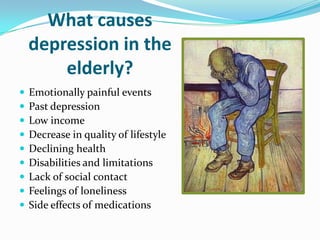
What causes
depression in the
elderly?
ď‚— Emotionally painful events
ď‚— Past depression
ď‚— Low income
ď‚— Decrease in quality of lifestyle
ď‚— Declining health
ď‚— Disabilities and limitations
ď‚— Lack of social contact
ď‚— Feelings of loneliness
ď‚— Side effects of medications
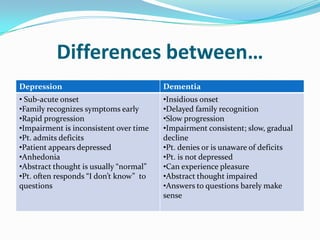
Differences between…
Depression Dementia
• Sub-acute onset
•Family recognizes symptoms early
•Rapid progression
•Impairment is inconsistent over time
•Pt. admits deficits
•Patient appears depressed
•Anhedonia
•Abstract thought is usually “normal”
•Pt. often responds “I don’t know” to
questions
•Insidious onset
•Delayed family recognition
•Slow progression
•Impairment consistent; slow, gradual
decline
•Pt. denies or is unaware of deficits
•Pt. is not depressed
•Can experience pleasure
•Abstract thought impaired
•Answers to questions barely make
sense
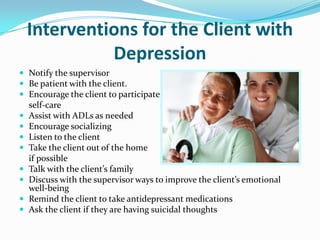
Interventions for the Client with
Depression
ď‚— Notify the supervisor
ď‚— Be patient with the client.
ď‚— Encourage the client to participate in
self-care
ď‚— Assist with ADLs as needed
ď‚— Encourage socializing
ď‚— Listen to the client
ď‚— Take the client out of the home
if possible
 Talk with the client’s family
 Discuss with the supervisor ways to improve the client’s emotional
well-being
ď‚— Remind the client to take antidepressant medications
ď‚— Ask the client if they are having suicidal thoughts
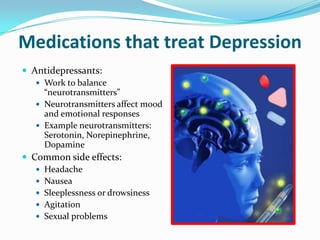
Medications that treat Depression
ď‚— Antidepressants:
ď‚— Work to balance
“neurotransmitters”
ď‚— Neurotransmitters affect mood
and emotional responses
ď‚— Example neurotransmitters:
Serotonin, Norepinephrine,
Dopamine
ď‚— Common side effects:
ď‚— Headache
ď‚— Nausea
ď‚— Sleeplessness or drowsiness
ď‚— Agitation
ď‚— Sexual problems
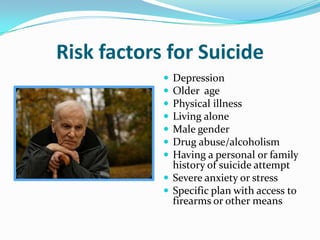
Risk factors for Suicide
ď‚— Depression
ď‚— Older age
ď‚— Physical illness
ď‚— Living alone
ď‚— Male gender
ď‚— Drug abuse/alcoholism
ď‚— Having a personal or family
history of suicide attempt
ď‚— Severe anxiety or stress
ď‚— Specific plan with access to
firearms or other means
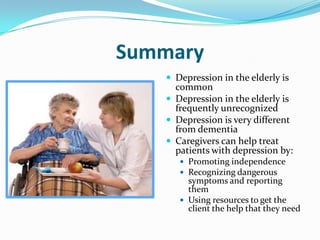
Summary
ď‚— Depression in the elderly is
common
ď‚— Depression in the elderly is
frequently unrecognized
ď‚— Depression is very different
from dementia
ď‚— Caregivers can help treat
patients with depression by:
ď‚— Promoting independence
ď‚— Recognizing dangerous
symptoms and reporting
them
ď‚— Using resources to get the
client the help that they need

Depression in the Elderly

  • 1.
    La Jolla NursesHomecare HHA/PCA In-service Powerpoint
  • 2.
    Depression Facts  Morethan 2 million Americans over the age of 65 suffer from some form of depression  Depression is a mental illness  Depression is not a normal part of aging  Major depression interferes with clients’ ability to carry out ADL’s
  • 3.
    What are thesymptoms of Depression? ď‚— Sadness ď‚— Loss of interest in life ď‚— Loss of interest in enjoyable activities ď‚— Loss of appetite ď‚— Feelings of anxiety ď‚— Avoidance of people ď‚— Problems sleeping ď‚— Low confidence level ď‚— Feelings of unworthiness or guilt ď‚— Thoughts of suicide
  • 4.
    How is depressiondifferent in the elderly compared to other age groups?  Depression in the elderly is often unrecognized  Depression increases risk of cardiac disease, increases risk of death following a heart attack, and increases likelihood of death following any disease  Depression reduces elderly person’s ability to rehabilitate  Depression increases risk of suicide  Rate in people ages 80-84 is 2 x as much as rest of population  Advancing age often accompanied with loss
  • 5.
    What causes depression inthe elderly? ď‚— Emotionally painful events ď‚— Past depression ď‚— Low income ď‚— Decrease in quality of lifestyle ď‚— Declining health ď‚— Disabilities and limitations ď‚— Lack of social contact ď‚— Feelings of loneliness ď‚— Side effects of medications
  • 6.
    Differences between… Depression Dementia •Sub-acute onset •Family recognizes symptoms early •Rapid progression •Impairment is inconsistent over time •Pt. admits deficits •Patient appears depressed •Anhedonia •Abstract thought is usually “normal” •Pt. often responds “I don’t know” to questions •Insidious onset •Delayed family recognition •Slow progression •Impairment consistent; slow, gradual decline •Pt. denies or is unaware of deficits •Pt. is not depressed •Can experience pleasure •Abstract thought impaired •Answers to questions barely make sense
  • 7.
    Interventions for theClient with Depression  Notify the supervisor  Be patient with the client.  Encourage the client to participate in self-care  Assist with ADLs as needed  Encourage socializing  Listen to the client  Take the client out of the home if possible  Talk with the client’s family  Discuss with the supervisor ways to improve the client’s emotional well-being  Remind the client to take antidepressant medications  Ask the client if they are having suicidal thoughts
  • 8.
    Medications that treatDepression  Antidepressants:  Work to balance “neurotransmitters”  Neurotransmitters affect mood and emotional responses  Example neurotransmitters: Serotonin, Norepinephrine, Dopamine  Common side effects:  Headache  Nausea  Sleeplessness or drowsiness  Agitation  Sexual problems
  • 9.
    Risk factors forSuicide ď‚— Depression ď‚— Older age ď‚— Physical illness ď‚— Living alone ď‚— Male gender ď‚— Drug abuse/alcoholism ď‚— Having a personal or family history of suicide attempt ď‚— Severe anxiety or stress ď‚— Specific plan with access to firearms or other means
  • 10.
    Summary ď‚— Depression inthe elderly is common ď‚— Depression in the elderly is frequently unrecognized ď‚— Depression is very different from dementia ď‚— Caregivers can help treat patients with depression by: ď‚— Promoting independence ď‚— Recognizing dangerous symptoms and reporting them ď‚— Using resources to get the client the help that they need

Editor's Notes

  • #3 Speaker’s Notes:Depression is a serious mental illness. Everyone has days when they feel sad or blue, but when a person is depressed it affects their ability to perform activities of daily living and causes pain for both the person affected by the disease and those that care for them. -More than 2 million Americans over the age of 65 suffer from some form of depression, according to the National Institute of Mental Health. -Major depression interferes with normal function and the ability to carry out ADLs.-Some people think that depression comes naturally with old age. However, this condition is not a normal part of aging.-The aging client complains less about depression but complains more about physical conditions. Clients frequently do not discuss feelings of depression with their doctors.-The depressed client is easily agitated, causing anxiety and confusion. The client worries about about being confused, and then cycle continues.
  • #4 People with depression frequently have persistent sad, anxious, and “empty” feelings. Activities that used to be enjoyable for the patient no longer are appealing and they feel that there isn’t much of a point to living any longer. Some people lose their appetite while others overeat. Some people avoid social interaction, have trouble concentrating, and have trouble making decisions. Frequently, depressed people have problems falling asleep or sleep at strange hours or for extended periods of time. Other feelings that come with depression include low confidence level, feelings of unworthiness, guilt, and in the most severe cases: thoughts of suicide and suicide attempts.
  • #5 -Depression in the elderly is frequently confused with the effects of multiple illnesses and the medicines used to treat them. Also, because of the changes in an elderly person’s circumstances and the fact that elderly people are expected to slow down, doctors and family may miss the signs of depression-Depression often occurs with other medical illnesses and disabilities. Depression in the elderly also increases their risk of cardiac diseases. Depression reduces an elderly person’s ability to rehabilitate. Studies of nursing home patients have shown that the presence of depression substantially increases the likelihood of death from those illnesses. Depression also has been associated with increased risk of death following heart attack. -Depression greatly increases the risk of suicide in the elderly, specifically in elderly white men. The suicide rate in people ages 80 to 84 is greater than twice that of the general population. Depression in people 65 and older is a major public health problem, according to the NIMH.-Advancing age is often accompanied by loss of social support systems due to death of a spouse or siblings, retirement, or relocation of residence. -Because it can be hard to recognize symptoms of depression in the elderly, effective treatment is often delayed.
  • #6 Depression is caused by a combination of genetic, biological, environmental and psychological factors. Depressive illnesses are disorders for the brain and some theories suggest that depression is caused by neurotransmitters in the brain that are out of balance. *neurotransmitters=chemicals that use brain cells to communicateYou will see causes of depression listed on this slide. Emotionally painful events can often lead to depression. However, it can be difficult to distinguish between grief and depression. Grief after loss of a loved one is normal, however, grief that lasts an extended period of time and is complicated may require treatment. Those who have had periods of depression in the past are more prone to the condition in their old age. Money problems can also lead to symptoms of depression.Older adults may have medical conditions that are causing their health to deteriorate and therefore leading to symptoms of depression. Also, medications that older adults take for other conditions may have side effects that lead to depression. Other causes of depression may be lack of social contact, disabilities and feelings of loneliness.
  • #7 Depression and dementia are two common diseases in the elderly. It’s important to be able to recognize the differences between them. Depression is acute in it’s onset, where as dementia is slower in it’s onset. Family and close friends tend to recognize that their family member is depressed much more quickly than they realize that their loved one may be experiencing dementia. Depression has a rapid progression, where as dementia starts with just a few signs and symptoms, and increases with time. Depression tends to be more inconsistent than dementia as well; people with depression can have good days/weeks alternating with bad ones, where as someone with dementia starts this way but eventually most of their days are affected by the dementia. People with depression often suffer from anhedonia, which means they no longer experience pleasure in activities they once loved. For example, a patient may have loved playing tennis, but is now suffering from depression and finds tennis to be a chore. A patient with dementia may have greatly enjoyed playing tennis before their dementia, and still enjoy it afterwards, although their skills may diminish and they might forget how to play/that they used to play at all. Someone with depression has random thoughts that are “normal” where as someone with dementia has random thoughts that don’t fit the place, person, or time. Someone with depression often responds to questions by saying “I don’t know” where as someone with dementia may answer questions with statements that don’t relate or nearly relate to the question asked.
  • #8 -Notify the supervisor if the client is exhibiting signs of depression-Be patient with the client and recognize their symptoms of depression-Encourage the client to partcipate in self-care. Assist with ADLs only as much as is needed in order to promote independence. A depressed client may relate independence with being able to do the same things that were possible at a younger age and therefore may make them feel less depressed.-Remember to encourage the client to socialize and always be there to listen to them. They do not need to know about their caregiver’s problems.-Take the client out of the home if possible. Also, talk to the client’s family about possibly getting the patient more outside help if necessary. For example, a counselor may help/-Discuss with your RN supervisor ways to improve the client’s emotional well-being. -Remind the patient to take their anti-depressant medications. Remember that it can take 4 to 6 weeks for the medication to take effect. -Ask whether the client is having suicidal thoughts; report to the RN supervisor immediately.
  • #9 Depression is commonly treated with antidepressant medications. Antidepressants work to balance some of the natural chemicals in our brains. These chemicals are called neurotransmitters, and they affect our mood and emotional responses. Antidepressants work on neurotransmitters such as serotonin, norepinephrine, and dopamine.The most common side effects associated with antidepressants include:Headache, which usually goes away within a few days.Nausea (feeling sick to your stomach), which usually goes away within a few days.Sleeplessness or drowsiness, which may happen during the first few weeks but then goes away. Sometimes the medication dose needs to be reduced or the time of day it is taken needs to be adjusted to help lessen these side effects.Agitation (feeling jittery).Sexual problems, which can affect both men and women and may include reduced sex drive, and problems having and enjoying sex.
  • #10 Depression and old age are two major risk factors for suicide. As a caregiver for the elderly population, you should be able to recognize signs and symptoms of suicide. Other risk factors include physical illness, living alone, male gender, drug abuse, alcoholism, having a personal or family history of suicide/suicide attempt, severe anxiety or stress, and a specific plan/access to firearms. Always report to your supervisor if you feel that your patient is at risk. Also remember that people who are taking anti-depressants have a higher risk of suicide once their medication starts to take effect, as they will have more energy all of a sudden.