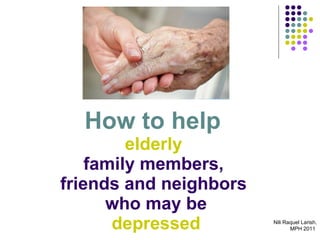
How to help  elderly  family members,  friends and neighbors  who may be   depressed  Nili Raquel Larish, MPH 2011
What is depression? Everybody feels sad sometimes. _____  ______  ______  ______  ______  ______  ______ Mon.  Tues.  Wed.  Thurs.  Fri.  Sat.  Sun.  But with depression, you feel sad a lot. ______  ______  ______  ______  ______  ______  ______ Mon.  Tues.  Wed.  Thurs.  Fri.  Sat.  Sun.
What can cause  depression in the  elderly? Living alone Losing a loved one Living on less money Disabling illness Recent surgery Use of some medicines Other big life changes (Oslin, Datto, Kallan, Katz, Edell & Tenhave, 2002.)
How can you tell if someone is depressed? Elderly may not want to talk about it.   But if they are depressed, there are  signs   you should know: emotional physical thinking problems If  5   of the signs last for at least  two weeks , this may mean depression. (American Psychiatric Association. 2002).
Signs of Depression Emotional: Feeling sad Feeling stressed  Feeling guilty  Not wanting to do what they usually like Crying Moody Wanting to be alone Thinking about suicide (Depression Alliance, 2008)
Signs of Depression Physical: Eating too much or too little Gaining or losing weight Sleeping too much or too little Constipation Feeling tired Not wanting sex (Depression Alliance, 2008)
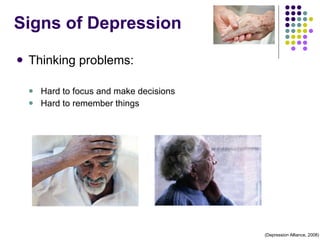
Signs of Depression Thinking problems: Hard to focus and make decisions Hard to remember things (Depression Alliance, 2008)
How common is it? Depression affects almost 20% of Americans who are over the age of 65.  That’s almost 7 million people in the U.S.  In New York City, 430,000 people suffer from depression. (Ramos, n.d.)
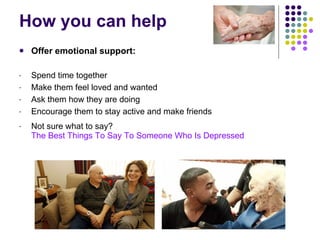
How you can help Offer emotional support: Spend time together Make them feel loved and wanted Ask them how they are doing Encourage them to stay active and make friends Not sure what to say?  The Best Things To Say To Someone Who Is Depressed
How you can help Take them out!  There’s lots to do right in Washington  Heights: Weekly  free  jazz fitness  walks walking tours tai-chi Want to know what’s going on in the neighborhood ?   calendar of events.
How you can help S.T.A.R Senior Center 650 West 187th Street, New York, NY 10033. Tel: 212-781-8331, web:  http://starseniorcenter.org/home.html Riverstone Senior Life Services 99 Fort Washington Avenue, New York, NY 10032. Tel: 212-927-5600, web:  http://www.riverstonenyc.org/   e-mail:  [email_address] Encourage them to join a neighborhood senior center:
How you can help ARC XVI Fort Washington Senior Center: 21 Wadsworth Avenue, New York, NY 10033. Tel: 212-781-5700    Free Activities in English and Spanish Health Services Offers breakfast and lunch   ARC XVI Inwood Senior Center: 84 Vermilyea Avenue, New York, NY 10034.  Tel: 212-567-3200   Free Arts and crafts Bingo, dominoes, pool ESL classes Yoga Field Trips More neighborhood senior centers:
How you can help Isabella Senior Resource Center: 4026 Broadway near 169th street Open Tues., Wed. and Fri., 9:00 AM – 5:00 PM. Tel: 212-342-9619 Free Has info on health Insurance, prescription insurance and Medicare and Medicaid counseling.  Links you to neighborhood resources . Washington Heights/Inwood Council on Aging (WHICOA):  Tel: 212-781-5700, e-mail:  [email_address] Helps area seniors Works to create programs  Meets monthly Involves leaders from all the area senior centers. Get more info or get involved:
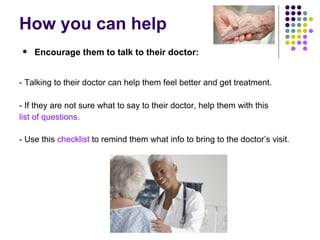
How you can help - Talking to their doctor can help them feel better and get treatment. - If they are not sure what to say to their doctor, help them with this  list of questions.  - Use this  checklist  to remind them what info to bring to the doctor’s visit. Encourage them to talk to their doctor:
How you can help Mobile Crisis Service  Tel: 212-342-5797 Get tested at home.  Medicaid and Medicare accepted, and nobody is turned away. May take up to 5 days to make an appointment. Follow-up appointment for treatment is made near home, and clients are taken to the appointment. In English and Spanish. Mental Health Outreach Program for Homebound Elderly 513 W 166 th , Tel: 212-342-5799 Get care at home. Testing and treatment Must live above155 th  St, be over the age of 60. Help them arrange to get tested for depression at home:
How you can help Hispanic Treatment Program for Depression and Anxiety 1051 Riverside Drive, Room 3200, Unit 69.  Tel: 212-543-5367, Web:  http ://www.nyspi.org   Free treatment/medication Up to age 70  For Hispanics only Services offered in English and Spanish Adult and Late Life Depression Research Center 1051 Riverside Drive, 1 st  Floor, Rm 1501 Tel: 212-543-5825, 212-543-5067(Spanish) Web:  http://www.nyspi.org / Free treatment Must be at least 50 years old Talk to them about getting free medicine through a  study  in the neighborhood:
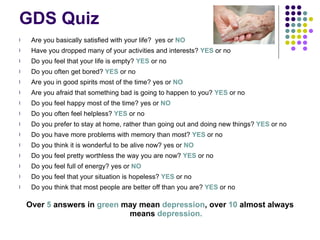
Is there a quiz for depression in the elderly? Yes! It’s called the Geriatric Depression Scale, or  GDS.  It has 15 questions, all answered with “yes” or “no”.  The quiz is on the next slide.  You can also pick up a copy of the quiz at the front desk, to take home with you or give to a loved one. People over 65 should choose the best answers for how they felt this past week.
GDS Quiz Are you basically satisfied with your life?  yes or  NO Have you dropped many of your activities and interests?  YES  or no Do you feel that your life is empty?  YES  or no Do you often get bored?  YES  or no Are you in good spirits most of the time? yes or  NO Are you afraid that something bad is going to happen to you?  YES  or no Do you feel happy most of the time? yes or  NO Do you often feel helpless?  YES  or no Do you prefer to stay at home, rather than going out and doing new things?  YES  or no Do you have more problems with memory than most?  YES  or no Do you think it is wonderful to be alive now? yes or  NO Do you feel pretty worthless the way you are now?  YES  or no Do you feel full of energy? yes or  NO Do you feel that your situation is hopeless?  YES  or no Do you think that most people are better off than you are?  YES  or no Over  5  answers in  green  may mean  depression , over  10  almost always means  depression.
References American Psychiatric Association. (2002).  Diagnostic and Statistical Manual of Mental Disorders, Fourth Edition, Text Revised.  Washington, DC., 356-419. Depression Alliance. (2008). Impact of Depression on Daily Life. Retrieved from  http://www.depressionalliance.org/PDF/inside-story-report.pdf Oslin, D.W., Datto, C.J., Kallan, M.J. Katz, I.R., Edell, W.S. and Tenhave, T. (2002). Association between medical morbidity and treatment outcomes in late-life depression.  Journal of American Geriatrics Society, 50,  823-828. Ramos, S. (n.d.) General introduction to depression [PowerPoint slides.] Retrieved from  http://www.nyc.gov/html/doh/html/dmh/dmh-depression-initiative.shtml Sheikh, J.I., Yesavage, J.A.: Geriatric Depression Scale (GDS): Recent evidence and development of a shorter version. Clinical Gerontology : A Guide to Assessment and Intervention 165-173, NY: The Haworth Press, 1986.

Elderly Depression

  • 1.
    How to help elderly family members, friends and neighbors who may be depressed Nili Raquel Larish, MPH 2011
  • 2.
    What is depression?Everybody feels sad sometimes. _____ ______ ______ ______ ______ ______ ______ Mon. Tues. Wed. Thurs. Fri. Sat. Sun. But with depression, you feel sad a lot. ______ ______ ______ ______ ______ ______ ______ Mon. Tues. Wed. Thurs. Fri. Sat. Sun.
  • 3.
    What can cause depression in the elderly? Living alone Losing a loved one Living on less money Disabling illness Recent surgery Use of some medicines Other big life changes (Oslin, Datto, Kallan, Katz, Edell & Tenhave, 2002.)
  • 4.
    How can youtell if someone is depressed? Elderly may not want to talk about it. But if they are depressed, there are signs you should know: emotional physical thinking problems If 5 of the signs last for at least two weeks , this may mean depression. (American Psychiatric Association. 2002).
  • 5.
    Signs of DepressionEmotional: Feeling sad Feeling stressed Feeling guilty Not wanting to do what they usually like Crying Moody Wanting to be alone Thinking about suicide (Depression Alliance, 2008)
  • 6.
    Signs of DepressionPhysical: Eating too much or too little Gaining or losing weight Sleeping too much or too little Constipation Feeling tired Not wanting sex (Depression Alliance, 2008)
  • 7.
    Signs of DepressionThinking problems: Hard to focus and make decisions Hard to remember things (Depression Alliance, 2008)
  • 8.
    How common isit? Depression affects almost 20% of Americans who are over the age of 65. That’s almost 7 million people in the U.S. In New York City, 430,000 people suffer from depression. (Ramos, n.d.)
  • 9.
    How you canhelp Offer emotional support: Spend time together Make them feel loved and wanted Ask them how they are doing Encourage them to stay active and make friends Not sure what to say? The Best Things To Say To Someone Who Is Depressed
  • 10.
    How you canhelp Take them out! There’s lots to do right in Washington Heights: Weekly free jazz fitness walks walking tours tai-chi Want to know what’s going on in the neighborhood ? calendar of events.
  • 11.
    How you canhelp S.T.A.R Senior Center 650 West 187th Street, New York, NY 10033. Tel: 212-781-8331, web: http://starseniorcenter.org/home.html Riverstone Senior Life Services 99 Fort Washington Avenue, New York, NY 10032. Tel: 212-927-5600, web: http://www.riverstonenyc.org/ e-mail: [email_address] Encourage them to join a neighborhood senior center:
  • 12.
    How you canhelp ARC XVI Fort Washington Senior Center: 21 Wadsworth Avenue, New York, NY 10033. Tel: 212-781-5700   Free Activities in English and Spanish Health Services Offers breakfast and lunch ARC XVI Inwood Senior Center: 84 Vermilyea Avenue, New York, NY 10034. Tel: 212-567-3200 Free Arts and crafts Bingo, dominoes, pool ESL classes Yoga Field Trips More neighborhood senior centers:
  • 13.
    How you canhelp Isabella Senior Resource Center: 4026 Broadway near 169th street Open Tues., Wed. and Fri., 9:00 AM – 5:00 PM. Tel: 212-342-9619 Free Has info on health Insurance, prescription insurance and Medicare and Medicaid counseling. Links you to neighborhood resources . Washington Heights/Inwood Council on Aging (WHICOA): Tel: 212-781-5700, e-mail: [email_address] Helps area seniors Works to create programs Meets monthly Involves leaders from all the area senior centers. Get more info or get involved:
  • 14.
    How you canhelp - Talking to their doctor can help them feel better and get treatment. - If they are not sure what to say to their doctor, help them with this list of questions. - Use this checklist to remind them what info to bring to the doctor’s visit. Encourage them to talk to their doctor:
  • 15.
    How you canhelp Mobile Crisis Service Tel: 212-342-5797 Get tested at home. Medicaid and Medicare accepted, and nobody is turned away. May take up to 5 days to make an appointment. Follow-up appointment for treatment is made near home, and clients are taken to the appointment. In English and Spanish. Mental Health Outreach Program for Homebound Elderly 513 W 166 th , Tel: 212-342-5799 Get care at home. Testing and treatment Must live above155 th St, be over the age of 60. Help them arrange to get tested for depression at home:
  • 16.
    How you canhelp Hispanic Treatment Program for Depression and Anxiety 1051 Riverside Drive, Room 3200, Unit 69. Tel: 212-543-5367, Web: http ://www.nyspi.org Free treatment/medication Up to age 70 For Hispanics only Services offered in English and Spanish Adult and Late Life Depression Research Center 1051 Riverside Drive, 1 st Floor, Rm 1501 Tel: 212-543-5825, 212-543-5067(Spanish) Web: http://www.nyspi.org / Free treatment Must be at least 50 years old Talk to them about getting free medicine through a study in the neighborhood:
  • 17.
    Is there aquiz for depression in the elderly? Yes! It’s called the Geriatric Depression Scale, or GDS. It has 15 questions, all answered with “yes” or “no”. The quiz is on the next slide. You can also pick up a copy of the quiz at the front desk, to take home with you or give to a loved one. People over 65 should choose the best answers for how they felt this past week.
  • 18.
    GDS Quiz Areyou basically satisfied with your life? yes or NO Have you dropped many of your activities and interests? YES or no Do you feel that your life is empty? YES or no Do you often get bored? YES or no Are you in good spirits most of the time? yes or NO Are you afraid that something bad is going to happen to you? YES or no Do you feel happy most of the time? yes or NO Do you often feel helpless? YES or no Do you prefer to stay at home, rather than going out and doing new things? YES or no Do you have more problems with memory than most? YES or no Do you think it is wonderful to be alive now? yes or NO Do you feel pretty worthless the way you are now? YES or no Do you feel full of energy? yes or NO Do you feel that your situation is hopeless? YES or no Do you think that most people are better off than you are? YES or no Over 5 answers in green may mean depression , over 10 almost always means depression.
  • 19.
    References American PsychiatricAssociation. (2002). Diagnostic and Statistical Manual of Mental Disorders, Fourth Edition, Text Revised. Washington, DC., 356-419. Depression Alliance. (2008). Impact of Depression on Daily Life. Retrieved from http://www.depressionalliance.org/PDF/inside-story-report.pdf Oslin, D.W., Datto, C.J., Kallan, M.J. Katz, I.R., Edell, W.S. and Tenhave, T. (2002). Association between medical morbidity and treatment outcomes in late-life depression. Journal of American Geriatrics Society, 50, 823-828. Ramos, S. (n.d.) General introduction to depression [PowerPoint slides.] Retrieved from http://www.nyc.gov/html/doh/html/dmh/dmh-depression-initiative.shtml Sheikh, J.I., Yesavage, J.A.: Geriatric Depression Scale (GDS): Recent evidence and development of a shorter version. Clinical Gerontology : A Guide to Assessment and Intervention 165-173, NY: The Haworth Press, 1986.