DEPRESSION:
TREATMENT AND
PROGRAMS: Acute Care to
Wellness
Objectives:
Depression in Older Adults
 List and discuss barriers to treatment
 Identify treatment goals
 Understand treatment preferences, provider and
patient
 Describe the various treatments modalities
Goals of Treatment
 Remission/Resolution of depressive symptoms
 Prevent relapse and recurrence
 Improve quality of life and functioning
 Improve medical health and reduce mortality and
suicide
 Develop and strengthen coping skills
 Reduce secondary symptoms
 Reduce healthcare cost
Barriers to Depression Care
 Inadequate treatment
 Medication adherence
 Lack of accessible, affordable, and age-appropriate
care
 Limited use of specialty mental health care
 Lack of coordination and collaboration between
providers
(Ell, 2006)
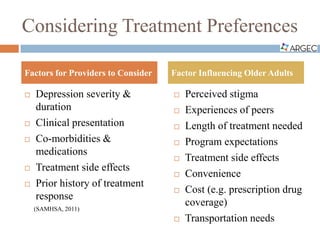
Considering Treatment Preferences
 Depression severity &
duration
 Clinical presentation
 Co-morbidities &
medications
 Treatment side effects
 Prior history of treatment
response
(SAMHSA, 2011)
 Perceived stigma
 Experiences of peers
 Length of treatment needed
 Program expectations
 Treatment side effects
 Convenience
 Cost (e.g. prescription drug
coverage)
 Transportation needs
Factors for Providers to Consider Factor Influencing Older Adults
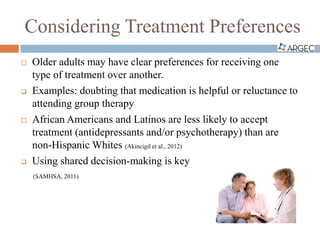
Considering Treatment Preferences
 Older adults may have clear preferences for receiving one
type of treatment over another.
 Examples: doubting that medication is helpful or reluctance to
attending group therapy
 African Americans and Latinos are less likely to accept
treatment (antidepressants and/or psychotherapy) than are
non-Hispanic Whites (Akincigil et al., 2012)
 Using shared decision-making is key
(SAMHSA, 2011)
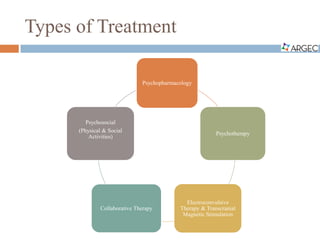
Types of Treatment
Psychopharmacology
Psychotherapy
Electroconvulsive
Therapy & Transcranial
Magnetic Stimulation
Collaborative Therapy
Psychosocial
(Physical & Social
Activities)
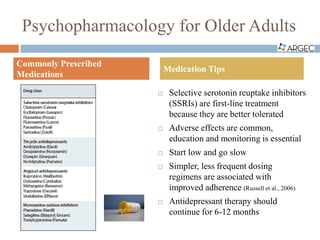
Psychopharmacology for Older Adults
 Selective serotonin reuptake inhibitors
(SSRIs) are first-line treatment
because they are better tolerated
 Adverse effects are common,
education and monitoring is essential
 Start low and go slow
 Simpler, less frequent dosing
regimens are associated with
improved adherence (Russell et al., 2006)
 Antidepressant therapy should
continue for 6-12 months
Commonly Prescribed
Medications
Medication Tips
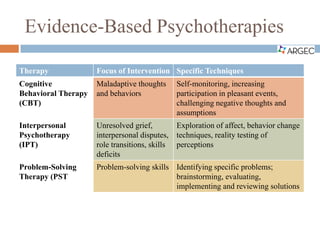
Evidence-Based Psychotherapies
Therapy Focus of Intervention Specific Techniques
Cognitive
Behavioral Therapy
(CBT)
Maladaptive thoughts
and behaviors
Self-monitoring, increasing
participation in pleasant events,
challenging negative thoughts and
assumptions
Interpersonal
Psychotherapy
(IPT)
Unresolved grief,
interpersonal disputes,
role transitions, skills
deficits
Exploration of affect, behavior change
techniques, reality testing of
perceptions
Problem-Solving
Therapy (PST
Problem-solving skills Identifying specific problems;
brainstorming, evaluating,
implementing and reviewing solutions
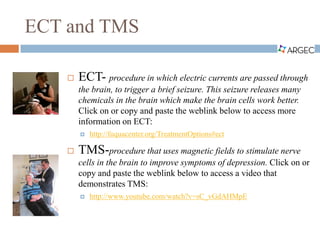
ECT and TMS
 ECT- procedure in which electric currents are passed through
the brain, to trigger a brief seizure. This seizure releases many
chemicals in the brain which make the brain cells work better.
Click on or copy and paste the weblink below to access more
information on ECT:
 http://fuquacenter.org/TreatmentOptions#ect
 TMS-procedure that uses magnetic fields to stimulate nerve
cells in the brain to improve symptoms of depression. Click on or
copy and paste the weblink below to access a video that
demonstrates TMS:
 http://www.youtube.com/watch?v=sC_vGdAHMpE
Case Study
 Ms. G is a 75-year old female living alone in her apartment in
New York City. Her husband died suddenly two years ago of a
heart attack. Their two children are alive and living out-of-
state. Both of her sons maintain weekly phone contact with
Ms. G and visit usually once a year. Ms. G has been doing
well until about 6 weeks ago when she fell in her apartment
and sustained bruises but, did not require a hospital visit.
Since then, she has been preoccupied with her failing eyesight
and decreased ambulation. She does not go shopping as often,
stating she doesn’t enjoy going out anymore and feels “very
sad and teary.” Ms. G states that her shopping needs are less,
since she is not as hungry as she used to be and she states,
“I’m getting too old to cook for one person only”.
Case Study Discussion Questions
 What type(s) of treatment/interventions would be
beneficial for the depression Ms. G may be
experiencing? Describe why you think this type of
treatment/intervention may be an appropriate
choice.
 What would be the goals of the intervention that
you selected?
 What are some of the barriers to treatment you
should consider for Ms. G?
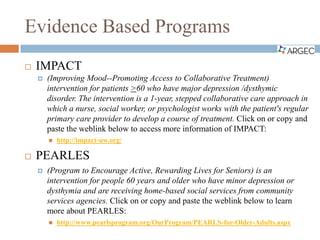
Evidence Based Programs
 IMPACT
 (Improving Mood--Promoting Access to Collaborative Treatment)
intervention for patients >60 who have major depression /dysthymic
disorder. The intervention is a 1-year, stepped collaborative care approach in
which a nurse, social worker, or psychologist works with the patient's regular
primary care provider to develop a course of treatment. Click on or copy and
paste the weblink below to access more information of IMPACT:
 http://impact-uw.org/
 PEARLES
 (Program to Encourage Active, Rewarding Lives for Seniors) is an
intervention for people 60 years and older who have minor depression or
dysthymia and are receiving home-based social services from community
services agencies. Click on or copy and paste the weblink below to learn
more about PEARLES:
 http://www.pearlsprogram.org/OurProgram/PEARLS-for-Older-Adults.aspx
Evidence Based Programs
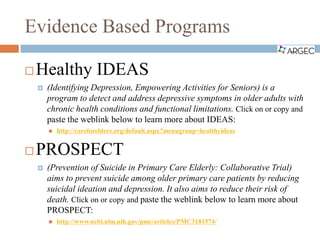
 Healthy IDEAS
 (Identifying Depression, Empowering Activities for Seniors) is a
program to detect and address depressive symptoms in older adults with
chronic health conditions and functional limitations. Click on or copy and
paste the weblink below to learn more about IDEAS:
 http://careforelders.org/default.aspx?menugroup=healthyideas
 PROSPECT
 (Prevention of Suicide in Primary Care Elderly: Collaborative Trial)
aims to prevent suicide among older primary care patients by reducing
suicidal ideation and depression. It also aims to reduce their risk of
death. Click on or copy and paste the weblink below to learn more about
PROSPECT:
 http://www.ncbi.nlm.nih.gov/pmc/articles/PMC3181574/
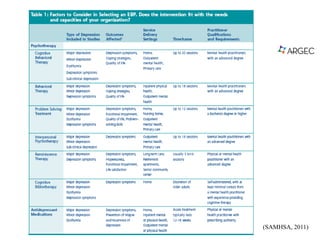
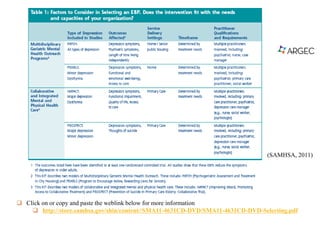
(SAMHSA, 2011)
 Click on or copy and paste the weblink below for more information
 http://store.samhsa.gov/shin/content//SMA11-4631CD-DVD/SMA11-4631CD-DVD-Selecting.pdf
(SAMHSA, 2011)
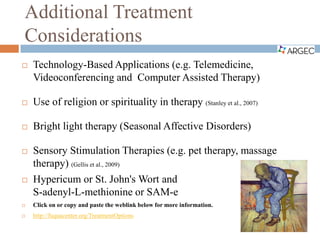
Additional Treatment
Considerations
 Technology-Based Applications (e.g. Telemedicine,
Videoconferencing and Computer Assisted Therapy)
 Use of religion or spirituality in therapy (Stanley et al., 2007)
 Bright light therapy (Seasonal Affective Disorders)
 Sensory Stimulation Therapies (e.g. pet therapy, massage
therapy) (Gellis et al., 2009)
 Hypericum or St. John's Wort and
S-adenyl-L-methionine or SAM-e
 Click on or copy and paste the weblink below for more information.
 http://fuquacenter.org/TreatmentOptions
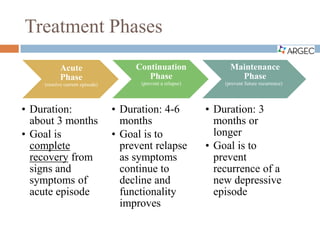
Treatment Phases
Acute
Phase
(resolve current episode)
• Duration:
about 3 months
• Goal is
complete
recovery from
signs and
symptoms of
acute episode
Continuation
Phase
(prevent a relapse)
• Duration: 4-6
months
• Goal is to
prevent relapse
as symptoms
continue to
decline and
functionality
improves
Maintenance
Phase
(prevent future recurrence)
• Duration: 3
months or
longer
• Goal is to
prevent
recurrence of a
new depressive
episode
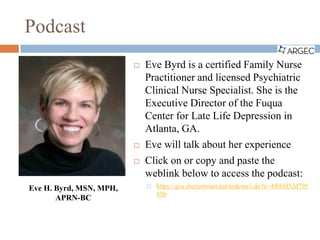
Podcast
 Eve Byrd is a certified Family Nurse
Practitioner and licensed Psychiatric
Clinical Nurse Specialist. She is the
Executive Director of the Fuqua
Center for Late Life Depression in
Atlanta, GA.
 Eve will talk about her experience
 Click on or copy and paste the
weblink below to access the podcast:
 https://gsu.sharestream.net/ssdcms/i.do?u=4fb8fd52d795
45b
Eve H. Byrd, MSN, MPH,
APRN-BC
Final Thoughts
 Depression in older adults is
treatable in up to 80% of cases.
 Combination treatment, medication
and psychotherapy, is the most
effective for treating depression and
preventing relapse.
References
 Ell, K. (2006). Depression care for the elderly: Reducing barriers to evidence-based practice. Home Health
Care Services Quarterly, 25(1/2), 115-148.
 Substance Abuse and Mental Health Services Administration. (2011). The treatment of depression in older
adults: Selecting evidence-based practices for treatment of depression in older adults. HHS Pub. No. SMA-
11-4631. Retrieved from http://store.samhsa.gov/shin/content/SMA11-4631CD-DVD/SMA11-4631CD-
DVD-Selecting.pdf
 Akincigil, A., Olfson, M., Siegel, M., Zurlo, K. A., Walkup, J. T., & Crystal, S. (2012). Racial and ethnic
disparities in depression care in community-dwelling elderly in the United States. American Journal of
Public Health, 102(2), 319-328. doi: 10.2105/AJPH.2011.300349
 Russell, C.L., Conn, V. S., Jantarakupt, P. (2006). Older adult medication compliance: Integrated review of
randomized controlled trials. American Journal of Health Behaviors. 30(6), 636-650.
 Stanley, M. A., Bush, A. L., Camp, M. E., Jameson, J. P., Phillips, L. L., Barber, C. R.,... Cully, J. A. (2011).
Older adults' preferences for religion/spirituality in treatment for anxiety and depression. Aging & Mental
Health, 15(3), 334-343. doi: 10.1080/13607863.2010.519326
 Gellis, Z. D., McClive-Reed, K. P., & Brown, E. L. (2009). Treatments for depression in older persons with
dementia. Annals of Long-Term Care, 17(2), 29-36.
 Katon, W., Lin, E., Russo, J., & Unutzer, J. (2003). Increased medical costs of a population-based sample of
depressed elderly patients. Archives of General Psychiatry, 60(9), 897-903.

ARGEC Depression Treatment and Programs

  • 1.
  • 2.
    Objectives: Depression in OlderAdults  List and discuss barriers to treatment  Identify treatment goals  Understand treatment preferences, provider and patient  Describe the various treatments modalities
  • 3.
    Goals of Treatment Remission/Resolution of depressive symptoms  Prevent relapse and recurrence  Improve quality of life and functioning  Improve medical health and reduce mortality and suicide  Develop and strengthen coping skills  Reduce secondary symptoms  Reduce healthcare cost
  • 4.
    Barriers to DepressionCare  Inadequate treatment  Medication adherence  Lack of accessible, affordable, and age-appropriate care  Limited use of specialty mental health care  Lack of coordination and collaboration between providers (Ell, 2006)
  • 5.
    Considering Treatment Preferences Depression severity & duration  Clinical presentation  Co-morbidities & medications  Treatment side effects  Prior history of treatment response (SAMHSA, 2011)  Perceived stigma  Experiences of peers  Length of treatment needed  Program expectations  Treatment side effects  Convenience  Cost (e.g. prescription drug coverage)  Transportation needs Factors for Providers to Consider Factor Influencing Older Adults
  • 6.
    Considering Treatment Preferences Older adults may have clear preferences for receiving one type of treatment over another.  Examples: doubting that medication is helpful or reluctance to attending group therapy  African Americans and Latinos are less likely to accept treatment (antidepressants and/or psychotherapy) than are non-Hispanic Whites (Akincigil et al., 2012)  Using shared decision-making is key (SAMHSA, 2011)
  • 7.
    Types of Treatment Psychopharmacology Psychotherapy Electroconvulsive Therapy& Transcranial Magnetic Stimulation Collaborative Therapy Psychosocial (Physical & Social Activities)
  • 8.
    Psychopharmacology for OlderAdults  Selective serotonin reuptake inhibitors (SSRIs) are first-line treatment because they are better tolerated  Adverse effects are common, education and monitoring is essential  Start low and go slow  Simpler, less frequent dosing regimens are associated with improved adherence (Russell et al., 2006)  Antidepressant therapy should continue for 6-12 months Commonly Prescribed Medications Medication Tips
  • 9.
    Evidence-Based Psychotherapies Therapy Focusof Intervention Specific Techniques Cognitive Behavioral Therapy (CBT) Maladaptive thoughts and behaviors Self-monitoring, increasing participation in pleasant events, challenging negative thoughts and assumptions Interpersonal Psychotherapy (IPT) Unresolved grief, interpersonal disputes, role transitions, skills deficits Exploration of affect, behavior change techniques, reality testing of perceptions Problem-Solving Therapy (PST Problem-solving skills Identifying specific problems; brainstorming, evaluating, implementing and reviewing solutions
  • 10.
    ECT and TMS ECT- procedure in which electric currents are passed through the brain, to trigger a brief seizure. This seizure releases many chemicals in the brain which make the brain cells work better. Click on or copy and paste the weblink below to access more information on ECT:  http://fuquacenter.org/TreatmentOptions#ect  TMS-procedure that uses magnetic fields to stimulate nerve cells in the brain to improve symptoms of depression. Click on or copy and paste the weblink below to access a video that demonstrates TMS:  http://www.youtube.com/watch?v=sC_vGdAHMpE
  • 11.
    Case Study  Ms.G is a 75-year old female living alone in her apartment in New York City. Her husband died suddenly two years ago of a heart attack. Their two children are alive and living out-of- state. Both of her sons maintain weekly phone contact with Ms. G and visit usually once a year. Ms. G has been doing well until about 6 weeks ago when she fell in her apartment and sustained bruises but, did not require a hospital visit. Since then, she has been preoccupied with her failing eyesight and decreased ambulation. She does not go shopping as often, stating she doesn’t enjoy going out anymore and feels “very sad and teary.” Ms. G states that her shopping needs are less, since she is not as hungry as she used to be and she states, “I’m getting too old to cook for one person only”.
  • 12.
    Case Study DiscussionQuestions  What type(s) of treatment/interventions would be beneficial for the depression Ms. G may be experiencing? Describe why you think this type of treatment/intervention may be an appropriate choice.  What would be the goals of the intervention that you selected?  What are some of the barriers to treatment you should consider for Ms. G?
  • 13.
    Evidence Based Programs IMPACT  (Improving Mood--Promoting Access to Collaborative Treatment) intervention for patients >60 who have major depression /dysthymic disorder. The intervention is a 1-year, stepped collaborative care approach in which a nurse, social worker, or psychologist works with the patient's regular primary care provider to develop a course of treatment. Click on or copy and paste the weblink below to access more information of IMPACT:  http://impact-uw.org/  PEARLES  (Program to Encourage Active, Rewarding Lives for Seniors) is an intervention for people 60 years and older who have minor depression or dysthymia and are receiving home-based social services from community services agencies. Click on or copy and paste the weblink below to learn more about PEARLES:  http://www.pearlsprogram.org/OurProgram/PEARLS-for-Older-Adults.aspx
  • 14.
    Evidence Based Programs Healthy IDEAS  (Identifying Depression, Empowering Activities for Seniors) is a program to detect and address depressive symptoms in older adults with chronic health conditions and functional limitations. Click on or copy and paste the weblink below to learn more about IDEAS:  http://careforelders.org/default.aspx?menugroup=healthyideas  PROSPECT  (Prevention of Suicide in Primary Care Elderly: Collaborative Trial) aims to prevent suicide among older primary care patients by reducing suicidal ideation and depression. It also aims to reduce their risk of death. Click on or copy and paste the weblink below to learn more about PROSPECT:  http://www.ncbi.nlm.nih.gov/pmc/articles/PMC3181574/
  • 15.
  • 16.
     Click onor copy and paste the weblink below for more information  http://store.samhsa.gov/shin/content//SMA11-4631CD-DVD/SMA11-4631CD-DVD-Selecting.pdf (SAMHSA, 2011)
  • 17.
    Additional Treatment Considerations  Technology-BasedApplications (e.g. Telemedicine, Videoconferencing and Computer Assisted Therapy)  Use of religion or spirituality in therapy (Stanley et al., 2007)  Bright light therapy (Seasonal Affective Disorders)  Sensory Stimulation Therapies (e.g. pet therapy, massage therapy) (Gellis et al., 2009)  Hypericum or St. John's Wort and S-adenyl-L-methionine or SAM-e  Click on or copy and paste the weblink below for more information.  http://fuquacenter.org/TreatmentOptions
  • 18.
    Treatment Phases Acute Phase (resolve currentepisode) • Duration: about 3 months • Goal is complete recovery from signs and symptoms of acute episode Continuation Phase (prevent a relapse) • Duration: 4-6 months • Goal is to prevent relapse as symptoms continue to decline and functionality improves Maintenance Phase (prevent future recurrence) • Duration: 3 months or longer • Goal is to prevent recurrence of a new depressive episode
  • 19.
    Podcast  Eve Byrdis a certified Family Nurse Practitioner and licensed Psychiatric Clinical Nurse Specialist. She is the Executive Director of the Fuqua Center for Late Life Depression in Atlanta, GA.  Eve will talk about her experience  Click on or copy and paste the weblink below to access the podcast:  https://gsu.sharestream.net/ssdcms/i.do?u=4fb8fd52d795 45b Eve H. Byrd, MSN, MPH, APRN-BC
  • 20.
    Final Thoughts  Depressionin older adults is treatable in up to 80% of cases.  Combination treatment, medication and psychotherapy, is the most effective for treating depression and preventing relapse.
  • 21.
    References  Ell, K.(2006). Depression care for the elderly: Reducing barriers to evidence-based practice. Home Health Care Services Quarterly, 25(1/2), 115-148.  Substance Abuse and Mental Health Services Administration. (2011). The treatment of depression in older adults: Selecting evidence-based practices for treatment of depression in older adults. HHS Pub. No. SMA- 11-4631. Retrieved from http://store.samhsa.gov/shin/content/SMA11-4631CD-DVD/SMA11-4631CD- DVD-Selecting.pdf  Akincigil, A., Olfson, M., Siegel, M., Zurlo, K. A., Walkup, J. T., & Crystal, S. (2012). Racial and ethnic disparities in depression care in community-dwelling elderly in the United States. American Journal of Public Health, 102(2), 319-328. doi: 10.2105/AJPH.2011.300349  Russell, C.L., Conn, V. S., Jantarakupt, P. (2006). Older adult medication compliance: Integrated review of randomized controlled trials. American Journal of Health Behaviors. 30(6), 636-650.  Stanley, M. A., Bush, A. L., Camp, M. E., Jameson, J. P., Phillips, L. L., Barber, C. R.,... Cully, J. A. (2011). Older adults' preferences for religion/spirituality in treatment for anxiety and depression. Aging & Mental Health, 15(3), 334-343. doi: 10.1080/13607863.2010.519326  Gellis, Z. D., McClive-Reed, K. P., & Brown, E. L. (2009). Treatments for depression in older persons with dementia. Annals of Long-Term Care, 17(2), 29-36.  Katon, W., Lin, E., Russo, J., & Unutzer, J. (2003). Increased medical costs of a population-based sample of depressed elderly patients. Archives of General Psychiatry, 60(9), 897-903.