INCONTINENCE
M.Indumathi,M.sc-1st year
Med-surg Depart.
INCONTINENCE
Unable to retain the
natural discharge or
evacuation of urine
or feces.
What will you learn in the upcoming minutes?
What is happening to bladder ?
How will get evaluated?
Therapy with medication
Others Forms of interventions
ANATOMY
TERMS TO KNOW:
URGE
VOID
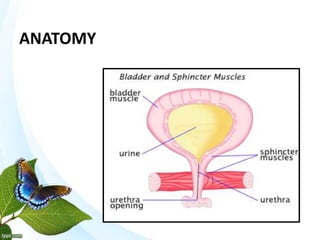
Anatomy Review
Bladder: stores urine
Urethra: tube that allows urine to pass
Urethral sphincter: muscle surrounding the
urethra that hold the urine
Brain signals are key to coordinating the
function of these anatomical structures
What is happening to bladder?
1. Autonomic nervous system control
– Nerve coming from the spinal cord and go directly to the
bladder
– When bladder gets fuller, signals are sent to the brain
2. Central nervous system
– Voluntary control to choose when to void
 Both can be altered by aging or
neurological disease
7
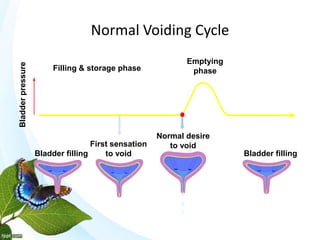
Normal Voiding Cycle
Filling & storage phase
Emptying
phase
Bladder filling
Normal desire
to voidFirst sensation
to voidBladder filling
Bladderpressure
DEFINITION
- BLADDER INCONTINENCE/URINARY
INCONTINENCE -
• Urinary incontinence means there is loss of
bladder control which leads to unintentional
passing of urine
TYPES OF INCONTINENCE
• There are several types of bladder
incontinence which are:
 Stress incontinence – abdominal pr. occurs
during certain activities like coughing,
sneezing, laughing etc.
 Urge incontinence –Inability to hold the
flow of urine,when feeling the urge to void
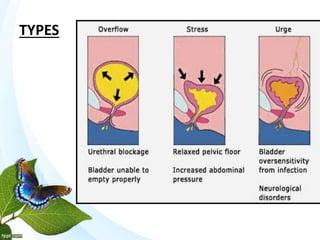
TYPES
Mixed incontinence – combination of both stress
and urge incontinence symptoms
Overflow incontinence – retention with overflow
of small amounts of urine.
Urgency is a sudden desire to void
Frequency is passing of urine seven or
more/day or being awoken from sleep more than
jif once a night to void.
What is urinary
incontinence
What is stress
incontinence
ETIOLOGY
• Bladder incontinence:
 Stress incontinence
- weakening of urethral sphincter and
pelvic floor muscles
- pregnancy
- childbirth
- age
- obesity
- menopause
- surgical procedures, e.g. hysterectomy
 Urge incontinence
- overactivity of the detrusor muscles
- cystitis
- central nervous system (CNS) problems
- an enlarged prostate
 Overflow incontinence
- an obstruction or blockage to the bladder
- an enlarged prostate gland
- a tumor pressing against the bladder
- urinary stones
- constipation
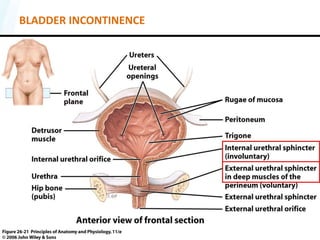
BLADDER INCONTINENCE
PATHOPHYSIOLOGY
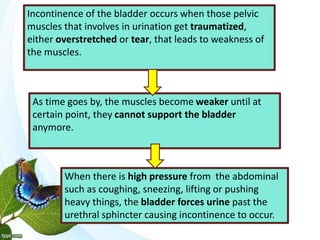
Incontinence of the bladder occurs when those pelvic
muscles that involves in urination get traumatized,
either overstretched or tear, that leads to weakness of
the muscles.
As time goes by, the muscles become weaker until at
certain point, they cannot support the bladder
anymore.
When there is high pressure from the abdominal
such as coughing, sneezing, lifting or pushing
heavy things, the bladder forces urine past the
urethral sphincter causing incontinence to occur.
CLINICAL FEATURES
STRESS INCONTINENCE OCCURS WHEN:
1) Cough
2) Sneeze
3) Laughing
4) Lifting heavy objects
5) Vigorous exercise
6) Have sexual intercourse
7) Standing in prolonged time
URGE INCONTINENCE OCCURS :
1) Frequent urination, in a day and at
nighttime
2) Sudden urination and urinary urgency
OVERFLOW INCONTINENCE OCCURS:
1) Bladder never feels empty.
2) Inability to void when the urge is felt
3) Urine dribbles even after voiding
“Hello, incontinence helpline – Can
you hold?”
How will I get evaluated?
INVESTIGATIONS
• Physical examination- to identify pelvic
muscle prolapse.
• Urine culture & sensitivity—to identify
Infections.
• Pad test
• Measure Postvoidal Residual Volume by
bladder ultrasound or urethral catheter .
• Urodynamic studies
Uroflowmetry-- Bladder outlet obstruction
Cystometry -- Detrusor/bladder contraction
activity
• Cystogram – to visualize the bladder.
• Cystoscopy
– Tumors, stones
What is
cystogram
MANAGEMENT
Medication
- Anticholinergics (medication to calm an
overactive bladder)
- Anti depressant
-Imipramine
- Duloxetine
- Topical estrogen.
-alpha & beta adrenergic antagonist
-phenylpropanolamine
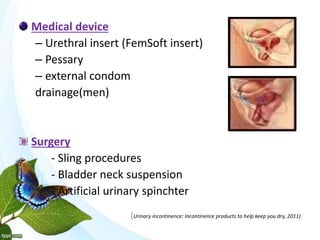
Medical device
– Urethral insert (FemSoft insert)
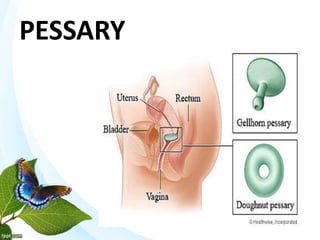
– Pessary
– external condom
drainage(men)
Surgery
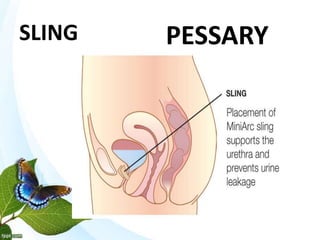
- Sling procedures
- Bladder neck suspension
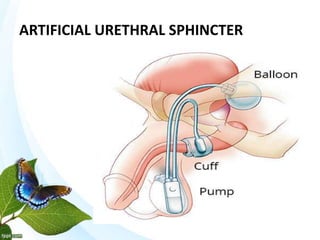
- Artificial urinary spinchter
(Urinary incontinence: Incontinence products to help keep you dry, 2011)
ARTIFICIAL URETHRAL SPHINCTER
PESSARY
SLING PESSARY
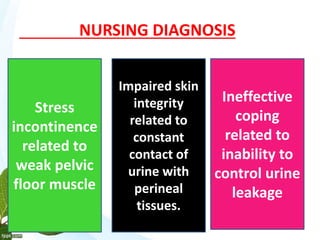
NURSING DIAGNOSIS
Stress
incontinence
related to
weak pelvic
floor muscle
Impaired skin
integrity
related to
constant
contact of
urine with
perineal
tissues.
Ineffective
coping
related to
inability to
control urine
leakage
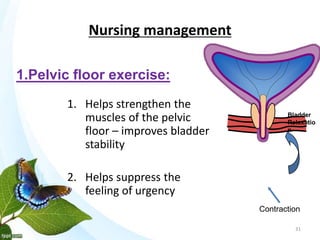
Nursing management
31
1. Helps strengthen the
muscles of the pelvic
floor – improves bladder
stability
2. Helps suppress the
feeling of urgency
Contraction
Bladder
Relaxatio
n
1.Pelvic floor exercise:
2.Bladder training:
Scheduled voiding at set times during the
day
Active use of muscles to prevent urine
loss
Keep own input and output chart
33
3.BEHAVIOUR MODIFICATION :
1. Drink less than 5 glasses/day (40 oz)
2. Stop drinking after dinner
3. Elevate legs
4. Timed voiding
5. Regular pelvic floor exercises
34
Find your pelvic floor muscles.
Squeeze your pelvic floor muscles as hard as
you can and hold them (squeeze 3-5 sec
and relax for 5 sec).
Do sets of repetitions of squeezing (start with 5
repetitions: squeeze, hold, relax).
Increase lengths, intensity, and repetitions
every couple of days.
Perform Kegel exercises 3-4x during the day.
36
Kegel exercise for men and women:

Urinary incontinence

  • 1.
  • 2.
    INCONTINENCE Unable to retainthe natural discharge or evacuation of urine or feces.
  • 3.
    What will youlearn in the upcoming minutes? What is happening to bladder ? How will get evaluated? Therapy with medication Others Forms of interventions
  • 4.
  • 5.
  • 6.
    Anatomy Review Bladder: storesurine Urethra: tube that allows urine to pass Urethral sphincter: muscle surrounding the urethra that hold the urine Brain signals are key to coordinating the function of these anatomical structures
  • 7.
    What is happeningto bladder? 1. Autonomic nervous system control – Nerve coming from the spinal cord and go directly to the bladder – When bladder gets fuller, signals are sent to the brain 2. Central nervous system – Voluntary control to choose when to void  Both can be altered by aging or neurological disease 7
  • 8.
    Normal Voiding Cycle Filling& storage phase Emptying phase Bladder filling Normal desire to voidFirst sensation to voidBladder filling Bladderpressure
  • 9.
    DEFINITION - BLADDER INCONTINENCE/URINARY INCONTINENCE- • Urinary incontinence means there is loss of bladder control which leads to unintentional passing of urine
  • 10.
    TYPES OF INCONTINENCE •There are several types of bladder incontinence which are:  Stress incontinence – abdominal pr. occurs during certain activities like coughing, sneezing, laughing etc.  Urge incontinence –Inability to hold the flow of urine,when feeling the urge to void
  • 11.
  • 12.
    Mixed incontinence –combination of both stress and urge incontinence symptoms Overflow incontinence – retention with overflow of small amounts of urine. Urgency is a sudden desire to void Frequency is passing of urine seven or more/day or being awoken from sleep more than jif once a night to void.
  • 13.
    What is urinary incontinence Whatis stress incontinence
  • 14.
    ETIOLOGY • Bladder incontinence: Stress incontinence - weakening of urethral sphincter and pelvic floor muscles - pregnancy - childbirth - age - obesity - menopause - surgical procedures, e.g. hysterectomy
  • 15.
     Urge incontinence -overactivity of the detrusor muscles - cystitis - central nervous system (CNS) problems - an enlarged prostate  Overflow incontinence - an obstruction or blockage to the bladder - an enlarged prostate gland - a tumor pressing against the bladder - urinary stones - constipation
  • 16.
  • 17.
  • 18.
    Incontinence of thebladder occurs when those pelvic muscles that involves in urination get traumatized, either overstretched or tear, that leads to weakness of the muscles. As time goes by, the muscles become weaker until at certain point, they cannot support the bladder anymore. When there is high pressure from the abdominal such as coughing, sneezing, lifting or pushing heavy things, the bladder forces urine past the urethral sphincter causing incontinence to occur.
  • 19.
    CLINICAL FEATURES STRESS INCONTINENCEOCCURS WHEN: 1) Cough 2) Sneeze 3) Laughing 4) Lifting heavy objects 5) Vigorous exercise 6) Have sexual intercourse 7) Standing in prolonged time
  • 20.
    URGE INCONTINENCE OCCURS: 1) Frequent urination, in a day and at nighttime 2) Sudden urination and urinary urgency OVERFLOW INCONTINENCE OCCURS: 1) Bladder never feels empty. 2) Inability to void when the urge is felt 3) Urine dribbles even after voiding
  • 21.
    “Hello, incontinence helpline– Can you hold?” How will I get evaluated?
  • 22.
    INVESTIGATIONS • Physical examination-to identify pelvic muscle prolapse. • Urine culture & sensitivity—to identify Infections. • Pad test • Measure Postvoidal Residual Volume by bladder ultrasound or urethral catheter .
  • 23.
    • Urodynamic studies Uroflowmetry--Bladder outlet obstruction Cystometry -- Detrusor/bladder contraction activity • Cystogram – to visualize the bladder. • Cystoscopy – Tumors, stones
  • 24.
  • 25.
    MANAGEMENT Medication - Anticholinergics (medicationto calm an overactive bladder) - Anti depressant -Imipramine - Duloxetine - Topical estrogen. -alpha & beta adrenergic antagonist -phenylpropanolamine
  • 26.
    Medical device – Urethralinsert (FemSoft insert) – Pessary – external condom drainage(men) Surgery - Sling procedures - Bladder neck suspension - Artificial urinary spinchter (Urinary incontinence: Incontinence products to help keep you dry, 2011)
  • 27.
  • 28.
  • 29.
  • 30.
    NURSING DIAGNOSIS Stress incontinence related to weakpelvic floor muscle Impaired skin integrity related to constant contact of urine with perineal tissues. Ineffective coping related to inability to control urine leakage
  • 31.
    Nursing management 31 1. Helpsstrengthen the muscles of the pelvic floor – improves bladder stability 2. Helps suppress the feeling of urgency Contraction Bladder Relaxatio n 1.Pelvic floor exercise:
  • 33.
    2.Bladder training: Scheduled voidingat set times during the day Active use of muscles to prevent urine loss Keep own input and output chart 33
  • 34.
    3.BEHAVIOUR MODIFICATION : 1.Drink less than 5 glasses/day (40 oz) 2. Stop drinking after dinner 3. Elevate legs 4. Timed voiding 5. Regular pelvic floor exercises 34
  • 36.
    Find your pelvicfloor muscles. Squeeze your pelvic floor muscles as hard as you can and hold them (squeeze 3-5 sec and relax for 5 sec). Do sets of repetitions of squeezing (start with 5 repetitions: squeeze, hold, relax). Increase lengths, intensity, and repetitions every couple of days. Perform Kegel exercises 3-4x during the day. 36 Kegel exercise for men and women: