Geriatric Depression
(Depression in Older Adults)
www.poonyah.co.in
DEFINITION
An illness that involves the body,
mood, and thoughts and that
affects the way a person eats,
sleeps, feels about himself or
herself, and thinks about things.
Depression is more than just a low
mood – it's a serious condition that
affects your physical and mental
health.
www.poonyah.co.in
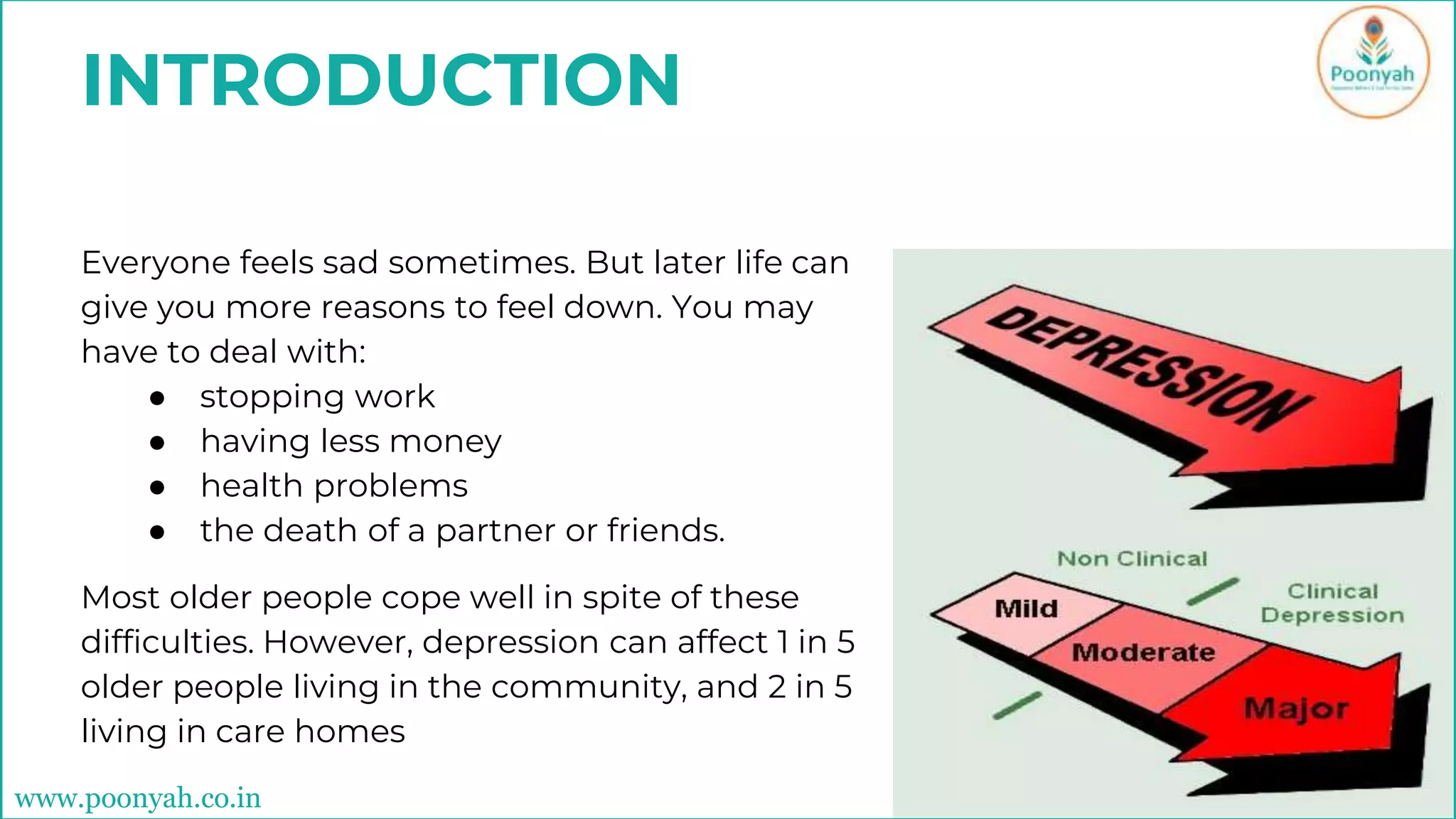
Everyone feels sad sometimes. But later life can
give you more reasons to feel down. You may
have to deal with:
● stopping work
● having less money
● health problems
● the death of a partner or friends.
Most older people cope well in spite of these
difficulties. However, depression can affect 1 in 5
older people living in the community, and 2 in 5
living in care homes
INTRODUCTION
www.poonyah.co.in
www.poonyah.co.in
EPIDEMIOLOGY OF
DEPRESSION IN ELDERLY
❏ At present, there are 322 million people with depression in the world “Near
half of these people live in the South-East Area Region and western Pacific
Region.
❏ Worldwide,the Prevalence of depression increased by 18% from 2005 to 2015
❏ Depression is more common among females (5.1%) than males (3.6%).
❏ According to WHO Report, Almost 7.5% of Indians Suffer from major or
minor mental disorders that require expert intervention.
❏ 14.3 of every 100,000 people age 65 and older died by suicide in 2004, higher
than the rate of about 11 per 100,000 in the general population.
www.poonyah.co.in
www.poonyah.co.in
Why do people get depressed?
Past depression
Physical illness
Medicines
Painful events
www.poonyah.co.in
?
Causes and Risk Factors for
Depression
Several factors, or a combination of factors, may contribute to
depression.
● Genes—People with a family history of depression may be more
likely to develop it than those whose families do not have the
illness.
● Personal history—Older adults who had depression when they
were younger are more at risk for developing depression in late
life than those who did not have the illness earlier in life.
● Brain chemistry—People with depression may have different
brain chemistry than those without the illness.
● Stress—Loss of a loved one, a difficult relationship, or any
stressful situation may trigger depression.
www.poonyah.co.in
Types of Depression
There are several types of depressive disorders.
Major depression involves severe symptoms that interfere with the ability to
work, sleep, study, eat, and enjoy life. An episode can occur only once in a
person’s lifetime, but more often, a person has several episodes.
Persistent depressive disorder is a depressed mood that lasts for at least 2
years. A person diagnosed with persistent depressive disorder may have
episodes of major depression along with periods of less severe symptoms, but
symptoms must last for 2 years to be considered persistent depressive
disorder.
Other forms of depression include psychotic depression, postpartum
depression, and seasonal affective disorder.
www.poonyah.co.in
Common Symptoms of
Depression
There are many symptoms associated with depression,
and some will vary depending on the individual. However,
some of the most common symptoms are listed below. If
you have several of these symptoms for more than 2
weeks, you may have depression.
❏ Persistent sad, anxious, or "empty" mood
❏ Feelings of hopelessness, guilt, worthlessness, or
helplessness
❏ Irritability, restlessness, or having trouble sitting still
❏ Loss of interest in once pleasurable activities,
including sex
❏ Decreased energy or fatigue
❏ Moving or talking more slowly
www.poonyah.co.in
❏ Difficulty sleeping, early-morning awakening, or oversleeping
❏ Eating more or less than usual, usually with unplanned weight
gain or loss
❏ Thoughts of death or suicide, or suicide attempts
❏ Aches or pains, headaches, cramps, or digestive problems without
a clear physical cause and/or that do not ease with treatment
❏ Frequent crying
❏ Difficulty concentrating, remembering, making decision
www.poonyah.co.in
Treatments For Depression
❏ Therapy for Depression.
❏ Medication for Depression
❏ By changing your daily Lifestyle
❏ By the help of Vedic Science
www.poonyah.co.in
Therapy for Depression
Psychotherapy, also called "talk therapy," can help people with depression.
Cognitive behavioral therapy is one type of talk therapy used to treat depression. It
focuses on helping people change negative thinking and any behaviors that may
be making depression worse.
Interpersonal therapy can help an individual understand and work through
troubled relationships that may cause the depression or make it worse.
Other types of talk therapy, like problem-solving therapy, can be helpful for people
with depression.
www.poonyah.co.in
MEDICATION FOR DEPRESSION
Antidepressants
Antidepressants, sometimes in
combination with psychotherapy, are
often the first treatment people get
for depression. If one antidepressant
doesn't work well, you might try
another drug of the same class or a
different class of depression
medicines altogether.
www.poonyah.co.in
Lifestyle changes used to treat
depression include
Increasing physical activity
Regular exercise can boost your mood
if you have depression, and it's
especially useful for people with mild
to moderate depression.
"Any type of exercise is useful, as long
as it suits you and you do enough of
it," says Dr Alan Cohen, a GP with a
special interest in mental health.
www.poonyah.co.in
Research shows that people
with hobbies are less likely to
suffer from stress, low mood,
and depression. Activities that
get you out and about can
make you feel happier and
more relaxed.
Finding new hobby or interest
www.poonyah.co.in
Having regular visits with family
and friends
Regular visits with family and
friends is also the best way to
overcome from depression. So,
always share your problems with
your friends and family
members.
www.poonyah.co.in
Getting enough sleep daily
Every senior should try their
best to get enough sleep.
Proper sleep keeps your
mind alert, preserves energy
levels, and helps you live life
to the fullest. On top of
feeling well rested, it can
lower the risk of age-related
cognitive decline that is
common among the elderly
www.poonyah.co.in
Eating a well-balanced diet
is an important part of
staying healthy as you age. It
can help you maintain a
healthy weight, stay
energized, and get the
nutrients you need. It also
lowers your risk of developing
chronic health conditions,
such as heart disease and
diabetes.
www.poonyah.co.in
How do you know when it's
time to get help?
www.poonyah.co.in
What are the effective Ayurvedic Treatments
for Depression and Anxiety?
❏ Abhyangam
❏ Padabhyanga
❏ Nasyam
❏ Pizhichil
❏ Kizhi
❏ Shirodhara
www.poonyah.co.in
Abhyangam
It involves the full body massage with
medicated herbal oils. Abhyangam
therapy increases blood circulation to
remove metabolic wastes and toxins
from the body. It stimulates vital
pressure points, which leads to nervous
stimulation and reduction in Stress,
Anxiety, and Depression.
www.poonyah.co.in
Padabhyanga
This Ayurvedic massage
includes the stimulation of
nerve endings and vital pressure
points present in the foot to
balance the Doshas. This also
promotes mental calmness and
relieves Stress and Anxiety.
www.poonyah.co.in
Nasyam
Nasyam is a part of
Panchakarma therapy and
involves the administration
of medicated oils or drugs
through nostrils. This
treatment stimulates the
vital centres of the brain to
overcome problems such
as Stress, Anxiety,
Depression, and Insomnia.
www.poonyah.co.in
Pizhichil
Pizhichil treatment involves the
squeezing of warm medicated oils to
help the system retune itself thereby
inducing both physical and mental
relaxation. The stress and tension
building up in the system due to
various factors often lead to oxidative
stress, which can be effectively
combated by this Ayurvedic treatment.
www.poonyah.co.in
Kizhi
Kizhi enhances circulation and
reduces the oxidative stress
thereby relieving the psycho-
physical symptoms of stress.
This therapy makes use of
powders, herbs, rice, sand tied
in a muslin cloth to make small
satchels
www.poonyah.co.in
Shirodhara
This healing massage involves the
continuous pouring of medicated oil
on the forehead with pendulum
motion for a specific period of time.
Shirodhara may also include the
pouring of decoctions, buttermilk, or
even water.
www.poonyah.co.in
www.poonyah.co.in
Thanks !
www.poonyah.co.in

Depression In Elderly

  • 1.
    Geriatric Depression (Depression inOlder Adults) www.poonyah.co.in
  • 2.
    DEFINITION An illness thatinvolves the body, mood, and thoughts and that affects the way a person eats, sleeps, feels about himself or herself, and thinks about things. Depression is more than just a low mood – it's a serious condition that affects your physical and mental health. www.poonyah.co.in
  • 3.
    Everyone feels sadsometimes. But later life can give you more reasons to feel down. You may have to deal with: ● stopping work ● having less money ● health problems ● the death of a partner or friends. Most older people cope well in spite of these difficulties. However, depression can affect 1 in 5 older people living in the community, and 2 in 5 living in care homes INTRODUCTION www.poonyah.co.in
  • 4.
  • 5.
    EPIDEMIOLOGY OF DEPRESSION INELDERLY ❏ At present, there are 322 million people with depression in the world “Near half of these people live in the South-East Area Region and western Pacific Region. ❏ Worldwide,the Prevalence of depression increased by 18% from 2005 to 2015 ❏ Depression is more common among females (5.1%) than males (3.6%). ❏ According to WHO Report, Almost 7.5% of Indians Suffer from major or minor mental disorders that require expert intervention. ❏ 14.3 of every 100,000 people age 65 and older died by suicide in 2004, higher than the rate of about 11 per 100,000 in the general population. www.poonyah.co.in
  • 6.
  • 7.
    Why do peopleget depressed? Past depression Physical illness Medicines Painful events www.poonyah.co.in ?
  • 8.
    Causes and RiskFactors for Depression Several factors, or a combination of factors, may contribute to depression. ● Genes—People with a family history of depression may be more likely to develop it than those whose families do not have the illness. ● Personal history—Older adults who had depression when they were younger are more at risk for developing depression in late life than those who did not have the illness earlier in life. ● Brain chemistry—People with depression may have different brain chemistry than those without the illness. ● Stress—Loss of a loved one, a difficult relationship, or any stressful situation may trigger depression. www.poonyah.co.in
  • 9.
    Types of Depression Thereare several types of depressive disorders. Major depression involves severe symptoms that interfere with the ability to work, sleep, study, eat, and enjoy life. An episode can occur only once in a person’s lifetime, but more often, a person has several episodes. Persistent depressive disorder is a depressed mood that lasts for at least 2 years. A person diagnosed with persistent depressive disorder may have episodes of major depression along with periods of less severe symptoms, but symptoms must last for 2 years to be considered persistent depressive disorder. Other forms of depression include psychotic depression, postpartum depression, and seasonal affective disorder. www.poonyah.co.in
  • 10.
    Common Symptoms of Depression Thereare many symptoms associated with depression, and some will vary depending on the individual. However, some of the most common symptoms are listed below. If you have several of these symptoms for more than 2 weeks, you may have depression. ❏ Persistent sad, anxious, or "empty" mood ❏ Feelings of hopelessness, guilt, worthlessness, or helplessness ❏ Irritability, restlessness, or having trouble sitting still ❏ Loss of interest in once pleasurable activities, including sex ❏ Decreased energy or fatigue ❏ Moving or talking more slowly www.poonyah.co.in
  • 11.
    ❏ Difficulty sleeping,early-morning awakening, or oversleeping ❏ Eating more or less than usual, usually with unplanned weight gain or loss ❏ Thoughts of death or suicide, or suicide attempts ❏ Aches or pains, headaches, cramps, or digestive problems without a clear physical cause and/or that do not ease with treatment ❏ Frequent crying ❏ Difficulty concentrating, remembering, making decision www.poonyah.co.in
  • 12.
    Treatments For Depression ❏Therapy for Depression. ❏ Medication for Depression ❏ By changing your daily Lifestyle ❏ By the help of Vedic Science www.poonyah.co.in
  • 13.
    Therapy for Depression Psychotherapy,also called "talk therapy," can help people with depression. Cognitive behavioral therapy is one type of talk therapy used to treat depression. It focuses on helping people change negative thinking and any behaviors that may be making depression worse. Interpersonal therapy can help an individual understand and work through troubled relationships that may cause the depression or make it worse. Other types of talk therapy, like problem-solving therapy, can be helpful for people with depression. www.poonyah.co.in
  • 14.
    MEDICATION FOR DEPRESSION Antidepressants Antidepressants,sometimes in combination with psychotherapy, are often the first treatment people get for depression. If one antidepressant doesn't work well, you might try another drug of the same class or a different class of depression medicines altogether. www.poonyah.co.in
  • 15.
    Lifestyle changes usedto treat depression include Increasing physical activity Regular exercise can boost your mood if you have depression, and it's especially useful for people with mild to moderate depression. "Any type of exercise is useful, as long as it suits you and you do enough of it," says Dr Alan Cohen, a GP with a special interest in mental health. www.poonyah.co.in
  • 16.
    Research shows thatpeople with hobbies are less likely to suffer from stress, low mood, and depression. Activities that get you out and about can make you feel happier and more relaxed. Finding new hobby or interest www.poonyah.co.in
  • 17.
    Having regular visitswith family and friends Regular visits with family and friends is also the best way to overcome from depression. So, always share your problems with your friends and family members. www.poonyah.co.in
  • 18.
    Getting enough sleepdaily Every senior should try their best to get enough sleep. Proper sleep keeps your mind alert, preserves energy levels, and helps you live life to the fullest. On top of feeling well rested, it can lower the risk of age-related cognitive decline that is common among the elderly www.poonyah.co.in
  • 19.
    Eating a well-balanceddiet Eating a well-balanced diet is an important part of staying healthy as you age. It can help you maintain a healthy weight, stay energized, and get the nutrients you need. It also lowers your risk of developing chronic health conditions, such as heart disease and diabetes. www.poonyah.co.in
  • 20.
    How do youknow when it's time to get help? www.poonyah.co.in
  • 21.
    What are theeffective Ayurvedic Treatments for Depression and Anxiety? ❏ Abhyangam ❏ Padabhyanga ❏ Nasyam ❏ Pizhichil ❏ Kizhi ❏ Shirodhara www.poonyah.co.in
  • 22.
    Abhyangam It involves thefull body massage with medicated herbal oils. Abhyangam therapy increases blood circulation to remove metabolic wastes and toxins from the body. It stimulates vital pressure points, which leads to nervous stimulation and reduction in Stress, Anxiety, and Depression. www.poonyah.co.in
  • 23.
    Padabhyanga This Ayurvedic massage includesthe stimulation of nerve endings and vital pressure points present in the foot to balance the Doshas. This also promotes mental calmness and relieves Stress and Anxiety. www.poonyah.co.in
  • 24.
    Nasyam Nasyam is apart of Panchakarma therapy and involves the administration of medicated oils or drugs through nostrils. This treatment stimulates the vital centres of the brain to overcome problems such as Stress, Anxiety, Depression, and Insomnia. www.poonyah.co.in
  • 25.
    Pizhichil Pizhichil treatment involvesthe squeezing of warm medicated oils to help the system retune itself thereby inducing both physical and mental relaxation. The stress and tension building up in the system due to various factors often lead to oxidative stress, which can be effectively combated by this Ayurvedic treatment. www.poonyah.co.in
  • 26.
    Kizhi Kizhi enhances circulationand reduces the oxidative stress thereby relieving the psycho- physical symptoms of stress. This therapy makes use of powders, herbs, rice, sand tied in a muslin cloth to make small satchels www.poonyah.co.in
  • 27.
    Shirodhara This healing massageinvolves the continuous pouring of medicated oil on the forehead with pendulum motion for a specific period of time. Shirodhara may also include the pouring of decoctions, buttermilk, or even water. www.poonyah.co.in
  • 28.
  • 29.