Depression in older AdultsCurrent & Future Need for Better Diagnoses & TreatmentSara DavenportArgosy University
AbstractA cross-section of theories relating to characteristics of and risks for depression in older adults
Effective, documented treatments
Frequency by which depression is overlooked by primary care physicians
Common theme: Better strategies in managing mental health care for older adults
The Baby Boom Generation
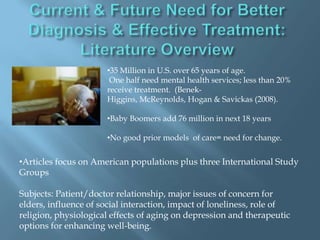
Urgent call for more comprehensive researchCurrent & Future Need for Better Diagnosis & Effective Treatment: LiteratureOverview 35 Million in U.S. over 65 years of age. One half need mental health services; less than 20% receive treatment.  (Benek-Higgins, McReynolds, Hogan & Savickas (2008).Baby Boomers add 76 million in next 18 years
No good prior models  of care= need for change.
Articles focus on American populations plus three International Study GroupsSubjects: Patient/doctor relationship, major issues of concern for elders, influence of social interaction, impact of loneliness, role of religion, physiological effects of aging on depression and therapeutic options for enhancing well-being.
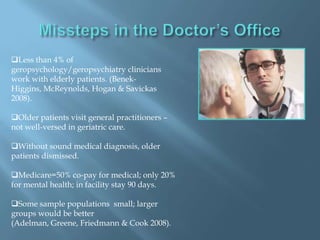
Missteps in the Doctor’s OfficeLess than 4% of geropsychology/geropsychiatry clinicians work with elderly patients. (Benek-Higgins, McReynolds, Hogan & Savickas 2008).
Older patients visit general practitioners – not well-versed in geriatric care.
Without sound medical diagnosis, older patients dismissed.
Medicare=50% co-pay for medical; only 20% for mental health; in facility stay 90 days.

Au Psy492 Week7 As2 Elderly Depression Davenport

  • 1.
    Depression in olderAdultsCurrent & Future Need for Better Diagnoses & TreatmentSara DavenportArgosy University
  • 2.
    AbstractA cross-section oftheories relating to characteristics of and risks for depression in older adults
  • 3.
  • 4.
    Frequency by whichdepression is overlooked by primary care physicians
  • 5.
    Common theme: Betterstrategies in managing mental health care for older adults
  • 6.
    The Baby BoomGeneration
  • 7.
    Urgent call formore comprehensive researchCurrent & Future Need for Better Diagnosis & Effective Treatment: LiteratureOverview 35 Million in U.S. over 65 years of age. One half need mental health services; less than 20% receive treatment. (Benek-Higgins, McReynolds, Hogan & Savickas (2008).Baby Boomers add 76 million in next 18 years
  • 8.
    No good priormodels of care= need for change.
  • 9.
    Articles focus onAmerican populations plus three International Study GroupsSubjects: Patient/doctor relationship, major issues of concern for elders, influence of social interaction, impact of loneliness, role of religion, physiological effects of aging on depression and therapeutic options for enhancing well-being.
  • 10.
    Missteps in theDoctor’s OfficeLess than 4% of geropsychology/geropsychiatry clinicians work with elderly patients. (Benek-Higgins, McReynolds, Hogan & Savickas 2008).
  • 11.
    Older patients visitgeneral practitioners – not well-versed in geriatric care.
  • 12.
    Without sound medicaldiagnosis, older patients dismissed.
  • 13.
    Medicare=50% co-pay formedical; only 20% for mental health; in facility stay 90 days.

Editor's Notes

  • #3 This literature review represents a cross-section of theories relating to characteristics of and risks for depression in older adults, as well as effective, documented treatments. Equally important in reviewing this topic is how frequently depression is overlooked by primary care physicians. The research from all sources is informative and aligned with the topic. A common theme is for better strategies in managing mental health care for older adults today. Plus, the sobering reality that the Baby Boom generation is rapidly moving into the senior years signals significant challenges ahead for individuals, families, communities and society as a whole. A dramatic escalation of awareness, resources and action is needed. It is also an urgent call for more comprehensive research to address these issues.
  • #4 Literature review reveals statistics that present sobering facts about serious lack of mental health services for America’s elder population. The aging Baby Boom generation signals new challenges to a system already deficient. Articles cited are from U.S. studies plus International research groups in Canada, Australia and the United Kingdom. Biopsychosocial factors as indicated that predispose elders to depression and current, successful treatment strategies are considered.
  • #5 Few clinicians work with the elderly. Older patients resort to general practitioners who typically are not well-versed in geriatric care and dismiss clues masked in physical discomfort, but have mental and/or emotional roots. Without medical diagnosis, elders left disillusioned. Costs for mental health services are often prohibitive – Medicare has a 50% co-pay for medical and only 30% co-pay for mental health services. There is a limited lifetime in-facility stay of only 90 days. Doctors do not often talk about depression. Discussion of depression in follow-up visits less than 7% (Adelman, Greene, Friedmann & Cook 2008). The two articles noted on this subject agree on difficulties encountered by elders within medical community, and stated that future research should include larger populations.
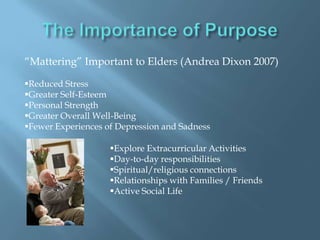
  • #6 According to Andrea Dixon (2007) “mattering” in life is important to elders. Benefits to a sense of purpose are highlighted, as well as factors that contribute to this improved well-being.
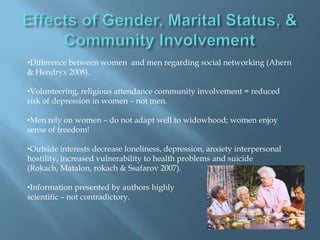
  • #7 Ahern & Hendryx (2008) identified gender differences in the relationship of social support (contact with and through community engagement). Women need social contact more than men, and women’s participation in activities outlined above, are correlated to reduced risk of first-time depressive symptoms. This was not true for men. Men do not adapt well to widowhood, while women experience a newfound sense of freedom and autonomy on becoming single. The two contributing articles presented highly scientific research and they were not contradictory.
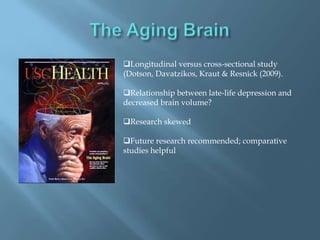
  • #8 This was the only article with a physiological approach to depression in older adults. The authors found a correlation between late-life depression and decreased brain volume – particularly with advancing age. They acknowledged that the study participants were not population –based: they were highly educated and white. Further research is recommended – and comparative research would be helpful as this is the single source for such information.
  • #9 It seems not surprising that religion plays an important role in the lives of older people, and statistics validate this. Church attendance increases with age and religious persons experience physical and mental health benefits. McFadden (1995) believes there could be a strong link between disability, disability and the link that religion could make between the two. However, other studies indicate that the link between mental health and religion are not as established as those between religion and physical health. McFadden (1995) states that religion can have positive effect on late-life well-being.
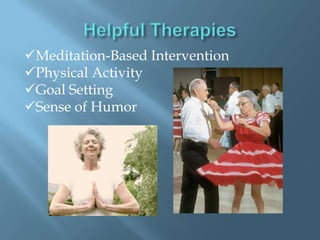
  • #10 In research by Smith, Graham & Senthinathan (2007), a meditation-based intervention called mindfulness-based cognitive therapy (MBCT) was delivered to participants with relapsing unipolar major depression. It was cost-effective and the participants said it was helpful in addressing depression. The authors contend there is a high recurrence rate and may be a common mental health problem for adults – but is underdiagnosed and undertreated. This is another example of the medical community being ineffective at diagnosis as shown in the work of Benek-Higgins, McReynolds, Hogan & Savickas (2008). Cairney, Faulker, Veldhuizen & Wade (2009) show an inverse relationship between the level of physical activity and depression in older adults. They also point to improved sense of self worth and perceived mastery – which can have great impact on psychological distress on older adults. Limitations of this research is that it is a qualitative study with results being observational and self-reported.Street, O’Connor & Robinson (2007) studied the effect of goal-setting on attitudes of happiness and well-being. If elders felt goals were unattainable, they were prone to depression. Finally, a sense of humor is presented positively for elders by Marziali, Mcdonald and Donahue (2008). They believe that sense of humor along with a social support system, spiritual beliefs and self-perception of mental and physical health are optimum blend for older adults coping with mental and physical health challenges.
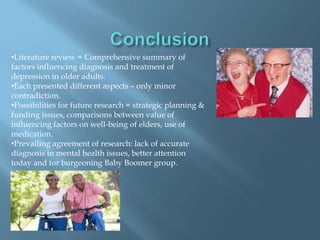
  • #11 The material presented in this paper as a review of literature is a comprehensive summary of important factors influencing diagnosis and treatment of depression in older adults. Each of the articles provided research into different aspects of depression in elders, with only minor contradiction in the material as presented. Summarizing the research and possibilities for future study, strategic planning including funding issues could be addressed. There was only scant reference to costs in one of the articles (Benek-Higgins, Hogan, McReynolds & Savickas 2008) which highlighted Medicare coverage. General comparisons on the value of one influencing factor versus another on the well-being of elders could be interesting. The focus of the articles chosen was more on alternative methodologies; surprisingly, only in cases of severe depression was medication referenced. None of the therapies seems to be the singularly the most effective solution to the challenges outlined. The prevailing observation by the authors presented is that our nation’s elders are already experiencing lack of accurate, if any, diagnosis relating to mental health issues. Most authors assert that with the tremendous growth in the aging population in America, more attention should be given to elders today, and we should be better equipped to assess and address the needs of tomorrow’s older adults– e.g. the burgeoning Baby Boomer group.