Hoping that we are getting enough light on DEPRECIATION …
We have understood enough about  ACCOUNTING FOR DEPRECIATION
And, now we go for some more  INTERESTING  thing about depreciation…
… provide for proportional amount of depreciation. What should be amount of depreciation on an asset acquired during the year?
Revising Depreciation Estimates
Revising Depreciation Estimates A machine purchased for Rs.130,000 was originally estimated to have a useful life of 30 years and a residual value of Rs.10,000.  The asset has been depreciated for ten years using the straight-  line method. Annual  Depreciation = Rs.4,000 per year Rs.130,000  –  Rs.10,000 30 years
Equipment 130,000 Accumulated Depreciation 4,000 4,000 4,000 4,000 4,000 4,000 4,000 4,000 4,000   4,000 40,000 Before revising Book value = Rs.90,000 Revising Depreciation Estimates
During the eleventh year, it is estimated that the remaining useful life is 25 years (rather than 20) and that the revised estimated residual value is Rs.5,000. Revising Depreciation Estimates Book value  –  revised residual value Revised estimated remaining life Rs.90,000  –  Rs.5,000 25 years Rs.3,400 revised annual depreciation =
Changing the Method of Depreciation
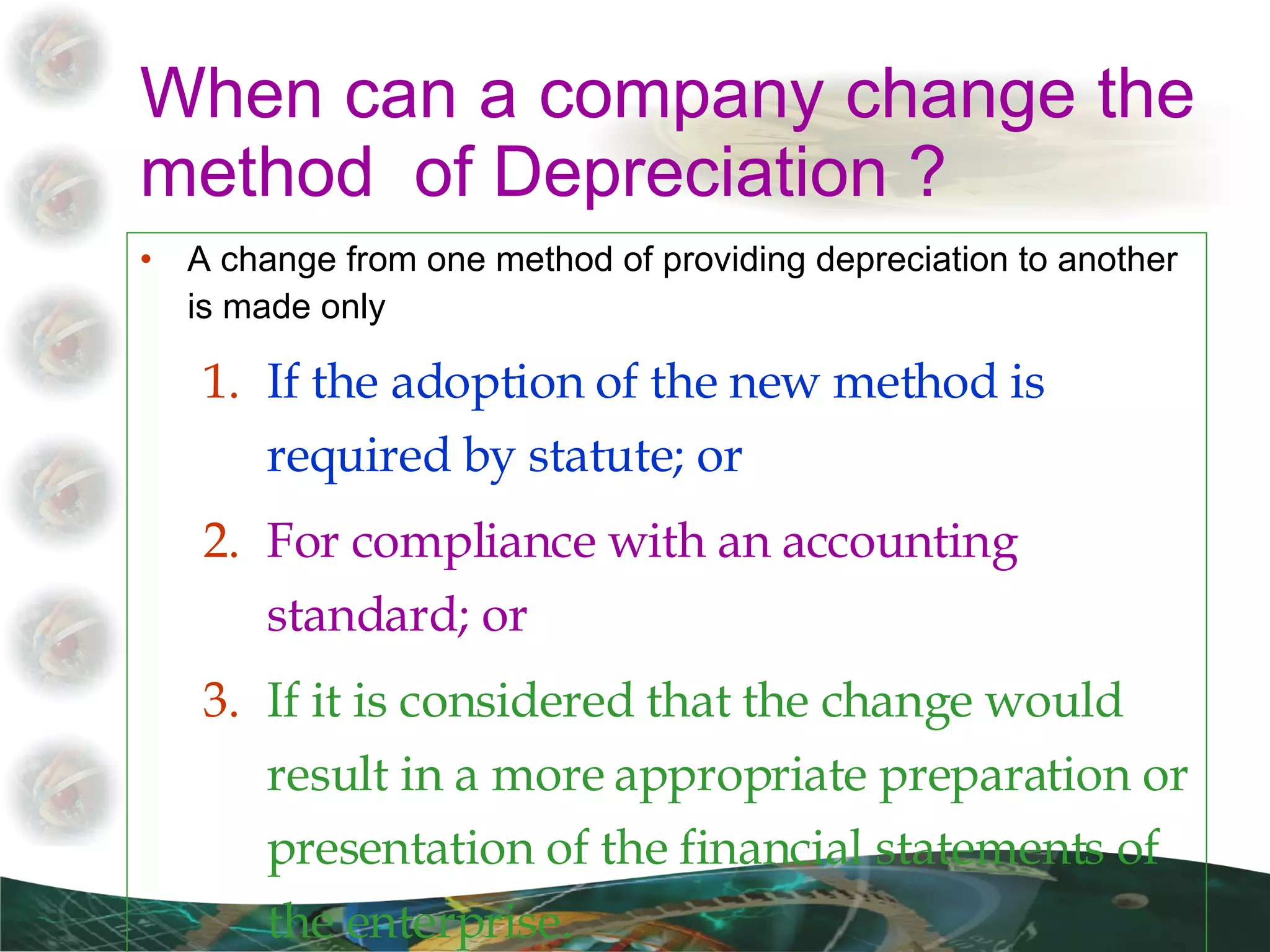
When can a company change the method  of Depreciation ? A change from one method of providing depreciation to another is made only If the adoption of the new method is required by statute; or  For compliance with an accounting standard; or  If it is considered that the change would result in a more appropriate preparation or presentation of the financial statements of the enterprise.
How to account for the impact of change in the method of depreciation? When a change in the method of depreciation is made,  depreciation is recalculated in accordance with the new method from the date of the asset coming into use.   The deficiency or surplus arising from retrospective recomputation of depreciation in accordance with the new method is adjusted in the accounts in the year in which the method of depreciation is changed.  In case the change in the method results in deficiency in depreciation in respect of past years, the deficiency is charged in the statement of profit and loss.  In case the change in the method results in surplus, the surplus is credited to the statement of profit and loss. Such a change is treated as a change in accounting policy and its effect is quantified and disclosed.
Changing Depreciation Method A machine purchased for Rs.130,000 was originally estimated to have a useful life of 30 years and a residual value of Rs.10,000.  The asset has been depreciated for ten years using the straight-  line method. Annual  Depreciation = Rs.4,000 per year Rs.130,000  –  Rs.10,000 30 years
Equipment 130,000 Accumulated Depreciation 4,000 4,000 4,000 4,000 4,000 4,000 4,000 4,000 4,000   4,000 40,000 Before Change Book value = Rs.90,000 Changing Depreciation Method
Now, suppose it is decide that… …  the method  of depreciation will be Written Down Value Method  instead of Straight Line Method .
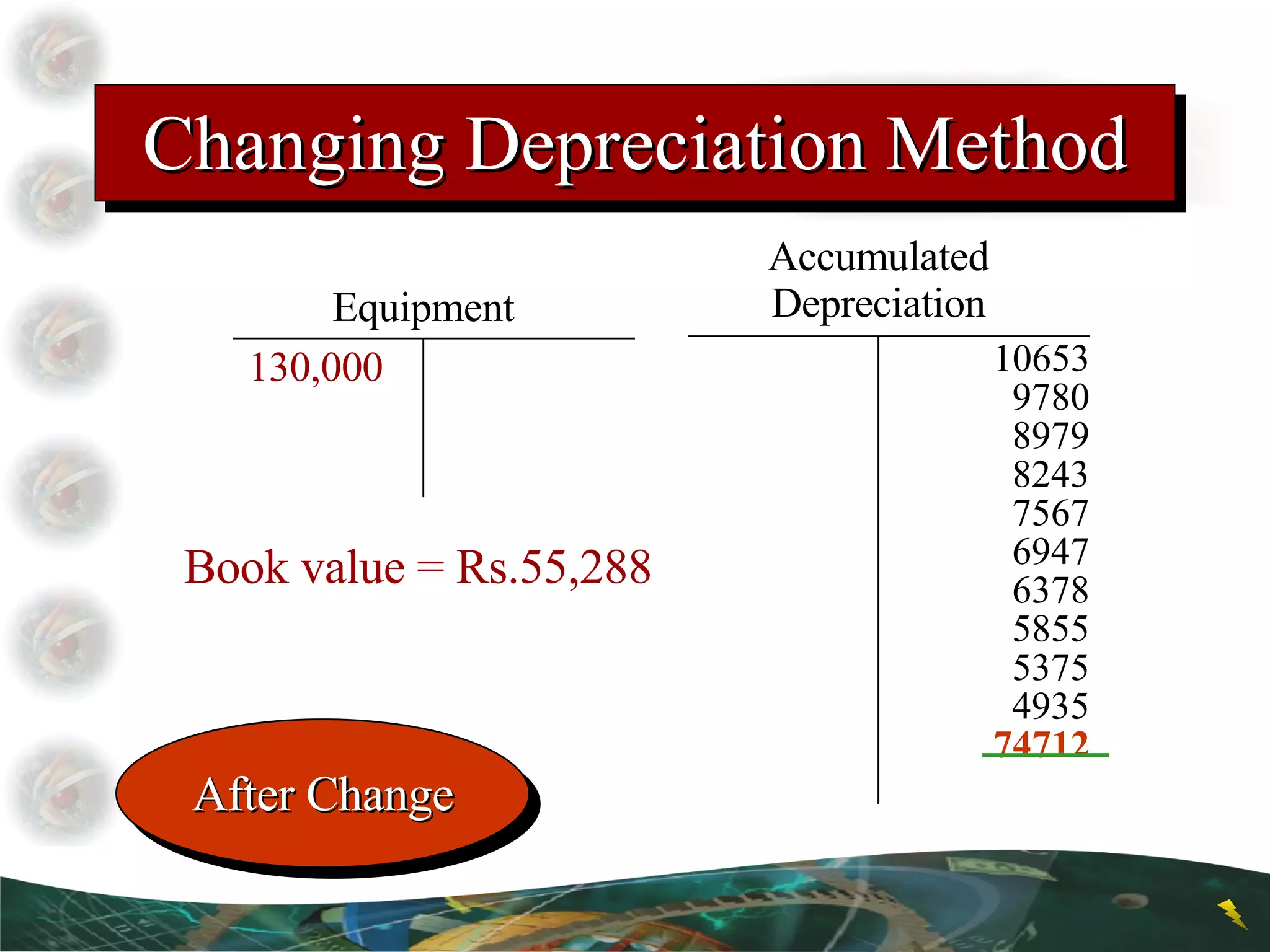
Equipment 130,000 Accumulated Depreciation 10653 9780 8979 8243 7567 6947 6378 5855 5375 4935 74712 After Change Book value = Rs.55,288 Changing Depreciation Method
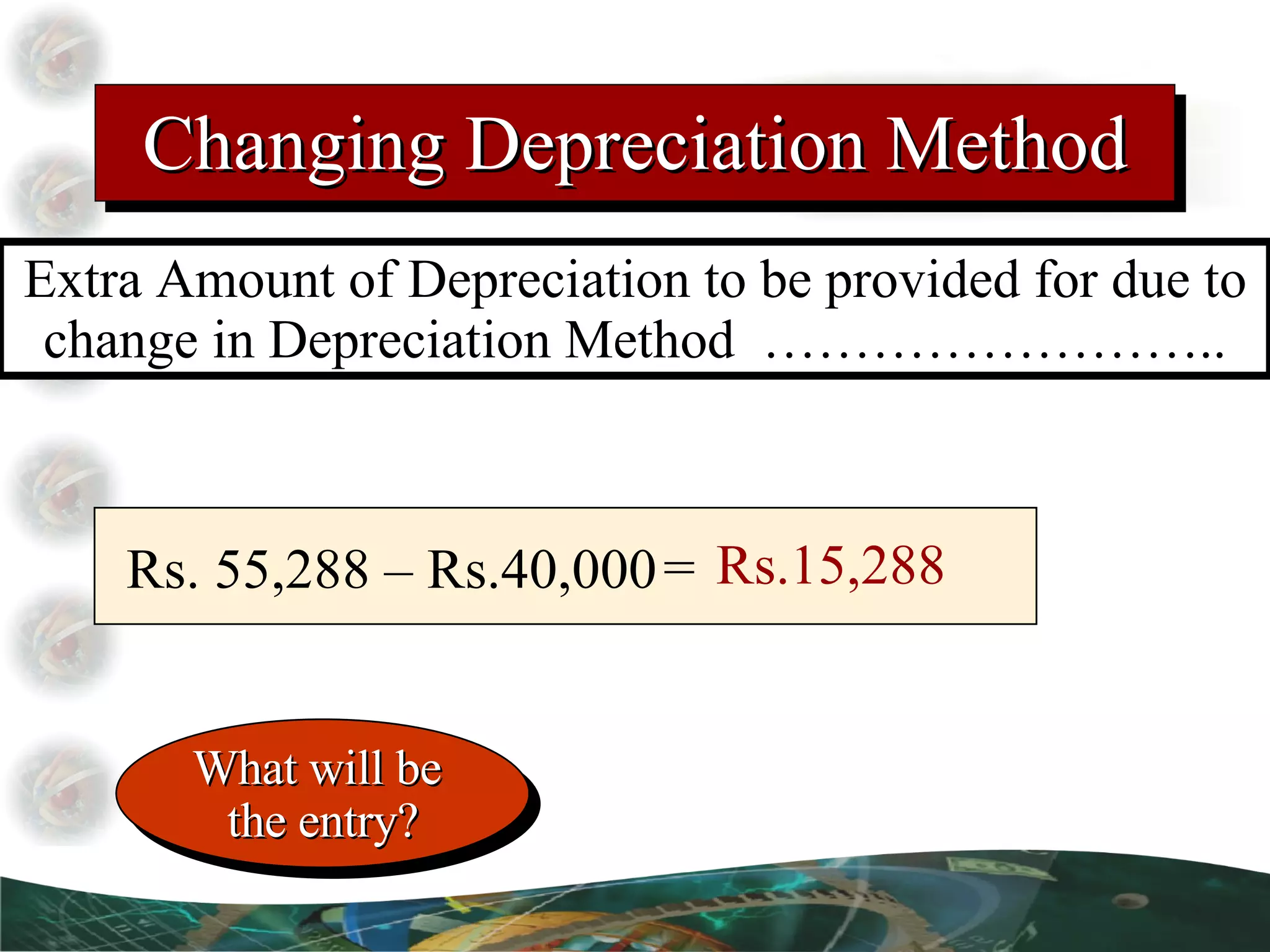
Extra Amount of Depreciation to be provided for due to change in Depreciation Method  …………………….. Changing Depreciation Method Rs. 55,288  –  Rs.40,000 Rs.15,288 = What will be  the entry?
Instead of depreciating an asset,  can I appreciate an asset ? Revaluation of Assets …?
Upward revaluation of an asset is allowed!!!! A firm may be allowed to  APPRECIATE  an asset. When an asset is revalued, then the company has to create a Revaluation Reserve Account by an amount with which the value of the asset has been increased. What will be the accounting entry for it?
Depreciation on the Revalued Asset… Revalued Amount of the asset  less  the new estimated residual value of the asset will be written off over the remaining useful life of the asset.
What you  can not do  with Revaluation Reserves? Revaluation Reserve can not be used for the following: Declaring Dividend. Declaring Bonus Shares What we can do with Revaluation Reserve? What you  can do  with Revaluation Reserves? Revaluation Reserves can be used for the following: Incremental Depreciation on upward revaluation. Decrease on subsequent downward revaluation of previously. Loss on the disposal of an upward revalued asset.
PRESENTATION AND REPORTING ABOUT DEPRECIATION IN FINANCIAL STATEMENTS … As per Indian Accounting Standards – AS 6
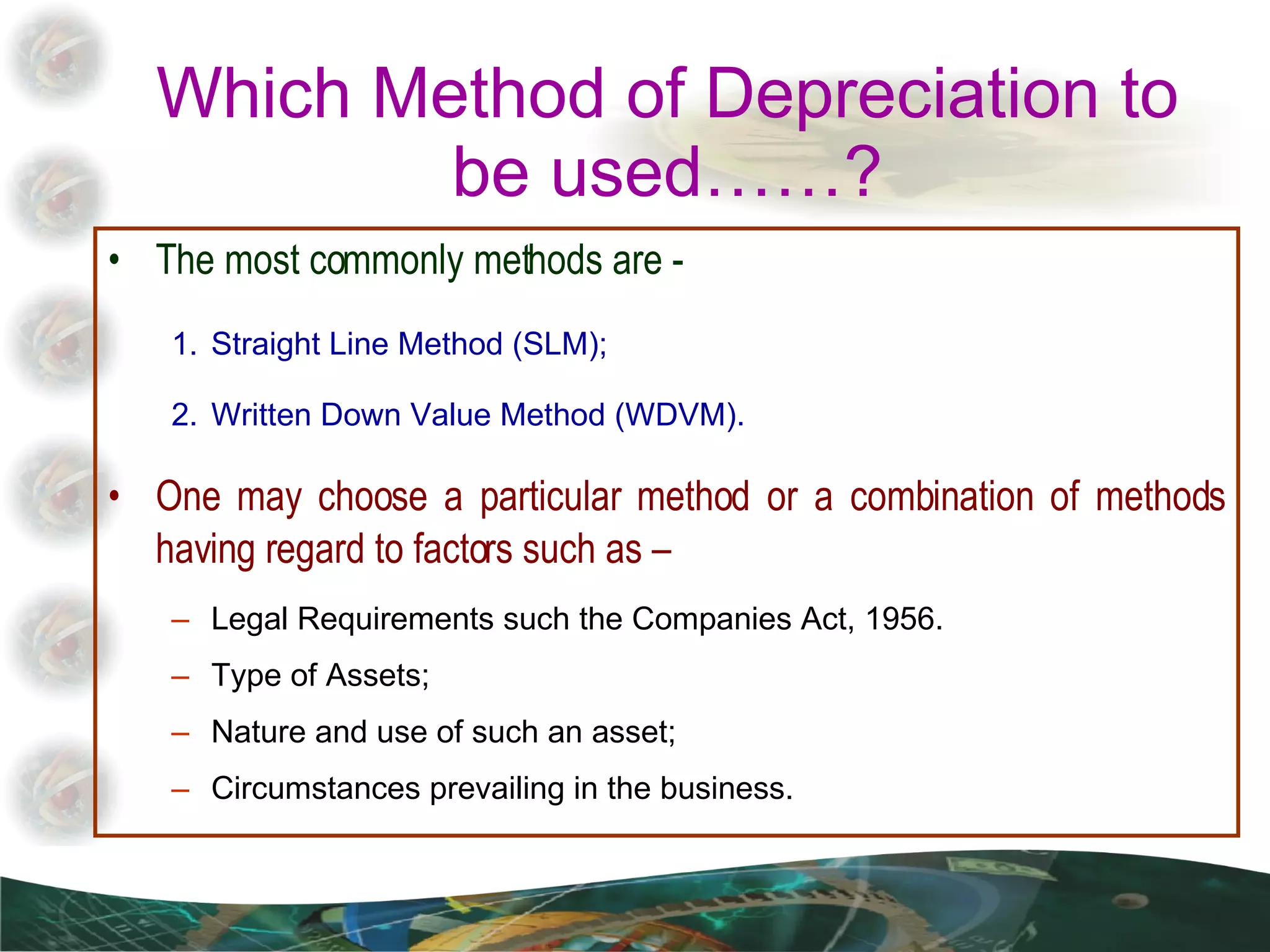
Which Method of Depreciation to be used……? The most commonly methods are - Straight Line Method (SLM); Written Down Value Method (WDVM). One may choose a particular method or a combination of methods having regard to factors such as –  Legal Requirements such the Companies Act, 1956. Type of Assets; Nature and use of such an asset; Circumstances prevailing in the business.
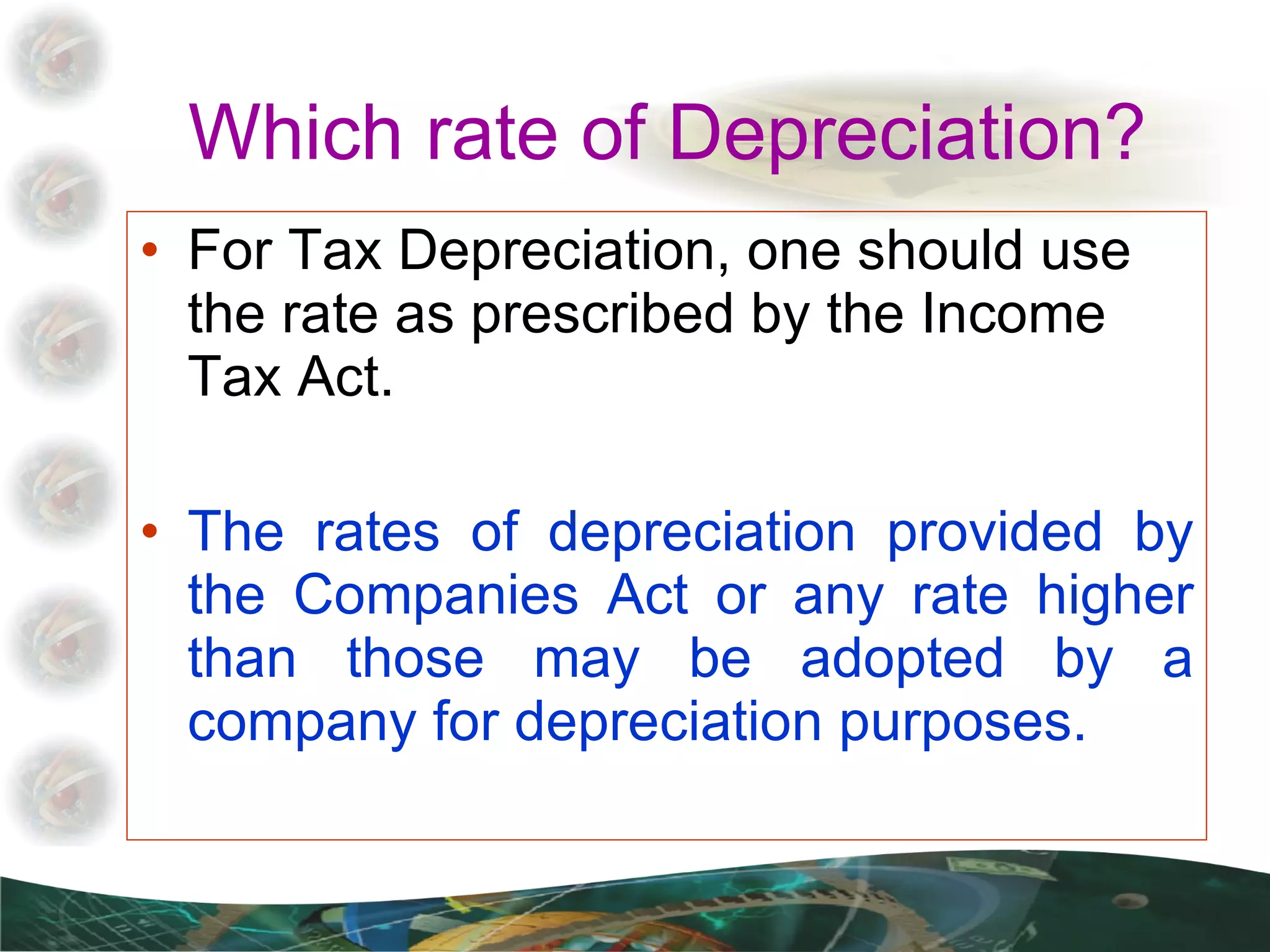
Which rate of Depreciation? For Tax Depreciation, one should use the rate as prescribed by the Income Tax Act. The rates of depreciation provided by the Companies Act or any rate higher than those may be adopted by a company for depreciation purposes.
Presentation in Balance Sheet… BALANCE SHEET AS AT … Application of Funds Gross Block Less:  Depreciation   Net Block xxxxx xxxxx xxxxx
The  depreciable amount  of a depreciable asset should be allocated on a systematic basis to each accounting period during the useful life of the asset. The following information should be disclosed in the financial statements: the historical cost or other amount substituted for historical cost of each class of depreciable assets; total depreciation for the period for each class of assets;  the related accumulated depreciation. depreciation methods used; and any change thereof, along with their effects if material; depreciation rates or the useful lives of the assets, if they are different from the principal rates specified in the statute governing the enterprise. Where depreciable assets are disposed of, discarded, demolished or destroyed, the net surplus or deficiency, if material, is disclosed separately. Disclosures…….
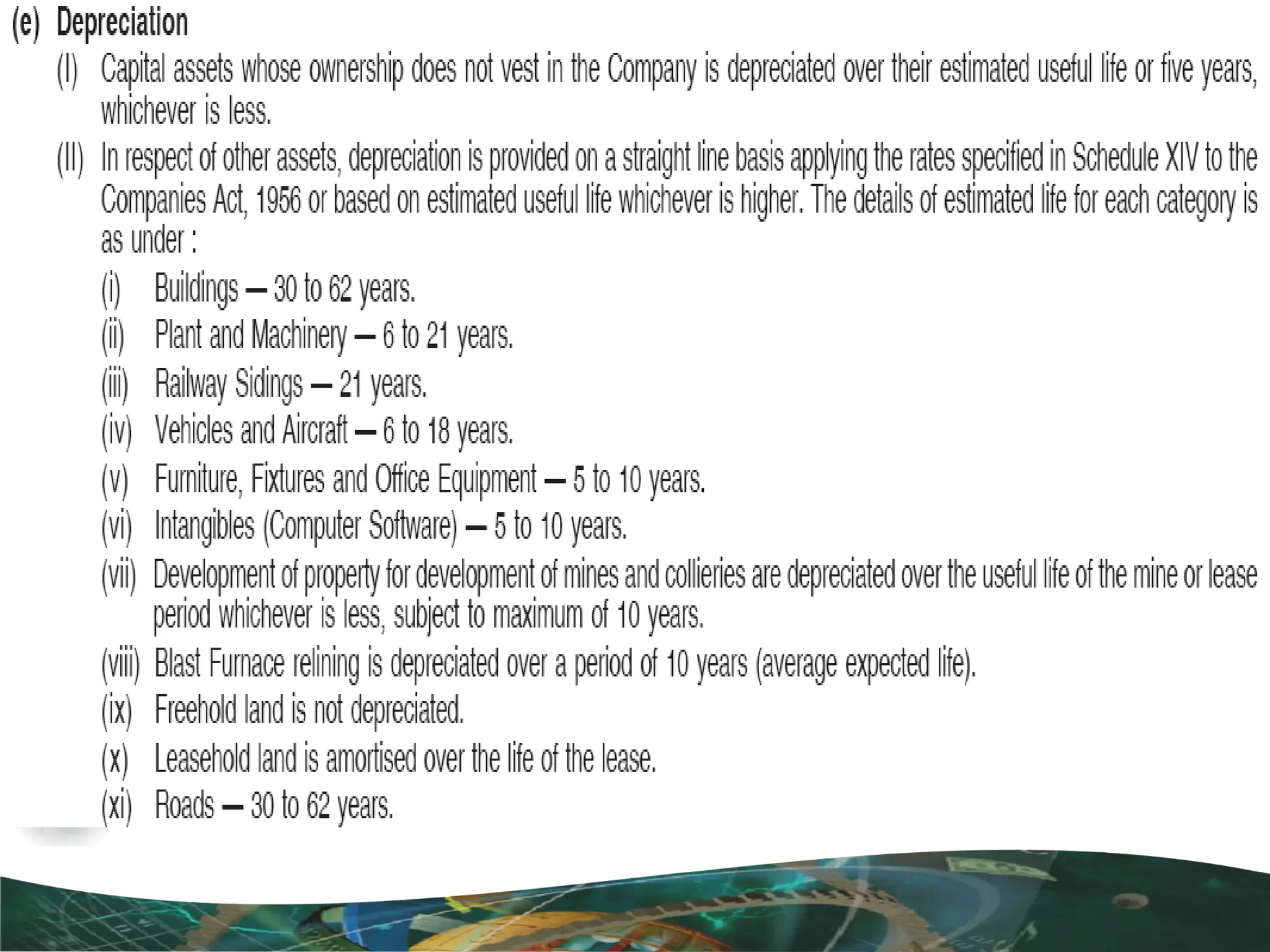
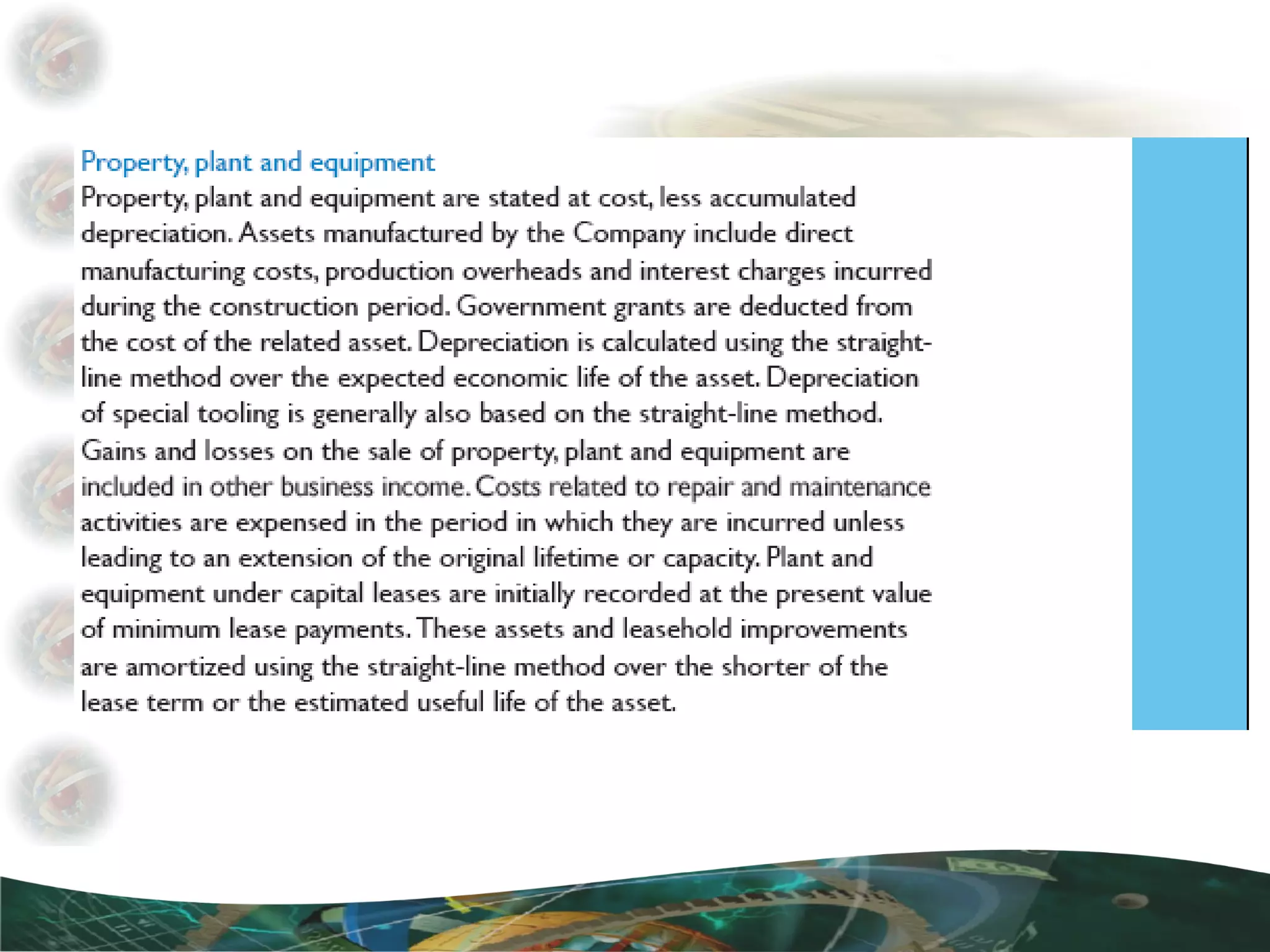
Disclosures by Indian Companies in their Financial Statements……
 
 
Disclosure in Balance sheet
 
 
Disclosure in Balance sheet
COMPARATIVE ANALYSIS – AS, US GAAP, IAS/IFRS
Methods of Depreciation… AS, US GAAP and IAS ---- all are allowing companies to use any method  of depreciation – Straight Line, Written Down, Unit-of-Production and Sum-of Years-Digits.
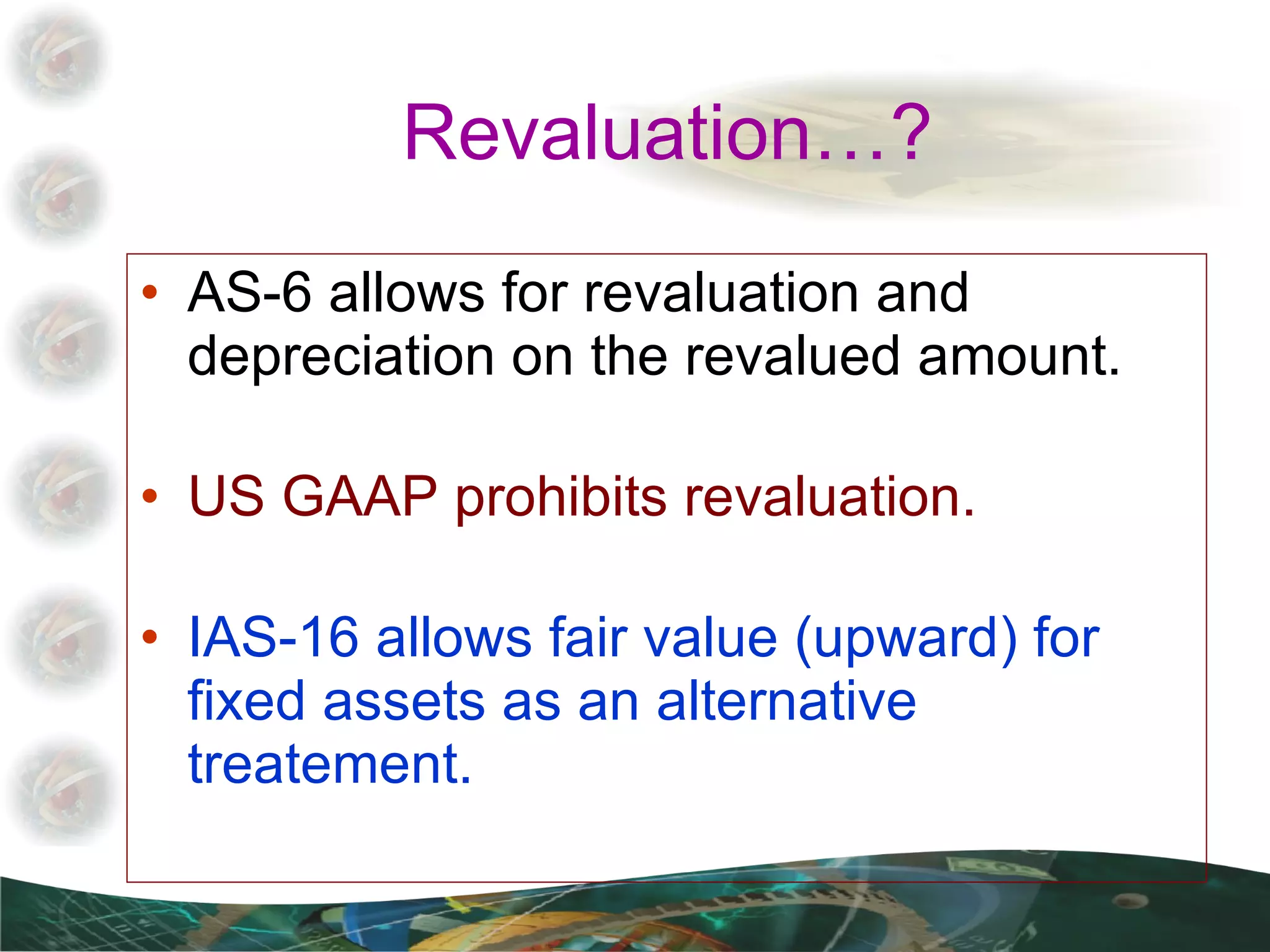
Revaluation…? AS-6 allows for revaluation and depreciation on the revalued amount. US GAAP prohibits revaluation. IAS-16 allows fair value (upward) for fixed assets as an alternative treatement.
Change in Depreciation Method  …? A change in depreciation method  under AS-6 is treated as change in the Accounting Policy and should be reported accordingly. US GAAP also treats change in the method  of depreciation as change in Accounting Policy. IAS-16 treats it as a change in the estimate of depreciation amount.
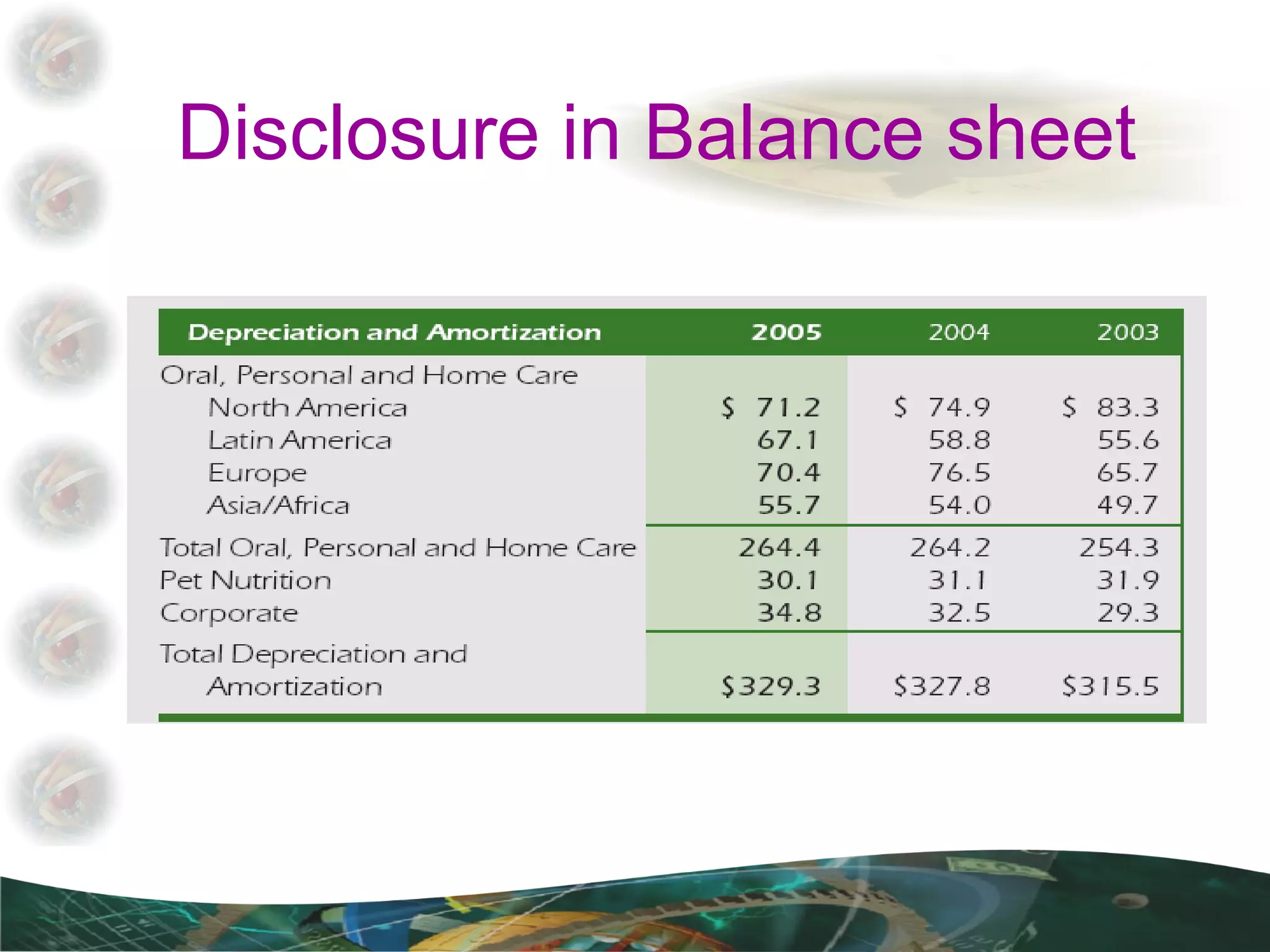
Disclosures by Foreign Companies in their Financial Statements……
 
 
Disclosure in Balance sheet
 
 
Disclosure in Balance sheet
With this, we come to an end of the TOPIC on depreciation .!!! The End
I hope that it has not depreciated your knowledge but in fact, has  APPRECIATED  the same!!!!
What NEXT…????

Depreciation 3

  • 1.
    Hoping that weare getting enough light on DEPRECIATION …
  • 2.
    We have understoodenough about ACCOUNTING FOR DEPRECIATION
  • 3.
    And, now wego for some more INTERESTING thing about depreciation…
  • 4.
    … provide forproportional amount of depreciation. What should be amount of depreciation on an asset acquired during the year?
  • 5.
  • 6.
    Revising Depreciation EstimatesA machine purchased for Rs.130,000 was originally estimated to have a useful life of 30 years and a residual value of Rs.10,000. The asset has been depreciated for ten years using the straight- line method. Annual Depreciation = Rs.4,000 per year Rs.130,000 – Rs.10,000 30 years
  • 7.
    Equipment 130,000 AccumulatedDepreciation 4,000 4,000 4,000 4,000 4,000 4,000 4,000 4,000 4,000 4,000 40,000 Before revising Book value = Rs.90,000 Revising Depreciation Estimates
  • 8.
    During the eleventhyear, it is estimated that the remaining useful life is 25 years (rather than 20) and that the revised estimated residual value is Rs.5,000. Revising Depreciation Estimates Book value – revised residual value Revised estimated remaining life Rs.90,000 – Rs.5,000 25 years Rs.3,400 revised annual depreciation =
  • 9.
    Changing the Methodof Depreciation
  • 10.
    When can acompany change the method of Depreciation ? A change from one method of providing depreciation to another is made only If the adoption of the new method is required by statute; or For compliance with an accounting standard; or If it is considered that the change would result in a more appropriate preparation or presentation of the financial statements of the enterprise.
  • 11.
    How to accountfor the impact of change in the method of depreciation? When a change in the method of depreciation is made, depreciation is recalculated in accordance with the new method from the date of the asset coming into use. The deficiency or surplus arising from retrospective recomputation of depreciation in accordance with the new method is adjusted in the accounts in the year in which the method of depreciation is changed. In case the change in the method results in deficiency in depreciation in respect of past years, the deficiency is charged in the statement of profit and loss. In case the change in the method results in surplus, the surplus is credited to the statement of profit and loss. Such a change is treated as a change in accounting policy and its effect is quantified and disclosed.
  • 12.
    Changing Depreciation MethodA machine purchased for Rs.130,000 was originally estimated to have a useful life of 30 years and a residual value of Rs.10,000. The asset has been depreciated for ten years using the straight- line method. Annual Depreciation = Rs.4,000 per year Rs.130,000 – Rs.10,000 30 years
  • 13.
    Equipment 130,000 AccumulatedDepreciation 4,000 4,000 4,000 4,000 4,000 4,000 4,000 4,000 4,000 4,000 40,000 Before Change Book value = Rs.90,000 Changing Depreciation Method
  • 14.
    Now, suppose itis decide that… … the method of depreciation will be Written Down Value Method instead of Straight Line Method .
  • 15.
    Equipment 130,000 AccumulatedDepreciation 10653 9780 8979 8243 7567 6947 6378 5855 5375 4935 74712 After Change Book value = Rs.55,288 Changing Depreciation Method
  • 16.
    Extra Amount ofDepreciation to be provided for due to change in Depreciation Method …………………….. Changing Depreciation Method Rs. 55,288 – Rs.40,000 Rs.15,288 = What will be the entry?
  • 17.
    Instead of depreciatingan asset, can I appreciate an asset ? Revaluation of Assets …?
  • 18.
    Upward revaluation ofan asset is allowed!!!! A firm may be allowed to APPRECIATE an asset. When an asset is revalued, then the company has to create a Revaluation Reserve Account by an amount with which the value of the asset has been increased. What will be the accounting entry for it?
  • 19.
    Depreciation on theRevalued Asset… Revalued Amount of the asset less the new estimated residual value of the asset will be written off over the remaining useful life of the asset.
  • 20.
    What you can not do with Revaluation Reserves? Revaluation Reserve can not be used for the following: Declaring Dividend. Declaring Bonus Shares What we can do with Revaluation Reserve? What you can do with Revaluation Reserves? Revaluation Reserves can be used for the following: Incremental Depreciation on upward revaluation. Decrease on subsequent downward revaluation of previously. Loss on the disposal of an upward revalued asset.
  • 21.
    PRESENTATION AND REPORTINGABOUT DEPRECIATION IN FINANCIAL STATEMENTS … As per Indian Accounting Standards – AS 6
  • 22.
    Which Method ofDepreciation to be used……? The most commonly methods are - Straight Line Method (SLM); Written Down Value Method (WDVM). One may choose a particular method or a combination of methods having regard to factors such as – Legal Requirements such the Companies Act, 1956. Type of Assets; Nature and use of such an asset; Circumstances prevailing in the business.
  • 23.
    Which rate ofDepreciation? For Tax Depreciation, one should use the rate as prescribed by the Income Tax Act. The rates of depreciation provided by the Companies Act or any rate higher than those may be adopted by a company for depreciation purposes.
  • 24.
    Presentation in BalanceSheet… BALANCE SHEET AS AT … Application of Funds Gross Block Less: Depreciation Net Block xxxxx xxxxx xxxxx
  • 25.
    The depreciableamount of a depreciable asset should be allocated on a systematic basis to each accounting period during the useful life of the asset. The following information should be disclosed in the financial statements: the historical cost or other amount substituted for historical cost of each class of depreciable assets; total depreciation for the period for each class of assets; the related accumulated depreciation. depreciation methods used; and any change thereof, along with their effects if material; depreciation rates or the useful lives of the assets, if they are different from the principal rates specified in the statute governing the enterprise. Where depreciable assets are disposed of, discarded, demolished or destroyed, the net surplus or deficiency, if material, is disclosed separately. Disclosures…….
  • 26.
    Disclosures by IndianCompanies in their Financial Statements……
  • 27.
  • 28.
  • 29.
  • 30.
  • 31.
  • 32.
  • 33.
    COMPARATIVE ANALYSIS –AS, US GAAP, IAS/IFRS
  • 34.
    Methods of Depreciation…AS, US GAAP and IAS ---- all are allowing companies to use any method of depreciation – Straight Line, Written Down, Unit-of-Production and Sum-of Years-Digits.
  • 35.
    Revaluation…? AS-6 allowsfor revaluation and depreciation on the revalued amount. US GAAP prohibits revaluation. IAS-16 allows fair value (upward) for fixed assets as an alternative treatement.
  • 36.
    Change in DepreciationMethod …? A change in depreciation method under AS-6 is treated as change in the Accounting Policy and should be reported accordingly. US GAAP also treats change in the method of depreciation as change in Accounting Policy. IAS-16 treats it as a change in the estimate of depreciation amount.
  • 37.
    Disclosures by ForeignCompanies in their Financial Statements……
  • 38.
  • 39.
  • 40.
  • 41.
  • 42.
  • 43.
  • 44.
  • 45.
    With this, wecome to an end of the TOPIC on depreciation .!!! The End
  • 46.
    I hope thatit has not depreciated your knowledge but in fact, has APPRECIATED the same!!!!
  • 47.