WELCOME BACK ...........................
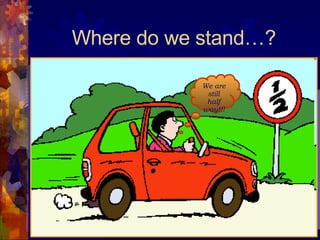
Where do we stand…? We are still half way!!!
What Next?
Accounting for Inventory  Dr. C. P. Gupta
 
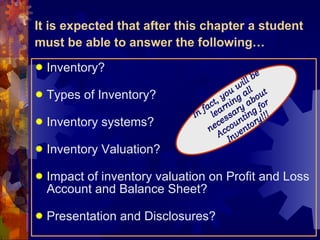
It is expected that after this chapter a student must be able to answer the following… Inventory? Types of Inventory? Inventory systems? Inventory Valuation? Impact of inventory valuation on Profit and Loss Account and Balance Sheet? Presentation and Disclosures? In fact, you will be learning all necessary about Accounting for Inventory!!!
So, let’s start with INVENTORY…
What is Inventory?
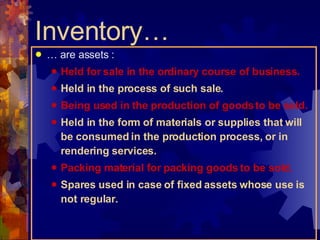
…  are assets : Held for sale in the ordinary course of business. Held in the process of such sale. Being used in the production of goods to be sold. Held in the form of materials or supplies that will be consumed in the production process, or in rendering services. Packing material for packing goods to be sold. Spares used in case of fixed assets whose use is not regular. Inventory…
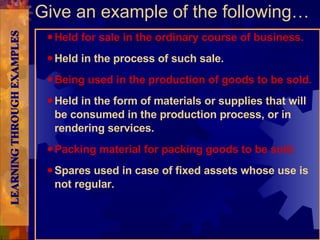
Held for sale in the ordinary course of business. Held in the process of such sale. Being used in the production of goods to be sold. Held in the form of materials or supplies that will be consumed in the production process, or in rendering services. Packing material for packing goods to be sold. Spares used in case of fixed assets whose use is not regular. Give an example of the following… LEARNING THROUGH EXAMPLES
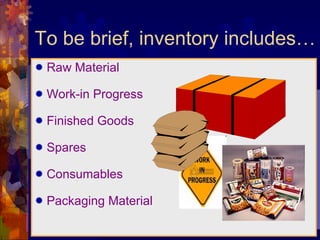
To be brief, inventory includes…  Raw Material Work-in Progress Finished Goods Spares Consumables Packaging Material
Inventory  Flow?
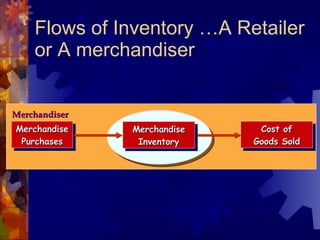
Flows of Inventory …A Retailer or A merchandiser  Merchandise Purchases Cost of Goods Sold Merchandise Inventory Merchandiser
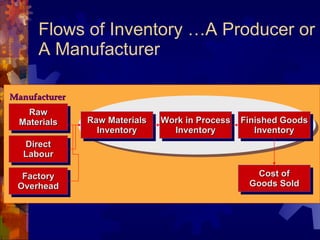
Flows of Inventory …A Producer or A Manufacturer  Direct Labour Factory Overhead Raw Materials Inventory Work in Process Inventory Finished Goods Inventory Cost of Goods Sold Manufacturer Raw Materials
Where cost flows of Inventory have impacts?
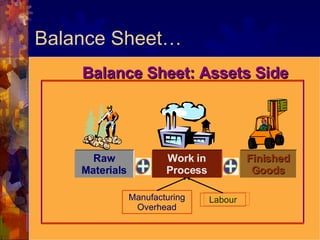
Balance Sheet… Raw Materials Work in Process Finished Goods Balance Sheet: Assets Side Manufacturing Overhead Labour
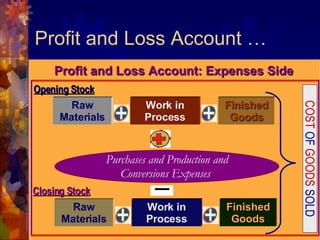
Profit and Loss Account … Profit and Loss Account: Expenses Side Opening Stock Purchases and Production and Conversions Expenses  Closing Stock COST  OF  GOODS  SOLD Raw Materials Work in Process Finished Goods Raw Materials Work in Process Finished Goods
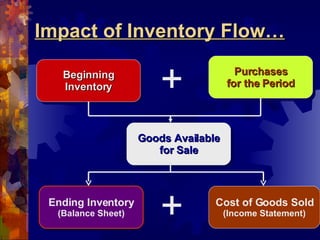
Impact of Inventory Flow… Beginning Inventory Purchases for the Period Ending Inventory (Balance Sheet) Goods Available for Sale Cost of Goods Sold (Income Statement) + +
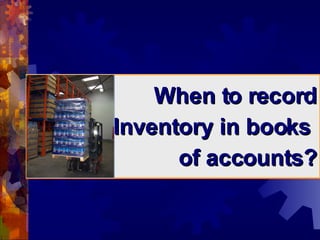
When to record Inventory in books  of accounts?
The General Rule is … …  purchases should be recorded by the buyer when the legal title to the goods passes to the buyer. But, in some cases, it is difficult to determine when the legal title is passed to the buyer?
Exception to the General Rule… Goods in transit Goods received on approval basis Consigned goods
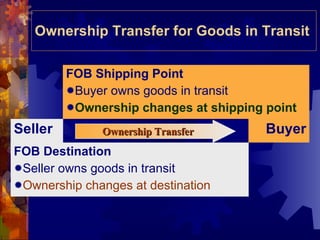
Goods in Transit… In case of Goods in Transit, legal title depends upon the shipping terms. Shipping terms : FOB (free-on-board) destination The seller is paying the shipping cost The  seller owns the inventory  until it is delivered FOB shipping point The buyer is paying the shipping cost The  buyer owns the inventory  during transit
Ownership Transfer for Goods in Transit Ownership Transfer FOB Shipping Point Buyer owns goods in transit Ownership changes at shipping point Seller Buyer FOB Destination Seller owns goods in transit Ownership changes at destination
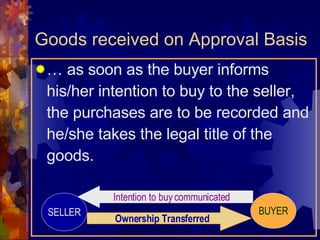
Goods received on Approval Basis …  as soon as the buyer informs his/her intention to buy to the seller, the purchases are to be recorded and he/she takes the legal title of the goods. SELLER BUYER Ownership Transferred Intention to buy communicated
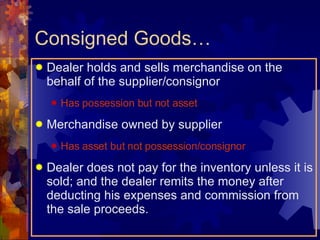
Consigned Goods… Dealer holds and sells merchandise on the behalf of the supplier/consignor Has possession but not asset Merchandise owned by supplier Has asset but not possession/consignor Dealer does not pay for the inventory unless it is sold; and the dealer remits the money after deducting his expenses and commission from the sale proceeds.
What costs to  be included  in inventory?
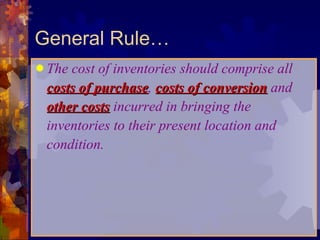
General Rule… The cost of inventories should comprise all   costs of purchase ,   costs of conversion   and   other costs   incurred in bringing the inventories to their present location and condition.
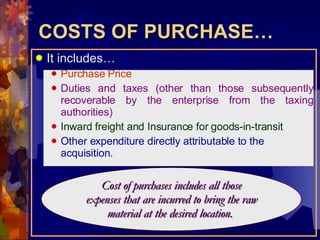
COSTS OF PURCHASE… It includes… Purchase Price Duties and taxes (other than those subsequently recoverable by the enterprise from the taxing authorities) Inward freight and Insurance for goods-in-transit Other expenditure directly attributable to the acquisition. Cost of purchases includes all those expenses that are incurred to bring the raw material at the desired location.
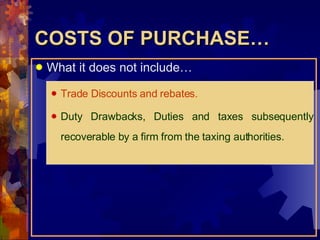
COSTS OF PURCHASE… What it does not include… Trade Discounts and rebates. Duty Drawbacks, Duties and taxes subsequently recoverable by a firm from the taxing authorities.
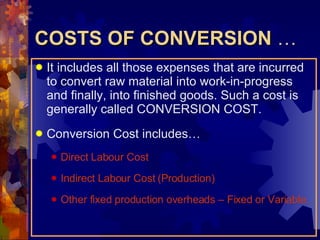
COSTS OF CONVERSION  … It includes all those expenses that are incurred to convert raw material into work-in-progress and finally, into finished goods. Such a cost is generally called CONVERSION COST. Conversion Cost includes… Direct Labour Cost Indirect Labour Cost (Production) Other fixed production overheads – Fixed or Variable.
COSTS OF CONVERSION  … Costs of Conversion do not include… Storage Costs , unless those costs are necessary in the production process prior to a further production stage. Administrative Overheads  that do not contribute to bringing the inventories to their present location and condition. Selling and Distribution Costs.
OTHER COSTS  … Other costs are included in the cost of inventories only to the extent that they are incurred in bringing the inventories to their present location and condition.
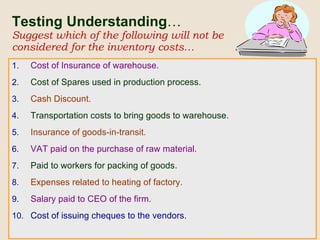
Testing Understanding … Suggest which of the following will not be considered for the inventory costs… Cost of Insurance of warehouse. Cost of Spares used in production process. Cash Discount. Transportation costs to bring goods to warehouse. Insurance of goods-in-transit. VAT paid on the purchase of raw material. Paid to workers for packing of goods. Expenses related to heating of factory. Salary paid to CEO of the firm. Cost of issuing cheques to the vendors.
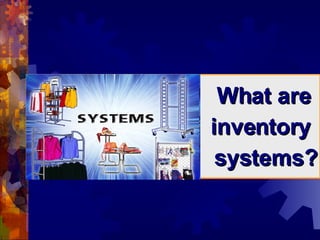
What are  inventory  systems?
The issue of Inventory System is … …  should we record transactions related to inventory  INSTANTANEOUSLY  or  PERIODICALLY ?
If we record transactions related to inventory  INSTANTANEOUSLY,  then we are using a System of Inventory which is known as … PERPETUAL INVENTORY SYSTEM
And, if we are recording  transactions related to inventory periodically then, it is called …  PERIODIC INVENTORY SYSTEM .
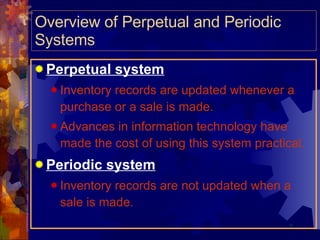
Overview of Perpetual and Periodic Systems Perpetual system Inventory records are updated whenever a purchase or a sale is made. Advances in information technology have made the cost of using this system practical. Periodic system Inventory records are not updated when a sale is made.

Inventory 1

  • 1.
  • 2.
    Where do westand…? We are still half way!!!
  • 3.
  • 4.
    Accounting for Inventory Dr. C. P. Gupta
  • 5.
  • 6.
    It is expectedthat after this chapter a student must be able to answer the following… Inventory? Types of Inventory? Inventory systems? Inventory Valuation? Impact of inventory valuation on Profit and Loss Account and Balance Sheet? Presentation and Disclosures? In fact, you will be learning all necessary about Accounting for Inventory!!!
  • 7.
    So, let’s startwith INVENTORY…
  • 8.
  • 9.
    … areassets : Held for sale in the ordinary course of business. Held in the process of such sale. Being used in the production of goods to be sold. Held in the form of materials or supplies that will be consumed in the production process, or in rendering services. Packing material for packing goods to be sold. Spares used in case of fixed assets whose use is not regular. Inventory…
  • 10.
    Held for salein the ordinary course of business. Held in the process of such sale. Being used in the production of goods to be sold. Held in the form of materials or supplies that will be consumed in the production process, or in rendering services. Packing material for packing goods to be sold. Spares used in case of fixed assets whose use is not regular. Give an example of the following… LEARNING THROUGH EXAMPLES
  • 11.
    To be brief,inventory includes… Raw Material Work-in Progress Finished Goods Spares Consumables Packaging Material
  • 12.
  • 13.
    Flows of Inventory…A Retailer or A merchandiser Merchandise Purchases Cost of Goods Sold Merchandise Inventory Merchandiser
  • 14.
    Flows of Inventory…A Producer or A Manufacturer Direct Labour Factory Overhead Raw Materials Inventory Work in Process Inventory Finished Goods Inventory Cost of Goods Sold Manufacturer Raw Materials
  • 15.
    Where cost flowsof Inventory have impacts?
  • 16.
    Balance Sheet… RawMaterials Work in Process Finished Goods Balance Sheet: Assets Side Manufacturing Overhead Labour
  • 17.
    Profit and LossAccount … Profit and Loss Account: Expenses Side Opening Stock Purchases and Production and Conversions Expenses Closing Stock COST OF GOODS SOLD Raw Materials Work in Process Finished Goods Raw Materials Work in Process Finished Goods
  • 18.
    Impact of InventoryFlow… Beginning Inventory Purchases for the Period Ending Inventory (Balance Sheet) Goods Available for Sale Cost of Goods Sold (Income Statement) + +
  • 19.
    When to recordInventory in books of accounts?
  • 20.
    The General Ruleis … … purchases should be recorded by the buyer when the legal title to the goods passes to the buyer. But, in some cases, it is difficult to determine when the legal title is passed to the buyer?
  • 21.
    Exception to theGeneral Rule… Goods in transit Goods received on approval basis Consigned goods
  • 22.
    Goods in Transit…In case of Goods in Transit, legal title depends upon the shipping terms. Shipping terms : FOB (free-on-board) destination The seller is paying the shipping cost The seller owns the inventory until it is delivered FOB shipping point The buyer is paying the shipping cost The buyer owns the inventory during transit
  • 23.
    Ownership Transfer forGoods in Transit Ownership Transfer FOB Shipping Point Buyer owns goods in transit Ownership changes at shipping point Seller Buyer FOB Destination Seller owns goods in transit Ownership changes at destination
  • 24.
    Goods received onApproval Basis … as soon as the buyer informs his/her intention to buy to the seller, the purchases are to be recorded and he/she takes the legal title of the goods. SELLER BUYER Ownership Transferred Intention to buy communicated
  • 25.
    Consigned Goods… Dealerholds and sells merchandise on the behalf of the supplier/consignor Has possession but not asset Merchandise owned by supplier Has asset but not possession/consignor Dealer does not pay for the inventory unless it is sold; and the dealer remits the money after deducting his expenses and commission from the sale proceeds.
  • 26.
    What costs to be included in inventory?
  • 27.
    General Rule… Thecost of inventories should comprise all costs of purchase , costs of conversion and other costs incurred in bringing the inventories to their present location and condition.
  • 28.
    COSTS OF PURCHASE…It includes… Purchase Price Duties and taxes (other than those subsequently recoverable by the enterprise from the taxing authorities) Inward freight and Insurance for goods-in-transit Other expenditure directly attributable to the acquisition. Cost of purchases includes all those expenses that are incurred to bring the raw material at the desired location.
  • 29.
    COSTS OF PURCHASE…What it does not include… Trade Discounts and rebates. Duty Drawbacks, Duties and taxes subsequently recoverable by a firm from the taxing authorities.
  • 30.
    COSTS OF CONVERSION … It includes all those expenses that are incurred to convert raw material into work-in-progress and finally, into finished goods. Such a cost is generally called CONVERSION COST. Conversion Cost includes… Direct Labour Cost Indirect Labour Cost (Production) Other fixed production overheads – Fixed or Variable.
  • 31.
    COSTS OF CONVERSION … Costs of Conversion do not include… Storage Costs , unless those costs are necessary in the production process prior to a further production stage. Administrative Overheads that do not contribute to bringing the inventories to their present location and condition. Selling and Distribution Costs.
  • 32.
    OTHER COSTS … Other costs are included in the cost of inventories only to the extent that they are incurred in bringing the inventories to their present location and condition.
  • 33.
    Testing Understanding …Suggest which of the following will not be considered for the inventory costs… Cost of Insurance of warehouse. Cost of Spares used in production process. Cash Discount. Transportation costs to bring goods to warehouse. Insurance of goods-in-transit. VAT paid on the purchase of raw material. Paid to workers for packing of goods. Expenses related to heating of factory. Salary paid to CEO of the firm. Cost of issuing cheques to the vendors.
  • 34.
    What are inventory systems?
  • 35.
    The issue ofInventory System is … … should we record transactions related to inventory INSTANTANEOUSLY or PERIODICALLY ?
  • 36.
    If we recordtransactions related to inventory INSTANTANEOUSLY, then we are using a System of Inventory which is known as … PERPETUAL INVENTORY SYSTEM
  • 37.
    And, if weare recording transactions related to inventory periodically then, it is called … PERIODIC INVENTORY SYSTEM .
  • 38.
    Overview of Perpetualand Periodic Systems Perpetual system Inventory records are updated whenever a purchase or a sale is made. Advances in information technology have made the cost of using this system practical. Periodic system Inventory records are not updated when a sale is made.