Product Life cycle cost is defined as the “total
cost throughout its life including planning,
designing, developing, operating and
maintaining & any other costs directly
attributable to owning/using the asset”.
Product Life cycle costing(PLCC) is a
system that tracks and accumulates all costs
and revenues attribute between to cost object
from its invention to its abandonment.
• By using LCC, total cost of the product can be
calculated over the total span of product life
cycle
• Category of LCC of Capital assets :
•Initial costs ( Design & development cost,
Investment on product, or cost of equipment,
Installation cost)
•Operation & Maintenance Cost (Labour
cost, Energy cost, Spare & maintenance cost,
Raw material cost)
• Product Life Cycle Cost (PLCC) concept become
popular in the 1960s.
• PLCC was used by the United States Defense
agency, as an instrument to improve the cost
effectiveness of equipment procurement.
• In 1996 international electro technical
commission published the standard ( IEC 60300),
how to carry out life cycle costing in an
organisation
• This standard was revised in July 2004
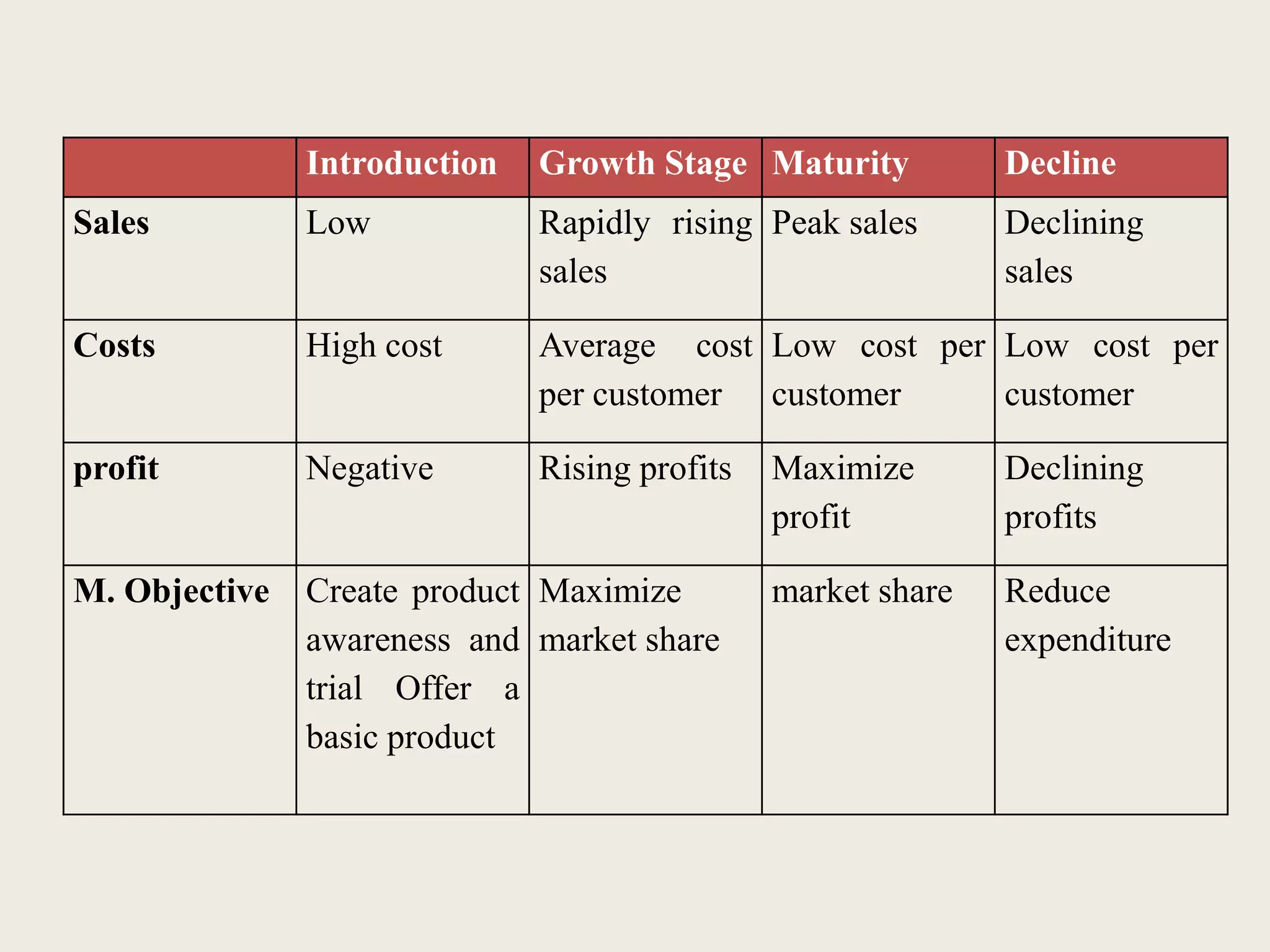
Introduction Growth Stage Maturity Decline
Sales Low Rapidly rising
sales
Peak sales Declining
sales
Costs High cost Average cost
per customer
Low cost per
customer
Low cost per
customer
profit Negative Rising profits Maximize
profit
Declining
profits
M. Objective Create product
awareness and
trial Offer a
basic product
Maximize
market share
market share Reduce
expenditure
• life cycle costing involves tracing of costs
and revenues of throughout its life cycle.
• costs for each individual product are
compared with total product revenue
• Using different strategic actions at different
stages.
• It help to finding new uses or users or by
increasing the consumption of the present
users.
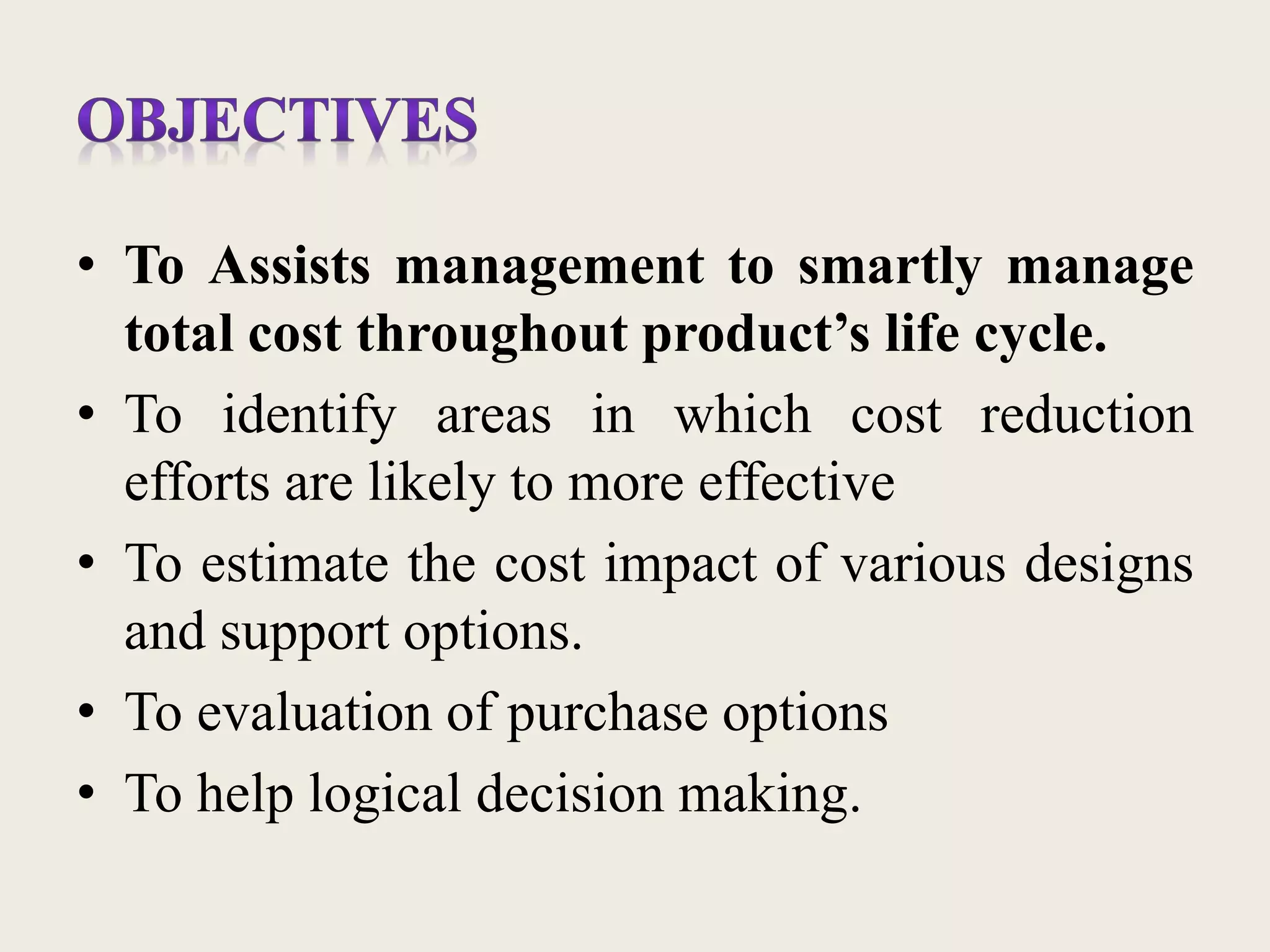
• To Assists management to smartly manage
total cost throughout product’s life cycle.
• To identify areas in which cost reduction
efforts are likely to more effective
• To estimate the cost impact of various designs
and support options.
• To evaluation of purchase options
• To help logical decision making.
• To help logical decision making process.(Better
decisions should follow from a more accurate and
realistic assessment of revenues and costs)
• To evaluate and compare alternative options.
• With help of PLLC organization can assess the
economic viability of projects or products.
• To evaluate operating and maintenance cost.
• Application of PLCC techniques provides
management with an improved awareness of the
factors that drive cost and the resources required
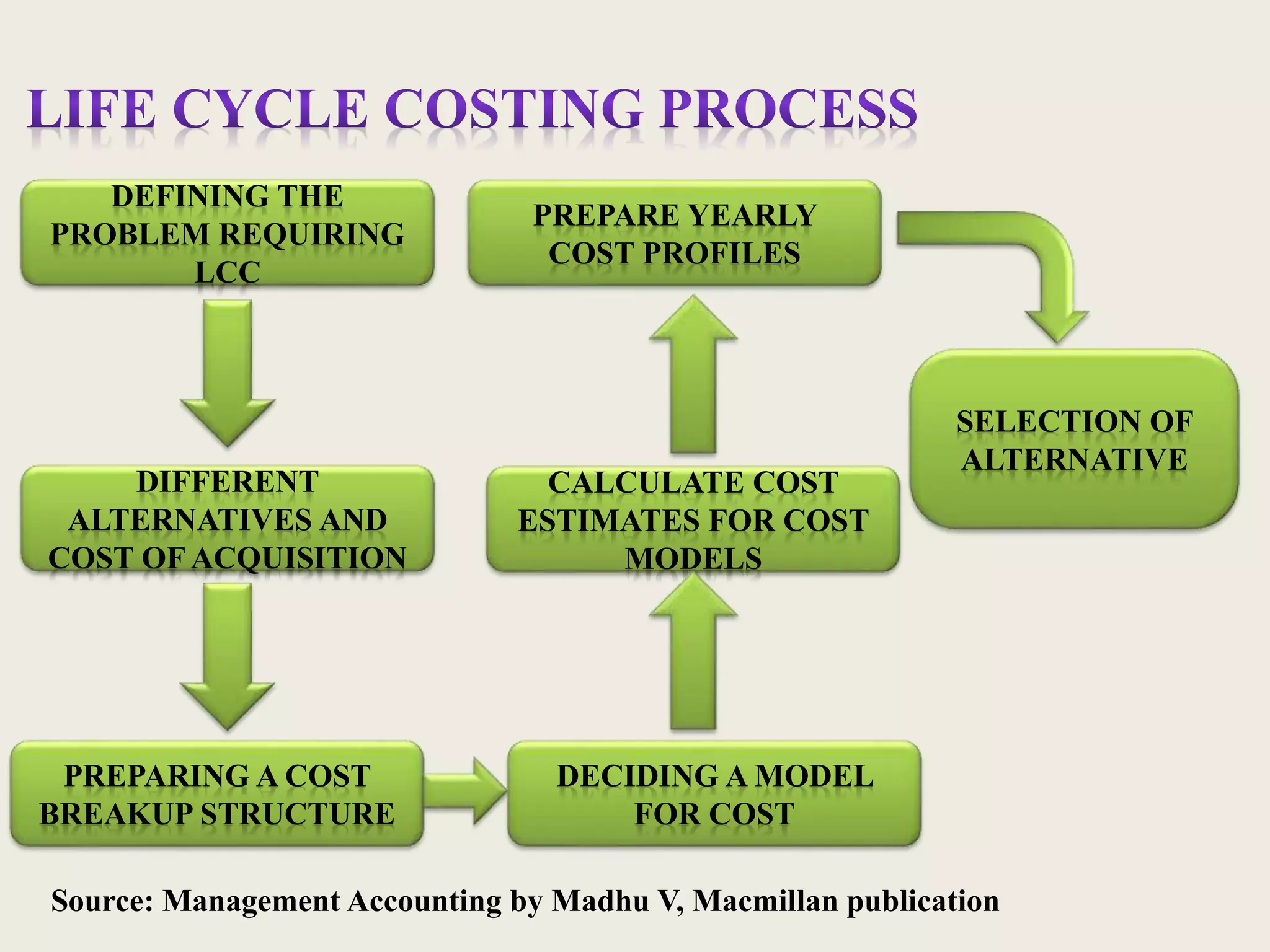
DEFINING THE
PROBLEM REQUIRING
LCC
SELECTION OF
ALTERNATIVE
DECIDING A MODEL
FOR COST
DIFFERENT
ALTERNATIVES AND
COST OF ACQUISITION
PREPARING A COST
BREAKUP STRUCTURE
PREPARE YEARLY
COST PROFILES
CALCULATE COST
ESTIMATES FOR COST
MODELS
Source: Management Accounting by Madhu V, Macmillan publication
Traditional Method PLCC Method
It reports cost and revenues on a calendar
basis ( monthly, quarterly and annually .
It involves tracing cost and revenues on a
product or services over several calendar
period, over its lifespan
Takes into consideration only the costs
concerning production in product costing.
Takes into consideration all costs
(including period expenses) that can be
related to the product in product costing.
Attaches importance to the control of the
costs only in the production phase.
Attaches importance to cost management
from the development phase onward.
Is based on periodical reporting. Is based on product life cycle reporting.
total profitability of a product over its
entire life becomes difficult to determine.
It enables a product’s true profitability to
be determined at the end of the economic
life
• LCC is a tool which helps makes logical business
decision
• Using LCC company can:
• Evaluate and compare among different alternatives
• Assess economic viability of project
• Allows company to take earlier action to generate
revenue or to generate revenue or to lower costs than
otherwise might be considered
• LCC helps manager to understand acquisition cost Vs
operating and support costs
Period production
(units)
Fixed cost
per annum
(Rs.)
Variable
cost @ Rs .
2 (Rs.)
Total cost
(Rs.)
Cost per
unit (Rs)
1 10000 50000 20000 70000 7.00
2 20000 50000 40000 90000 4.50
3 100000 50000 200000 250000 2.50
4 30000 50000 60000 110000 3.67
5 5000 50000 10000 60000 12.00
165000 250000 330000 580000 3.52
Source: Cost Accounting T&P by Banerjee B, PHI learning Private limited
Period production
(units)
Fixed cost
per annum
(Rs.)
Variable
cost (Rs.)
Total cost
(Rs.)
Cost per
unit (Rs)
1 10000 50000 21000 (2.1) 71000 7.1
2 20000 50000 38000 (1.9) 88000 4.4
3 100000 50000 150000
(1.5)
200000 2.00
4 30000 50000 52000
(1.73)
102000 3.4
5 5000 50000 14000 (2.8) 64000 12.8
165000 250000 275000 525000 3.18
Hedge limited (3.18)
Source: Cost Accounting T&P by Banerjee B, PHI learning Private limited
Hedge limited ( LCC)
particular cost
Variable cost 275000
Fixed cost 250000
Total cost during product life 525000
total production 165000 units
Average cost per unit 3.18
Sales (5 per units) 825000
Profit( s-tc) 300000
Source: Cost Accounting T&P by Banerjee B, PHI learning Private limited
Tarpo limited (traditional costing)
Particular Cost
Variable cost 350000
Fixed cost 250000
Total cost during product life 650000
total production 165000 units
Average cost per unit 3.93
Sales (5 per units) 825000
Profit(s-tc) 225000
Advantages of life cycle costing
• Evaluating of competing purchase option
• Improved awareness of cost drivers and total
cost
• Improved forecasting
• Performance trade off against cost
Disadvantages of LCC
• Costly
• Time consuming process
Life cycle costing

Life cycle costing

  • 2.
    Product Life cyclecost is defined as the “total cost throughout its life including planning, designing, developing, operating and maintaining & any other costs directly attributable to owning/using the asset”. Product Life cycle costing(PLCC) is a system that tracks and accumulates all costs and revenues attribute between to cost object from its invention to its abandonment.
  • 3.
    • By usingLCC, total cost of the product can be calculated over the total span of product life cycle • Category of LCC of Capital assets : •Initial costs ( Design & development cost, Investment on product, or cost of equipment, Installation cost) •Operation & Maintenance Cost (Labour cost, Energy cost, Spare & maintenance cost, Raw material cost)
  • 4.
    • Product LifeCycle Cost (PLCC) concept become popular in the 1960s. • PLCC was used by the United States Defense agency, as an instrument to improve the cost effectiveness of equipment procurement. • In 1996 international electro technical commission published the standard ( IEC 60300), how to carry out life cycle costing in an organisation • This standard was revised in July 2004
  • 6.
    Introduction Growth StageMaturity Decline Sales Low Rapidly rising sales Peak sales Declining sales Costs High cost Average cost per customer Low cost per customer Low cost per customer profit Negative Rising profits Maximize profit Declining profits M. Objective Create product awareness and trial Offer a basic product Maximize market share market share Reduce expenditure
  • 7.
    • life cyclecosting involves tracing of costs and revenues of throughout its life cycle. • costs for each individual product are compared with total product revenue • Using different strategic actions at different stages. • It help to finding new uses or users or by increasing the consumption of the present users.
  • 8.
    • To Assistsmanagement to smartly manage total cost throughout product’s life cycle. • To identify areas in which cost reduction efforts are likely to more effective • To estimate the cost impact of various designs and support options. • To evaluation of purchase options • To help logical decision making.
  • 9.
    • To helplogical decision making process.(Better decisions should follow from a more accurate and realistic assessment of revenues and costs) • To evaluate and compare alternative options. • With help of PLLC organization can assess the economic viability of projects or products. • To evaluate operating and maintenance cost. • Application of PLCC techniques provides management with an improved awareness of the factors that drive cost and the resources required
  • 10.
    DEFINING THE PROBLEM REQUIRING LCC SELECTIONOF ALTERNATIVE DECIDING A MODEL FOR COST DIFFERENT ALTERNATIVES AND COST OF ACQUISITION PREPARING A COST BREAKUP STRUCTURE PREPARE YEARLY COST PROFILES CALCULATE COST ESTIMATES FOR COST MODELS Source: Management Accounting by Madhu V, Macmillan publication
  • 12.
    Traditional Method PLCCMethod It reports cost and revenues on a calendar basis ( monthly, quarterly and annually . It involves tracing cost and revenues on a product or services over several calendar period, over its lifespan Takes into consideration only the costs concerning production in product costing. Takes into consideration all costs (including period expenses) that can be related to the product in product costing. Attaches importance to the control of the costs only in the production phase. Attaches importance to cost management from the development phase onward. Is based on periodical reporting. Is based on product life cycle reporting. total profitability of a product over its entire life becomes difficult to determine. It enables a product’s true profitability to be determined at the end of the economic life
  • 13.
    • LCC isa tool which helps makes logical business decision • Using LCC company can: • Evaluate and compare among different alternatives • Assess economic viability of project • Allows company to take earlier action to generate revenue or to generate revenue or to lower costs than otherwise might be considered • LCC helps manager to understand acquisition cost Vs operating and support costs
  • 14.
    Period production (units) Fixed cost perannum (Rs.) Variable cost @ Rs . 2 (Rs.) Total cost (Rs.) Cost per unit (Rs) 1 10000 50000 20000 70000 7.00 2 20000 50000 40000 90000 4.50 3 100000 50000 200000 250000 2.50 4 30000 50000 60000 110000 3.67 5 5000 50000 10000 60000 12.00 165000 250000 330000 580000 3.52 Source: Cost Accounting T&P by Banerjee B, PHI learning Private limited
  • 15.
    Period production (units) Fixed cost perannum (Rs.) Variable cost (Rs.) Total cost (Rs.) Cost per unit (Rs) 1 10000 50000 21000 (2.1) 71000 7.1 2 20000 50000 38000 (1.9) 88000 4.4 3 100000 50000 150000 (1.5) 200000 2.00 4 30000 50000 52000 (1.73) 102000 3.4 5 5000 50000 14000 (2.8) 64000 12.8 165000 250000 275000 525000 3.18 Hedge limited (3.18) Source: Cost Accounting T&P by Banerjee B, PHI learning Private limited
  • 16.
    Hedge limited (LCC) particular cost Variable cost 275000 Fixed cost 250000 Total cost during product life 525000 total production 165000 units Average cost per unit 3.18 Sales (5 per units) 825000 Profit( s-tc) 300000 Source: Cost Accounting T&P by Banerjee B, PHI learning Private limited
  • 17.
    Tarpo limited (traditionalcosting) Particular Cost Variable cost 350000 Fixed cost 250000 Total cost during product life 650000 total production 165000 units Average cost per unit 3.93 Sales (5 per units) 825000 Profit(s-tc) 225000
  • 18.
    Advantages of lifecycle costing • Evaluating of competing purchase option • Improved awareness of cost drivers and total cost • Improved forecasting • Performance trade off against cost Disadvantages of LCC • Costly • Time consuming process