“Formulation of Dentifrices”
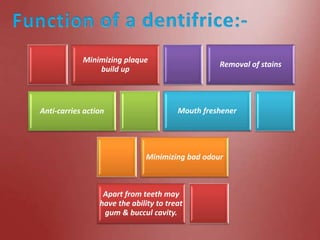
Minimizing plaque
build up
Anti-carries action
Removal of stains
Mouth freshener
Minimizing bad odour
Apart from teeth may
have the ability to treat
gum & buccul cavity.
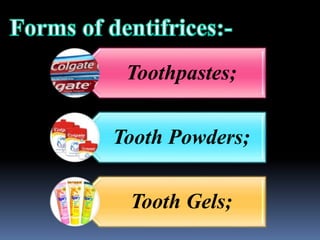
Toothpastes;
Tooth Powders;
Tooth Gels;
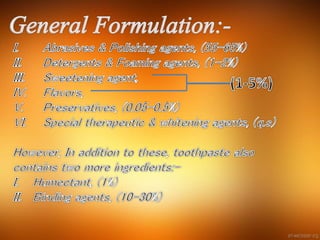
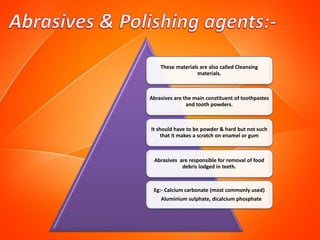
These materials are also called Cleansing
materials.
Abrasives are the main constituent of toothpastes
and tooth powders.
It should have to be powder & hard but not such
that it makes a scratch on enamel or gum
Abrasives are responsible for removal of food
debris lodged in teeth.
Eg:- Calcium carbonate (most commonly used)
Aluminium sulphate, dicalcium phosphate
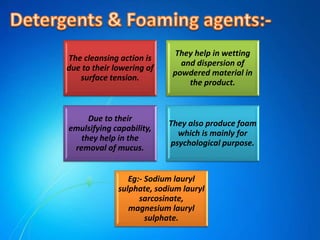
The cleansing action is
due to their lowering of
surface tension.
They help in wetting
and dispersion of
powdered material in
the product.
Due to their
emulsifying capability,
they help in the
removal of mucus.
They also produce foam
which is mainly for
psychological purpose.
Eg:- Sodium lauryl
sulphate, sodium lauryl
sarcosinate,
magnesium lauryl
sulphate.
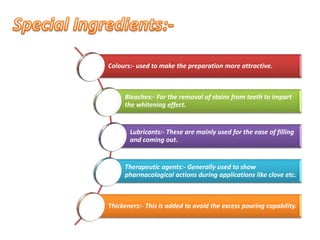
Colours:- used to make the preparation more attractive.
Bleaches:- For the removal of stains from teeth to impart
the whitening effect.
Lubricants:- These are mainly used for the ease of filling
and coming out.
Therapeutic agents:- Generally used to show
pharmacological actions during applications like clove etc.
Thickeners:- This is added to avoid the excess pouring capability.
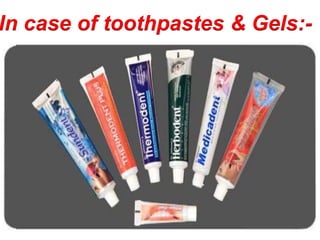
In case of toothpastes & Gels:-
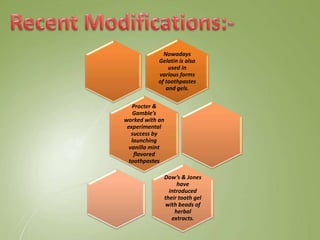
Nowadays
Gelatin is also
used in
various forms
of toothpastes
and gels.
Procter &
Gamble’s
worked with an
experimental
success by
launching
vanilla mint
flavored
toothpastes
Dow’s & Jones
have
introduced
their tooth gel
with beads of
herbal
extracts.
Dentifrices & “Formulation of Dentifrices”

Dentifrices & “Formulation of Dentifrices”

  • 1.
  • 3.
    Minimizing plaque build up Anti-carriesaction Removal of stains Mouth freshener Minimizing bad odour Apart from teeth may have the ability to treat gum & buccul cavity.
  • 4.
  • 6.
    These materials arealso called Cleansing materials. Abrasives are the main constituent of toothpastes and tooth powders. It should have to be powder & hard but not such that it makes a scratch on enamel or gum Abrasives are responsible for removal of food debris lodged in teeth. Eg:- Calcium carbonate (most commonly used) Aluminium sulphate, dicalcium phosphate
  • 7.
    The cleansing actionis due to their lowering of surface tension. They help in wetting and dispersion of powdered material in the product. Due to their emulsifying capability, they help in the removal of mucus. They also produce foam which is mainly for psychological purpose. Eg:- Sodium lauryl sulphate, sodium lauryl sarcosinate, magnesium lauryl sulphate.
  • 9.
    Colours:- used tomake the preparation more attractive. Bleaches:- For the removal of stains from teeth to impart the whitening effect. Lubricants:- These are mainly used for the ease of filling and coming out. Therapeutic agents:- Generally used to show pharmacological actions during applications like clove etc. Thickeners:- This is added to avoid the excess pouring capability.
  • 10.
    In case oftoothpastes & Gels:-
  • 12.
    Nowadays Gelatin is also usedin various forms of toothpastes and gels. Procter & Gamble’s worked with an experimental success by launching vanilla mint flavored toothpastes Dow’s & Jones have introduced their tooth gel with beads of herbal extracts.