TOOTHPASTES
Presented By
Manish Jajodiya
M.Pharm
(Pharmaceutics)
A toothpaste or dentifrice is a substance used with a toothbrush for the
purpose of cleaning the accessible surfaces of the teeth.
Purposes:
• Cleaning
• Polishing
• Removal of stains
• Reduce incidence of tooth decay
• Reduction of oral malodors
ADVANTAGES
 Delivers active ingredients such as fluoride or xylitol to help prevent
tooth and gum disease.
 Recent advances in toothpaste enable high efficacy of oral health
delivery:
 Special toothpaste for kids with fluoride and relatively low abrasion
value
 Desensitizing toothpaste
 Whitening toothpaste
 Easy to use, available in collapsible tubes.
 Combination of various contents available as to combat different
oral healthcare needs at once.
DISADVANTAGES
 Extended consumption of large volumes of fluoridated toothpaste can result
in fluorosis. Fluoridated toothpaste can be either acutely toxic if swallowed
in large amounts or chronically toxic if swallowed in any amount
consistently.
 Triclosan, an active ingredient in many toothpastes can combine with
chlorine in tap water to form chloroform which is a human carcinogen.
According to some scientists it can leave unborn babies brain damaged.
 Although in several studies whitening toothpaste show the ability to
improve tooth color they have side effects. The most significant one is
enamel and dentin abrasion which in turn leads to increased tooth
sensitivity.
TOOTHPASTE FORMULATION
General toothpaste formulation composition contains:
1. Abrasives
2. Detergents
3. Water
4. Humectants
5. Thickening Agents
6. Flavor
7. Sweeteners8. Preservatives
9. Corrosion Inhibitors
10. Colorants
11. Bleaches
12. Anticaries Actives
13. Anticalculus Agents
14. Desensitizing Agents
15.Antimicrobials /antiplaque/ antigengivitis agents
1 . Abrasives:
The main component responsible for cleaning the teeth.
Should be abrasive enough to clean the tooth & avoid damage to
tooth surface
Ability depends on particles size, shape, & brittleness of the
material.
EXAMPLES :
hydrated silica
 calcium carbonate,
calcium pyrophosphate
 dicalcium phosphate dihydrate
2. Detergents:
major contributor to teeth cleaning process
Should be tasteless, nontoxic, nonirritant, producing large
volume of non- gagging foam.
Examples:
 Sodium lauryl sulfate (SLS),
Sodium lauryl sarcosinate
3. Humectants :
Prevents toothpaste from drying out
Glycerin (50% aq. solution)
EXAMPLES :
 Sorbitol
 hydrogenated starch hydrolysate
 Propylene glycol, PEG :
Disadvantage: bitter taste
Advantage : 1. sweet & cooliness feeling
2. anticaries
4. Thickening Agents:
Needed to maintain the stability of high-solid dispersion
Affect the dispersibility ,foam character, and mouth feel
Examples:
Sodium carboxymethylcellulose (interacts with cationic antimicrobials),
Hydroxypropyl methyl cellulose (HPMC)
 hydroxyethyl cellulose (nonionic),
Xanthan gum,
carbomer
5. Flavor :
Influence consumer acceptance
Leaves a fresh clean feeling after brushing
Considered highest cost ingredient in the toothpaste formulation
Examples : Peppermint, spearmint, menthol, wintergreen, cinnamon,…
6. Sweeteners :
Most flavor oils have bitter taste leaving the toothpaste
formulation unpalatable without sweeteners
Artificial sweeteners are used (non cariogenic effect like natural
sugar)
Examples :
Saccharin, sodium saccharin
 potassium acesulfame
7. Preservatives :
Rarely used nowadays due to safety concerns
Proper formulation ingredient selection can result in preservative
free toothpaste
8. Corrosion inhibitors: :
Used to avoid corrosion of the aluminum tubes (e.g. sodium
silicate)
Not needed nowadays due to the use of plastic tubes
9. Anticaries Actives :
Fluoride ions reduce the incidence of carious lesion by reducing
the acid solubility of tooth enamel
Examples :
Sodium fluoride
 sodium monofluorophosphate
 stannous fluoride
FDA recommends levels of soluble fluoride ion between 850-
1150ppm
10. Anticalculus Agents :
Examples:
 zinc chloride,
zinc citrate (Crest)
tetra sodium pyrophosphate,
 disodium pyrophosphate (used more than zinc salts, and it has
antiplaque activity)
11. Desensitizing Agent :
Potassium Nitrate(5%)
Compatible with fluoride, and has salty taste
Ex. Sensodyne toothpastes
12. Antibacterial/Antiplaque/antigingivitis:
Triclosan, Chlorhexidine, Zinc citrate.
GENERAL METHOD OF PREPARATION
 The preparations are preferably made in stainless steel mixer container
for large scale manufacture filled with slowly rotating blades .
 It can be done for in planetary mixer or similar mixer used for semisolid
preparations. Small scale batch can be made in glass container.
 The gum is mixed with suitable quantity of humectant without any water
proper dispersion.
 Chloroform and alc. Can also be used for dispersion of binding agent.
Other colloid may be disperse in water.
 Methyl cellulose should be mixed with cold water, but ethyl cellulose
should be disperse in warm water.
 Other powder ingredient are shifted together and added gradually to
mucilaginous mixture with continue Gentle stirring.
 Then aq. Media is mixed and stirred to get a product.
 Flavour and detergent added at the last.
Formula 1
Calcium carbonate 56.0 g
Na.lauryl sulphate 1.0 g
Glycerin 22.0 g
Gum tragacanth 1.5 g
Water 19.4 g
Saccharine 0.1 g
Flavour q.s.
Preservative q.s.
Anti-cavity Agents:
(a) Sodium Monofluorophosphate (Na2PO3F)
(b) Sodium Fluoride (NaF)
(c) Organo (amine) Fluorides
(d) Stannous Fluoride (SnF2)
Anti-tartar Toothpastes:
(a) Tetra sodium pyrophosphate (TSPP)
(b) Tetra potassium pyrophosphate (TKPP)
(c) Disodium dihydrogen pyrophosphate
Clinical studies have shown that, starting from a clean mouth, toothpastes
containing 3.3% pyrophosphate ion can inhibit the growth of tartar by
approximately 30% after three months of regular use.
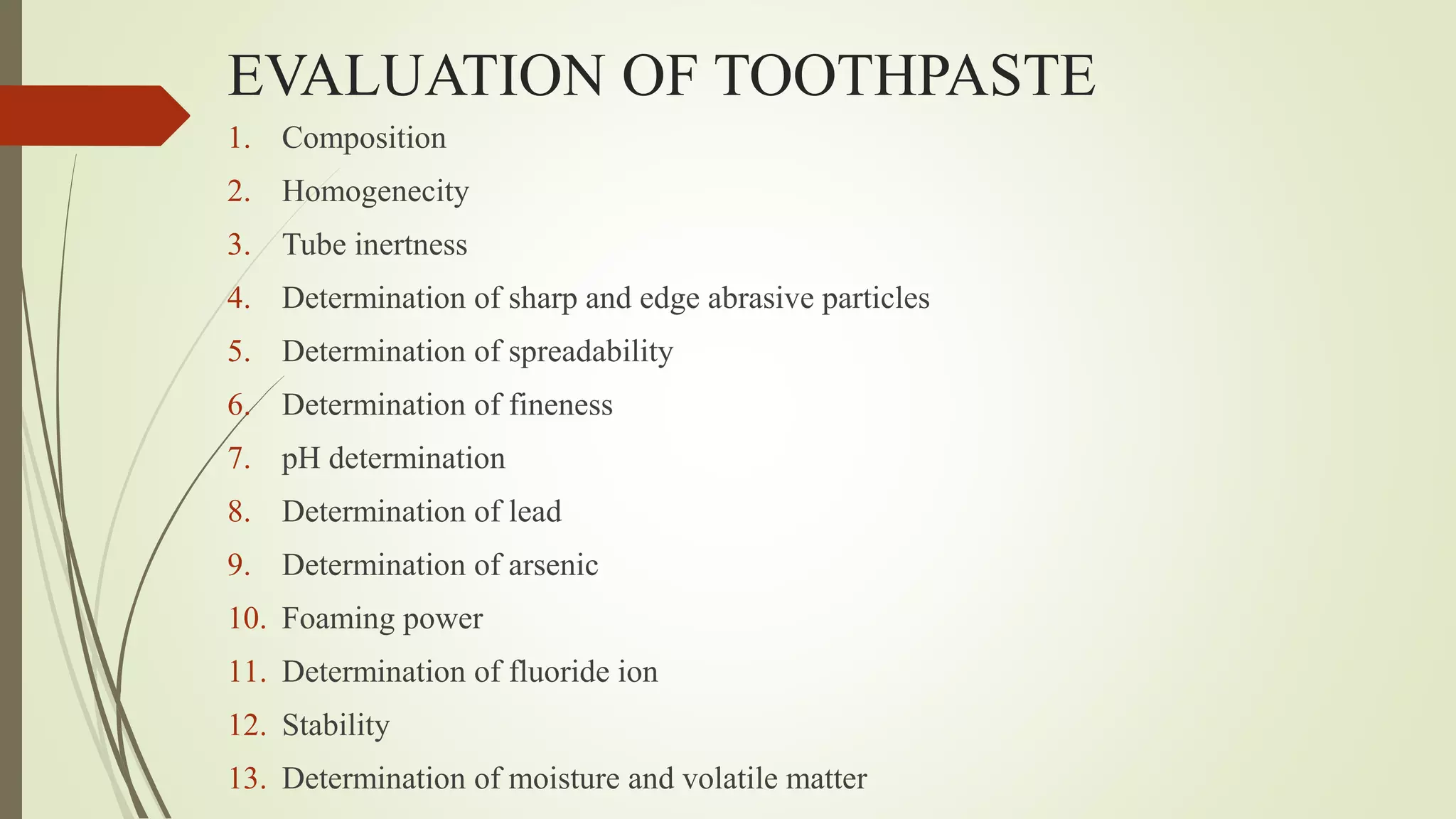
EVALUATION OF TOOTHPASTE
1. Composition
2. Homogenecity
3. Tube inertness
4. Determination of sharp and edge abrasive particles
5. Determination of spreadability
6. Determination of fineness
7. pH determination
8. Determination of lead
9. Determination of arsenic
10. Foaming power
11. Determination of fluoride ion
12. Stability
13. Determination of moisture and volatile matter
REFERENCES
1. Harry’s Cosmeticology, Volume 1 of 2, 8th edition, Published by
chemical publishing Co. Inc. New york.
2. Haward I. Maibach’s Handbook of Cosmetic Science and
Technology, third edition, Published by Informa Healthcare USA
Inc. New york- 10017
3. www.google.com
Toothpastes

Toothpastes

  • 1.
  • 2.
    A toothpaste ordentifrice is a substance used with a toothbrush for the purpose of cleaning the accessible surfaces of the teeth. Purposes: • Cleaning • Polishing • Removal of stains • Reduce incidence of tooth decay • Reduction of oral malodors
  • 3.
    ADVANTAGES  Delivers activeingredients such as fluoride or xylitol to help prevent tooth and gum disease.  Recent advances in toothpaste enable high efficacy of oral health delivery:  Special toothpaste for kids with fluoride and relatively low abrasion value  Desensitizing toothpaste  Whitening toothpaste  Easy to use, available in collapsible tubes.  Combination of various contents available as to combat different oral healthcare needs at once.
  • 4.
    DISADVANTAGES  Extended consumptionof large volumes of fluoridated toothpaste can result in fluorosis. Fluoridated toothpaste can be either acutely toxic if swallowed in large amounts or chronically toxic if swallowed in any amount consistently.  Triclosan, an active ingredient in many toothpastes can combine with chlorine in tap water to form chloroform which is a human carcinogen. According to some scientists it can leave unborn babies brain damaged.  Although in several studies whitening toothpaste show the ability to improve tooth color they have side effects. The most significant one is enamel and dentin abrasion which in turn leads to increased tooth sensitivity.
  • 5.
    TOOTHPASTE FORMULATION General toothpasteformulation composition contains: 1. Abrasives 2. Detergents 3. Water 4. Humectants 5. Thickening Agents 6. Flavor 7. Sweeteners8. Preservatives 9. Corrosion Inhibitors 10. Colorants 11. Bleaches 12. Anticaries Actives 13. Anticalculus Agents 14. Desensitizing Agents 15.Antimicrobials /antiplaque/ antigengivitis agents
  • 6.
    1 . Abrasives: Themain component responsible for cleaning the teeth. Should be abrasive enough to clean the tooth & avoid damage to tooth surface Ability depends on particles size, shape, & brittleness of the material. EXAMPLES : hydrated silica  calcium carbonate, calcium pyrophosphate  dicalcium phosphate dihydrate
  • 7.
    2. Detergents: major contributorto teeth cleaning process Should be tasteless, nontoxic, nonirritant, producing large volume of non- gagging foam. Examples:  Sodium lauryl sulfate (SLS), Sodium lauryl sarcosinate
  • 8.
    3. Humectants : Preventstoothpaste from drying out Glycerin (50% aq. solution) EXAMPLES :  Sorbitol  hydrogenated starch hydrolysate  Propylene glycol, PEG : Disadvantage: bitter taste Advantage : 1. sweet & cooliness feeling 2. anticaries
  • 9.
    4. Thickening Agents: Neededto maintain the stability of high-solid dispersion Affect the dispersibility ,foam character, and mouth feel Examples: Sodium carboxymethylcellulose (interacts with cationic antimicrobials), Hydroxypropyl methyl cellulose (HPMC)  hydroxyethyl cellulose (nonionic), Xanthan gum, carbomer
  • 10.
    5. Flavor : Influenceconsumer acceptance Leaves a fresh clean feeling after brushing Considered highest cost ingredient in the toothpaste formulation Examples : Peppermint, spearmint, menthol, wintergreen, cinnamon,…
  • 11.
    6. Sweeteners : Mostflavor oils have bitter taste leaving the toothpaste formulation unpalatable without sweeteners Artificial sweeteners are used (non cariogenic effect like natural sugar) Examples : Saccharin, sodium saccharin  potassium acesulfame
  • 12.
    7. Preservatives : Rarelyused nowadays due to safety concerns Proper formulation ingredient selection can result in preservative free toothpaste 8. Corrosion inhibitors: : Used to avoid corrosion of the aluminum tubes (e.g. sodium silicate) Not needed nowadays due to the use of plastic tubes
  • 13.
    9. Anticaries Actives: Fluoride ions reduce the incidence of carious lesion by reducing the acid solubility of tooth enamel Examples : Sodium fluoride  sodium monofluorophosphate  stannous fluoride FDA recommends levels of soluble fluoride ion between 850- 1150ppm
  • 14.
    10. Anticalculus Agents: Examples:  zinc chloride, zinc citrate (Crest) tetra sodium pyrophosphate,  disodium pyrophosphate (used more than zinc salts, and it has antiplaque activity)
  • 15.
    11. Desensitizing Agent: Potassium Nitrate(5%) Compatible with fluoride, and has salty taste Ex. Sensodyne toothpastes 12. Antibacterial/Antiplaque/antigingivitis: Triclosan, Chlorhexidine, Zinc citrate.
  • 16.
    GENERAL METHOD OFPREPARATION  The preparations are preferably made in stainless steel mixer container for large scale manufacture filled with slowly rotating blades .  It can be done for in planetary mixer or similar mixer used for semisolid preparations. Small scale batch can be made in glass container.  The gum is mixed with suitable quantity of humectant without any water proper dispersion.  Chloroform and alc. Can also be used for dispersion of binding agent. Other colloid may be disperse in water.  Methyl cellulose should be mixed with cold water, but ethyl cellulose should be disperse in warm water.  Other powder ingredient are shifted together and added gradually to mucilaginous mixture with continue Gentle stirring.
  • 17.
     Then aq.Media is mixed and stirred to get a product.  Flavour and detergent added at the last. Formula 1 Calcium carbonate 56.0 g Na.lauryl sulphate 1.0 g Glycerin 22.0 g Gum tragacanth 1.5 g Water 19.4 g Saccharine 0.1 g Flavour q.s. Preservative q.s.
  • 18.
    Anti-cavity Agents: (a) SodiumMonofluorophosphate (Na2PO3F) (b) Sodium Fluoride (NaF) (c) Organo (amine) Fluorides (d) Stannous Fluoride (SnF2) Anti-tartar Toothpastes: (a) Tetra sodium pyrophosphate (TSPP) (b) Tetra potassium pyrophosphate (TKPP) (c) Disodium dihydrogen pyrophosphate Clinical studies have shown that, starting from a clean mouth, toothpastes containing 3.3% pyrophosphate ion can inhibit the growth of tartar by approximately 30% after three months of regular use.
  • 20.
    EVALUATION OF TOOTHPASTE 1.Composition 2. Homogenecity 3. Tube inertness 4. Determination of sharp and edge abrasive particles 5. Determination of spreadability 6. Determination of fineness 7. pH determination 8. Determination of lead 9. Determination of arsenic 10. Foaming power 11. Determination of fluoride ion 12. Stability 13. Determination of moisture and volatile matter
  • 21.
    REFERENCES 1. Harry’s Cosmeticology,Volume 1 of 2, 8th edition, Published by chemical publishing Co. Inc. New york. 2. Haward I. Maibach’s Handbook of Cosmetic Science and Technology, third edition, Published by Informa Healthcare USA Inc. New york- 10017 3. www.google.com