3-
Composition
5-Mouthwashes
6-Aerosol mouth
fresheners
4-Smoker’s tooth powder
1-Definition
2-Tooth
Paste
4-
Tooth
Powde
s
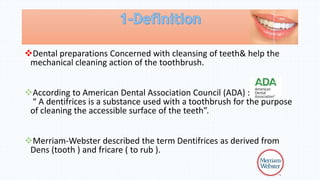
Dental preparations Concerned with cleansing of teeth& help the
mechanical cleaning action of the toothbrush.
According to American Dental Association Council (ADA) :
“ A dentifrices is a substance used with a toothbrush for the purpose
of cleaning the accessible surface of the teeth”.
Merriam-Webster described the term Dentifrices as derived from
Dens (tooth ) and fricare ( to rub ).
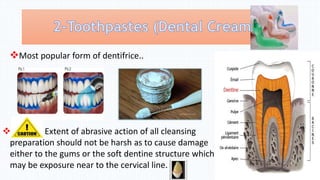
Most popular form of dentifrice..
 Extent of abrasive action of all cleansing
preparation should not be harsh as to cause damage
either to the gums or the soft dentine structure which
may be exposure near to the cervical line.
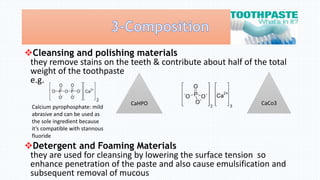
Cleansing and polishing materials
they remove stains on the teeth & contribute about half of the total
weight of the toothpaste
e.g.
Detergent and Foaming Materials
they are used for cleansing by lowering the surface tension so
enhance penetration of the paste and also cause emulsification and
subsequent removal of mucous
Calcium pyrophosphate: mild
abrasive and can be used as
the sole ingredient because
it’s compatible with stannous
fluoride
CaHPO CaCo3
Cont.
Soap is tilled used, although it has the disadvantage of being strongly
alkaline.
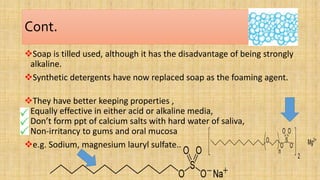
Synthetic detergents have now replaced soap as the foaming agent.
They have better keeping properties ,
Equally effective in either acid or alkaline media,
Don’t form ppt of calcium salts with hard water of saliva,
Non-irritancy to gums and oral mucosa
e.g. Sodium, magnesium lauryl sulfate..
3- Humectants:
Used to prevent the paste from drying out and
hardening to an acceptable level, also give shine and
some plasticity to the paste. The proportion of
humectants can vary from 5 or 10% to as high as 30%.
Three humectants are considered for use in toothpaste.
These are glycerin, propylene glycol and sorbitol.
Propylene glycol tends to give pastes of a softer
consistency and may be preferred for use with powders
of high specific gravity but has slighter bitter taste.
Sorbitol gives firmer pastes than glycerin with good
plasticity and effective in preventing separation of
water.
4- Binding agents: (Gelling):
Are hydrophilic (water -loving) colloids which
disperse and swell in the water phase of the
toothpaste and are thus necessary to maintain the
integral stability of the paste and prevent separation
into component phases.
5- Sweetening agents:
These are important for product acceptance, the final
product must be neither too sweet, nor too bitter.
Sodium saccharin is generally used.
6- Flavors:
Since one of the primary consumers
requirements of toothpaste is the perception of
freshness and cleanliness after brushing.
Mint flavors tend to predominate.
The flavor is a blend of many suitable oils, with
peppermint and spearmint being the major
base components. These are nearly always
fortified with other components such as
thymol, menthol, eugenol (clove oil),
cinnamon, and eucalyptol.
7- Minor ingredients:
Titanium dioxide TiO2
pH-regulators
Therapeutic agents

Dental preparartions

  • 2.
    3- Composition 5-Mouthwashes 6-Aerosol mouth fresheners 4-Smoker’s toothpowder 1-Definition 2-Tooth Paste 4- Tooth Powde s
  • 3.
    Dental preparations Concernedwith cleansing of teeth& help the mechanical cleaning action of the toothbrush. According to American Dental Association Council (ADA) : “ A dentifrices is a substance used with a toothbrush for the purpose of cleaning the accessible surface of the teeth”. Merriam-Webster described the term Dentifrices as derived from Dens (tooth ) and fricare ( to rub ).
  • 4.
    Most popular formof dentifrice..  Extent of abrasive action of all cleansing preparation should not be harsh as to cause damage either to the gums or the soft dentine structure which may be exposure near to the cervical line.
  • 5.
    Cleansing and polishingmaterials they remove stains on the teeth & contribute about half of the total weight of the toothpaste e.g. Detergent and Foaming Materials they are used for cleansing by lowering the surface tension so enhance penetration of the paste and also cause emulsification and subsequent removal of mucous Calcium pyrophosphate: mild abrasive and can be used as the sole ingredient because it’s compatible with stannous fluoride CaHPO CaCo3
  • 6.
    Cont. Soap is tilledused, although it has the disadvantage of being strongly alkaline. Synthetic detergents have now replaced soap as the foaming agent. They have better keeping properties , Equally effective in either acid or alkaline media, Don’t form ppt of calcium salts with hard water of saliva, Non-irritancy to gums and oral mucosa e.g. Sodium, magnesium lauryl sulfate..
  • 7.
    3- Humectants: Used toprevent the paste from drying out and hardening to an acceptable level, also give shine and some plasticity to the paste. The proportion of humectants can vary from 5 or 10% to as high as 30%. Three humectants are considered for use in toothpaste. These are glycerin, propylene glycol and sorbitol. Propylene glycol tends to give pastes of a softer consistency and may be preferred for use with powders of high specific gravity but has slighter bitter taste. Sorbitol gives firmer pastes than glycerin with good plasticity and effective in preventing separation of water.
  • 8.
    4- Binding agents:(Gelling): Are hydrophilic (water -loving) colloids which disperse and swell in the water phase of the toothpaste and are thus necessary to maintain the integral stability of the paste and prevent separation into component phases. 5- Sweetening agents: These are important for product acceptance, the final product must be neither too sweet, nor too bitter. Sodium saccharin is generally used.
  • 9.
    6- Flavors: Since oneof the primary consumers requirements of toothpaste is the perception of freshness and cleanliness after brushing. Mint flavors tend to predominate. The flavor is a blend of many suitable oils, with peppermint and spearmint being the major base components. These are nearly always fortified with other components such as thymol, menthol, eugenol (clove oil), cinnamon, and eucalyptol.
  • 10.
    7- Minor ingredients: Titaniumdioxide TiO2 pH-regulators Therapeutic agents