DENTAL
CERAMICS
NISHU PRIYA
1ST YEAR PGT
CONTENTS
⚫ Introduction
⚫ History of dental ceramics
⚫ Structure
⚫ Composition
⚫ Properties
⚫ Classification
⚫ Metal-ceramic systems: Composition and Properties
⚫ Components of metal-ceramic restoration
⚫ Fabrication of metal-ceramic prosthesis
⚫ Bonding mechanisms
⚫ Strengthening of metal ceramic
⚫ Advances
⚫ References
The word Ceramic is derived from the
Greek word “keramos”, which literally
means ‘burnt stuff’, but which has
come to mean more specifically a
material produced by burning or
firing.
INTRODUCTION
DENTAL CERAMICS : An inorganic compound with non-metallic
properties typically consisting of oxygen and one or more metallic or
semi-metallic elements that is formulated to produce the whole part of
a ceramic based dental prosthesis. – GPT 7
STRUCTURE
⚫ Ceramics can appear as either crystalline or non- crystalline
(amorphous solids or glasses).
⚫ The mechanical and optical properties of dental ceramics mainly
depend on the nature and the amount of crystalline phase present.
Properties of glassy phase:
• Brittleness
• Non- directional fracture
pattern
• Translucency
• Surface tension
• Insulating properties
Properties of crystalline phase:
• Controls coefficient of
thermal expansion
• Increases strength
NON- CRYSTALLINE CERAMICS
⚫ These are a mixture of crystalline minerals
(feldspar, silica and alumina) in an amorphous
(non- crystalline matrix of glass) vitreous
phase.
⚫ Their structures are characterized by chains of
(SiO4)4− tetrahedra in which Si4+ cations are
positioned at the center of each tetrahedron
with O− anions at each of the four corners.
⚫ The atomic bonds in this glass structure have
both a covalent and ionic character thus making
it stable.
⚫ Alkali cations such as
potassium or sodium tend to
disrupt silicate chains leading
to lower sintering temperatures
and increased coefficients of
thermal expansion.
CRYSTALLINE CERAMICS
⚫ Regular dental porcelain, being of a glassy nature is largely
non crystalline and exhibits only a short range order in
atomic arrangement.
⚫ The only true crystalline ceramic used in restorative dentistry
is Alumina; which is one of the hardest and probably the
strongest oxides known.
⚫ Crystalline ceramics may have ionic or covalent bonds
⚫ Ceramics are reinforced with crystalline inclusions such as
alumina and leucite into the glass matrix to strengthen the
material and improve its fracture resistance.
GLASS FORMATION
When silica melts, it
produces an extremely
viscous liquid
cools rapidly
Forms a glassy solid
called Fused Quartz.
This process of
forming a glass is
called ‘Vitrification’.
HISTORY OF DENTAL CERAMICS
Stone
age
• Stone chips were shaped into tools by a process
called flaking.
• Chert, flint, ignimbrite, shale, lava, quartz,
silicified limestone
700 BC
• Etruscans made teeth of ivory and bone
1789
• The first porcelain tooth material was patented in
1789 by de Chemant, a French dentist in
collaboration with Duchateau, a French
pharmacist
1808
• Fonzi, an Italian dentist, invented a
“terrometallic” teeth. Individual porcelain
teeth posterior porcelain blocks
1817
1822
• Planteau, a French dentist, introduced
porcelain teeth to the United States.
• Peale, an artist, developed a baking process
in Philadelphia.
1903
• Charles Land introduced one of the first
ceramic crowns to dentistry.
1962
• most important breakthrough described
formulations of feldspathic porcelain by
Weinstein and Weinstein (1962) and
Weinstein et al. (1962).
1963
• The first commercial porcelain was
developed by VITA Zahnfabrik.
1965
• Mc Lean &Hughes developed aluminous
core ceramics
1984
• controlled crystallization of a glass (Dicor)
was demonstrated by Adair and Grossman
1990
• IPS Empress , In Ceram Zirconia, IPS
Empress2 were used for ceramic
prostheses.
1992
• Duceram LFC was introduced
WHY DENTAL CERAMICS?
Dental
ceramics
Refractory
nature
Long term
colour
stability
Chemically
inert
aesthetics
Can be
formed into
precise
shapes
insulator
DRAWBACKS
Low fracture
toughness
Brittleness
High wear
resistance
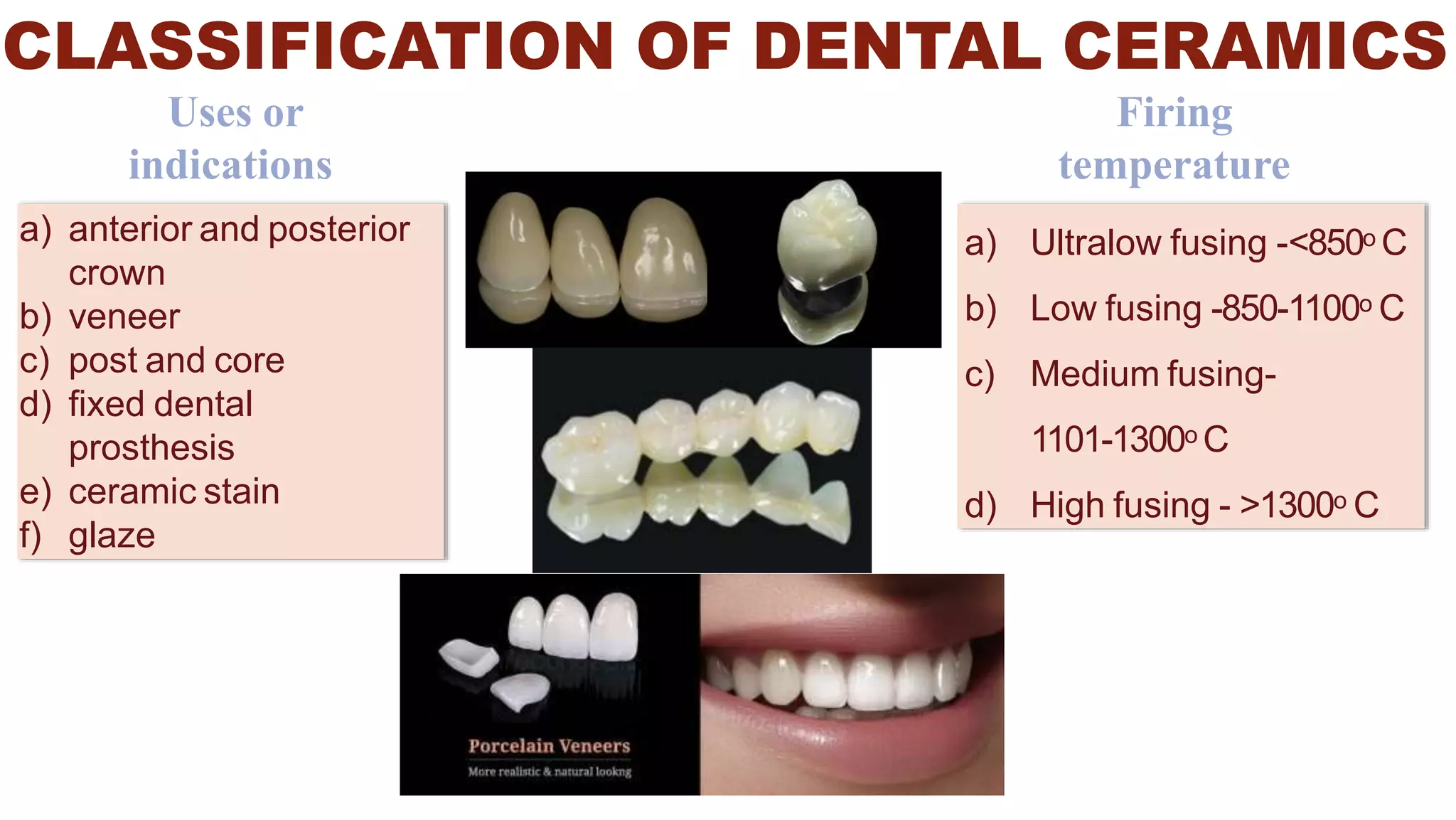
CLASSIFICATION OF DENTAL CERAMICS
Uses or
indications
a) anterior and posterior
crown
b) veneer
c) post and core
d) fixed dental
prosthesis
e) ceramic stain
f) glaze
a) Ultralow fusing -<850o C
b) Low fusing -850-1100o C
c) Medium fusing-
1101-1300o C
d) High fusing - >1300o C
Firing
temperature
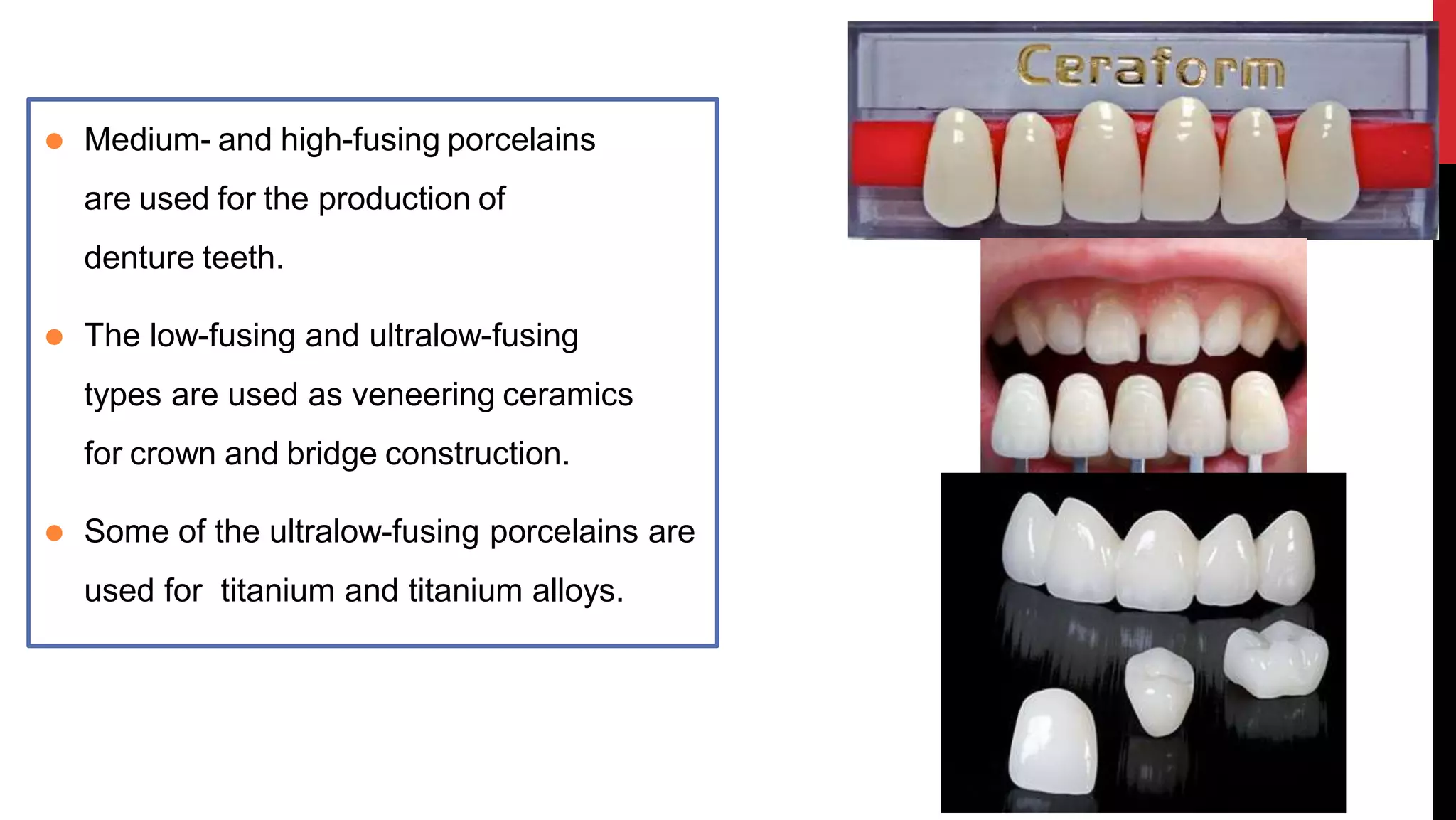
⚫ Medium- and high-fusing porcelains
are used for the production of
denture teeth.
⚫ The low-fusing and ultralow-fusing
types are used as veneering ceramics
for crown and bridge construction.
⚫ Some of the ultralow-fusing porcelains are
used for titanium and titanium alloys.
i. Casting
ii. Sintering
iii. Partial sintering and glass
infiltration
iv. Slip casting and sintering
v. Heat press
vi. CAD-CAM milling
vii. Copy-milling
Processing
method
Principal
crystal phase
a) Feldspathic porcelain
b) Leucite-based glass ceramic
c) Lithia-based glass-ceramic
d) Aluminous porcelain
e) Alumina
f) Glass-infused alumina,
g) Glass-infused spinel
h) Glass-infused zirconia,
i) Glass ceramic
Translucency
i. Opaque
ii. Translucent
iii. Transparent
i. Amorphous glass
ii. Crystalline
iii. Polycrystalline
Based on
microstructure
J. Robert KellyJADA, Vol. 139 http://jada.ada.org September 2008
⚫ Dental ceramics are mainly composed with crystalline minerals and glass matrix.
COMPOSITION
• Feldspar - 60 to 80% - basic glass former
• Kaolin - 3 to 5 % - binder
• Silica - 15 to 25% - filler
• Alumina - 8 to 20 % - glass former
• Oxides of Zirconium, Titanium, Tin - opacifiers
• Oxides of sodium, potassium, calcium - glass modifiers
• Metal pigments - colour matching
Feldspar
• naturally occurring crystalline rocks
• Forms- potash feldspar and soda feldspar(albite).
• It is the lowest melting compound and melts first on firing.
• Pure feldspathic glass is colorless and transparent
Role of feldspar :
Glass phase formation: During firing, the feldspar fuses and forms a
glassy phase that softens and flows slightly allowing the porcelain
powder particles to coalesce together.
Feldspar crystals of leucite + liquid glass
Exhibit liquid phase sintering
Leucite formation:
Potassium aluminium silicate mineral
1150 ⁰C -1530 ⁰C
Incongruent melting
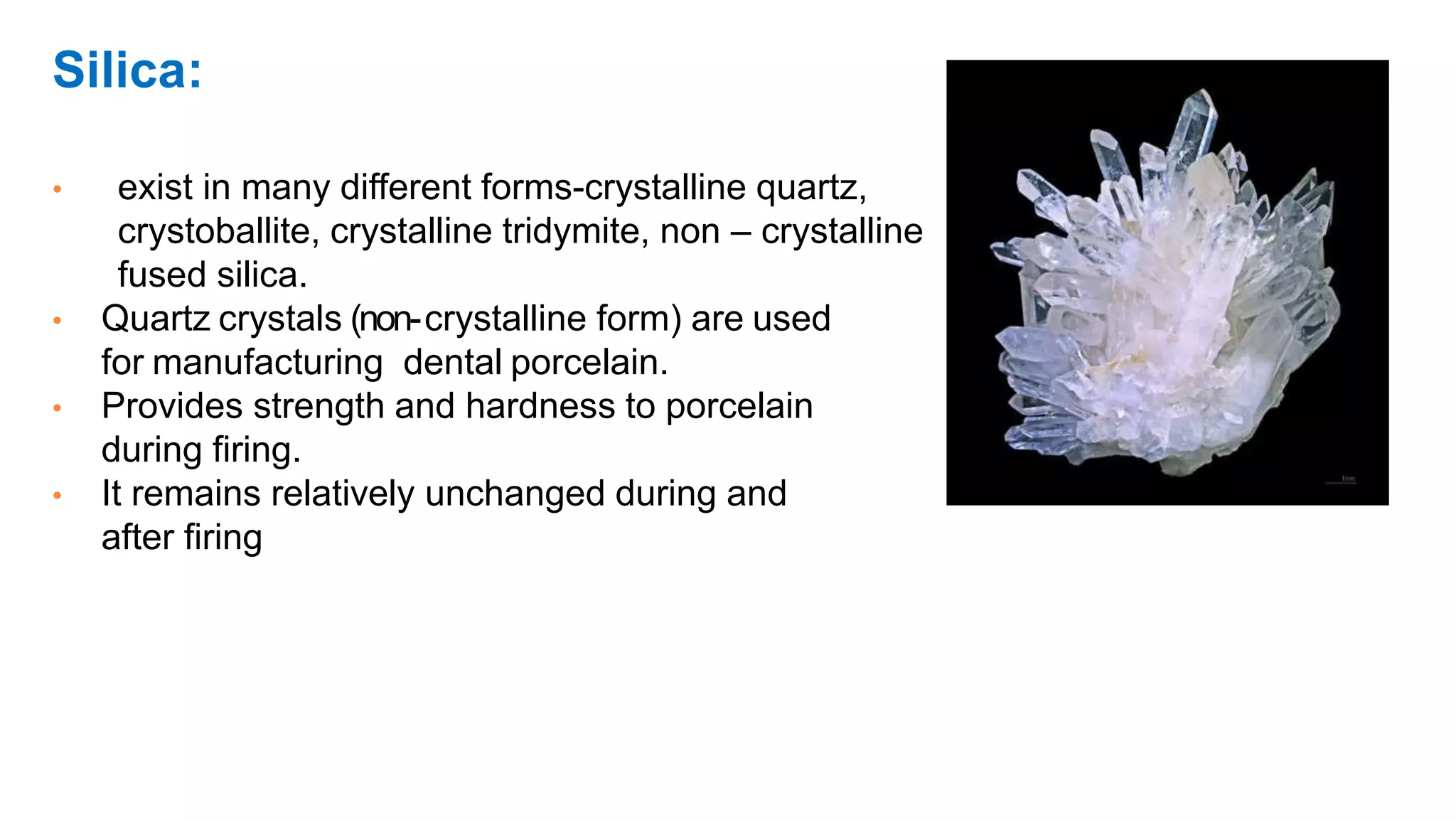
Silica:
• exist in many different forms-crystalline quartz,
crystoballite, crystalline tridymite, non – crystalline
fused silica.
• Quartz crystals (non-crystalline form) are used
for manufacturing dental porcelain.
• Provides strength and hardness to porcelain
during firing.
• It remains relatively unchanged during and
after firing
Kaolin
• a type of clay material which is usually obtained
from igneous rock containing alumina- hydrated
aluminum silicate
• Kaolin acts as a binder and increases the
moldability of the unfired porcelain.
• It also imparts opacity to the porcelain
restoration so dental porcelains are formulated
with limited quantity of kaolin.
Glass modifiers
• are used as fluxes
• potassium, sodium and calcium ions- break bonds
between silica tetrahedron- move easily at lower
temperatures
• lower the softening temperature and increase the
fluidity
• Increasethermalexpansion
• High concentrationof glassmodifiersdecreasechemical
durability ofglass
• Boric oxide fluxes (B2O3) can behave as a glass
modifier to form its own glass network.
Color pigments
Metal oxide frits are fused to provide the characteristic shade
Metal oxides Color
Titanium oxide Yellowish brown
Nickel oxide or iron brown
Copper oxide green
Manganese oxide lavender
Cobalt oxide blue
Zirconium oxide, alumina,
silica
white
MANUFACTURING
Raw materials are mixed together in a refractory crucible and
heated to a temperature well above their fusion temperature
Glass and crystalline phases are produced
Fused mass is quenched in water
Shatters into small fragments of glass- fritting
Ball milled to achieve uniform particles,
opacifiers and pigments are added
Manufacturing completed
METAL-CERAMIC SYSTEM
Consist of cast metallic framework (core) on which at least two layers of
ceramics are baked
COMPOSITION
• Feldspathic porcelain is used for metal bonding
• Higher alkali content- to raise the coefficient of thermal expansion- helps in
bonding with metal
• Silicate glass
• The opaquer powder -high content of opacifiers- to mask the underlying metal
CLASSIFICATION
1. Cast metal ceramic restorations
 Cast noble metal alloys (feldspathic porcelain)
 Cast base metal alloys (feldspathic porcelain)
 Cast titanium (ultra low fusing porcelain)
2. Swaged metal ceramic restorations
 Gold alloy foil coping (Renaissance, Captek)
 Bonded platinum foil coping
⚫ To bond to alloys suitable for the copings, porcelains must
have a sufficiently
o Low sintering temperature
o CTEs closely matched to those of the alloys.
⚫ Both the metal and the ceramic must have coefficients of
thermal expansion and contraction that are closely matched
such that the metal must have a slightly higher value to
avoid the development of undesirable residual tensile
stresses in the porcelain.
⚫ Ceramic must wet the surface of alloy readily such that the
contact angle is less that or equal to 60 degrees to prevent
void formation.
REQUIREMENTS FOR METAL- CERAMIC SYSTEM
⚫ A good bond between metal and ceramic surfaces is required
⚫ Adequate stiffness and strength of the alloy core is necessary to
decrease the stress in porcelain
⚫ Alloys should have high sag resistance as the distortion of alloy will
compromise the fit of prosthesis
⚫ Alloy should have high proportional limit and high modulus of
elasticity as they share greater proportion of stress compared to
porcelain
ALLOYS FOR METAL-CERAMIC SYSTEM
Alloys - Noble metal alloys
a) Gold - Platinum
b) Gold – Platinum - Silver
c) Gold - Palladium
d) Palladium - silver
e) High palladium
System - Base-metal alloys
a) Nickel - Chromium
b) Cobalt - Chromium
c) Other systems
PREPARATION OF CAST METAL CERAMIC
RESTORATIONS
⚫ Copings and frameworks for metal-ceramic prostheses are produced by:
a) Casting of molten metal
b) CAD-CAM machining
c) Electrolytic deposition techniques
d) Swaged metal processes
Most common method is melting and
casting.
• A wax pattern of restoration constructed
• Cast in metal
• High melting temperature of alloys-
phosphate bonded investment
Metal preparation
• Clean metal surface essential for good
bonding
• Oil from fingers and other sources–
possible contaminant
• Cleanse surface
• Finish with clean ceramic bonded
stones/sintered diamonds
• Final sandblasting with high purity alumina
Degassing and oxidizing
• Heat in porcelain furnace to burn
off any impurities to the form thin
oxide layer.
• Degas the interior structure of alloy
Opaqer
• Mask/cover the metal frame and
prevent it from being visible
• Bond the veneering porcelains to the
underlying frame
• Condensed on the oxidized surface at
a thickness of approximately 0.3 mm
• Translucent porcelain is applied
• Porcelain powder is applied by the
condensation methods
MANIPULATION
condensation/ packing
Pre-heating/ drying
sintering/ firing
Surface treatments
cooling
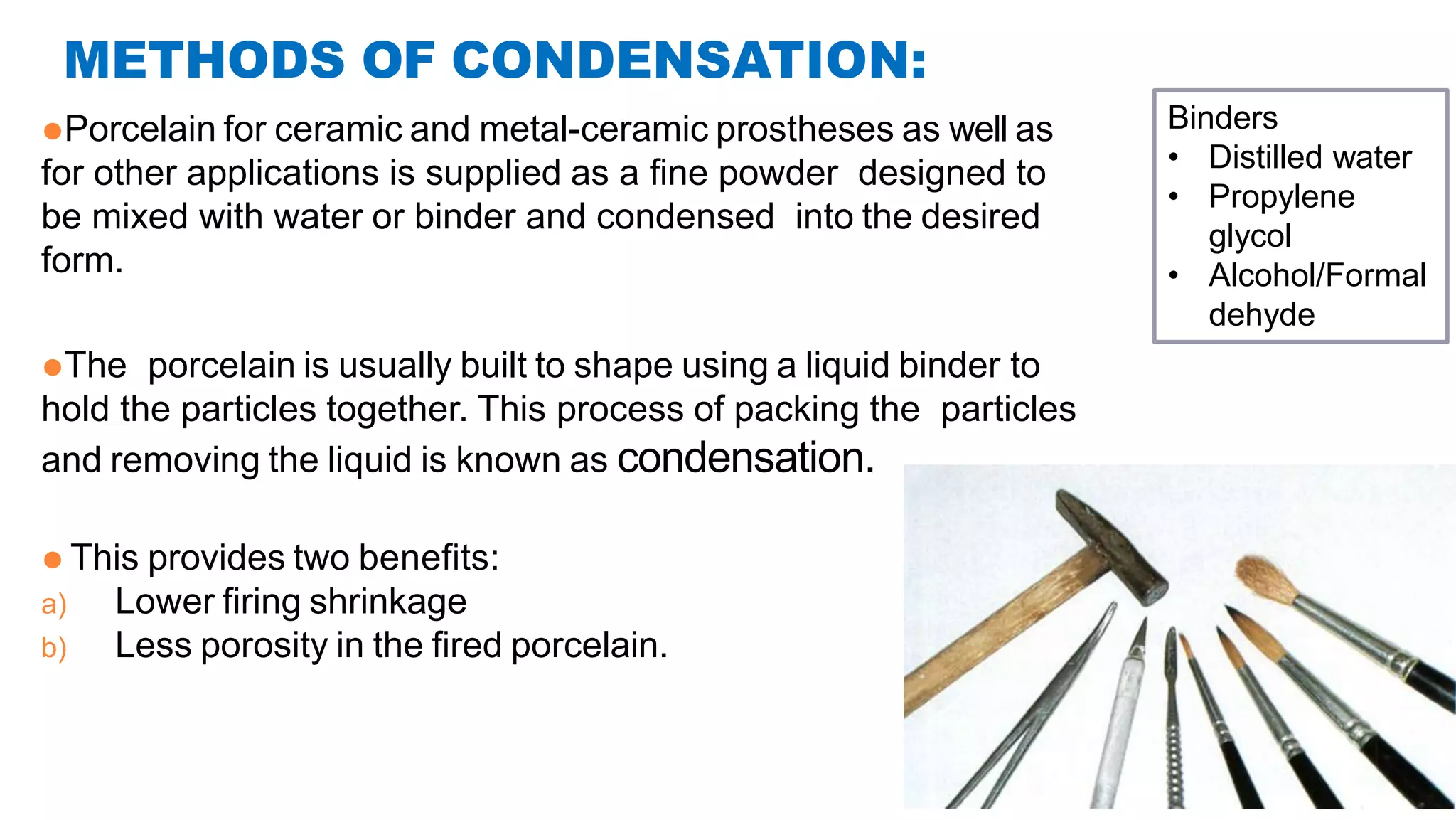
METHODS OF CONDENSATION:
⚫Porcelain for ceramic and metal-ceramic prostheses as well as
for other applications is supplied as a fine powder designed to
be mixed with water or binder and condensed into the desired
form.
⚫The porcelain is usually built to shape using a liquid binder to
hold the particles together. This process of packing the particles
and removing the liquid is known as condensation.
⚫ This provides two benefits:
a) Lower firing shrinkage
b) Less porosity in the fired porcelain.
Binders
• Distilled water
• Propylene
glycol
• Alcohol/Formal
dehyde
Vibration:
Mild vibrations are used to densely pack the wet powder upon
the underlying matrix. The excess water comes to the surface
and is blotted with a tissue paper.
Spatulation:
A small spatula is used, to apply and smoothen the wet
porcelain. This action brings excess water to the surface
where it is removed.
Brush technique:
The dry powder is placed by a brush to the side opposite from
an increment of wet porcelain. As the water is drawn toward
the dry powder, the wet particles are pulled together.
Dentin
• Pink powder+distilled water/supplied liquid
• The main bulk of tooth
• A portion of the dentin in the incisal area is cut back for
enamel porcelain.
Enamel
• White powder
• build the restoration
• Transparent porcelains used near incisal edges
Gingival porcelain
• Darker -cervical portion
Steps of condensation
Build up
of cervical
porcelain
Build up
body
porcelain
Cut back
Build up
enamel
porcelain
Pre-heating
• Placing the porcelain object on a tray in front of/below
the muffle of a preheated furnace
• at 650⁰C for 5min for low fusing porcelain
• at 480⁰C for 8min for high fusing porcelains till
reaching the green or leathery state.
Significance of pre-heating stage:
• Removal of excess water allowing the porcelain object
to gain its green strength.
• Preventing sudden production of steam that could
result in voids or fractures.
• Ceramic particles held together in the “green state”
after all liquid has been dried off
FIRING DENTAL PORCELAIN:
After the condensation and building of a crown it is fired to high density and
correct form. At this stage the green porcelain is introduced into the hot zone
of the furnace and the firing starts, the glass particles soften at their contact
areas and fuse together. This is referred to as sintering.
⚫ As sintering of the particles begins, the porcelain particles bond at their points of
contact and the structure shrinks and becomes dense.
⚫ The thermochemical reactions between the porcelain powder components are
virtually completed during the original manufacturing process. Thus some
chemical reactions occur during prolonged firing times or multiple firings
The initial firing temperature
• The voids are occupied by the
atmosphere of the furnace.
• As the sintering of the particles
begins, the porcelain particles bond
at their points of contact.
As temperature is raised
• The sintered glass gradually flows to fill up the
air spaces.
• The particles fuse together by sintering forming
a continuous mass, this results in a decrease in
volume referred to as firing shrinkage
With progression of firing
• The gaps between particles become
porosities. The viscosity of the glass is
low enough for it to flow due to
its own surface tension. The result is
that the porosity voids will gradually
become rounded as firing proceeds
The final firing stage
• The voids slowly rise to free surfaces
and disappear
Vacuum(negative pressure) firing
⚫ Porcelain in furnace- packed powder particles
and air channels around
⚫ air pressure inside the furnace is reduced to about
one tenth of atmospheric pressure, the air around the
particles is also reduced to this pressure. As the
temperature rises, the particles sinter together.
⚫ Pores are compressed to one tenth of their original
size, and the total volume of porosity is accordingly
reduced.
⚫ Advantages of vacuum-fired porcelain
◦ Decreased porosity
◦ increase in the strength of the porcelain
◦ greater translucence
THE STAGES IN MATURITY:
Low Bisque: surface of the porcelain is very porous.At this
stage the grains of porcelain will have started to soften.
Shrinkage will be minimal and the fired body is extremely
weak and friable. Lack translucency and glaze.
Medium bisque: surface will still be slightly porous but the
flow of the glass grains will have increased. A definite
shrinkage but lacks translucency and high glaze.
High bisque: surface of the porcelain would be completely
sealed and presents a much smoother surface with a slight
shine. Shrinkage is complete.Appears glazed.
overfiring
• reduce the strength due to
formation of undesirable
crystal phases at higher
temperature [devitrification]
• increases the chances of
slumping [eliminate the
shape we made and leave
a globule of ceramic].
underfiring
• The porcelain object will
have a chalky white color
overlaying its shade
because light is reflected
and scattered at
boundaries between
particles and at the
surfaces of porosity
PORCELAIN SURFACE TREATMENT
• Natural/auto glaze
• Applied/add-on glaze
• Polishing
• Custom staining
GLAZING
Porcelains are glazed to give a smooth and glossy
surface. The glazing should be done only on a
slightly roughened surface and never should be
applied on glazed surfaces.
Objectives
• Life like appearance/ esthetics
• Improves Strength and life
• Seal surface flaws
• Enhances Hygiene
• Reduces wear of opposing
teeth
Over glaze
• These are ceramic powders containing more
amount of glass modifiers thus lowering fusion
temperature
• Applied on to restoration
• Firing temperature is less than that of body
porcelain
• Disadvantage-Chemical durability less
compared to self glaze(because of the high flux
content)
Self glaze
• No separate glaze layer
• All the constituents on the surface are
melted to form a molten mass about 25μm
thick
• Restoration subjected to controlled
heating at fusion temperature
• Only surface layer melts and flows to
form a vitreous layer resembling glaze
• Disadvantage-porcelain must be stripped
completely if it is unacceptable
Polishing
• Using special abrasives
• Sof-Lex (3M,Minneapolis,MN),Fi
nishing disks (Shofu, Kyoto,
Japan) porcelain laminate polishing
kit, or other abrasive system.
• Difficult to polish
Surface staining and characterisation
• Stain powders + special liquid- applied and
blended with brush
• By staining and characterization more
emphasis on recreating natural look
• Can include
1. Defects
2. Cracks
3. Other anomalies on enamel
ADD ON PORCELAINS
⚫The add on porcelains are made from similar materials toglaze
porcelain except for the addition of opacifiers and coloring pigments.
⚫These are sparingly used for simplest corrections like correcting
of tooth contour / contact points.
COOLING
• Should be well controlled
• slowly
• Uniformly
• Rapid cooling can cause cracks
• Induce stresses and weakens ceramic
If it cools too slowly
• Crystals form within the glass body
which will degrade its optical properties,
turning if from a clear glass into a cloudy
one.
if it is cooled too quickly
• Stress build up in the glass.
• To reduce the stresses ,it is kept near
the glass transition temperature (its
solidus) for a long time so that the atoms
in the glass can rearrange just enough to
relieve the stress.
• When most of the stress has been
eliminated, the finished glass is finally
allowed to cool to room temperature
SWAGED METAL-CERAMIC SYSTEM
⚫ The most widely used product of this type has been
Captek (Precious Chemicals Co., Inc., Altamonte
Springs, FL), which is an acronym for “capillary
assisted technology.”
⚫ Developed by Shoher and Whiteman
⚫ The product is designed to fabricate the metal
coping of a metal- ceramic crown without the use of
a melting and casting process.
⚫ It is a laminated gold alloy foil sold as a metal strip.
CAPTEK P
•Platinum/palladium/gold
•Porous structure
•Serves as internal reinforcing skeleton.
•On heating in a furnace captek P acts as metal
sponge draws hot liquid gold completely into it
(capillary technique)
CAPTEK G
• 97.5%-GOLD
• 2.5%-SILVER
• Provides characteristic gold color
⚫ Captek P and G metals can yield thin metal copings for crowns or
frameworks for metal-ceramic bridges.
FABRICATION
Master
refractory
die
Captek
p
metal
adapted
Advantages
• Thinner foil alloy copings
(0.25mm)
• Greater thickness of
ceramic
• Improved esthetics
• Gold color of alloy
BONDED PLATINUM FOIL CERAMIC
• Platinum foil coping adapted on to the die
• Electro-deposition technique-to improve bonding and esthetics
• Thin layer of tin is electrodeposited on to the foil and then
oxidized in a furnace
Platinum foil is adapted on the die
Opaque porcelain
Dentin porcelain
Enamel porcelain
Laminate is separated
Gaps filled with porcelain prior to second firing
Surface texture created
Luted platinum veneers veneers after cementation
BONDING MECHANISMS
Chemical adhesion
• Primary bonding mechanism
• Chemisorption by diffusion of oxides between alloy and ceramic – forms an interface
• Base metal alloys-chromic oxide
• Noble metal alloys-iridium oxide
Mechanical entrapment
• creates attachment by interlocking the ceramic into the microabrasion on the surface of the metal
• Air abrasion appears to enhance the wettability, provide mechanical interlocking.
Compression bonding
• Coefficient of thermal expansion mismatch- As a result of higher metal contraction on cooling , -
The fused porcelain will be sucked (attracted) more strongly into the metal surface irregularities. -
Residual compressive stresses will developed in and strengthen the porcelain.
ADVANTAGES OF METAL CERAMIC SYSTEM
1. A properly made metal-ceramic crown is more fracture resistant
and durable than most all-ceramic crowns and bridges.
2. Low fracture rate
3. Less removal of tooth structure
4. Better marginal fit
5. Long term clinical durability
DISADVANTAGES OF METAL CERAMIC SYSTEM
1. Potential for metal allergy
2. Poor esthetics(Can not be used when a
relatively high degree of translucency is
desired.)
3. Abrasive damage to opposing dentition
4. Potential for fracture
5. metal framework sometimes shows
through gingiva resulting in dark margins
ALL CERAMIC SYSTEM
“All-Ceramic” refers to – Any restorative material composed exclusively of
ceramic, such as feldspathic porcelain, glass ceramic, alumina core systems
and certain combination of these materials. (J.Esth Dent 1997, 9 (2):86)
CLASSIFICATION
• Conventional ceramics
• Castable glass ceramics
• Injection moulded glass ceramics
• Glass infiltrated core ceramics
• Machinable ceramics
Conrad et al. (2007) JPD; 85: 5 classified all ceramic materials under three
categories
Depending on the
core of ceramic
Glass ceramic
Feldspathic
Leucite
Lithium disilicate
alumina
Aluminium oxide
zirconia
Yttrium tetragonal
Zirconia
polycrystals
CONVENTIONAL CERAMICS
 Alumina – Reinforced porcelain (Aluminous Porcelain)
• Hi-Ceram
• Vitadur – N core
 Leucite Reinforced
• Optec HSP
• Optec VP
ALUMINIOUS CORE CERAMICS
• The high-strength ceramic core was first introduced to
dentistry by McLean and Hughes in 1965.
• It is composed of aluminum oxide crystals (40-50%)
dispersed in a glassy matrix.
• Examples :
– Hi-Ceram (Vident)
– Vitadur – N core (Vident)
Why Alumina?
• Good Mechanical
properties.
• Interfacial region between
alumina and porcelain
virtually stress free.
• High modulus of elasticity
• High fracture toughness
• Significant strengthening
of the core
FABRICATION
VITA HI-CERAM
• Similar to traditional alumina core, with increased
alumina.
• Fired directly on the refractory die – rough surface
which aids in retention.
DISADVANTAGES
• Alumina is opaque, ceramic
layers have to be applied to
mask it
• High shrinkage, compromised fit
ADVANTAGES
• withstand torque better than conventional
porcelains with fracture rates slightly less
than 0.5% (McLean)
• Pure alumina is 6 times stronger than
standard porcelains
• Low thermal conductivity
• Both alumina and porcelain show the
same co-efficient of expansion and
contraction
INDICATIONS
• Single anterior & posterior
crowns
• Anterior 3-unit FPDs
CONTRAINDICATIONS
• Low fracture toughness- not
indicated as posterior FPD
• Not indicated for patients with
bruxism
Vitadur N
LEUCITE REINFORCED PORCELAIN
• feldspathic porcelain with a higher leucite crystal content (leucite
reinforced).
• Leucite increases flexural strength, compressive strength and
cofficient of thermal expansion.
• Its manipulation, condensation and firing is quite similar to the alumina
reinforced porcelain jacket crowns (using platinum foil matrix).
• Increase resistance to glassy phase to crack propagation
• Eg. Optec HSP
Advantages
• more esthetic - core is less opaque (more
translucent) compared to the aluminous
porcelain
• Higher strength
• No need of special laboratory equipment
Disadvantages
• Fit is not as good as metal ceramic crowns
• High abrasiveness due to leucite content
• Not strong enough for posterior use.
Uses:
1. Inlays
2. Onlays
3. Low stress crowns.
MAGNESIA BASED CORE PORCELAIN
• Used high expansion magnesia based core material compatible with
porcelain
• Similar to leucite reinforced
ADVANTAGES
• Easy to veneer with widely
available ceramics
DISADVANTAGE
• Highly opaque
• Not used for fixed partial
dentures.
CASTABLE GLASS CERAMICS
Glass-ceramics are polycrystalline
materials developed for application by
casting procedures using the lost wax
technique, hence referred to as
“castable ceramic”.
Castable glass
ceramics
fluormicas
Dicor
Apatite glass
ceramics
Cera Pearl
Other glass
ceramics
Based on:
Lithia
Calcium Phosphate
DICOR
• The first commercially available castable glass-
ceramic.
• Developed by ‘The Corning Glass Works’ (Corning
N.Y.) and marketed by Dentsply International (Yord,
PA,U.S.A).
• Cast glass ceramic is composed of:
a. Tetrasilicic flouromica crystals (crystalline) - 55%
by volume.
b. Glass matrix (non-crystalline) - 45% by volume.
CHAMELEON EFFECT
• Dicor glass-ceramic was capable of producing remarkably good esthetics
because of the “chameleon” effect- part of the color of the restoration was picked
up from the adjacent teeth as well as from the tinted cements used for luting the
restorations.
• Transparent crystals scatter the incoming light as if light is bouncing off a large
number of small mirrors that reflect the light and spread it over the entire surface
of ceramic. Thus dicor glass change color according to their surroundings.
FABRICATION
Casting : The glass liquefies at
1370⁰C to such a degree that it
can be cast into a mold using
lost-wax and centrifugal casting
techniques.
Ceramming : The cast glass
material is subject to a single-
step heat treatment called
“Ceramming” to produce
controlled crystallization by
internal nucleation and crystal
growth of microscopic plate like
mica crystals within the glass
matrix.
Advantages of ceramming:
• Increase strength and toughness
• Increase resistance to abrasion
• Thermal shock resistance
• Increase chemical durability
• Decreased translucency
Advantages
• Ease of fabrication
• Good esthetics(greater translucency and
chameleon effect)
• Improved strength and fracture toughness
• Good marginal fit - low processing shrinkage
• Low abrasion of opposing teeth
Disadvantages
• Inadequate strength for posterior use
• High fracture rate of veneers
• Has to be stained externally to improve esthetics
Indications:
• Used for anterior single crown
(low stress area)
• Used in situations where high
translucency is required.
Contraindications:
• Not used as posterior crowns.
• Not used in high stress
bearing areas.
Products introduced to overcome the disadvantages:
• Dicor plus: consists of a cast cerammed core and a shaded
feldspathic porcelain veneer
• Willis glass: consist dicor cast cerammed core and Vitadur N porcelain
veneer
CASTABLE APATITE GLASS CERAMIC
• 1985 -Sumiya Hobo & Iwata developed a castable apatite glass-ceramic
which was commercially available as Cera Pearl (Kyocera Bioceram,
Japan).
• CERA PEARL (Kyocera San Diego, CA): contains a glass powder
distributed in a vitreous or non-crystalline state
Chemistry:
Apatite Glass-Ceramic Molten glass CaPO4
CaPO4 Oxyapatite Hydroxyapatite
moisture
ceramming
casting
Desirable characteristics of Apatite Ceramics
Cerapearl is similar to natural enamel in composition, density, refractive index, thermal
conductivity, coefficient of thermal expansion and hardness.
Bonding to tooth structure : Cerapearl surface is activated by air abrading (to provide
mechanical interlocking effect) or treatment with activator solution (etching of with HCI
preferentially removes the glassy phase from the surface, thus exposing the apatite phase).
The glass ionomer can then bond to this apatite phase both chemically (ion-exchange) and
mechanically (interlocking effect).
cerapearl enamel
FABRICATION
Advantages of castable apatite glass
ceramics
• High strength because of controlled particle
size reinforcement.
• Excellent esthetics resulting from light
transmission similar to that of natural teeth
and convenient procedures for imparting the
required colour.
• Favorable soft tissue response.
• Dimensional stability regardless of any
porcelain corrective procedure and subsequent
firings.
PRESSABLE CERAMICS
Can be heated to a specific temperature and forced under pressure to fill
a cavity in a refractory mold.
Pressable glass ceramics
Shrink free
ceramic
Cerestone
Al- Ceram
Leucite
reinforced
IPS Empress
Optec
Lithia
reinforced
IPS Empress2
OPC 3G
SHRINK FREE CERAMICS
• The development of non-shrinking ceramics such as the Cerestore
system was directed towards providing an alternate treatment.
• 1987 - Hullah & Williams described the formulation of shrink free
ceramics
• Injection moulded/heat pressed
• Shrink-free ceramics were marketed as two generation of materials
under the commercial names :
i. Cerestore (Johnson & Johnson. NJ, USA)
ii. Al-Ceram (Innotek Dental Corp, USA)
COMPOSITION
The shrink free ceramic material essentially consists of alumina and MgO mixed with
Barium glass frits.
CHEMISTRY
On firing a combination of chemical and crystalline transformation produces Magnesium
aluminate spinel, which occupies a greater volume than the original mixed oxides and
thus compensates for the conventional firing shrinkage of ceramic.
During firing
Chemical transformation crystalline transformation
160⁰C-800⁰C alumina
SiO SiO2 aluminosilicate + incorporated magnesia Mg aluminate spinel
Advantages :
• Innovative feature is the dimensional
stability of the core material in the molded
(unfired) and fired states. Hence, failures
related to firing shrinkage are eliminated.
• Better accuracy of fit
• Low thermal conductivity; thus reduced
thermal sensitivity.
• Low coefficient of thermal expansion and
high modulus of elasticity results in
protection of seal.
Disadvantages :
• Inadequate flexural strength
compared to the metal-ceramic
restorations.
• Poor abrasion resistance, hence not
recommended in patients with heavy
bruxism or inadequate clearance.
The material underwent further
improvement and developed into a product
with a 70 to 90% higher flexural strength.
This was marketed under the commercial
name Al Ceram.
LEUCITE REINFORCED PORCELAINS
• Leucite reinforced porcelains can be broadly divided into:
i. IPS Empress (Ivoclar Williams)
ii. Optec Pressable Ceramic / OPC (Jeneric/Pentron)
IPS EMPRESS (Ivoclar Williams)
• pre-cerammed, pre-coloured leucite reinforced glass-ceramic formed
from the leucite system by controlled surface crystallization
• It is a type of feldspathic porcelain containing a higher concentration of
leucite crystals, which increases the resistance to crack propagation.
• 30%-35% leucite content
A special furnace
Empress EP500
designed for this system
is capable of high
temperatures.
FABRICATION
Crucible former placed in furnace that has an alumina plunger
Ceramic ingot &an Alumina plunger is inserted in to the sprue
Compatible veneering porcelains are added to core to build up
final restoration
Divesting
Advantages :
• Lack of metal
• Excellent fit (low-shrinkage
ceramic)
• Improved esthetics (translucent,
fluorescence)
• Etchable
• Less susceptible to fatigue and
stress failure
• Unlike previous glass-ceramic
systems IPS Empress does not
require ceramming to initiate the
crystalline phase of leucite crystals
(They are formed throughout the
various temperature cycles).
Disadvantages :
• Potential to fracture in posterior areas.
• Need for special laboratory equipment such
as pressing oven and die material
(expensive).
• Inability to cover the colour of a darkened
tooth preparation or post and core, since the
crowns are relatively translucent.
• Compressive strength and flexural strength
lesser than metal-ceramic or glass-infiltrated
(In-Ceram) crowns.
Uses :
• Laminate veneers and full crowns for
anterior teeth
• Inlays, onlays and partial coverage crowns
LITHIA REINFORCED PORCELAINS
• IPS Empress 2 (Ivoclar Vivadent) and
Optec OPC 3G contain more than 70%
by volume of lithia disilicate as the
principal crystal phase.
• IPS Empress 2 is a recently introduced
hot-pressed ceramic
Advantages:
• Improved fracture resistance.
• Very high chemical resistance of
both framework and layering
ceramics.
• High translucency.
• Outstanding optical properties
due to apatite (also a component
of natural teeth).
• Wear behavior similar to that of
natural enamel.
• Ingots available in the most
popular Chromoscope shades.
INDICATIONS
• Thin veneers (0.3 mm)
• Inlays , onlays, occlusal veneers
• Crowns in the anterior and
posterior region
• Bridges in the anterior and
premolar region
• Implant superstructures
• Hybrid abutments and abutment
crowns
GLASS INFILTRATED CERAMICS/SLIP
CAST CERAMICS
• Specialized ceramics reinforced by an unique glass infiltration process
• Involves condensation of an aqeuous slip on a refractory die
In-ceram
In-ceram
alumina core
In-ceram
spinell core
In-ceram
zirconia core
IN-CERAM ALUMINA
• Developed by a French scientist and dentist Dr. Michael Sadoun
(1980)
Composition: In-Ceram ceramic consists of two 3- D interpenetrating
phases :
1. Alumina crystalline- 99.56 wt%
2. An Infiltration glass lanthanum aluminosilicate with small amounts of
sodium and calcium.
Slurry of alumina
Capillary action
Uses:
• Single anterior &
posterior crowns
• Anterior 3-unit
FPD's
Advantages :
• Minimal firing shrinkage, hence
an accurate fit.
• High flexure strengths (almost 3
times of ordinary porcelain)
makes the material suitable even
for multiple-unit bridges.
• Aluminous core being opaque
can be used to cover darkened
teeth or post/ core.
Disadvantages :
• Requires specialized equipment to
fabricate the restoration, hence
laboratory expense is more.
• Poor optical properties or esthetics
(opaque alumina core reduces the
translucency of the final restoration).
• Slip casting is a complex technique
and requires considerable practice.
IN-CERAM SPINELL
• The porous core is fabricated from a magnesium alumina powder after
sintering. This type of material has a specific crystalline structure
referred to as spinell.
• The primary difference is a change in composition to produce a more
translucent core.
Indications:
• Anterior crowns, particularly in
clinical situations where
maximum translucency is
needed.
Contraindications:
• Posterior restorations.
• Anterior and posterior FPDs.
• In discolored preparations and
cast posts as the level of
translucency is excessive and
leads to an overly glassy low
value appearance.
Advantage:
• The translucency closely
matches that of dentin and is
twice more than Inceram
alumina.
Disadvantage:
• Decreased flexural strength
• Incapable to be etched
IN-CERAM ZIRCONIA
• A second-generation material based on In
ceram fabrication technique.
• Core is 30% glass and 70% zirconia
• high degree of opacity but has good modulous
of elasticity and fracture toghness • Crystalline oxide of
zirconium
• Zirconia is a nonmetal
• extremely low thermal
conductivity
• It is chemically inert
• highly corrosion
resistant
Advantages:
• Highest flexural strength
• Highest fracture toughness
• Metal free prosthesis
Disadvantages:
• High opacity
• Less aesthetics
Indications:
• Posterior crown
• Posterior bridges
MACHINABLE CERAMICS
From 1998 , machined ceramics came into being. There are two major
systems for the fabrication of this technique.
1. Digital systems
• CAD CAM technology
2. Analogous systems
• Copy milling / grinding technique
• Erosive techniques
STRENGTHENING OF CERAMICS
METHODS OF STRENGTHENING CERAMICS
Ion exchange mechanism:
 This technique is called as chemical
tempering and is the most sophisticated
and effective way of introducing residual
compressive stresses.
 This process is best used on the
internal surface of the crown,
veneer/inlay as the surface is
protected from grinding and
exposure to acids.
Characterize the finished crown and adjust the
occlusion.
Crown is placed into a mould of pure potassium
nitrate powder which is in a small porcelain crucible/
stainless steel container.
Place the container in a cool furnace and raise the
temperature slowly to 500C
Hold the temperature at 500 C for 6 hours.
Remove the crown from the solution and allow it
to drain in the furnace. Remove the crown from
the furnace and cool to room temperature.
Thermal tempering
 This is the most common method of strengthening glass.
 In dentistry silicone oil and other special liquids are used for quenching ceramics instead of
water/air
INTERRUPTION OF CRACK PROPAGATION-
DISPERSION OF CRYSTALLINE PHASE
⚫ Crystalline reinforcement:
◦ A method of strengthening glasses and ceramics is to reinforce them with a
dispresed phase of different material that is capable of hindering crack
propagation through the material.
◦ The crystalline phase with greater thermal expansion coefficient than the matrix
produces tangential compressive stress (and radial tension) near the crystal
matrix interface. Such tangential stresses divert the crack around the particle.
Examples of dispersed
crystalline phases
• Leucite
• Lithium disilicate
• Alumina
• Magnesia alumina
spinel
• Zirconia
• Tetra silicic flouromica
Transformation toughening
◦ A newer technique of strengthening glasses involves the incorporation of a crystalline
material that is capable of undergoing a change in crystal structure when placed
under stress.
◦ The crystalline material usually used is termed partially stabilized Zirconia (PZC).
◦ Pure zirconia would be useless for dental restorative applications as Tetragonal
phase is not stable at room temperature and it can transform to the monoclinic phase
leading to a corresponding volume increase.
High-temperature tetragonal phase can be stabilized at
room temperature by :
• Doping with Mg, Ca, Sc, Y, or Nd
• Reduce the crystal size to less than 10 nm
• Yttria stabilized zirconia ceramics is known as
ceramic steel(due to transformation toughening)
• stabilizing oxides
 magnesium oxide
 yttrium oxide
 calcium oxide
 cerium oxide
A change in
crystal structure
under stress
Absorbs energy
required for
propagation of
crack
Crack shielding
and toughening
of ceramic
The energy required for the
transformation of PSZ is
taken from the energy that
allows the crack to propagate.
When sufficient stress
develops in the tetragonal
structure and a crack in the
area begins to propagate, the
metastable tetragonal crystals
(grains) precipitates next to
the crack tip can transform to
the stable monoclinic form.
Crack propagation
METHODS OF DESIGNING COMPONENTS TO
MINIMIZE STRESS
MINIMIZING TENSILE
STRESSES:
The design should avoid
exposure of ceramics to high
tensile stresses. It should also
avoid stress concentration at
sharp angles or marked
changes in thickness.
REDUCING STRESS RAISERS
Discontinuities in brittle materials
Abrupt change in shape/thickness
in ceramic contour
Cause stress concentration in these
areas
Restoration more prone to fracture
How to avoid stress
raisers
• Sufficient bulk
• Minimum sharp
angular changes
• Proper proportioning
• Proper compaction
• Proper drying
• Firing under vacuum
• Non rapid cooling
• Glazing
MACHINABLE CERAMICS-
ADVANCES
Dental ceramics and processing technologies have evolved significantly in
the past few decades, with most of the evolution being related to new
microstructures and CAD-CAM methods.
We shall discuss the main advantages and disadvantages of the new
ceramic systems and processing methods.
Dental ceramics: a review of new materials and processing methods- SILVA L et al. Braz. Oral Res. 2017;31(suppl):e58
MULTILAYERED DENTAL PROSTHESES
• metal/ceramic bilayers are still considered the gold
standard for FPDs
• development of a series of ceramic materials with
high crystalline content are able to withstand the
mechanical stresses :
i. alumina-based zirconia-reinforced glass infiltrated
ceramic
ii. polycrystalline alumina
iii. Y-TZP
• chipping fractures of the veneering ceramic were
frequently reported
• Multilayered restorations made from CAD-CAM
blocks showed significantly higher fracture strength
values
MONOLITHIC ZIRCONIA RESTORATIONS
• Among polycrystalline ceramics, yttria stabilized
tetragonal zirconia polycrystal (Y-TZP) for monolithic
restorations has been developed more recently to
overcome problems related to chipping of porcelain layers
applied over zirconia
• Y-TZP shows superior performance among dental
ceramics due the high strength
• superior fracture toughness
• The better translucency of the new zirconia materials
ADVANTAGES
• processing methods are simplified in comparison to
traditional multilayered restorations
• less time consuming.
• much less invasive preparations since this ceramic
material has relatively high mechanical properties
• thinner structures can be constructed
• transformation toughening, hinder crack propagation
• monolithic zirconia showed relatively low fracture rates
• causes minimum wear of the antagonists, this wear rate is
within the physiological range
• marginal adaptation of the monolithic restorations of Y-
TZP improved over the years due to the evolution of CAD-
CAM systems
NEW GLASS-CERAMICS
• new glass-ceramics were designed to contain lithium
silicate as the main crystalline phase in a vitreous
matrix reinforced with zirconium dioxide crystals (10%).
• commercial examples of lithium silicate glass-ceramics
are:
a. Suprinity (Vita Zahnfabrik, Bad Sachingen, Germany),
a material marketed in a partially crystallized state and
that requires an additional thermal cycle in a furnace
b. CELTRA Duo (Dentisply-Sirona, Bensheim, Germany),
a material that is already in its final crystallization
ADVANTAGES
• lithium silicate crystals are up to 6 times smaller than
lithium disilicate crystals present in lithium disilicate glass
ceramic- due to the presence of zirconia particles in the
material
• these new zirconium-reinforced lithium silicate materials
maintain good optical properties
• attain good surface finishing as they have a high amount of
glass matrix
• have good mechanical properties
• faster to be milled in CAD-CAM machines than lithium
disilicate glass-ceramics and are already offered in their
fully crystallized or need a very short crystallization cycle
• superior polishability due to the smaller crystal sizes in the
microstructure.
POLYMER INFILTRATED CERAMIC
NETWORKS (PICNS)
• Recently, a new material has been developed by Vita
which is marketed as a polymer infiltrated in a porous
ceramic
• The material is considered a resin-ceramic composite
material, composed of two interconnected networks: a
dominant ceramic and a polymer.
• final shrinkage of the polymer after infiltration is much
greater than the shrinkage experienced upon cooling
of the infiltration glass.
• PICN is based on initial sintering of a porcelain powder
followed by infiltration with a monomer mixture.
ADVANTAGES:
• easier to mill and can be easily
repaired by composite resins.
• lower elastic modulus and higher
damage tolerance.
• The fracture toughness value was
similar to that of the feldspathic
ceramic.
• the stain resistance of PICN was
superior to Lava Ultimate and
inferior than that reported for IPS
e.max
INDICATIONS
• Based on the reduced elastic
modulus of Enamic, this material is
especially indicated for prosthetic
treatments on stiff implants.
• Due to the inferior optical properties,
PICNs are more suitable in the molar
than in the anterior region
DISADVANTAGE
• the shrinkage of the curing resin results
in interfacial stresses occurring between
the ceramic framework and the polymer
results in debonding and a higher
opacity because of the gaps developed
at the interface.
CAD-CAM
• Development of CAD-CAM systems for the dental profession began in the
1970‘s with Duret in France, Altschuler in the US and Mormann and
Brandestini in Switzerland.
ESSENTIALS OF CAD CAM
THE CAD CAM PROCESS
A CAD CAM system utilizes a process chain consisting of scanning, designing and milling
phases.
Machinable ceramic blanks:
• Feldspathic porcelain blanks
-Vitablocs Mark II (Vita)
• Glass ceramic blanks
-Dicor MGC,(tetrasilicis flouromica)
-Pro Cad,Everest G(Kavo)(leucite),
-IPS emax CAD(Kavo)(lithia disilicate)
• Glass infiltrated blanks
-Alumina,(Vita InCeram Alumina)
-spinell,(Vita InCeram Spinell),
-zirconia(Vita In Ceram Zircona)
• Pre-sintered blanks
-Alumina (Vita InCeram Al)
-Yttria stabilized zirconia (Vita In Ceram
VZ)
• Sintered blanks
-Yttria stabilized zirconia (Everest ZH
blanks)
HARD MACHINING
• Machined in fully sintered state
• Restoration is machined directly to final
size
SOFT MACHINING FOLLOWING SINTERING
• In partially sintered state - later fully sintered
• Requires milling of an enlarged restoration to compensate for
sintering shrinkage
• Used for alumina,spinell,zirconia (difficult to machine in fully
sintered state) Copings are furthur glass infiltrated
ADVANTAGES
• Dentists control the manufacturing of restoration without
laboratory assistance
• Reduced porosity & greater strength
• Single appointment
• Decreases fabrication time by 90%
• Minimal abrasion of opposing tooth structure due to
homogenieity of material
DISADVANTAGES
• Expensive and limited availability
• Technique sensitive
• Inability to build layers of porcelain
• Decreased marginal accuracy
MOST COMMON CAD CAM SYSTEMS
DIRECT CAD CAM SYSTEM
CEREC SYSTEM
• CEREC- Chair Side Economic Reconstruction
of Esthetic Ceramic
• First demonstrated in 1986
Cerec System consists of :
• A 3-D video camera (scan head)
• An electronic image processor (video
processor) with memory unit (contour
memory)
• A digital processor (computer)
• A miniature milling machine
Materials used with CEREC
• Dicor MGC: mica based machinable glass ceramic
containing 70% vol of crystalline phase
• Vita Mark II (Vident):contain sanidine as a major
crystalline phase within a glassy matrix.
• ProCad (Ivoclar):Like Ivoclar's popular Empress™
material, ProCAD is reinforced with tiny leucite
particles, and has been referred to as: "Empress
on a stick".
• Vita IN-Ceram Blanks (Vita Zhanfabrik):
• IN-Ceram Spinell.
• IN-Ceram Alumina.
• IN-Ceram Zirconia
Clinical Procedure:
Clinical shortcoming of Cerec 1 system :
• Although the CEREC system generated all internal and external aspects of the
restoration, the occlusal anatomy had to be developed by the clinician using a
flame-shaped, fine-particle diamond instrument and conventional porcelain
polishing procedures were required to finalize the restoration.
• Inaccuracy of fit or large interfacial gaps.
• Clinical fracture related to insufficient depth of preparation.
• Relatively poor esthetics due to the uniform colour and lack of characterization
in the materials used.
CEREC 2
The CEREC 2 unit (Siemen/Sirona) was introduced in
1992
The changes include :
• Enlargement of the grinding unit
• Upgrading allows machining of the occlusal surfaces
for the occlusion and the complex machining of the
floor parts.
• The improved Cerec 2 camera to improve accuracy
and reduce errors
• Magnification factor increased from x8 to x12 for
improved accuracy during measurements.
• Improved accuracy of fit
CEREC 3
• Software still easy and user friendly which
uses windows as operating system.
• Two compatible cameras available-
SIROCAM 2 / SIDEXIS.
• Precise restorations.
• Extra-oral and intra-oral measuring.
• Rapid production.
• The imaging unit and the milling unit can be
linked via cable
• Supported with online help and design.
PRO-CAD
It is a new CEREC ceramic material based on leucite reinforced
glass ceramic with increased strength.
Indications:
• Veneers
• Partial crowns
• Anterior and
posterior crowns
Advantages of CEREC System
• One or two appointments.
• Optical impression, max time required
is 5 sec.
• Wear hardness similar to enamel.
• Less fracture due to single
homogenous block.
• Excellent polish.
• Improved esthetics.
• Good occlusal morphology in relation to
antagonist.
INDIRECT CAD - CAM
• System that consists of several modules with at least, two distinctive
CAD & CAM stations
• The optical impression is taken in the dental office, where CAD is done;
data are transmitted to CAM station for restoration fabrication.
1. Duret system.
2. Procera system (Noble Bio-Care).
3. Cicero system(Elephant Industries).
4. President system (DCS Dental).
5. CEREC SCAN & CEREC InLAB (Sirona Dental company
PROCERA ALL CERAM
SYSTEM
• introduced in 1994.
• first system which provides outsourced
fabrication using a network connection.
• Developed by Dr. Matts Anderson for
Nobel Biocare embraces the concept of
CAD CAM.
• The Procera AllCeram Crown involves a
densely sintered high-purity alumina core
combined with a low fusing veneering
porcelain fabricated by the pressed
powder technology.
Procera scanner
Procera optical probe
Consists of computer controlled design station in dental laboratory that is joined
through a modern communication link to Procera, where the coping is
manufactured
CICERO SYSTEM
• computer integrated crown reconstruction
• was introduced by Denison et al in 1999,
• it includes optical scanning, metal and
Ceramic sintering and computer assisted
milling to obtain restoration.
• the aim of CICERO is mass production of
ceramic restorations at one integrated site.
• It includes rapid custom fabrication of high
strength alumina coping and also partially
finished crowns to be delivered to dental
laboratories
The CICERO method of crown fabrication consists of
i. optically digitizing a gypsum die
ii. designing the crown layer buildup
iii. subsequently pressing, sintering
iv. milling consecutive layers of a shaded high-strength alumina-based
core material
v. Final finishing is performed in the dental laboratory.
LAVA SYSTEM
• introduced in 2002
• mainly used for fabricating zirconia
framework for the all ceramic
restorations.
• uses a laser optical system to transfer
and digitize information received from
the preparation.
• The Lava CAD software suggests a
pontic automatically according to the
margin.
CEREC SCAN
• CEREC SCAN (inclusive of both scanning and milling device)with lap
top(imaging device).
• Tooth preparation.
• Conventional impressions.
• Die preparation.
• Works upon CEREC 3 software.
• Intra oral scanning device is not present.
COPY MILLING
• Mechanical shaping of an industrially prefabricated material
• Wax pattern of restoration is scanned and replica is milled out of the ceramic blank
• Copy milling takes about 20-30 minutes
CELEY SYSTEMS
• Uses copy milling technique- first available in 1992
• Resin pattern fabricated directly on master die and pattern is used for milling
porcelain restorations
• Sorenson 1994 : marginal fit of CELAY is better than CEREC
Pattern mounted for probing
Copy milling pattern out of ceramic blank
As the tracing tool passes over the pattern, a milling machine duplicates these
movements as it grinds a copy of the pattern from a block of ceramic material
CERCON SYSTEM
• It is commonly called as a
CAM system as it does not
have a CAD component.
• This system scans the wax
pattern and mills a zirconia
bridge coping from
presintered zirconia blanks,
which is sintered at 1,350⁰C
for 6-8 hrs.
• Veneering is done later on to
provide esthetic contour.
CERAMILL SYSTEM
• Based on pantograph type of copy milling
• Probe tip traces the resin build up
• Milling handpiece simultaneously mills a
duplicate coping out of zirconia block
Zirconia reinforced lithium disilicate
Advantages
• Precisely fitting ceramic
restorations can be developed
without a lab technician
• The grains are finer than
conventional In-Ceram,
therefore the strength is more
than conventional.
Disadvantages
• marginal quality of crowns made
from the copy-milling technique
is likely to be inferior to that of
copings made from the hot
pressing method.
Although the CAD-CAM systems described above are already well
established in the dental market, they present a major drawback related to
the great waste of material upon machining. Therefore, new technologies
have been developed to overcome this problem.
These techniques are:
1. Selective Laser Sintering or Melting (BEGO Medifacturing® System,
BEGO Medical GmbH, Bremen, Germany)
2. Direct 3D Printing/rapid prototyping
3. Stereolithography.
CONCLUSION
It is apparent that ceramics as a material group would continue to play a
vital role in dentistry owing to their natural aesthetics and sovereign
biocompatibility with no known adverse reactions. However, there will
always remain a compromise between aesthetics and biomechanical
strength.
REFERENCES
1. Phillips science of dental materials –11th edition
2. Craig’s Restorative dental materials –13th edition.
3. Mannapallil – 3rd edition
4. W. Patrick Naylor,Introduction to Metal – Ceramic Technology –
Second edition
5. William J.O Brien, Dental materials and their selection- 3rd edition.
6. Kelly JR. Nishimura I. Campbell SD. Ceramics in dentistry: Historical roots
and current perspectives. J prosthet dent 1996:75 18-32.
7. Kelly J. Dental ceramics: current thinking and trends. Dent Clin N Am
2004(48):513-530.
8. Dental ceramics: a review of new materials and processing methods- SILVA
L et al. Braz. Oral Res. 2017;31(suppl):e58

Dental ceramics

  • 1.
  • 2.
    CONTENTS ⚫ Introduction ⚫ Historyof dental ceramics ⚫ Structure ⚫ Composition ⚫ Properties ⚫ Classification ⚫ Metal-ceramic systems: Composition and Properties ⚫ Components of metal-ceramic restoration ⚫ Fabrication of metal-ceramic prosthesis ⚫ Bonding mechanisms ⚫ Strengthening of metal ceramic ⚫ Advances ⚫ References
  • 3.
    The word Ceramicis derived from the Greek word “keramos”, which literally means ‘burnt stuff’, but which has come to mean more specifically a material produced by burning or firing. INTRODUCTION DENTAL CERAMICS : An inorganic compound with non-metallic properties typically consisting of oxygen and one or more metallic or semi-metallic elements that is formulated to produce the whole part of a ceramic based dental prosthesis. – GPT 7
  • 4.
    STRUCTURE ⚫ Ceramics canappear as either crystalline or non- crystalline (amorphous solids or glasses). ⚫ The mechanical and optical properties of dental ceramics mainly depend on the nature and the amount of crystalline phase present. Properties of glassy phase: • Brittleness • Non- directional fracture pattern • Translucency • Surface tension • Insulating properties Properties of crystalline phase: • Controls coefficient of thermal expansion • Increases strength
  • 6.
    NON- CRYSTALLINE CERAMICS ⚫These are a mixture of crystalline minerals (feldspar, silica and alumina) in an amorphous (non- crystalline matrix of glass) vitreous phase. ⚫ Their structures are characterized by chains of (SiO4)4− tetrahedra in which Si4+ cations are positioned at the center of each tetrahedron with O− anions at each of the four corners. ⚫ The atomic bonds in this glass structure have both a covalent and ionic character thus making it stable.
  • 7.
    ⚫ Alkali cationssuch as potassium or sodium tend to disrupt silicate chains leading to lower sintering temperatures and increased coefficients of thermal expansion.
  • 8.
    CRYSTALLINE CERAMICS ⚫ Regulardental porcelain, being of a glassy nature is largely non crystalline and exhibits only a short range order in atomic arrangement. ⚫ The only true crystalline ceramic used in restorative dentistry is Alumina; which is one of the hardest and probably the strongest oxides known. ⚫ Crystalline ceramics may have ionic or covalent bonds ⚫ Ceramics are reinforced with crystalline inclusions such as alumina and leucite into the glass matrix to strengthen the material and improve its fracture resistance.
  • 9.
    GLASS FORMATION When silicamelts, it produces an extremely viscous liquid cools rapidly Forms a glassy solid called Fused Quartz. This process of forming a glass is called ‘Vitrification’.
  • 10.
    HISTORY OF DENTALCERAMICS Stone age • Stone chips were shaped into tools by a process called flaking. • Chert, flint, ignimbrite, shale, lava, quartz, silicified limestone 700 BC • Etruscans made teeth of ivory and bone 1789 • The first porcelain tooth material was patented in 1789 by de Chemant, a French dentist in collaboration with Duchateau, a French pharmacist
  • 11.
    1808 • Fonzi, anItalian dentist, invented a “terrometallic” teeth. Individual porcelain teeth posterior porcelain blocks 1817 1822 • Planteau, a French dentist, introduced porcelain teeth to the United States. • Peale, an artist, developed a baking process in Philadelphia. 1903 • Charles Land introduced one of the first ceramic crowns to dentistry.
  • 12.
    1962 • most importantbreakthrough described formulations of feldspathic porcelain by Weinstein and Weinstein (1962) and Weinstein et al. (1962). 1963 • The first commercial porcelain was developed by VITA Zahnfabrik. 1965 • Mc Lean &Hughes developed aluminous core ceramics
  • 13.
    1984 • controlled crystallizationof a glass (Dicor) was demonstrated by Adair and Grossman 1990 • IPS Empress , In Ceram Zirconia, IPS Empress2 were used for ceramic prostheses. 1992 • Duceram LFC was introduced
  • 14.
    WHY DENTAL CERAMICS? Dental ceramics Refractory nature Longterm colour stability Chemically inert aesthetics Can be formed into precise shapes insulator
  • 15.
  • 16.
    CLASSIFICATION OF DENTALCERAMICS Uses or indications a) anterior and posterior crown b) veneer c) post and core d) fixed dental prosthesis e) ceramic stain f) glaze a) Ultralow fusing -<850o C b) Low fusing -850-1100o C c) Medium fusing- 1101-1300o C d) High fusing - >1300o C Firing temperature
  • 17.
    ⚫ Medium- andhigh-fusing porcelains are used for the production of denture teeth. ⚫ The low-fusing and ultralow-fusing types are used as veneering ceramics for crown and bridge construction. ⚫ Some of the ultralow-fusing porcelains are used for titanium and titanium alloys.
  • 18.
    i. Casting ii. Sintering iii.Partial sintering and glass infiltration iv. Slip casting and sintering v. Heat press vi. CAD-CAM milling vii. Copy-milling Processing method Principal crystal phase a) Feldspathic porcelain b) Leucite-based glass ceramic c) Lithia-based glass-ceramic d) Aluminous porcelain e) Alumina f) Glass-infused alumina, g) Glass-infused spinel h) Glass-infused zirconia, i) Glass ceramic
  • 19.
    Translucency i. Opaque ii. Translucent iii.Transparent i. Amorphous glass ii. Crystalline iii. Polycrystalline Based on microstructure J. Robert KellyJADA, Vol. 139 http://jada.ada.org September 2008
  • 20.
    ⚫ Dental ceramicsare mainly composed with crystalline minerals and glass matrix. COMPOSITION • Feldspar - 60 to 80% - basic glass former • Kaolin - 3 to 5 % - binder • Silica - 15 to 25% - filler • Alumina - 8 to 20 % - glass former • Oxides of Zirconium, Titanium, Tin - opacifiers • Oxides of sodium, potassium, calcium - glass modifiers • Metal pigments - colour matching
  • 21.
    Feldspar • naturally occurringcrystalline rocks • Forms- potash feldspar and soda feldspar(albite). • It is the lowest melting compound and melts first on firing. • Pure feldspathic glass is colorless and transparent
  • 22.
    Role of feldspar: Glass phase formation: During firing, the feldspar fuses and forms a glassy phase that softens and flows slightly allowing the porcelain powder particles to coalesce together. Feldspar crystals of leucite + liquid glass Exhibit liquid phase sintering Leucite formation: Potassium aluminium silicate mineral 1150 ⁰C -1530 ⁰C Incongruent melting
  • 23.
    Silica: • exist inmany different forms-crystalline quartz, crystoballite, crystalline tridymite, non – crystalline fused silica. • Quartz crystals (non-crystalline form) are used for manufacturing dental porcelain. • Provides strength and hardness to porcelain during firing. • It remains relatively unchanged during and after firing
  • 24.
    Kaolin • a typeof clay material which is usually obtained from igneous rock containing alumina- hydrated aluminum silicate • Kaolin acts as a binder and increases the moldability of the unfired porcelain. • It also imparts opacity to the porcelain restoration so dental porcelains are formulated with limited quantity of kaolin.
  • 25.
    Glass modifiers • areused as fluxes • potassium, sodium and calcium ions- break bonds between silica tetrahedron- move easily at lower temperatures • lower the softening temperature and increase the fluidity • Increasethermalexpansion • High concentrationof glassmodifiersdecreasechemical durability ofglass • Boric oxide fluxes (B2O3) can behave as a glass modifier to form its own glass network.
  • 26.
    Color pigments Metal oxidefrits are fused to provide the characteristic shade Metal oxides Color Titanium oxide Yellowish brown Nickel oxide or iron brown Copper oxide green Manganese oxide lavender Cobalt oxide blue Zirconium oxide, alumina, silica white
  • 27.
    MANUFACTURING Raw materials aremixed together in a refractory crucible and heated to a temperature well above their fusion temperature Glass and crystalline phases are produced Fused mass is quenched in water Shatters into small fragments of glass- fritting Ball milled to achieve uniform particles, opacifiers and pigments are added Manufacturing completed
  • 28.
    METAL-CERAMIC SYSTEM Consist ofcast metallic framework (core) on which at least two layers of ceramics are baked
  • 29.
    COMPOSITION • Feldspathic porcelainis used for metal bonding • Higher alkali content- to raise the coefficient of thermal expansion- helps in bonding with metal • Silicate glass • The opaquer powder -high content of opacifiers- to mask the underlying metal
  • 30.
    CLASSIFICATION 1. Cast metalceramic restorations  Cast noble metal alloys (feldspathic porcelain)  Cast base metal alloys (feldspathic porcelain)  Cast titanium (ultra low fusing porcelain) 2. Swaged metal ceramic restorations  Gold alloy foil coping (Renaissance, Captek)  Bonded platinum foil coping
  • 31.
    ⚫ To bondto alloys suitable for the copings, porcelains must have a sufficiently o Low sintering temperature o CTEs closely matched to those of the alloys. ⚫ Both the metal and the ceramic must have coefficients of thermal expansion and contraction that are closely matched such that the metal must have a slightly higher value to avoid the development of undesirable residual tensile stresses in the porcelain. ⚫ Ceramic must wet the surface of alloy readily such that the contact angle is less that or equal to 60 degrees to prevent void formation. REQUIREMENTS FOR METAL- CERAMIC SYSTEM
  • 32.
    ⚫ A goodbond between metal and ceramic surfaces is required ⚫ Adequate stiffness and strength of the alloy core is necessary to decrease the stress in porcelain ⚫ Alloys should have high sag resistance as the distortion of alloy will compromise the fit of prosthesis ⚫ Alloy should have high proportional limit and high modulus of elasticity as they share greater proportion of stress compared to porcelain
  • 33.
    ALLOYS FOR METAL-CERAMICSYSTEM Alloys - Noble metal alloys a) Gold - Platinum b) Gold – Platinum - Silver c) Gold - Palladium d) Palladium - silver e) High palladium System - Base-metal alloys a) Nickel - Chromium b) Cobalt - Chromium c) Other systems
  • 34.
    PREPARATION OF CASTMETAL CERAMIC RESTORATIONS ⚫ Copings and frameworks for metal-ceramic prostheses are produced by: a) Casting of molten metal b) CAD-CAM machining c) Electrolytic deposition techniques d) Swaged metal processes
  • 35.
    Most common methodis melting and casting. • A wax pattern of restoration constructed • Cast in metal • High melting temperature of alloys- phosphate bonded investment Metal preparation • Clean metal surface essential for good bonding • Oil from fingers and other sources– possible contaminant • Cleanse surface • Finish with clean ceramic bonded stones/sintered diamonds • Final sandblasting with high purity alumina
  • 36.
    Degassing and oxidizing •Heat in porcelain furnace to burn off any impurities to the form thin oxide layer. • Degas the interior structure of alloy Opaqer • Mask/cover the metal frame and prevent it from being visible • Bond the veneering porcelains to the underlying frame • Condensed on the oxidized surface at a thickness of approximately 0.3 mm • Translucent porcelain is applied • Porcelain powder is applied by the condensation methods
  • 37.
  • 38.
    METHODS OF CONDENSATION: ⚫Porcelainfor ceramic and metal-ceramic prostheses as well as for other applications is supplied as a fine powder designed to be mixed with water or binder and condensed into the desired form. ⚫The porcelain is usually built to shape using a liquid binder to hold the particles together. This process of packing the particles and removing the liquid is known as condensation. ⚫ This provides two benefits: a) Lower firing shrinkage b) Less porosity in the fired porcelain. Binders • Distilled water • Propylene glycol • Alcohol/Formal dehyde
  • 39.
    Vibration: Mild vibrations areused to densely pack the wet powder upon the underlying matrix. The excess water comes to the surface and is blotted with a tissue paper. Spatulation: A small spatula is used, to apply and smoothen the wet porcelain. This action brings excess water to the surface where it is removed. Brush technique: The dry powder is placed by a brush to the side opposite from an increment of wet porcelain. As the water is drawn toward the dry powder, the wet particles are pulled together.
  • 40.
    Dentin • Pink powder+distilledwater/supplied liquid • The main bulk of tooth • A portion of the dentin in the incisal area is cut back for enamel porcelain. Enamel • White powder • build the restoration • Transparent porcelains used near incisal edges Gingival porcelain • Darker -cervical portion
  • 41.
    Steps of condensation Buildup of cervical porcelain Build up body porcelain Cut back Build up enamel porcelain
  • 42.
    Pre-heating • Placing theporcelain object on a tray in front of/below the muffle of a preheated furnace • at 650⁰C for 5min for low fusing porcelain • at 480⁰C for 8min for high fusing porcelains till reaching the green or leathery state. Significance of pre-heating stage: • Removal of excess water allowing the porcelain object to gain its green strength. • Preventing sudden production of steam that could result in voids or fractures. • Ceramic particles held together in the “green state” after all liquid has been dried off
  • 43.
    FIRING DENTAL PORCELAIN: Afterthe condensation and building of a crown it is fired to high density and correct form. At this stage the green porcelain is introduced into the hot zone of the furnace and the firing starts, the glass particles soften at their contact areas and fuse together. This is referred to as sintering.
  • 44.
    ⚫ As sinteringof the particles begins, the porcelain particles bond at their points of contact and the structure shrinks and becomes dense. ⚫ The thermochemical reactions between the porcelain powder components are virtually completed during the original manufacturing process. Thus some chemical reactions occur during prolonged firing times or multiple firings The initial firing temperature • The voids are occupied by the atmosphere of the furnace. • As the sintering of the particles begins, the porcelain particles bond at their points of contact. As temperature is raised • The sintered glass gradually flows to fill up the air spaces. • The particles fuse together by sintering forming a continuous mass, this results in a decrease in volume referred to as firing shrinkage
  • 45.
    With progression offiring • The gaps between particles become porosities. The viscosity of the glass is low enough for it to flow due to its own surface tension. The result is that the porosity voids will gradually become rounded as firing proceeds The final firing stage • The voids slowly rise to free surfaces and disappear
  • 46.
    Vacuum(negative pressure) firing ⚫Porcelain in furnace- packed powder particles and air channels around ⚫ air pressure inside the furnace is reduced to about one tenth of atmospheric pressure, the air around the particles is also reduced to this pressure. As the temperature rises, the particles sinter together. ⚫ Pores are compressed to one tenth of their original size, and the total volume of porosity is accordingly reduced. ⚫ Advantages of vacuum-fired porcelain ◦ Decreased porosity ◦ increase in the strength of the porcelain ◦ greater translucence
  • 47.
    THE STAGES INMATURITY: Low Bisque: surface of the porcelain is very porous.At this stage the grains of porcelain will have started to soften. Shrinkage will be minimal and the fired body is extremely weak and friable. Lack translucency and glaze. Medium bisque: surface will still be slightly porous but the flow of the glass grains will have increased. A definite shrinkage but lacks translucency and high glaze. High bisque: surface of the porcelain would be completely sealed and presents a much smoother surface with a slight shine. Shrinkage is complete.Appears glazed.
  • 48.
    overfiring • reduce thestrength due to formation of undesirable crystal phases at higher temperature [devitrification] • increases the chances of slumping [eliminate the shape we made and leave a globule of ceramic]. underfiring • The porcelain object will have a chalky white color overlaying its shade because light is reflected and scattered at boundaries between particles and at the surfaces of porosity
  • 49.
    PORCELAIN SURFACE TREATMENT •Natural/auto glaze • Applied/add-on glaze • Polishing • Custom staining
  • 50.
    GLAZING Porcelains are glazedto give a smooth and glossy surface. The glazing should be done only on a slightly roughened surface and never should be applied on glazed surfaces. Objectives • Life like appearance/ esthetics • Improves Strength and life • Seal surface flaws • Enhances Hygiene • Reduces wear of opposing teeth
  • 51.
    Over glaze • Theseare ceramic powders containing more amount of glass modifiers thus lowering fusion temperature • Applied on to restoration • Firing temperature is less than that of body porcelain • Disadvantage-Chemical durability less compared to self glaze(because of the high flux content) Self glaze • No separate glaze layer • All the constituents on the surface are melted to form a molten mass about 25μm thick • Restoration subjected to controlled heating at fusion temperature • Only surface layer melts and flows to form a vitreous layer resembling glaze • Disadvantage-porcelain must be stripped completely if it is unacceptable
  • 52.
    Polishing • Using specialabrasives • Sof-Lex (3M,Minneapolis,MN),Fi nishing disks (Shofu, Kyoto, Japan) porcelain laminate polishing kit, or other abrasive system. • Difficult to polish Surface staining and characterisation • Stain powders + special liquid- applied and blended with brush • By staining and characterization more emphasis on recreating natural look • Can include 1. Defects 2. Cracks 3. Other anomalies on enamel
  • 53.
    ADD ON PORCELAINS ⚫Theadd on porcelains are made from similar materials toglaze porcelain except for the addition of opacifiers and coloring pigments. ⚫These are sparingly used for simplest corrections like correcting of tooth contour / contact points.
  • 54.
    COOLING • Should bewell controlled • slowly • Uniformly • Rapid cooling can cause cracks • Induce stresses and weakens ceramic If it cools too slowly • Crystals form within the glass body which will degrade its optical properties, turning if from a clear glass into a cloudy one. if it is cooled too quickly • Stress build up in the glass. • To reduce the stresses ,it is kept near the glass transition temperature (its solidus) for a long time so that the atoms in the glass can rearrange just enough to relieve the stress. • When most of the stress has been eliminated, the finished glass is finally allowed to cool to room temperature
  • 55.
    SWAGED METAL-CERAMIC SYSTEM ⚫The most widely used product of this type has been Captek (Precious Chemicals Co., Inc., Altamonte Springs, FL), which is an acronym for “capillary assisted technology.” ⚫ Developed by Shoher and Whiteman ⚫ The product is designed to fabricate the metal coping of a metal- ceramic crown without the use of a melting and casting process. ⚫ It is a laminated gold alloy foil sold as a metal strip.
  • 56.
    CAPTEK P •Platinum/palladium/gold •Porous structure •Servesas internal reinforcing skeleton. •On heating in a furnace captek P acts as metal sponge draws hot liquid gold completely into it (capillary technique) CAPTEK G • 97.5%-GOLD • 2.5%-SILVER • Provides characteristic gold color
  • 57.
    ⚫ Captek Pand G metals can yield thin metal copings for crowns or frameworks for metal-ceramic bridges.
  • 58.
  • 59.
    Advantages • Thinner foilalloy copings (0.25mm) • Greater thickness of ceramic • Improved esthetics • Gold color of alloy
  • 60.
    BONDED PLATINUM FOILCERAMIC • Platinum foil coping adapted on to the die • Electro-deposition technique-to improve bonding and esthetics • Thin layer of tin is electrodeposited on to the foil and then oxidized in a furnace
  • 61.
    Platinum foil isadapted on the die Opaque porcelain Dentin porcelain Enamel porcelain Laminate is separated Gaps filled with porcelain prior to second firing Surface texture created
  • 62.
    Luted platinum veneersveneers after cementation
  • 63.
    BONDING MECHANISMS Chemical adhesion •Primary bonding mechanism • Chemisorption by diffusion of oxides between alloy and ceramic – forms an interface • Base metal alloys-chromic oxide • Noble metal alloys-iridium oxide Mechanical entrapment • creates attachment by interlocking the ceramic into the microabrasion on the surface of the metal • Air abrasion appears to enhance the wettability, provide mechanical interlocking. Compression bonding • Coefficient of thermal expansion mismatch- As a result of higher metal contraction on cooling , - The fused porcelain will be sucked (attracted) more strongly into the metal surface irregularities. - Residual compressive stresses will developed in and strengthen the porcelain.
  • 65.
    ADVANTAGES OF METALCERAMIC SYSTEM 1. A properly made metal-ceramic crown is more fracture resistant and durable than most all-ceramic crowns and bridges. 2. Low fracture rate 3. Less removal of tooth structure 4. Better marginal fit 5. Long term clinical durability
  • 66.
    DISADVANTAGES OF METALCERAMIC SYSTEM 1. Potential for metal allergy 2. Poor esthetics(Can not be used when a relatively high degree of translucency is desired.) 3. Abrasive damage to opposing dentition 4. Potential for fracture 5. metal framework sometimes shows through gingiva resulting in dark margins
  • 67.
    ALL CERAMIC SYSTEM “All-Ceramic”refers to – Any restorative material composed exclusively of ceramic, such as feldspathic porcelain, glass ceramic, alumina core systems and certain combination of these materials. (J.Esth Dent 1997, 9 (2):86)
  • 68.
    CLASSIFICATION • Conventional ceramics •Castable glass ceramics • Injection moulded glass ceramics • Glass infiltrated core ceramics • Machinable ceramics
  • 69.
    Conrad et al.(2007) JPD; 85: 5 classified all ceramic materials under three categories Depending on the core of ceramic Glass ceramic Feldspathic Leucite Lithium disilicate alumina Aluminium oxide zirconia Yttrium tetragonal Zirconia polycrystals
  • 70.
    CONVENTIONAL CERAMICS  Alumina– Reinforced porcelain (Aluminous Porcelain) • Hi-Ceram • Vitadur – N core  Leucite Reinforced • Optec HSP • Optec VP
  • 71.
    ALUMINIOUS CORE CERAMICS •The high-strength ceramic core was first introduced to dentistry by McLean and Hughes in 1965. • It is composed of aluminum oxide crystals (40-50%) dispersed in a glassy matrix. • Examples : – Hi-Ceram (Vident) – Vitadur – N core (Vident) Why Alumina? • Good Mechanical properties. • Interfacial region between alumina and porcelain virtually stress free. • High modulus of elasticity • High fracture toughness • Significant strengthening of the core
  • 72.
  • 74.
    VITA HI-CERAM • Similarto traditional alumina core, with increased alumina. • Fired directly on the refractory die – rough surface which aids in retention.
  • 75.
    DISADVANTAGES • Alumina isopaque, ceramic layers have to be applied to mask it • High shrinkage, compromised fit ADVANTAGES • withstand torque better than conventional porcelains with fracture rates slightly less than 0.5% (McLean) • Pure alumina is 6 times stronger than standard porcelains • Low thermal conductivity • Both alumina and porcelain show the same co-efficient of expansion and contraction
  • 76.
    INDICATIONS • Single anterior& posterior crowns • Anterior 3-unit FPDs CONTRAINDICATIONS • Low fracture toughness- not indicated as posterior FPD • Not indicated for patients with bruxism Vitadur N
  • 77.
    LEUCITE REINFORCED PORCELAIN •feldspathic porcelain with a higher leucite crystal content (leucite reinforced). • Leucite increases flexural strength, compressive strength and cofficient of thermal expansion. • Its manipulation, condensation and firing is quite similar to the alumina reinforced porcelain jacket crowns (using platinum foil matrix). • Increase resistance to glassy phase to crack propagation • Eg. Optec HSP
  • 78.
    Advantages • more esthetic- core is less opaque (more translucent) compared to the aluminous porcelain • Higher strength • No need of special laboratory equipment Disadvantages • Fit is not as good as metal ceramic crowns • High abrasiveness due to leucite content • Not strong enough for posterior use. Uses: 1. Inlays 2. Onlays 3. Low stress crowns.
  • 79.
    MAGNESIA BASED COREPORCELAIN • Used high expansion magnesia based core material compatible with porcelain • Similar to leucite reinforced ADVANTAGES • Easy to veneer with widely available ceramics DISADVANTAGE • Highly opaque • Not used for fixed partial dentures.
  • 80.
    CASTABLE GLASS CERAMICS Glass-ceramicsare polycrystalline materials developed for application by casting procedures using the lost wax technique, hence referred to as “castable ceramic”.
  • 81.
    Castable glass ceramics fluormicas Dicor Apatite glass ceramics CeraPearl Other glass ceramics Based on: Lithia Calcium Phosphate
  • 82.
    DICOR • The firstcommercially available castable glass- ceramic. • Developed by ‘The Corning Glass Works’ (Corning N.Y.) and marketed by Dentsply International (Yord, PA,U.S.A). • Cast glass ceramic is composed of: a. Tetrasilicic flouromica crystals (crystalline) - 55% by volume. b. Glass matrix (non-crystalline) - 45% by volume.
  • 83.
    CHAMELEON EFFECT • Dicorglass-ceramic was capable of producing remarkably good esthetics because of the “chameleon” effect- part of the color of the restoration was picked up from the adjacent teeth as well as from the tinted cements used for luting the restorations. • Transparent crystals scatter the incoming light as if light is bouncing off a large number of small mirrors that reflect the light and spread it over the entire surface of ceramic. Thus dicor glass change color according to their surroundings.
  • 84.
    FABRICATION Casting : Theglass liquefies at 1370⁰C to such a degree that it can be cast into a mold using lost-wax and centrifugal casting techniques. Ceramming : The cast glass material is subject to a single- step heat treatment called “Ceramming” to produce controlled crystallization by internal nucleation and crystal growth of microscopic plate like mica crystals within the glass matrix. Advantages of ceramming: • Increase strength and toughness • Increase resistance to abrasion • Thermal shock resistance • Increase chemical durability • Decreased translucency
  • 87.
    Advantages • Ease offabrication • Good esthetics(greater translucency and chameleon effect) • Improved strength and fracture toughness • Good marginal fit - low processing shrinkage • Low abrasion of opposing teeth Disadvantages • Inadequate strength for posterior use • High fracture rate of veneers • Has to be stained externally to improve esthetics Indications: • Used for anterior single crown (low stress area) • Used in situations where high translucency is required. Contraindications: • Not used as posterior crowns. • Not used in high stress bearing areas.
  • 88.
    Products introduced toovercome the disadvantages: • Dicor plus: consists of a cast cerammed core and a shaded feldspathic porcelain veneer • Willis glass: consist dicor cast cerammed core and Vitadur N porcelain veneer
  • 89.
    CASTABLE APATITE GLASSCERAMIC • 1985 -Sumiya Hobo & Iwata developed a castable apatite glass-ceramic which was commercially available as Cera Pearl (Kyocera Bioceram, Japan). • CERA PEARL (Kyocera San Diego, CA): contains a glass powder distributed in a vitreous or non-crystalline state Chemistry: Apatite Glass-Ceramic Molten glass CaPO4 CaPO4 Oxyapatite Hydroxyapatite moisture ceramming casting
  • 90.
    Desirable characteristics ofApatite Ceramics Cerapearl is similar to natural enamel in composition, density, refractive index, thermal conductivity, coefficient of thermal expansion and hardness. Bonding to tooth structure : Cerapearl surface is activated by air abrading (to provide mechanical interlocking effect) or treatment with activator solution (etching of with HCI preferentially removes the glassy phase from the surface, thus exposing the apatite phase). The glass ionomer can then bond to this apatite phase both chemically (ion-exchange) and mechanically (interlocking effect). cerapearl enamel
  • 91.
  • 92.
    Advantages of castableapatite glass ceramics • High strength because of controlled particle size reinforcement. • Excellent esthetics resulting from light transmission similar to that of natural teeth and convenient procedures for imparting the required colour. • Favorable soft tissue response. • Dimensional stability regardless of any porcelain corrective procedure and subsequent firings.
  • 93.
    PRESSABLE CERAMICS Can beheated to a specific temperature and forced under pressure to fill a cavity in a refractory mold. Pressable glass ceramics Shrink free ceramic Cerestone Al- Ceram Leucite reinforced IPS Empress Optec Lithia reinforced IPS Empress2 OPC 3G
  • 94.
    SHRINK FREE CERAMICS •The development of non-shrinking ceramics such as the Cerestore system was directed towards providing an alternate treatment. • 1987 - Hullah & Williams described the formulation of shrink free ceramics • Injection moulded/heat pressed • Shrink-free ceramics were marketed as two generation of materials under the commercial names : i. Cerestore (Johnson & Johnson. NJ, USA) ii. Al-Ceram (Innotek Dental Corp, USA)
  • 95.
    COMPOSITION The shrink freeceramic material essentially consists of alumina and MgO mixed with Barium glass frits. CHEMISTRY On firing a combination of chemical and crystalline transformation produces Magnesium aluminate spinel, which occupies a greater volume than the original mixed oxides and thus compensates for the conventional firing shrinkage of ceramic. During firing Chemical transformation crystalline transformation 160⁰C-800⁰C alumina SiO SiO2 aluminosilicate + incorporated magnesia Mg aluminate spinel
  • 96.
    Advantages : • Innovativefeature is the dimensional stability of the core material in the molded (unfired) and fired states. Hence, failures related to firing shrinkage are eliminated. • Better accuracy of fit • Low thermal conductivity; thus reduced thermal sensitivity. • Low coefficient of thermal expansion and high modulus of elasticity results in protection of seal. Disadvantages : • Inadequate flexural strength compared to the metal-ceramic restorations. • Poor abrasion resistance, hence not recommended in patients with heavy bruxism or inadequate clearance. The material underwent further improvement and developed into a product with a 70 to 90% higher flexural strength. This was marketed under the commercial name Al Ceram.
  • 97.
    LEUCITE REINFORCED PORCELAINS •Leucite reinforced porcelains can be broadly divided into: i. IPS Empress (Ivoclar Williams) ii. Optec Pressable Ceramic / OPC (Jeneric/Pentron)
  • 98.
    IPS EMPRESS (IvoclarWilliams) • pre-cerammed, pre-coloured leucite reinforced glass-ceramic formed from the leucite system by controlled surface crystallization • It is a type of feldspathic porcelain containing a higher concentration of leucite crystals, which increases the resistance to crack propagation. • 30%-35% leucite content
  • 99.
    A special furnace EmpressEP500 designed for this system is capable of high temperatures. FABRICATION Crucible former placed in furnace that has an alumina plunger
  • 100.
    Ceramic ingot &anAlumina plunger is inserted in to the sprue Compatible veneering porcelains are added to core to build up final restoration Divesting
  • 101.
    Advantages : • Lackof metal • Excellent fit (low-shrinkage ceramic) • Improved esthetics (translucent, fluorescence) • Etchable • Less susceptible to fatigue and stress failure • Unlike previous glass-ceramic systems IPS Empress does not require ceramming to initiate the crystalline phase of leucite crystals (They are formed throughout the various temperature cycles). Disadvantages : • Potential to fracture in posterior areas. • Need for special laboratory equipment such as pressing oven and die material (expensive). • Inability to cover the colour of a darkened tooth preparation or post and core, since the crowns are relatively translucent. • Compressive strength and flexural strength lesser than metal-ceramic or glass-infiltrated (In-Ceram) crowns. Uses : • Laminate veneers and full crowns for anterior teeth • Inlays, onlays and partial coverage crowns
  • 102.
    LITHIA REINFORCED PORCELAINS •IPS Empress 2 (Ivoclar Vivadent) and Optec OPC 3G contain more than 70% by volume of lithia disilicate as the principal crystal phase. • IPS Empress 2 is a recently introduced hot-pressed ceramic
  • 103.
    Advantages: • Improved fractureresistance. • Very high chemical resistance of both framework and layering ceramics. • High translucency. • Outstanding optical properties due to apatite (also a component of natural teeth). • Wear behavior similar to that of natural enamel. • Ingots available in the most popular Chromoscope shades. INDICATIONS • Thin veneers (0.3 mm) • Inlays , onlays, occlusal veneers • Crowns in the anterior and posterior region • Bridges in the anterior and premolar region • Implant superstructures • Hybrid abutments and abutment crowns
  • 106.
    GLASS INFILTRATED CERAMICS/SLIP CASTCERAMICS • Specialized ceramics reinforced by an unique glass infiltration process • Involves condensation of an aqeuous slip on a refractory die In-ceram In-ceram alumina core In-ceram spinell core In-ceram zirconia core
  • 107.
    IN-CERAM ALUMINA • Developedby a French scientist and dentist Dr. Michael Sadoun (1980) Composition: In-Ceram ceramic consists of two 3- D interpenetrating phases : 1. Alumina crystalline- 99.56 wt% 2. An Infiltration glass lanthanum aluminosilicate with small amounts of sodium and calcium.
  • 108.
  • 110.
    Uses: • Single anterior& posterior crowns • Anterior 3-unit FPD's Advantages : • Minimal firing shrinkage, hence an accurate fit. • High flexure strengths (almost 3 times of ordinary porcelain) makes the material suitable even for multiple-unit bridges. • Aluminous core being opaque can be used to cover darkened teeth or post/ core. Disadvantages : • Requires specialized equipment to fabricate the restoration, hence laboratory expense is more. • Poor optical properties or esthetics (opaque alumina core reduces the translucency of the final restoration). • Slip casting is a complex technique and requires considerable practice.
  • 111.
    IN-CERAM SPINELL • Theporous core is fabricated from a magnesium alumina powder after sintering. This type of material has a specific crystalline structure referred to as spinell. • The primary difference is a change in composition to produce a more translucent core.
  • 112.
    Indications: • Anterior crowns,particularly in clinical situations where maximum translucency is needed. Contraindications: • Posterior restorations. • Anterior and posterior FPDs. • In discolored preparations and cast posts as the level of translucency is excessive and leads to an overly glassy low value appearance. Advantage: • The translucency closely matches that of dentin and is twice more than Inceram alumina. Disadvantage: • Decreased flexural strength • Incapable to be etched
  • 113.
    IN-CERAM ZIRCONIA • Asecond-generation material based on In ceram fabrication technique. • Core is 30% glass and 70% zirconia • high degree of opacity but has good modulous of elasticity and fracture toghness • Crystalline oxide of zirconium • Zirconia is a nonmetal • extremely low thermal conductivity • It is chemically inert • highly corrosion resistant
  • 114.
    Advantages: • Highest flexuralstrength • Highest fracture toughness • Metal free prosthesis Disadvantages: • High opacity • Less aesthetics Indications: • Posterior crown • Posterior bridges
  • 115.
    MACHINABLE CERAMICS From 1998, machined ceramics came into being. There are two major systems for the fabrication of this technique. 1. Digital systems • CAD CAM technology 2. Analogous systems • Copy milling / grinding technique • Erosive techniques
  • 116.
  • 118.
  • 119.
    Ion exchange mechanism: This technique is called as chemical tempering and is the most sophisticated and effective way of introducing residual compressive stresses.  This process is best used on the internal surface of the crown, veneer/inlay as the surface is protected from grinding and exposure to acids. Characterize the finished crown and adjust the occlusion. Crown is placed into a mould of pure potassium nitrate powder which is in a small porcelain crucible/ stainless steel container. Place the container in a cool furnace and raise the temperature slowly to 500C Hold the temperature at 500 C for 6 hours. Remove the crown from the solution and allow it to drain in the furnace. Remove the crown from the furnace and cool to room temperature.
  • 121.
    Thermal tempering  Thisis the most common method of strengthening glass.  In dentistry silicone oil and other special liquids are used for quenching ceramics instead of water/air
  • 122.
    INTERRUPTION OF CRACKPROPAGATION- DISPERSION OF CRYSTALLINE PHASE ⚫ Crystalline reinforcement: ◦ A method of strengthening glasses and ceramics is to reinforce them with a dispresed phase of different material that is capable of hindering crack propagation through the material. ◦ The crystalline phase with greater thermal expansion coefficient than the matrix produces tangential compressive stress (and radial tension) near the crystal matrix interface. Such tangential stresses divert the crack around the particle.
  • 123.
    Examples of dispersed crystallinephases • Leucite • Lithium disilicate • Alumina • Magnesia alumina spinel • Zirconia • Tetra silicic flouromica
  • 124.
    Transformation toughening ◦ Anewer technique of strengthening glasses involves the incorporation of a crystalline material that is capable of undergoing a change in crystal structure when placed under stress. ◦ The crystalline material usually used is termed partially stabilized Zirconia (PZC). ◦ Pure zirconia would be useless for dental restorative applications as Tetragonal phase is not stable at room temperature and it can transform to the monoclinic phase leading to a corresponding volume increase.
  • 125.
    High-temperature tetragonal phasecan be stabilized at room temperature by : • Doping with Mg, Ca, Sc, Y, or Nd • Reduce the crystal size to less than 10 nm • Yttria stabilized zirconia ceramics is known as ceramic steel(due to transformation toughening) • stabilizing oxides  magnesium oxide  yttrium oxide  calcium oxide  cerium oxide
  • 126.
    A change in crystalstructure under stress Absorbs energy required for propagation of crack Crack shielding and toughening of ceramic The energy required for the transformation of PSZ is taken from the energy that allows the crack to propagate. When sufficient stress develops in the tetragonal structure and a crack in the area begins to propagate, the metastable tetragonal crystals (grains) precipitates next to the crack tip can transform to the stable monoclinic form.
  • 127.
  • 128.
    METHODS OF DESIGNINGCOMPONENTS TO MINIMIZE STRESS MINIMIZING TENSILE STRESSES: The design should avoid exposure of ceramics to high tensile stresses. It should also avoid stress concentration at sharp angles or marked changes in thickness.
  • 129.
    REDUCING STRESS RAISERS Discontinuitiesin brittle materials Abrupt change in shape/thickness in ceramic contour Cause stress concentration in these areas Restoration more prone to fracture How to avoid stress raisers • Sufficient bulk • Minimum sharp angular changes • Proper proportioning • Proper compaction • Proper drying • Firing under vacuum • Non rapid cooling • Glazing
  • 130.
  • 131.
    Dental ceramics andprocessing technologies have evolved significantly in the past few decades, with most of the evolution being related to new microstructures and CAD-CAM methods. We shall discuss the main advantages and disadvantages of the new ceramic systems and processing methods. Dental ceramics: a review of new materials and processing methods- SILVA L et al. Braz. Oral Res. 2017;31(suppl):e58
  • 132.
    MULTILAYERED DENTAL PROSTHESES •metal/ceramic bilayers are still considered the gold standard for FPDs • development of a series of ceramic materials with high crystalline content are able to withstand the mechanical stresses : i. alumina-based zirconia-reinforced glass infiltrated ceramic ii. polycrystalline alumina iii. Y-TZP • chipping fractures of the veneering ceramic were frequently reported • Multilayered restorations made from CAD-CAM blocks showed significantly higher fracture strength values
  • 133.
    MONOLITHIC ZIRCONIA RESTORATIONS •Among polycrystalline ceramics, yttria stabilized tetragonal zirconia polycrystal (Y-TZP) for monolithic restorations has been developed more recently to overcome problems related to chipping of porcelain layers applied over zirconia • Y-TZP shows superior performance among dental ceramics due the high strength • superior fracture toughness • The better translucency of the new zirconia materials
  • 135.
    ADVANTAGES • processing methodsare simplified in comparison to traditional multilayered restorations • less time consuming. • much less invasive preparations since this ceramic material has relatively high mechanical properties • thinner structures can be constructed • transformation toughening, hinder crack propagation • monolithic zirconia showed relatively low fracture rates • causes minimum wear of the antagonists, this wear rate is within the physiological range • marginal adaptation of the monolithic restorations of Y- TZP improved over the years due to the evolution of CAD- CAM systems
  • 136.
    NEW GLASS-CERAMICS • newglass-ceramics were designed to contain lithium silicate as the main crystalline phase in a vitreous matrix reinforced with zirconium dioxide crystals (10%). • commercial examples of lithium silicate glass-ceramics are: a. Suprinity (Vita Zahnfabrik, Bad Sachingen, Germany), a material marketed in a partially crystallized state and that requires an additional thermal cycle in a furnace b. CELTRA Duo (Dentisply-Sirona, Bensheim, Germany), a material that is already in its final crystallization
  • 137.
    ADVANTAGES • lithium silicatecrystals are up to 6 times smaller than lithium disilicate crystals present in lithium disilicate glass ceramic- due to the presence of zirconia particles in the material • these new zirconium-reinforced lithium silicate materials maintain good optical properties • attain good surface finishing as they have a high amount of glass matrix • have good mechanical properties • faster to be milled in CAD-CAM machines than lithium disilicate glass-ceramics and are already offered in their fully crystallized or need a very short crystallization cycle • superior polishability due to the smaller crystal sizes in the microstructure.
  • 138.
    POLYMER INFILTRATED CERAMIC NETWORKS(PICNS) • Recently, a new material has been developed by Vita which is marketed as a polymer infiltrated in a porous ceramic • The material is considered a resin-ceramic composite material, composed of two interconnected networks: a dominant ceramic and a polymer. • final shrinkage of the polymer after infiltration is much greater than the shrinkage experienced upon cooling of the infiltration glass. • PICN is based on initial sintering of a porcelain powder followed by infiltration with a monomer mixture.
  • 139.
    ADVANTAGES: • easier tomill and can be easily repaired by composite resins. • lower elastic modulus and higher damage tolerance. • The fracture toughness value was similar to that of the feldspathic ceramic. • the stain resistance of PICN was superior to Lava Ultimate and inferior than that reported for IPS e.max INDICATIONS • Based on the reduced elastic modulus of Enamic, this material is especially indicated for prosthetic treatments on stiff implants. • Due to the inferior optical properties, PICNs are more suitable in the molar than in the anterior region DISADVANTAGE • the shrinkage of the curing resin results in interfacial stresses occurring between the ceramic framework and the polymer results in debonding and a higher opacity because of the gaps developed at the interface.
  • 140.
    CAD-CAM • Development ofCAD-CAM systems for the dental profession began in the 1970‘s with Duret in France, Altschuler in the US and Mormann and Brandestini in Switzerland.
  • 141.
  • 142.
    THE CAD CAMPROCESS A CAD CAM system utilizes a process chain consisting of scanning, designing and milling phases.
  • 145.
    Machinable ceramic blanks: •Feldspathic porcelain blanks -Vitablocs Mark II (Vita) • Glass ceramic blanks -Dicor MGC,(tetrasilicis flouromica) -Pro Cad,Everest G(Kavo)(leucite), -IPS emax CAD(Kavo)(lithia disilicate) • Glass infiltrated blanks -Alumina,(Vita InCeram Alumina) -spinell,(Vita InCeram Spinell), -zirconia(Vita In Ceram Zircona) • Pre-sintered blanks -Alumina (Vita InCeram Al) -Yttria stabilized zirconia (Vita In Ceram VZ) • Sintered blanks -Yttria stabilized zirconia (Everest ZH blanks)
  • 146.
    HARD MACHINING • Machinedin fully sintered state • Restoration is machined directly to final size SOFT MACHINING FOLLOWING SINTERING • In partially sintered state - later fully sintered • Requires milling of an enlarged restoration to compensate for sintering shrinkage • Used for alumina,spinell,zirconia (difficult to machine in fully sintered state) Copings are furthur glass infiltrated
  • 147.
    ADVANTAGES • Dentists controlthe manufacturing of restoration without laboratory assistance • Reduced porosity & greater strength • Single appointment • Decreases fabrication time by 90% • Minimal abrasion of opposing tooth structure due to homogenieity of material DISADVANTAGES • Expensive and limited availability • Technique sensitive • Inability to build layers of porcelain • Decreased marginal accuracy
  • 148.
    MOST COMMON CADCAM SYSTEMS
  • 149.
  • 150.
    CEREC SYSTEM • CEREC-Chair Side Economic Reconstruction of Esthetic Ceramic • First demonstrated in 1986 Cerec System consists of : • A 3-D video camera (scan head) • An electronic image processor (video processor) with memory unit (contour memory) • A digital processor (computer) • A miniature milling machine
  • 151.
    Materials used withCEREC • Dicor MGC: mica based machinable glass ceramic containing 70% vol of crystalline phase • Vita Mark II (Vident):contain sanidine as a major crystalline phase within a glassy matrix. • ProCad (Ivoclar):Like Ivoclar's popular Empress™ material, ProCAD is reinforced with tiny leucite particles, and has been referred to as: "Empress on a stick". • Vita IN-Ceram Blanks (Vita Zhanfabrik): • IN-Ceram Spinell. • IN-Ceram Alumina. • IN-Ceram Zirconia
  • 152.
  • 153.
    Clinical shortcoming ofCerec 1 system : • Although the CEREC system generated all internal and external aspects of the restoration, the occlusal anatomy had to be developed by the clinician using a flame-shaped, fine-particle diamond instrument and conventional porcelain polishing procedures were required to finalize the restoration. • Inaccuracy of fit or large interfacial gaps. • Clinical fracture related to insufficient depth of preparation. • Relatively poor esthetics due to the uniform colour and lack of characterization in the materials used.
  • 154.
    CEREC 2 The CEREC2 unit (Siemen/Sirona) was introduced in 1992 The changes include : • Enlargement of the grinding unit • Upgrading allows machining of the occlusal surfaces for the occlusion and the complex machining of the floor parts. • The improved Cerec 2 camera to improve accuracy and reduce errors • Magnification factor increased from x8 to x12 for improved accuracy during measurements. • Improved accuracy of fit
  • 155.
    CEREC 3 • Softwarestill easy and user friendly which uses windows as operating system. • Two compatible cameras available- SIROCAM 2 / SIDEXIS. • Precise restorations. • Extra-oral and intra-oral measuring. • Rapid production. • The imaging unit and the milling unit can be linked via cable • Supported with online help and design.
  • 156.
    PRO-CAD It is anew CEREC ceramic material based on leucite reinforced glass ceramic with increased strength. Indications: • Veneers • Partial crowns • Anterior and posterior crowns
  • 157.
    Advantages of CERECSystem • One or two appointments. • Optical impression, max time required is 5 sec. • Wear hardness similar to enamel. • Less fracture due to single homogenous block. • Excellent polish. • Improved esthetics. • Good occlusal morphology in relation to antagonist.
  • 158.
    INDIRECT CAD -CAM • System that consists of several modules with at least, two distinctive CAD & CAM stations • The optical impression is taken in the dental office, where CAD is done; data are transmitted to CAM station for restoration fabrication. 1. Duret system. 2. Procera system (Noble Bio-Care). 3. Cicero system(Elephant Industries). 4. President system (DCS Dental). 5. CEREC SCAN & CEREC InLAB (Sirona Dental company
  • 159.
    PROCERA ALL CERAM SYSTEM •introduced in 1994. • first system which provides outsourced fabrication using a network connection. • Developed by Dr. Matts Anderson for Nobel Biocare embraces the concept of CAD CAM. • The Procera AllCeram Crown involves a densely sintered high-purity alumina core combined with a low fusing veneering porcelain fabricated by the pressed powder technology. Procera scanner Procera optical probe
  • 160.
    Consists of computercontrolled design station in dental laboratory that is joined through a modern communication link to Procera, where the coping is manufactured
  • 161.
    CICERO SYSTEM • computerintegrated crown reconstruction • was introduced by Denison et al in 1999, • it includes optical scanning, metal and Ceramic sintering and computer assisted milling to obtain restoration. • the aim of CICERO is mass production of ceramic restorations at one integrated site. • It includes rapid custom fabrication of high strength alumina coping and also partially finished crowns to be delivered to dental laboratories
  • 162.
    The CICERO methodof crown fabrication consists of i. optically digitizing a gypsum die ii. designing the crown layer buildup iii. subsequently pressing, sintering iv. milling consecutive layers of a shaded high-strength alumina-based core material v. Final finishing is performed in the dental laboratory.
  • 163.
    LAVA SYSTEM • introducedin 2002 • mainly used for fabricating zirconia framework for the all ceramic restorations. • uses a laser optical system to transfer and digitize information received from the preparation. • The Lava CAD software suggests a pontic automatically according to the margin.
  • 165.
    CEREC SCAN • CERECSCAN (inclusive of both scanning and milling device)with lap top(imaging device). • Tooth preparation. • Conventional impressions. • Die preparation. • Works upon CEREC 3 software. • Intra oral scanning device is not present.
  • 166.
    COPY MILLING • Mechanicalshaping of an industrially prefabricated material • Wax pattern of restoration is scanned and replica is milled out of the ceramic blank • Copy milling takes about 20-30 minutes
  • 167.
    CELEY SYSTEMS • Usescopy milling technique- first available in 1992 • Resin pattern fabricated directly on master die and pattern is used for milling porcelain restorations • Sorenson 1994 : marginal fit of CELAY is better than CEREC
  • 168.
    Pattern mounted forprobing Copy milling pattern out of ceramic blank As the tracing tool passes over the pattern, a milling machine duplicates these movements as it grinds a copy of the pattern from a block of ceramic material
  • 169.
    CERCON SYSTEM • Itis commonly called as a CAM system as it does not have a CAD component. • This system scans the wax pattern and mills a zirconia bridge coping from presintered zirconia blanks, which is sintered at 1,350⁰C for 6-8 hrs. • Veneering is done later on to provide esthetic contour.
  • 170.
    CERAMILL SYSTEM • Basedon pantograph type of copy milling • Probe tip traces the resin build up • Milling handpiece simultaneously mills a duplicate coping out of zirconia block Zirconia reinforced lithium disilicate
  • 171.
    Advantages • Precisely fittingceramic restorations can be developed without a lab technician • The grains are finer than conventional In-Ceram, therefore the strength is more than conventional. Disadvantages • marginal quality of crowns made from the copy-milling technique is likely to be inferior to that of copings made from the hot pressing method.
  • 172.
    Although the CAD-CAMsystems described above are already well established in the dental market, they present a major drawback related to the great waste of material upon machining. Therefore, new technologies have been developed to overcome this problem. These techniques are: 1. Selective Laser Sintering or Melting (BEGO Medifacturing® System, BEGO Medical GmbH, Bremen, Germany) 2. Direct 3D Printing/rapid prototyping 3. Stereolithography.
  • 173.
    CONCLUSION It is apparentthat ceramics as a material group would continue to play a vital role in dentistry owing to their natural aesthetics and sovereign biocompatibility with no known adverse reactions. However, there will always remain a compromise between aesthetics and biomechanical strength.
  • 174.
    REFERENCES 1. Phillips scienceof dental materials –11th edition 2. Craig’s Restorative dental materials –13th edition. 3. Mannapallil – 3rd edition 4. W. Patrick Naylor,Introduction to Metal – Ceramic Technology – Second edition 5. William J.O Brien, Dental materials and their selection- 3rd edition. 6. Kelly JR. Nishimura I. Campbell SD. Ceramics in dentistry: Historical roots and current perspectives. J prosthet dent 1996:75 18-32. 7. Kelly J. Dental ceramics: current thinking and trends. Dent Clin N Am 2004(48):513-530. 8. Dental ceramics: a review of new materials and processing methods- SILVA L et al. Braz. Oral Res. 2017;31(suppl):e58