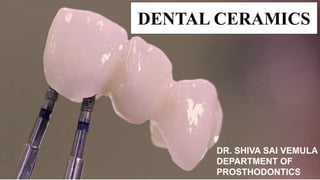
DENTAL CERAMICS
DR. SHIVA SAI VEMULA
DEPARTMENT OF
PROSTHODONTICS
1
CONTENTS
• Introduction
• Composition
• Manufacture of ceramics
• Classification
• Application
• Classification
• Properties
• Processing
– Wax coping methods
– Removal of oxide layer
– Assembling into cramic crowns
– Method of porcelain cndensation
– Stages of firing
– Bonding and bond failures in
PFM 2
• Strengthening of ceramics
• Recent advancements
• References
• The materials used for the reconstruction of decayed,
damaged or missing teeth are :–Metals, Polymers, Ceramics
( major), Composites
INTRODUCTIONN
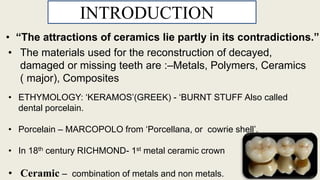
• ETHYMOLOGY: ‘KERAMOS’(GREEK) - ‘BURNT STUFF Also called
dental porcelain.
• Porcelain – MARCOPOLO from ‘Porcellana, or cowrie shell’.
• In 18th century RICHMOND- 1st metal ceramic crown
• Ceramic – combination of metals and non metals.
3
• “The attractions of ceramics lie partly in its contradictions.”
• DEFINITION :
DENTALCERAMIC (Anusavice):-
• A specially formulated ceramic material that exhibits
adequate strength, durability and color that is used
intraorally to restore anatomic form and function, and/or
esthetics.
4
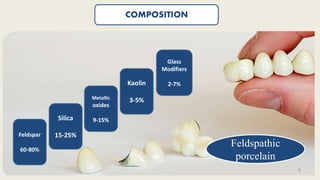
Glass
Modifiers
2-7%
Metallic
oxides
9-15%
Feldspar
60-80%
Silica
15-25%
Feldspathic
porcelain
COMPOSITION
5
Kaolin
3-5%
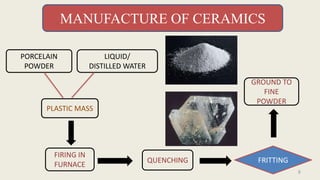
LIQUID/
DISTILLED WATER
PORCELAIN
POWDER
PLASTIC MASS
FIRING IN
FURNACE
QUENCHING
GROUND TO
FINE
POWDER
FRITTING
MANUFACTURE OF CERAMICS
6
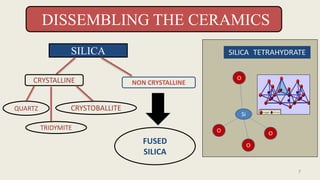
CRYSTALLINE NON CRYSTALLINE
QUARTZ CRYSTOBALLITE
FUSED
SILICA
TRIDYMITE
SILICA
DISSEMBLING THE CERAMICS
7
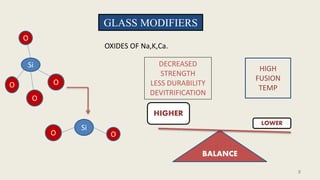
BALANCE
HIGHER
LOWER
DECREASED
STRENGTH
LESS DURABILITY
DEVITRIFICATION
GLASS MODIFIERS
HIGH
FUSION
TEMP
Si
O
O
O
Si
O O
OXIDES OF Na,K,Ca.
8
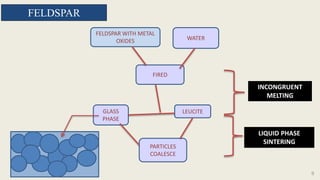
FELDSPAR WITH METAL
OXIDES WATER
FIRED
GLASS
PHASE
LEUCITE
PARTICLES
COALESCE
INCONGRUENT
MELTING
LIQUID PHASE
SINTERING
FELDSPAR
9
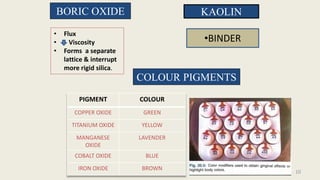
• Flux
• Viscosity
• Forms a separate
lattice & interrupt
more rigid silica.
BORIC OXIDE KAOLIN
•BINDER
COLOUR PIGMENTS
PIGMENT COLOUR
COPPER OXIDE GREEN
TITANIUM OXIDE YELLOW
MANGANESE
OXIDE
LAVENDER
COBALT OXIDE BLUE
IRON OXIDE BROWN
10
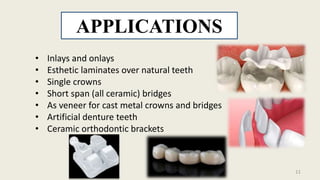
• Inlays and onlays
• Esthetic laminates over natural teeth
• Single crowns
• Short span (all ceramic) bridges
• As veneer for cast metal crowns and bridges
• Artificial denture teeth
• Ceramic orthodontic brackets
APPLICATIONS
11
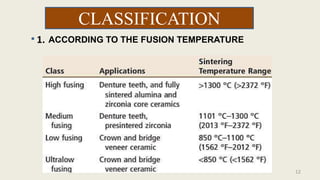
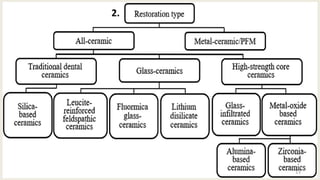
CLASSIFICATION
ACCORDING TO THE FUSION TEMPERATURE
12
1.
13
2.
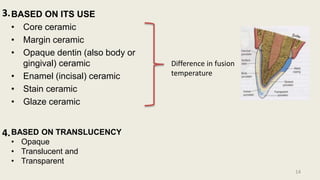
BASED ON ITS USE
• Core ceramic
• Margin ceramic
• Opaque dentin (also body or
gingival) ceramic
• Enamel (incisal) ceramic
• Stain ceramic
• Glaze ceramic
Difference in fusion
temperature
BASED ON TRANSLUCENCY
• Opaque
• Translucent and
• Transparent
14
3.
4.
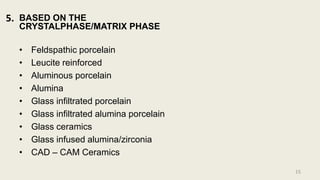
BASED ON THE
CRYSTALPHASE/MATRIX PHASE
• Feldspathic porcelain
• Leucite reinforced
• Aluminous porcelain
• Alumina
• Glass infiltrated porcelain
• Glass infiltrated alumina porcelain
• Glass ceramics
• Glass infused alumina/zirconia
• CAD – CAM Ceramics
15
5.
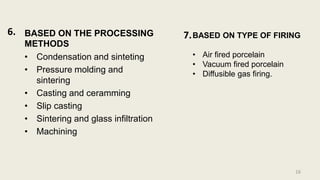
BASED ON THE PROCESSING
METHODS
• Condensation and sinteting
• Pressure molding and
sintering
• Casting and ceramming
• Slip casting
• Sintering and glass infiltration
• Machining
16
6. 7.BASED ON TYPE OF FIRING
• Air fired porcelain
• Vacuum fired porcelain
• Diffusible gas firing.
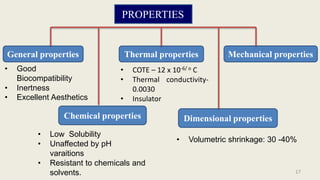
PROPERTIES
General properties
Chemical properties
Thermal properties
Dimensional properties
Mechanical properties
• COTE – 12 x 10-6/ o C
• Thermal conductivity-
0.0030
• Insulator
• Good
Biocompatibility
• Inertness
• Excellent Aesthetics
• Low Solubility
• Unaffected by pH
varaitions
• Resistant to chemicals and
solvents.
• Volumetric shrinkage: 30 -40%
17
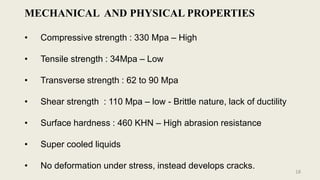
MECHANICAL AND PHYSICAL PROPERTIES
• Compressive strength : 330 Mpa – High
• Tensile strength : 34Mpa – Low
• Transverse strength : 62 to 90 Mpa
• Shear strength : 110 Mpa – low - Brittle nature, lack of ductility
• Surface hardness : 460 KHN – High abrasion resistance
• Super cooled liquids
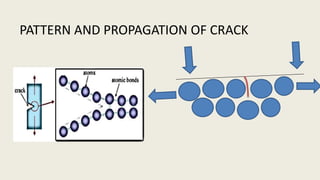
• No deformation under stress, instead develops cracks.
18
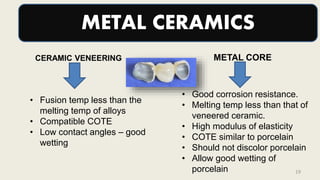
METAL CERAMICS
METAL CORE
• Good corrosion resistance.
• Melting temp less than that of
veneered ceramic.
• High modulus of elasticity
• COTE similar to porcelain
• Should not discolor porcelain
• Allow good wetting of
porcelain
• Fusion temp less than the
melting temp of alloys
• Compatible COTE
• Low contact angles – good
wetting
CERAMIC VENEERING
19
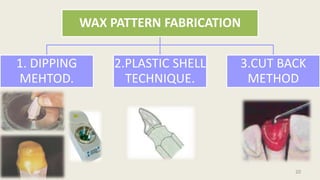
WAX PATTERN FABRICATION
1. DIPPING
MEHTOD.
2.PLASTIC SHELL
TECHNIQUE.
3.CUT BACK
METHOD
20
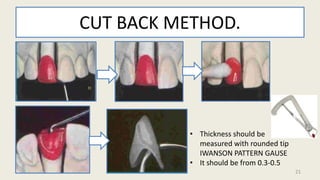
CUT BACK METHOD.
• Thickness should be
measured with rounded tip
IWANSON PATTERN GAUSE
• It should be from 0.3-0.5
21
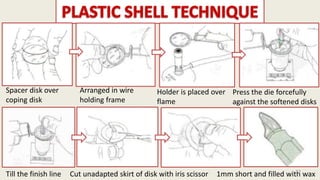
Spacer disk over
coping disk
Arranged in wire
holding frame
Holder is placed over
flame
Press the die forcefully
against the softened disks
Till the finish line Cut unadapted skirt of disk with iris scissor 1mm short and filled with wax
22
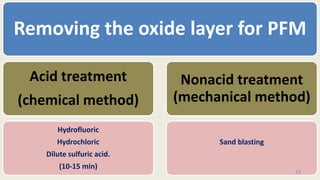
Removing the oxide layer for PFM
Acid treatment
(chemical method)
Hydrofluoric
Hydrochloric
Dilute sulfuric acid.
(10-15 min)
Nonacid treatment
(mechanical method)
Sand blasting
23
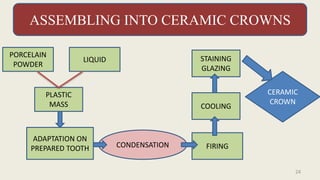
ASSEMBLING INTO CERAMIC CROWNS
PORCELAIN
POWDER
LIQUID
PLASTIC
MASS
ADAPTATION ON
PREPARED TOOTH FIRING
COOLING
STAINING
GLAZING
CONDENSATION
CERAMIC
CROWN
24
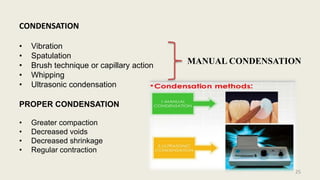
CONDENSATION
• Vibration
• Spatulation
• Brush technique or capillary action
• Whipping
• Ultrasonic condensation
PROPER CONDENSATION
• Greater compaction
• Decreased voids
• Decreased shrinkage
• Regular contraction
MANUAL CONDENSATION
25
Methods of porcelain condensation.
1.Capillary action:-
The technique of blotting a wet built up
with absorbent paper uses surface
tension.
2.Vibration:-
Is created by passing a serrated
instrument over the neck of a hemostat in
which the restoration is held.
3.Spatulation:- A spatula is used to
apply , then rub the porcelain built up to
force the liquid to the surface.
4.Whipping:-
A no. 10 sable brush is rapidly moved over
the porcelain surface with a whipping
motion. The whipping motion brings the
liquid to the outer surface for blotting.
5.Dry powder addition:- Requires dry
porcelain powder be sprinkled on an
area of wet porcelain, using the existing
liquid to moisten the powder addition
26
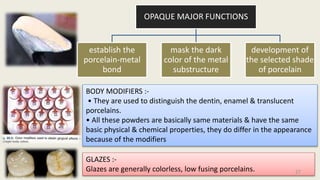
OPAQUE MAJOR FUNCTIONS
establish the
porcelain-metal
bond
mask the dark
color of the metal
substructure
development of
the selected shade
of porcelain
BODY MODIFIERS :-
• They are used to distinguish the dentin, enamel & translucent
porcelains.
• All these powders are basically same materials & have the same
basic physical & chemical properties, they do differ in the appearance
because of the modifiers
GLAZES :-
Glazes are generally colorless, low fusing porcelains. 27
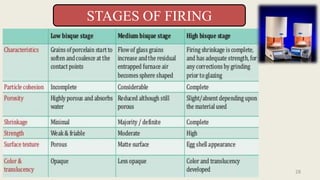
STAGES OF FIRING
28
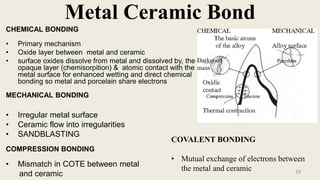
CHEMICAL BONDING
• Primary mechanism
• Oxide layer between metal and ceramic
• surface oxides dissolve from metal and dissolved by, the
opaque layer (chemisorpition) & atomic contact with the
metal surface for enhanced wetting and direct chemical
bonding so metal and porcelain share electrons
MECHANICAL BONDING
• Irregular metal surface
• Ceramic flow into irregularities
• SANDBLASTING
COMPRESSION BONDING
• Mismatch in COTE between metal
and ceramic
Metal Ceramic Bond
COVALENT BONDING
• Mutual exchange of electrons between
the metal and ceramic 29
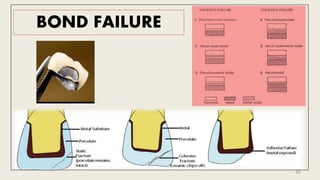
BOND FAILURE
30
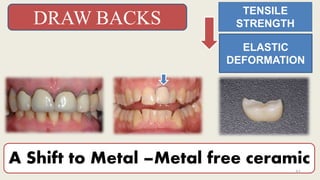
A Shift to Metal –Metal free ceramic
DRAW BACKS
TENSILE
STRENGTH
ELASTIC
DEFORMATION
31
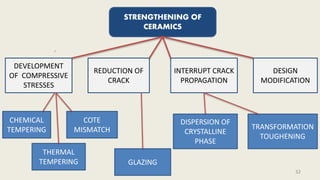
STRENGTHENING OF
CERAMICS
REDUCTION OF
CRACK
INTERRUPT CRACK
PROPAGATION
DESIGN
MODIFICATION
DEVELOPMENT
OF COMPRESSIVE
STRESSES
CHEMICAL
TEMPERING
THERMAL
TEMPERING
COTE
MISMATCH
DISPERSION OF
CRYSTALLINE
PHASE
TRANSFORMATION
TOUGHENING
GLAZING
32
PATTERN AND PROPAGATION OF CRACK
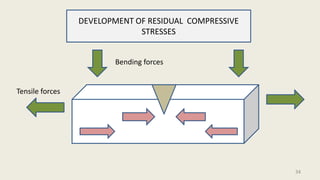
DEVELOPMENT OF RESIDUAL COMPRESSIVE
STRESSES
Bending forces
Tensile forces
34
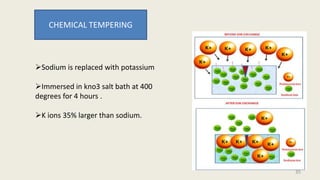
CHEMICAL TEMPERING
Sodium is replaced with potassium
Immersed in kno3 salt bath at 400
degrees for 4 hours .
K ions 35% larger than sodium.
35
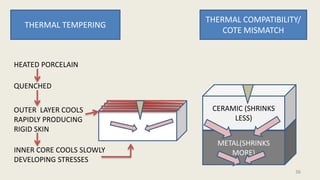
THERMAL TEMPERING
THERMAL COMPATIBILITY/
COTE MISMATCH
HEATED PORCELAIN
QUENCHED
OUTER LAYER COOLS
RAPIDLY PRODUCING
RIGID SKIN
INNER CORE COOLS SLOWLY
DEVELOPING STRESSES
METAL(SHRINKS
MORE)
CERAMIC (SHRINKS
LESS)
36
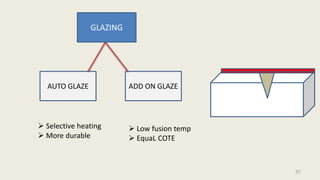
AUTO GLAZE ADD ON GLAZE
 Low fusion temp
 EquaL COTE
 Selective heating
 More durable
GLAZING
37
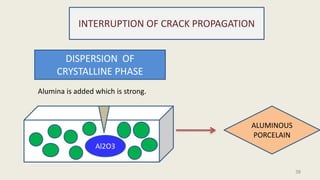
DISPERSION OF
CRYSTALLINE PHASE
Al2O3
ALUMINOUS
PORCELAIN
Alumina is added which is strong.
INTERRUPTION OF CRACK PROPAGATION
38
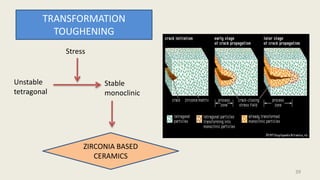
TRANSFORMATION
TOUGHENING
Stress
Unstable
tetragonal
Stable
monoclinic
ZIRCONIA BASED
CERAMICS
39
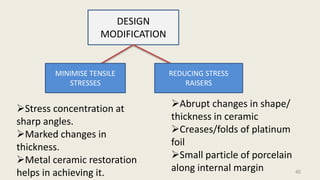
DESIGN
MODIFICATION
Stress concentration at
sharp angles.
Marked changes in
thickness.
Metal ceramic restoration
helps in achieving it.
Abrupt changes in shape/
thickness in ceramic
Creases/folds of platinum
foil
Small particle of porcelain
along internal margin
MINIMISE TENSILE
STRESSES
REDUCING STRESS
RAISERS
40
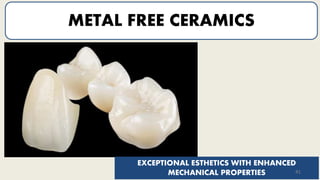
METAL FREE CERAMICS
EXCEPTIONAL ESTHETICS WITH ENHANCED
MECHANICAL PROPERTIES 41
Reinforced
core ceramics
Resin
bonded
Metal
ceramics
Particle filled
glass ceramics
Predominantly
glass based
ceramics
Polycrystalline
ceramics
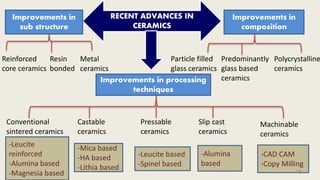
Conventional
sintered ceramics
Castable
ceramics
Slip cast
ceramics
Machinable
ceramics
Pressable
ceramics
RECENT ADVANCES IN
CERAMICS
-CAD CAM
-Copy Milling
-Alumina
based
-Leucite based
-Spinel based
-Mica based
-HA based
-Lithia based
-Leucite
reinforced
-Alumina based
-Magnesia based
Improvements in
sub structure
Improvements in
composition
Improvements in processing
techniques
42
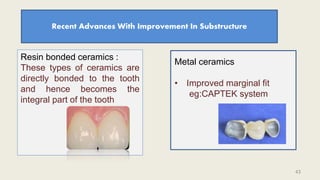
Recent Advances With Improvement In Substructure
Resin bonded ceramics :
These types of ceramics are
directly bonded to the tooth
and hence becomes the
integral part of the tooth
Metal ceramics
• Improved marginal fit
eg:CAPTEK system
43
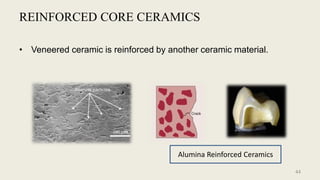
REINFORCED CORE CERAMICS
• Veneered ceramic is reinforced by another ceramic material.
Alumina Reinforced Ceramics
44
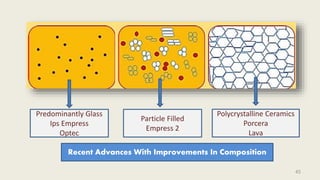
Predominantly Glass
Ips Empress
Optec
Polycrystalline Ceramics
Porcera
Lava
Particle Filled
Empress 2
Recent Advances With Improvements In Composition
45
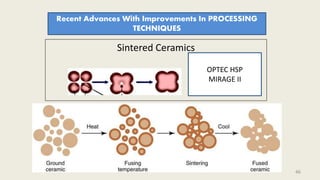
Sintered Ceramics
OPTEC HSP
MIRAGE II
Recent Advances With Improvements In PROCESSING
TECHNIQUES
46
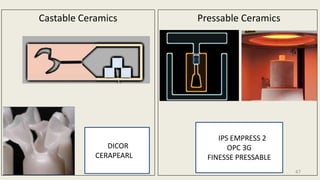
Pressable Ceramics
IPIPS EMPRESS 2
OPC 3G
FINESSE PRESSABLE
Castable Ceramics
DICOR
CERAPEARL
47
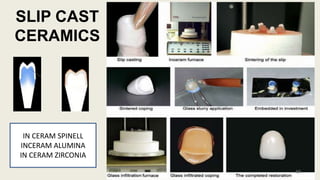
IN CERAM SPINELL
INCERAM ALUMINA
IN CERAM ZIRCONIA
SLIP CAST
CERAMICS
48
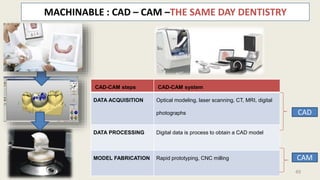
MACHINABLE : CAD – CAM –THE SAME DAY DENTISTRY
CAD-CAM steps CAD-CAM system
DATA ACQUISITION Optical modeling, laser scanning, CT, MRI, digital
photographs
DATA PROCESSING Digital data is process to obtain a CAD model
MODEL FABRICATION Rapid prototyping, CNC milling
CAD
CAM
49
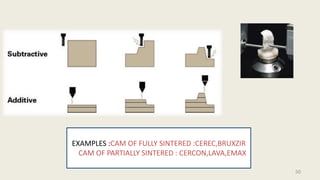
EXAMPLES :CAM OF FULLY SINTERED :CEREC,BRUXZIR
CAM OF PARTIALLY SINTERED : CERCON,LAVA,EMAX
50
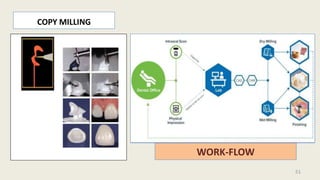
COPY MILLING
WORK-FLOW
51
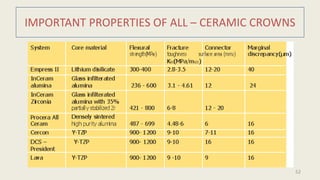
IMPORTANT PROPERTIES OF ALL – CERAMIC CROWNS
52
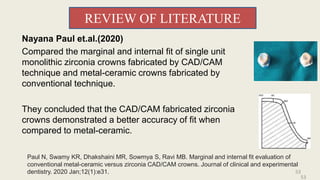
REVIEW OF LITERATURE
53
Nayana Paul et.al.(2020)
Compared the marginal and internal fit of single unit
monolithic zirconia crowns fabricated by CAD/CAM
technique and metal-ceramic crowns fabricated by
conventional technique.
They concluded that the CAD/CAM fabricated zirconia
crowns demonstrated a better accuracy of fit when
compared to metal-ceramic.
Paul N, Swamy KR, Dhakshaini MR, Sowmya S, Ravi MB. Marginal and internal fit evaluation of
conventional metal-ceramic versus zirconia CAD/CAM crowns. Journal of clinical and experimental
dentistry. 2020 Jan;12(1):e31.
53
REFERENCES:
• Anusavice KJ, Shen C, Rawls HR, editors. Phillips' science of dental materials.
Elsevier Health Sciences; 2012 Sep 27.
• Babu PJ, Alla RK, Alluri VR, Datla SR, Konakanchi A. Dental ceramics: Part I–An
overview of composition, structure and properties. Am J Mater Eng Technol.
2015;3(1):13-8.
• Datla SR, Alla RK, Alluri VR, Babu JP, Konakanchi A. Dental ceramics: Part II-Recent
advances in dental ceramics. Am J Mater Eng Technol. 2015;3(2):19-26.
• Srividya S, Nair CK, Shetty JM. Recent advances in ceramics. Trends in
Prosthodontics and Dental Implantology. 2010 Dec 24;1(2):38-44.
• Kwon SJ, Lawson NC, McLaren EE, Nejat AH, Burgess JO. Comparison of the
mechanical properties of translucent zirconia and lithium disilicate. The Journal of
prosthetic dentistry. 2018 Jul 1;120(1):132-7.
• Vianna ALSV, Prado CJD, Bicalho AA, Pereira RADS, Neves FDD, Soares CJ. Effect of
cavity preparation design and ceramic type on the stress distribution, strain and fracture
resistance of CAD/CAM onlays in molars. J Appl Oral Sci. 2018;26:e20180004.
54
• Paul N, Swamy KR, Dhakshaini MR, Sowmya S, Ravi MB. Marginal and internal fit
evaluation of conventional metal-ceramic versus zirconia CAD/CAM crowns. Journal of
clinical and experimental dentistry. 2020 Jan;12(1):e31
• Reddy NR, Padmaja BI, Devi G, Priya GK, Bindu GH, Babu NS. The effect of
commonly consumed beverages on colour stability and surface roughness of two
metal ceramic materials: An in-vitro study. Journal of Dr. NTR University of Health
Sciences. 2018 Jan 1;7(1):31.
55
56
• Ceramics have a great past in dentistry. Their
biocompatibility and excellent esthetics have
positioned them in the high-end segment of
restorative dentistry. The future of ceramics is
even greater since manufacturing technology and
materials which also means that newer
compounds, precisely engineered to function will
be developed
CONCLUSION
THANK YOU
57

Dental Ceramics

  • 1.
    DENTAL CERAMICS DR. SHIVASAI VEMULA DEPARTMENT OF PROSTHODONTICS 1
  • 2.
    CONTENTS • Introduction • Composition •Manufacture of ceramics • Classification • Application • Classification • Properties • Processing – Wax coping methods – Removal of oxide layer – Assembling into cramic crowns – Method of porcelain cndensation – Stages of firing – Bonding and bond failures in PFM 2 • Strengthening of ceramics • Recent advancements • References
  • 3.
    • The materialsused for the reconstruction of decayed, damaged or missing teeth are :–Metals, Polymers, Ceramics ( major), Composites INTRODUCTIONN • ETHYMOLOGY: ‘KERAMOS’(GREEK) - ‘BURNT STUFF Also called dental porcelain. • Porcelain – MARCOPOLO from ‘Porcellana, or cowrie shell’. • In 18th century RICHMOND- 1st metal ceramic crown • Ceramic – combination of metals and non metals. 3 • “The attractions of ceramics lie partly in its contradictions.”
  • 4.
    • DEFINITION : DENTALCERAMIC(Anusavice):- • A specially formulated ceramic material that exhibits adequate strength, durability and color that is used intraorally to restore anatomic form and function, and/or esthetics. 4
  • 5.
  • 6.
    LIQUID/ DISTILLED WATER PORCELAIN POWDER PLASTIC MASS FIRINGIN FURNACE QUENCHING GROUND TO FINE POWDER FRITTING MANUFACTURE OF CERAMICS 6
  • 7.
    CRYSTALLINE NON CRYSTALLINE QUARTZCRYSTOBALLITE FUSED SILICA TRIDYMITE SILICA DISSEMBLING THE CERAMICS 7
  • 8.
  • 9.
    FELDSPAR WITH METAL OXIDESWATER FIRED GLASS PHASE LEUCITE PARTICLES COALESCE INCONGRUENT MELTING LIQUID PHASE SINTERING FELDSPAR 9
  • 10.
    • Flux • Viscosity •Forms a separate lattice & interrupt more rigid silica. BORIC OXIDE KAOLIN •BINDER COLOUR PIGMENTS PIGMENT COLOUR COPPER OXIDE GREEN TITANIUM OXIDE YELLOW MANGANESE OXIDE LAVENDER COBALT OXIDE BLUE IRON OXIDE BROWN 10
  • 11.
    • Inlays andonlays • Esthetic laminates over natural teeth • Single crowns • Short span (all ceramic) bridges • As veneer for cast metal crowns and bridges • Artificial denture teeth • Ceramic orthodontic brackets APPLICATIONS 11
  • 12.
    CLASSIFICATION ACCORDING TO THEFUSION TEMPERATURE 12 1.
  • 13.
  • 14.
    BASED ON ITSUSE • Core ceramic • Margin ceramic • Opaque dentin (also body or gingival) ceramic • Enamel (incisal) ceramic • Stain ceramic • Glaze ceramic Difference in fusion temperature BASED ON TRANSLUCENCY • Opaque • Translucent and • Transparent 14 3. 4.
  • 15.
    BASED ON THE CRYSTALPHASE/MATRIXPHASE • Feldspathic porcelain • Leucite reinforced • Aluminous porcelain • Alumina • Glass infiltrated porcelain • Glass infiltrated alumina porcelain • Glass ceramics • Glass infused alumina/zirconia • CAD – CAM Ceramics 15 5.
  • 16.
    BASED ON THEPROCESSING METHODS • Condensation and sinteting • Pressure molding and sintering • Casting and ceramming • Slip casting • Sintering and glass infiltration • Machining 16 6. 7.BASED ON TYPE OF FIRING • Air fired porcelain • Vacuum fired porcelain • Diffusible gas firing.
  • 17.
    PROPERTIES General properties Chemical properties Thermalproperties Dimensional properties Mechanical properties • COTE – 12 x 10-6/ o C • Thermal conductivity- 0.0030 • Insulator • Good Biocompatibility • Inertness • Excellent Aesthetics • Low Solubility • Unaffected by pH varaitions • Resistant to chemicals and solvents. • Volumetric shrinkage: 30 -40% 17
  • 18.
    MECHANICAL AND PHYSICALPROPERTIES • Compressive strength : 330 Mpa – High • Tensile strength : 34Mpa – Low • Transverse strength : 62 to 90 Mpa • Shear strength : 110 Mpa – low - Brittle nature, lack of ductility • Surface hardness : 460 KHN – High abrasion resistance • Super cooled liquids • No deformation under stress, instead develops cracks. 18
  • 19.
    METAL CERAMICS METAL CORE •Good corrosion resistance. • Melting temp less than that of veneered ceramic. • High modulus of elasticity • COTE similar to porcelain • Should not discolor porcelain • Allow good wetting of porcelain • Fusion temp less than the melting temp of alloys • Compatible COTE • Low contact angles – good wetting CERAMIC VENEERING 19
  • 20.
    WAX PATTERN FABRICATION 1.DIPPING MEHTOD. 2.PLASTIC SHELL TECHNIQUE. 3.CUT BACK METHOD 20
  • 21.
    CUT BACK METHOD. •Thickness should be measured with rounded tip IWANSON PATTERN GAUSE • It should be from 0.3-0.5 21
  • 22.
    Spacer disk over copingdisk Arranged in wire holding frame Holder is placed over flame Press the die forcefully against the softened disks Till the finish line Cut unadapted skirt of disk with iris scissor 1mm short and filled with wax 22
  • 23.
    Removing the oxidelayer for PFM Acid treatment (chemical method) Hydrofluoric Hydrochloric Dilute sulfuric acid. (10-15 min) Nonacid treatment (mechanical method) Sand blasting 23
  • 24.
    ASSEMBLING INTO CERAMICCROWNS PORCELAIN POWDER LIQUID PLASTIC MASS ADAPTATION ON PREPARED TOOTH FIRING COOLING STAINING GLAZING CONDENSATION CERAMIC CROWN 24
  • 25.
    CONDENSATION • Vibration • Spatulation •Brush technique or capillary action • Whipping • Ultrasonic condensation PROPER CONDENSATION • Greater compaction • Decreased voids • Decreased shrinkage • Regular contraction MANUAL CONDENSATION 25
  • 26.
    Methods of porcelaincondensation. 1.Capillary action:- The technique of blotting a wet built up with absorbent paper uses surface tension. 2.Vibration:- Is created by passing a serrated instrument over the neck of a hemostat in which the restoration is held. 3.Spatulation:- A spatula is used to apply , then rub the porcelain built up to force the liquid to the surface. 4.Whipping:- A no. 10 sable brush is rapidly moved over the porcelain surface with a whipping motion. The whipping motion brings the liquid to the outer surface for blotting. 5.Dry powder addition:- Requires dry porcelain powder be sprinkled on an area of wet porcelain, using the existing liquid to moisten the powder addition 26
  • 27.
    OPAQUE MAJOR FUNCTIONS establishthe porcelain-metal bond mask the dark color of the metal substructure development of the selected shade of porcelain BODY MODIFIERS :- • They are used to distinguish the dentin, enamel & translucent porcelains. • All these powders are basically same materials & have the same basic physical & chemical properties, they do differ in the appearance because of the modifiers GLAZES :- Glazes are generally colorless, low fusing porcelains. 27
  • 28.
  • 29.
    CHEMICAL BONDING • Primarymechanism • Oxide layer between metal and ceramic • surface oxides dissolve from metal and dissolved by, the opaque layer (chemisorpition) & atomic contact with the metal surface for enhanced wetting and direct chemical bonding so metal and porcelain share electrons MECHANICAL BONDING • Irregular metal surface • Ceramic flow into irregularities • SANDBLASTING COMPRESSION BONDING • Mismatch in COTE between metal and ceramic Metal Ceramic Bond COVALENT BONDING • Mutual exchange of electrons between the metal and ceramic 29
  • 30.
  • 31.
    A Shift toMetal –Metal free ceramic DRAW BACKS TENSILE STRENGTH ELASTIC DEFORMATION 31
  • 32.
    STRENGTHENING OF CERAMICS REDUCTION OF CRACK INTERRUPTCRACK PROPAGATION DESIGN MODIFICATION DEVELOPMENT OF COMPRESSIVE STRESSES CHEMICAL TEMPERING THERMAL TEMPERING COTE MISMATCH DISPERSION OF CRYSTALLINE PHASE TRANSFORMATION TOUGHENING GLAZING 32
  • 33.
  • 34.
    DEVELOPMENT OF RESIDUALCOMPRESSIVE STRESSES Bending forces Tensile forces 34
  • 35.
    CHEMICAL TEMPERING Sodium isreplaced with potassium Immersed in kno3 salt bath at 400 degrees for 4 hours . K ions 35% larger than sodium. 35
  • 36.
    THERMAL TEMPERING THERMAL COMPATIBILITY/ COTEMISMATCH HEATED PORCELAIN QUENCHED OUTER LAYER COOLS RAPIDLY PRODUCING RIGID SKIN INNER CORE COOLS SLOWLY DEVELOPING STRESSES METAL(SHRINKS MORE) CERAMIC (SHRINKS LESS) 36
  • 37.
    AUTO GLAZE ADDON GLAZE  Low fusion temp  EquaL COTE  Selective heating  More durable GLAZING 37
  • 38.
    DISPERSION OF CRYSTALLINE PHASE Al2O3 ALUMINOUS PORCELAIN Aluminais added which is strong. INTERRUPTION OF CRACK PROPAGATION 38
  • 39.
  • 40.
    DESIGN MODIFICATION Stress concentration at sharpangles. Marked changes in thickness. Metal ceramic restoration helps in achieving it. Abrupt changes in shape/ thickness in ceramic Creases/folds of platinum foil Small particle of porcelain along internal margin MINIMISE TENSILE STRESSES REDUCING STRESS RAISERS 40
  • 41.
    METAL FREE CERAMICS EXCEPTIONALESTHETICS WITH ENHANCED MECHANICAL PROPERTIES 41
  • 42.
    Reinforced core ceramics Resin bonded Metal ceramics Particle filled glassceramics Predominantly glass based ceramics Polycrystalline ceramics Conventional sintered ceramics Castable ceramics Slip cast ceramics Machinable ceramics Pressable ceramics RECENT ADVANCES IN CERAMICS -CAD CAM -Copy Milling -Alumina based -Leucite based -Spinel based -Mica based -HA based -Lithia based -Leucite reinforced -Alumina based -Magnesia based Improvements in sub structure Improvements in composition Improvements in processing techniques 42
  • 43.
    Recent Advances WithImprovement In Substructure Resin bonded ceramics : These types of ceramics are directly bonded to the tooth and hence becomes the integral part of the tooth Metal ceramics • Improved marginal fit eg:CAPTEK system 43
  • 44.
    REINFORCED CORE CERAMICS •Veneered ceramic is reinforced by another ceramic material. Alumina Reinforced Ceramics 44
  • 45.
    Predominantly Glass Ips Empress Optec PolycrystallineCeramics Porcera Lava Particle Filled Empress 2 Recent Advances With Improvements In Composition 45
  • 46.
    Sintered Ceramics OPTEC HSP MIRAGEII Recent Advances With Improvements In PROCESSING TECHNIQUES 46
  • 47.
    Pressable Ceramics IPIPS EMPRESS2 OPC 3G FINESSE PRESSABLE Castable Ceramics DICOR CERAPEARL 47
  • 48.
    IN CERAM SPINELL INCERAMALUMINA IN CERAM ZIRCONIA SLIP CAST CERAMICS 48
  • 49.
    MACHINABLE : CAD– CAM –THE SAME DAY DENTISTRY CAD-CAM steps CAD-CAM system DATA ACQUISITION Optical modeling, laser scanning, CT, MRI, digital photographs DATA PROCESSING Digital data is process to obtain a CAD model MODEL FABRICATION Rapid prototyping, CNC milling CAD CAM 49
  • 50.
    EXAMPLES :CAM OFFULLY SINTERED :CEREC,BRUXZIR CAM OF PARTIALLY SINTERED : CERCON,LAVA,EMAX 50
  • 51.
  • 52.
    IMPORTANT PROPERTIES OFALL – CERAMIC CROWNS 52
  • 53.
    REVIEW OF LITERATURE 53 NayanaPaul et.al.(2020) Compared the marginal and internal fit of single unit monolithic zirconia crowns fabricated by CAD/CAM technique and metal-ceramic crowns fabricated by conventional technique. They concluded that the CAD/CAM fabricated zirconia crowns demonstrated a better accuracy of fit when compared to metal-ceramic. Paul N, Swamy KR, Dhakshaini MR, Sowmya S, Ravi MB. Marginal and internal fit evaluation of conventional metal-ceramic versus zirconia CAD/CAM crowns. Journal of clinical and experimental dentistry. 2020 Jan;12(1):e31. 53
  • 54.
    REFERENCES: • Anusavice KJ,Shen C, Rawls HR, editors. Phillips' science of dental materials. Elsevier Health Sciences; 2012 Sep 27. • Babu PJ, Alla RK, Alluri VR, Datla SR, Konakanchi A. Dental ceramics: Part I–An overview of composition, structure and properties. Am J Mater Eng Technol. 2015;3(1):13-8. • Datla SR, Alla RK, Alluri VR, Babu JP, Konakanchi A. Dental ceramics: Part II-Recent advances in dental ceramics. Am J Mater Eng Technol. 2015;3(2):19-26. • Srividya S, Nair CK, Shetty JM. Recent advances in ceramics. Trends in Prosthodontics and Dental Implantology. 2010 Dec 24;1(2):38-44. • Kwon SJ, Lawson NC, McLaren EE, Nejat AH, Burgess JO. Comparison of the mechanical properties of translucent zirconia and lithium disilicate. The Journal of prosthetic dentistry. 2018 Jul 1;120(1):132-7. • Vianna ALSV, Prado CJD, Bicalho AA, Pereira RADS, Neves FDD, Soares CJ. Effect of cavity preparation design and ceramic type on the stress distribution, strain and fracture resistance of CAD/CAM onlays in molars. J Appl Oral Sci. 2018;26:e20180004. 54
  • 55.
    • Paul N,Swamy KR, Dhakshaini MR, Sowmya S, Ravi MB. Marginal and internal fit evaluation of conventional metal-ceramic versus zirconia CAD/CAM crowns. Journal of clinical and experimental dentistry. 2020 Jan;12(1):e31 • Reddy NR, Padmaja BI, Devi G, Priya GK, Bindu GH, Babu NS. The effect of commonly consumed beverages on colour stability and surface roughness of two metal ceramic materials: An in-vitro study. Journal of Dr. NTR University of Health Sciences. 2018 Jan 1;7(1):31. 55
  • 56.
    56 • Ceramics havea great past in dentistry. Their biocompatibility and excellent esthetics have positioned them in the high-end segment of restorative dentistry. The future of ceramics is even greater since manufacturing technology and materials which also means that newer compounds, precisely engineered to function will be developed CONCLUSION
  • 57.