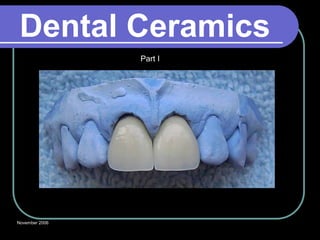
Dental Ceramics
November 2006
Part I
 DENTAL CERAMICS
Keramos: Greek
Keramika: Sanskrit
A material produced by firing or burning
” a combination of one or more metals with a
non metallic element, usually oxygen.”
Gilman 1967.
Phillips. 11th Ed.
An inorganic compound with nonmetallic properties
typically consisting of oxygen and one or more metallic or sem
imetallic elements( Eg: Aluminium, calcium, lithium, magnesiu
m, potassium, silicon, sodium, tin, titanium and zirconium) that
is formulated to produce the whole or
part of a ceramic based prosthesis.
Definition: Dental Ceramics
0’Brien:
Combination of one or more metals with non met
allic elements especially oxygen, larger
atoms of oxygen serving as a matrix with
smaller metal atoms tucked into the spaces
between oxygen.
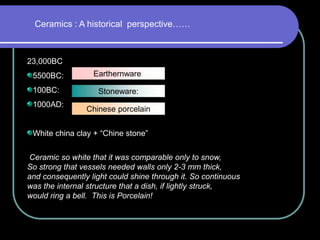
Ceramics : A historical perspective……
23,000BC
5500BC:
100BC:
1000AD:
White china clay + “Chine stone”
Ceramic so white that it was comparable only to snow,
So strong that vessels needed walls only 2-3 mm thick,
and consequently light could shine through it. So continuous
was the internal structure that a dish, if lightly struck,
would ring a bell. This is Porcelain!
Earthernware:
Stoneware:
Chinese porcelain
Attempts to imitate the Chinese Porcelain……
1717: Pere, Francois Xavier d’ Entrecolles
In less than 60 years, dental restorative material!
1728: Pierre Fauchard.
1774: Alexis Duchateau: Porcelain dentures.
1791: Nicholas Dubois de Chemant of Paris
Paris Faculty of Medicine :
“united the qualities of beauty, solidity and comfort to the
exigencies of hygiene.”
1806: Giuseppangelo Fonzi : Terrometallic teeth.
1817: Antoine Plantou : porcelain teeth to America
1830: Samuel Stockton: produces first porcelain teeth in the US.
1845: SS White : Porcelain teeth on a commercial basis.
1864: Claudius Ash : Tube Teeth
1882: William Herbst : Inlays of pulverized glass.
1884: Charles H Land : Platinum foil technique.
1886 : First successful inlays.
1894: Custer :Porcelain furnace.
1898: Jenkins :low fusing porcelain
1903: Land :porcelain jacket crown
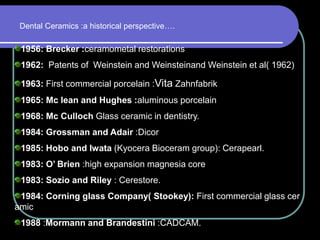
Dental Ceramics :a historical perspective….
1956: Brecker :ceramometal restorations
1962: Patents of Weinstein and Weinsteinand Weinstein et al( 1962)
1963: First commercial porcelain :Vita Zahnfabrik
1965: Mc lean and Hughes :aluminous porcelain
1968: Mc Culloch Glass ceramic in dentistry.
1984: Grossman and Adair :Dicor
1985: Hobo and Iwata (Kyocera Bioceram group): Cerapearl.
1983: O’ Brien :high expansion magnesia core
1983: Sozio and Riley : Cerestore.
1984: Corning glass Company( Stookey): First commercial glass cer
amic
1988 :Mormann and Brandestini :CADCAM.
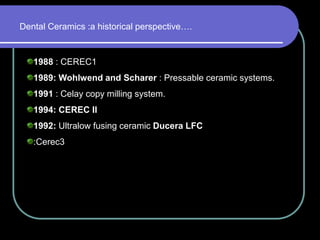
Dental Ceramics :a historical perspective….
1988 : CEREC1
1989: Wohlwend and Scharer : Pressable ceramic systems.
1991 : Celay copy milling system.
1994: CEREC II
1992: Ultralow fusing ceramic Ducera LFC
:Cerec3
Dental Ceramics :a historical perspective….
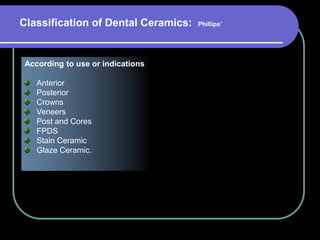
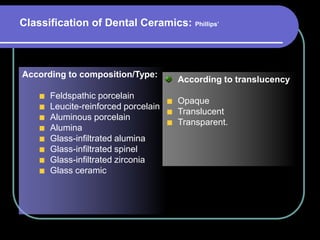
Classification of Dental Ceramics: Phillips’
According to use or indications
Anterior
Posterior
Crowns
Veneers
Post and Cores
FPDS
Stain Ceramic
Glaze Ceramic.
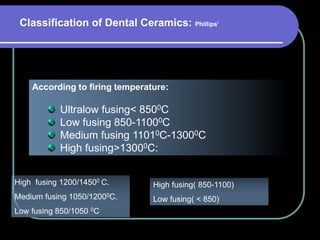
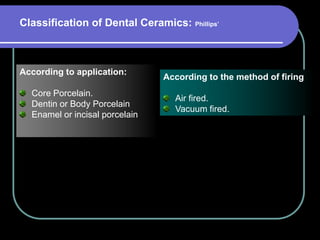
According to firing temperature:
Ultralow fusing< 8500C
Low fusing 850-11000C
Medium fusing 11010C-13000C
High fusing>13000C:
Classification of Dental Ceramics: Phillips’
High fusing 1200/14500 C.
Medium fusing 1050/12000C.
Low fusing 850/1050 0C
High fusing( 850-1100)
Low fusing( < 850)
High fusing:
Minimizing the additives such as sodium or potassium,
Maximizing the silicate cross links.
Low solubility, high strength and high stability.
Hardness exceeds enamel by 30%.
Classification of Dental Ceramics:
Medium fusing:
fired under vacuum with air admitted at the end of
firing
Low fusing:
increasing the amount of additives in porcelain
reducing the number of crosslinks within the silicate network
It helps to avoid overheating the metal framework
slightly weaker and less stable than high fusing
fired under vacuum.
Classification of Dental Ceramics:
Ultra low fusing:
Coefficient of thermal expansion match titanium alloys.
Lower firing temperatures -less oxide formation.
Classification of Dental Ceramics: Phillips’
According to the
processing method:
Sintering
Partial sintering
Glass infilteration
CADCAM
Copy milling.
According to microstructure
Glass
Crystalline.
Crystal containing glass.
Classification of Dental Ceramics: Phillips’
According to composition/Type:
Feldspathic porcelain
Leucite-reinforced porcelain
Aluminous porcelain
Alumina
Glass-infiltrated alumina
Glass-infiltrated spinel
Glass-infiltrated zirconia
Glass ceramic
According to translucency
Opaque
Translucent
Transparent.
Classification of Dental Ceramics: Phillips’
According to application:
Core Porcelain.
Dentin or Body Porcelain
Enamel or incisal porcelain
According to the method of firing
Air fired.
Vacuum fired.
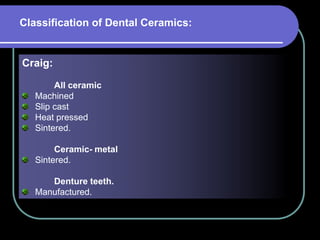
Classification of Dental Ceramics: Phillips’
Craig:
All ceramic
Machined
Slip cast
Heat pressed
Sintered.
Ceramic- metal
Sintered.
Denture teeth.
Manufactured.
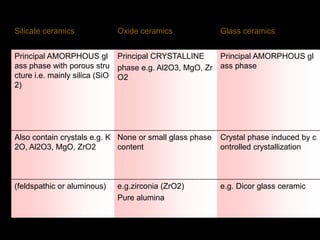
Classification of Dental Ceramics:
Silicate ceramics Oxide ceramics Glass ceramics
Principal AMORPHOUS gl
ass phase with porous stru
cture i.e. mainly silica (SiO
2)
Principal CRYSTALLINE
phase e.g. Al2O3, MgO, Zr
O2
Principal AMORPHOUS gl
ass phase
Also contain crystals e.g. K
2O, Al2O3, MgO, ZrO2
None or small glass phase
content
Crystal phase induced by c
ontrolled crystallization
(feldspathic or aluminous) e.g.zirconia (ZrO2)
Pure alumina
e.g. Dicor glass ceramic
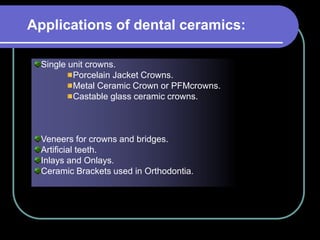
Single unit crowns.
Porcelain Jacket Crowns.
Metal Ceramic Crown or PFMcrowns.
Castable glass ceramic crowns.
Veneers for crowns and bridges.
Artificial teeth.
Inlays and Onlays.
Ceramic Brackets used in Orthodontia.
Applications of dental ceramics:
Ceramic V/S Porcelain :
What’s the difference?
Ceramic:
Nonmetallic
Inorganic
Man made objects formed by baking raw materials at high
temperatures.
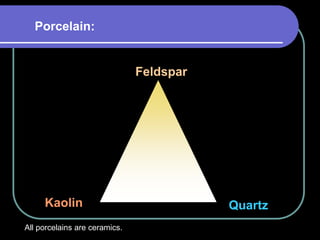
Porcelain:
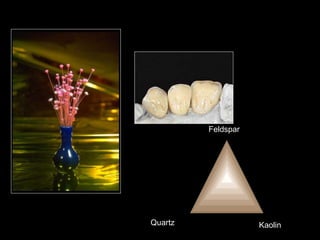
Feldspar
Kaolin Quartz
All porcelains are ceramics.
Esthetic alternative to discolored teeth.
Esthetic alternative :grossly decayed carious teeth.
Congenital anamolies
Veneers
Inlays
Onlays
Abutment retainers
Denture tooth materials.
Orthodontics as ceramic brackets.
Indications for ceramics:
Young permanent teeth.
Small short or thin crowns( relative contraindications)
PFM not indicated in high lip line patients.
Teeth round in cross section OR
Teeth more axially tapered than usual.
Abusive bite.
Patient’s lifestyle susceptible to trauma.
Contraindications:
Biocompatibility
Esthetics:
Color and translucency
Capable of being pigmented.
Colour stability.
Stain resistance.
Chamaleon like effect
Durability: Wear resistance and low solubility.
Ability to form precise shapes
High stiffness
High melting point.
Low thermal conductivity
Low electrical conductivity.
Advantages
Brittle: Low fracture toughness.
High firing shrinkage of conventional porcelains.
Attrition of opposing teeth.
More tooth reduction.
Cervical bulge and metal line in case of PFM restoration
Technique sensitive.
Specialized training required.
Expensive equipment required.
Difficult to repair if fails.
Cannot be repaired if the shade is altered.
Patient may complain of crackling sound on biting.
Disadvantages:
Feldspar
Quartz Kaolin
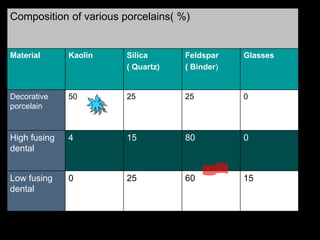
Composition of various porcelains( %)
Material Kaolin Silica
( Quartz)
Feldspar
( Binder)
Glasses
Decorative
porcelain
50 25 25 0
High fusing
dental
4 15 80 0
Low fusing
dental
0 25 60 15
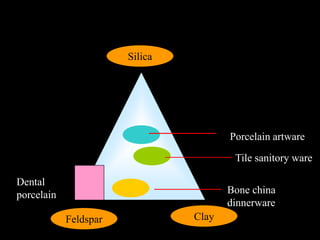
Tile sanitory ware
Porcelain artware
Bone china
dinnerware
Dental
porcelain
Silica
Clay
Feldspar
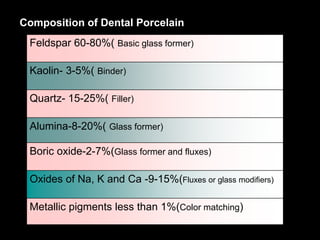
Composition of Dental Porcelain
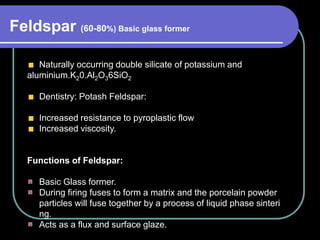
Feldspar 60-80%( Basic glass former)
Kaolin- 3-5%( Binder)
Quartz- 15-25%( Filler)
Alumina-8-20%( Glass former)
Boric oxide-2-7%(Glass former and fluxes)
Oxides of Na, K and Ca -9-15%(Fluxes or glass modifiers)
Metallic pigments less than 1%(Color matching)
Naturally occurring double silicate of potassium and
aluminium.K20.Al2O36SiO2
Dentistry: Potash Feldspar:
Increased resistance to pyroplastic flow
Increased viscosity.
Functions of Feldspar:
Basic Glass former.
During firing fuses to form a matrix and the porcelain powder
particles will fuse together by a process of liquid phase sinteri
ng.
Acts as a flux and surface glaze.
Feldspar (60-80%) Basic glass former
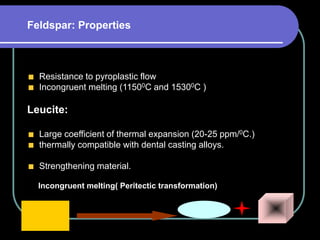
Resistance to pyroplastic flow
Incongruent melting (11500C and 15300C )
Leucite:
Large coefficient of thermal expansion (20-25 ppm/0C.)
thermally compatible with dental casting alloys.
Strengthening material.
Incongruent melting( Peritectic transformation)
Feldspar: Properties
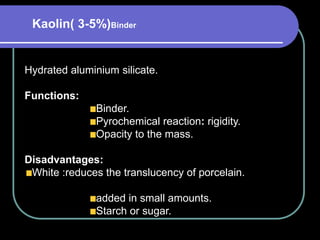
Hydrated aluminium silicate.
Functions:
Binder.
Pyrochemical reaction: rigidity.
Opacity to the mass.
Disadvantages:
White :reduces the translucency of porcelain.
added in small amounts.
Starch or sugar.
Kaolin( 3-5%)Binder
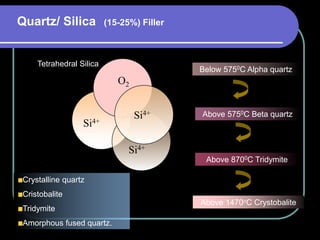
O2
Si4+
Si4+
Si4+
Tetrahedral Silica
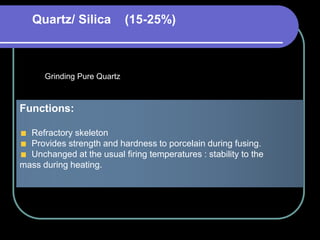
Quartz/ Silica (15-25%) Filler
Crystalline quartz
Cristobalite
Tridymite
Amorphous fused quartz.
Below 5750C Alpha quartz
Above 5750C Beta quartz
Above 8700C Tridymite
Above 1470oC Crystobalite
Functions:
Refractory skeleton
Provides strength and hardness to porcelain during fusing.
Unchanged at the usual firing temperatures : stability to the
mass during heating.
Quartz/ Silica (15-25%)
Grinding Pure Quartz
Functions:
Strength and opacity to the porcelain.
Alters softening point
increases the viscosity of porcelain during firing.
Aluminium oxide( 8-20% glass former)
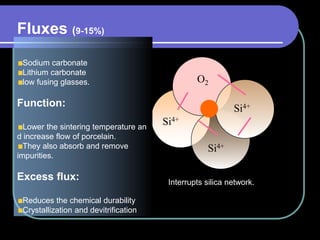
O2
Si4+
Si4+
Si4+
Sodium carbonate
Lithium carbonate
low fusing glasses.
Function:
Lower the sintering temperature an
d increase flow of porcelain.
They also absorb and remove
impurities.
Excess flux:
Reduces the chemical durability
Crystallization and devitrification
Fluxes (9-15%)
Interrupts silica network.
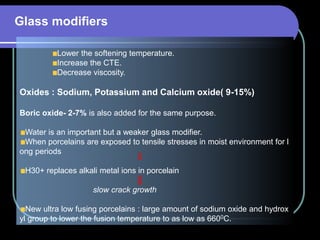
Glass modifiers
Lower the softening temperature.
Increase the CTE.
Decrease viscosity.
Oxides : Sodium, Potassium and Calcium oxide( 9-15%)
Boric oxide- 2-7% is also added for the same purpose.
Water is an important but a weaker glass modifier.
When porcelains are exposed to tensile stresses in moist environment for l
ong periods
H30+ replaces alkali metal ions in porcelain
slow crack growth
New ultra low fusing porcelains : large amount of sodium oxide and hydrox
yl group to lower the fusion temperature to as low as 6600C.
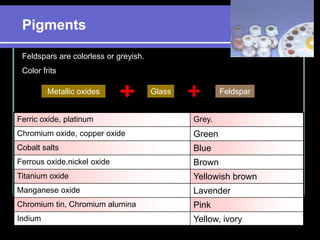
Pigments
Feldspars are colorless or greyish.
Color frits
Metallic oxides Glass Feldspar
Ferric oxide, platinum Grey.
Chromium oxide, copper oxide Green
Cobalt salts Blue
Ferrous oxide,nickel oxide Brown
Titanium oxide Yellowish brown
Manganese oxide Lavender
Chromium tin, Chromium alumina Pink
Indium Yellow, ivory
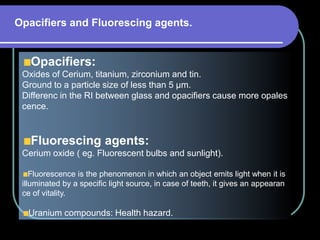
Opacifiers:
Oxides of Cerium, titanium, zirconium and tin.
Ground to a particle size of less than 5 µm.
Differenc in the RI between glass and opacifiers cause more opales
cence.
Fluorescing agents:
Cerium oxide ( eg. Fluorescent bulbs and sunlight).
Fluorescence is the phenomenon in which an object emits light when it is
illuminated by a specific light source, in case of teeth, it gives an appearan
ce of vitality.
Uranium compounds: Health hazard.
Opacifiers and Fluorescing agents.
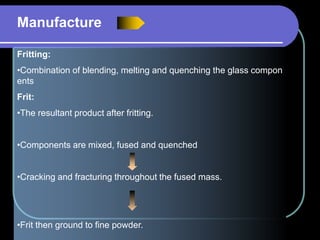
Fritting:
•Combination of blending, melting and quenching the glass compon
ents
Frit:
•The resultant product after fritting.
•Components are mixed, fused and quenched
•Cracking and fracturing throughout the fused mass.
•Frit then ground to fine powder.
Manufacture
Pyrochemical reaction occurs and much of the shrinkage is
complete
Technician fuses the porcelain powder, he simply remelts the fluxes
without causing significant increase in reaction between the com
ponents.
Glaze:
• Overglaze.
• Selfglaze.
Overglazes :
Ceramic powders containing more glass modifiers
Lower fusion temperatures.
The coefficient of thermal expansion slightly lower than that of the bo
dy porcelain.
Self glaze:
Constituents of porcelain frit completely melted to form a single phase
glass.
Chemical durability is better due to higher fusion temperature.
Glazes
Strengthening of the material perse.
Methods of designing components.
Methods of strengthening porcelain
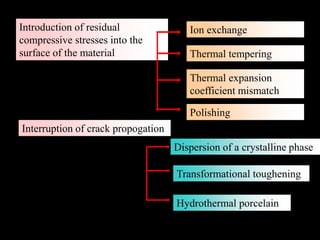
Introduction of residual
compressive stresses into the
surface of the material
Interruption of crack propogation
Ion exchange
Thermal tempering
Thermal expansion
coefficient mismatch
Polishing
Dispersion of a crystalline phase
Transformational toughening
Hydrothermal porcelain
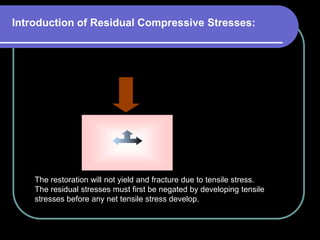
Introduction of Residual Compressive Stresses:
The restoration will not yield and fracture due to tensile stress.
The residual stresses must first be negated by developing tensile
stresses before any net tensile stress develop.
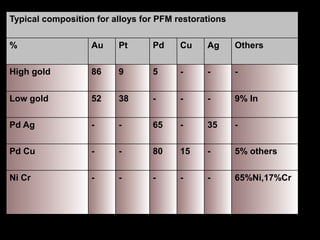
Typical composition for alloys for PFM restorations
% Au Pt Pd Cu Ag Others
High gold 86 9 5 - - -
Low gold 52 38 - - - 9% In
Pd Ag - - 65 - 35 -
Pd Cu - - 80 15 - 5% others
Ni Cr - - - - - 65%Ni,17%Cr
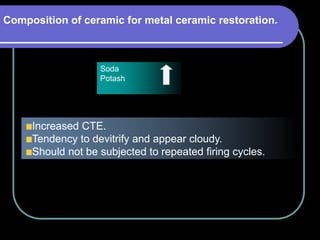
Composition of ceramic for metal ceramic restoration.
Increased CTE.
Tendency to devitrify and appear cloudy.
Should not be subjected to repeated firing cycles.
Soda
Potash
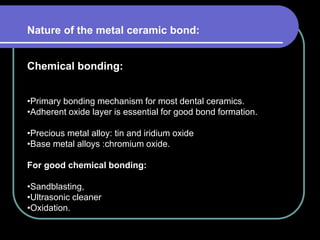
Nature of the metal ceramic bond:
Chemical bonding:
•Primary bonding mechanism for most dental ceramics.
•Adherent oxide layer is essential for good bond formation.
•Precious metal alloy: tin and iridium oxide
•Base metal alloys :chromium oxide.
For good chemical bonding:
•Sandblasting,
•Ultrasonic cleaner
•Oxidation.
Procedure recommended to clean the metal of organic debris and
remove entrapped surface gases such as hydrogen.
Advantage:
Removes volatile contaminants not eliminated by Steam or air abrasion.
Allows specific oxides to form on the surface which help in bonding.
Post oxidation treatment:
To reduce oxide layer:
Acid treatment: Hydroflouric, Hydrochloric or dilute sulfuric acids.
Non acid treatment: Air abrasion with pure 50 μm aluminium oxide.
Oxidation or degassing:
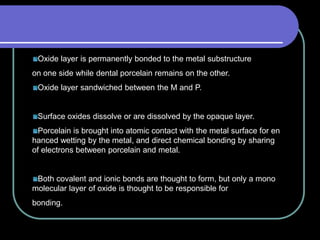
Oxide layer is permanently bonded to the metal substructure
on one side while dental porcelain remains on the other.
Oxide layer sandwiched between the M and P.
Surface oxides dissolve or are dissolved by the opaque layer.
Porcelain is brought into atomic contact with the metal surface for en
hanced wetting by the metal, and direct chemical bonding by sharing
of electrons between porcelain and metal.
Both covalent and ionic bonds are thought to form, but only a mono
molecular layer of oxide is thought to be responsible for
bonding.
A layer of pure gold is deposited onto the cast metal,
short flash deposition of tin.
Cobalt chromium, stainless steel.
Palladium silver, high and low gold content alloys
Titanium.
Advantages:
Improved wetting of the metal by porcelain.
Electrodeposited layer acts as a barrier to inhibit ion penetration by
the metal
Gold color of the oxide film :vitality and esthetics.
Color control of the oxidated surface from gray to reddish brown to gold
Deposited layer acts as a buffer zone to absorb stresses.
The maturation time and temperature of the porcelain is reduced :highly
reflective surface of the gold layer, and the infrared radiation emitted by the gold o
n heating.
Bonding using electrodeposition:
Mechanical interlocking:
Presence of surface roughness
Wettability is important for bonding.
Smaller the contact angle: better is the wetting efficiency.
3. Vanderwaals Forces:
Secondary forces generated by a physical attraction between the
charged particles rather than by actual sharing of electrons
4. Compressive Forces:
Ceramic is strongest under compression and weakest under tension
Hence if the coefficient of thermal expansion of the metal substrate is greate
r than the porcelain fired over it, porcelain is under compression.
Nature of the metal ceramic bond
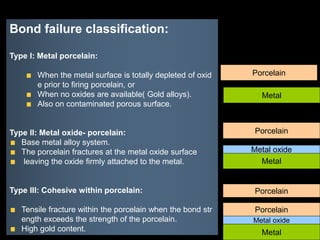
Bond failure classification:
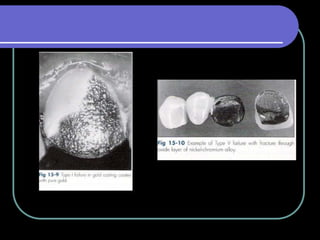
Type I: Metal porcelain:
When the metal surface is totally depleted of oxid
e prior to firing porcelain, or
When no oxides are available( Gold alloys).
Also on contaminated porous surface.
Type II: Metal oxide- porcelain:
Base metal alloy system.
The porcelain fractures at the metal oxide surface
leaving the oxide firmly attached to the metal.
Type III: Cohesive within porcelain:
Tensile fracture within the porcelain when the bond str
ength exceeds the strength of the porcelain.
High gold content.
Metal
Porcelain
Metal
Porcelain
Metal oxide
Metal
Porcelain
Porcelain
Metal oxide
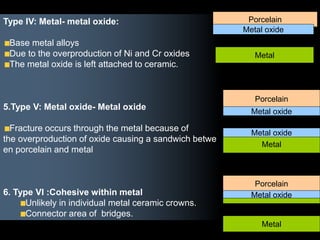
Type IV: Metal- metal oxide:
Base metal alloys
Due to the overproduction of Ni and Cr oxides
The metal oxide is left attached to ceramic.
5.Type V: Metal oxide- Metal oxide
Fracture occurs through the metal because of
the overproduction of oxide causing a sandwich betwe
en porcelain and metal
6. Type VI :Cohesive within metal
Unlikely in individual metal ceramic crowns.
Connector area of bridges.
Metal
Porcelain
Metal oxide
Metal
Porcelain
Metal oxide
Metal oxide
Metal
Porcelain
Metal oxide
Improved bonding on the bondable surface of the metal
can be achieved by the following ways:
•Grit blasting with 30-50µm alumina particles at an air pressure of
0.4 to 0.7 Mpa .
•Electrochemical etching.
•Naturally formed oxides on the base metal surface also contributes to the b
onding when MDP or 4 META based resins are used.
•In noble metals :electrochemically deposit a thin layer of tin( 0.5µm) on no
ble metal and heat it to an appropriate temperature to
form metal oxide.
A silica coating can be used to improve bonding to noble and base metal
alloys
Bonding of metallic prosthesis
Bonded platinum foil coping:
Defects originating from the internal
surface of the crown:
Fracture of porcelain.
Tinplating the platinum foil.
Laying down 2 platinum foils in close
approximation with each other.
Inner foil: 0.025 mm platinum
provides a matrix for baking ceramic
Outer foil: forms the inner skin to the crown
tin plated and oxidized
strong chemical bond with aluminous porcelai
n crown.
Bonded alumina crown/ twin foil technique: Mc Lean and Sced( 1976)
The inner foil is then removed after porcelain firing.
Bonded gold foil coping: Rogers 1979. UMK68
To prevent porcelain from lifting the platinum skirt and spoling the fit:
Cervical Contact technique:
Application of a layer of porcelain on the shoulder area to shrink first.
The second bake will then shrink towards the cervical porcelain and
maintain the fit.
Cervical ditch technique:
Porcelain is removed from the shoulder area after the initial build up is compl
ete, such that a thinnest ditch possible is made to expose the
cervical platinum at the shoulder.
Removal of platinum foil:
Soaking the crown in water.
A fine pointed tweezer is used to lift the skirt away from the edge.
Peel the platinum away from the entire circumference without damaging the fi
ne porcelain edge (internally towards the incisal edge).
Porcelain veneer crowning of adolescent teeth where minimal tooth
preparation is necessary.
Anterior teeth, when metal reinforcement is essential.
In heavily worn teeth, thin or short teeth where minimal occlusal cle
arance present (not less than 0.8mm), porcelain crowning of all ant
erior teeth is indicated.
Repair of fractured metal- ceramic bridges, when removal of bridge
or splint is undesirable.
Coping jacket crowns on unit built bridge -work
Indications for bonded alumina crowns
In periodontally involved teeth, where preparations extend deeply into
root- face and no shoulder preparations are possible.
Posterior teeth where large areas of tooth are missing and uneven bu
lk of porcelain is inevitable.
If lingual shoulder preparations are impossible particularly in molar re
gion.
Contraindications for bonded alumina crowns
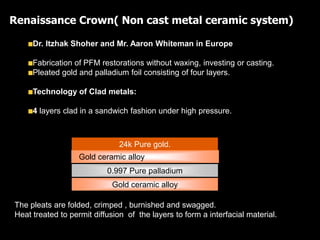
Dr. Itzhak Shoher and Mr. Aaron Whiteman in Europe
Fabrication of PFM restorations without waxing, investing or casting.
Pleated gold and palladium foil consisting of four layers.
Technology of Clad metals:
4 layers clad in a sandwich fashion under high pressure.
Renaissance Crown( Non cast metal ceramic system)
0.997 Pure palladium
Gold ceramic alloy
Gold ceramic alloy
24k Pure gold.
The pleats are folded, crimped , burnished and swagged.
Heat treated to permit diffusion of the layers to form a interfacial material.
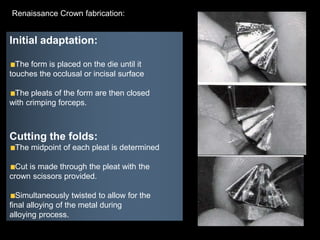
Initial adaptation:
The form is placed on the die until it
touches the occlusal or incisal surface
The pleats of the form are then closed
with crimping forceps.
Cutting the folds:
The midpoint of each pleat is determined
Cut is made through the pleat with the
crown scissors provided.
Simultaneously twisted to allow for the
final alloying of the metal during
alloying process.
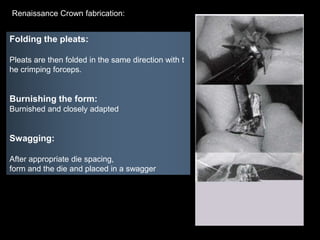
Renaissance Crown fabrication:
Folding the pleats:
Pleats are then folded in the same direction with t
he crimping forceps.
Burnishing the form:
Burnished and closely adapted
Swagging:
After appropriate die spacing,
form and the die and placed in a swagger
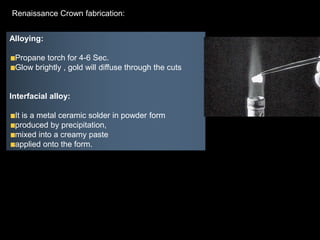
Renaissance Crown fabrication:
Alloying:
Propane torch for 4-6 Sec.
Glow brightly , gold will diffuse through the cuts
Interfacial alloy:
It is a metal ceramic solder in powder form
produced by precipitation,
mixed into a creamy paste
applied onto the form.
Renaissance Crown fabrication:
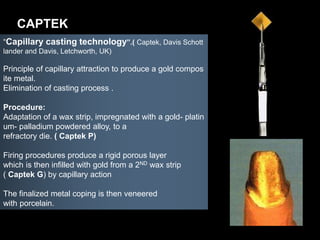
“Capillary casting technology”.( Captek, Davis Schott
lander and Davis, Letchworth, UK)
Principle of capillary attraction to produce a gold compos
ite metal.
Elimination of casting process .
Procedure:
Adaptation of a wax strip, impregnated with a gold- platin
um- palladium powdered alloy, to a
refractory die. ( Captek P)
Firing procedures produce a rigid porous layer
which is then infilled with gold from a 2ND wax strip
( Captek G) by capillary action
The finalized metal coping is then veneered
with porcelain.
CAPTEK
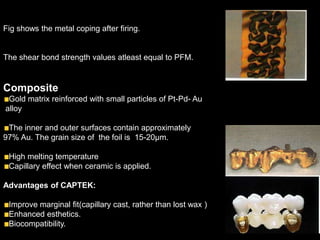
Fig shows the metal coping after firing.
The shear bond strength values atleast equal to PFM.
Composite
Gold matrix reinforced with small particles of Pt-Pd- Au
alloy
The inner and outer surfaces contain approximately
97% Au. The grain size of the foil is 15-20µm.
High melting temperature
Capillary effect when ceramic is applied.
Advantages of CAPTEK:
Improve marginal fit(capillary cast, rather than lost wax )
Enhanced esthetics.
Biocompatibility.

Basic ceramic (2).ppt

  • 1.
  • 2.
  • 3.
    Keramos: Greek Keramika: Sanskrit Amaterial produced by firing or burning ” a combination of one or more metals with a non metallic element, usually oxygen.” Gilman 1967.
  • 4.
    Phillips. 11th Ed. Aninorganic compound with nonmetallic properties typically consisting of oxygen and one or more metallic or sem imetallic elements( Eg: Aluminium, calcium, lithium, magnesiu m, potassium, silicon, sodium, tin, titanium and zirconium) that is formulated to produce the whole or part of a ceramic based prosthesis. Definition: Dental Ceramics
  • 5.
    Definition: Dental Ceramics 0’Brien: Combinationof one or more metals with non met allic elements especially oxygen, larger atoms of oxygen serving as a matrix with smaller metal atoms tucked into the spaces between oxygen.
  • 6.
    Ceramics : Ahistorical perspective…… 23,000BC 5500BC: 100BC: 1000AD: White china clay + “Chine stone” Ceramic so white that it was comparable only to snow, So strong that vessels needed walls only 2-3 mm thick, and consequently light could shine through it. So continuous was the internal structure that a dish, if lightly struck, would ring a bell. This is Porcelain! Earthernware: Stoneware: Chinese porcelain
  • 7.
    Attempts to imitatethe Chinese Porcelain…… 1717: Pere, Francois Xavier d’ Entrecolles In less than 60 years, dental restorative material! 1728: Pierre Fauchard. 1774: Alexis Duchateau: Porcelain dentures. 1791: Nicholas Dubois de Chemant of Paris Paris Faculty of Medicine : “united the qualities of beauty, solidity and comfort to the exigencies of hygiene.”
  • 8.
    1806: Giuseppangelo Fonzi: Terrometallic teeth. 1817: Antoine Plantou : porcelain teeth to America 1830: Samuel Stockton: produces first porcelain teeth in the US. 1845: SS White : Porcelain teeth on a commercial basis. 1864: Claudius Ash : Tube Teeth 1882: William Herbst : Inlays of pulverized glass. 1884: Charles H Land : Platinum foil technique. 1886 : First successful inlays. 1894: Custer :Porcelain furnace. 1898: Jenkins :low fusing porcelain 1903: Land :porcelain jacket crown Dental Ceramics :a historical perspective….
  • 9.
    1956: Brecker :ceramometalrestorations 1962: Patents of Weinstein and Weinsteinand Weinstein et al( 1962) 1963: First commercial porcelain :Vita Zahnfabrik 1965: Mc lean and Hughes :aluminous porcelain 1968: Mc Culloch Glass ceramic in dentistry. 1984: Grossman and Adair :Dicor 1985: Hobo and Iwata (Kyocera Bioceram group): Cerapearl. 1983: O’ Brien :high expansion magnesia core 1983: Sozio and Riley : Cerestore. 1984: Corning glass Company( Stookey): First commercial glass cer amic 1988 :Mormann and Brandestini :CADCAM. Dental Ceramics :a historical perspective….
  • 10.
    1988 : CEREC1 1989:Wohlwend and Scharer : Pressable ceramic systems. 1991 : Celay copy milling system. 1994: CEREC II 1992: Ultralow fusing ceramic Ducera LFC :Cerec3 Dental Ceramics :a historical perspective….
  • 11.
    Classification of DentalCeramics: Phillips’ According to use or indications Anterior Posterior Crowns Veneers Post and Cores FPDS Stain Ceramic Glaze Ceramic.
  • 12.
    According to firingtemperature: Ultralow fusing< 8500C Low fusing 850-11000C Medium fusing 11010C-13000C High fusing>13000C: Classification of Dental Ceramics: Phillips’ High fusing 1200/14500 C. Medium fusing 1050/12000C. Low fusing 850/1050 0C High fusing( 850-1100) Low fusing( < 850)
  • 13.
    High fusing: Minimizing theadditives such as sodium or potassium, Maximizing the silicate cross links. Low solubility, high strength and high stability. Hardness exceeds enamel by 30%. Classification of Dental Ceramics:
  • 14.
    Medium fusing: fired undervacuum with air admitted at the end of firing Low fusing: increasing the amount of additives in porcelain reducing the number of crosslinks within the silicate network It helps to avoid overheating the metal framework slightly weaker and less stable than high fusing fired under vacuum. Classification of Dental Ceramics:
  • 15.
    Ultra low fusing: Coefficientof thermal expansion match titanium alloys. Lower firing temperatures -less oxide formation. Classification of Dental Ceramics: Phillips’
  • 16.
    According to the processingmethod: Sintering Partial sintering Glass infilteration CADCAM Copy milling. According to microstructure Glass Crystalline. Crystal containing glass. Classification of Dental Ceramics: Phillips’
  • 17.
    According to composition/Type: Feldspathicporcelain Leucite-reinforced porcelain Aluminous porcelain Alumina Glass-infiltrated alumina Glass-infiltrated spinel Glass-infiltrated zirconia Glass ceramic According to translucency Opaque Translucent Transparent. Classification of Dental Ceramics: Phillips’
  • 18.
    According to application: CorePorcelain. Dentin or Body Porcelain Enamel or incisal porcelain According to the method of firing Air fired. Vacuum fired. Classification of Dental Ceramics: Phillips’
  • 19.
    Craig: All ceramic Machined Slip cast Heatpressed Sintered. Ceramic- metal Sintered. Denture teeth. Manufactured. Classification of Dental Ceramics:
  • 20.
    Silicate ceramics Oxideceramics Glass ceramics Principal AMORPHOUS gl ass phase with porous stru cture i.e. mainly silica (SiO 2) Principal CRYSTALLINE phase e.g. Al2O3, MgO, Zr O2 Principal AMORPHOUS gl ass phase Also contain crystals e.g. K 2O, Al2O3, MgO, ZrO2 None or small glass phase content Crystal phase induced by c ontrolled crystallization (feldspathic or aluminous) e.g.zirconia (ZrO2) Pure alumina e.g. Dicor glass ceramic
  • 21.
    Single unit crowns. PorcelainJacket Crowns. Metal Ceramic Crown or PFMcrowns. Castable glass ceramic crowns. Veneers for crowns and bridges. Artificial teeth. Inlays and Onlays. Ceramic Brackets used in Orthodontia. Applications of dental ceramics:
  • 22.
    Ceramic V/S Porcelain: What’s the difference?
  • 23.
    Ceramic: Nonmetallic Inorganic Man made objectsformed by baking raw materials at high temperatures.
  • 24.
  • 25.
    Esthetic alternative todiscolored teeth. Esthetic alternative :grossly decayed carious teeth. Congenital anamolies Veneers Inlays Onlays Abutment retainers Denture tooth materials. Orthodontics as ceramic brackets. Indications for ceramics:
  • 26.
    Young permanent teeth. Smallshort or thin crowns( relative contraindications) PFM not indicated in high lip line patients. Teeth round in cross section OR Teeth more axially tapered than usual. Abusive bite. Patient’s lifestyle susceptible to trauma. Contraindications:
  • 27.
    Biocompatibility Esthetics: Color and translucency Capableof being pigmented. Colour stability. Stain resistance. Chamaleon like effect Durability: Wear resistance and low solubility. Ability to form precise shapes High stiffness High melting point. Low thermal conductivity Low electrical conductivity. Advantages
  • 28.
    Brittle: Low fracturetoughness. High firing shrinkage of conventional porcelains. Attrition of opposing teeth. More tooth reduction. Cervical bulge and metal line in case of PFM restoration Technique sensitive. Specialized training required. Expensive equipment required. Difficult to repair if fails. Cannot be repaired if the shade is altered. Patient may complain of crackling sound on biting. Disadvantages:
  • 29.
  • 30.
    Composition of variousporcelains( %) Material Kaolin Silica ( Quartz) Feldspar ( Binder) Glasses Decorative porcelain 50 25 25 0 High fusing dental 4 15 80 0 Low fusing dental 0 25 60 15
  • 31.
    Tile sanitory ware Porcelainartware Bone china dinnerware Dental porcelain Silica Clay Feldspar
  • 32.
    Composition of DentalPorcelain Feldspar 60-80%( Basic glass former) Kaolin- 3-5%( Binder) Quartz- 15-25%( Filler) Alumina-8-20%( Glass former) Boric oxide-2-7%(Glass former and fluxes) Oxides of Na, K and Ca -9-15%(Fluxes or glass modifiers) Metallic pigments less than 1%(Color matching)
  • 33.
    Naturally occurring doublesilicate of potassium and aluminium.K20.Al2O36SiO2 Dentistry: Potash Feldspar: Increased resistance to pyroplastic flow Increased viscosity. Functions of Feldspar: Basic Glass former. During firing fuses to form a matrix and the porcelain powder particles will fuse together by a process of liquid phase sinteri ng. Acts as a flux and surface glaze. Feldspar (60-80%) Basic glass former
  • 34.
    Resistance to pyroplasticflow Incongruent melting (11500C and 15300C ) Leucite: Large coefficient of thermal expansion (20-25 ppm/0C.) thermally compatible with dental casting alloys. Strengthening material. Incongruent melting( Peritectic transformation) Feldspar: Properties
  • 35.
    Hydrated aluminium silicate. Functions: Binder. Pyrochemicalreaction: rigidity. Opacity to the mass. Disadvantages: White :reduces the translucency of porcelain. added in small amounts. Starch or sugar. Kaolin( 3-5%)Binder
  • 36.
    O2 Si4+ Si4+ Si4+ Tetrahedral Silica Quartz/ Silica(15-25%) Filler Crystalline quartz Cristobalite Tridymite Amorphous fused quartz. Below 5750C Alpha quartz Above 5750C Beta quartz Above 8700C Tridymite Above 1470oC Crystobalite
  • 37.
    Functions: Refractory skeleton Provides strengthand hardness to porcelain during fusing. Unchanged at the usual firing temperatures : stability to the mass during heating. Quartz/ Silica (15-25%) Grinding Pure Quartz
  • 38.
    Functions: Strength and opacityto the porcelain. Alters softening point increases the viscosity of porcelain during firing. Aluminium oxide( 8-20% glass former)
  • 39.
    O2 Si4+ Si4+ Si4+ Sodium carbonate Lithium carbonate lowfusing glasses. Function: Lower the sintering temperature an d increase flow of porcelain. They also absorb and remove impurities. Excess flux: Reduces the chemical durability Crystallization and devitrification Fluxes (9-15%) Interrupts silica network.
  • 40.
    Glass modifiers Lower thesoftening temperature. Increase the CTE. Decrease viscosity. Oxides : Sodium, Potassium and Calcium oxide( 9-15%) Boric oxide- 2-7% is also added for the same purpose. Water is an important but a weaker glass modifier. When porcelains are exposed to tensile stresses in moist environment for l ong periods H30+ replaces alkali metal ions in porcelain slow crack growth New ultra low fusing porcelains : large amount of sodium oxide and hydrox yl group to lower the fusion temperature to as low as 6600C.
  • 41.
    Pigments Feldspars are colorlessor greyish. Color frits Metallic oxides Glass Feldspar Ferric oxide, platinum Grey. Chromium oxide, copper oxide Green Cobalt salts Blue Ferrous oxide,nickel oxide Brown Titanium oxide Yellowish brown Manganese oxide Lavender Chromium tin, Chromium alumina Pink Indium Yellow, ivory
  • 42.
    Opacifiers: Oxides of Cerium,titanium, zirconium and tin. Ground to a particle size of less than 5 µm. Differenc in the RI between glass and opacifiers cause more opales cence. Fluorescing agents: Cerium oxide ( eg. Fluorescent bulbs and sunlight). Fluorescence is the phenomenon in which an object emits light when it is illuminated by a specific light source, in case of teeth, it gives an appearan ce of vitality. Uranium compounds: Health hazard. Opacifiers and Fluorescing agents.
  • 43.
    Fritting: •Combination of blending,melting and quenching the glass compon ents Frit: •The resultant product after fritting. •Components are mixed, fused and quenched •Cracking and fracturing throughout the fused mass. •Frit then ground to fine powder. Manufacture
  • 44.
    Pyrochemical reaction occursand much of the shrinkage is complete Technician fuses the porcelain powder, he simply remelts the fluxes without causing significant increase in reaction between the com ponents. Glaze: • Overglaze. • Selfglaze.
  • 45.
    Overglazes : Ceramic powderscontaining more glass modifiers Lower fusion temperatures. The coefficient of thermal expansion slightly lower than that of the bo dy porcelain. Self glaze: Constituents of porcelain frit completely melted to form a single phase glass. Chemical durability is better due to higher fusion temperature. Glazes
  • 46.
    Strengthening of thematerial perse. Methods of designing components. Methods of strengthening porcelain
  • 47.
    Introduction of residual compressivestresses into the surface of the material Interruption of crack propogation Ion exchange Thermal tempering Thermal expansion coefficient mismatch Polishing Dispersion of a crystalline phase Transformational toughening Hydrothermal porcelain
  • 48.
    Introduction of ResidualCompressive Stresses: The restoration will not yield and fracture due to tensile stress. The residual stresses must first be negated by developing tensile stresses before any net tensile stress develop.
  • 93.
    Typical composition foralloys for PFM restorations % Au Pt Pd Cu Ag Others High gold 86 9 5 - - - Low gold 52 38 - - - 9% In Pd Ag - - 65 - 35 - Pd Cu - - 80 15 - 5% others Ni Cr - - - - - 65%Ni,17%Cr
  • 94.
    Composition of ceramicfor metal ceramic restoration. Increased CTE. Tendency to devitrify and appear cloudy. Should not be subjected to repeated firing cycles. Soda Potash
  • 95.
    Nature of themetal ceramic bond: Chemical bonding: •Primary bonding mechanism for most dental ceramics. •Adherent oxide layer is essential for good bond formation. •Precious metal alloy: tin and iridium oxide •Base metal alloys :chromium oxide. For good chemical bonding: •Sandblasting, •Ultrasonic cleaner •Oxidation.
  • 96.
    Procedure recommended toclean the metal of organic debris and remove entrapped surface gases such as hydrogen. Advantage: Removes volatile contaminants not eliminated by Steam or air abrasion. Allows specific oxides to form on the surface which help in bonding. Post oxidation treatment: To reduce oxide layer: Acid treatment: Hydroflouric, Hydrochloric or dilute sulfuric acids. Non acid treatment: Air abrasion with pure 50 μm aluminium oxide. Oxidation or degassing:
  • 97.
    Oxide layer ispermanently bonded to the metal substructure on one side while dental porcelain remains on the other. Oxide layer sandwiched between the M and P. Surface oxides dissolve or are dissolved by the opaque layer. Porcelain is brought into atomic contact with the metal surface for en hanced wetting by the metal, and direct chemical bonding by sharing of electrons between porcelain and metal. Both covalent and ionic bonds are thought to form, but only a mono molecular layer of oxide is thought to be responsible for bonding.
  • 98.
    A layer ofpure gold is deposited onto the cast metal, short flash deposition of tin. Cobalt chromium, stainless steel. Palladium silver, high and low gold content alloys Titanium. Advantages: Improved wetting of the metal by porcelain. Electrodeposited layer acts as a barrier to inhibit ion penetration by the metal Gold color of the oxide film :vitality and esthetics. Color control of the oxidated surface from gray to reddish brown to gold Deposited layer acts as a buffer zone to absorb stresses. The maturation time and temperature of the porcelain is reduced :highly reflective surface of the gold layer, and the infrared radiation emitted by the gold o n heating. Bonding using electrodeposition:
  • 99.
    Mechanical interlocking: Presence ofsurface roughness Wettability is important for bonding. Smaller the contact angle: better is the wetting efficiency. 3. Vanderwaals Forces: Secondary forces generated by a physical attraction between the charged particles rather than by actual sharing of electrons 4. Compressive Forces: Ceramic is strongest under compression and weakest under tension Hence if the coefficient of thermal expansion of the metal substrate is greate r than the porcelain fired over it, porcelain is under compression. Nature of the metal ceramic bond
  • 100.
    Bond failure classification: TypeI: Metal porcelain: When the metal surface is totally depleted of oxid e prior to firing porcelain, or When no oxides are available( Gold alloys). Also on contaminated porous surface. Type II: Metal oxide- porcelain: Base metal alloy system. The porcelain fractures at the metal oxide surface leaving the oxide firmly attached to the metal. Type III: Cohesive within porcelain: Tensile fracture within the porcelain when the bond str ength exceeds the strength of the porcelain. High gold content. Metal Porcelain Metal Porcelain Metal oxide Metal Porcelain Porcelain Metal oxide
  • 101.
    Type IV: Metal-metal oxide: Base metal alloys Due to the overproduction of Ni and Cr oxides The metal oxide is left attached to ceramic. 5.Type V: Metal oxide- Metal oxide Fracture occurs through the metal because of the overproduction of oxide causing a sandwich betwe en porcelain and metal 6. Type VI :Cohesive within metal Unlikely in individual metal ceramic crowns. Connector area of bridges. Metal Porcelain Metal oxide Metal Porcelain Metal oxide Metal oxide Metal Porcelain Metal oxide
  • 103.
    Improved bonding onthe bondable surface of the metal can be achieved by the following ways: •Grit blasting with 30-50µm alumina particles at an air pressure of 0.4 to 0.7 Mpa . •Electrochemical etching. •Naturally formed oxides on the base metal surface also contributes to the b onding when MDP or 4 META based resins are used. •In noble metals :electrochemically deposit a thin layer of tin( 0.5µm) on no ble metal and heat it to an appropriate temperature to form metal oxide. A silica coating can be used to improve bonding to noble and base metal alloys Bonding of metallic prosthesis
  • 104.
    Bonded platinum foilcoping: Defects originating from the internal surface of the crown: Fracture of porcelain. Tinplating the platinum foil. Laying down 2 platinum foils in close approximation with each other. Inner foil: 0.025 mm platinum provides a matrix for baking ceramic Outer foil: forms the inner skin to the crown tin plated and oxidized strong chemical bond with aluminous porcelai n crown. Bonded alumina crown/ twin foil technique: Mc Lean and Sced( 1976) The inner foil is then removed after porcelain firing. Bonded gold foil coping: Rogers 1979. UMK68
  • 105.
    To prevent porcelainfrom lifting the platinum skirt and spoling the fit: Cervical Contact technique: Application of a layer of porcelain on the shoulder area to shrink first. The second bake will then shrink towards the cervical porcelain and maintain the fit. Cervical ditch technique: Porcelain is removed from the shoulder area after the initial build up is compl ete, such that a thinnest ditch possible is made to expose the cervical platinum at the shoulder.
  • 106.
    Removal of platinumfoil: Soaking the crown in water. A fine pointed tweezer is used to lift the skirt away from the edge. Peel the platinum away from the entire circumference without damaging the fi ne porcelain edge (internally towards the incisal edge).
  • 107.
    Porcelain veneer crowningof adolescent teeth where minimal tooth preparation is necessary. Anterior teeth, when metal reinforcement is essential. In heavily worn teeth, thin or short teeth where minimal occlusal cle arance present (not less than 0.8mm), porcelain crowning of all ant erior teeth is indicated. Repair of fractured metal- ceramic bridges, when removal of bridge or splint is undesirable. Coping jacket crowns on unit built bridge -work Indications for bonded alumina crowns
  • 108.
    In periodontally involvedteeth, where preparations extend deeply into root- face and no shoulder preparations are possible. Posterior teeth where large areas of tooth are missing and uneven bu lk of porcelain is inevitable. If lingual shoulder preparations are impossible particularly in molar re gion. Contraindications for bonded alumina crowns
  • 109.
    Dr. Itzhak Shoherand Mr. Aaron Whiteman in Europe Fabrication of PFM restorations without waxing, investing or casting. Pleated gold and palladium foil consisting of four layers. Technology of Clad metals: 4 layers clad in a sandwich fashion under high pressure. Renaissance Crown( Non cast metal ceramic system) 0.997 Pure palladium Gold ceramic alloy Gold ceramic alloy 24k Pure gold. The pleats are folded, crimped , burnished and swagged. Heat treated to permit diffusion of the layers to form a interfacial material.
  • 110.
    Initial adaptation: The formis placed on the die until it touches the occlusal or incisal surface The pleats of the form are then closed with crimping forceps. Cutting the folds: The midpoint of each pleat is determined Cut is made through the pleat with the crown scissors provided. Simultaneously twisted to allow for the final alloying of the metal during alloying process. Renaissance Crown fabrication:
  • 111.
    Folding the pleats: Pleatsare then folded in the same direction with t he crimping forceps. Burnishing the form: Burnished and closely adapted Swagging: After appropriate die spacing, form and the die and placed in a swagger Renaissance Crown fabrication:
  • 112.
    Alloying: Propane torch for4-6 Sec. Glow brightly , gold will diffuse through the cuts Interfacial alloy: It is a metal ceramic solder in powder form produced by precipitation, mixed into a creamy paste applied onto the form. Renaissance Crown fabrication:
  • 113.
    “Capillary casting technology”.(Captek, Davis Schott lander and Davis, Letchworth, UK) Principle of capillary attraction to produce a gold compos ite metal. Elimination of casting process . Procedure: Adaptation of a wax strip, impregnated with a gold- platin um- palladium powdered alloy, to a refractory die. ( Captek P) Firing procedures produce a rigid porous layer which is then infilled with gold from a 2ND wax strip ( Captek G) by capillary action The finalized metal coping is then veneered with porcelain. CAPTEK
  • 114.
    Fig shows themetal coping after firing. The shear bond strength values atleast equal to PFM. Composite Gold matrix reinforced with small particles of Pt-Pd- Au alloy The inner and outer surfaces contain approximately 97% Au. The grain size of the foil is 15-20µm. High melting temperature Capillary effect when ceramic is applied. Advantages of CAPTEK: Improve marginal fit(capillary cast, rather than lost wax ) Enhanced esthetics. Biocompatibility.