Dental Ceramics
Contents
 What are ceramics?
 History
 Classification
 Composition and manufacture
 General properties
 Processing methods
 Methods of strengthening ceramics
 Metal ceramic systems
• Alloys
• Foil bonded
What are Dental
Ceramics?
Ceramics
 ‘Keramos’ – Ceramic
 Consists of silicate, glass and oxide
ceramics
Types
 Silicate
 Oxide
 Glass
 Non-oxide
Dental Ceramics
An inorganic compound
with non-metallic properties typically
consisting of oxygen and one or
more metallic or semi-metallic
elements (e.g. Al, Ca, Li, Mg, K, Si,
Na, Sn, Ti and Zr) that is formulated
to produce the whole or part of a
ceramic based prosthesis.
 Philips (11th Ed.)
History of Dental
Ceramics
History of Dental Ceramics
 1774 – Alexis Duchateau
 1789 – Nicolas de Chemant
 1808 – Giuseppangelo Fonzi
 1817 – Planteau
 1822 – Peale
 1825 – Stockton
 1903 – Dr. Charles Land
 1938 – Dr. Charles Pincus
 1962 – Weinstein and Weinstein
• Porcelain with high TEC and low
sintering temp.
• Thermally compatible and bondable
alloys
 1965 – Mc Lean and Hughes
 1980’s – Dr. Horn
 1984 – Adair and Grossman: Dicor
Classification of Dental
Ceramics
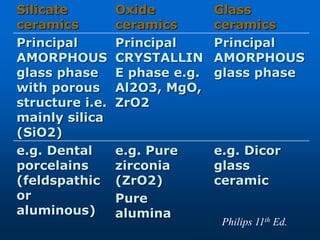
Silicate
ceramics
Oxide
ceramics
Glass
ceramics
Principal
AMORPHOUS
glass phase
with porous
structure i.e.
mainly silica
(SiO2)
Principal
CRYSTALLIN
E phase e.g.
Al2O3, MgO,
ZrO2
Principal
AMORPHOUS
glass phase
e.g. Dental
porcelains
(feldspathic
or
aluminous)
e.g. Pure
zirconia
(ZrO2)
Pure
alumina
e.g. Dicor
glass
ceramic
Philips 11th Ed.
Philips
 Use or indications
• Anterior crowns
• Posterior crowns
• Veneers
• Post and Cores
• FPDs
• Stain ceramic
• Glaze ceramic
• Denture teeth
 Firing temperature
• High fusing - 1300˚C
• Medium fusing – 1101-1300˚C
• Low fusing – 850-1100˚C
• Ultralow fusing - < 850˚C
 Application
• Core porcelain
• Dentine or body porcelain
• Enamel porcelain
 Composition
• Feldspathic porcelain
• Leucite-reinforced porcelain
• Aluminous porcelain
• Alumina
• Glass-infiltrated alumina
• Glass-infiltrated spinel
• Glass-infiltrated zirconia
• Glass ceramic
 Processing method
• Sintering
• Partial sintering and glass infiltration
• CAD-CAM
• Copy Milling
 Microstructure
• Glass
• Crystalline
• Crystal-containing glass
 Translucency
• Opaque
• Translucent
• Transparent
 Method of Firing
• At atmospheric pressure
• At reduced pressure – Vacuum firing
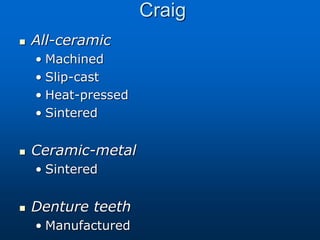
Craig
 All-ceramic
• Machined
• Slip-cast
• Heat-pressed
• Sintered
 Ceramic-metal
• Sintered
 Denture teeth
• Manufactured
Composition
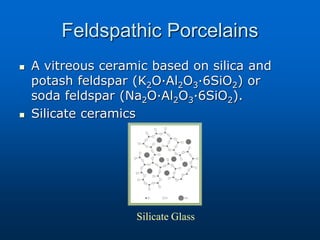
Feldspathic Porcelains
 A vitreous ceramic based on silica and
potash feldspar (K2O·Al2O3·6SiO2) or
soda feldspar (Na2O·Al2O3·6SiO2).
 Silicate ceramics
Silicate Glass
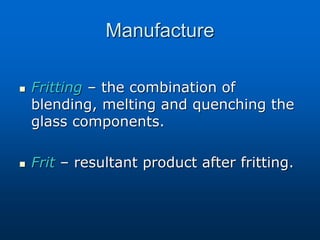
Manufacture
 Fritting – the combination of
blending, melting and quenching the
glass components.
 Frit – resultant product after fritting.
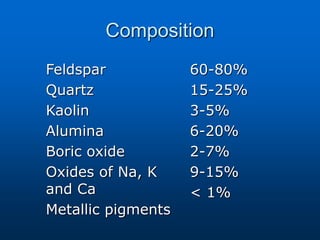
Composition
Feldspar
Quartz
Kaolin
Alumina
Boric oxide
Oxides of Na, K
and Ca
Metallic pigments
60-80%
15-25%
3-5%
6-20%
2-7%
9-15%
< 1%
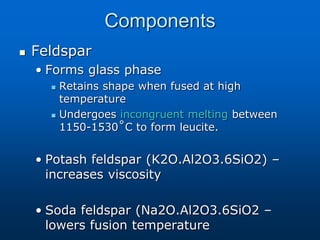
Components
 Feldspar
• Forms glass phase
 Retains shape when fused at high
temperature
 Undergoes incongruent melting between
1150-1530˚C to form leucite.
• Potash feldspar (K2O.Al2O3.6SiO2) –
increases viscosity
• Soda feldspar (Na2O.Al2O3.6SiO2 –
lowers fusion temperature
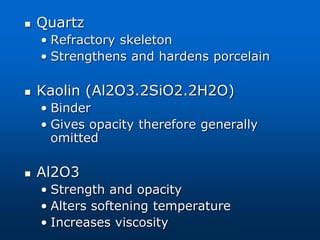
 Quartz
• Refractory skeleton
• Strengthens and hardens porcelain
 Kaolin (Al2O3.2SiO2.2H2O)
• Binder
• Gives opacity therefore generally
omitted
 Al2O3
• Strength and opacity
• Alters softening temperature
• Increases viscosity
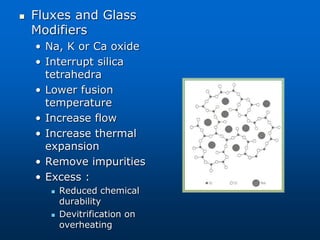
 Fluxes and Glass
Modifiers
• Na, K or Ca oxide
• Interrupt silica
tetrahedra
• Lower fusion
temperature
• Increase flow
• Increase thermal
expansion
• Remove impurities
• Excess :
 Reduced chemical
durability
 Devitrification on
overheating
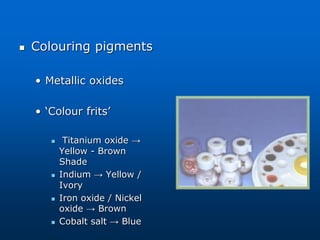
 Colouring pigments
• Metallic oxides
• ‘Colour frits’
 Titanium oxide →
Yellow - Brown
Shade
 Indium → Yellow /
Ivory
 Iron oxide / Nickel
oxide → Brown
 Cobalt salt → Blue
 Opacifying agents
• To mask oxide layer
• Metal oxide 8-15% : ZrO, CeO, TiO,
SnO
 Stains and color modifiers
• Low fusing coloured porcelain
 Other additives
• Boric oxide
• Lithium oxide
• Magnesium oxide
Glazes
 To seal the open pores
 Self-glaze or Auto-glaze
• High temperature
 Add-on glaze
• Higher glass modifiers
• Lower temperature
• Less durable
General Properties
Including Advantages and
Disadvantages
Advantages
 Biocompatibility
 Esthetics
• Colour and Translucency
• Long term colour stability
 Durability
• Wear resistant
• No Solubility
 Ability to be formed into precise
shapes
Disadvantages
 Brittle
 High shrinkage of conventional
porcelains
 Technique sensitive
 Specialized training required
 Costly equipment
 More tooth reduction
 Attrition of opposing tooth
 Difficult to repair
 Expensive
Good Properties
 Translucency like enamel (Refractive
index – 1.52-1.54)
 High Stiffness (Elastic modulus – 10
x 106 psi)
 Low thermal conductivity
(0.0050˚C/cm)
 Low electrical conductivity
 High melting point
Strength
 Compressive strength
• 350-550 MPa
 Tensile strength
• 20-60 MPa
 Brittle
• Critical strain – 0.1%
 Low fracture toughness
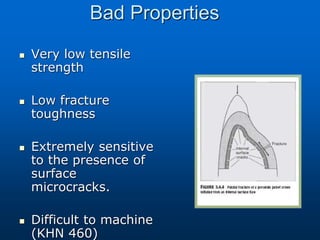
Bad Properties
 Very low tensile
strength
 Low fracture
toughness
 Extremely sensitive
to the presence of
surface
microcracks.
 Difficult to machine
(KHN 460)
Coefficient of thermal expansion
 Feldspathic porcelains
• Dependent on leucite content
• Metal ceramics – 13.5-15.5 ppm/˚C
• All ceramics – 5.5-7.5 ppm/˚C
• Pressed Leucite systems – 16 ppm/˚C
Processing
Condensation
Firing
Glazing
Compaction/Condensation
 The process of packing the particles
together and of removing the liquid
binder is known as condensation.
 The main driving force involved in
condensing dental porcelain is
surface tension.
 Liquid
• Distilled water
• Propylene glycol
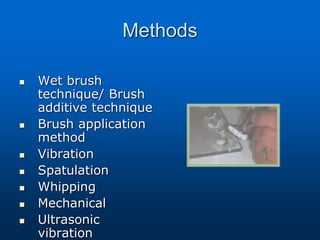
Methods
 Wet brush
technique/ Brush
additive technique
 Brush application
method
 Vibration
 Spatulation
 Whipping
 Mechanical
 Ultrasonic
vibration
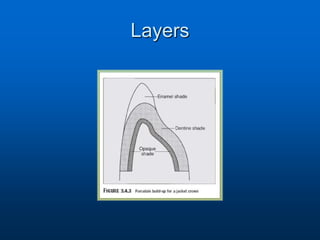
Layers
Firing
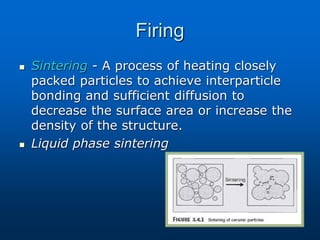
 Sintering - A process of heating closely
packed particles to achieve interparticle
bonding and sufficient diffusion to
decrease the surface area or increase the
density of the structure.
 Liquid phase sintering
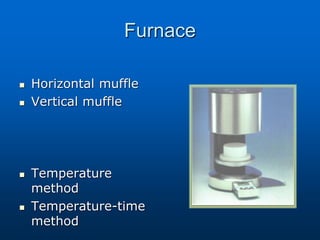
Furnace
 Horizontal muffle
 Vertical muffle
 Temperature
method
 Temperature-time
method
Types
 Air fired
• Slow maturation period
 Vacuum fired
• Dense, pore-free mass
• Shorter firing time
 Diffusible gas firing procedure
• Helium, hydrogen or steam
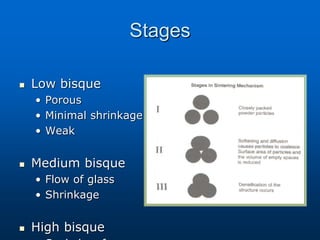
Stages
 Low bisque
• Porous
• Minimal shrinkage
• Weak
 Medium bisque
• Flow of glass
• Shrinkage
 High bisque
Glazing
 Advantages
• Increased strength (40-46%)
• Wear resistance
• Lower solubillity
• Less abrasive to opposing dentition
Methods of
strengthening ceramics
Why do Ceramics have a Low
Fracture Toughness?
 Actual strength 100 times lower than
theoretical strength
 Why?
• Defects and flaws on surface or bulk of
restorations
Methods of Strengthening
 Strengthening of the brittle material
• Development of residual compressive
stresses within the surface of the
material.
• Interruption of crack propagation
through the material.
 Methods of designing components to
minimize stress concentrations and
tensile stresses
Development of Residual
Compressive Stresses
The residual stresses must first be
negated by developing tensile
stresses before any net tensile stress
develops.
 Ion exchange/ chemical tempering:
• Introduces larger ions into smaller ion
vacancies
• A molten KNO3 bath is used
• Residual compressive stresses = 700
MPa
 Thermal tempering
• Rapid cooling/quenching of the surface
of the object while it is in
molten/softened state
• Hot glass-phase ceramics are quenched
in silicone oil or other special liquids to
uniformly cool the surface
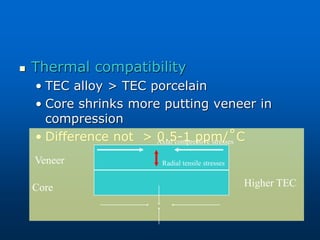
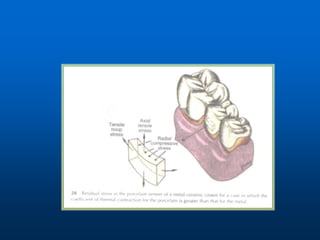
 Thermal compatibility
• TEC alloy > TEC porcelain
• Core shrinks more putting veneer in
compression
• Difference not > 0.5-1 ppm/˚C
Core
Veneer
Higher TEC
Radial tensile stresses
Axial compressive stresses
Interruption of crack propagation
 Dispersion of a crystalline phase
• Alumina (e.g. In Ceram)
• Mica (Dicor)
 Transformation toughening
• Partially Stabilised Zirconia (PSZ)
• Contains 3mol% Yttria which causes the
zirconia to form in the metastable
tetragonal form
• On crack approaching, the tetragonal -
ZrO2 inverts to monoclinic-ZrO2
• There is a volume expansion
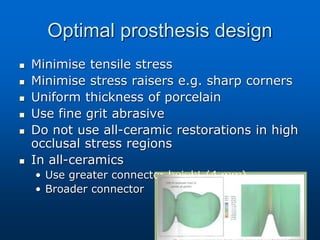
Optimal prosthesis design
 Minimise tensile stress
 Minimise stress raisers e.g. sharp corners
 Uniform thickness of porcelain
 Use fine grit abrasive
 Do not use all-ceramic restorations in high
occlusal stress regions
 In all-ceramics
• Use greater connector height (4 mm)
• Broader connector
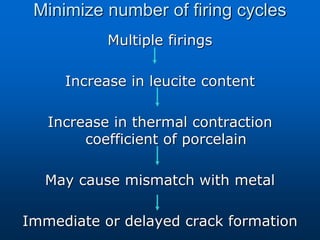
Minimize number of firing cycles
Multiple firings
Increase in leucite content
Increase in thermal contraction
coefficient of porcelain
May cause mismatch with metal
Immediate or delayed crack formation
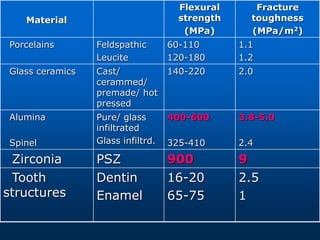
Material
Flexural
strength
(MPa)
Fracture
toughness
(MPa/m2)
Porcelains Feldspathic
Leucite
60-110
120-180
1.1
1.2
Glass ceramics Cast/
cerammed/
premade/ hot
pressed
140-220 2.0
Alumina
Spinel
Pure/ glass
infiltrated
Glass infiltrd.
400-600
325-410
3.8-5.0
2.4
Zirconia PSZ 900 9
Tooth
structures
Dentin
Enamel
16-20
65-75
2.5
1
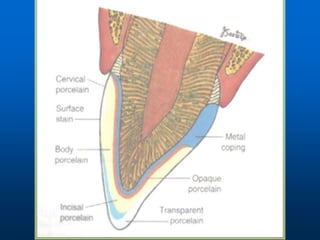
Metal Ceramic Systems
Advantages
 High strength values due to metal
reinforcement. More fracture
resistant.
 Improved fit on individual crowns
provided by cast metal collar.
 Less tooth structure removal
compared to all ceramic restorations.
 Permanent esthetics
Disadvantages
 Difficult to obtain good esthetics due to increased
opacity of metal substructure.
 Porcelains used in metal ceramic techniques are
more liable to devitrification.
 More difficult to create depth of translucency
because of dense opaque porcelain
 Preparation for metal ceramic requires significant
tooth reduction to provide sufficient space for the
materials when compared to all metal
restoration.
 Patients may be allergic to the metal
Indications
 Discolored teeth
 Grossly decayed carious teeth
 Congenital anomalies
 Abutment retainers
 Splinting mobile teeth
 Occlusal corrections
 Alignment corrections
Contraindications
 Patients with active caries or untreated
periodontal disease.
 In young patients with large pulp chambers due
to high risk of pulp exposure
 Teeth where enamel wear is high and there is
insufficient bulk of tooth structure to allow room
for metal and porcelain.
 High lip line
 Anterior teeth where esthetics is of prime
importance
 Short and thin crowns
Feldspathic Porcelain
 Leucite is a potassium aluminium silicate
(KAlSi2O6 )
 One of the most important phases in dental
ceramics
 Leucite tends to form readily from feldspars
 Importance:
• Increases thermal expansion
• Gives strength
 Drawbacks:
• Greater tendency to devitrify due to alkali content
• Changes in thermal contraction on repeated firing
 Shoulder porcelain: used with or without a knife
edge metal margin to avoid metal collar.
Types of veneering ceramics
 Low fusing ceramics (850-1100˚C)
• Feldspar based porcelains
 Ultra low-fusing ceramics (< 850˚C)
• Porcelains and glasses
• E.g. Duceram LFC
 Hydrothermal glass
 Well distributed small crystal particles (400-500 nm)
 Reduced enamel wear
 No of sag of alloy
 Glazes
• Self-glaze
• Add-on
 Stains
Classification of MC alloys
(Naylor 1986)
 Alloys divided into 2 systems:
A. Noble (Precious) metal alloys
B. Base-metal (Non-noble/non-precious)
alloys
Each system further divided into
constituents
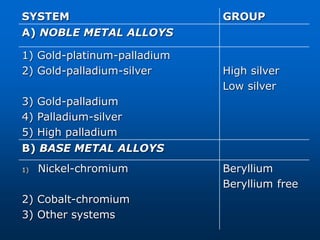
SYSTEM GROUP
A) NOBLE METAL ALLOYS
1) Gold-platinum-palladium
2) Gold-palladium-silver
3) Gold-palladium
4) Palladium-silver
5) High palladium
High silver
Low silver
B) BASE METAL ALLOYS
1) Nickel-chromium
2) Cobalt-chromium
3) Other systems
Beryllium
Beryllium free
Requirements of MC alloys
 Must be able to produce surface oxides for chemical
bonding with dental porcelains.
 Co-efficient of thermal expansion should be slightly
greater (0.5-1 ppm/˚C) than that of the porcelain veneer
to maintain the metal- porcelain attachment.
 Melting range considerably higher than the fusing range of
the dental porcelain fired on it.
 The alloy must have high temperature strength or sag
resistance → that is the ability to withstand exposure to
high temperatures without undergoing dimensional
change.
 Processing should not be too technically demanding.
 A casting alloy should be biocompatible.
Nature of Metal-ceramic Bond
 Van der Waals forces
 Mechanical retention/entrapment
 Compressive forces
 Direct chemical bonding
Direct Chemical Bonding
 Formation of surface oxides which
bond to porcelain
 Mechanisms:
• Oxide layer permanently bonded to the
metal
• Surface oxides dissolved by the opaque
layer. Enhanced wetting of metal
surface.
 Techniques:
• < 1% of Fe, Sn or In added to alloy.
Oxidation or Degassing
 This high temperature processing
allows specific oxides to form on the
metal surface which are responsible
for forming a mature, stable oxide
layer for the porcelain metal
attachment
 Also recommended for cleaning the
metal of organic debris and remove
entrapped surface gases such as
hydrogen
Proprietary agents
 Available for application to metal
surface before condensation of
opaque layer.
 Applied as thin liquid and fired like
opaque layer.
 Functions:
• Improve bonding by limiting build-up of
oxide layer on the base metal surface
Copings for MC prostheses
 Electrodeposition of Au or other
metal on a duplicate die
 Burnishing and heat-treating metal
foils on a die
 CAD-CAM processing of a metal ingot
 Casting of CP Ti or an alloy through
lost wax process
Bonding to Platinum foil
 Platinum Bonded Alumina Crown
• 0.025 mm Pt foil burnished onto die
• Coated with 2 m layer of Sn and
oxidized
• Advantages
 Reduces subsurface porosity and micro
cracks in the porcelain
 Twin Foil Technique (Mc Lean et al,
1976)
• Inner foil of 0.025mm platinum provides
a matrix for the baking of the porcelain
• Outer foil which forms the inner skin to
the crown is tin-plated and oxidized to
achieve strong chemical bond with
aluminous core porcelain
• Inner foil removed after firing by
soaking in water
Advantages
 Reduction of metal and labor costs in
construction.
 Provision of a porcelain butt fit on
the labial/buccal surface of the
crown, eliminating the dark shadow
of a metal collar.
 Improvement in strength of
aluminous porcelain crown by
reducing internal microcracks and
subsurface porosity
Disadvantages
 The shrinkage of porcelain makes it
difficult to achieve an accurate fit of
the core porcelain in one bake
 Therefore, important to allow for
shrinkage and prevent the fired
porcelain from lifting the platinum
skirt and spoiling the fit
• The cervical contact technique.
Bonding to Gold foil
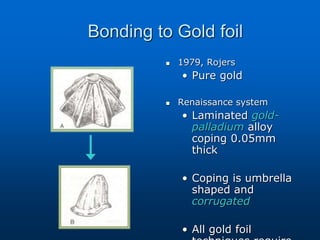
 1979, Rojers
• Pure gold
 Renaissance system
• Laminated gold-
palladium alloy
coping 0.05mm
thick
• Coping is umbrella
shaped and
corrugated
• All gold foil
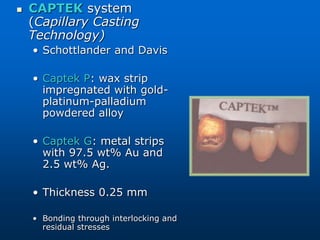
 CAPTEK system
(Capillary Casting
Technology)
• Schottlander and Davis
• Captek P: wax strip
impregnated with gold-
platinum-palladium
powdered alloy
• Captek G: metal strips
with 97.5 wt% Au and
2.5 wt% Ag.
• Thickness 0.25 mm
• Bonding through interlocking and
residual stresses
• Advantages
 Thinner coping
 Improved marginal fit
 Enhanced esthetics
 Biocompatibility (since 88% of the alloy is
non-oxidizing)
• Indications
 Single crowns
 FPDs with maximum span length of 18 mm
Indications for Foil bonded MC restorations
 Porcelain veneer crowning of adolescent teeth
where minimal tooth preparation is necessary.
 Anterior teeth, when metal reinforcement is
essential.
 Complete porcelain cantilever bridges on
anterior teeth replacing lateral incisors
 In heavily worn teeth, thin or short teeth where
minimal occlusal clearance present (not less
than 0.8mm)
 Repair of fractured metal- ceramic bridges,
when removal of bridge or splint is undesirable.
Contraindications
 In periodontally involved teeth,
where preparations extend deeply
into root- face and no shoulder
preparations are possible.
 Posterior teeth where large areas of
tooth are missing and uneven bulk
of porcelain is inevitable.
 If lingual shoulder preparations are
impossible particularly in molar
region
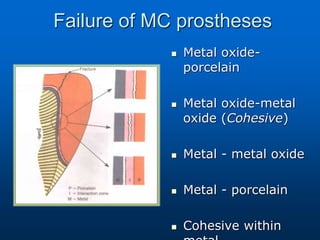
Failure of MC prostheses
 Metal oxide-
porcelain
 Metal oxide-metal
oxide (Cohesive)
 Metal - metal oxide
 Metal - porcelain
 Cohesive within
Thank You

dental ceramics

  • 1.
  • 2.
    Contents  What areceramics?  History  Classification  Composition and manufacture  General properties  Processing methods  Methods of strengthening ceramics  Metal ceramic systems • Alloys • Foil bonded
  • 3.
  • 4.
    Ceramics  ‘Keramos’ –Ceramic  Consists of silicate, glass and oxide ceramics
  • 5.
  • 6.
    Dental Ceramics An inorganiccompound with non-metallic properties typically consisting of oxygen and one or more metallic or semi-metallic elements (e.g. Al, Ca, Li, Mg, K, Si, Na, Sn, Ti and Zr) that is formulated to produce the whole or part of a ceramic based prosthesis.  Philips (11th Ed.)
  • 7.
  • 8.
    History of DentalCeramics  1774 – Alexis Duchateau  1789 – Nicolas de Chemant  1808 – Giuseppangelo Fonzi  1817 – Planteau  1822 – Peale  1825 – Stockton  1903 – Dr. Charles Land
  • 9.
     1938 –Dr. Charles Pincus  1962 – Weinstein and Weinstein • Porcelain with high TEC and low sintering temp. • Thermally compatible and bondable alloys  1965 – Mc Lean and Hughes  1980’s – Dr. Horn  1984 – Adair and Grossman: Dicor
  • 10.
  • 11.
    Silicate ceramics Oxide ceramics Glass ceramics Principal AMORPHOUS glass phase with porous structurei.e. mainly silica (SiO2) Principal CRYSTALLIN E phase e.g. Al2O3, MgO, ZrO2 Principal AMORPHOUS glass phase e.g. Dental porcelains (feldspathic or aluminous) e.g. Pure zirconia (ZrO2) Pure alumina e.g. Dicor glass ceramic Philips 11th Ed.
  • 12.
    Philips  Use orindications • Anterior crowns • Posterior crowns • Veneers • Post and Cores • FPDs • Stain ceramic • Glaze ceramic • Denture teeth
  • 13.
     Firing temperature •High fusing - 1300˚C • Medium fusing – 1101-1300˚C • Low fusing – 850-1100˚C • Ultralow fusing - < 850˚C  Application • Core porcelain • Dentine or body porcelain • Enamel porcelain
  • 14.
     Composition • Feldspathicporcelain • Leucite-reinforced porcelain • Aluminous porcelain • Alumina • Glass-infiltrated alumina • Glass-infiltrated spinel • Glass-infiltrated zirconia • Glass ceramic
  • 15.
     Processing method •Sintering • Partial sintering and glass infiltration • CAD-CAM • Copy Milling  Microstructure • Glass • Crystalline • Crystal-containing glass
  • 16.
     Translucency • Opaque •Translucent • Transparent  Method of Firing • At atmospheric pressure • At reduced pressure – Vacuum firing
  • 17.
    Craig  All-ceramic • Machined •Slip-cast • Heat-pressed • Sintered  Ceramic-metal • Sintered  Denture teeth • Manufactured
  • 18.
  • 19.
    Feldspathic Porcelains  Avitreous ceramic based on silica and potash feldspar (K2O·Al2O3·6SiO2) or soda feldspar (Na2O·Al2O3·6SiO2).  Silicate ceramics Silicate Glass
  • 20.
    Manufacture  Fritting –the combination of blending, melting and quenching the glass components.  Frit – resultant product after fritting.
  • 21.
    Composition Feldspar Quartz Kaolin Alumina Boric oxide Oxides ofNa, K and Ca Metallic pigments 60-80% 15-25% 3-5% 6-20% 2-7% 9-15% < 1%
  • 22.
    Components  Feldspar • Formsglass phase  Retains shape when fused at high temperature  Undergoes incongruent melting between 1150-1530˚C to form leucite. • Potash feldspar (K2O.Al2O3.6SiO2) – increases viscosity • Soda feldspar (Na2O.Al2O3.6SiO2 – lowers fusion temperature
  • 23.
     Quartz • Refractoryskeleton • Strengthens and hardens porcelain  Kaolin (Al2O3.2SiO2.2H2O) • Binder • Gives opacity therefore generally omitted  Al2O3 • Strength and opacity • Alters softening temperature • Increases viscosity
  • 24.
     Fluxes andGlass Modifiers • Na, K or Ca oxide • Interrupt silica tetrahedra • Lower fusion temperature • Increase flow • Increase thermal expansion • Remove impurities • Excess :  Reduced chemical durability  Devitrification on overheating
  • 25.
     Colouring pigments •Metallic oxides • ‘Colour frits’  Titanium oxide → Yellow - Brown Shade  Indium → Yellow / Ivory  Iron oxide / Nickel oxide → Brown  Cobalt salt → Blue
  • 26.
     Opacifying agents •To mask oxide layer • Metal oxide 8-15% : ZrO, CeO, TiO, SnO  Stains and color modifiers • Low fusing coloured porcelain  Other additives • Boric oxide • Lithium oxide • Magnesium oxide
  • 27.
    Glazes  To sealthe open pores  Self-glaze or Auto-glaze • High temperature  Add-on glaze • Higher glass modifiers • Lower temperature • Less durable
  • 28.
  • 29.
    Advantages  Biocompatibility  Esthetics •Colour and Translucency • Long term colour stability  Durability • Wear resistant • No Solubility  Ability to be formed into precise shapes
  • 30.
    Disadvantages  Brittle  Highshrinkage of conventional porcelains  Technique sensitive  Specialized training required  Costly equipment  More tooth reduction  Attrition of opposing tooth  Difficult to repair  Expensive
  • 31.
    Good Properties  Translucencylike enamel (Refractive index – 1.52-1.54)  High Stiffness (Elastic modulus – 10 x 106 psi)  Low thermal conductivity (0.0050˚C/cm)  Low electrical conductivity  High melting point
  • 32.
    Strength  Compressive strength •350-550 MPa  Tensile strength • 20-60 MPa  Brittle • Critical strain – 0.1%  Low fracture toughness
  • 33.
    Bad Properties  Verylow tensile strength  Low fracture toughness  Extremely sensitive to the presence of surface microcracks.  Difficult to machine (KHN 460)
  • 34.
    Coefficient of thermalexpansion  Feldspathic porcelains • Dependent on leucite content • Metal ceramics – 13.5-15.5 ppm/˚C • All ceramics – 5.5-7.5 ppm/˚C • Pressed Leucite systems – 16 ppm/˚C
  • 35.
  • 36.
    Compaction/Condensation  The processof packing the particles together and of removing the liquid binder is known as condensation.  The main driving force involved in condensing dental porcelain is surface tension.  Liquid • Distilled water • Propylene glycol
  • 37.
    Methods  Wet brush technique/Brush additive technique  Brush application method  Vibration  Spatulation  Whipping  Mechanical  Ultrasonic vibration
  • 38.
  • 39.
    Firing  Sintering -A process of heating closely packed particles to achieve interparticle bonding and sufficient diffusion to decrease the surface area or increase the density of the structure.  Liquid phase sintering
  • 40.
    Furnace  Horizontal muffle Vertical muffle  Temperature method  Temperature-time method
  • 41.
    Types  Air fired •Slow maturation period  Vacuum fired • Dense, pore-free mass • Shorter firing time  Diffusible gas firing procedure • Helium, hydrogen or steam
  • 42.
    Stages  Low bisque •Porous • Minimal shrinkage • Weak  Medium bisque • Flow of glass • Shrinkage  High bisque
  • 43.
    Glazing  Advantages • Increasedstrength (40-46%) • Wear resistance • Lower solubillity • Less abrasive to opposing dentition
  • 44.
  • 45.
    Why do Ceramicshave a Low Fracture Toughness?  Actual strength 100 times lower than theoretical strength  Why? • Defects and flaws on surface or bulk of restorations
  • 46.
    Methods of Strengthening Strengthening of the brittle material • Development of residual compressive stresses within the surface of the material. • Interruption of crack propagation through the material.  Methods of designing components to minimize stress concentrations and tensile stresses
  • 47.
    Development of Residual CompressiveStresses The residual stresses must first be negated by developing tensile stresses before any net tensile stress develops.  Ion exchange/ chemical tempering: • Introduces larger ions into smaller ion vacancies • A molten KNO3 bath is used • Residual compressive stresses = 700 MPa
  • 48.
     Thermal tempering •Rapid cooling/quenching of the surface of the object while it is in molten/softened state • Hot glass-phase ceramics are quenched in silicone oil or other special liquids to uniformly cool the surface
  • 49.
     Thermal compatibility •TEC alloy > TEC porcelain • Core shrinks more putting veneer in compression • Difference not > 0.5-1 ppm/˚C Core Veneer Higher TEC Radial tensile stresses Axial compressive stresses
  • 51.
    Interruption of crackpropagation  Dispersion of a crystalline phase • Alumina (e.g. In Ceram) • Mica (Dicor)  Transformation toughening • Partially Stabilised Zirconia (PSZ) • Contains 3mol% Yttria which causes the zirconia to form in the metastable tetragonal form • On crack approaching, the tetragonal - ZrO2 inverts to monoclinic-ZrO2 • There is a volume expansion
  • 52.
    Optimal prosthesis design Minimise tensile stress  Minimise stress raisers e.g. sharp corners  Uniform thickness of porcelain  Use fine grit abrasive  Do not use all-ceramic restorations in high occlusal stress regions  In all-ceramics • Use greater connector height (4 mm) • Broader connector
  • 53.
    Minimize number offiring cycles Multiple firings Increase in leucite content Increase in thermal contraction coefficient of porcelain May cause mismatch with metal Immediate or delayed crack formation
  • 54.
    Material Flexural strength (MPa) Fracture toughness (MPa/m2) Porcelains Feldspathic Leucite 60-110 120-180 1.1 1.2 Glass ceramicsCast/ cerammed/ premade/ hot pressed 140-220 2.0 Alumina Spinel Pure/ glass infiltrated Glass infiltrd. 400-600 325-410 3.8-5.0 2.4 Zirconia PSZ 900 9 Tooth structures Dentin Enamel 16-20 65-75 2.5 1
  • 55.
  • 57.
    Advantages  High strengthvalues due to metal reinforcement. More fracture resistant.  Improved fit on individual crowns provided by cast metal collar.  Less tooth structure removal compared to all ceramic restorations.  Permanent esthetics
  • 58.
    Disadvantages  Difficult toobtain good esthetics due to increased opacity of metal substructure.  Porcelains used in metal ceramic techniques are more liable to devitrification.  More difficult to create depth of translucency because of dense opaque porcelain  Preparation for metal ceramic requires significant tooth reduction to provide sufficient space for the materials when compared to all metal restoration.  Patients may be allergic to the metal
  • 59.
    Indications  Discolored teeth Grossly decayed carious teeth  Congenital anomalies  Abutment retainers  Splinting mobile teeth  Occlusal corrections  Alignment corrections
  • 60.
    Contraindications  Patients withactive caries or untreated periodontal disease.  In young patients with large pulp chambers due to high risk of pulp exposure  Teeth where enamel wear is high and there is insufficient bulk of tooth structure to allow room for metal and porcelain.  High lip line  Anterior teeth where esthetics is of prime importance  Short and thin crowns
  • 61.
    Feldspathic Porcelain  Leuciteis a potassium aluminium silicate (KAlSi2O6 )  One of the most important phases in dental ceramics  Leucite tends to form readily from feldspars  Importance: • Increases thermal expansion • Gives strength  Drawbacks: • Greater tendency to devitrify due to alkali content • Changes in thermal contraction on repeated firing  Shoulder porcelain: used with or without a knife edge metal margin to avoid metal collar.
  • 62.
    Types of veneeringceramics  Low fusing ceramics (850-1100˚C) • Feldspar based porcelains  Ultra low-fusing ceramics (< 850˚C) • Porcelains and glasses • E.g. Duceram LFC  Hydrothermal glass  Well distributed small crystal particles (400-500 nm)  Reduced enamel wear  No of sag of alloy  Glazes • Self-glaze • Add-on  Stains
  • 63.
    Classification of MCalloys (Naylor 1986)  Alloys divided into 2 systems: A. Noble (Precious) metal alloys B. Base-metal (Non-noble/non-precious) alloys Each system further divided into constituents
  • 64.
    SYSTEM GROUP A) NOBLEMETAL ALLOYS 1) Gold-platinum-palladium 2) Gold-palladium-silver 3) Gold-palladium 4) Palladium-silver 5) High palladium High silver Low silver B) BASE METAL ALLOYS 1) Nickel-chromium 2) Cobalt-chromium 3) Other systems Beryllium Beryllium free
  • 65.
    Requirements of MCalloys  Must be able to produce surface oxides for chemical bonding with dental porcelains.  Co-efficient of thermal expansion should be slightly greater (0.5-1 ppm/˚C) than that of the porcelain veneer to maintain the metal- porcelain attachment.  Melting range considerably higher than the fusing range of the dental porcelain fired on it.  The alloy must have high temperature strength or sag resistance → that is the ability to withstand exposure to high temperatures without undergoing dimensional change.  Processing should not be too technically demanding.  A casting alloy should be biocompatible.
  • 66.
    Nature of Metal-ceramicBond  Van der Waals forces  Mechanical retention/entrapment  Compressive forces  Direct chemical bonding
  • 67.
    Direct Chemical Bonding Formation of surface oxides which bond to porcelain  Mechanisms: • Oxide layer permanently bonded to the metal • Surface oxides dissolved by the opaque layer. Enhanced wetting of metal surface.  Techniques: • < 1% of Fe, Sn or In added to alloy.
  • 68.
    Oxidation or Degassing This high temperature processing allows specific oxides to form on the metal surface which are responsible for forming a mature, stable oxide layer for the porcelain metal attachment  Also recommended for cleaning the metal of organic debris and remove entrapped surface gases such as hydrogen
  • 69.
    Proprietary agents  Availablefor application to metal surface before condensation of opaque layer.  Applied as thin liquid and fired like opaque layer.  Functions: • Improve bonding by limiting build-up of oxide layer on the base metal surface
  • 70.
    Copings for MCprostheses  Electrodeposition of Au or other metal on a duplicate die  Burnishing and heat-treating metal foils on a die  CAD-CAM processing of a metal ingot  Casting of CP Ti or an alloy through lost wax process
  • 71.
    Bonding to Platinumfoil  Platinum Bonded Alumina Crown • 0.025 mm Pt foil burnished onto die • Coated with 2 m layer of Sn and oxidized • Advantages  Reduces subsurface porosity and micro cracks in the porcelain
  • 72.
     Twin FoilTechnique (Mc Lean et al, 1976) • Inner foil of 0.025mm platinum provides a matrix for the baking of the porcelain • Outer foil which forms the inner skin to the crown is tin-plated and oxidized to achieve strong chemical bond with aluminous core porcelain • Inner foil removed after firing by soaking in water
  • 73.
    Advantages  Reduction ofmetal and labor costs in construction.  Provision of a porcelain butt fit on the labial/buccal surface of the crown, eliminating the dark shadow of a metal collar.  Improvement in strength of aluminous porcelain crown by reducing internal microcracks and subsurface porosity
  • 74.
    Disadvantages  The shrinkageof porcelain makes it difficult to achieve an accurate fit of the core porcelain in one bake  Therefore, important to allow for shrinkage and prevent the fired porcelain from lifting the platinum skirt and spoiling the fit • The cervical contact technique.
  • 75.
    Bonding to Goldfoil  1979, Rojers • Pure gold  Renaissance system • Laminated gold- palladium alloy coping 0.05mm thick • Coping is umbrella shaped and corrugated • All gold foil
  • 77.
     CAPTEK system (CapillaryCasting Technology) • Schottlander and Davis • Captek P: wax strip impregnated with gold- platinum-palladium powdered alloy • Captek G: metal strips with 97.5 wt% Au and 2.5 wt% Ag. • Thickness 0.25 mm • Bonding through interlocking and residual stresses
  • 78.
    • Advantages  Thinnercoping  Improved marginal fit  Enhanced esthetics  Biocompatibility (since 88% of the alloy is non-oxidizing) • Indications  Single crowns  FPDs with maximum span length of 18 mm
  • 79.
    Indications for Foilbonded MC restorations  Porcelain veneer crowning of adolescent teeth where minimal tooth preparation is necessary.  Anterior teeth, when metal reinforcement is essential.  Complete porcelain cantilever bridges on anterior teeth replacing lateral incisors  In heavily worn teeth, thin or short teeth where minimal occlusal clearance present (not less than 0.8mm)  Repair of fractured metal- ceramic bridges, when removal of bridge or splint is undesirable.
  • 80.
    Contraindications  In periodontallyinvolved teeth, where preparations extend deeply into root- face and no shoulder preparations are possible.  Posterior teeth where large areas of tooth are missing and uneven bulk of porcelain is inevitable.  If lingual shoulder preparations are impossible particularly in molar region
  • 81.
    Failure of MCprostheses  Metal oxide- porcelain  Metal oxide-metal oxide (Cohesive)  Metal - metal oxide  Metal - porcelain  Cohesive within
  • 82.