DENGUE
FEVER
NUR FARRA NAJWA
BINTI ABDUL AZIM
082015100035
OBJECTIVES
At the end of the seminar, students should be able to
Define and understand what is dengue and its patho-
physiology
List the risk for being infected by dengue
Explain in brief the clinical feature of dengue
Know the epidemiology for dengue
Understand the lab diagnosis for dengue
Briefly enumerate the treatment for dengue
List the prophylaxis measure to be taken for dengue
AEDES MOSQUITOS
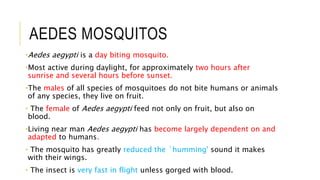
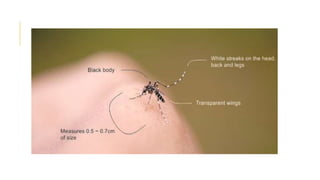
•Aedes aegypti is a day biting mosquito.
•Most active during daylight, for approximately two hours after
sunrise and several hours before sunset.
•The males of all species of mosquitoes do not bite humans or animals
of any species, they live on fruit.
• The female of Aedes aegypti feed not only on fruit, but also on
blood.
•Living near man Aedes aegypti has become largely dependent on and
adapted to humans.
• The mosquito has greatly reduced the `humming' sound it makes
with their wings.
• The insect is very fast in flight unless gorged with blood.
INTRODUCTION
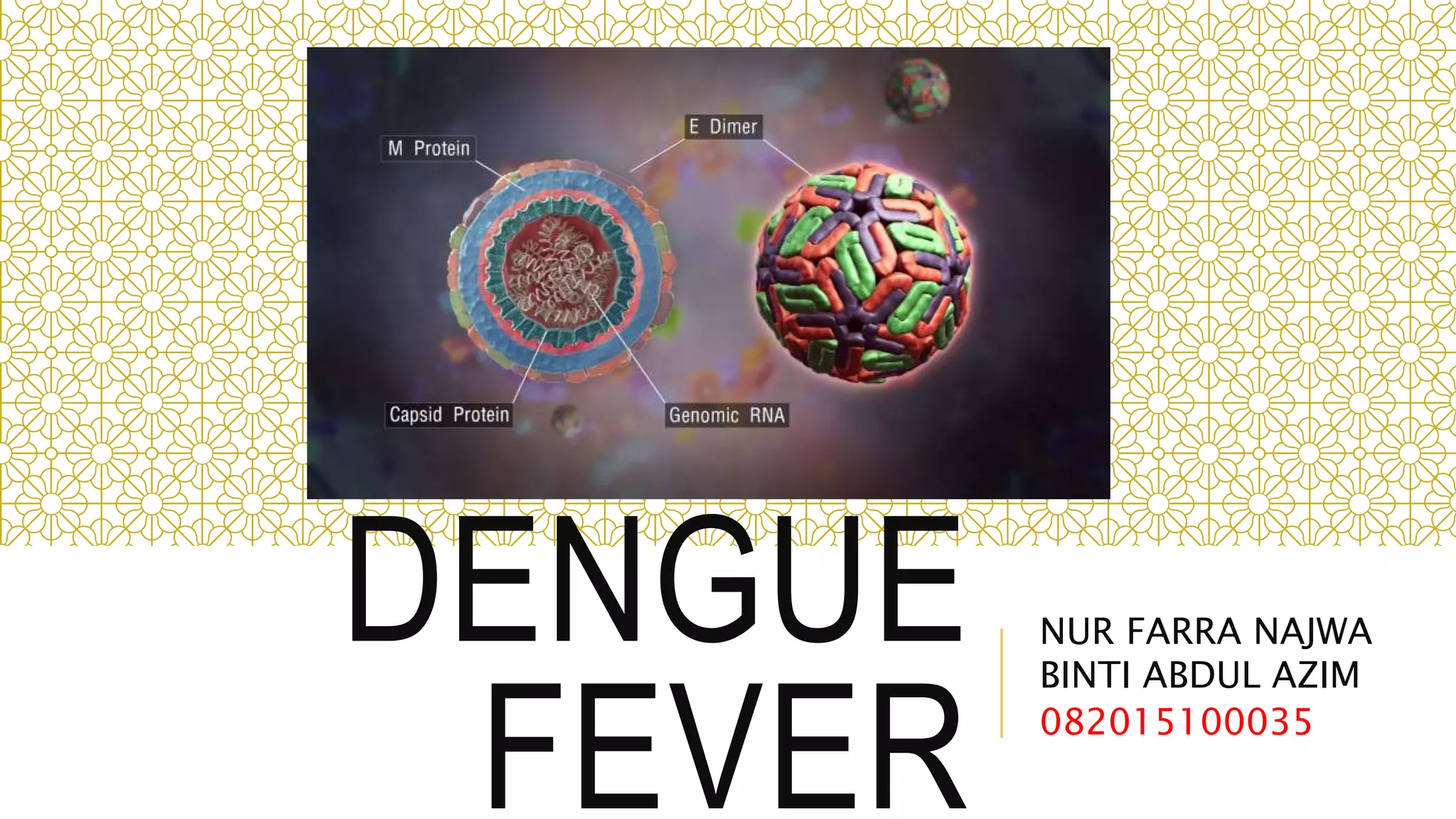
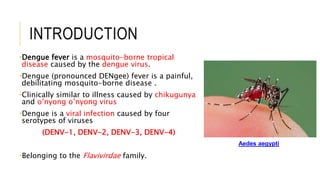
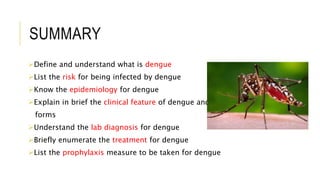
•Dengue fever is a mosquito-borne tropical
disease caused by the dengue virus.
•Dengue (pronounced DENgee) fever is a painful,
debilitating mosquito-borne disease .
•Clinically similar to illness caused by chikugunya
and o’nyong o’nyong virus
•Dengue is a viral infection caused by four
serotypes of viruses
(DENV-1, DENV-2, DENV-3, DENV-4)
•Belonging to the Flavivirdae family.
Aedes aegypti
DENGUE FEVER
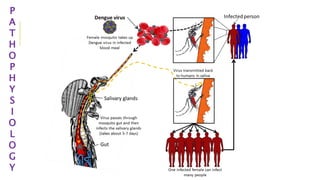
•Transmission : through the bite of infected Aedes aegypti and Aedes
albopictus female mosquitoes .
•Vector : Aedes aegypti and Aedes albopictus female mosquitoes
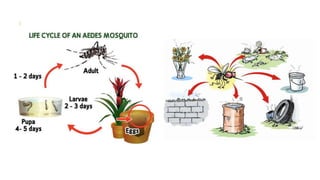
•These mosquitoes thrive in areas with standing water, including
puddles, water tanks, containers and old tires. Lack of reliable
sanitation and regular garbage collection also contribute to the spread
of the mosquitoes
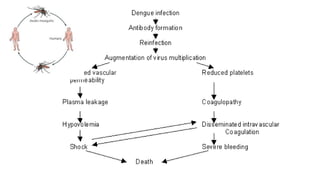
P
A
T
H
O
P
H
Y
S
I
O
L
O
G
Y
RISKS
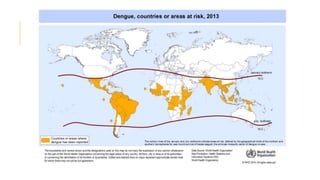
•Risk of Dengue exists in tropical and subtropical areas of Central
America, South America, Africa, Asia, and Oceania.
•All travellers are at risk during outbreaks.
•Long-term travellers and humanitarian workers going to areas where
Dengue is endemic are at higher risk.
•Dengue occurs in urban and suburban settings with higher
transmission rates happening during the rainy season
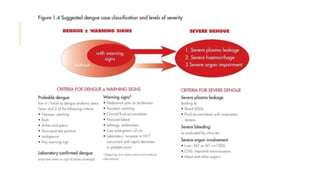
CLINICAL FEATURES
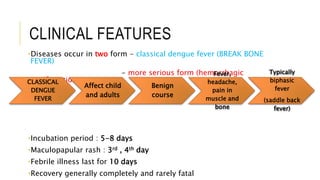
•Diseases occur in two form - classical dengue fever (BREAK BONE
FEVER)
- more serious form (hemorrhagic
manifestation)
•Incubation period : 5-8 days
•Maculopapular rash : 3rd , 4th day
•Febrile illness last for 10 days
•Recovery generally completely and rarely fatal
CLASSICAL
DENGUE
FEVER
Affect child
and adults
Benign
course
Fever,
headache,
pain in
muscle and
bone
Typically
biphasic
fever
(saddle back
fever)
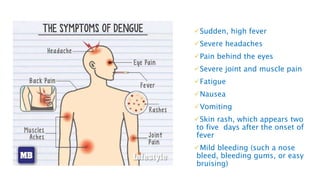
Sudden, high fever
Severe headaches
Pain behind the eyes
Severe joint and muscle pain
Fatigue
Nausea
Vomiting
Skin rash, which appears two
to five days after the onset of
fever
Mild bleeding (such a nose
bleed, bleeding gums, or easy
bruising)
CONT.
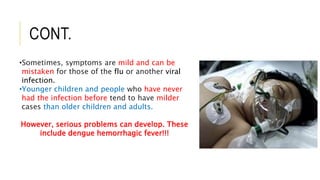
•Sometimes, symptoms are mild and can be
mistaken for those of the flu or another viral
infection.
•Younger children and people who have never
had the infection before tend to have milder
cases than older children and adults.
However, serious problems can develop. These
include dengue hemorrhagic fever!!!
DENGUE HEMORRHAGIC FEVER
(DHF/DSS)
• A rare complication characterized by
•high fever,
•damage to lymph and blood vessels,
•bleeding from the nose and gums,
•enlargement of the liver,
•failure of the circulatory system.
The symptoms may progress to massive bleeding, shock, and
death.
• People with weakened immune systems as well as those with a
second or subsequent dengue infection are believed to be at
greater risk for developing dengue hemorrhagic fever.
CONT.
DHF / DSS
•More serious form
•With hemorrhagic and shock form
DHF (dengue hemorrhagic fever) , DSS (dengue shock syndrome)
•Mostly confined to children 5-10 year old in area where multiple
dengue virus cause diseases
•Appears to be hyperimmune reaction
•Seen in patient previously infected dengue virus
•On reinfection with different virus serotype, antibody form against
first virus react with second serotype forming immune complexes
CONT
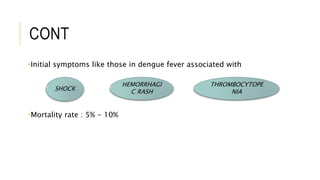
•Initial symptoms like those in dengue fever associated with
•Mortality rate : 5% - 10%
SHOCK
THROMBOCYTOPE
NIA
HEMORRHAGI
C RASH
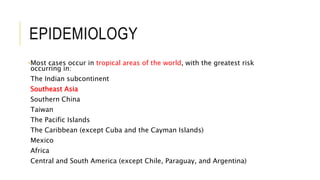
EPIDEMIOLOGY
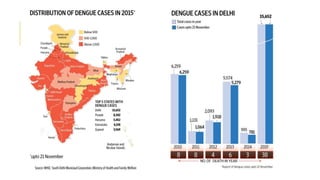
•Most cases occur in tropical areas of the world, with the greatest risk
occurring in:
The Indian subcontinent
Southeast Asia
Southern China
Taiwan
The Pacific Islands
The Caribbean (except Cuba and the Cayman Islands)
Mexico
Africa
Central and South America (except Chile, Paraguay, and Argentina)
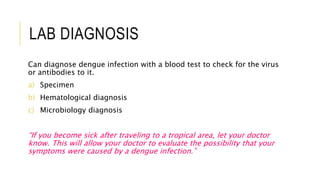
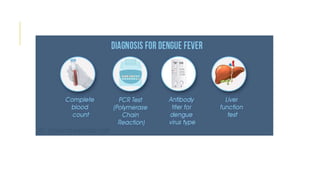
LAB DIAGNOSIS
Can diagnose dengue infection with a blood test to check for the virus
or antibodies to it.
a) Specimen
b) Hematological diagnosis
c) Microbiology diagnosis
“If you become sick after traveling to a tropical area, let your doctor
know. This will allow your doctor to evaluate the possibility that your
symptoms were caused by a dengue infection.”
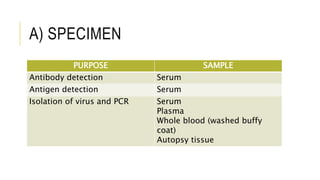
A) SPECIMEN
PURPOSE SAMPLE
Antibody detection Serum
Antigen detection Serum
Isolation of virus and PCR Serum
Plasma
Whole blood (washed buffy
coat)
Autopsy tissue
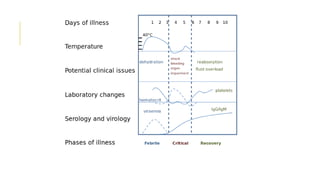
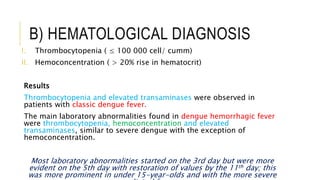
B) HEMATOLOGICAL DIAGNOSIS
I. Thrombocytopenia ( ≤ 100 000 cell/ cumm)
II. Hemoconcentration ( > 20% rise in hematocrit)
Results
Thrombocytopenia and elevated transaminases were observed in
patients with classic dengue fever.
The main laboratory abnormalities found in dengue hemorrhagic fever
were thrombocytopenia, hemoconcentration and elevated
transaminases, similar to severe dengue with the exception of
hemoconcentration.
Most laboratory abnormalities started on the 3rd day but were more
evident on the 5th day with restoration of values by the 11th day; this
was more prominent in under 15-year-olds and with the more severe
C) MICROBIOLOGICAL DIAGNOSIS
I. Isolation of virus is difficult but serology is major role in diognosis
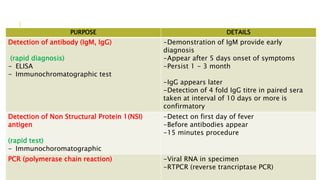
PURPOSE DETAILS
Detection of antibody (IgM, IgG)
(rapid diagnosis)
- ELISA
- Immunochromatographic test
-Demonstration of IgM provide early
diagnosis
-Appear after 5 days onset of symptoms
-Persist 1 - 3 month
-IgG appears later
-Detection of 4 fold IgG titre in paired sera
taken at interval of 10 days or more is
confirmatory
Detection of Non Structural Protein 1(NSI)
antigen
(rapid test)
- Immunochoromatographic
-Detect on first day of fever
-Before antibodies appear
-15 minutes procedure
PCR (polymerase chain reaction) -Viral RNA in specimen
-RTPCR (reverse trancriptase PCR)
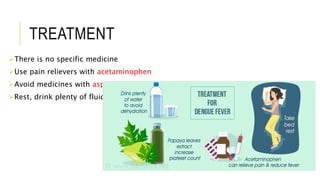
TREATMENT
There is no specific medicine
Use pain relievers with acetaminophen
Avoid medicines with aspirin
Rest, drink plenty of fluids
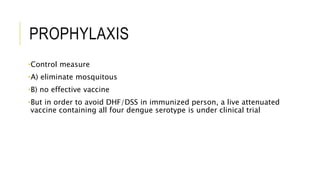
PROPHYLAXIS
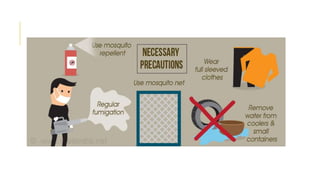
•Control measure
•A) eliminate mosquitous
•B) no effective vaccine
•But in order to avoid DHF/DSS in immunized person, a live attenuated
vaccine containing all four dengue serotype is under clinical trial
SUMMARY
Define and understand what is dengue
List the risk for being infected by dengue
Know the epidemiology for dengue
Explain in brief the clinical feature of dengue and its rare
forms
Understand the lab diagnosis for dengue
Briefly enumerate the treatment for dengue
List the prophylaxis measure to be taken for dengue
REFERENCES
1. Textbook Of Microbiology Prof Cp Baveja, 4th Edition
2. Textbook Of Microbiology Ananthanarayan And Paniker, 8th Edition
3. http://www.antimicrobe.org/new/v34.asp
4. http://www.denguevirusnet.com/aedes-aegypti.html
5. http://www.medicinenet.com/dengue_fever/article.htm
6. http://www.webmd.com/a-to-z-guides/dengue-fever-
reference#2
microb dengoo
microb dengoo

microb dengoo

  • 1.
    DENGUE FEVER NUR FARRA NAJWA BINTIABDUL AZIM 082015100035
  • 2.
    OBJECTIVES At the endof the seminar, students should be able to Define and understand what is dengue and its patho- physiology List the risk for being infected by dengue Explain in brief the clinical feature of dengue Know the epidemiology for dengue Understand the lab diagnosis for dengue Briefly enumerate the treatment for dengue List the prophylaxis measure to be taken for dengue
  • 3.
    AEDES MOSQUITOS •Aedes aegyptiis a day biting mosquito. •Most active during daylight, for approximately two hours after sunrise and several hours before sunset. •The males of all species of mosquitoes do not bite humans or animals of any species, they live on fruit. • The female of Aedes aegypti feed not only on fruit, but also on blood. •Living near man Aedes aegypti has become largely dependent on and adapted to humans. • The mosquito has greatly reduced the `humming' sound it makes with their wings. • The insect is very fast in flight unless gorged with blood.
  • 7.
    INTRODUCTION •Dengue fever isa mosquito-borne tropical disease caused by the dengue virus. •Dengue (pronounced DENgee) fever is a painful, debilitating mosquito-borne disease . •Clinically similar to illness caused by chikugunya and o’nyong o’nyong virus •Dengue is a viral infection caused by four serotypes of viruses (DENV-1, DENV-2, DENV-3, DENV-4) •Belonging to the Flavivirdae family. Aedes aegypti
  • 10.
    DENGUE FEVER •Transmission :through the bite of infected Aedes aegypti and Aedes albopictus female mosquitoes . •Vector : Aedes aegypti and Aedes albopictus female mosquitoes •These mosquitoes thrive in areas with standing water, including puddles, water tanks, containers and old tires. Lack of reliable sanitation and regular garbage collection also contribute to the spread of the mosquitoes
  • 11.
  • 13.
    RISKS •Risk of Dengueexists in tropical and subtropical areas of Central America, South America, Africa, Asia, and Oceania. •All travellers are at risk during outbreaks. •Long-term travellers and humanitarian workers going to areas where Dengue is endemic are at higher risk. •Dengue occurs in urban and suburban settings with higher transmission rates happening during the rainy season
  • 14.
    CLINICAL FEATURES •Diseases occurin two form - classical dengue fever (BREAK BONE FEVER) - more serious form (hemorrhagic manifestation) •Incubation period : 5-8 days •Maculopapular rash : 3rd , 4th day •Febrile illness last for 10 days •Recovery generally completely and rarely fatal CLASSICAL DENGUE FEVER Affect child and adults Benign course Fever, headache, pain in muscle and bone Typically biphasic fever (saddle back fever)
  • 16.
    Sudden, high fever Severeheadaches Pain behind the eyes Severe joint and muscle pain Fatigue Nausea Vomiting Skin rash, which appears two to five days after the onset of fever Mild bleeding (such a nose bleed, bleeding gums, or easy bruising)
  • 17.
    CONT. •Sometimes, symptoms aremild and can be mistaken for those of the flu or another viral infection. •Younger children and people who have never had the infection before tend to have milder cases than older children and adults. However, serious problems can develop. These include dengue hemorrhagic fever!!!
  • 18.
    DENGUE HEMORRHAGIC FEVER (DHF/DSS) •A rare complication characterized by •high fever, •damage to lymph and blood vessels, •bleeding from the nose and gums, •enlargement of the liver, •failure of the circulatory system. The symptoms may progress to massive bleeding, shock, and death. • People with weakened immune systems as well as those with a second or subsequent dengue infection are believed to be at greater risk for developing dengue hemorrhagic fever.
  • 19.
    CONT. DHF / DSS •Moreserious form •With hemorrhagic and shock form DHF (dengue hemorrhagic fever) , DSS (dengue shock syndrome) •Mostly confined to children 5-10 year old in area where multiple dengue virus cause diseases •Appears to be hyperimmune reaction •Seen in patient previously infected dengue virus •On reinfection with different virus serotype, antibody form against first virus react with second serotype forming immune complexes
  • 20.
    CONT •Initial symptoms likethose in dengue fever associated with •Mortality rate : 5% - 10% SHOCK THROMBOCYTOPE NIA HEMORRHAGI C RASH
  • 21.
    EPIDEMIOLOGY •Most cases occurin tropical areas of the world, with the greatest risk occurring in: The Indian subcontinent Southeast Asia Southern China Taiwan The Pacific Islands The Caribbean (except Cuba and the Cayman Islands) Mexico Africa Central and South America (except Chile, Paraguay, and Argentina)
  • 23.
    LAB DIAGNOSIS Can diagnosedengue infection with a blood test to check for the virus or antibodies to it. a) Specimen b) Hematological diagnosis c) Microbiology diagnosis “If you become sick after traveling to a tropical area, let your doctor know. This will allow your doctor to evaluate the possibility that your symptoms were caused by a dengue infection.”
  • 25.
    A) SPECIMEN PURPOSE SAMPLE Antibodydetection Serum Antigen detection Serum Isolation of virus and PCR Serum Plasma Whole blood (washed buffy coat) Autopsy tissue
  • 26.
    B) HEMATOLOGICAL DIAGNOSIS I.Thrombocytopenia ( ≤ 100 000 cell/ cumm) II. Hemoconcentration ( > 20% rise in hematocrit) Results Thrombocytopenia and elevated transaminases were observed in patients with classic dengue fever. The main laboratory abnormalities found in dengue hemorrhagic fever were thrombocytopenia, hemoconcentration and elevated transaminases, similar to severe dengue with the exception of hemoconcentration. Most laboratory abnormalities started on the 3rd day but were more evident on the 5th day with restoration of values by the 11th day; this was more prominent in under 15-year-olds and with the more severe
  • 27.
    C) MICROBIOLOGICAL DIAGNOSIS I.Isolation of virus is difficult but serology is major role in diognosis
  • 28.
    PURPOSE DETAILS Detection ofantibody (IgM, IgG) (rapid diagnosis) - ELISA - Immunochromatographic test -Demonstration of IgM provide early diagnosis -Appear after 5 days onset of symptoms -Persist 1 - 3 month -IgG appears later -Detection of 4 fold IgG titre in paired sera taken at interval of 10 days or more is confirmatory Detection of Non Structural Protein 1(NSI) antigen (rapid test) - Immunochoromatographic -Detect on first day of fever -Before antibodies appear -15 minutes procedure PCR (polymerase chain reaction) -Viral RNA in specimen -RTPCR (reverse trancriptase PCR)
  • 29.
    TREATMENT There is nospecific medicine Use pain relievers with acetaminophen Avoid medicines with aspirin Rest, drink plenty of fluids
  • 30.
    PROPHYLAXIS •Control measure •A) eliminatemosquitous •B) no effective vaccine •But in order to avoid DHF/DSS in immunized person, a live attenuated vaccine containing all four dengue serotype is under clinical trial
  • 33.
    SUMMARY Define and understandwhat is dengue List the risk for being infected by dengue Know the epidemiology for dengue Explain in brief the clinical feature of dengue and its rare forms Understand the lab diagnosis for dengue Briefly enumerate the treatment for dengue List the prophylaxis measure to be taken for dengue
  • 34.
    REFERENCES 1. Textbook OfMicrobiology Prof Cp Baveja, 4th Edition 2. Textbook Of Microbiology Ananthanarayan And Paniker, 8th Edition 3. http://www.antimicrobe.org/new/v34.asp 4. http://www.denguevirusnet.com/aedes-aegypti.html 5. http://www.medicinenet.com/dengue_fever/article.htm 6. http://www.webmd.com/a-to-z-guides/dengue-fever- reference#2