HYPOGAMMAGL
OBULINEMIA
OUTLINE
• INTRODUCTION
• DEFINITION OF HYPOGAMMAGLOBULINEMIA
• METHOD OF INVESTIGATION
• CAUSES OF HYPOGAMMAGLOBULINEMIA
• TREATMENTS
INTRODUCTION
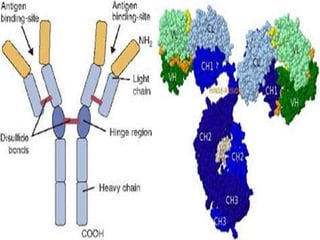
Gamma globulins are soluble, high molecular
weight globular proteins with a typical weight of
about 120 kDa and above.
The normal level of plasma gamma globulins
is 20-30g/l and they are the only plasma
proteins that do not originate from the liver.
DEFINITION OF
HYPOGAMMAGLOBULINEMIA
Hypogammaglobulinemia is a pathology
characterized by a decrease in the level of plasma
gamma globulins that results from deficiency in B
lymphocytes.
PLASMA PROTEINS INVESTIGATION
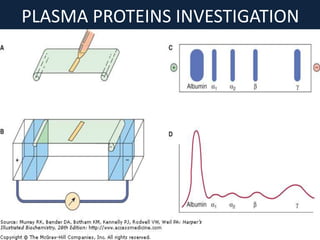
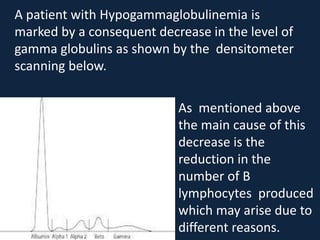
A patient with Hypogammaglobulinemia is
marked by a consequent decrease in the level of
gamma globulins as shown by the densitometer
scanning below.
As mentioned above
the main cause of this
decrease is the
reduction in the
number of B
lymphocytes produced
which may arise due to
different reasons.
CAUSES
- Hypogammaglobulinemia may be caused by primary
(congenital) or secondary (acquired) disorders.
- The primary (congenital disorders include:
A) X-linked agammaglobulinemia (XLA, Bruton
agammaglobulinemia)
This is a genetic disorder that affects mainly boys.
The symptoms start between the 7-9 months after a
significant decline in maternal antibodies and is
characterized by recurrent bacterial infections commonly
H influenzae B (HIB) and S pneumoniae.
This disorder has been attributed to mutation in
Tyrosine kinase gene and protein.
B) Autosomal recessive agammaglobulinemia (ARA)
The implicated molecules or genes include
IgM heavy chain, Ig alpha, surrogate light chain, B
cell linker protein (BLNK)
C) Specific antibody deficiency (SAD) or specific
polysaccharide antibody deficiency (SPAD)
SAD is characterized by total levels of IgG, IgA,
and IgM within the normal range, but with an
inability to make appropriate quantities of specific
antibodies and/or to retain memory of
polysaccharide vaccines.
D) Hyper-IgM syndromes (including deficiencies of
CD40 ligand (CD154), activation-induced cytidine
deaminase [AID], and uracil-nucleoside-glycosylase
[UNG]):
This is a heterogeneous group of disorders in
which normal or elevated IgM levels are found along
with low levels of IgA, IgG, and, sometimes, IgE.
E) Common variable immunodeficiency (CVID)
CVID is usually differentiated from XLA and
autosomal recessive agammaglobulinemia by the
presence of B-cells, visible tonsils or a history of
tonsillectomy, and palpable or even enlarged lymph
nodes.
F) Transient hypogammaglobulinemia of
infancy
This occurs when there is a delay in the production of IgG
in the baby after exhaustion of the maternal IgG around
the 6th month of age. The reason for this delay is still not
well understood but the child during this period remains
susceptible to different kinds of infections.
G) Wiskott-Aldrich syndrome
This defined by mutation of WAS protein on the
short arm of chromosome X and characterized by
eczema, petechiae, bruising or bleeding, recurrent severe
infections (including opportunistic infections)
autoimmune diseases, and B-cell lymphomas.
The secondary gamma globulinemia are present in:
- Nephrotic syndrome: Decreased levels of IgG can
appear with normal levels of IgA and IgM in the
nephrotic syndrome.
- Protein-losing enteropathy: This occurs because of
intestinal lymphatic blockade with resulting
leakage of lymphatic fluid and cellular components
into the lumen.
- Immunosuppressive therapy
- Lymphoproliferative malignancies (leukemia &
leukocytosis B-CLL cells inhibit Ig secreting plasma
proteins)
- Prematurity in infants:
TREATMENT
Immunoglobulin replacement therapy is the
most effective therapy against all forms of
Hypogammaglobulinemia and can be achieved
mainly by vaccination ( PASSIVE AND ACTIVE).
Other syndromes that can not be stabilized by
Vaccination e.g WAS are resolved mainly by
bone marrow transplantation,
THANKS FOR
YOUR ATTENTION

Hypogammaglobulinemia

  • 1.
  • 2.
    OUTLINE • INTRODUCTION • DEFINITIONOF HYPOGAMMAGLOBULINEMIA • METHOD OF INVESTIGATION • CAUSES OF HYPOGAMMAGLOBULINEMIA • TREATMENTS
  • 3.
    INTRODUCTION Gamma globulins aresoluble, high molecular weight globular proteins with a typical weight of about 120 kDa and above. The normal level of plasma gamma globulins is 20-30g/l and they are the only plasma proteins that do not originate from the liver.
  • 5.
    DEFINITION OF HYPOGAMMAGLOBULINEMIA Hypogammaglobulinemia isa pathology characterized by a decrease in the level of plasma gamma globulins that results from deficiency in B lymphocytes.
  • 6.
  • 7.
    A patient withHypogammaglobulinemia is marked by a consequent decrease in the level of gamma globulins as shown by the densitometer scanning below. As mentioned above the main cause of this decrease is the reduction in the number of B lymphocytes produced which may arise due to different reasons.
  • 8.
    CAUSES - Hypogammaglobulinemia maybe caused by primary (congenital) or secondary (acquired) disorders. - The primary (congenital disorders include: A) X-linked agammaglobulinemia (XLA, Bruton agammaglobulinemia) This is a genetic disorder that affects mainly boys. The symptoms start between the 7-9 months after a significant decline in maternal antibodies and is characterized by recurrent bacterial infections commonly H influenzae B (HIB) and S pneumoniae. This disorder has been attributed to mutation in Tyrosine kinase gene and protein.
  • 9.
    B) Autosomal recessiveagammaglobulinemia (ARA) The implicated molecules or genes include IgM heavy chain, Ig alpha, surrogate light chain, B cell linker protein (BLNK) C) Specific antibody deficiency (SAD) or specific polysaccharide antibody deficiency (SPAD) SAD is characterized by total levels of IgG, IgA, and IgM within the normal range, but with an inability to make appropriate quantities of specific antibodies and/or to retain memory of polysaccharide vaccines.
  • 10.
    D) Hyper-IgM syndromes(including deficiencies of CD40 ligand (CD154), activation-induced cytidine deaminase [AID], and uracil-nucleoside-glycosylase [UNG]): This is a heterogeneous group of disorders in which normal or elevated IgM levels are found along with low levels of IgA, IgG, and, sometimes, IgE. E) Common variable immunodeficiency (CVID) CVID is usually differentiated from XLA and autosomal recessive agammaglobulinemia by the presence of B-cells, visible tonsils or a history of tonsillectomy, and palpable or even enlarged lymph nodes.
  • 11.
    F) Transient hypogammaglobulinemiaof infancy This occurs when there is a delay in the production of IgG in the baby after exhaustion of the maternal IgG around the 6th month of age. The reason for this delay is still not well understood but the child during this period remains susceptible to different kinds of infections. G) Wiskott-Aldrich syndrome This defined by mutation of WAS protein on the short arm of chromosome X and characterized by eczema, petechiae, bruising or bleeding, recurrent severe infections (including opportunistic infections) autoimmune diseases, and B-cell lymphomas.
  • 12.
    The secondary gammaglobulinemia are present in: - Nephrotic syndrome: Decreased levels of IgG can appear with normal levels of IgA and IgM in the nephrotic syndrome. - Protein-losing enteropathy: This occurs because of intestinal lymphatic blockade with resulting leakage of lymphatic fluid and cellular components into the lumen. - Immunosuppressive therapy - Lymphoproliferative malignancies (leukemia & leukocytosis B-CLL cells inhibit Ig secreting plasma proteins) - Prematurity in infants:
  • 13.
    TREATMENT Immunoglobulin replacement therapyis the most effective therapy against all forms of Hypogammaglobulinemia and can be achieved mainly by vaccination ( PASSIVE AND ACTIVE). Other syndromes that can not be stabilized by Vaccination e.g WAS are resolved mainly by bone marrow transplantation,
  • 14.

Editor's Notes

  • #7 Technique of cellulose acetate zone electrophoresis. (A) A small amount of serum or other fluid is applied to a cellulose acetate strip. (B) Electrophoresis of sample in electrolyte buffer is performed. (C) Separated protein bands are visualized in characteristic positions after being stained. (D) Densitometer scanning from cellulose acetate strip converts bands to characteristic peaks of albumin, 1-globulin, 2-globulin, -globulin, and -globulin.