DENGUE FEVER
Dengue fever, a benign syndrome
caused by several arthropod-borne
viruses, is characterized by biphasic
fever, myalgia or arthralgia, rash,
leukopenia, and lymphadenopathy.
Dengue hemorrhagic fever (Philippine,
Thai, or Singapore hemorrhagic fever;
hemorrhagic dengue; acute infectious
thrombocytopenic purpura) is a severe,
often fatal, febrile disease caused by
dengue viruses. It is characterized by
capillary permeability, abnormalities of
hemostasis, and, in severe cases, a
protein-losing shock syndrome (dengue
shock syndrome), which is thought to
have an immunopathologic basis
Epidemiology
• In India first outbreak of dengue was recorded in 1812
• A double peak hemorrhagic fever epidemic occurred in India for the
first time in Calcutta between July 1963 & March 1964
• In New Delhi, outbreaks of dengue fever reported in 1967,1970,1982,
&1996
EPIDOMIOLOGY
Vector
• Dengue viruses are transmitted by
mosquitoes of the stegomyia family.
• Aedes aegypti a day time biting mosquito
is the principal vector and all 4 types of
virus have been recovered from it.
Vector
• Aedes mosquitoes (Tiger mosquito):
distinguished by white stripes on black
body.
• Important members aedes family:A.
aegypty, A.vittatus and A. albopictus.
• They are most abundent during rainy
season.
Dengue Virus
1. Causes dengue and dengue hemorrhagic fever
2. It is an arbovirus
3. Transmitted by mosquitoes
4. Composed of single-stranded RNA
5. Has 4 serotypes (DEN-1, 2, 3, 4)
Dengue Virus
•Each serotype provides specific lifetime immunity,
and short-term cross-immunity
•All serotypes can cause severe and fatal disease
•Genetic variation within serotypes
•Some genetic variants within each serotype appear
to be more virulent or have greater epidemic potential
The most common epidemic vector of dengue in the world is
the Aedes aegypti mosquito. It can be identified by the white
bands or scale patterns on its legs and thorax.
Aedes aegypti
•Dengue transmitted by infected female
mosquito
•Primarily a daytime feeder
•Lives around human habitation
•Lays eggs and produces larvae
preferentially in artificial containers
Dengue
Classification
• Dengue fever
• Dengue hemorrhagic fever
• Dengue shock syndrome
Dengue fever is an acute febnile viral illness presenting
Clinical Characteristics of Dengue Fever
•Fever
•Headache
•Muscle and joint pain
•Nausea/vomiting
•Rash
•Hemorrhagic manifestations
Patients may also report other symptoms, such as
itching and aberrations in the sense of taste,
particularly a metallic taste. In addition, there have
been reports of severe depression after the acute
phase of the illness.
1.The virus is inoculated into
humans with the mosquito
saliva.
2.The virus localizes and
replicates in various target
organs, for example, local
lymph nodes and the liver.
3.The virus is then released
from these tissues and
spreads through the blood to
infect white blood cells and
other lymphatic tissues.
4.The virus is then released
from these tissues and
circulates in the blood.
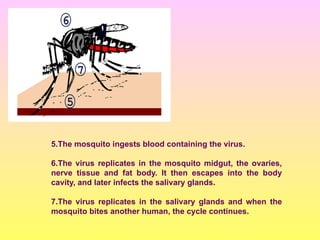
5.The mosquito ingests blood containing the virus.
6.The virus replicates in the mosquito midgut, the ovaries,
nerve tissue and fat body. It then escapes into the body
cavity, and later infects the salivary glands.
7.The virus replicates in the salivary glands and when the
mosquito bites another human, the cycle continues.
The transmission cycle of dengue virus by the mosquito
Aedes aegypti begins with a dengue-infected person. This
person will have virus circulating in the blood—a viremia that
lasts for about five days. During the viremic period, an
uninfected female Aedes aegypti mosquito bites the person
and ingests blood that contains dengue virus. Although there
is some evidence of transovarial transmission of dengue
virus in Aedes aegypti, usually mosquitoes are only infected
by biting a viremic person.
Then, within the mosquito, the virus replicates during an
extrinsic incubation period of eight to twelve days.
The mosquito then bites a susceptible person and transmits
the virus to him or her, as well as to every other susceptible
person the mosquito bites for the rest of its lifetime.
The virus then replicates in the second person and
produces symptoms. The symptoms begin to appear
an average of four to seven days after the mosquito
bite—this is the intrinsic incubation period, within
humans. While the intrinsic incubation period
averages from four to seven days, it can range from
three to 14 days.
The viremia begins slightly before the onset of
symptoms. Symptoms caused by dengue infection
may last three to 10 days, with an average of five
days, after the onset of symptoms—so the illness
persists several days after the viremia has ended.
There are actually four dengue clinical
syndromes:
1.Undifferentiated fever;
2.Classic dengue fever;
3.Dengue hemorrhagic fever, or DHF; and
4.Dengue shock syndrome, or DSS.
Dengue shock syndrome is actually a severe
form of DHF.
Clinical Case Definition for Dengue Fever
Classical Dengue fever or Break bone fever is an acute febrile
viral disease frequently presenting with headaches, bone or joint
pain, muscular pains,rash,and leucopenia
Clinical Case Definition for Dengue Hemorrhagic Fever
4 Necessary Criteria:
1. Fever, or recent history of acute fever
2. Hemorrhagic manifestations
3. Low platelet count (100,000/mm3 or less)
4. Objective evidence of “leaky capillaries:”
• elevated hematocrit (20% or more over baseline)
• low albumin
• pleural or other effusions
Clinical Case Definition for Dengue Shock Syndrome
•4 criteria for DHF
+
•Evidence of circulatory failure manifested indirectly by
all of the following:
•Rapid and weak pulse
•Narrow pulse pressure (< 20 mm Hg) OR
hypotension for age
•Cold, clammy skin and altered mental status
•Frank shock is direct evidence of circulatory failure
Hemorrhagic Manifestations of Dengue
•Skin hemorrhages:
petechiae, purpura, ecchymoses
•Gingival bleeding
•Nasal bleeding
•Gastrointestinal bleeding:
Hematemesis, melena, hematochezia
•Hematuria
•Increased menstrual flow
Signs and Symptoms of Encephalitis/Encephalopathy
Associated with Acute Dengue Infection
•Decreased level of consciousness:
lethargy, confusion, coma
•Seizures
•Nuchal rigidity
•Paresis
Four Grades of DHF
Grade 1
Fever and nonspecific constitutional symptoms
Positive tourniquet test is only hemorrhagic
manifestation
Grade 2
Grade 1 manifestations + spontaneous bleeding
Grade 3
Signs of circulatory failure (rapid/weak pulse,
narrow pulse pressure, hypotension,
cold/clammy skin)
Grade 4
Profound shock (undetectable pulse and BP)
Danger Signs in Dengue Hemorrhagic
Fever
•Abdominal pain - intense and sustained
•Persistent vomiting
•Abrupt change from fever to hypothermia,
with sweating and prostration
•Restlessness or somnolence
*All of these are signs of impending shock and
should alert clinicians that the patient needs close
observation and fluids.
This thermometer illustrates the developments in the illness that are
progressive warning signs that DSS may occur.
The initial evaluation is made by determining how many days have passed
since the onset of symptoms.
Most patients who develop DSS do so 3-6 days after onset of symptoms.
Therefore, if a patient is seven days into the illness, it is likely that the worst
is over.
If the fever goes between three and six days after the symptoms began, this is
a warning signal that the patient must be closely observed, as shock often
occurs at or around the disappearance of fever.
Other early warning signs to be alert for include a drop in platelets, an
increase in hematocrit, or other signs of plasma leakage.
If you document hemoconcentration and
thrombocytopenia and other signs of DHF and the
patient meets the criteria for DHF, the prognosis and
the patient's risk category have changed. Though
dengue fever does not often cause fatalities, a greater
proportion of DHF cases are fatal.
The next concern would be observation of the danger
signs—severe abdominal pain, change in mental
status, vomiting and abrupt change from fever to
hypothermia. These often herald the onset of DSS.
The goal of treatment is to prevent shock. The plasma
leakage syndrome is self-limited. If you can support
the patient through the plasma leakage phase and
provide sufficient fluids to prevent shock, the illness
will resolve itself.
DIAGNOSIS.
Virologic diagnosis can be established
by serologic tests or by isolation of the
virus from blood leukocytes or serum. In
both primary and secondary dengue
infections, there is a relatively transient
appearance of antidengue
immunoglobulin M (IgM) antibodies
LABORATORY CRITERIA
• ISOLATION OF DENQUE VIRUS
• INCREASED IgM OR IgM ANTIBODIES TITRES
• DENQUE ANTIGEN DETECTION BY
IMMUNOHISTOCHEMISTRY,IMMUNOFLUROSCENCE,ELISA
• PCR
• LEUCOPENIA,THROMPOCYTOPENIA
LABORATORY FINDINGS.
In dengue fever, pancytopenia may occur
after the 3–4 days of illness.
Neutropenia may persist or reappear
during the latter stage of the disease and
may continue into convalescence with
white blood cell counts of <2,000/mm3
.
Platelets rarely fall below 100,000/mm3
.
Venous clotting, bleeding and
prothrombin times, and plasma
fibrinogen values are within normal
ranges
most common hematologic
abnormalities during dengue
hemorrhagic fever and dengue shock
syndrome are hemoconcentration with
an increase of >20% in hematocrit,
thrombocytopenia, prolonged bleeding
time, and moderately decreased
prothrombin level that is seldom <40%
of control.
The differential diagnosis of dengue
fever includes:
1. viral respiratory and
2. influenza-like diseases.
3. the early stages of malaria.
4. mild yellow fever.
5. scrub typhusm.
6. viral hepatitis, and
7. leptospirosis
TREATMENT.
Treatment of uncomplicated dengue fever
is supportive. Bed rest is advised during
the febrile period. Antipyretics should be
used to keep body temperature <40°C
(104°F). Analgesics or mild sedation may
be required to control pain. Aspirin is
contraindicated and should not be used
because of its effects on hemostasis. Fluid
and electrolyte replacement is required for
deficits caused by sweating, fasting,
thirsting, vomiting, and diarrhea.
Dengue Hemorrhagic Fever.
Management of dengue hemorrhagic
fever and dengue shock syndrome
includes immediate evaluation of vital
signs and degrees of
hemoconcentration, dehydration, and
electrolyte imbalance. Close monitoring
is essential for at least 48 hr because
shock may occur or recur precipitously
early in the disease
Patients who are cyanotic or have labored
breathing should be given oxygen. Rapid
intravenous replacement of fluids and
electrolytes can frequently sustain patients
until spontaneous recovery occurs. Normal
saline is more effective in treating shock
than the more expensive Ringer lactated
saline. When pulse pressure is ≤10 mm Hg,
or when elevation of the hematocrit
persists after replacement of fluids, plasma
or colloid preparations are indicated.
Transfusions of fresh blood or platelets
suspended in plasma may be required to
control bleeding; they should not be given
during hemoconcentration, but only after
evaluation of hemoglobin or hematocrit
values. Salicylates are contraindicated
because of their effect on blood clotting
Purpose of Control
•Reduce female vector density to a level
below which epidemic vector transmission
will not occur
•Based on the assumption that eliminating or
reducing the number of larval habitats in the
domestic environment will control the vector
•The minimum vector density to prevent
epidemic transmission
Vector Control Methods:
Biological and Environmental Control
•Biological control
•Largely experimental
•Option: place fish in containers to eat larvae
•Environmental control
•Elimination of larval habitats
•Most likely method to be effective in the long term
Vector Control Methods:
Chemical Control:
•Larvicides may be used to kill immature aquatic
stages
•Ultra-low volume fumigation against adult
mosquitoes
•Mosquitoes may have resistance to commercial
aerosol sprays
Programs to Minimize the Impact of Epidemics
•Education of the medical community
•Implementation of emergency contingency plan
•Education of the general population
THANK YOU

DENGUE.pptx...............................

  • 1.
  • 2.
    Dengue fever, abenign syndrome caused by several arthropod-borne viruses, is characterized by biphasic fever, myalgia or arthralgia, rash, leukopenia, and lymphadenopathy.
  • 3.
    Dengue hemorrhagic fever(Philippine, Thai, or Singapore hemorrhagic fever; hemorrhagic dengue; acute infectious thrombocytopenic purpura) is a severe, often fatal, febrile disease caused by dengue viruses. It is characterized by capillary permeability, abnormalities of hemostasis, and, in severe cases, a protein-losing shock syndrome (dengue shock syndrome), which is thought to have an immunopathologic basis
  • 4.
    Epidemiology • In Indiafirst outbreak of dengue was recorded in 1812 • A double peak hemorrhagic fever epidemic occurred in India for the first time in Calcutta between July 1963 & March 1964 • In New Delhi, outbreaks of dengue fever reported in 1967,1970,1982, &1996
  • 5.
    EPIDOMIOLOGY Vector • Dengue virusesare transmitted by mosquitoes of the stegomyia family. • Aedes aegypti a day time biting mosquito is the principal vector and all 4 types of virus have been recovered from it.
  • 6.
    Vector • Aedes mosquitoes(Tiger mosquito): distinguished by white stripes on black body. • Important members aedes family:A. aegypty, A.vittatus and A. albopictus. • They are most abundent during rainy season.
  • 7.
    Dengue Virus 1. Causesdengue and dengue hemorrhagic fever 2. It is an arbovirus 3. Transmitted by mosquitoes 4. Composed of single-stranded RNA 5. Has 4 serotypes (DEN-1, 2, 3, 4)
  • 8.
    Dengue Virus •Each serotypeprovides specific lifetime immunity, and short-term cross-immunity •All serotypes can cause severe and fatal disease •Genetic variation within serotypes •Some genetic variants within each serotype appear to be more virulent or have greater epidemic potential
  • 10.
    The most commonepidemic vector of dengue in the world is the Aedes aegypti mosquito. It can be identified by the white bands or scale patterns on its legs and thorax.
  • 12.
    Aedes aegypti •Dengue transmittedby infected female mosquito •Primarily a daytime feeder •Lives around human habitation •Lays eggs and produces larvae preferentially in artificial containers
  • 13.
    Dengue Classification • Dengue fever •Dengue hemorrhagic fever • Dengue shock syndrome
  • 14.
    Dengue fever isan acute febnile viral illness presenting Clinical Characteristics of Dengue Fever •Fever •Headache •Muscle and joint pain •Nausea/vomiting •Rash •Hemorrhagic manifestations Patients may also report other symptoms, such as itching and aberrations in the sense of taste, particularly a metallic taste. In addition, there have been reports of severe depression after the acute phase of the illness.
  • 15.
    1.The virus isinoculated into humans with the mosquito saliva. 2.The virus localizes and replicates in various target organs, for example, local lymph nodes and the liver. 3.The virus is then released from these tissues and spreads through the blood to infect white blood cells and other lymphatic tissues. 4.The virus is then released from these tissues and circulates in the blood.
  • 16.
    5.The mosquito ingestsblood containing the virus. 6.The virus replicates in the mosquito midgut, the ovaries, nerve tissue and fat body. It then escapes into the body cavity, and later infects the salivary glands. 7.The virus replicates in the salivary glands and when the mosquito bites another human, the cycle continues.
  • 17.
    The transmission cycleof dengue virus by the mosquito Aedes aegypti begins with a dengue-infected person. This person will have virus circulating in the blood—a viremia that lasts for about five days. During the viremic period, an uninfected female Aedes aegypti mosquito bites the person and ingests blood that contains dengue virus. Although there is some evidence of transovarial transmission of dengue virus in Aedes aegypti, usually mosquitoes are only infected by biting a viremic person. Then, within the mosquito, the virus replicates during an extrinsic incubation period of eight to twelve days. The mosquito then bites a susceptible person and transmits the virus to him or her, as well as to every other susceptible person the mosquito bites for the rest of its lifetime.
  • 18.
    The virus thenreplicates in the second person and produces symptoms. The symptoms begin to appear an average of four to seven days after the mosquito bite—this is the intrinsic incubation period, within humans. While the intrinsic incubation period averages from four to seven days, it can range from three to 14 days. The viremia begins slightly before the onset of symptoms. Symptoms caused by dengue infection may last three to 10 days, with an average of five days, after the onset of symptoms—so the illness persists several days after the viremia has ended.
  • 19.
    There are actuallyfour dengue clinical syndromes: 1.Undifferentiated fever; 2.Classic dengue fever; 3.Dengue hemorrhagic fever, or DHF; and 4.Dengue shock syndrome, or DSS. Dengue shock syndrome is actually a severe form of DHF.
  • 20.
    Clinical Case Definitionfor Dengue Fever Classical Dengue fever or Break bone fever is an acute febrile viral disease frequently presenting with headaches, bone or joint pain, muscular pains,rash,and leucopenia Clinical Case Definition for Dengue Hemorrhagic Fever 4 Necessary Criteria: 1. Fever, or recent history of acute fever 2. Hemorrhagic manifestations 3. Low platelet count (100,000/mm3 or less) 4. Objective evidence of “leaky capillaries:” • elevated hematocrit (20% or more over baseline) • low albumin • pleural or other effusions
  • 21.
    Clinical Case Definitionfor Dengue Shock Syndrome •4 criteria for DHF + •Evidence of circulatory failure manifested indirectly by all of the following: •Rapid and weak pulse •Narrow pulse pressure (< 20 mm Hg) OR hypotension for age •Cold, clammy skin and altered mental status •Frank shock is direct evidence of circulatory failure
  • 22.
    Hemorrhagic Manifestations ofDengue •Skin hemorrhages: petechiae, purpura, ecchymoses •Gingival bleeding •Nasal bleeding •Gastrointestinal bleeding: Hematemesis, melena, hematochezia •Hematuria •Increased menstrual flow
  • 23.
    Signs and Symptomsof Encephalitis/Encephalopathy Associated with Acute Dengue Infection •Decreased level of consciousness: lethargy, confusion, coma •Seizures •Nuchal rigidity •Paresis
  • 24.
    Four Grades ofDHF Grade 1 Fever and nonspecific constitutional symptoms Positive tourniquet test is only hemorrhagic manifestation Grade 2 Grade 1 manifestations + spontaneous bleeding Grade 3 Signs of circulatory failure (rapid/weak pulse, narrow pulse pressure, hypotension, cold/clammy skin) Grade 4 Profound shock (undetectable pulse and BP)
  • 25.
    Danger Signs inDengue Hemorrhagic Fever •Abdominal pain - intense and sustained •Persistent vomiting •Abrupt change from fever to hypothermia, with sweating and prostration •Restlessness or somnolence *All of these are signs of impending shock and should alert clinicians that the patient needs close observation and fluids.
  • 27.
    This thermometer illustratesthe developments in the illness that are progressive warning signs that DSS may occur. The initial evaluation is made by determining how many days have passed since the onset of symptoms. Most patients who develop DSS do so 3-6 days after onset of symptoms. Therefore, if a patient is seven days into the illness, it is likely that the worst is over. If the fever goes between three and six days after the symptoms began, this is a warning signal that the patient must be closely observed, as shock often occurs at or around the disappearance of fever. Other early warning signs to be alert for include a drop in platelets, an increase in hematocrit, or other signs of plasma leakage.
  • 28.
    If you documenthemoconcentration and thrombocytopenia and other signs of DHF and the patient meets the criteria for DHF, the prognosis and the patient's risk category have changed. Though dengue fever does not often cause fatalities, a greater proportion of DHF cases are fatal. The next concern would be observation of the danger signs—severe abdominal pain, change in mental status, vomiting and abrupt change from fever to hypothermia. These often herald the onset of DSS. The goal of treatment is to prevent shock. The plasma leakage syndrome is self-limited. If you can support the patient through the plasma leakage phase and provide sufficient fluids to prevent shock, the illness will resolve itself.
  • 29.
    DIAGNOSIS. Virologic diagnosis canbe established by serologic tests or by isolation of the virus from blood leukocytes or serum. In both primary and secondary dengue infections, there is a relatively transient appearance of antidengue immunoglobulin M (IgM) antibodies
  • 30.
    LABORATORY CRITERIA • ISOLATIONOF DENQUE VIRUS • INCREASED IgM OR IgM ANTIBODIES TITRES • DENQUE ANTIGEN DETECTION BY IMMUNOHISTOCHEMISTRY,IMMUNOFLUROSCENCE,ELISA • PCR • LEUCOPENIA,THROMPOCYTOPENIA
  • 31.
    LABORATORY FINDINGS. In denguefever, pancytopenia may occur after the 3–4 days of illness. Neutropenia may persist or reappear during the latter stage of the disease and may continue into convalescence with white blood cell counts of <2,000/mm3 . Platelets rarely fall below 100,000/mm3 . Venous clotting, bleeding and prothrombin times, and plasma fibrinogen values are within normal ranges
  • 32.
    most common hematologic abnormalitiesduring dengue hemorrhagic fever and dengue shock syndrome are hemoconcentration with an increase of >20% in hematocrit, thrombocytopenia, prolonged bleeding time, and moderately decreased prothrombin level that is seldom <40% of control.
  • 33.
    The differential diagnosisof dengue fever includes: 1. viral respiratory and 2. influenza-like diseases. 3. the early stages of malaria. 4. mild yellow fever. 5. scrub typhusm. 6. viral hepatitis, and 7. leptospirosis
  • 34.
    TREATMENT. Treatment of uncomplicateddengue fever is supportive. Bed rest is advised during the febrile period. Antipyretics should be used to keep body temperature <40°C (104°F). Analgesics or mild sedation may be required to control pain. Aspirin is contraindicated and should not be used because of its effects on hemostasis. Fluid and electrolyte replacement is required for deficits caused by sweating, fasting, thirsting, vomiting, and diarrhea.
  • 35.
    Dengue Hemorrhagic Fever. Managementof dengue hemorrhagic fever and dengue shock syndrome includes immediate evaluation of vital signs and degrees of hemoconcentration, dehydration, and electrolyte imbalance. Close monitoring is essential for at least 48 hr because shock may occur or recur precipitously early in the disease
  • 36.
    Patients who arecyanotic or have labored breathing should be given oxygen. Rapid intravenous replacement of fluids and electrolytes can frequently sustain patients until spontaneous recovery occurs. Normal saline is more effective in treating shock than the more expensive Ringer lactated saline. When pulse pressure is ≤10 mm Hg, or when elevation of the hematocrit persists after replacement of fluids, plasma or colloid preparations are indicated.
  • 37.
    Transfusions of freshblood or platelets suspended in plasma may be required to control bleeding; they should not be given during hemoconcentration, but only after evaluation of hemoglobin or hematocrit values. Salicylates are contraindicated because of their effect on blood clotting
  • 38.
    Purpose of Control •Reducefemale vector density to a level below which epidemic vector transmission will not occur •Based on the assumption that eliminating or reducing the number of larval habitats in the domestic environment will control the vector •The minimum vector density to prevent epidemic transmission
  • 39.
    Vector Control Methods: Biologicaland Environmental Control •Biological control •Largely experimental •Option: place fish in containers to eat larvae •Environmental control •Elimination of larval habitats •Most likely method to be effective in the long term
  • 40.
    Vector Control Methods: ChemicalControl: •Larvicides may be used to kill immature aquatic stages •Ultra-low volume fumigation against adult mosquitoes •Mosquitoes may have resistance to commercial aerosol sprays
  • 41.
    Programs to Minimizethe Impact of Epidemics •Education of the medical community •Implementation of emergency contingency plan •Education of the general population
  • 43.