Demystifying Engineering Analytics
By applying engineering analytics across the business,
manufacturers can reimagine how they design, produce and deliver
new products and services that resonate with customer needs and
preferences.
Executive Summary
A growing focus on operational efficiencies
and financial performance is causing manufac-
turers across industries to sharpen and refine
their engineering and manufacturing discipline.
Many are looking at analytical techniques across
stages — from design, to delivery and service — to
reimagine and revamp how they work.
Industrial equipment manufacturers, for example,
are seeking ways to detect component failures
and predict the likelihood of failure by monitoring
field data, usage patterns and environmental
conditions. In the automotive industry, many car
manufacturers are looking to boost revenues and
achieve market differentiation by offering new
digital features and services informed by data
generated by the vehicle, and combined with
an understanding of customer preferences and
lifestyles.
As businesses move from one-size-fits-all to more
customized products, personalization is becoming
critical, especially in new product design, feature
enhancements and the connected products space.
As these trends accelerate, utilities, infrastructure
and transportation companies face heightened
challenges to simultaneously improve margins
and future-proof their businesses by embracing
sustainability measures that enhance energy
efficiency and reduce their carbon footprint.
As if these challenges weren’t big enough, many
businesses are dealing with the proliferation of
data volume, variety and velocity across their
ecosystems — from raw material and suppliers,
through finished products and customer usability
patterns. Many are sitting on huge repositories of
structured and unstructured data, seeking ways
to make more informed, fact-based decisions on
business strategy and market direction.
This white paper introduces the concept of engi-
neering analytics (EA) and how it can be applied
to solve various industrial problems by leveraging
a structured approach that binds principles
of domain engineering, system thinking and
analytical techniques.
Defining EA
EA is a discipline that helps organizations derive
meaningful insights from information provided
by physical devices, machines and equipment to
develop a knowledge base for actionable intel-
cognizant 20-20 insights | march 2015
• Cognizant 20-20 Insights
Quick Take
DE encompasses engineering principles from elec-
trical, chemical, mechatronics, heat mechanics
and computer science. Most industry segment
problems can be easily broken down using these
disciplines.
Here’s an example: Directional drilling in the oil
and gas patch requires characterization of drilling
operations in the form of differential pressures
in the borehole, gravitational, torsional and
hydraulic forces, as well as their impact on the life
of drill-bit and drilling dysfunctions.
ST involves the identification of system functions
and sub-systems, their logical and functional rela-
tionships and their impact on failure, reliability,
performance and total cost of ownership (TCO). It
handles software, hardware interfaces and system
interaction with the environment under different
operating conditions.
For example, in cold chain logistics, several
factors — such as ambient conditions, product
metabolism and driving behavior (door opening/
closing patterns, harsh driving), controller tuning,
loading conditions and vehicle health index —
have an impact on operational expenditures (e.g.,
fuel and maintenance), quality (e.g., tempera-
ture variance) and service (e.g., SLA, quality on
arrival). To solve such problems, various systems
must be studied, including diesel engines, refrig-
eration units, container and regional climate, etc.
With analytics, data in different forms is consumed
to derive specific insights in the form of patterns,
correlations and models that capture cause-
effect relationships and behavioral/functional
representation to address business scenarios.
This includes well-known techniques of data pre-
processing, filtering, data mining, modeling and
visualization.
For example, asset performance management (in
utilities) requires time-series processing of data
emanating from geographical distributed assets
(e.g., transformers) to detect failure signature
and build a case-based library to diagnose faults
based on derived multivariate statistical patterns.
Domain Engineering and Systems Thinking Are Integral to
Engineering Analytics
cognizant 20-20 insights 2
ligence. It uses engineering/scientific principles
and mathematical representations of the
functional behavior of devices and machines —
coupled with deep domain understanding and
analytical tools — to build models that can address
specific business problems. The problem canvas
covers issues such as process efficiency improve-
ment, asset assurance, customer experience
enhancement, new product features introduction,
cost reduction, time-to-market reduction and ser-
vitization.1
Through all of this, a natural question arises:
What’s the difference between analytics and engi-
neering analytics?
Engineering analytics is a multi-disciplinary
approach for formulating problems using systems
thinking (ST) and domain engineering (DE) when
applying analytics techniques to solve business
challenges. Problem formulation is an involved
activity comprised of identifying influencing
variables and understanding in-depth principles
of physics, mechatronics, fluid mechanics, ener-
gy-mass balances, thermodynamics and specific
engineering laws. The main challenges include
sensor enablement, sensor diagnostics and
management, identifying secondary variables,
reconciling data and reducing the dimensional-
ity of the parameter space for building real-time
implementation models, while preserving the
engineering sanctity.
Oil & Gas Energy & Utilities Farming Automotive
cognizant 20-20 insights 3
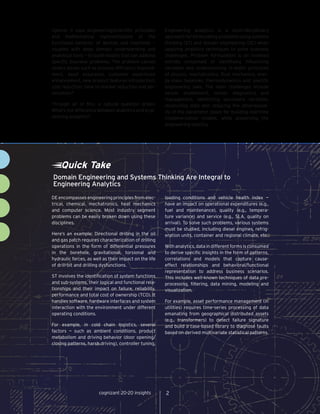
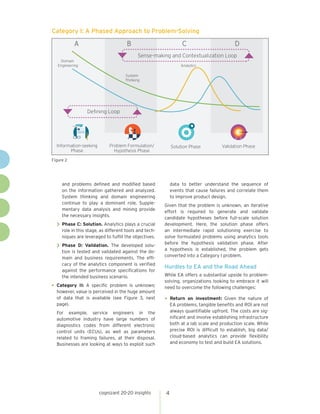
Figure 1 illustrates market segments in which we
have leveraged EA to address specific industry
problems.
For example, we worked with an independent
major U.S. upstream company in the oil and gas
space with international operations in exploration
and production. This company sought to leverage
EA for asset optimization and tool downtime
management, using predictive analytics and a
proprietary application that was being rolled out
to different rigs to improve operator visualization
and decision-making.
The solution involves a domain-driven signal
processing and specific energy formulation for
identifying and predicting the drilling dysfunc-
tions and equipment failure based on limited
measurements at the surface and without any
down-hole measurement or data samples. The
algorithms enable drilling operators to visualize
and choose the sweet spots for drilling.
For every 5% reduction in drilling time, this
customer expects to realize savings of $1 million
annually, per rig. Along with downtime reduction,
its life of down-hole tools will now be extended by
reducing destructive vibrations.
Contending with Unique Challenges
Each EA problem is unique and requires indepen-
dent scrutiny; however, EA-based challenges can
be broadly divided into two categories. Problems
in both categories can be addressed via a four-
phased approach.
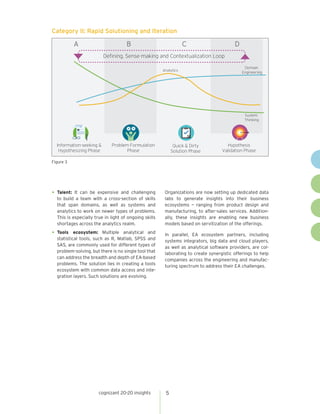
•	Category I: A specific problem is known, and
a large amount of associated data is available
(see Figure 2, next page).
For example, in heavy-duty engines, valve
failures result in degraded engine performance.
In order to predict the likelihood of failure, thus
minimizing risk, various parameters must be
analyzed together, including engine param-
eters, operating conditions, control variables,
command triggers and quality metrics.
>> Phase A: Information-seeking. Relevant
information is gathered about the problem
and the associated system and sub-systems.
This requires a high level of domain engi-
neering and system thinking to arrive at data
requirements and evaluate data gaps.
>> Phase B: Problem formulation/hypothesis.
The initial hypothesis is defined, and the
problem formulation is performed. Phases A
and B are iterated, with multiple hypotheses
Applying EA to Solve Industry Challenges
Figure 1
•	 Predictive analytics
for improving drilling
efficiency.
•	 Reduction in non-
productive time and
savings on sensors.
•	 Estimated saving of
$1M per year per rig for
every 5% reduction.
•	 Predictive asset
analytics.
•	 Reduction in
failure rates and
maintenance.
•	 Crop disease diagnostics
solution for integrated
farming.
•	 Savings on pesticide use
and loss of crop; guidance
on preserving soil fertility.
•	 Reduce crop losses for
cash crops up to 5%.
•	 Applications in safety
and performance.
•	 Total cost of
ownership for fleet
performance.
•	 New revenue
opportunity in urban
mobility.
and problems defined and modified based
on the information gathered and analyzed.
System thinking and domain engineering
continue to play a dominant role. Supple-
mentary data analysis and mining provide
the necessary insights.
>> Phase C: Solution. Analytics plays a crucial
role in this stage, as different tools and tech-
niques are leveraged to fulfill the objectives.
>> Phase D: Validation. The developed solu-
tion is tested and validated against the do-
main and business requirements. The effi-
cacy of the analytics component is verified
against the performance specifications for
the intended business scenario.
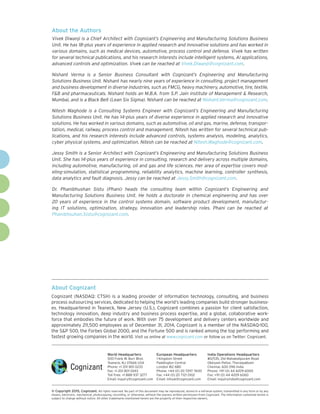
•	Category II: A specific problem is unknown;
however, value is perceived in the huge amount
of data that is available (see Figure 3, next
page).
For example, service engineers in the
automotive industry have large numbers of
diagnostics codes from different electronic
control units (ECUs), as well as parameters
related to framing failures, at their disposal.
Businesses are looking at ways to exploit such
data to better understand the sequence of
events that cause failures and correlate them
to improve product design.
Given that the problem is unknown, an iterative
effort is required to generate and validate
candidate hypotheses before full-scale solution
development. Here, the solution phase offers
an intermediate rapid solutioning exercise to
solve formulated problems using analytics tools
before the hypothesis validation phase. After
a hypothesis is established, the problem gets
converted into a Category I problem.
Hurdles to EA and the Road Ahead
While EA offers a substantial upside to problem-
solving, organizations looking to embrace it will
need to overcome the following challenges:
•	Return on investment: Given the nature of
EA problems, tangible benefits and ROI are not
always quantifiable upfront. The costs are sig-
nificant and involve establishing infrastructure
both at a lab scale and production scale. While
precise ROI is difficult to establish, big data/
cloud-based analytics can provide flexibility
and economy to test and build EA solutions.
cognizant 20-20 insights 4
Category I: A Phased Approach to Problem-Solving
Validation PhaseSolution Phase
A B C D
Analytics
Defining Loop
Sense-making and Contextualization Loop
Information-seeking
Phase
Problem Formulation/
Hypothesis Phase
System
Thinking
Domain
Engineering
Figure 2
•	Talent: It can be expensive and challenging
to build a team with a cross-section of skills
that span domains, as well as systems and
analytics to work on newer types of problems.
This is especially true in light of ongoing skills
shortages across the analytics realm.
•	Tools ecosystem: Multiple analytical and
statistical tools, such as R, Matlab, SPSS and
SAS, are commonly used for different types of
problem-solving, but there is no single tool that
can address the breadth and depth of EA-based
problems. The solution lies in creating a tools
ecosystem with common data access and inte-
gration layers. Such solutions are evolving.
Organizations are now setting up dedicated data
labs to generate insights into their business
ecosystems — ranging from product design and
manufacturing, to after-sales services. Addition-
ally, these insights are enabling new business
models based on servitization of the offerings.
In parallel, EA ecosystem partners, including
systems integrators, big data and cloud players,
as well as analytical software providers, are col-
laborating to create synergistic offerings to help
companies across the engineering and manufac-
turing spectrum to address their EA challenges.
cognizant 20-20 insights 5
Category II: Rapid Solutioning and Iteration
Quick & Dirty
Solution Phase
A B C D
Analytics
Defining, Sense-making and Contextualization Loop
Information-seeking &
Hypothesizing Phase
Problem Formulation
Phase
Hypothesis
Validation Phase
System
Thinking
Domain
Engineering
Figure 3
About Cognizant
Cognizant (NASDAQ: CTSH) is a leading provider of information technology, consulting, and business
process outsourcing services, dedicated to helping the world’s leading companies build stronger business-
es. Headquartered in Teaneck, New Jersey (U.S.), Cognizant combines a passion for client satisfaction,
technology innovation, deep industry and business process expertise, and a global, collaborative work-
force that embodies the future of work. With over 75 development and delivery centers worldwide and
approximately 211,500 employees as of December 31, 2014, Cognizant is a member of the NASDAQ-100,
the S&P 500, the Forbes Global 2000, and the Fortune 500 and is ranked among the top performing and
fastest growing companies in the world. Visit us online at www.cognizant.com or follow us on Twitter: Cognizant.
World Headquarters
500 Frank W. Burr Blvd.
Teaneck, NJ 07666 USA
Phone: +1 201 801 0233
Fax: +1 201 801 0243
Toll Free: +1 888 937 3277
Email: inquiry@cognizant.com
European Headquarters
1 Kingdom Street
Paddington Central
London W2 6BD
Phone: +44 (0) 20 7297 7600
Fax: +44 (0) 20 7121 0102
Email: infouk@cognizant.com
India Operations Headquarters
#5/535, Old Mahabalipuram Road
Okkiyam Pettai, Thoraipakkam
Chennai, 600 096 India
Phone: +91 (0) 44 4209 6000
Fax: +91 (0) 44 4209 6060
Email: inquiryindia@cognizant.com
­­© Copyright 2015, Cognizant. All rights reserved. No part of this document may be reproduced, stored in a retrieval system, transmitted in any form or by any
means, electronic, mechanical, photocopying, recording, or otherwise, without the express written permission from Cognizant. The information contained herein is
subject to change without notice. All other trademarks mentioned herein are the property of their respective owners.
About the Authors
Vivek Diwanji is a Chief Architect with Cognizant’s Engineering and Manufacturing Solutions Business
Unit. He has 18-plus years of experience in applied research and innovative solutions and has worked in
various domains, such as medical devices, automotive, process control and defense. Vivek has written
for several technical publications, and his research interests include intelligent systems, AI applications,
advanced controls and optimization. Vivek can be reached at Vivek.Diwanji@cognizant.com.
Nishant Verma is a Senior Business Consultant with Cognizant’s Engineering and Manufacturing
Solutions Business Unit. Nishant has nearly nine years of experience in consulting, project management
and business development in diverse industries, such as FMCG, heavy machinery, automotive, tire, textile,
F&B and pharmaceuticals. Nishant holds an M.B.A. from S.P. Jain institute of Management & Research,
Mumbai, and is a Black Belt (Lean Six Sigma). Nishant can be reached at Nishant.Verma@cognizant.com.
Nitesh Waghode is a Consulting Systems Engineer with Cognizant’s Engineering and Manufacturing
Solutions Business Unit. He has 14-plus years of diverse experience in applied research and innovative
solutions. He has worked in various domains, such as automotive, oil and gas, marine, defense, transpor-
tation, medical, railway, process control and management. Nitesh has written for several technical pub-
lications, and his research interests include advanced controls, systems analysis, modeling, analytics,
cyber physical systems, and optimization. Nitesh can be reached at Nitesh.Waghode@cognizant.com.
Jessy Smith is a Senior Architect with Cognizant’s Engineering and Manufacturing Solutions Business
Unit. She has 14-plus years of experience in consulting, research and delivery across multiple domains,
including automotive, manufacturing, oil and gas and life sciences. Her area of expertise covers mod-
eling-simulation, statistical programming, reliability analytics, machine learning, controller synthesis,
data analytics and fault diagnosis. Jessy can be reached at Jessy.Smith@cognizant.com.
Dr. Phanibhushan Sistu (Phani) heads the consulting team within Cognizant’s Engineering and
Manufacturing Solutions Business Unit. He holds a doctorate in chemical engineering and has over
20 years of experience in the control systems domain, software product development, manufactur-
ing IT solutions, optimization, strategy, innovation and leadership roles. Phani can be reached at
Phanibhsuhan.Sistu@cognizant.com.

Demystifying Engineering Analytics

  • 1.
    Demystifying Engineering Analytics Byapplying engineering analytics across the business, manufacturers can reimagine how they design, produce and deliver new products and services that resonate with customer needs and preferences. Executive Summary A growing focus on operational efficiencies and financial performance is causing manufac- turers across industries to sharpen and refine their engineering and manufacturing discipline. Many are looking at analytical techniques across stages — from design, to delivery and service — to reimagine and revamp how they work. Industrial equipment manufacturers, for example, are seeking ways to detect component failures and predict the likelihood of failure by monitoring field data, usage patterns and environmental conditions. In the automotive industry, many car manufacturers are looking to boost revenues and achieve market differentiation by offering new digital features and services informed by data generated by the vehicle, and combined with an understanding of customer preferences and lifestyles. As businesses move from one-size-fits-all to more customized products, personalization is becoming critical, especially in new product design, feature enhancements and the connected products space. As these trends accelerate, utilities, infrastructure and transportation companies face heightened challenges to simultaneously improve margins and future-proof their businesses by embracing sustainability measures that enhance energy efficiency and reduce their carbon footprint. As if these challenges weren’t big enough, many businesses are dealing with the proliferation of data volume, variety and velocity across their ecosystems — from raw material and suppliers, through finished products and customer usability patterns. Many are sitting on huge repositories of structured and unstructured data, seeking ways to make more informed, fact-based decisions on business strategy and market direction. This white paper introduces the concept of engi- neering analytics (EA) and how it can be applied to solve various industrial problems by leveraging a structured approach that binds principles of domain engineering, system thinking and analytical techniques. Defining EA EA is a discipline that helps organizations derive meaningful insights from information provided by physical devices, machines and equipment to develop a knowledge base for actionable intel- cognizant 20-20 insights | march 2015 • Cognizant 20-20 Insights
  • 2.
    Quick Take DE encompassesengineering principles from elec- trical, chemical, mechatronics, heat mechanics and computer science. Most industry segment problems can be easily broken down using these disciplines. Here’s an example: Directional drilling in the oil and gas patch requires characterization of drilling operations in the form of differential pressures in the borehole, gravitational, torsional and hydraulic forces, as well as their impact on the life of drill-bit and drilling dysfunctions. ST involves the identification of system functions and sub-systems, their logical and functional rela- tionships and their impact on failure, reliability, performance and total cost of ownership (TCO). It handles software, hardware interfaces and system interaction with the environment under different operating conditions. For example, in cold chain logistics, several factors — such as ambient conditions, product metabolism and driving behavior (door opening/ closing patterns, harsh driving), controller tuning, loading conditions and vehicle health index — have an impact on operational expenditures (e.g., fuel and maintenance), quality (e.g., tempera- ture variance) and service (e.g., SLA, quality on arrival). To solve such problems, various systems must be studied, including diesel engines, refrig- eration units, container and regional climate, etc. With analytics, data in different forms is consumed to derive specific insights in the form of patterns, correlations and models that capture cause- effect relationships and behavioral/functional representation to address business scenarios. This includes well-known techniques of data pre- processing, filtering, data mining, modeling and visualization. For example, asset performance management (in utilities) requires time-series processing of data emanating from geographical distributed assets (e.g., transformers) to detect failure signature and build a case-based library to diagnose faults based on derived multivariate statistical patterns. Domain Engineering and Systems Thinking Are Integral to Engineering Analytics cognizant 20-20 insights 2 ligence. It uses engineering/scientific principles and mathematical representations of the functional behavior of devices and machines — coupled with deep domain understanding and analytical tools — to build models that can address specific business problems. The problem canvas covers issues such as process efficiency improve- ment, asset assurance, customer experience enhancement, new product features introduction, cost reduction, time-to-market reduction and ser- vitization.1 Through all of this, a natural question arises: What’s the difference between analytics and engi- neering analytics? Engineering analytics is a multi-disciplinary approach for formulating problems using systems thinking (ST) and domain engineering (DE) when applying analytics techniques to solve business challenges. Problem formulation is an involved activity comprised of identifying influencing variables and understanding in-depth principles of physics, mechatronics, fluid mechanics, ener- gy-mass balances, thermodynamics and specific engineering laws. The main challenges include sensor enablement, sensor diagnostics and management, identifying secondary variables, reconciling data and reducing the dimensional- ity of the parameter space for building real-time implementation models, while preserving the engineering sanctity.
  • 3.
    Oil & GasEnergy & Utilities Farming Automotive cognizant 20-20 insights 3 Figure 1 illustrates market segments in which we have leveraged EA to address specific industry problems. For example, we worked with an independent major U.S. upstream company in the oil and gas space with international operations in exploration and production. This company sought to leverage EA for asset optimization and tool downtime management, using predictive analytics and a proprietary application that was being rolled out to different rigs to improve operator visualization and decision-making. The solution involves a domain-driven signal processing and specific energy formulation for identifying and predicting the drilling dysfunc- tions and equipment failure based on limited measurements at the surface and without any down-hole measurement or data samples. The algorithms enable drilling operators to visualize and choose the sweet spots for drilling. For every 5% reduction in drilling time, this customer expects to realize savings of $1 million annually, per rig. Along with downtime reduction, its life of down-hole tools will now be extended by reducing destructive vibrations. Contending with Unique Challenges Each EA problem is unique and requires indepen- dent scrutiny; however, EA-based challenges can be broadly divided into two categories. Problems in both categories can be addressed via a four- phased approach. • Category I: A specific problem is known, and a large amount of associated data is available (see Figure 2, next page). For example, in heavy-duty engines, valve failures result in degraded engine performance. In order to predict the likelihood of failure, thus minimizing risk, various parameters must be analyzed together, including engine param- eters, operating conditions, control variables, command triggers and quality metrics. >> Phase A: Information-seeking. Relevant information is gathered about the problem and the associated system and sub-systems. This requires a high level of domain engi- neering and system thinking to arrive at data requirements and evaluate data gaps. >> Phase B: Problem formulation/hypothesis. The initial hypothesis is defined, and the problem formulation is performed. Phases A and B are iterated, with multiple hypotheses Applying EA to Solve Industry Challenges Figure 1 • Predictive analytics for improving drilling efficiency. • Reduction in non- productive time and savings on sensors. • Estimated saving of $1M per year per rig for every 5% reduction. • Predictive asset analytics. • Reduction in failure rates and maintenance. • Crop disease diagnostics solution for integrated farming. • Savings on pesticide use and loss of crop; guidance on preserving soil fertility. • Reduce crop losses for cash crops up to 5%. • Applications in safety and performance. • Total cost of ownership for fleet performance. • New revenue opportunity in urban mobility.
  • 4.
    and problems definedand modified based on the information gathered and analyzed. System thinking and domain engineering continue to play a dominant role. Supple- mentary data analysis and mining provide the necessary insights. >> Phase C: Solution. Analytics plays a crucial role in this stage, as different tools and tech- niques are leveraged to fulfill the objectives. >> Phase D: Validation. The developed solu- tion is tested and validated against the do- main and business requirements. The effi- cacy of the analytics component is verified against the performance specifications for the intended business scenario. • Category II: A specific problem is unknown; however, value is perceived in the huge amount of data that is available (see Figure 3, next page). For example, service engineers in the automotive industry have large numbers of diagnostics codes from different electronic control units (ECUs), as well as parameters related to framing failures, at their disposal. Businesses are looking at ways to exploit such data to better understand the sequence of events that cause failures and correlate them to improve product design. Given that the problem is unknown, an iterative effort is required to generate and validate candidate hypotheses before full-scale solution development. Here, the solution phase offers an intermediate rapid solutioning exercise to solve formulated problems using analytics tools before the hypothesis validation phase. After a hypothesis is established, the problem gets converted into a Category I problem. Hurdles to EA and the Road Ahead While EA offers a substantial upside to problem- solving, organizations looking to embrace it will need to overcome the following challenges: • Return on investment: Given the nature of EA problems, tangible benefits and ROI are not always quantifiable upfront. The costs are sig- nificant and involve establishing infrastructure both at a lab scale and production scale. While precise ROI is difficult to establish, big data/ cloud-based analytics can provide flexibility and economy to test and build EA solutions. cognizant 20-20 insights 4 Category I: A Phased Approach to Problem-Solving Validation PhaseSolution Phase A B C D Analytics Defining Loop Sense-making and Contextualization Loop Information-seeking Phase Problem Formulation/ Hypothesis Phase System Thinking Domain Engineering Figure 2
  • 5.
    • Talent: It canbe expensive and challenging to build a team with a cross-section of skills that span domains, as well as systems and analytics to work on newer types of problems. This is especially true in light of ongoing skills shortages across the analytics realm. • Tools ecosystem: Multiple analytical and statistical tools, such as R, Matlab, SPSS and SAS, are commonly used for different types of problem-solving, but there is no single tool that can address the breadth and depth of EA-based problems. The solution lies in creating a tools ecosystem with common data access and inte- gration layers. Such solutions are evolving. Organizations are now setting up dedicated data labs to generate insights into their business ecosystems — ranging from product design and manufacturing, to after-sales services. Addition- ally, these insights are enabling new business models based on servitization of the offerings. In parallel, EA ecosystem partners, including systems integrators, big data and cloud players, as well as analytical software providers, are col- laborating to create synergistic offerings to help companies across the engineering and manufac- turing spectrum to address their EA challenges. cognizant 20-20 insights 5 Category II: Rapid Solutioning and Iteration Quick & Dirty Solution Phase A B C D Analytics Defining, Sense-making and Contextualization Loop Information-seeking & Hypothesizing Phase Problem Formulation Phase Hypothesis Validation Phase System Thinking Domain Engineering Figure 3
  • 6.
    About Cognizant Cognizant (NASDAQ:CTSH) is a leading provider of information technology, consulting, and business process outsourcing services, dedicated to helping the world’s leading companies build stronger business- es. Headquartered in Teaneck, New Jersey (U.S.), Cognizant combines a passion for client satisfaction, technology innovation, deep industry and business process expertise, and a global, collaborative work- force that embodies the future of work. With over 75 development and delivery centers worldwide and approximately 211,500 employees as of December 31, 2014, Cognizant is a member of the NASDAQ-100, the S&P 500, the Forbes Global 2000, and the Fortune 500 and is ranked among the top performing and fastest growing companies in the world. Visit us online at www.cognizant.com or follow us on Twitter: Cognizant. World Headquarters 500 Frank W. Burr Blvd. Teaneck, NJ 07666 USA Phone: +1 201 801 0233 Fax: +1 201 801 0243 Toll Free: +1 888 937 3277 Email: inquiry@cognizant.com European Headquarters 1 Kingdom Street Paddington Central London W2 6BD Phone: +44 (0) 20 7297 7600 Fax: +44 (0) 20 7121 0102 Email: infouk@cognizant.com India Operations Headquarters #5/535, Old Mahabalipuram Road Okkiyam Pettai, Thoraipakkam Chennai, 600 096 India Phone: +91 (0) 44 4209 6000 Fax: +91 (0) 44 4209 6060 Email: inquiryindia@cognizant.com ­­© Copyright 2015, Cognizant. All rights reserved. No part of this document may be reproduced, stored in a retrieval system, transmitted in any form or by any means, electronic, mechanical, photocopying, recording, or otherwise, without the express written permission from Cognizant. The information contained herein is subject to change without notice. All other trademarks mentioned herein are the property of their respective owners. About the Authors Vivek Diwanji is a Chief Architect with Cognizant’s Engineering and Manufacturing Solutions Business Unit. He has 18-plus years of experience in applied research and innovative solutions and has worked in various domains, such as medical devices, automotive, process control and defense. Vivek has written for several technical publications, and his research interests include intelligent systems, AI applications, advanced controls and optimization. Vivek can be reached at Vivek.Diwanji@cognizant.com. Nishant Verma is a Senior Business Consultant with Cognizant’s Engineering and Manufacturing Solutions Business Unit. Nishant has nearly nine years of experience in consulting, project management and business development in diverse industries, such as FMCG, heavy machinery, automotive, tire, textile, F&B and pharmaceuticals. Nishant holds an M.B.A. from S.P. Jain institute of Management & Research, Mumbai, and is a Black Belt (Lean Six Sigma). Nishant can be reached at Nishant.Verma@cognizant.com. Nitesh Waghode is a Consulting Systems Engineer with Cognizant’s Engineering and Manufacturing Solutions Business Unit. He has 14-plus years of diverse experience in applied research and innovative solutions. He has worked in various domains, such as automotive, oil and gas, marine, defense, transpor- tation, medical, railway, process control and management. Nitesh has written for several technical pub- lications, and his research interests include advanced controls, systems analysis, modeling, analytics, cyber physical systems, and optimization. Nitesh can be reached at Nitesh.Waghode@cognizant.com. Jessy Smith is a Senior Architect with Cognizant’s Engineering and Manufacturing Solutions Business Unit. She has 14-plus years of experience in consulting, research and delivery across multiple domains, including automotive, manufacturing, oil and gas and life sciences. Her area of expertise covers mod- eling-simulation, statistical programming, reliability analytics, machine learning, controller synthesis, data analytics and fault diagnosis. Jessy can be reached at Jessy.Smith@cognizant.com. Dr. Phanibhushan Sistu (Phani) heads the consulting team within Cognizant’s Engineering and Manufacturing Solutions Business Unit. He holds a doctorate in chemical engineering and has over 20 years of experience in the control systems domain, software product development, manufactur- ing IT solutions, optimization, strategy, innovation and leadership roles. Phani can be reached at Phanibhsuhan.Sistu@cognizant.com.