MENTAL STATUS
EXAMINATION
Presented by
Rahul Singh Gusain
Msc nursing Ist year
INTRODUCTION
Mental status examination is a description of the
patient’s appearance, speech, actions & thoughts
during the interview. It is a systematic format for
recording finding about , thinking & behavior
patient history remains stable, where the mental
status can change daily or hours.
Definition
A mental status examination is an
assessment of a patient’s level of cognitive
(knowledge-related) ability, appearance,
emotional mood, & speech , thought patterns
at the time of evaluation.
Purpose
To check the current status of client.
To obtain a comprehensive cross sectional
description of the patients mental state.
To get biographical and historical information of
client.
To allow us to make a diagnosis
To test the mental capacity.
Components of mental status examination
 General Behavior
 Psychomotor activity
 speech
 thought
 Mood
 Perception
 Cognitive function
Identification data
 Name
 Gender
 Age
 Date of admission
 Ward
 Religion
 Type of family education
 Marital status
 Diet
 Informant name
General appearance
Conscious level- fully conscious/lethargic
Physical feature- thin, good built
Facial expression- dull, happy, excited
Eye contact- maintained/ difficult/ not established
Rapport- spontaneous/difficult/ not established
Personal hygiene- adequate/ inadequate/overtly clean
Posture-upright, rigid , slump
Motor disturbances
Over-activity or hyper activity- pace, sit still
Under activity- psychomotor retardation
Compulsion
Echopraxia-evidence of mimicking
Range of motion
speech
 Intensity- loud, high
 Pitch- high, low
 Speed- slow , rapid, normal, not clear
 Pressure of speech- present/ absent
 Tone- normal variation/ monotonous
 Manner- normal/highly formal/ inappropriate
 Aphasia- formation of words, making of words
 Coherence- fully coherent/over elaborate, incoherent
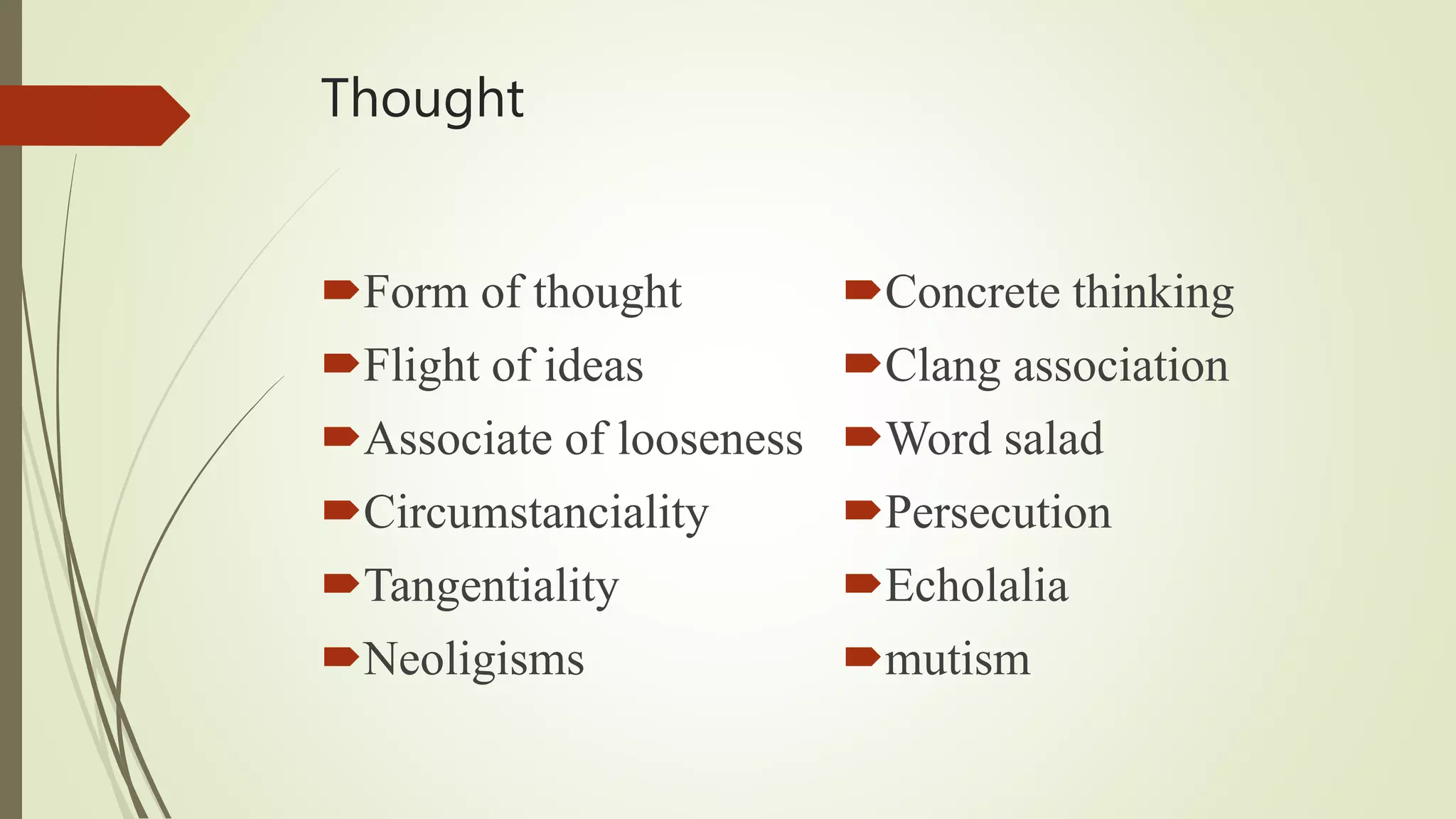
Thought
Form of thought
Flight of ideas
Associate of looseness
Circumstanciality
Tangentiality
Neoligisms
Concrete thinking
Clang association
Word salad
Persecution
Echolalia
mutism
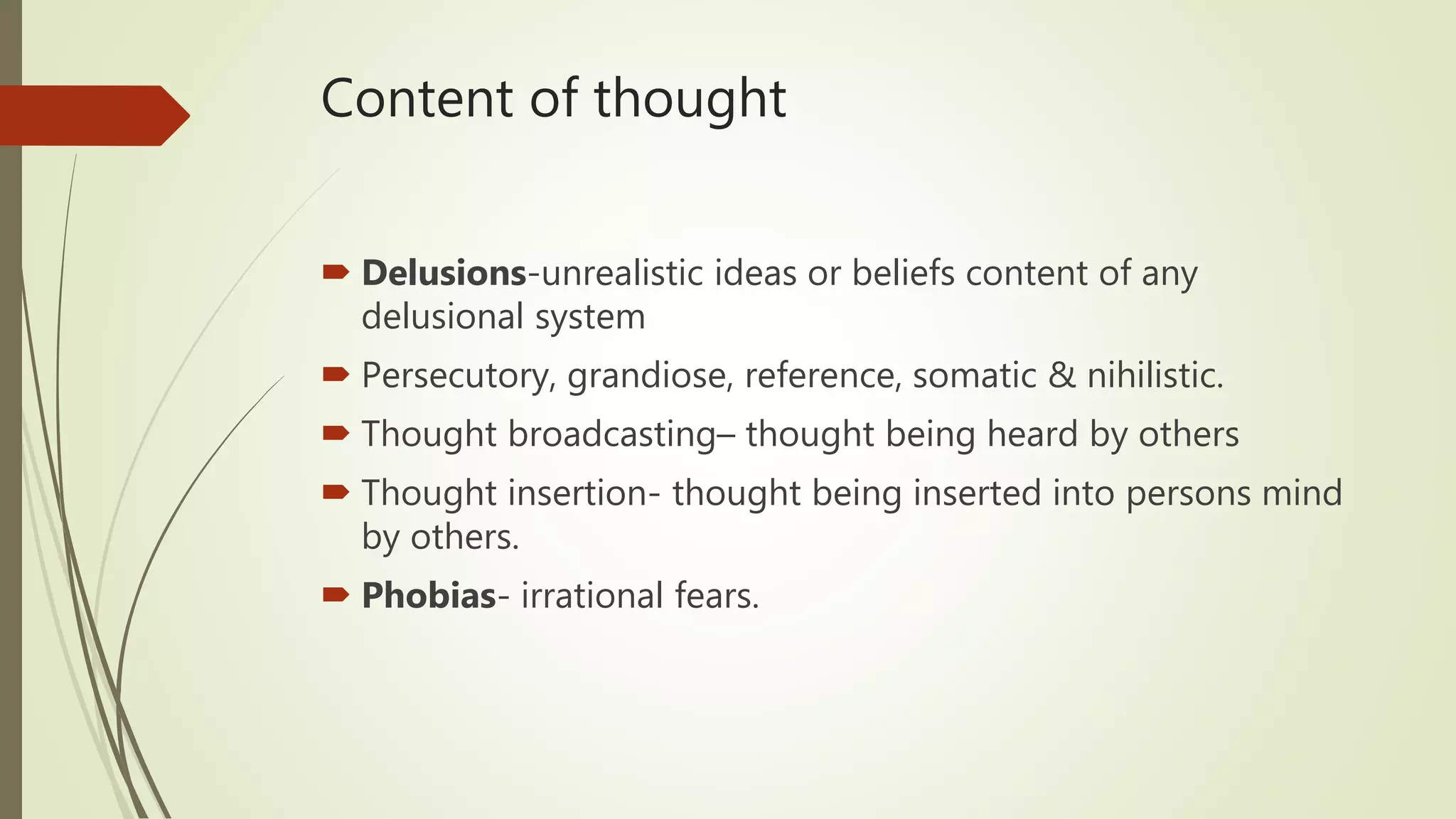
Content of thought
 Delusions-unrealistic ideas or beliefs content of any
delusional system
 Persecutory, grandiose, reference, somatic & nihilistic.
 Thought broadcasting– thought being heard by others
 Thought insertion- thought being inserted into persons mind
by others.
 Phobias- irrational fears.
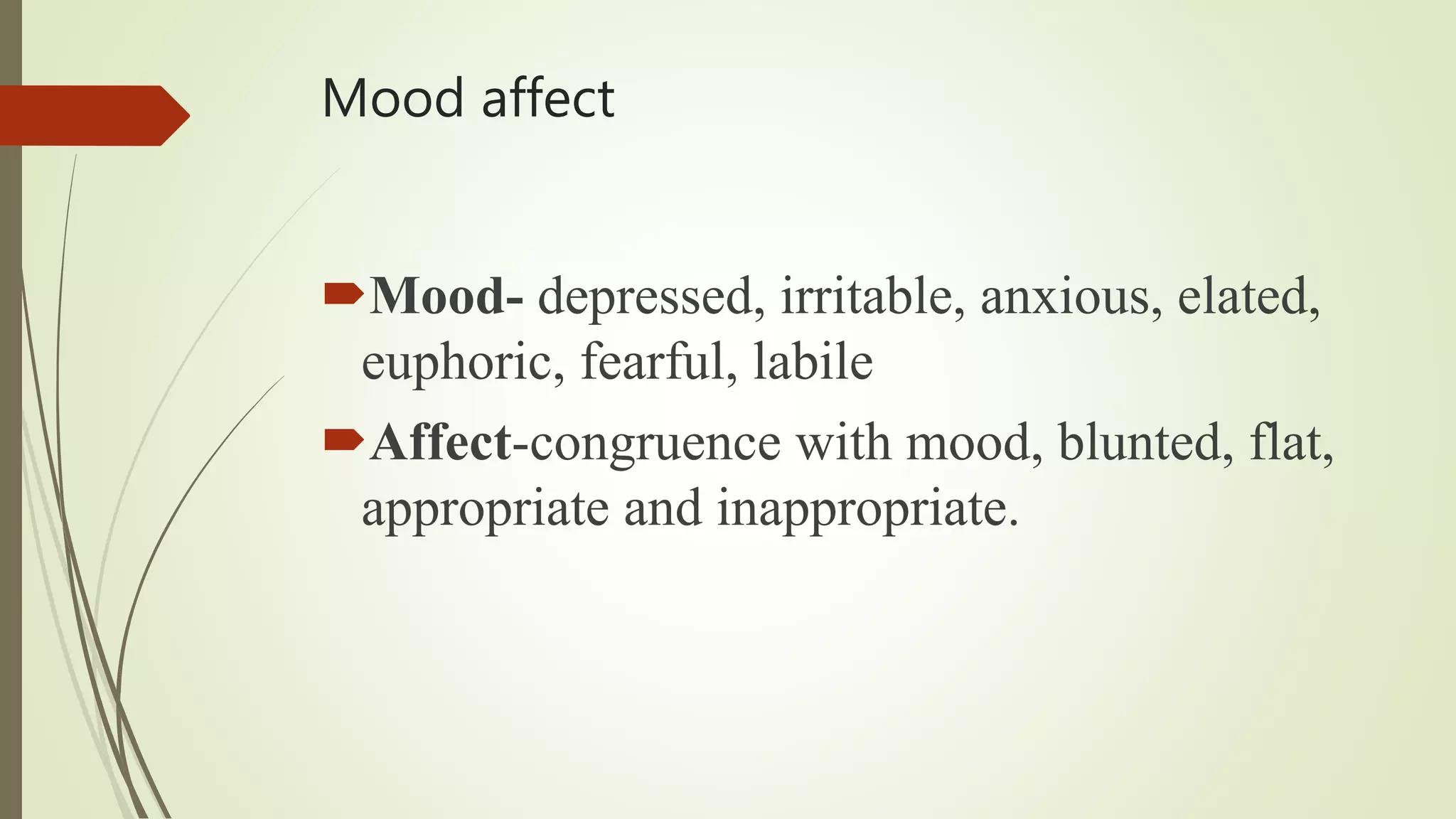
Mood affect
Mood- depressed, irritable, anxious, elated,
euphoric, fearful, labile
Affect-congruence with mood, blunted, flat,
appropriate and inappropriate.
Perception
 Hallucination- unrealistic sensory perception
a) Auditory
b) Visual
c) Tactile
d) Olfactory
e) gustatory
Illusion
Misinterpretation of real stimuli
 Depersonalization- altered perception of self
 Derealization- altered perception of environment
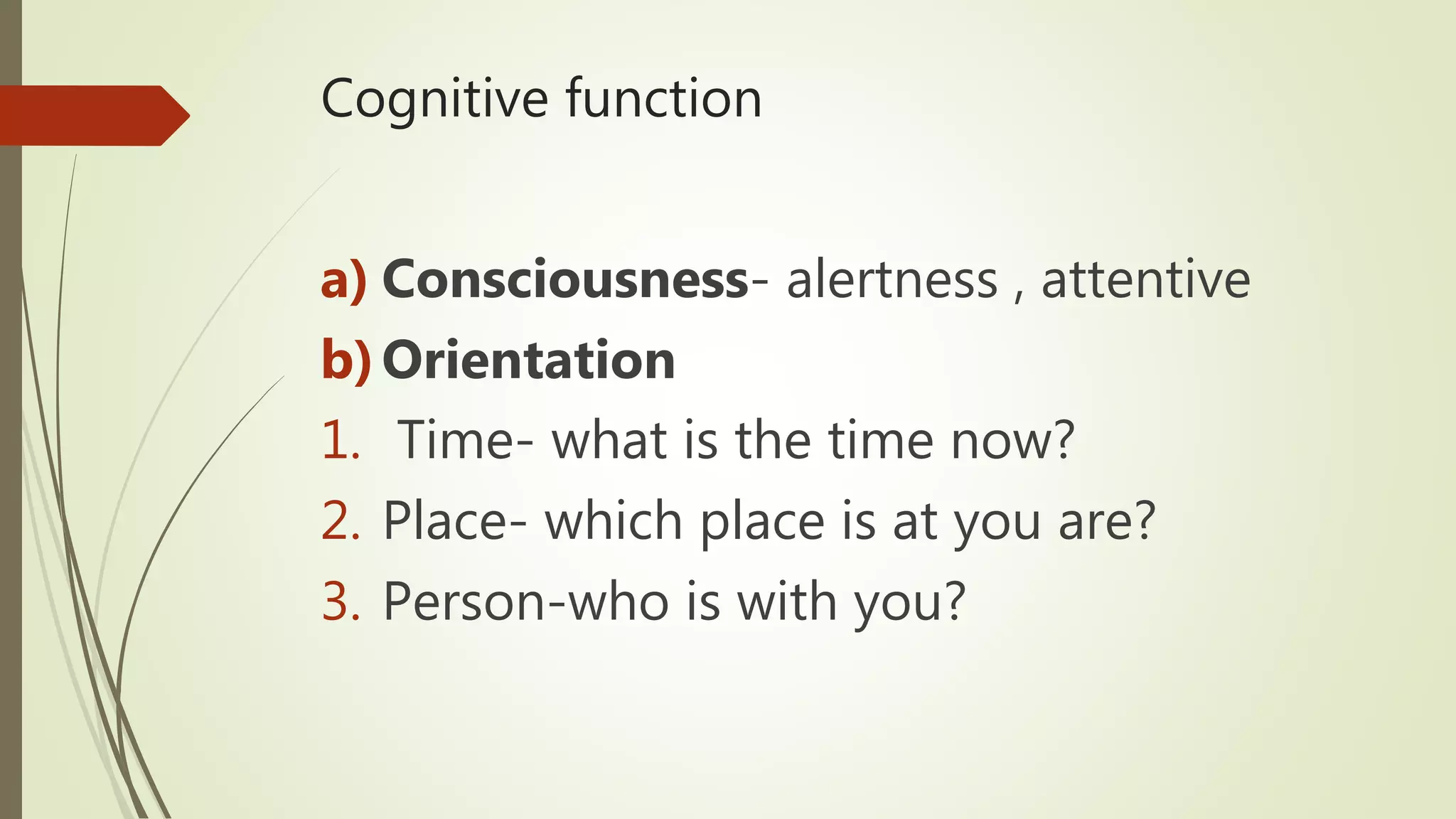
Cognitive function
a) Consciousness- alertness , attentive
b)Orientation
1. Time- what is the time now?
2. Place- which place is at you are?
3. Person-who is with you?
Attention & concentration
Attention- normally aroused/ aroused with difficulty
Concentration- focus on subject
subtract 7 from 100
7 from 93
3 from 20
keep going
Digit forward- 11,12,13…
Digit backward-100,99,98…
Name of month (backward)
Name of days in week (backward)
memory
 To check the whether registration, retention, or recollection of
material is involved.
1. Immediate – repeat six forward & backward (normal
response)
 test after 5 minutes
 3-5 unrelated objects
 Recall
Recent
 Question -What did you had in breakfast?
Remote memory-
 date of birth or age
 Number of children
 Names & number of family members
 Year of completing education
judgement
 Ability to solve problems & make decision
 Assessment area
1. Personal – inquire about patient future plan
2. Social- by observation in social situations
3. Test- predictions of one’s own behavior in imaginary situations.
 fire problem
 Letter problem
intelligence
 Includes the areas of general information, comprehension, arithmetic & vocabulary
 Education status- literate/ illiterate
 General knowledge-
1. Name of prime minister
2. 5 river , cities or state
3. Capital of countries
illiterate
a) Seasons
b) Crops of fruit in seasons
c) Prices of food grains or food items.
d) Price of land
e) Vocabulary: common objects/ uncommon objects/parts of object
f) Similarities – pen & pencil
g) Differences-stone-potato
-fly – butterfly
-iron - silver
arithmetic
Questions
If 18 boys are divided into groups of 6, how
many groups will be there be?
comprehension
 Questions
a) What will you do when you feel cold?
b) What will you do if it rains when you start to work?
c) What will you do when you miss the bus when you
are on a journey?
proverb
Whether the patient understand the
proverb like as:
1. Slow & steady wins the race
2. A barking dog never bites.
3. As you sow , so shall you reap
insight
 Knowledge of self
a) Complete denial of illness
b) Slight awareness of being sick
c) Awareness of being sick attribute it to external/ physical factor
d) Awareness of being sick, but due to something unknown in himself
e) Intellectual insight
f) True emotional insight
g) Grade 1-6
Physiological factor
Bowel & bladder habits
Sleep
appetite
Psychological factor
Stress
Social relation
occupation
General observation
Patient’s generalize mental health status.
Episodic disturbances
Epilepsy
Hysterical impulsive aggressive
Distructive
Conclusion
Conclusion of mental examination of patient
Summary
conclusion
Bibliogrphy
 Kaplan & sadock, clinical psychiatry, 6th edition, wollter klwuier, page no. 14-20
 Practical guide to mental health nursing , Ist edition, jaypee page no. 6-10
 Mary. c. townsend, psychiatric mental health nursing, concepts of care in evidence
–based practice, jaypee, page no. 962-966
 R.sreevani A guide to helath & psychiatric nursing second edition, jaypee.
Thank you

Mental status examination

  • 1.
    MENTAL STATUS EXAMINATION Presented by RahulSingh Gusain Msc nursing Ist year
  • 2.
    INTRODUCTION Mental status examinationis a description of the patient’s appearance, speech, actions & thoughts during the interview. It is a systematic format for recording finding about , thinking & behavior patient history remains stable, where the mental status can change daily or hours.
  • 3.
    Definition A mental statusexamination is an assessment of a patient’s level of cognitive (knowledge-related) ability, appearance, emotional mood, & speech , thought patterns at the time of evaluation.
  • 4.
    Purpose To check thecurrent status of client. To obtain a comprehensive cross sectional description of the patients mental state. To get biographical and historical information of client. To allow us to make a diagnosis To test the mental capacity.
  • 5.
    Components of mentalstatus examination  General Behavior  Psychomotor activity  speech  thought  Mood  Perception  Cognitive function
  • 6.
    Identification data  Name Gender  Age  Date of admission  Ward  Religion  Type of family education  Marital status  Diet  Informant name
  • 7.
    General appearance Conscious level-fully conscious/lethargic Physical feature- thin, good built Facial expression- dull, happy, excited Eye contact- maintained/ difficult/ not established Rapport- spontaneous/difficult/ not established Personal hygiene- adequate/ inadequate/overtly clean Posture-upright, rigid , slump
  • 8.
    Motor disturbances Over-activity orhyper activity- pace, sit still Under activity- psychomotor retardation Compulsion Echopraxia-evidence of mimicking Range of motion
  • 9.
    speech  Intensity- loud,high  Pitch- high, low  Speed- slow , rapid, normal, not clear  Pressure of speech- present/ absent  Tone- normal variation/ monotonous  Manner- normal/highly formal/ inappropriate  Aphasia- formation of words, making of words  Coherence- fully coherent/over elaborate, incoherent
  • 10.
    Thought Form of thought Flightof ideas Associate of looseness Circumstanciality Tangentiality Neoligisms Concrete thinking Clang association Word salad Persecution Echolalia mutism
  • 11.
    Content of thought Delusions-unrealistic ideas or beliefs content of any delusional system  Persecutory, grandiose, reference, somatic & nihilistic.  Thought broadcasting– thought being heard by others  Thought insertion- thought being inserted into persons mind by others.  Phobias- irrational fears.
  • 12.
    Mood affect Mood- depressed,irritable, anxious, elated, euphoric, fearful, labile Affect-congruence with mood, blunted, flat, appropriate and inappropriate.
  • 13.
    Perception  Hallucination- unrealisticsensory perception a) Auditory b) Visual c) Tactile d) Olfactory e) gustatory
  • 14.
    Illusion Misinterpretation of realstimuli  Depersonalization- altered perception of self  Derealization- altered perception of environment
  • 15.
    Cognitive function a) Consciousness-alertness , attentive b)Orientation 1. Time- what is the time now? 2. Place- which place is at you are? 3. Person-who is with you?
  • 16.
    Attention & concentration Attention-normally aroused/ aroused with difficulty Concentration- focus on subject subtract 7 from 100 7 from 93 3 from 20 keep going
  • 17.
    Digit forward- 11,12,13… Digitbackward-100,99,98… Name of month (backward) Name of days in week (backward)
  • 18.
    memory  To checkthe whether registration, retention, or recollection of material is involved. 1. Immediate – repeat six forward & backward (normal response)  test after 5 minutes  3-5 unrelated objects  Recall
  • 19.
    Recent  Question -Whatdid you had in breakfast? Remote memory-  date of birth or age  Number of children  Names & number of family members  Year of completing education
  • 20.
    judgement  Ability tosolve problems & make decision  Assessment area 1. Personal – inquire about patient future plan 2. Social- by observation in social situations 3. Test- predictions of one’s own behavior in imaginary situations.  fire problem  Letter problem
  • 21.
    intelligence  Includes theareas of general information, comprehension, arithmetic & vocabulary  Education status- literate/ illiterate  General knowledge- 1. Name of prime minister 2. 5 river , cities or state 3. Capital of countries
  • 22.
    illiterate a) Seasons b) Cropsof fruit in seasons c) Prices of food grains or food items. d) Price of land e) Vocabulary: common objects/ uncommon objects/parts of object f) Similarities – pen & pencil g) Differences-stone-potato -fly – butterfly -iron - silver
  • 23.
    arithmetic Questions If 18 boysare divided into groups of 6, how many groups will be there be?
  • 24.
    comprehension  Questions a) Whatwill you do when you feel cold? b) What will you do if it rains when you start to work? c) What will you do when you miss the bus when you are on a journey?
  • 25.
    proverb Whether the patientunderstand the proverb like as: 1. Slow & steady wins the race 2. A barking dog never bites. 3. As you sow , so shall you reap
  • 26.
    insight  Knowledge ofself a) Complete denial of illness b) Slight awareness of being sick c) Awareness of being sick attribute it to external/ physical factor d) Awareness of being sick, but due to something unknown in himself e) Intellectual insight f) True emotional insight g) Grade 1-6
  • 27.
    Physiological factor Bowel &bladder habits Sleep appetite
  • 28.
  • 29.
    General observation Patient’s generalizemental health status. Episodic disturbances Epilepsy Hysterical impulsive aggressive Distructive Conclusion Conclusion of mental examination of patient
  • 30.
  • 31.
    Bibliogrphy  Kaplan &sadock, clinical psychiatry, 6th edition, wollter klwuier, page no. 14-20  Practical guide to mental health nursing , Ist edition, jaypee page no. 6-10  Mary. c. townsend, psychiatric mental health nursing, concepts of care in evidence –based practice, jaypee, page no. 962-966  R.sreevani A guide to helath & psychiatric nursing second edition, jaypee.
  • 32.