ResMed implemented Oracle Demantra and ASCP to better manage their global planning and operations as their business grew in complexity. Key reasons included reducing inventory and backorders, increasing forecast accuracy, and providing a foundation for future growth. ResMed's presentation outlined their implementation process, focusing on integrating Demantra and ASCP, improving forecasts through modifying buyer behavior, and tips for bucketing demand data and maintaining separate inputs. The conclusion noted that consultant support was important and their next challenge is fully implementing ASCP for constraint-based optimization over 12 months.
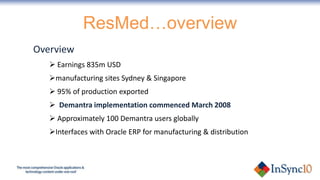
Introduction to ResMed's operations, earning >1B USD, global production facilities, and Demantra implementation.
Reasons for implementing Oracle Demand Management and Advanced Supply Chain Planning, focusing on both tangible ROI and intangibles like process stability.
Discussion on Demantra's limitations, importance of user involvement, and the influence of personnel on system effectiveness.
Strategies for integrating ASCP and Demantra to improve data integrity and forecasting flexibility amid distribution challenges.
Methods to enhance forecast accuracy, emphasizing demand capture over sales metrics and structuring user inputs.
Critical points on maintaining comprehensive data and avoiding pitfalls in data management strategies.
Conclusion on implementation support from Oracle, future challenges, and initiating ASCP implementation.
Using Oracle Demantra& ASCP in a Global Planning EnvironmentPhillip BrownResMed16 August 2010The most comprehensive Oracle applications & technology content under one roof
Why implement?Tangibles…Positive ROIReduceinventoryReduce backorders or lost salesIntangibles….Manage increased business complexityIntroduce process stabilityReduce dependence on specific individual knowledgeProvide foundation for future growth
10.
Why implement…tangible reasonsMaximuminventory reduction from forecast accuracy achievedCurrent forecast accuracy ~90%Variation in supply chain now greater challengeVariations in shipping timesDelays through customsStock discrepancy & quality issuesThe need to rebalance between nodes without triggering new builds
11.
Why implement…intangible reasonsKeydrivers for DemantraIncreasing distribution complexityRisks associated with reliance on individualsRisks with lack of robustness in existing systemNeed for seamless global system that facilitates accountability and visibility
12.
Why implement…intangible reasonsKeydrivers for ASCPIncreasing distribution complexityNeed for more effective optimisation modelNeed to remove reliance on individualsRisks with lack of robustness in existing system
13.
Musings about Demantra& ASCPWhy Demantra wont improve your forecast accuracy…furtherDo I have the right people?Getting ASCP & Demantra to work togetherTips & traps…I wish I hadn’t done that!
14.
People puzzle…Demantra, &to some extent ASCP evolution will be influenced by… caliber of people available to perform various rolesdefining ownership between Business Process and ITDegree of autonomy of users
15.
People puzzle…Key usersinvolved with the running of Demantra…System developersDatabase administratorsPower users (demand planners)Casual users
16.
Integrating ASCP &Demantra…Loading forecasts to ASCPCreate customer/warehouse combinations in DemantraLoad based on warehouseCreate customer/region combinations in DemantraMap regions to warehouses through dynamic combinations table
17.
Integrating ASCP &Demantra…Using Customer/Warehouse combinations in Demantra…simple distribution operationcreates visibility of warehouse demand in Demantradata integrity for customer/region combinations is not available from sourceDownside…changes in Warehouse source for a given customer is not easy to update in Demantra…can lead to erroneous forecasts
18.
Integrating ASCP &Demantra…Using Customer/Region combinations in Demantra…allows greater flexibility to change distribution network without impacting forecastcould facilitate forecasts by territory/sales person or other similar splitsDownsiderequires available data integrity to support this…ResMed didn’t have this on a global basis
19.
Improving forecast accuracy…Modifybuyer behaviour rather than modifying forecastsMany sales incentives encourage customers to buy in erratic patterns. Erratic demand makes forecasting difficult.
20.
Tips & Traps…tipsBucketingof demandNot too much/not too little gives a balance between system performance and quality infoResMed optionCapture data by customer for top 50% revenueBundle data of customers for next 30% revenueBundle data for remaining 20% revenue
21.
Tips & Traps…tipsCapturedemand not salesTo give true indication of future potential demandRecognises customer orders in the period they were requested, whether shipped or not, as opposed to shipped or invoiced ordersForecasts in future periods are then based on customers desires rather than operation capability at a previous point in time
22.
Tips & Traps…tipsCreateseparate inputs for functionsSuch as separate series to create visibility of user inputscreate clear override hierarchy for forecast modificationCreates opportunity for input of reference forecasts for future comparison or negotiation (eg Marketing/Finance series)
23.
Tricks & Traps…trapsMaintainingdata for full spectrum of itemsIgnoring data for “inactive” codes may present problems later for things like exception reportsAvoid inappropriate use of fieldsinappropriate/inconsistent use of fields such as “Territory” makes them difficult to use for meaningful data capture later
24.
ConclusionSupport through implementationOracleconsultants provided effective guidance in the direction we tookThis was useful in either tempering our expectations, developing our ideas or providing alternatives to arrive at effective solutionsFew changes were made after implementation largely as a result of an effective collaborative approach between Oracle & ResMed during development
25.
ConclusionFuture directionOur keychallenge now is implementation of ASCPObjective is constraint based optimisationHorizon of at least 12 months to enter this phaseImplementation of unconstrained ASCP as precursor to this
26.
Tell us whatyou think…http://feedback.insync10.com.au
Editor's Notes
#3 My presentation looks at the pro’s of implementing Demantra & SCP from ResMed’s perspective, and some of the tricks and traps we have experienced
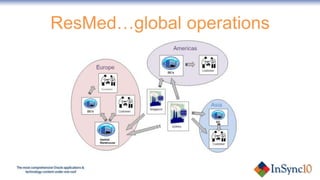
#5 ResMed manufactures in two main sites in Sydney and Singapore and distributes through a central warehouse in Europe and a network of distribution centre’s globally to customers
#6 In many cases we talk about the financial benefits we expect to achieve from these types of systems, however there are many non-financial reasons to implement, and these were some of the major reasons for ResMed going down this path with Oracle. Our existing systems were already performing reasonably well.
#7 At ResMed we have achieved much of the tangible benefit from improved forecast accuracy. Increasing forecast accuracy at this point is not the path to reduced inventory because much of the inventory holding is required to support variation in the supply chain, not variation in sales. Resmed’s shipping lead time from plant to customer is around 8 weeks. Supply chain planning becomes a critical element here as an effective system is required to ensure that production and shipping occur to optimise service and minimise freight costs. Objectives will be to ensure that stock is held at an optimimum position in the supply chain hub, that distribution around the wheel occurs if it is desirable to meet objectives, and that stock is distributed on a “fair share” basis in a short supply position
#8 Addressing or achieving the “intangible benefits” was one of the key drivers for ResMed to implement both Demantra and ASCP
#10 My presentation focuses more on the intrinsic benefits of implementing Demantra & SCP from ResMed’s perspective, and some of the tricks and traps we have experienced
#11 Demantra and ASCP both have possibilities that to some extent will be unlocked based on the calibre of people you have. Key users are System developers, database administrators, power users, casual users. In terms of ownership, we have placed this in the hands of the business, rather than IT, which creates more autonomy to develop the system. This won’t be the case for ASCP due to greater complexity.
#12 We see these as the key users, each will require certain skills levels in order to perform effectively
#13 One of the key considerations is how and where will data be loaded into ASCP, and how will the determination of destination be determined?
#14 We captured data by warehouse/customer combination as that was the most feasible at the time. We didn’t perceive a problem as supply sources are largely handled by Sourcing rules within Oracle ERP. It is only with the move to multiple central warehouses shipping direct to customers that this has become a problem. In hindsight perhaps we should have changed to Customer/Region relationships and tried to fix the underlying data problems.
#16 Data stability will help improve the quality of forecasts generated by Demantra. Managing supply chain processes and variations could help improve results.
#17 It was felt that capturing data for all customers would lead to discontinuous and erratic forecasts, and degradation of system performance, however we still wanted the ability to analyse sales at a customer level. The compromise was to capture individual customer sales where the customer was big enough to generate good forecasts, and bucket sales where they were not
#20 Within our database there are many items and parameters that haven’t been maintained over time. This has turned out to be problematic in implementing ASCP particularly as this “unclean” data makes it difficult to get to real issues. In addition, inappropriate use of fields through lack of foresight in some cases made what could have been simple/effective solutions difficult or impossible.
#21 Utilise experience and knowledge of consultants to avoid hidden pitfalls during system development
#22 We see constraint based optimisation through ASCP as our solution to replacing our existing systems (which are effective but not robust) with an effective and efficient alternative