STUDY  OF  ERP Neha Khandelwal Arpit Khandelwal Rohish Yadav
A US $28 billion corporation with a market cap of US $31.5 billion and in the league of Fortune 500. The Aditya Birla Group is anchored by an extraordinary force of 100,000 employees, belonging to 25 different nationalities.  In India, the Group has been adjudged "  The Best Employer in India and among the top 20 in Asia  " by the Hewitt-Economic Times and Wall Street Journal Study 2007.  Over 50 per cent of its revenues flow from its overseas operations.  GLOBAL VISION OF  ADITYA BRILA GROUP
♦  The world no. 1 in viscose staple fibre, ♦  The world's largest single location palm oil producer, ♦  Asia's largest integrated aluminium producer, ♦  A globally competitive, fast-growing copper producer ♦  The world's third largest producer of insulators, ♦  Globally, the fifth largest producer of carbon  black, ♦  The world's eight largest producer of cement, and the largest in a  single geography, ♦  India's premier branded garments player, ♦  Among India's most energy efficient private sector fertilizer plants, ♦  India's second largest producer of viscose filament yarn, ♦  The no. 2 private sector insurance company, and the fourth largest asset management company in India, ♦  The Group has also made successful forays into the IT and BPO sectors AN OVERVIEW  ADITYA  BIRLA  GROUP
HISTORY The  concept of ERP has  been around since  1960’s Five  managers of  IBM  left , to  start  what  is SAP(Syatem  Applicaation  Products) SAP  was the first  company  to invert  ERP  Software>
SAP was founded in 1972 as Systemanalyse and Programmentwicklung by five former IBM engineers in Mannheim. The acronym was later changed to stand for Systeme, Anwendungen und Produkte in “ Systems, Applications and Products in Data Processing “ . Process industries, Discrete industries,  Consumer industries, Service industries, Financial services, and  Public services.  It offers more than 25 industry solution portfolios for large enterprises and more than 550 micro-vertical solutions for midsize companies and small businesses  WHAT  IS  SAP ?
ERP- Enterprise Resource Planning ( An Introduction)
Definition Of ERP Software solution that addresses all the needs of an enterprise with the process view of an organization to meet the organizational goals and integrate all the  functions of the enterprise
What is ERP ? Facilitates Company-wide integrated Information Systems Covering all functional Areas. Performs core  Corporate activities and increases customer service  augmenting Corporate Image. Organizes & Optimizes the data input methodologies systematically .
MIS - Management Information    Systems IIS - Integrated Information Systems EIS - Executive Information Systems CIS - Corporate Information Systems EWS - Enterprise Wide Systems Evolution of Business Applications
Materials Requirement Planning (MRP) Manufacturing Resource Planning ( MRP II) Enterprise Resource Planning ( ERP) Other terminologies are : Money Resource Planning  (MRP III) Supply Chain Management Value Chain Management Evolution of Planning Systems
Why ERP ?
Competition In the Market! Manufacturing Challenges. Manufacturing Globally. Distribution network spread. New Product introduction. Lower manufacturing lead time. Focus on industry markets. Satisfying the needs of  customers. Develop specific business methods and processes. Integration with  third party products.
Better products at lower costs Tough competition Need to analyze costs / revenues on a product or customer basis Flexibility to respond to changing business requirements  More informed management decision making Demands on the Industry
Unable to get accurate, timely information Applications not complete for existing business practices Modifications are time consuming or not   feasible What  are your Problems ?
ERP -  The Enabler
What is that ERP enables ? Systematic Look into your Systems & procedures Optimizing the processes Enables you to adapt yourself to new technologies Discipline across the functions
What does ERP integrate ? Database  Applications Interfaces Tools
What drives ERP ? Business  Customer Satisfaction Business Development - new areas, products, services Ability to face competition Efficient  processes required to push the company to top gear IT  Present  Software does not meet business needs Legacy systems difficult to maintain, Y2K Problem , Euro currency Obsolete hardware/software difficult to maintain
Subsystems of ERP Logistics Bill Of Materials Sales & Marketing Master Scheduling Materials Requirement Planning Capacity Requirements Planning Purchasing  Shop Floor Control Accounts Payable/Receivable HR
Understanding ERP
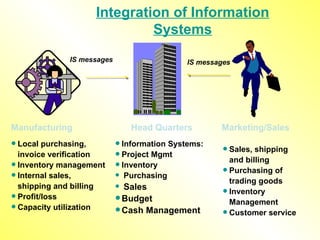
Integration of Information Systems Local purchasing, invoice verification Inventory management Internal sales, shipping and billing Profit/loss  Capacity utilization Information Systems: Project Mgmt Inventory Purchasing Sales Budget  Cash Management Manufacturing  Head Quarters Marketing/Sales IS messages Sales, shipping and billing Purchasing of trading goods Inventory Management Customer service IS messages
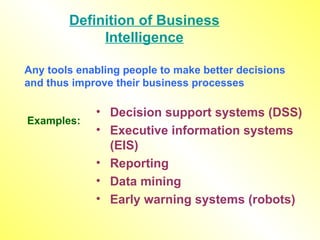
Definition of Business Intelligence Any tools enabling people to make better decisions and thus improve their business processes Decision support systems (DSS) Executive information systems (EIS) Reporting Data mining Early warning systems (robots) Examples:
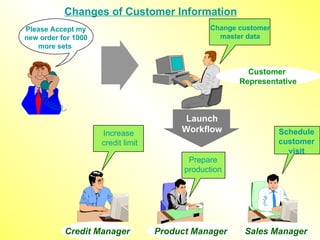
Changes of Customer Information Customer  Representative Sales Manager Credit Manager Increase credit limit Product Manager Launch Workflow Change customer master data Schedule customer visit Prepare production Please Accept my new order for 1000 more sets
Go Ahead with ERP
Business Process Re-Engineering ( BPR) In-depth study of existing systems/processes is  required before ERP is considered. This study brings out  deficiencies of the existing system/process. This study is called BPR BPR attempts to re-structure and re-organize the human resources, functional areas, Man-Machine interfaces in the organization. Hence BPR attempts to maximize productivity
Re-engineering Study the current system & Processes Design and develop new systems Define Process, organization structure, procedures Develop/Customize the software  Train people  Implement new system
ERP without Re-engineering Advantages No visible changes in Functionality Users find it more acceptable Can be completed within time frame. Cost can be with in your control Impact on Organization will be moderate Disadvantages Best Business practices would have been ignored Stability of the system is known only in long run May not achieve Corporate wide systems integration New technologies have to be studied your self Some functionality  may be lost
Re-Engineering -a part Life with ERP! Re-engineer  process before going for ERP Re-engineer  during  implementation of ERP Re-engineer after implementing ERP Continuous  re-engineering through ERP
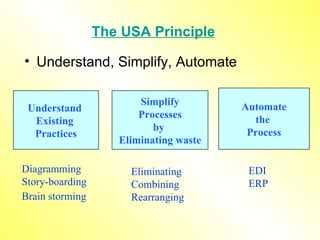
The USA Principle Understand, Simplify, Automate Understand  Existing  Practices Simplify Processes by  Eliminating waste Automate the  Process EDI ERP Eliminating Combining Rearranging Diagramming Story-boarding Brain storming
ERP Selection Check whether all functional aspects of your Business are covered Check whether all the business functions and processes are integrated Check whether all latest IT trends are covered Check whether the vendor has customizing & implementing capabilities Check the Service options available Check your purse & calculate ROI
Prepare Base for ERP Do not start without Management commitment  Allocate sufficient funds  Identify Core Project Team Select specialists from all functional areas Evaluate and select  ERP package  Evaluate  Implementation Partner Make an Implementation Plan Present plan to Management Committee for sanctions Present plan to Employee groups for feedback/acceptability Plan for User Training Plan for Future upgrades
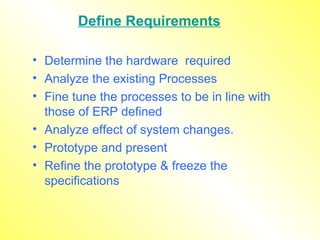
Define Requirements Determine the hardware  required Analyze the existing Processes Fine tune the processes to be in line with those of ERP defined  Analyze effect of system changes. Prototype and present  Refine the prototype & freeze the specifications
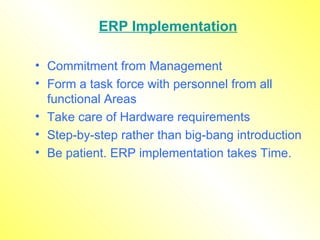
ERP Implementation Commitment from Management Form a task force with personnel from all functional Areas Take care of Hardware requirements Step-by-step rather than big-bang introduction Be patient. ERP implementation takes Time.
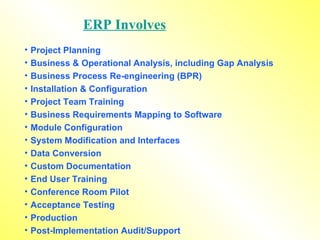
Project Planning Business & Operational Analysis, including Gap Analysis Business Process Re-engineering (BPR) Installation & Configuration Project Team Training Business Requirements Mapping to Software Module Configuration System Modification and Interfaces  Data Conversion Custom Documentation End User Training Conference Room Pilot Acceptance Testing Production Post-Implementation Audit/Support ERP Involves
Advantages Of ERP
Advantages Of ERP Package Highly based User Interface. Zero Down time/ planned down time. Graphics Readymade solutions for most of the Problems. Only Customization required. Integration of all functions ensured. ROI  earlier than the software developed in-house. Easy enterprise wide information sharing.  Suppliers and Customers can be on-line communication. Knowledge transfer between industries guarantees  innovation. Automatic adaptation to new technology.
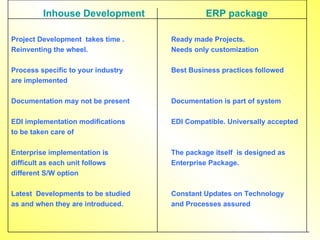
Inhouse Development  ERP package Project Development  takes time . Ready made Projects. Reinventing the wheel.   Needs only customization Process specific to your industry  Best Business practices followed are implemented Documentation may not be present Documentation is part of system EDI implementation modifications EDI Compatible. Universally accepted to be taken care of Enterprise implementation is  The package itself  is designed as difficult as each unit follows    Enterprise Package. different S/W option Latest  Developments to be studied Constant Updates on Technology as and when they are introduced. and Processes assured
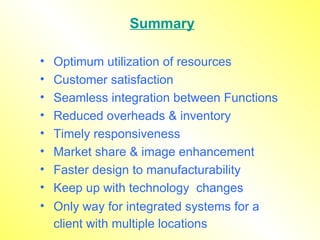
Summary Optimum utilization of resources Customer satisfaction Seamless integration between Functions Reduced overheads & inventory Timely responsiveness Market share & image enhancement Faster design to manufacturability Keep up with technology  changes Only way for integrated systems for a client with multiple locations

16870343 erp-enterprise-resource-planning

  • 1.
    STUDY OF ERP Neha Khandelwal Arpit Khandelwal Rohish Yadav
  • 2.
    A US $28billion corporation with a market cap of US $31.5 billion and in the league of Fortune 500. The Aditya Birla Group is anchored by an extraordinary force of 100,000 employees, belonging to 25 different nationalities. In India, the Group has been adjudged " The Best Employer in India and among the top 20 in Asia " by the Hewitt-Economic Times and Wall Street Journal Study 2007. Over 50 per cent of its revenues flow from its overseas operations. GLOBAL VISION OF ADITYA BRILA GROUP
  • 3.
    ♦ Theworld no. 1 in viscose staple fibre, ♦ The world's largest single location palm oil producer, ♦ Asia's largest integrated aluminium producer, ♦ A globally competitive, fast-growing copper producer ♦ The world's third largest producer of insulators, ♦ Globally, the fifth largest producer of carbon black, ♦ The world's eight largest producer of cement, and the largest in a single geography, ♦ India's premier branded garments player, ♦ Among India's most energy efficient private sector fertilizer plants, ♦ India's second largest producer of viscose filament yarn, ♦ The no. 2 private sector insurance company, and the fourth largest asset management company in India, ♦ The Group has also made successful forays into the IT and BPO sectors AN OVERVIEW ADITYA BIRLA GROUP
  • 4.
    HISTORY The concept of ERP has been around since 1960’s Five managers of IBM left , to start what is SAP(Syatem Applicaation Products) SAP was the first company to invert ERP Software>
  • 5.
    SAP was foundedin 1972 as Systemanalyse and Programmentwicklung by five former IBM engineers in Mannheim. The acronym was later changed to stand for Systeme, Anwendungen und Produkte in “ Systems, Applications and Products in Data Processing “ . Process industries, Discrete industries, Consumer industries, Service industries, Financial services, and Public services. It offers more than 25 industry solution portfolios for large enterprises and more than 550 micro-vertical solutions for midsize companies and small businesses WHAT IS SAP ?
  • 6.
    ERP- Enterprise ResourcePlanning ( An Introduction)
  • 7.
    Definition Of ERPSoftware solution that addresses all the needs of an enterprise with the process view of an organization to meet the organizational goals and integrate all the functions of the enterprise
  • 8.
    What is ERP? Facilitates Company-wide integrated Information Systems Covering all functional Areas. Performs core Corporate activities and increases customer service augmenting Corporate Image. Organizes & Optimizes the data input methodologies systematically .
  • 9.
    MIS - ManagementInformation Systems IIS - Integrated Information Systems EIS - Executive Information Systems CIS - Corporate Information Systems EWS - Enterprise Wide Systems Evolution of Business Applications
  • 10.
    Materials Requirement Planning(MRP) Manufacturing Resource Planning ( MRP II) Enterprise Resource Planning ( ERP) Other terminologies are : Money Resource Planning (MRP III) Supply Chain Management Value Chain Management Evolution of Planning Systems
  • 11.
  • 12.
    Competition In theMarket! Manufacturing Challenges. Manufacturing Globally. Distribution network spread. New Product introduction. Lower manufacturing lead time. Focus on industry markets. Satisfying the needs of customers. Develop specific business methods and processes. Integration with third party products.
  • 13.
    Better products atlower costs Tough competition Need to analyze costs / revenues on a product or customer basis Flexibility to respond to changing business requirements More informed management decision making Demands on the Industry
  • 14.
    Unable to getaccurate, timely information Applications not complete for existing business practices Modifications are time consuming or not feasible What are your Problems ?
  • 15.
    ERP - The Enabler
  • 16.
    What is thatERP enables ? Systematic Look into your Systems & procedures Optimizing the processes Enables you to adapt yourself to new technologies Discipline across the functions
  • 17.
    What does ERPintegrate ? Database Applications Interfaces Tools
  • 18.
    What drives ERP? Business Customer Satisfaction Business Development - new areas, products, services Ability to face competition Efficient processes required to push the company to top gear IT Present Software does not meet business needs Legacy systems difficult to maintain, Y2K Problem , Euro currency Obsolete hardware/software difficult to maintain
  • 19.
    Subsystems of ERPLogistics Bill Of Materials Sales & Marketing Master Scheduling Materials Requirement Planning Capacity Requirements Planning Purchasing Shop Floor Control Accounts Payable/Receivable HR
  • 20.
  • 21.
    Integration of InformationSystems Local purchasing, invoice verification Inventory management Internal sales, shipping and billing Profit/loss Capacity utilization Information Systems: Project Mgmt Inventory Purchasing Sales Budget Cash Management Manufacturing Head Quarters Marketing/Sales IS messages Sales, shipping and billing Purchasing of trading goods Inventory Management Customer service IS messages
  • 22.
    Definition of BusinessIntelligence Any tools enabling people to make better decisions and thus improve their business processes Decision support systems (DSS) Executive information systems (EIS) Reporting Data mining Early warning systems (robots) Examples:
  • 23.
    Changes of CustomerInformation Customer Representative Sales Manager Credit Manager Increase credit limit Product Manager Launch Workflow Change customer master data Schedule customer visit Prepare production Please Accept my new order for 1000 more sets
  • 24.
  • 25.
    Business Process Re-Engineering( BPR) In-depth study of existing systems/processes is required before ERP is considered. This study brings out deficiencies of the existing system/process. This study is called BPR BPR attempts to re-structure and re-organize the human resources, functional areas, Man-Machine interfaces in the organization. Hence BPR attempts to maximize productivity
  • 26.
    Re-engineering Study thecurrent system & Processes Design and develop new systems Define Process, organization structure, procedures Develop/Customize the software Train people Implement new system
  • 27.
    ERP without Re-engineeringAdvantages No visible changes in Functionality Users find it more acceptable Can be completed within time frame. Cost can be with in your control Impact on Organization will be moderate Disadvantages Best Business practices would have been ignored Stability of the system is known only in long run May not achieve Corporate wide systems integration New technologies have to be studied your self Some functionality may be lost
  • 28.
    Re-Engineering -a partLife with ERP! Re-engineer process before going for ERP Re-engineer during implementation of ERP Re-engineer after implementing ERP Continuous re-engineering through ERP
  • 29.
    The USA PrincipleUnderstand, Simplify, Automate Understand Existing Practices Simplify Processes by Eliminating waste Automate the Process EDI ERP Eliminating Combining Rearranging Diagramming Story-boarding Brain storming
  • 30.
    ERP Selection Checkwhether all functional aspects of your Business are covered Check whether all the business functions and processes are integrated Check whether all latest IT trends are covered Check whether the vendor has customizing & implementing capabilities Check the Service options available Check your purse & calculate ROI
  • 31.
    Prepare Base forERP Do not start without Management commitment Allocate sufficient funds Identify Core Project Team Select specialists from all functional areas Evaluate and select ERP package Evaluate Implementation Partner Make an Implementation Plan Present plan to Management Committee for sanctions Present plan to Employee groups for feedback/acceptability Plan for User Training Plan for Future upgrades
  • 32.
    Define Requirements Determinethe hardware required Analyze the existing Processes Fine tune the processes to be in line with those of ERP defined Analyze effect of system changes. Prototype and present Refine the prototype & freeze the specifications
  • 33.
    ERP Implementation Commitmentfrom Management Form a task force with personnel from all functional Areas Take care of Hardware requirements Step-by-step rather than big-bang introduction Be patient. ERP implementation takes Time.
  • 34.
    Project Planning Business& Operational Analysis, including Gap Analysis Business Process Re-engineering (BPR) Installation & Configuration Project Team Training Business Requirements Mapping to Software Module Configuration System Modification and Interfaces Data Conversion Custom Documentation End User Training Conference Room Pilot Acceptance Testing Production Post-Implementation Audit/Support ERP Involves
  • 35.
  • 36.
    Advantages Of ERPPackage Highly based User Interface. Zero Down time/ planned down time. Graphics Readymade solutions for most of the Problems. Only Customization required. Integration of all functions ensured. ROI earlier than the software developed in-house. Easy enterprise wide information sharing. Suppliers and Customers can be on-line communication. Knowledge transfer between industries guarantees innovation. Automatic adaptation to new technology.
  • 37.
    Inhouse Development ERP package Project Development takes time . Ready made Projects. Reinventing the wheel. Needs only customization Process specific to your industry Best Business practices followed are implemented Documentation may not be present Documentation is part of system EDI implementation modifications EDI Compatible. Universally accepted to be taken care of Enterprise implementation is The package itself is designed as difficult as each unit follows Enterprise Package. different S/W option Latest Developments to be studied Constant Updates on Technology as and when they are introduced. and Processes assured
  • 38.
    Summary Optimum utilizationof resources Customer satisfaction Seamless integration between Functions Reduced overheads & inventory Timely responsiveness Market share & image enhancement Faster design to manufacturability Keep up with technology changes Only way for integrated systems for a client with multiple locations