PLANTO PRODUCT
Presented by Group 8
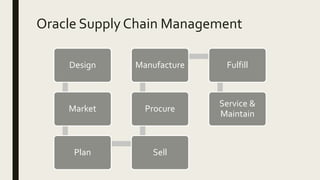
Oracle Supply Chain Management
Design
Market
Plan Sell
Procure
Manufacture Fulfill
Service &
Maintain
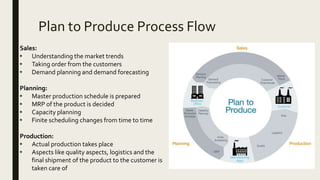
Plan to Produce Process Flow
Sales:
• Understanding the market trends
• Taking order from the customers
• Demand planning and demand forecasting
Planning:
• Master production schedule is prepared
• MRP of the product is decided
• Capacity planning
• Finite scheduling changes from time to time
Production:
• Actual production takes place
• Aspects like quality aspects, logistics and the
final shipment of the product to the customer is
taken care of
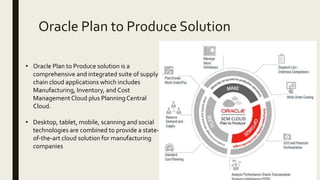
Oracle Plan to Produce Solution
• Oracle Plan to Produce solution is a
comprehensive and integrated suite of supply
chain cloud applications which includes
Manufacturing, Inventory, and Cost
ManagementCloud plus PlanningCentral
Cloud.
• Desktop, tablet, mobile, scanning and social
technologies are combined to provide a state-
of-the-art cloud solution for manufacturing
companies
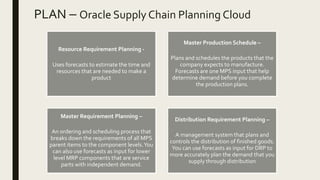
PLAN – Oracle Supply Chain Planning Cloud
Resource Requirement Planning -
Uses forecasts to estimate the time and
resources that are needed to make a
product
Master Production Schedule –
Plans and schedules the products that the
company expects to manufacture.
Forecasts are one MPS input that help
determine demand before you complete
the production plans.
Master Requirement Planning –
An ordering and scheduling process that
breaks down the requirements of all MPS
parent items to the component levels.You
can also use forecasts as input for lower
level MRP components that are service
parts with independent demand.
Distribution Requirement Planning –
A management system that plans and
controls the distribution of finished goods.
You can use forecasts as input for DRP to
more accurately plan the demand that you
supply through distribution
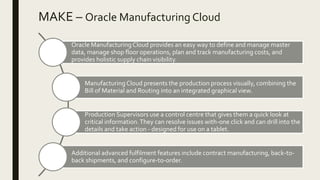
MAKE – Oracle Manufacturing Cloud
Oracle Manufacturing Cloud provides an easy way to define and manage master
data, manage shop floor operations, plan and track manufacturing costs, and
provides holistic supply chain visibility.
Manufacturing Cloud presents the production process visually, combining the
Bill of Material and Routing into an integrated graphical view.
Production Supervisors use a control centre that gives them a quick look at
critical information.They can resolve issues with-one click and can drill into the
details and take action - designed for use on a tablet.
Additional advanced fulfilment features include contract manufacturing, back-to-
back shipments, and configure-to-order.
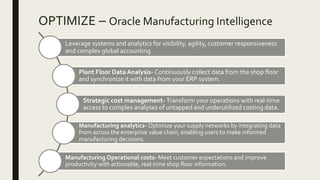
OPTIMIZE – Oracle Manufacturing Intelligence
Leverage systems and analytics for visibility, agility, customer responsiveness
and complex global accounting
Plant Floor Data Analysis- Continuously collect data from the shop floor
and synchronize it with data from your ERP system.
Strategic cost management- Transform your operations with real-time
access to complex analyses of untapped and underutilized costing data.
Manufacturing analytics- Optimize your supply networks by integrating data
from across the enterprise value chain, enabling users to make informed
manufacturing decisions.
Manufacturing Operational costs- Meet customer expectations and improve
productivity with actionable, real-time shop floor information.
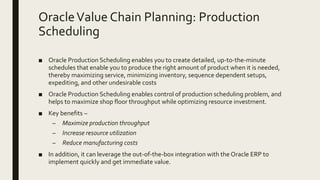
OracleValue Chain Planning: Production
Scheduling
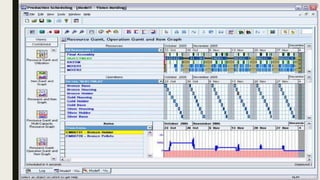
■ Oracle Production Scheduling enables you to create detailed, up-to-the-minute
schedules that enable you to produce the right amount of product when it is needed,
thereby maximizing service, minimizing inventory, sequence dependent setups,
expediting, and other undesirable costs
■ Oracle Production Scheduling enables control of production scheduling problem, and
helps to maximize shop floor throughput while optimizing resource investment.
■ Key benefits –
– Maximize production throughput
– Increase resource utilization
– Reduce manufacturing costs
■ In addition, it can leverage the out-of-the-box integration with the Oracle ERP to
implement quickly and get immediate value.
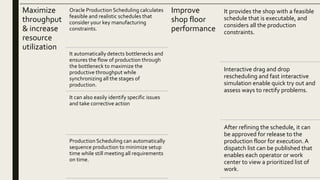
Maximize
throughput
& increase
resource
utilization
Oracle Production Scheduling calculates
feasible and realistic schedules that
consider your key manufacturing
constraints.
It automatically detects bottlenecks and
ensures the flow of production through
the bottleneck to maximize the
productive throughput while
synchronizing all the stages of
production.
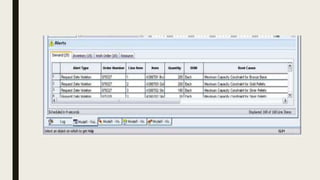
It can also easily identify specific issues
and take corrective action
Production Scheduling can automatically
sequence production to minimize setup
time while still meeting all requirements
on time.
Improve
shop floor
performance
It provides the shop with a feasible
schedule that is executable, and
considers all the production
constraints.
Interactive drag and drop
rescheduling and fast interactive
simulation enable quick try out and
assess ways to rectify problems.
After refining the schedule, it can
be approved for release to the
production floor for execution. A
dispatch list can be published that
enables each operator or work
center to view a prioritized list of
work.
Determine the best
schedule through
interactive
simulation
Oracle Production Scheduling
enables easy evaluation of one or
more schedules based on multiple
metrics.
It provides many pre-seeded key
performance indicators by which
the schedule quality can be
assessed.
It can also quickly compare
schedules and what-if scenarios to
identify the schedule that best
meets the business objectives.
Comprehensive
manufacturing
planning and
scheduling
Tight integration between Oracle E-
Business Suite, OracleAdvanced Supply
Chain Planning, and Oracle Production
Scheduling.
You can use Production Scheduling to
schedule production orders or process
batches maintenance visits and work
orders, or you can decide to
simultaneously plan both production and
planned orders fromAdvanced Supply
Chain Planning.
Once the schedule is refined and
finalized the scheduler can either release
it to execution or publish the planned
production orders back to Advanced
Supply Chain Planning
Honor complex
inter work order
relationships in
Maintenance
Visits
Maintenance activities for complex assets often involve the coordination of
hundreds of different tasks within the overall umbrella of a specific maintenance visit
for the asset.
Oracle Production Scheduling supports a maintenance work order scheduling
process that allows maintenance schedulers to view all the maintenance tasks within
the schedule, their inter-relationships, the associated resources and materials and
respect inter-work order relationships and other complex constraints when
scheduling work orders.
Create feasible
schedule
honoring
material and
resource
constraints
Maintenance work orders use human resources as well as equipment.
Oracle Production Scheduling enables a constraint based finite scheduling process
that creates a feasible maintenance schedule accounting for equipment
availability/downtime, material availability, lead times and other detailed constraints
such as work order relationships.
Maintenance Schedulers have an easy to use yet powerful and interactive user
interface
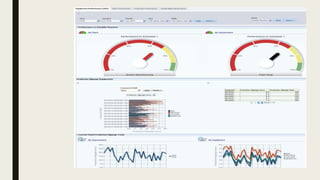
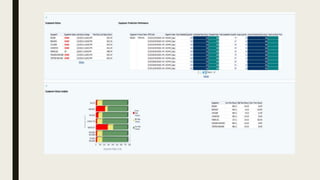
Oracle Manufacturing Operations Center
■ Extensible Role-based Dashboards and Key Performance Indicators (KPIs)
■ Analyze Production Loss and Overall Equipment Efficiency (OEE)
■ Increase ProductionThroughput
■ Improve Manufacturing Service Levels
■ Monitor Production Processes and Equipment Performance
■ Correlation between process parameters and equipment output and status
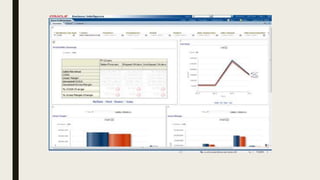
Oracle Cost management
■ Oracle's Cost Impact Simulator and Gross Profit Analyzer combine to help businesses
perform a range of functions not possible previously because of the long wait times
associated with batch processing of Big Data.
■ Oracle’s Cost Impact Simulator and Gross Profit Analyzer help organizations maximize
revenue and increase profits
■ Perform detailed ‘what-if’ cost simulations and timely analyses of cost and related
inventory valuations.
Success Stories
Closed month-end reports in one week, instead of
20 days
Reduced the monthly sales-close cycle by 10 days
Shortened the vendor payment cycle from 90 days
to around 30 to 45 days
Increased inventory turnover and reduced
inventory costs
Gained knowledge of and control over cash
positions by monitoring branch office receipts in
real time
Enabled accounts staff to generate financial
reports almost immediately
Prevented staff from making unauthorized
purchases by providing complete control
over the procurement of office items and
raw materials
Improved customer service levels
Provided insight into inventory at
construction sites, which ensured staff
always had the right amount of stock and
projects were completed on time
The system streamlined Mallcom’s financial reporting,
inventory management, and manufacturing processes while
providing more control over cash flow across its business units.
Improved Reporting, Cash Flow Management
Saving time through Automated Invoicing
Reducing wastage through Standard Purchasing System
Streamlining of Manufacturing Process
Oracle SCM Cloud ERP Solution

Oracle SCM Cloud ERP Solution

  • 1.
  • 2.
    Oracle Supply ChainManagement Design Market Plan Sell Procure Manufacture Fulfill Service & Maintain
  • 3.
    Plan to ProduceProcess Flow Sales: • Understanding the market trends • Taking order from the customers • Demand planning and demand forecasting Planning: • Master production schedule is prepared • MRP of the product is decided • Capacity planning • Finite scheduling changes from time to time Production: • Actual production takes place • Aspects like quality aspects, logistics and the final shipment of the product to the customer is taken care of
  • 4.
    Oracle Plan toProduce Solution • Oracle Plan to Produce solution is a comprehensive and integrated suite of supply chain cloud applications which includes Manufacturing, Inventory, and Cost ManagementCloud plus PlanningCentral Cloud. • Desktop, tablet, mobile, scanning and social technologies are combined to provide a state- of-the-art cloud solution for manufacturing companies
  • 5.
    PLAN – OracleSupply Chain Planning Cloud Resource Requirement Planning - Uses forecasts to estimate the time and resources that are needed to make a product Master Production Schedule – Plans and schedules the products that the company expects to manufacture. Forecasts are one MPS input that help determine demand before you complete the production plans. Master Requirement Planning – An ordering and scheduling process that breaks down the requirements of all MPS parent items to the component levels.You can also use forecasts as input for lower level MRP components that are service parts with independent demand. Distribution Requirement Planning – A management system that plans and controls the distribution of finished goods. You can use forecasts as input for DRP to more accurately plan the demand that you supply through distribution
  • 6.
    MAKE – OracleManufacturing Cloud Oracle Manufacturing Cloud provides an easy way to define and manage master data, manage shop floor operations, plan and track manufacturing costs, and provides holistic supply chain visibility. Manufacturing Cloud presents the production process visually, combining the Bill of Material and Routing into an integrated graphical view. Production Supervisors use a control centre that gives them a quick look at critical information.They can resolve issues with-one click and can drill into the details and take action - designed for use on a tablet. Additional advanced fulfilment features include contract manufacturing, back-to- back shipments, and configure-to-order.
  • 7.
    OPTIMIZE – OracleManufacturing Intelligence Leverage systems and analytics for visibility, agility, customer responsiveness and complex global accounting Plant Floor Data Analysis- Continuously collect data from the shop floor and synchronize it with data from your ERP system. Strategic cost management- Transform your operations with real-time access to complex analyses of untapped and underutilized costing data. Manufacturing analytics- Optimize your supply networks by integrating data from across the enterprise value chain, enabling users to make informed manufacturing decisions. Manufacturing Operational costs- Meet customer expectations and improve productivity with actionable, real-time shop floor information.
  • 8.
    OracleValue Chain Planning:Production Scheduling ■ Oracle Production Scheduling enables you to create detailed, up-to-the-minute schedules that enable you to produce the right amount of product when it is needed, thereby maximizing service, minimizing inventory, sequence dependent setups, expediting, and other undesirable costs ■ Oracle Production Scheduling enables control of production scheduling problem, and helps to maximize shop floor throughput while optimizing resource investment. ■ Key benefits – – Maximize production throughput – Increase resource utilization – Reduce manufacturing costs ■ In addition, it can leverage the out-of-the-box integration with the Oracle ERP to implement quickly and get immediate value.
  • 9.
    Maximize throughput & increase resource utilization Oracle ProductionScheduling calculates feasible and realistic schedules that consider your key manufacturing constraints. It automatically detects bottlenecks and ensures the flow of production through the bottleneck to maximize the productive throughput while synchronizing all the stages of production. It can also easily identify specific issues and take corrective action Production Scheduling can automatically sequence production to minimize setup time while still meeting all requirements on time. Improve shop floor performance It provides the shop with a feasible schedule that is executable, and considers all the production constraints. Interactive drag and drop rescheduling and fast interactive simulation enable quick try out and assess ways to rectify problems. After refining the schedule, it can be approved for release to the production floor for execution. A dispatch list can be published that enables each operator or work center to view a prioritized list of work.
  • 12.
    Determine the best schedulethrough interactive simulation Oracle Production Scheduling enables easy evaluation of one or more schedules based on multiple metrics. It provides many pre-seeded key performance indicators by which the schedule quality can be assessed. It can also quickly compare schedules and what-if scenarios to identify the schedule that best meets the business objectives. Comprehensive manufacturing planning and scheduling Tight integration between Oracle E- Business Suite, OracleAdvanced Supply Chain Planning, and Oracle Production Scheduling. You can use Production Scheduling to schedule production orders or process batches maintenance visits and work orders, or you can decide to simultaneously plan both production and planned orders fromAdvanced Supply Chain Planning. Once the schedule is refined and finalized the scheduler can either release it to execution or publish the planned production orders back to Advanced Supply Chain Planning
  • 13.
    Honor complex inter workorder relationships in Maintenance Visits Maintenance activities for complex assets often involve the coordination of hundreds of different tasks within the overall umbrella of a specific maintenance visit for the asset. Oracle Production Scheduling supports a maintenance work order scheduling process that allows maintenance schedulers to view all the maintenance tasks within the schedule, their inter-relationships, the associated resources and materials and respect inter-work order relationships and other complex constraints when scheduling work orders. Create feasible schedule honoring material and resource constraints Maintenance work orders use human resources as well as equipment. Oracle Production Scheduling enables a constraint based finite scheduling process that creates a feasible maintenance schedule accounting for equipment availability/downtime, material availability, lead times and other detailed constraints such as work order relationships. Maintenance Schedulers have an easy to use yet powerful and interactive user interface
  • 14.
    Oracle Manufacturing OperationsCenter ■ Extensible Role-based Dashboards and Key Performance Indicators (KPIs) ■ Analyze Production Loss and Overall Equipment Efficiency (OEE) ■ Increase ProductionThroughput ■ Improve Manufacturing Service Levels ■ Monitor Production Processes and Equipment Performance ■ Correlation between process parameters and equipment output and status
  • 17.
    Oracle Cost management ■Oracle's Cost Impact Simulator and Gross Profit Analyzer combine to help businesses perform a range of functions not possible previously because of the long wait times associated with batch processing of Big Data. ■ Oracle’s Cost Impact Simulator and Gross Profit Analyzer help organizations maximize revenue and increase profits ■ Perform detailed ‘what-if’ cost simulations and timely analyses of cost and related inventory valuations.
  • 19.
    Success Stories Closed month-endreports in one week, instead of 20 days Reduced the monthly sales-close cycle by 10 days Shortened the vendor payment cycle from 90 days to around 30 to 45 days Increased inventory turnover and reduced inventory costs Gained knowledge of and control over cash positions by monitoring branch office receipts in real time
  • 20.
    Enabled accounts staffto generate financial reports almost immediately Prevented staff from making unauthorized purchases by providing complete control over the procurement of office items and raw materials Improved customer service levels Provided insight into inventory at construction sites, which ensured staff always had the right amount of stock and projects were completed on time
  • 21.
    The system streamlinedMallcom’s financial reporting, inventory management, and manufacturing processes while providing more control over cash flow across its business units. Improved Reporting, Cash Flow Management Saving time through Automated Invoicing Reducing wastage through Standard Purchasing System Streamlining of Manufacturing Process