Life after upgrading to R12 at Origin Mark Bollmeyer Origin 16 th  August 2010 The most comprehensive Oracle applications & technology content under one roof
Origin in 2008
Origin in 2008 Oracle eBusiness version 11.5.10 Relatively low number of production issues Stable Production environment. Well known and understood processes No Performance issues
Why did Origin go to R12 ? Origin had multiple requirements for an Asset Management system Oracle Asset Management Solution (eAMS) selected as the enterprise solution The functionality Origin required in the eAMS solution had R12 as pre-requisite Project set up to Upgrade to R12 Rollout eAMS Migrate our upstream business from JD Edwards to Oracle eBusiness Introduce a new operating unit for APLNG – Joint Venture In hindsight, any one of these components would have been a project with sufficient challenges to tackle on their own
Origin’s R12 project Origin’s R12 project was run during 2008 Originally scheduled for go – live in November 2008 Rescheduled to January 2009 Key lessons learnt from the project Post Implementation Review The R12 Upgrade should be a project in it’s own right if possible Allocate time and resources to understanding the mandatory new modules and functionality Upgrading customisations will take more effort than you expect Test early, test thoroughly Defect management and resolution will take more effort than you expect Training is important, but communications are critical
R12 go live Go live went from 8 th  Jan – 11 th  Jan 2009 Implementations for the remainder of the project (upstream rollout, eAMS rollout ) occurred over the next 1-2 weeks Went live with version 12.0.5 Upgraded 2 existing operating units from R11 to R12 Implemented 2 new operating units in R12
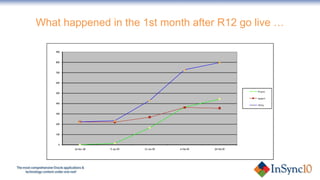
What happened in the 1st month after R12 go live …
Some of the key R12 issues we experienced were … Performance What we saw Delays logging on Java forms slow Disconnections Workflow mailer backlog What we did Ensure technical software versions and configurations are correct Web Cache software improved performance at remote sites Reverted to forms Socket Mode (from Servlet Mode) JVM sizing wrong for 11i and required resizing in R12 Tuned concurrent manager sizing
Some of the key R12 issues we experienced were … Points to note This was not unexpected due to limited R12 implementations in Australia Ensure time scheduled for load testing Ensure Oracle and hardware vendor reviews and signs off on versions and configurations
Some of the key R12 issues we experienced were … Invoice Validation Performance What we saw Invoice validation was not completing overnight Operating units conflicting with each other If a run was terminated -> records locked Particularly an issue at month end -> couldn’t close payables until finished What we did Baby-sit invoice validation overnight Hot-fix supplied by Oracle to ensure correct indexes used Patch supplied to limit the number of records processed Points to note Ensure hot-fix and patch applied Ensure invoice validation is in your regression test suite
Some of the key R12 issues we experienced were … Payables table structures changed What we saw Could not process R11 invoices in R12 What we did Data fixes to process some records Cancel R11 invoices and create R12 invoices Points to note Ensure all invoices processed before upgrade Develop in-flight process for those that can’t Ensure processes for how to handle R11 well communicated
Some of the key R12 issues we experienced were … Reports What we saw Origin’s plan to move back to standard reports as much as possible was not successful What we did Many custom reports upgrade / developed after go live Points to note Commit to using Standard reports or plan (schedule & budget) to do a lot of report upgrade / development
Some of the key R12 issues we experienced were … New  / Reworked modules (Payments, eBusiness tax, SLA) What we saw These modules gave us the most issues What we did Steep learning curve Obtain outside assistance Points to note Plan (schedule & budget) to understand these modules before go-live
Some of the key R12 issues we experienced were … Withholding Tax What we saw Withholding Tax did not work in R12 What we did Implement workarounds Long engagement with Oracle to resolve this SR Points to note Ensure the version you go live with contains the required patches
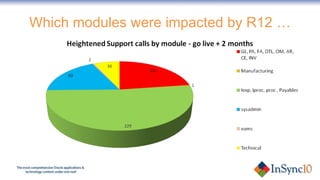
Which modules were impacted by R12 …
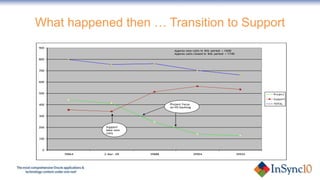
What happened then … Transition to Support
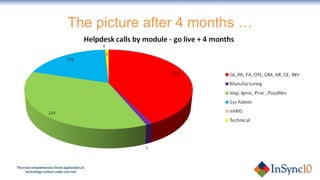
The picture after 4 months …
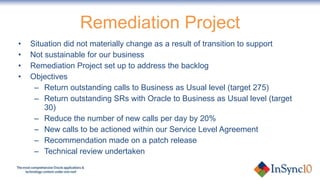
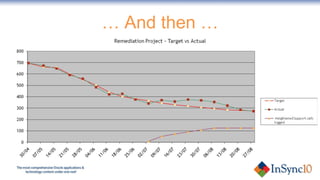
Remediation Project Situation did not materially change as a result of transition to support Not sustainable for our business Remediation Project set up to address the backlog Objectives Return outstanding calls to Business as Usual level (target 275) Return outstanding SRs with Oracle to Business as Usual level (target 30) Reduce the number of new calls per day by 20% New calls to be actioned within our Service Level Agreement Recommendation made on a patch release  Technical review undertaken
…  And then …
Remediation Project Details 4-6 additional functional resources required for 4 months Availability, Cost, Travel and Accom Lot of work required with Oracle to progress critical SRs Focus required to ensure support process for new calls was appropriate Outside of difficult SRs, no real problems encountered  Technical review done by Oracle – tactical hardware upgrade recommended Review of potential next patch release No official patch release would address our critical SRs Testing confirmed that a combination of several mega-patches (400-600 fixes in each patch), July CPC and a range of smaller patches would address our critical SRs Project Targets achieved
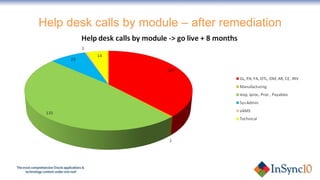
Help desk calls by module – after remediation
Tactical Hardware Upgrade Goals Address month end performance issues Create headroom to re-introduce end-user reporting capacity Ensure capacity available for coming 12 months Tasks Transform from 1-tier to 2-tier architecture New server plus additional memory required Proof of concept, Regression Test, Performance Test
Tactical Hardware Upgrade (cont) Timeframes Very tight timeframes to meet project deadlines and half year-end reporting Approval thru to implement in 2 months Results Very successful Performance issues gone Project deadlines not impacted Half Year end not impacted
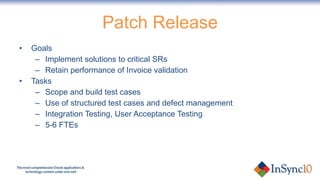
Patch Release Goals Implement solutions to critical SRs Retain performance of Invoice validation Tasks Scope and build test cases Use of structured test cases and defect management  Integration Testing, User Acceptance Testing 5-6 FTEs
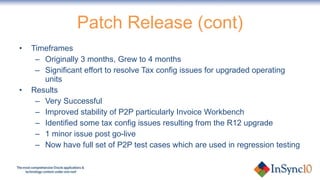
Patch Release (cont) Timeframes Originally 3 months, Grew to 4 months Significant effort to resolve Tax config issues for upgraded operating units Results Very Successful Improved stability of P2P particularly Invoice Workbench Identified some tax config issues resulting from the R12 upgrade 1 minor issue post go-live Now have full set of P2P test cases which are used in regression testing
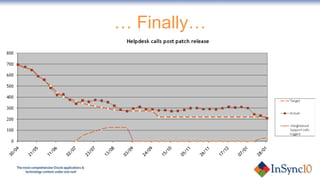
…  Finally…
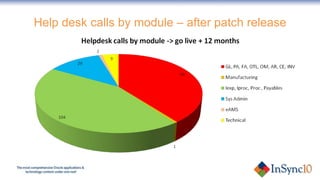
Help desk calls by module – after patch release
In Summary In the 12 months since go live, Origin has had 4 months of Project Heightened Support 4 months of Remediation project Implemented several new projects Hardware upgrade Major patch release This has been achieved by Significant hard work by my support team and our project team Significant hard work, patience and support from our business stakeholders Important assistance from Oracle at the crunch times First12 months after R12 was probably the 12 months we had to have as we were early adopters (thanks Paul Keating)
Final Thoughts Consider carefully before including any other scope  in your R12 project Make sure your technical environment and hardware is set up to perform to R12 requirements early on in your project Consider carefully whether you want to upgrade to R12 or re-implement R12.  Plan for expert assistance from Oracle to assist with  New Payments engine  E-Business Tax Sub Ledger Accounting Don’t plan on a short Heightened Support period – minimum of 3 month ends Plan for a period of Remediation and/or stabilization for some months after that Plan for a hardware health check post stabilization Regression Testing is all-important in an R12 environment
Tell us what you think… http://feedback.insync10.com.au

Life after upgrading to r12

  • 1.
    Life after upgradingto R12 at Origin Mark Bollmeyer Origin 16 th August 2010 The most comprehensive Oracle applications & technology content under one roof
  • 2.
  • 3.
    Origin in 2008Oracle eBusiness version 11.5.10 Relatively low number of production issues Stable Production environment. Well known and understood processes No Performance issues
  • 4.
    Why did Origingo to R12 ? Origin had multiple requirements for an Asset Management system Oracle Asset Management Solution (eAMS) selected as the enterprise solution The functionality Origin required in the eAMS solution had R12 as pre-requisite Project set up to Upgrade to R12 Rollout eAMS Migrate our upstream business from JD Edwards to Oracle eBusiness Introduce a new operating unit for APLNG – Joint Venture In hindsight, any one of these components would have been a project with sufficient challenges to tackle on their own
  • 5.
    Origin’s R12 projectOrigin’s R12 project was run during 2008 Originally scheduled for go – live in November 2008 Rescheduled to January 2009 Key lessons learnt from the project Post Implementation Review The R12 Upgrade should be a project in it’s own right if possible Allocate time and resources to understanding the mandatory new modules and functionality Upgrading customisations will take more effort than you expect Test early, test thoroughly Defect management and resolution will take more effort than you expect Training is important, but communications are critical
  • 6.
    R12 go liveGo live went from 8 th Jan – 11 th Jan 2009 Implementations for the remainder of the project (upstream rollout, eAMS rollout ) occurred over the next 1-2 weeks Went live with version 12.0.5 Upgraded 2 existing operating units from R11 to R12 Implemented 2 new operating units in R12
  • 7.
    What happened inthe 1st month after R12 go live …
  • 8.
    Some of thekey R12 issues we experienced were … Performance What we saw Delays logging on Java forms slow Disconnections Workflow mailer backlog What we did Ensure technical software versions and configurations are correct Web Cache software improved performance at remote sites Reverted to forms Socket Mode (from Servlet Mode) JVM sizing wrong for 11i and required resizing in R12 Tuned concurrent manager sizing
  • 9.
    Some of thekey R12 issues we experienced were … Points to note This was not unexpected due to limited R12 implementations in Australia Ensure time scheduled for load testing Ensure Oracle and hardware vendor reviews and signs off on versions and configurations
  • 10.
    Some of thekey R12 issues we experienced were … Invoice Validation Performance What we saw Invoice validation was not completing overnight Operating units conflicting with each other If a run was terminated -> records locked Particularly an issue at month end -> couldn’t close payables until finished What we did Baby-sit invoice validation overnight Hot-fix supplied by Oracle to ensure correct indexes used Patch supplied to limit the number of records processed Points to note Ensure hot-fix and patch applied Ensure invoice validation is in your regression test suite
  • 11.
    Some of thekey R12 issues we experienced were … Payables table structures changed What we saw Could not process R11 invoices in R12 What we did Data fixes to process some records Cancel R11 invoices and create R12 invoices Points to note Ensure all invoices processed before upgrade Develop in-flight process for those that can’t Ensure processes for how to handle R11 well communicated
  • 12.
    Some of thekey R12 issues we experienced were … Reports What we saw Origin’s plan to move back to standard reports as much as possible was not successful What we did Many custom reports upgrade / developed after go live Points to note Commit to using Standard reports or plan (schedule & budget) to do a lot of report upgrade / development
  • 13.
    Some of thekey R12 issues we experienced were … New / Reworked modules (Payments, eBusiness tax, SLA) What we saw These modules gave us the most issues What we did Steep learning curve Obtain outside assistance Points to note Plan (schedule & budget) to understand these modules before go-live
  • 14.
    Some of thekey R12 issues we experienced were … Withholding Tax What we saw Withholding Tax did not work in R12 What we did Implement workarounds Long engagement with Oracle to resolve this SR Points to note Ensure the version you go live with contains the required patches
  • 15.
    Which modules wereimpacted by R12 …
  • 16.
    What happened then… Transition to Support
  • 17.
    The picture after4 months …
  • 18.
    Remediation Project Situationdid not materially change as a result of transition to support Not sustainable for our business Remediation Project set up to address the backlog Objectives Return outstanding calls to Business as Usual level (target 275) Return outstanding SRs with Oracle to Business as Usual level (target 30) Reduce the number of new calls per day by 20% New calls to be actioned within our Service Level Agreement Recommendation made on a patch release Technical review undertaken
  • 19.
    … Andthen …
  • 20.
    Remediation Project Details4-6 additional functional resources required for 4 months Availability, Cost, Travel and Accom Lot of work required with Oracle to progress critical SRs Focus required to ensure support process for new calls was appropriate Outside of difficult SRs, no real problems encountered Technical review done by Oracle – tactical hardware upgrade recommended Review of potential next patch release No official patch release would address our critical SRs Testing confirmed that a combination of several mega-patches (400-600 fixes in each patch), July CPC and a range of smaller patches would address our critical SRs Project Targets achieved
  • 21.
    Help desk callsby module – after remediation
  • 22.
    Tactical Hardware UpgradeGoals Address month end performance issues Create headroom to re-introduce end-user reporting capacity Ensure capacity available for coming 12 months Tasks Transform from 1-tier to 2-tier architecture New server plus additional memory required Proof of concept, Regression Test, Performance Test
  • 23.
    Tactical Hardware Upgrade(cont) Timeframes Very tight timeframes to meet project deadlines and half year-end reporting Approval thru to implement in 2 months Results Very successful Performance issues gone Project deadlines not impacted Half Year end not impacted
  • 24.
    Patch Release GoalsImplement solutions to critical SRs Retain performance of Invoice validation Tasks Scope and build test cases Use of structured test cases and defect management Integration Testing, User Acceptance Testing 5-6 FTEs
  • 25.
    Patch Release (cont)Timeframes Originally 3 months, Grew to 4 months Significant effort to resolve Tax config issues for upgraded operating units Results Very Successful Improved stability of P2P particularly Invoice Workbench Identified some tax config issues resulting from the R12 upgrade 1 minor issue post go-live Now have full set of P2P test cases which are used in regression testing
  • 26.
  • 27.
    Help desk callsby module – after patch release
  • 28.
    In Summary Inthe 12 months since go live, Origin has had 4 months of Project Heightened Support 4 months of Remediation project Implemented several new projects Hardware upgrade Major patch release This has been achieved by Significant hard work by my support team and our project team Significant hard work, patience and support from our business stakeholders Important assistance from Oracle at the crunch times First12 months after R12 was probably the 12 months we had to have as we were early adopters (thanks Paul Keating)
  • 29.
    Final Thoughts Considercarefully before including any other scope in your R12 project Make sure your technical environment and hardware is set up to perform to R12 requirements early on in your project Consider carefully whether you want to upgrade to R12 or re-implement R12. Plan for expert assistance from Oracle to assist with New Payments engine E-Business Tax Sub Ledger Accounting Don’t plan on a short Heightened Support period – minimum of 3 month ends Plan for a period of Remediation and/or stabilization for some months after that Plan for a hardware health check post stabilization Regression Testing is all-important in an R12 environment
  • 30.
    Tell us whatyou think… http://feedback.insync10.com.au