ASCP Training
Chapter 1 – ERP understanding and Basics overview
Day 1 – 7th Nov’16
Trainer – Sarita Singh
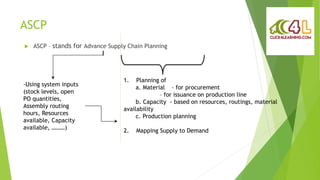
ASCP
 ASCP – stands for Advance Supply Chain Planning
1. Planning of
a. Material – for procurement
– for issuance on production line
b. Capacity - based on resources, routings, material
availability
c. Production planning
2. Mapping Supply to Demand
-Using system inputs
(stock levels, open
PO quantities,
Assembly routing
hours, Resources
available, Capacity
available, ………)
Basic terms
 Purchase Order
 Purchase Requisition
 Work Order
 Planned Order
 On-hand
 Routings
 Resources
 Assembly part
 Order type
 Sales Order
Oracle – ASCP (Advance Supply Chain
Planning)
Oracle Advanced Supply Chain Planning (ASCP) is a comprehensive, Internet-based planning
solution that decides when and where supplies (for example, inventory, purchase orders and work
orders) should be deployed within an extended supply chain. This is the supply planning function.
Oracle ASCP addresses the following key supply planning issues:
It is the main planning engine Oracle is offering, it has advanced features than the traditional
MRP module. It plans:
 The supply
(POs, Requisitions,
Work Orders)
 based on demand
(Forecast, Sales orders,
Dependent demand)
ORACLE ASCP OUTLOOK / ACTIVITIES
Oracle ASCP as we know by now is an advance planning tool with ample benefits and
features.
There is a flow of information between the components of the Oracle Advanced
Planning Suite.
There are 3 types of business flows:
 APS Information Flows
 The Demand-to-Make / Demand-to-Buy Business Flow
 The Inquiry-to-Order Business Flow
Planning Cycle
Planning Cycle
Planning Cycle: Planners perform end-to-end planning flow during the
course of planning cycle. The flow demonstrates the key features of
Oracle ASCP that a typical planner would use in the course of their
work.
 STEP 1: Various sources of demand are as below:
 STEP 2: Run collections to bring planning data from the source instance to
the planning server, where the data will be accessible to Oracle ASCP.
 STEP 3: After an MDS has been defined, a Production, Manufacturing, or
Distribution plan/schedule can be created.
 STEP 4: After you have created your MRP, MPS, or MPP plan/schedule and
saved it, choose the plan from [Production, Manufacturing, or Distribution
Plan] > Names and select Launch Plan.
 STEP 5: Review Key Performance Indicators (KPIs)
Planning Cycle
 STEP 6: Review Exceptions
 STEP 7: Review Workflow Notifications Oracle ASCP's powerful
collaboration features enable you to automate and streamline your
interactions with customers and suppliers.
 STEP 8: View Pegged Supply and Demand
 STEP 9: Modify the Plan Environment
 STEP 10: Modify Supply/Demand
 STEP 11: Modify Resources
 STEP 12: Modify Supplier Parameters
 STEP 13: Run Net Change
 STEP 14: Review a Constrained Forecast that Results from Net Change
Planning
 STEP 15: Release or Firm Orders
ORACLE ASCP IMPLEMENTATION
The project I took up was implementation of ASCP for Machining Centre due to below
reasons:
 Machining Centre was a combination of 21 machines
 Multiple SKU were machines on multiple parts as per routing
 The machining time at each Machining Centre was different for different parts
 The no. of SKUs was greater than 150.
 Some Machining Centre were similar and replaceable by each other
 A set of machines was dedicated for a particular SKU
Due to above complications we felt a need to shift from manual scheduling of
production and capacity planning to Advance Supply Chain planning (ASCP).
ORACLE ASCP IMPLEMENTATION
For ASCP to work well in the planning environment setup by the planner (in case of single org setup)
/Organization (in case of multi-org setup), there are some pre-requisites that are needed so that the
system throws the desired output based on the inputs provided to it. These pre-requisites are as below:
STEP 1: Cleanup activity
a. Open Purchase Requisitions
b. Past due / unwanted Purchase Orders
c. Past due / unwanted Work Orders
d. Unreleased Work Orders
For the project undertaken for Machining Centre, below are the numbers and volume which were
being cleaned:
 Open Purchase Requisitions – 2000+ PRs
 Past due / unwanted Purchase Orders - 1500+ lines
 Past due / unwanted Work Orders - 1800+ WOs
 Unreleased Work Orders - 1600+ WOs
ORACLE ASCP IMPLEMENTATION
STEP 2: Maintaining correct Item Master
a. Lead time: Pre-processing Lead time
Processing Lead time
Post-processing Lead time
Fixed Lead time
Variable Lead time
b. Inventory attributes: Inventory Item, Stockable, Transactable, Revision Control
c. General Planning attributes: Min-Max quantity, Planner, Safety Stock
d. MPS/MRP Planning Attribute Group: Planning Method, Planning Time Fence, Demand time Fence, Release
Time Fence
e. Order Entry Attribute Group: Customer Ordered, OE Transactable, RMA Inspection Required
ORACLE ASCP IMPLEMENTATION
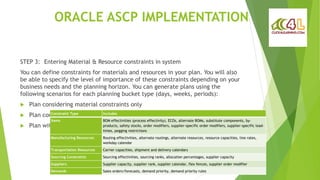
STEP 3: Entering Material & Resource constraints in system
You can define constraints for materials and resources in your plan. You will also
be able to specify the level of importance of these constraints depending on your
business needs and the planning horizon. You can generate plans using the
following scenarios for each planning bucket type (days, weeks, periods):
 Plan considering material constraints only
 Plan considering resource constraints only
 Plan with respect to both material and resource constraints
Constraint Type Includes
Items BOM effectivities (process effectivity), ECOs, alternate BOMs, substitute components, by-
products, safety stocks, order modifiers, supplier-specific order modifiers, supplier-specific lead-
times, pegging restrictions
Manufacturing Resources Routing effectivities, alternate routings, alternate resources, resource capacities, line rates,
workday calendar
Transportation Resources Carrier capacities, shipment and delivery calendars
Sourcing Constraints Sourcing effectivities, sourcing ranks, allocation percentages, supplier capacity
Suppliers Supplier capacity, supplier rank, supplier calendar, flex fences, supplier order modifier
Demands Sales orders/forecasts, demand priority, demand priority rules
ORACLE ASCP IMPLEMENTATION
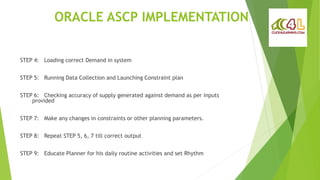
STEP 4: Loading correct Demand in system
STEP 5: Running Data Collection and Launching Constraint plan
STEP 6: Checking accuracy of supply generated against demand as per inputs
provided
STEP 7: Make any changes in constraints or other planning parameters.
STEP 8: Repeat STEP 5, 6, 7 till correct output
STEP 9: Educate Planner for his daily routine activities and set Rhythm
Thanks for a discussion filled session

Oracle ASCP Training

  • 1.
    ASCP Training Chapter 1– ERP understanding and Basics overview Day 1 – 7th Nov’16 Trainer – Sarita Singh
  • 2.
    ASCP  ASCP –stands for Advance Supply Chain Planning 1. Planning of a. Material – for procurement – for issuance on production line b. Capacity - based on resources, routings, material availability c. Production planning 2. Mapping Supply to Demand -Using system inputs (stock levels, open PO quantities, Assembly routing hours, Resources available, Capacity available, ………)
  • 3.
    Basic terms  PurchaseOrder  Purchase Requisition  Work Order  Planned Order  On-hand  Routings  Resources  Assembly part  Order type  Sales Order
  • 4.
    Oracle – ASCP(Advance Supply Chain Planning) Oracle Advanced Supply Chain Planning (ASCP) is a comprehensive, Internet-based planning solution that decides when and where supplies (for example, inventory, purchase orders and work orders) should be deployed within an extended supply chain. This is the supply planning function. Oracle ASCP addresses the following key supply planning issues: It is the main planning engine Oracle is offering, it has advanced features than the traditional MRP module. It plans:  The supply (POs, Requisitions, Work Orders)  based on demand (Forecast, Sales orders, Dependent demand)
  • 5.
    ORACLE ASCP OUTLOOK/ ACTIVITIES Oracle ASCP as we know by now is an advance planning tool with ample benefits and features. There is a flow of information between the components of the Oracle Advanced Planning Suite. There are 3 types of business flows:  APS Information Flows  The Demand-to-Make / Demand-to-Buy Business Flow  The Inquiry-to-Order Business Flow
  • 6.
  • 7.
    Planning Cycle Planning Cycle:Planners perform end-to-end planning flow during the course of planning cycle. The flow demonstrates the key features of Oracle ASCP that a typical planner would use in the course of their work.  STEP 1: Various sources of demand are as below:  STEP 2: Run collections to bring planning data from the source instance to the planning server, where the data will be accessible to Oracle ASCP.  STEP 3: After an MDS has been defined, a Production, Manufacturing, or Distribution plan/schedule can be created.  STEP 4: After you have created your MRP, MPS, or MPP plan/schedule and saved it, choose the plan from [Production, Manufacturing, or Distribution Plan] > Names and select Launch Plan.  STEP 5: Review Key Performance Indicators (KPIs)
  • 8.
    Planning Cycle  STEP6: Review Exceptions  STEP 7: Review Workflow Notifications Oracle ASCP's powerful collaboration features enable you to automate and streamline your interactions with customers and suppliers.  STEP 8: View Pegged Supply and Demand  STEP 9: Modify the Plan Environment  STEP 10: Modify Supply/Demand  STEP 11: Modify Resources  STEP 12: Modify Supplier Parameters  STEP 13: Run Net Change  STEP 14: Review a Constrained Forecast that Results from Net Change Planning  STEP 15: Release or Firm Orders
  • 9.
    ORACLE ASCP IMPLEMENTATION Theproject I took up was implementation of ASCP for Machining Centre due to below reasons:  Machining Centre was a combination of 21 machines  Multiple SKU were machines on multiple parts as per routing  The machining time at each Machining Centre was different for different parts  The no. of SKUs was greater than 150.  Some Machining Centre were similar and replaceable by each other  A set of machines was dedicated for a particular SKU Due to above complications we felt a need to shift from manual scheduling of production and capacity planning to Advance Supply Chain planning (ASCP).
  • 10.
    ORACLE ASCP IMPLEMENTATION ForASCP to work well in the planning environment setup by the planner (in case of single org setup) /Organization (in case of multi-org setup), there are some pre-requisites that are needed so that the system throws the desired output based on the inputs provided to it. These pre-requisites are as below: STEP 1: Cleanup activity a. Open Purchase Requisitions b. Past due / unwanted Purchase Orders c. Past due / unwanted Work Orders d. Unreleased Work Orders For the project undertaken for Machining Centre, below are the numbers and volume which were being cleaned:  Open Purchase Requisitions – 2000+ PRs  Past due / unwanted Purchase Orders - 1500+ lines  Past due / unwanted Work Orders - 1800+ WOs  Unreleased Work Orders - 1600+ WOs
  • 11.
    ORACLE ASCP IMPLEMENTATION STEP2: Maintaining correct Item Master a. Lead time: Pre-processing Lead time Processing Lead time Post-processing Lead time Fixed Lead time Variable Lead time b. Inventory attributes: Inventory Item, Stockable, Transactable, Revision Control c. General Planning attributes: Min-Max quantity, Planner, Safety Stock d. MPS/MRP Planning Attribute Group: Planning Method, Planning Time Fence, Demand time Fence, Release Time Fence e. Order Entry Attribute Group: Customer Ordered, OE Transactable, RMA Inspection Required
  • 12.
    ORACLE ASCP IMPLEMENTATION STEP3: Entering Material & Resource constraints in system You can define constraints for materials and resources in your plan. You will also be able to specify the level of importance of these constraints depending on your business needs and the planning horizon. You can generate plans using the following scenarios for each planning bucket type (days, weeks, periods):  Plan considering material constraints only  Plan considering resource constraints only  Plan with respect to both material and resource constraints Constraint Type Includes Items BOM effectivities (process effectivity), ECOs, alternate BOMs, substitute components, by- products, safety stocks, order modifiers, supplier-specific order modifiers, supplier-specific lead- times, pegging restrictions Manufacturing Resources Routing effectivities, alternate routings, alternate resources, resource capacities, line rates, workday calendar Transportation Resources Carrier capacities, shipment and delivery calendars Sourcing Constraints Sourcing effectivities, sourcing ranks, allocation percentages, supplier capacity Suppliers Supplier capacity, supplier rank, supplier calendar, flex fences, supplier order modifier Demands Sales orders/forecasts, demand priority, demand priority rules
  • 13.
    ORACLE ASCP IMPLEMENTATION STEP4: Loading correct Demand in system STEP 5: Running Data Collection and Launching Constraint plan STEP 6: Checking accuracy of supply generated against demand as per inputs provided STEP 7: Make any changes in constraints or other planning parameters. STEP 8: Repeat STEP 5, 6, 7 till correct output STEP 9: Educate Planner for his daily routine activities and set Rhythm
  • 14.
    Thanks for adiscussion filled session