MANAGERIAL ECONOMICS,
UNIT-II
BY Dr. RAVI KUMAR GUPTA
TABLE OF CONTENT
Concepts of Demand and Supply:
 Demand Analysis
 Law of Demand
 Determinants of Demand
 Elasticity of Demand: Price, Income and cross Elasticity
 Uses of concept of elasticity of demand in managerial decision
 Demand Forecasting: Meaning, significance and methods of demand forecasting,
 Law of Supply
 Determinants of supply
 Elasticity of supply
DEMAND
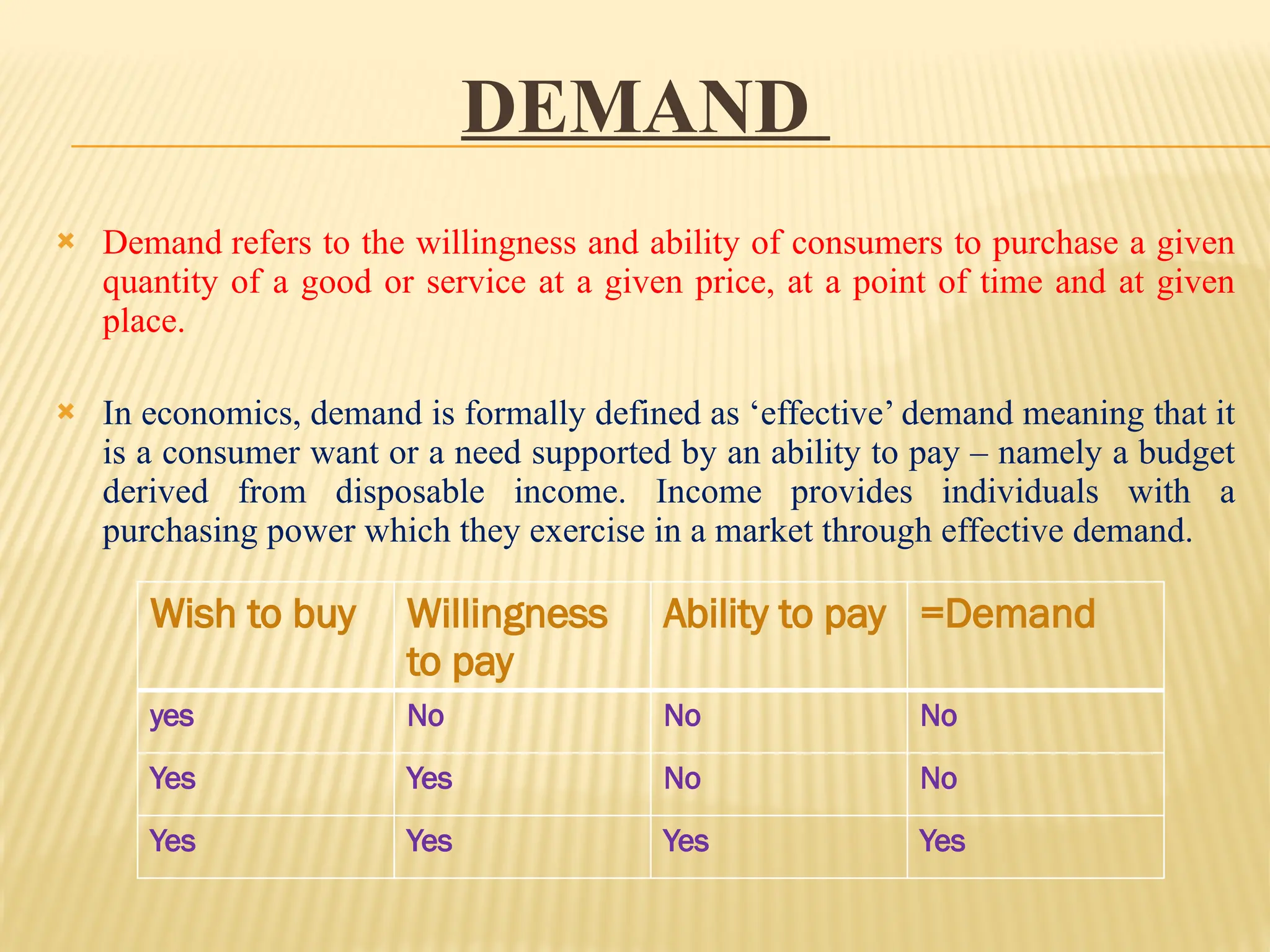
 Demand refers to the willingness and ability of consumers to purchase a given
quantity of a good or service at a given price, at a point of time and at given
place.
 In economics, demand is formally defined as ‘effective’ demand meaning that it
is a consumer want or a need supported by an ability to pay – namely a budget
derived from disposable income. Income provides individuals with a
purchasing power which they exercise in a market through effective demand.
Wish to buy Willingness
to pay
Ability to pay =Demand
yes No No No
Yes Yes No No
Yes Yes Yes Yes
CLARIFICATION…..
 Here consideration of possibility of sales of goods is important because we
always see the demand from the producers perspective. So any desire of
consumer which can not be converted into sales will not be amounted as
demand and hence not relevant.
means any ‘desire or willingness to buy’ a product if not supported by
‘willingness to pay’ and ‘ability to pay’ will not be considered as demand.
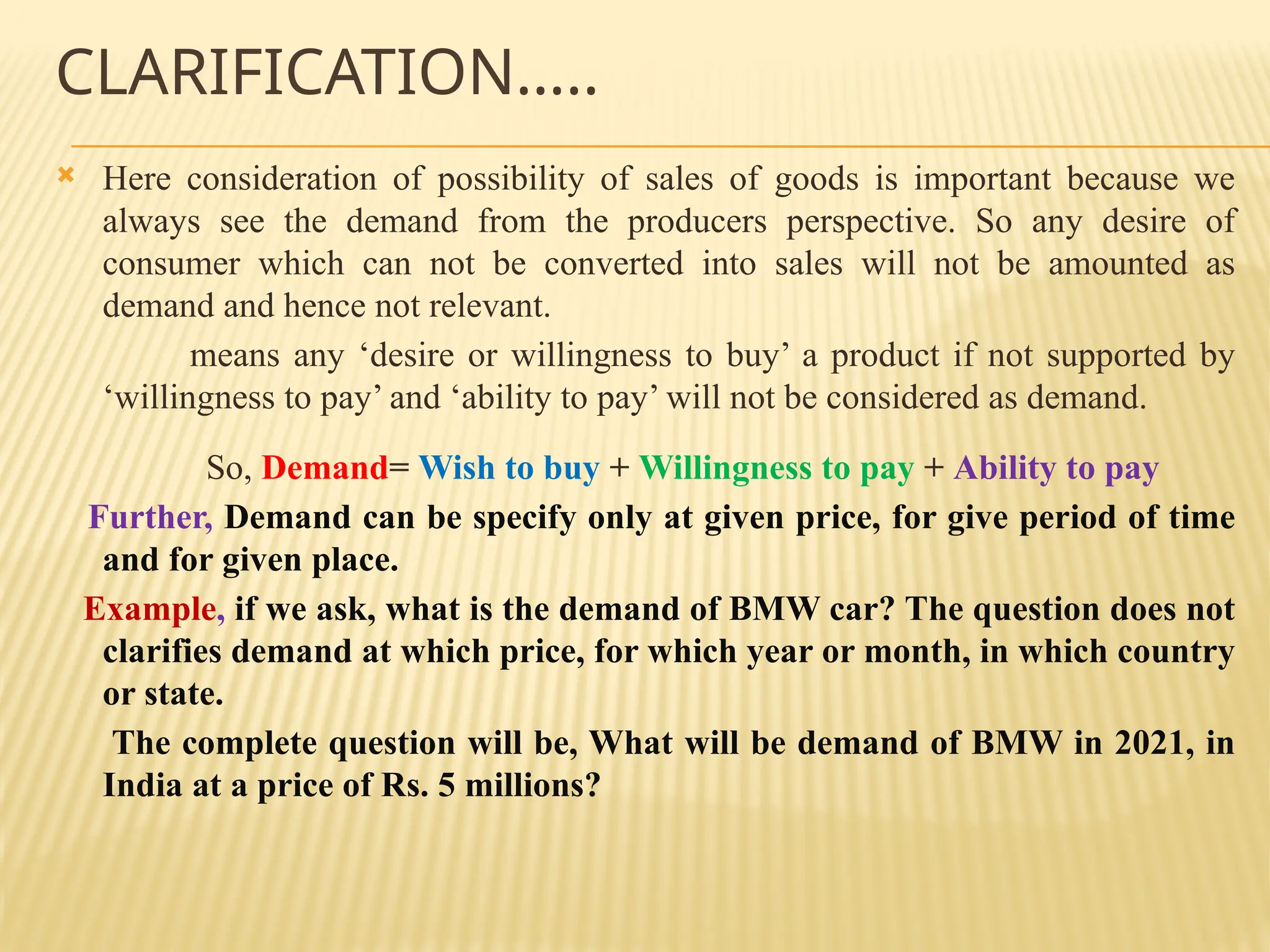
So, Demand= Wish to buy + Willingness to pay + Ability to pay
Further, Demand can be specify only at given price, for give period of time
and for given place.
Example, if we ask, what is the demand of BMW car? The question does not
clarifies demand at which price, for which year or month, in which country
or state.
The complete question will be, What will be demand of BMW in 2021, in
India at a price of Rs. 5 millions?
DEMAND FUNCTION
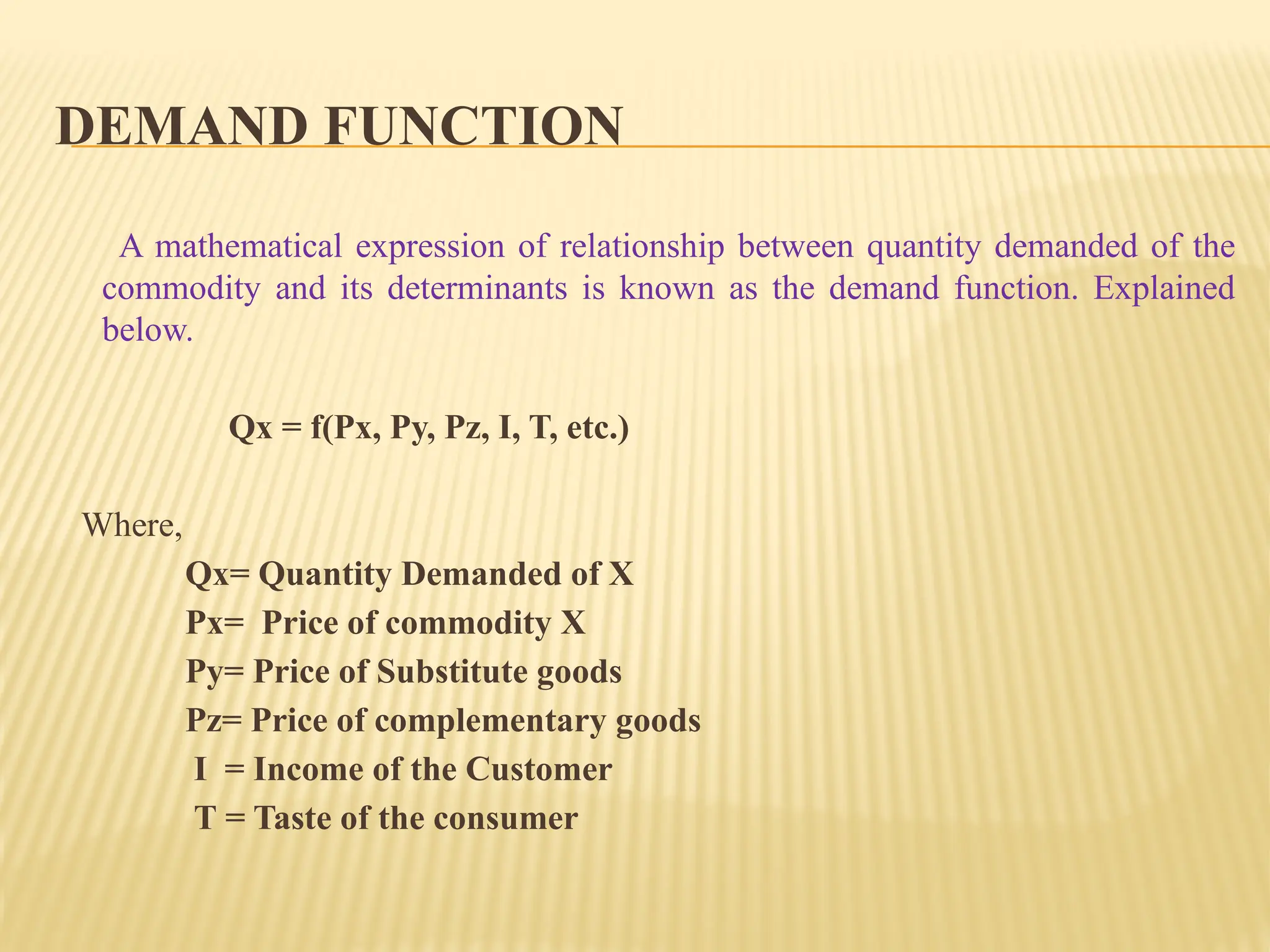
A mathematical expression of relationship between quantity demanded of the
commodity and its determinants is known as the demand function. Explained
below.
Qx = f(Px, Py, Pz, I, T, etc.)
Where,
Qx= Quantity Demanded of X
Px= Price of commodity X
Py= Price of Substitute goods
Pz= Price of complementary goods
I = Income of the Customer
T = Taste of the consumer
DEMAND SCHEDULE
Demand schedule is a tabular statement showing various quantities of a commodity
being demanded at various levels of price, during a given period of time. It shows
the relationship between price of the commodity and its quantity demanded.
A demand schedule can be determined both for individual buyers and for the
entire market. So, demand schedule is of two types:
1. Individual Demand Schedule:- Individual demand schedule refers to a tabular
statement showing various quantities of a commodity that a consumer is willing to
buy at various levels of price, during a given period of time.
2. Market Demand Schedule:- Market demand schedule refers to a tabular statement
showing various quantities of a commodity that all the consumers are willing to
buy at various levels of price, during a given period of time. It is the sum of all
individual demand schedules at each and every price.
DEMAND CURVE
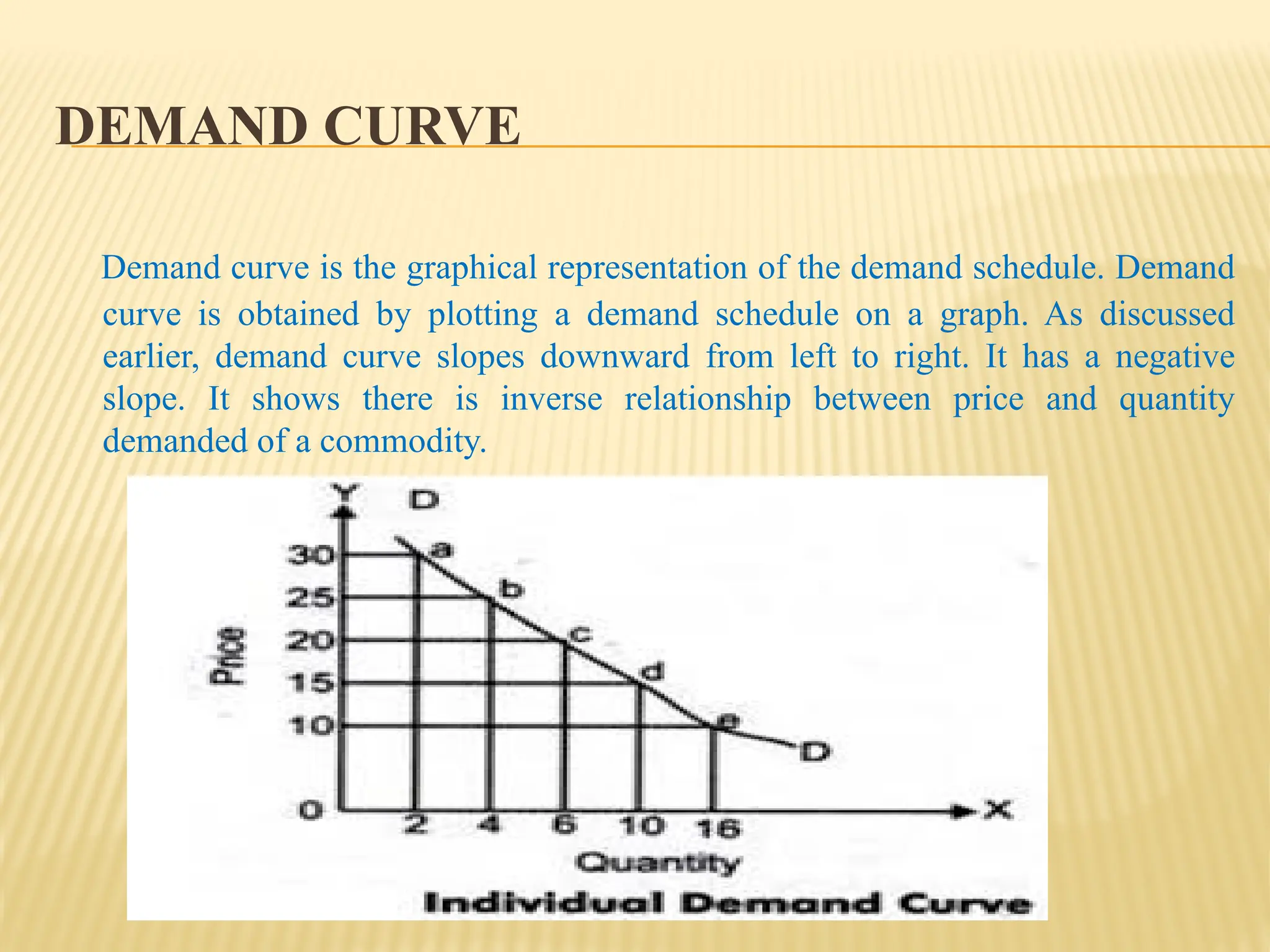
Demand curve is the graphical representation of the demand schedule. Demand
curve is obtained by plotting a demand schedule on a graph. As discussed
earlier, demand curve slopes downward from left to right. It has a negative
slope. It shows there is inverse relationship between price and quantity
demanded of a commodity.
TYPES OF DEMAND
1. Direct and indirect demand:
Producers’ goods and consumers’ goods: demand for goods that are directly used
for consumption by the ultimate consumer is known as direct demand (example:
Demand for T shirts).
On the other hand demand for goods that are used by producers for producing
goods and services. (example: Demand for cotton by a textile mill)
2. Derived demand and autonomous demand:
When a produce derives its usage from the use of some primary product it is known
as derived demand. (example: demand for tyres derived from demand for car)
Autonomous demand is the demand for a product that can be independently used.
(example: demand for a washing machine)
CONTINUED…..
3. Durable and non durable goods demand:
Durable goods are those that can be used more than once, over a period of time
(example: Microwave oven)
Non durable goods can be used only once (example: Band-aid)
4. Firm and industry demand:
Firm demand is the demand for the product of a particular firm. (example:
Dove soap)
The demand for the product of a particular industry is industry demand
(example: demand for steel in India )
CONTINUED…..
5. Total market and market segment demand:
A particular segment of the markets demand is called as segment demand
(example: demand for 21 laptops by engineering students)
The sum total of the demand for laptops by various segments in India is the
total market demand. (example: demand for laptops in India)
6. Short run and long run demand:
Short run demand refers to demand with its immediate reaction to price changes
and income fluctuations.
Long run demand is that which will ultimately exist as a result of the changes in
pricing, promotion or product improvement after market adjustment with
sufficient time.
CONTINUED…..
7. Joint demand and Composite demand:
When two goods are demanded in conjunction with one another at the same time to satisfy
a single want, it is called as joint or complementary demand. (example: demand for petrol
and two wheelers)
A composite demand is one in which a good is wanted for several different uses.
( example: demand for iron rods for various purposes)
8. Price demand, income demand and cross demand:
Demand for commodities by the consumers at alternative prices are called as price demand.
Quantity demanded by the consumers at alternative levels of income is income demand.
Cross demand refers to the quantity demanded of commodity ‘X’ at a price of a related
commodity ‘Y’ which may be a substitute or complementary to X.
THE LAW OF DEMAND
The law of demand states that, if all other factors remain equal,
“As the price increases, quantity demanded of that commodity decreases and as
the price decreases the quantity demanded of the commodity increases.”
Px Dx
Px Dx
Where,
Px= Price of Commodity X
Dx= Demand of Commodity X
ASSUMPTIONS TO LAW OF DEMAND
I. There is no change in the tastes and preferences of the consumer;
II. The income of the consumer remains constant;
III. There is no change in customs;
IV. There should not be any substitutes of the commodity;
V. There should not be any change in the prices of other products;
VI. There should not be any change in the quality of the product; and
VII. The habits of the consumers should remain unchanged.
EXCEPTIONS TO THE LAW OF DEMAND:
In certain cases, the demand curve slopes up from left to right, i.e., it has a positive
slope. Under certain circumstances, consumers buy more when the price of a
commodity rises, and less when price falls:
(i) War:- If shortage is feared in anticipation of war, people “may start buying for
building stocks or for hoarding even when the” price rises.
(ii) Depression:- During a depression, the prices of commodities are very low and
the demand for them is also less. This is because of the lack of purchasing power
with consumers.
(iii) Ignorance Effect:- Consumers buy more at a higher price under the influence of
the “ignorance effect”, where a commodity may be mistaken for some other
commodity, due to deceptive packing, label, etc.
CONTINUED…..
(iv) Giffen Paradox:- If a commodity happens to be a necessity of life like wheat
and its price goes up, consumers are forced to curtail the consumption of
more expensive foods like meat and fish, and wheat being still the cheapest,
food they will consume more of it.
(v) Demonstration Effect (Veblen Goods):- If consumers are affected by the
principle of conspicuous consumption or demonstration effect, they will like
to buy more of those commodities which confer distinction on the possessor,
when their prices rise. On the other hand, with the fall in the prices of such
articles, their demand falls, as is the case with diamonds.
DETERMINANTS OF DEMAND
The demand for a product is determined by different factors. The main demand
determinants are price, income, price of related goods and advertising.
Therefore, demand is a multivariate relationship, i.e. it is determined by
many factors simultaneously.
(A) Determinants of Individual Demand: Let us discuss the variables which
influence the individual demand.
1. Price of the Commodity:- Normally a larger quantity is demanded at a lower
price that at a higher price. There is inverse relationship between the price and
quantity demanded. This is called the law of demand.
CONTINUED…..
2. Income of the Consumer:- The income of the consumer is another important
variable which influences demand. The ability to buy a commodity depends upon the
income of the consumer. When the income of the consumers increases, they buy more
and when income falls they buy less.
3. Tastes and Preferences:- The demand for a product depends upon tastes and
preferences of the consumers. If the con­
sumers develop taste for a commodity they
buy whatever may be the price.
4. Prices of Related Goods:-The related goods are generally substitutes and
complementary goods. The demand for a product is also influenced by the prices of
substitutes and complements. When a want can be satisfied by alternative similar
goods they are called substitutes, such as coffee and tea. Whenever the price of one
good and the demand for another are inversely related then the goods are said to be
complementary, such as car and petrol.
CONTINUED…..
5. Advertisement and Sales Propaganda:- Advertisement helps in increasing
demand by informing the potential consumers about the avail­
ability of the
product, by showing the superiority of the product, and by influencing
consumer choice against the rival products. The demand for products like
detergents and cosmetics is mainly caused by advertisement.
6. Consumer’s Expectation:- A consumer s expectation about the future
changes in price and income may also affect his demand. If a consumer
expects a rise in prices he may buy large quantities of that particular
commodity. Similarly, if he expects its prices to fall in future, he will tend to
buy less at present. Similarly, expectation of rising income may induce him to
increase his current consumption.
CONTINUED…..
(B) Determinants of Market Demand:- Market demand for a product refers to the
total demand of all the buyers taken together. How much quantity the consumers
in general would buy at a given period of time constitutes the total market demand
for the product.
1. Price of the Product:- The law of demand states that if other things remain the
same when price falls, demand increases and vice-versa.
2. Standard of Living and Spending Habits:- When people are accustomed to high
standard of living their spending on comforts and luxuries also increase, that
automatically increase the demand.
3. Distribution of Income Pattern:- If the distribution pattern of income is fair and
equal the market demand for essential items tends to be greater.
CONTINUED…..
4. The Scale of Preferences:- The market demand for a product is also affected by the
scale of preference of buyers. If there is a shift in consumers’ preference from x to y,
the demand for у tends to increase.
5. The Growth of Population:- The growth of population is also another important
factor that affects the market demand. With the increase in population, people
naturally demand more goods for their survival.
6. Social Customs and Ceremonies:- Social customs and ceremonies are usually
celebrated collectively. They involve extra expenditure on certain items and thereby
increase the demand.
7. Future Expectation:- People are not sure about their future, because future is
uncertain. If the consumers expect a rise in prices of products, they buy more at
present and preserve the same for the future, thereby the market demand would be
affected.
CONTINUED…..
8. Tax Rate:- High tax rate would generally mean a low demand for the
goods. At certain times the government restricts the consumption of a
commodity and uses the tax as a weapon.
9. Inventions and Innovations:- Inventions and innovations introduce new
goods in the market. The consumers will have a strong tendency to
purchase the new product. The preference over the new goods adversely
affects the demand for the existing goods in the market.
10. Weather Conditions:- Seasonal factors also affect the demand. The
demand for certain items purely depends on climatic and weather
conditions. For example, the growing demand for cold drinks during the
summer season and the demand for sweaters during the winter season.
CONTINUED…..
11. Availability of Credit:- The purchasing power is influenced by the availability of
credit. If there is availability of cheap credit, the consumers try to spend more on
consumer durables thereby the demand for certain products increase.
12. Pattern of Saving:- If people begin to save more, their demand will decrease. It
means the disposable income will be less to purchase the goods and services. On
the contrary, if saving is less their demand will increase.
13. Demonstration Effect:- Demonstration effect helps to increase human wants. In
underde­
veloped countries, there is a desire in the minds of the people to imitate
other people for conspicuous consumption and that is why they are not able to
save. This change in the saving habits of the people is due to “contact effect”. The
demonstration effect has a positive effect on the demand for comforts and luxury
goods.
UTILITY ANALYSIS
What Is Utility?
Utility is a term in economics that refers to the total satisfaction received from
consuming a good or service. Economic theories based on rational choice
usually assume that consumers will strive to maximize their utility. The
economic utility of a good or service is important to understand, because it
directly influences the demand, and therefore price, of that good or service.
In practice, a consumer's utility is impossible to measure and quantify.
However, some economists believe that they can indirectly estimate what
is the utility for an economic good or service by employing various
models.
The utility definition in economics is derived from the concept of usefulness.
An economic good yields utility to the extent to which it's useful for
satisfying a consumer’s want or need.
APPROACHES TO UTILITY ANALYSIS
There are to ways to measure utility:-
1. Ordinal Approach:- according to this approach, utility is a psychological
term, can be explained in qualitative aspect. Hence can not be measured in
numerical value, only can be compared.
2. Cardinal Approach:- according to this approach, utility can be quantify
and hence can be measured in numerical value. Unit used for measuring utility
is “Util”.
TOTAL UTILITY
Total utility is the sum of utility derived from different units of a commodity
consumed by a consumer at any point of consumption.
According to Leftwitch, “Total utility refers to the entire amount of satisfaction
obtained from consuming various quantities of a commodity.”
Suppose a consumes X unit of a commodity, then total utility consumed by
consumer Ux is:-
Ux = U1+ U2+U3+………Ux
MARGINAL UTILITY
The Marginal Utility is the utility derived from the additional unit of a commodity consumed.
The change that takes place in the total utility by the consumption of an additional unit of
a commodity calls marginal utility.
According to Chapman,
“Marginal utility is the addition made to total utility by consuming one more unit of
commodity.”
The marginal utility can measure with the help of the following formula
MUnth = TUn – TUn-1
Here;
MUnth= Marginal utility of nth unit.
TUn= Total utility of “n” units, and.
TUn-1 = Total utility of n-1 units.
THE LAW OF DIMINISHING MARGINAL UTILITY
This is an important law under Marginal Utility Analysis. Alfred Marshall, British
Economist defines the law of diminishing marginal utility as follows:
“The additional benefit which a person derives from a given increase in the stock
of a thing diminishes with every increase in the stock that he already has.”
This law is based on the fundamental tendency of human nature. Human wants are
virtually unlimited. However, every single want is satiable. Hence, as we
consume more and more units of a good, the intensity of our want for the good
decreases. Eventually, it reaches a point where we no longer want it.
In other words, as we consume more units of a good, the extra satisfaction that we
derive from the extra unit keeps falling. However, it is important to remember
that the marginal utility declines not the total utility.
ELASTICITY OF DEMAND
If price changes we know the demand changes, but by how many percentage?
Means what is the elasticity of that demand?
Elasticity measures the extent to which demand will change. Elasticity of
demand is a measure to responsiveness of change in quantity demanded of a
commodity due to change in a particular factor of demand.
Elasticity of Demand=
Elasticity can be of three types:
1. Price Elasticity of Demand
2. Income Elasticity of Demand
3. Cross Elasticity of Demand
1. PRICE ELASTICITY OF DEMAND
Price elasticity of demand measures the percentage change in quantity demanded
caused by a percent change in price.
Price Elasticity of Demand (Ep)=
Ep=
Where,
∆q= Change in quantity demanded of commodity x
∆p= Change in price of commodity x
p= price of commodity x
q= quantity demanded of commodity x
TYPES OF PRICE ELASTICITY OF DEMAND
1. ELASTIC DEMAND:- a change in price, results in a greater than proportional
change in the quantity demanded. Ep>1
2. INELASTIC DEMAND:- a change in price results in a less than proportional
change. Ep<1
3. UNITARY ELASTIC DEMAND :- a change in price results in n equal
proportional change. Ep=1
4. PERFECTLY ELASTIC DEMAND :- demand changes even when price remains
unchanged. Ep=∞
5. PERFECTLY INELASTIC DEMAND ;- change in price does not result in any
change. Ep=0
INCOME ELASTICITY OF DEMAND
The percentage change in quantity demanded due to percentage change in income
is called income elasticity of demand. Income elasticity of demand measures the
responsiveness of demand for a good to change in income of consumer.
Income Elasticity of Demand (Ey) =
Ey=
Where,
∆q= change in quantity demanded of commodity x
∆y= change in the income of the consumer
q= quantity demanded of commodity x
y= income of the consumer
TYPES OF INCOME ELASTICITY OF DEMAND
1. POSITIVE INCOME ELASTICITY
A rise in income will cause a rise in demand , A fall in income will cause a fall
in demand. Ey>0
2. NEGATIVE INCOME ELASTICITY
An increase in income will result in a decrease in demand, A decrease in
income will result in a rise in demand. (ex. Inferior good) Ey<0
3. ZERO INCOME ELASTICITIES
This occurs when a change in income has NO effect on the demand for goods.
(ex. A rise of 5% income will leave the Demand for salt unchanged). Ey=0
CROSS ELASTICITY OF DEMAND
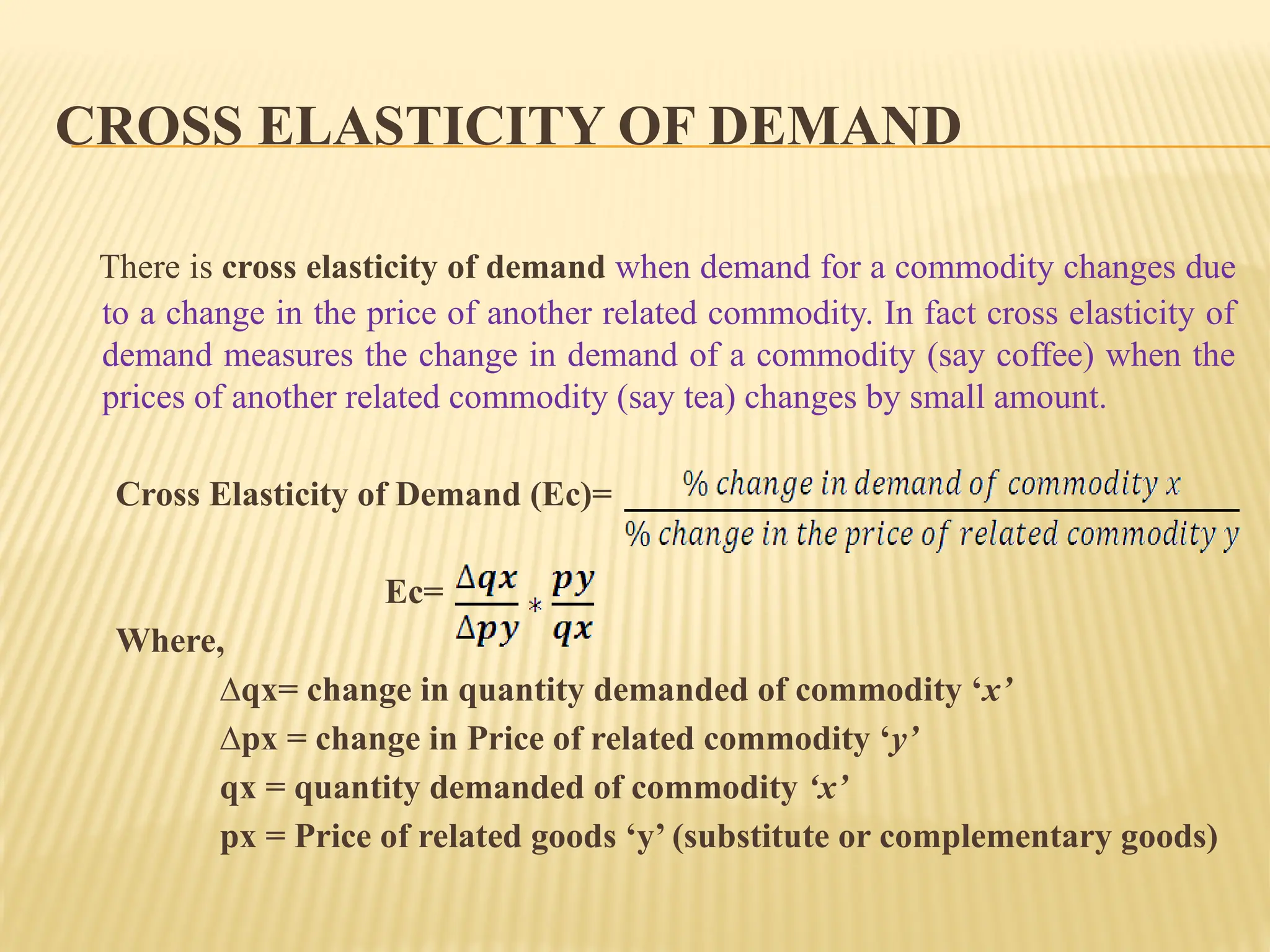
There is cross elasticity of demand when demand for a commodity changes due
to a change in the price of another related commodity. In fact cross elasticity of
demand measures the change in demand of a commodity (say coffee) when the
prices of another related commodity (say tea) changes by small amount.
Cross Elasticity of Demand (Ec)=
Ec=
Where,
∆qx= change in quantity demanded of commodity ‘x’
∆px = change in Price of related commodity ‘y’
qx = quantity demanded of commodity ‘x’
px = Price of related goods ‘y’ (substitute or complementary goods)
TYPES OF CROSS ELASTICITY OF DEMAND
1. Positive Cross Elasticity of Demand
Implies that the cross elasticity of demand would be positive when increase in
the price of one good (Y) causes increase in the demand for the other good
(X). In simple terms, cross elasticity would be positive for substitutes. (ex.
Tea and coffee). Ec>0
2. Negative Cross Elasticity of Demand
Refers to a situation when the rise in the price of one good (Y) reduces the
demand for the other good (X). The cross elasticity of demand would be
negative for complementary goods. (ex. Pen and Ink) Ec<0
USE OF ELASTICITY OF DEMAND IN
MANGERIAL DECISIONS
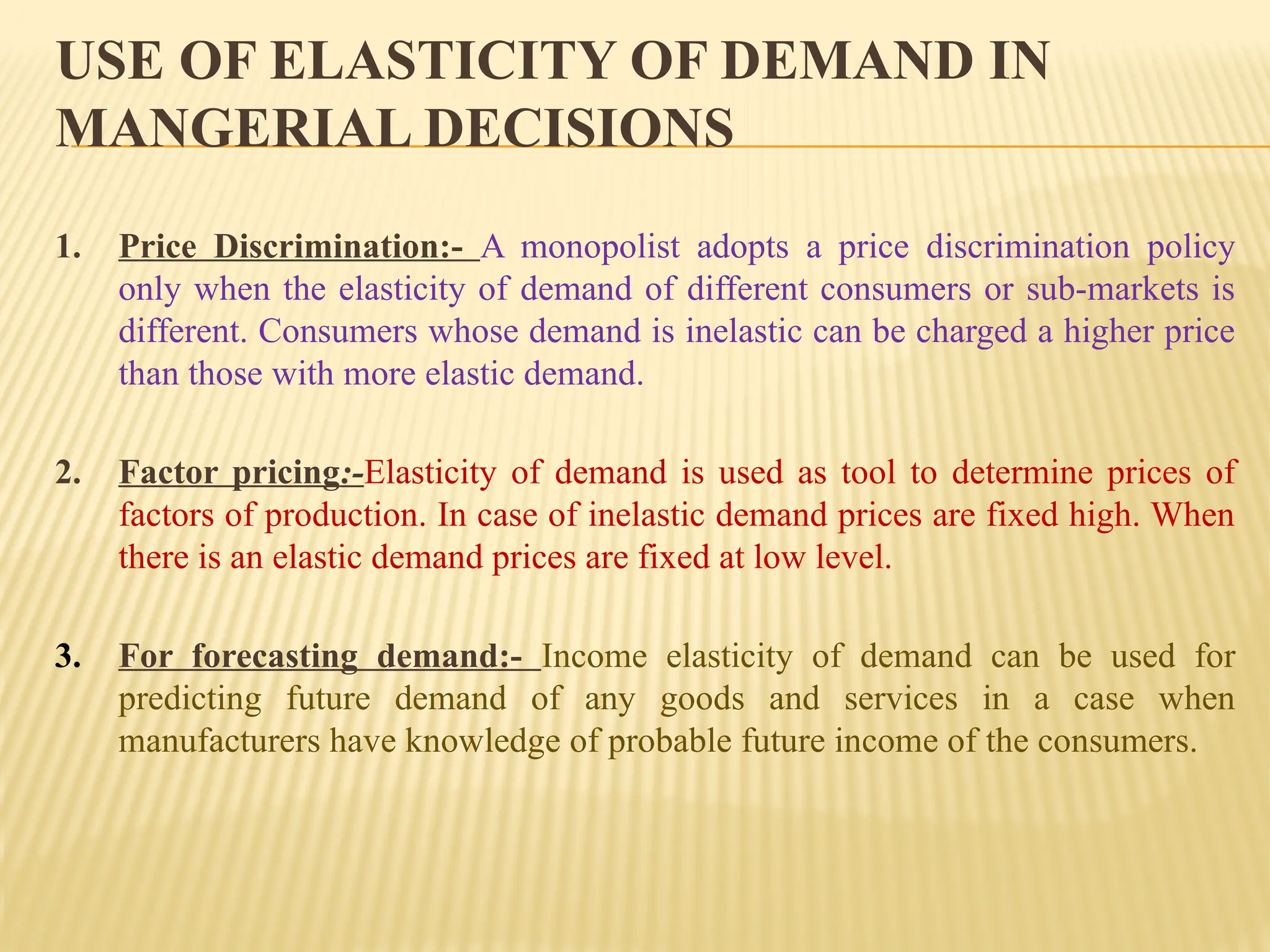
1. Price Discrimination:- A monopolist adopts a price discrimination policy
only when the elasticity of demand of different consumers or sub-markets is
different. Consumers whose demand is inelastic can be charged a higher price
than those with more elastic demand.
2. Factor pricing:-Elasticity of demand is used as tool to determine prices of
factors of production. In case of inelastic demand prices are fixed high. When
there is an elastic demand prices are fixed at low level.
3. For forecasting demand:- Income elasticity of demand can be used for
predicting future demand of any goods and services in a case when
manufacturers have knowledge of probable future income of the consumers.
CONTINUED……
4. Prices and output determination:- The producers make decisions about output
and prices. Elasticity of demand is helpful information for producers. The price
is high for less elastic demand. In case of elastic demand price is low.
5. Sales policy in super market:- In super market sales policy is determined on
the basis of elasticity of demand. Lowering price level maximizes the sales. So
they lower the price to increase sales quantity, Which will result as increase in
final sale value.
6. Labor Force Replacement:- Elasticity of demand for production determines
whether or not machines will replace labor. In case of inelastic demand output
will be fixed, so labor force can be replaced by machines. But in case of elastic
demand, output keep changing and to cope-up with that change labor force is
needed.
CONTINUED……
7. Shifting of Tax Burden:- It is possible for a business to shift a commodity tax in
case of inelastic demand to his customers. But if the demand is elastic, he will have
to bear the tax burden himself, otherwise demand for his goods will go down
sharply.
8. Joint Product Prices:-Certain goods, being products of the same process are
jointly supplied, e.g. milk and butter. Here if the demand for milk is inelastic
compared to the demand for butter, a higher price for milk can be charged with
advantage.
9. Imposition of GST:- The government can impose GST on different goods.
Elasticity of demand is helpful to select goods for tax. When demand is inelastic tax
GST can be imposed at high rate. In case of elastic demand tax GST will be
imposed at lower rate.
10. Others:- Product dumping, deciding of price strategy, Public utility pricing etc.
DEMAND FORECASTING
Demand forecasting is a combination of two words;
the first one is Demand and another forecasting. Demand means outside
requirements of a product or service. In general, forecasting means making an
estimation in the present for a future occurring event.
So, “Demand forecasting is the process of making estimations about
future customer demand over a defined period, using historical data and
other information.”
Critical business assumptions like turnover, profit margins, cash flow,
capital expenditure, risk assessment and mitigation plans, capacity planning,
etc. are dependent on Demand Forecasting.
IMPORTANCE OF DEMAND FORECASTING
 Sales forecasting helps with business planning, budgeting, and goal setting.
 It allows businesses to more effectively optimize inventory, increase inventory
turnover rates and reduce holding costs.
 Plays a crucial role in making budget by estimating costs and expected
revenues.
 Anticipating demand means knowing when to increase staff and other resources
to keep operations running smoothly during peak periods.
 It helps an organization to control its production and recruitment activities.
METHODS OF DEMAND FORECASTING
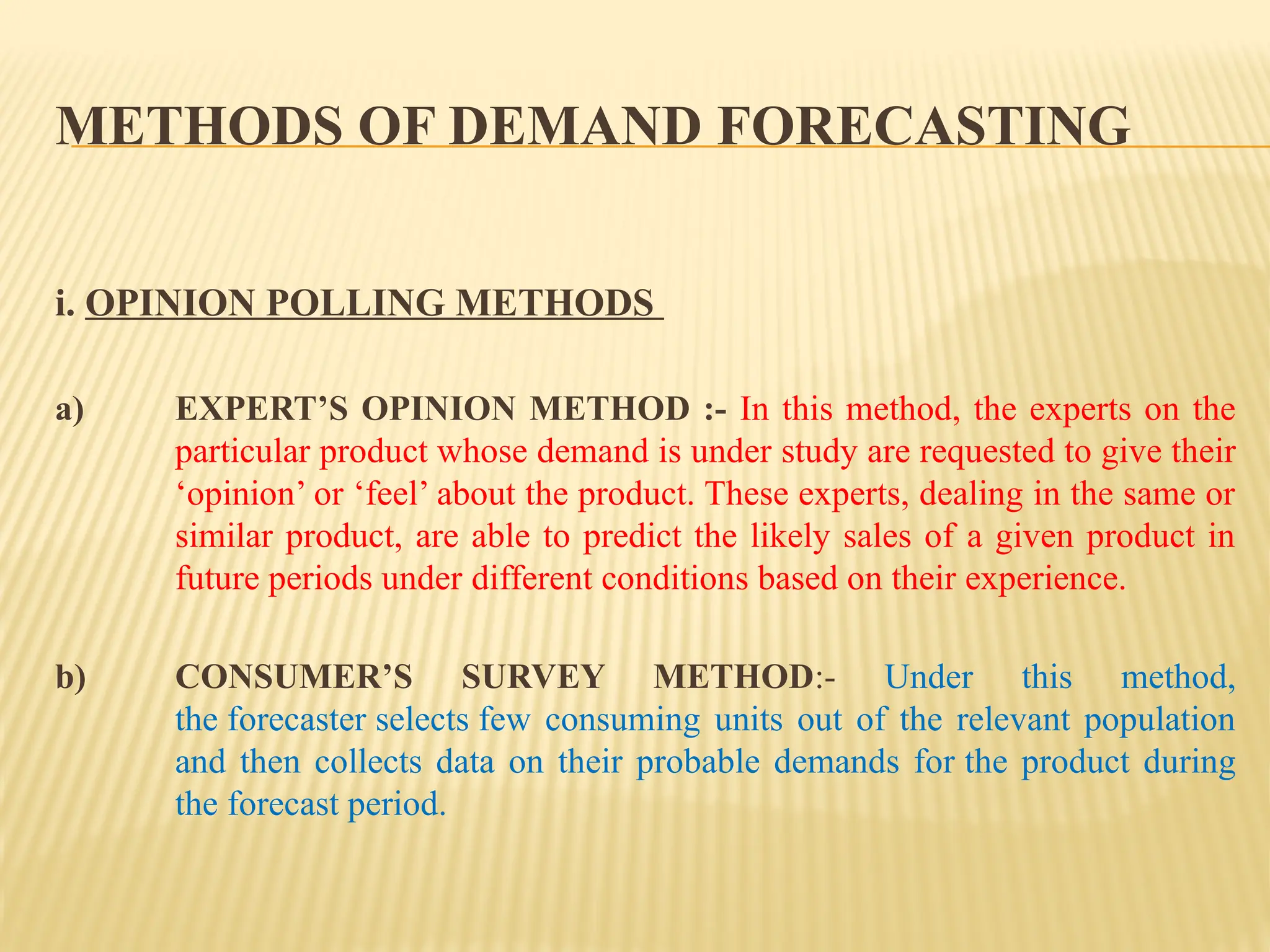
i. OPINION POLLING METHODS
a) EXPERT’S OPINION METHOD :- In this method, the experts on the
particular product whose demand is under study are requested to give their
‘opinion’ or ‘feel’ about the product. These experts, dealing in the same or
similar product, are able to predict the likely sales of a given product in
future periods under different conditions based on their experience.
b) CONSUMER’S SURVEY METHOD:- Under this method,
the forecaster selects few consuming units out of the relevant population
and then collects data on their probable demands for the product during
the forecast period.
CONTINUED……
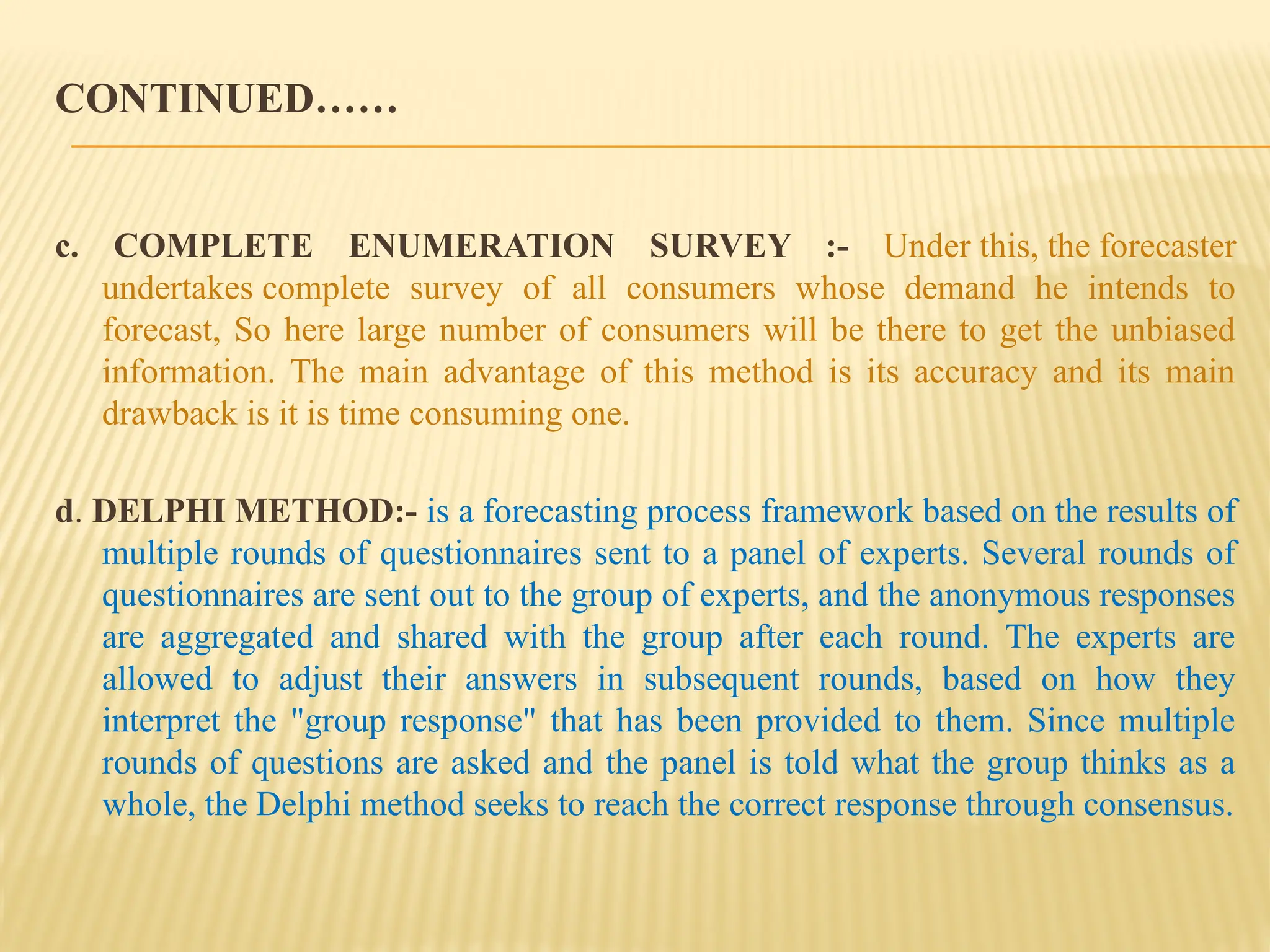
c. COMPLETE ENUMERATION SURVEY :- Under this, the forecaster
undertakes complete survey of all consumers whose demand he intends to
forecast, So here large number of consumers will be there to get the unbiased
information. The main advantage of this method is its accuracy and its main
drawback is it is time consuming one.
d. DELPHI METHOD:- is a forecasting process framework based on the results of
multiple rounds of questionnaires sent to a panel of experts. Several rounds of
questionnaires are sent out to the group of experts, and the anonymous responses
are aggregated and shared with the group after each round. The experts are
allowed to adjust their answers in subsequent rounds, based on how they
interpret the "group response" that has been provided to them. Since multiple
rounds of questions are asked and the panel is told what the group thinks as a
whole, the Delphi method seeks to reach the correct response through consensus.
CONTINUED……
ii. STATISTICAL METHODS:
a. TREND PROJECTION METHOD:- Under this method, the time series data
on the under forecast are used to fit a trend line or curve either graphically or
through statistical method of Least Squares. The trend line is worked out by fitting
a trend equation to time series data with the aid of an estimation method. The trend
equation could take either a linear or any kind of non-linear form.
b. BAROMETRIC TECHNIQUE:- the barometric method of forecasting is used
by the meteorologists in weather forecasting. The weather conditions are
forecasted on the basis of the movement of mercury in a barometer. This method is
based on the past demands of the product and tries to project the past into the
future. The economic indicators are used to predict the future trends of
the business. Based on future trends, the demand for the product is forecasted.
CONTINUED……
c. REGRESSION ANALYSIS: This method establishes a relationship between
the dependent variable and the independent variables. In our case, the quantity
demanded is the dependent variable and income, the price of goods, the price of
related goods, the price of substitute goods, etc. are independent variables. The
regression equation is derived assuming the relationship to be linear.
Regression Equation: Y = a + bX. Where Y is the forecasted demand for a
product or service.
d. SIMPLE MOVING AVERAGES:- The best-known forecasting methods is
the moving averages or simply takes a certain number of past periods and add
them together; then divide by the number of periods. Simple Moving Averages
(MA) is effective and efficient approach provided the time series is stationary
in both mean and variance. The following formula is used in finding the
moving average of order n, MA(n) for a period t+1,
SUPPLY
MEANING OF SUPPLY
Supply of a commodity refers to the various quantities of the commodity which
a seller is willing and able to sell at different prices in a given market at a point
of time, other things remaining the same. Supply is what the seller is able and
willing to offer for sale.
The quantity supplied is the amount of a particular commodity that a firm is
willing and able to offer for sale at a particular price during a given time period.
Law of Supply
States that, all other factors being equal, “as the price of a good or service
increases, the quantity of goods or services that suppliers offer will
increase, and vice versa.” The law of supply says that as the price of an item
goes up, suppliers will attempt to maximize their profits by increasing the
quantity offered for sale.
LAW OF SUPPLY
States that, all other factors being equal, “as the price of a good or service
increases, the quantity of goods or services that suppliers offer will
increase, and vice versa.” The law of supply says that as the price of an item
goes up, suppliers will attempt to maximize their profits by increasing the
quantity offered for sale.
Assumptions:-
 No change in cost of production
 No change in technology
 No change in prices of substitutes
 No change in price of capital goods
 No change in tax policy
 No change in climate
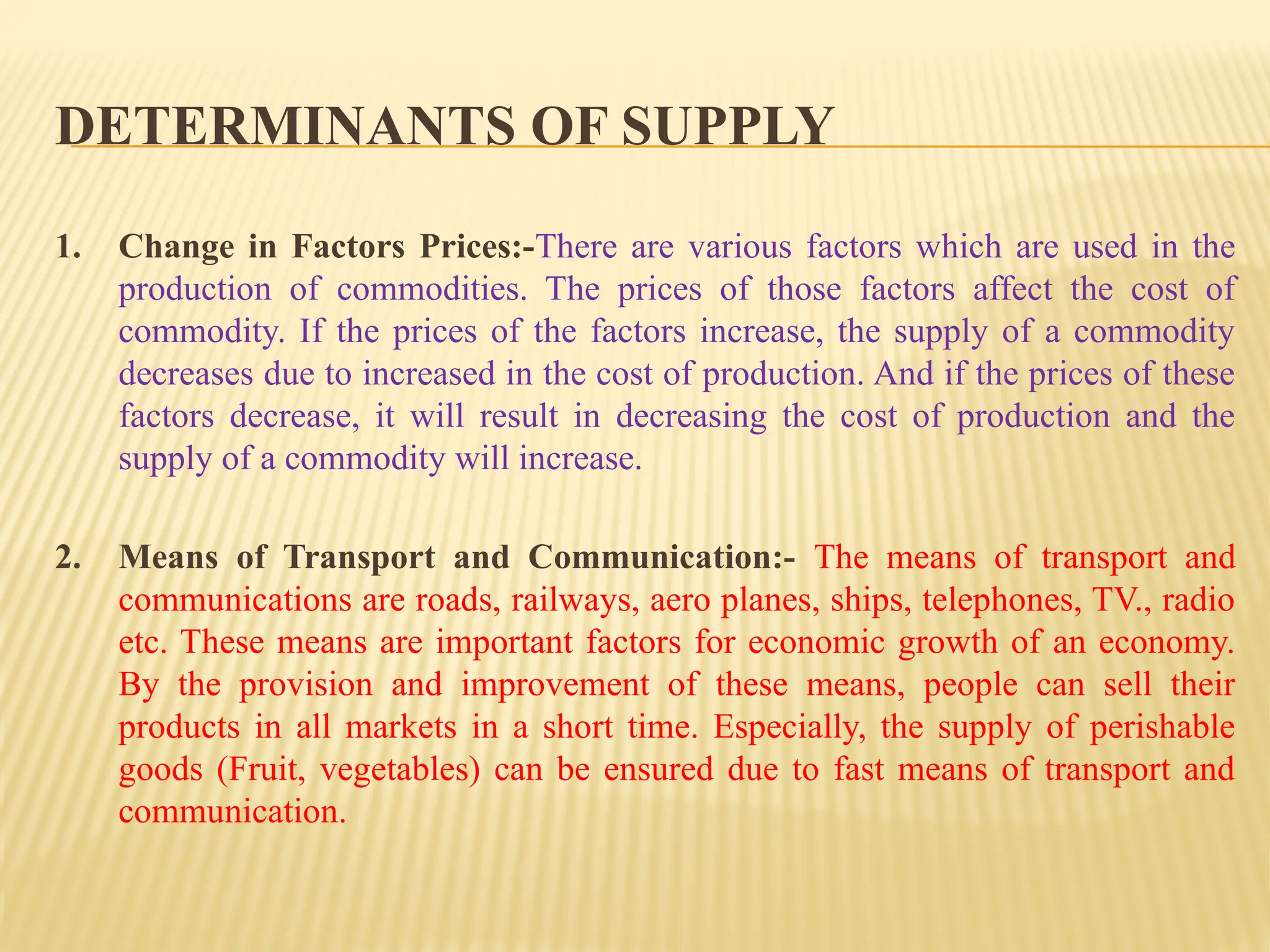
DETERMINANTS OF SUPPLY
1. Change in Factors Prices:-There are various factors which are used in the
production of commodities. The prices of those factors affect the cost of
commodity. If the prices of the factors increase, the supply of a commodity
decreases due to increased in the cost of production. And if the prices of these
factors decrease, it will result in decreasing the cost of production and the
supply of a commodity will increase.
2. Means of Transport and Communication:- The means of transport and
communications are roads, railways, aero planes, ships, telephones, TV., radio
etc. These means are important factors for economic growth of an economy.
By the provision and improvement of these means, people can sell their
products in all markets in a short time. Especially, the supply of perishable
goods (Fruit, vegetables) can be ensured due to fast means of transport and
communication.
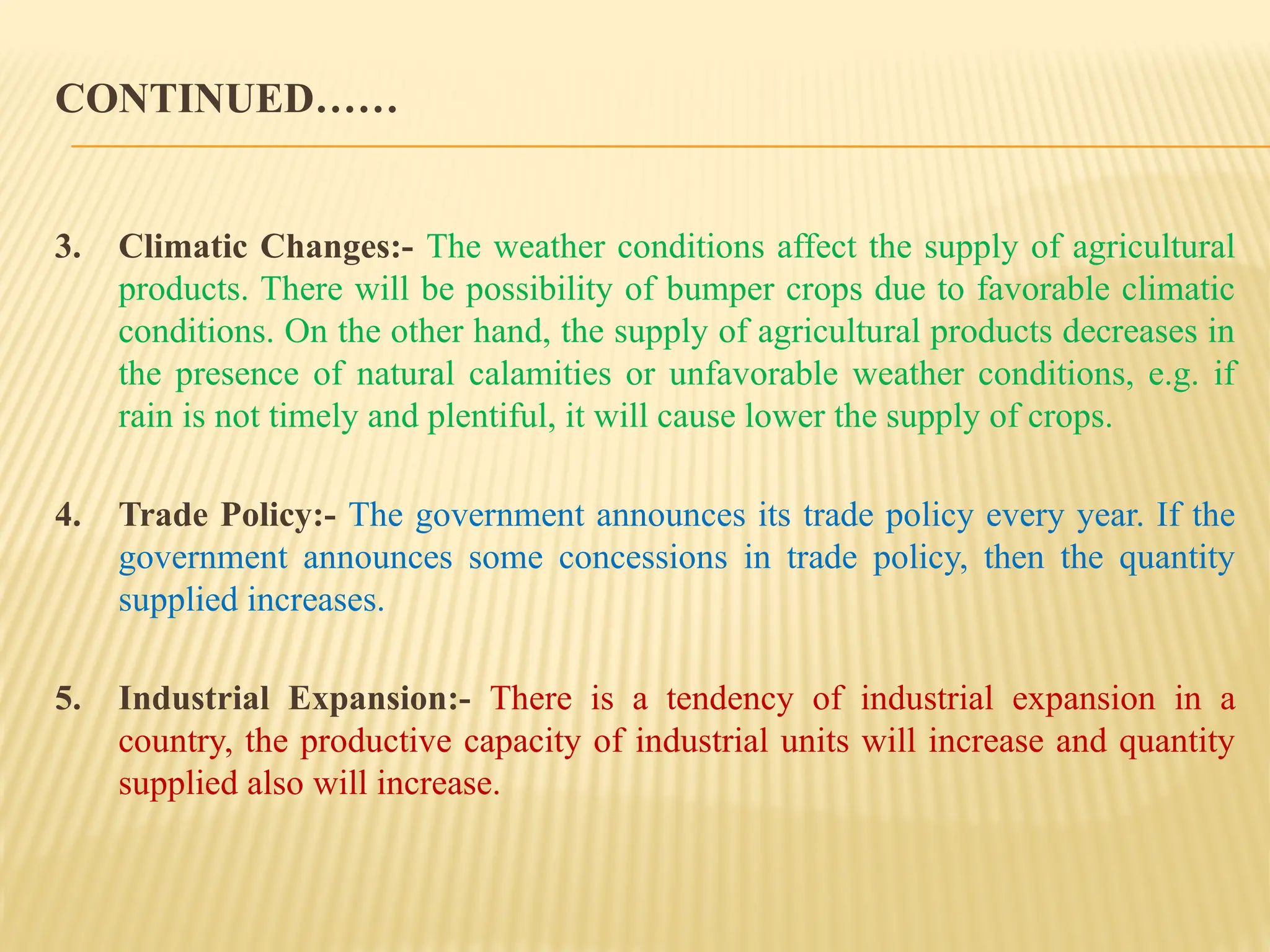
CONTINUED……
3. Climatic Changes:- The weather conditions affect the supply of agricultural
products. There will be possibility of bumper crops due to favorable climatic
conditions. On the other hand, the supply of agricultural products decreases in
the presence of natural calamities or unfavorable weather conditions, e.g. if
rain is not timely and plentiful, it will cause lower the supply of crops.
4. Trade Policy:- The government announces its trade policy every year. If the
government announces some concessions in trade policy, then the quantity
supplied increases.
5. Industrial Expansion:- There is a tendency of industrial expansion in a
country, the productive capacity of industrial units will increase and quantity
supplied also will increase.
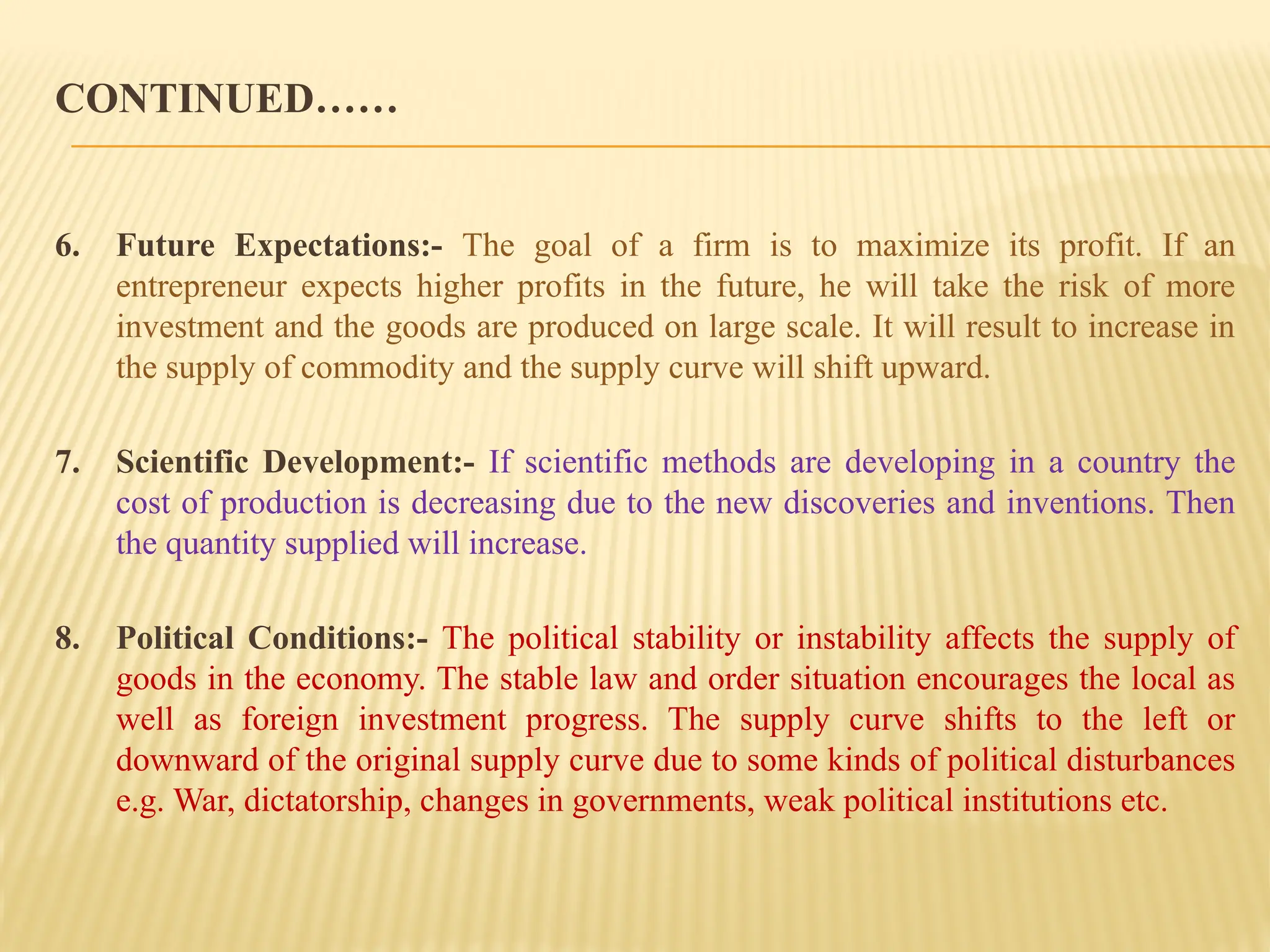
CONTINUED……
6. Future Expectations:- The goal of a firm is to maximize its profit. If an
entrepreneur expects higher profits in the future, he will take the risk of more
investment and the goods are produced on large scale. It will result to increase in
the supply of commodity and the supply curve will shift upward.
7. Scientific Development:- If scientific methods are developing in a country the
cost of production is decreasing due to the new discoveries and inventions. Then
the quantity supplied will increase.
8. Political Conditions:- The political stability or instability affects the supply of
goods in the economy. The stable law and order situation encourages the local as
well as foreign investment progress. The supply curve shifts to the left or
downward of the original supply curve due to some kinds of political disturbances
e.g. War, dictatorship, changes in governments, weak political institutions etc.
CONTINUED……
9. Taxation Policy:- The Taxation policy of a government directly affects the supply of
locally manufactured goods as well as imports. If government levies heavy taxes, the
supply of imports decreases. The supply curve shifts upward or down ward by
decreasing or increasing the rate of taxes.
10. Means of Transport and Communications:- The means of transport and
communications are important factors for economic growth of an economy. By the
provision and improvement of these means, people can sell their products in all
markets in a short time. Especially, the supply of perishable goods (Fruit, vegetables)
can be ensured due to fast means of transport and communication.
11. Change in the Prices of Substitutes:- If the. Prices of substitutes decrease the
purchasing tendency of buyers will divert to that commodities and the supply of
commodity will decrease.
ELASTICITY OF SUPPLY
Responsiveness of producers to changes in the price of their goods or services.
As a general rule, if prices rise so does the supply.
Elasticity of supply is measured as the ratio of proportionate change in the
quantity supplied to the proportionate change in price. High elasticity indicates
the supply is sensitive to changes in prices, low elasticity indicates little
sensitivity to price changes, and no elasticity means no relationship with price.
Also called price elasticity of supply.
Price elasticity of supply measures the relationship between change in
quantity supplied and a change in price.
Elasticity of Supply (Es)=
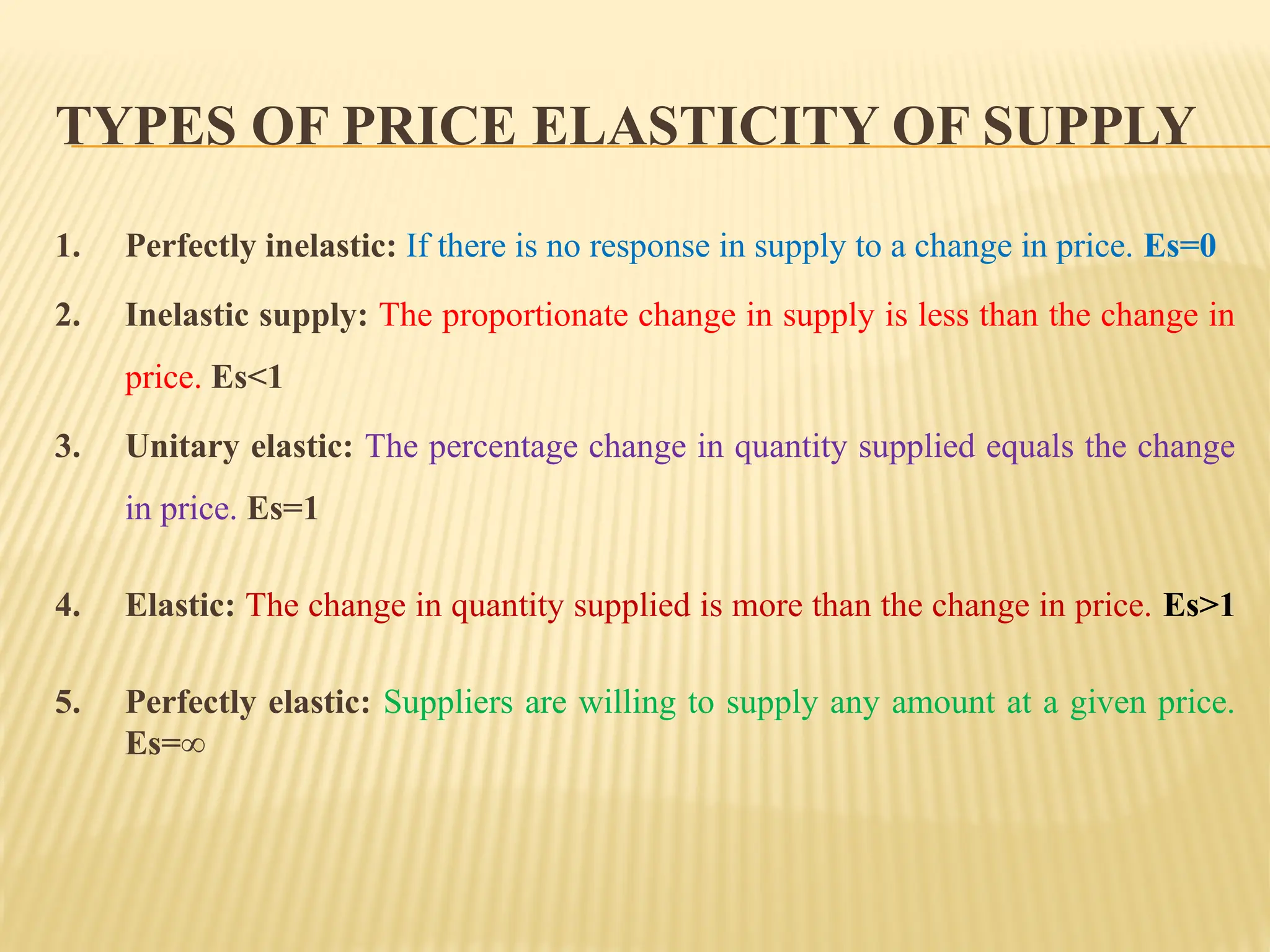
TYPES OF PRICE ELASTICITY OF SUPPLY
1. Perfectly inelastic: If there is no response in supply to a change in price. Es=0
2. Inelastic supply: The proportionate change in supply is less than the change in
price. Es<1
3. Unitary elastic: The percentage change in quantity supplied equals the change
in price. Es=1
4. Elastic: The change in quantity supplied is more than the change in price. Es>1
5. Perfectly elastic: Suppliers are willing to supply any amount at a given price.
Es=∞
Demand ANALYSIS.pptx for the education purpose

Demand ANALYSIS.pptx for the education purpose

  • 1.
  • 2.
    TABLE OF CONTENT Conceptsof Demand and Supply:  Demand Analysis  Law of Demand  Determinants of Demand  Elasticity of Demand: Price, Income and cross Elasticity  Uses of concept of elasticity of demand in managerial decision  Demand Forecasting: Meaning, significance and methods of demand forecasting,  Law of Supply  Determinants of supply  Elasticity of supply
  • 3.
    DEMAND  Demand refersto the willingness and ability of consumers to purchase a given quantity of a good or service at a given price, at a point of time and at given place.  In economics, demand is formally defined as ‘effective’ demand meaning that it is a consumer want or a need supported by an ability to pay – namely a budget derived from disposable income. Income provides individuals with a purchasing power which they exercise in a market through effective demand. Wish to buy Willingness to pay Ability to pay =Demand yes No No No Yes Yes No No Yes Yes Yes Yes
  • 4.
    CLARIFICATION…..  Here considerationof possibility of sales of goods is important because we always see the demand from the producers perspective. So any desire of consumer which can not be converted into sales will not be amounted as demand and hence not relevant. means any ‘desire or willingness to buy’ a product if not supported by ‘willingness to pay’ and ‘ability to pay’ will not be considered as demand. So, Demand= Wish to buy + Willingness to pay + Ability to pay Further, Demand can be specify only at given price, for give period of time and for given place. Example, if we ask, what is the demand of BMW car? The question does not clarifies demand at which price, for which year or month, in which country or state. The complete question will be, What will be demand of BMW in 2021, in India at a price of Rs. 5 millions?
  • 5.
    DEMAND FUNCTION A mathematicalexpression of relationship between quantity demanded of the commodity and its determinants is known as the demand function. Explained below. Qx = f(Px, Py, Pz, I, T, etc.) Where, Qx= Quantity Demanded of X Px= Price of commodity X Py= Price of Substitute goods Pz= Price of complementary goods I = Income of the Customer T = Taste of the consumer
  • 6.
    DEMAND SCHEDULE Demand scheduleis a tabular statement showing various quantities of a commodity being demanded at various levels of price, during a given period of time. It shows the relationship between price of the commodity and its quantity demanded. A demand schedule can be determined both for individual buyers and for the entire market. So, demand schedule is of two types: 1. Individual Demand Schedule:- Individual demand schedule refers to a tabular statement showing various quantities of a commodity that a consumer is willing to buy at various levels of price, during a given period of time. 2. Market Demand Schedule:- Market demand schedule refers to a tabular statement showing various quantities of a commodity that all the consumers are willing to buy at various levels of price, during a given period of time. It is the sum of all individual demand schedules at each and every price.
  • 7.
    DEMAND CURVE Demand curveis the graphical representation of the demand schedule. Demand curve is obtained by plotting a demand schedule on a graph. As discussed earlier, demand curve slopes downward from left to right. It has a negative slope. It shows there is inverse relationship between price and quantity demanded of a commodity.
  • 8.
    TYPES OF DEMAND 1.Direct and indirect demand: Producers’ goods and consumers’ goods: demand for goods that are directly used for consumption by the ultimate consumer is known as direct demand (example: Demand for T shirts). On the other hand demand for goods that are used by producers for producing goods and services. (example: Demand for cotton by a textile mill) 2. Derived demand and autonomous demand: When a produce derives its usage from the use of some primary product it is known as derived demand. (example: demand for tyres derived from demand for car) Autonomous demand is the demand for a product that can be independently used. (example: demand for a washing machine)
  • 9.
    CONTINUED….. 3. Durable andnon durable goods demand: Durable goods are those that can be used more than once, over a period of time (example: Microwave oven) Non durable goods can be used only once (example: Band-aid) 4. Firm and industry demand: Firm demand is the demand for the product of a particular firm. (example: Dove soap) The demand for the product of a particular industry is industry demand (example: demand for steel in India )
  • 10.
    CONTINUED….. 5. Total marketand market segment demand: A particular segment of the markets demand is called as segment demand (example: demand for 21 laptops by engineering students) The sum total of the demand for laptops by various segments in India is the total market demand. (example: demand for laptops in India) 6. Short run and long run demand: Short run demand refers to demand with its immediate reaction to price changes and income fluctuations. Long run demand is that which will ultimately exist as a result of the changes in pricing, promotion or product improvement after market adjustment with sufficient time.
  • 11.
    CONTINUED….. 7. Joint demandand Composite demand: When two goods are demanded in conjunction with one another at the same time to satisfy a single want, it is called as joint or complementary demand. (example: demand for petrol and two wheelers) A composite demand is one in which a good is wanted for several different uses. ( example: demand for iron rods for various purposes) 8. Price demand, income demand and cross demand: Demand for commodities by the consumers at alternative prices are called as price demand. Quantity demanded by the consumers at alternative levels of income is income demand. Cross demand refers to the quantity demanded of commodity ‘X’ at a price of a related commodity ‘Y’ which may be a substitute or complementary to X.
  • 12.
    THE LAW OFDEMAND The law of demand states that, if all other factors remain equal, “As the price increases, quantity demanded of that commodity decreases and as the price decreases the quantity demanded of the commodity increases.” Px Dx Px Dx Where, Px= Price of Commodity X Dx= Demand of Commodity X
  • 13.
    ASSUMPTIONS TO LAWOF DEMAND I. There is no change in the tastes and preferences of the consumer; II. The income of the consumer remains constant; III. There is no change in customs; IV. There should not be any substitutes of the commodity; V. There should not be any change in the prices of other products; VI. There should not be any change in the quality of the product; and VII. The habits of the consumers should remain unchanged.
  • 14.
    EXCEPTIONS TO THELAW OF DEMAND: In certain cases, the demand curve slopes up from left to right, i.e., it has a positive slope. Under certain circumstances, consumers buy more when the price of a commodity rises, and less when price falls: (i) War:- If shortage is feared in anticipation of war, people “may start buying for building stocks or for hoarding even when the” price rises. (ii) Depression:- During a depression, the prices of commodities are very low and the demand for them is also less. This is because of the lack of purchasing power with consumers. (iii) Ignorance Effect:- Consumers buy more at a higher price under the influence of the “ignorance effect”, where a commodity may be mistaken for some other commodity, due to deceptive packing, label, etc.
  • 15.
    CONTINUED….. (iv) Giffen Paradox:-If a commodity happens to be a necessity of life like wheat and its price goes up, consumers are forced to curtail the consumption of more expensive foods like meat and fish, and wheat being still the cheapest, food they will consume more of it. (v) Demonstration Effect (Veblen Goods):- If consumers are affected by the principle of conspicuous consumption or demonstration effect, they will like to buy more of those commodities which confer distinction on the possessor, when their prices rise. On the other hand, with the fall in the prices of such articles, their demand falls, as is the case with diamonds.
  • 16.
    DETERMINANTS OF DEMAND Thedemand for a product is determined by different factors. The main demand determinants are price, income, price of related goods and advertising. Therefore, demand is a multivariate relationship, i.e. it is determined by many factors simultaneously. (A) Determinants of Individual Demand: Let us discuss the variables which influence the individual demand. 1. Price of the Commodity:- Normally a larger quantity is demanded at a lower price that at a higher price. There is inverse relationship between the price and quantity demanded. This is called the law of demand.
  • 17.
    CONTINUED….. 2. Income ofthe Consumer:- The income of the consumer is another important variable which influences demand. The ability to buy a commodity depends upon the income of the consumer. When the income of the consumers increases, they buy more and when income falls they buy less. 3. Tastes and Preferences:- The demand for a product depends upon tastes and preferences of the consumers. If the con­ sumers develop taste for a commodity they buy whatever may be the price. 4. Prices of Related Goods:-The related goods are generally substitutes and complementary goods. The demand for a product is also influenced by the prices of substitutes and complements. When a want can be satisfied by alternative similar goods they are called substitutes, such as coffee and tea. Whenever the price of one good and the demand for another are inversely related then the goods are said to be complementary, such as car and petrol.
  • 18.
    CONTINUED….. 5. Advertisement andSales Propaganda:- Advertisement helps in increasing demand by informing the potential consumers about the avail­ ability of the product, by showing the superiority of the product, and by influencing consumer choice against the rival products. The demand for products like detergents and cosmetics is mainly caused by advertisement. 6. Consumer’s Expectation:- A consumer s expectation about the future changes in price and income may also affect his demand. If a consumer expects a rise in prices he may buy large quantities of that particular commodity. Similarly, if he expects its prices to fall in future, he will tend to buy less at present. Similarly, expectation of rising income may induce him to increase his current consumption.
  • 19.
    CONTINUED….. (B) Determinants ofMarket Demand:- Market demand for a product refers to the total demand of all the buyers taken together. How much quantity the consumers in general would buy at a given period of time constitutes the total market demand for the product. 1. Price of the Product:- The law of demand states that if other things remain the same when price falls, demand increases and vice-versa. 2. Standard of Living and Spending Habits:- When people are accustomed to high standard of living their spending on comforts and luxuries also increase, that automatically increase the demand. 3. Distribution of Income Pattern:- If the distribution pattern of income is fair and equal the market demand for essential items tends to be greater.
  • 20.
    CONTINUED….. 4. The Scaleof Preferences:- The market demand for a product is also affected by the scale of preference of buyers. If there is a shift in consumers’ preference from x to y, the demand for у tends to increase. 5. The Growth of Population:- The growth of population is also another important factor that affects the market demand. With the increase in population, people naturally demand more goods for their survival. 6. Social Customs and Ceremonies:- Social customs and ceremonies are usually celebrated collectively. They involve extra expenditure on certain items and thereby increase the demand. 7. Future Expectation:- People are not sure about their future, because future is uncertain. If the consumers expect a rise in prices of products, they buy more at present and preserve the same for the future, thereby the market demand would be affected.
  • 21.
    CONTINUED….. 8. Tax Rate:-High tax rate would generally mean a low demand for the goods. At certain times the government restricts the consumption of a commodity and uses the tax as a weapon. 9. Inventions and Innovations:- Inventions and innovations introduce new goods in the market. The consumers will have a strong tendency to purchase the new product. The preference over the new goods adversely affects the demand for the existing goods in the market. 10. Weather Conditions:- Seasonal factors also affect the demand. The demand for certain items purely depends on climatic and weather conditions. For example, the growing demand for cold drinks during the summer season and the demand for sweaters during the winter season.
  • 22.
    CONTINUED….. 11. Availability ofCredit:- The purchasing power is influenced by the availability of credit. If there is availability of cheap credit, the consumers try to spend more on consumer durables thereby the demand for certain products increase. 12. Pattern of Saving:- If people begin to save more, their demand will decrease. It means the disposable income will be less to purchase the goods and services. On the contrary, if saving is less their demand will increase. 13. Demonstration Effect:- Demonstration effect helps to increase human wants. In underde­ veloped countries, there is a desire in the minds of the people to imitate other people for conspicuous consumption and that is why they are not able to save. This change in the saving habits of the people is due to “contact effect”. The demonstration effect has a positive effect on the demand for comforts and luxury goods.
  • 23.
    UTILITY ANALYSIS What IsUtility? Utility is a term in economics that refers to the total satisfaction received from consuming a good or service. Economic theories based on rational choice usually assume that consumers will strive to maximize their utility. The economic utility of a good or service is important to understand, because it directly influences the demand, and therefore price, of that good or service. In practice, a consumer's utility is impossible to measure and quantify. However, some economists believe that they can indirectly estimate what is the utility for an economic good or service by employing various models. The utility definition in economics is derived from the concept of usefulness. An economic good yields utility to the extent to which it's useful for satisfying a consumer’s want or need.
  • 24.
    APPROACHES TO UTILITYANALYSIS There are to ways to measure utility:- 1. Ordinal Approach:- according to this approach, utility is a psychological term, can be explained in qualitative aspect. Hence can not be measured in numerical value, only can be compared. 2. Cardinal Approach:- according to this approach, utility can be quantify and hence can be measured in numerical value. Unit used for measuring utility is “Util”.
  • 25.
    TOTAL UTILITY Total utilityis the sum of utility derived from different units of a commodity consumed by a consumer at any point of consumption. According to Leftwitch, “Total utility refers to the entire amount of satisfaction obtained from consuming various quantities of a commodity.” Suppose a consumes X unit of a commodity, then total utility consumed by consumer Ux is:- Ux = U1+ U2+U3+………Ux
  • 26.
    MARGINAL UTILITY The MarginalUtility is the utility derived from the additional unit of a commodity consumed. The change that takes place in the total utility by the consumption of an additional unit of a commodity calls marginal utility. According to Chapman, “Marginal utility is the addition made to total utility by consuming one more unit of commodity.” The marginal utility can measure with the help of the following formula MUnth = TUn – TUn-1 Here; MUnth= Marginal utility of nth unit. TUn= Total utility of “n” units, and. TUn-1 = Total utility of n-1 units.
  • 27.
    THE LAW OFDIMINISHING MARGINAL UTILITY This is an important law under Marginal Utility Analysis. Alfred Marshall, British Economist defines the law of diminishing marginal utility as follows: “The additional benefit which a person derives from a given increase in the stock of a thing diminishes with every increase in the stock that he already has.” This law is based on the fundamental tendency of human nature. Human wants are virtually unlimited. However, every single want is satiable. Hence, as we consume more and more units of a good, the intensity of our want for the good decreases. Eventually, it reaches a point where we no longer want it. In other words, as we consume more units of a good, the extra satisfaction that we derive from the extra unit keeps falling. However, it is important to remember that the marginal utility declines not the total utility.
  • 28.
    ELASTICITY OF DEMAND Ifprice changes we know the demand changes, but by how many percentage? Means what is the elasticity of that demand? Elasticity measures the extent to which demand will change. Elasticity of demand is a measure to responsiveness of change in quantity demanded of a commodity due to change in a particular factor of demand. Elasticity of Demand= Elasticity can be of three types: 1. Price Elasticity of Demand 2. Income Elasticity of Demand 3. Cross Elasticity of Demand
  • 29.
    1. PRICE ELASTICITYOF DEMAND Price elasticity of demand measures the percentage change in quantity demanded caused by a percent change in price. Price Elasticity of Demand (Ep)= Ep= Where, ∆q= Change in quantity demanded of commodity x ∆p= Change in price of commodity x p= price of commodity x q= quantity demanded of commodity x
  • 30.
    TYPES OF PRICEELASTICITY OF DEMAND 1. ELASTIC DEMAND:- a change in price, results in a greater than proportional change in the quantity demanded. Ep>1 2. INELASTIC DEMAND:- a change in price results in a less than proportional change. Ep<1 3. UNITARY ELASTIC DEMAND :- a change in price results in n equal proportional change. Ep=1 4. PERFECTLY ELASTIC DEMAND :- demand changes even when price remains unchanged. Ep=∞ 5. PERFECTLY INELASTIC DEMAND ;- change in price does not result in any change. Ep=0
  • 31.
    INCOME ELASTICITY OFDEMAND The percentage change in quantity demanded due to percentage change in income is called income elasticity of demand. Income elasticity of demand measures the responsiveness of demand for a good to change in income of consumer. Income Elasticity of Demand (Ey) = Ey= Where, ∆q= change in quantity demanded of commodity x ∆y= change in the income of the consumer q= quantity demanded of commodity x y= income of the consumer
  • 32.
    TYPES OF INCOMEELASTICITY OF DEMAND 1. POSITIVE INCOME ELASTICITY A rise in income will cause a rise in demand , A fall in income will cause a fall in demand. Ey>0 2. NEGATIVE INCOME ELASTICITY An increase in income will result in a decrease in demand, A decrease in income will result in a rise in demand. (ex. Inferior good) Ey<0 3. ZERO INCOME ELASTICITIES This occurs when a change in income has NO effect on the demand for goods. (ex. A rise of 5% income will leave the Demand for salt unchanged). Ey=0
  • 33.
    CROSS ELASTICITY OFDEMAND There is cross elasticity of demand when demand for a commodity changes due to a change in the price of another related commodity. In fact cross elasticity of demand measures the change in demand of a commodity (say coffee) when the prices of another related commodity (say tea) changes by small amount. Cross Elasticity of Demand (Ec)= Ec= Where, ∆qx= change in quantity demanded of commodity ‘x’ ∆px = change in Price of related commodity ‘y’ qx = quantity demanded of commodity ‘x’ px = Price of related goods ‘y’ (substitute or complementary goods)
  • 34.
    TYPES OF CROSSELASTICITY OF DEMAND 1. Positive Cross Elasticity of Demand Implies that the cross elasticity of demand would be positive when increase in the price of one good (Y) causes increase in the demand for the other good (X). In simple terms, cross elasticity would be positive for substitutes. (ex. Tea and coffee). Ec>0 2. Negative Cross Elasticity of Demand Refers to a situation when the rise in the price of one good (Y) reduces the demand for the other good (X). The cross elasticity of demand would be negative for complementary goods. (ex. Pen and Ink) Ec<0
  • 35.
    USE OF ELASTICITYOF DEMAND IN MANGERIAL DECISIONS 1. Price Discrimination:- A monopolist adopts a price discrimination policy only when the elasticity of demand of different consumers or sub-markets is different. Consumers whose demand is inelastic can be charged a higher price than those with more elastic demand. 2. Factor pricing:-Elasticity of demand is used as tool to determine prices of factors of production. In case of inelastic demand prices are fixed high. When there is an elastic demand prices are fixed at low level. 3. For forecasting demand:- Income elasticity of demand can be used for predicting future demand of any goods and services in a case when manufacturers have knowledge of probable future income of the consumers.
  • 36.
    CONTINUED…… 4. Prices andoutput determination:- The producers make decisions about output and prices. Elasticity of demand is helpful information for producers. The price is high for less elastic demand. In case of elastic demand price is low. 5. Sales policy in super market:- In super market sales policy is determined on the basis of elasticity of demand. Lowering price level maximizes the sales. So they lower the price to increase sales quantity, Which will result as increase in final sale value. 6. Labor Force Replacement:- Elasticity of demand for production determines whether or not machines will replace labor. In case of inelastic demand output will be fixed, so labor force can be replaced by machines. But in case of elastic demand, output keep changing and to cope-up with that change labor force is needed.
  • 37.
    CONTINUED…… 7. Shifting ofTax Burden:- It is possible for a business to shift a commodity tax in case of inelastic demand to his customers. But if the demand is elastic, he will have to bear the tax burden himself, otherwise demand for his goods will go down sharply. 8. Joint Product Prices:-Certain goods, being products of the same process are jointly supplied, e.g. milk and butter. Here if the demand for milk is inelastic compared to the demand for butter, a higher price for milk can be charged with advantage. 9. Imposition of GST:- The government can impose GST on different goods. Elasticity of demand is helpful to select goods for tax. When demand is inelastic tax GST can be imposed at high rate. In case of elastic demand tax GST will be imposed at lower rate. 10. Others:- Product dumping, deciding of price strategy, Public utility pricing etc.
  • 38.
    DEMAND FORECASTING Demand forecastingis a combination of two words; the first one is Demand and another forecasting. Demand means outside requirements of a product or service. In general, forecasting means making an estimation in the present for a future occurring event. So, “Demand forecasting is the process of making estimations about future customer demand over a defined period, using historical data and other information.” Critical business assumptions like turnover, profit margins, cash flow, capital expenditure, risk assessment and mitigation plans, capacity planning, etc. are dependent on Demand Forecasting.
  • 39.
    IMPORTANCE OF DEMANDFORECASTING  Sales forecasting helps with business planning, budgeting, and goal setting.  It allows businesses to more effectively optimize inventory, increase inventory turnover rates and reduce holding costs.  Plays a crucial role in making budget by estimating costs and expected revenues.  Anticipating demand means knowing when to increase staff and other resources to keep operations running smoothly during peak periods.  It helps an organization to control its production and recruitment activities.
  • 40.
    METHODS OF DEMANDFORECASTING i. OPINION POLLING METHODS a) EXPERT’S OPINION METHOD :- In this method, the experts on the particular product whose demand is under study are requested to give their ‘opinion’ or ‘feel’ about the product. These experts, dealing in the same or similar product, are able to predict the likely sales of a given product in future periods under different conditions based on their experience. b) CONSUMER’S SURVEY METHOD:- Under this method, the forecaster selects few consuming units out of the relevant population and then collects data on their probable demands for the product during the forecast period.
  • 41.
    CONTINUED…… c. COMPLETE ENUMERATIONSURVEY :- Under this, the forecaster undertakes complete survey of all consumers whose demand he intends to forecast, So here large number of consumers will be there to get the unbiased information. The main advantage of this method is its accuracy and its main drawback is it is time consuming one. d. DELPHI METHOD:- is a forecasting process framework based on the results of multiple rounds of questionnaires sent to a panel of experts. Several rounds of questionnaires are sent out to the group of experts, and the anonymous responses are aggregated and shared with the group after each round. The experts are allowed to adjust their answers in subsequent rounds, based on how they interpret the "group response" that has been provided to them. Since multiple rounds of questions are asked and the panel is told what the group thinks as a whole, the Delphi method seeks to reach the correct response through consensus.
  • 42.
    CONTINUED…… ii. STATISTICAL METHODS: a.TREND PROJECTION METHOD:- Under this method, the time series data on the under forecast are used to fit a trend line or curve either graphically or through statistical method of Least Squares. The trend line is worked out by fitting a trend equation to time series data with the aid of an estimation method. The trend equation could take either a linear or any kind of non-linear form. b. BAROMETRIC TECHNIQUE:- the barometric method of forecasting is used by the meteorologists in weather forecasting. The weather conditions are forecasted on the basis of the movement of mercury in a barometer. This method is based on the past demands of the product and tries to project the past into the future. The economic indicators are used to predict the future trends of the business. Based on future trends, the demand for the product is forecasted.
  • 43.
    CONTINUED…… c. REGRESSION ANALYSIS:This method establishes a relationship between the dependent variable and the independent variables. In our case, the quantity demanded is the dependent variable and income, the price of goods, the price of related goods, the price of substitute goods, etc. are independent variables. The regression equation is derived assuming the relationship to be linear. Regression Equation: Y = a + bX. Where Y is the forecasted demand for a product or service. d. SIMPLE MOVING AVERAGES:- The best-known forecasting methods is the moving averages or simply takes a certain number of past periods and add them together; then divide by the number of periods. Simple Moving Averages (MA) is effective and efficient approach provided the time series is stationary in both mean and variance. The following formula is used in finding the moving average of order n, MA(n) for a period t+1,
  • 44.
    SUPPLY MEANING OF SUPPLY Supplyof a commodity refers to the various quantities of the commodity which a seller is willing and able to sell at different prices in a given market at a point of time, other things remaining the same. Supply is what the seller is able and willing to offer for sale. The quantity supplied is the amount of a particular commodity that a firm is willing and able to offer for sale at a particular price during a given time period. Law of Supply States that, all other factors being equal, “as the price of a good or service increases, the quantity of goods or services that suppliers offer will increase, and vice versa.” The law of supply says that as the price of an item goes up, suppliers will attempt to maximize their profits by increasing the quantity offered for sale.
  • 45.
    LAW OF SUPPLY Statesthat, all other factors being equal, “as the price of a good or service increases, the quantity of goods or services that suppliers offer will increase, and vice versa.” The law of supply says that as the price of an item goes up, suppliers will attempt to maximize their profits by increasing the quantity offered for sale. Assumptions:-  No change in cost of production  No change in technology  No change in prices of substitutes  No change in price of capital goods  No change in tax policy  No change in climate
  • 46.
    DETERMINANTS OF SUPPLY 1.Change in Factors Prices:-There are various factors which are used in the production of commodities. The prices of those factors affect the cost of commodity. If the prices of the factors increase, the supply of a commodity decreases due to increased in the cost of production. And if the prices of these factors decrease, it will result in decreasing the cost of production and the supply of a commodity will increase. 2. Means of Transport and Communication:- The means of transport and communications are roads, railways, aero planes, ships, telephones, TV., radio etc. These means are important factors for economic growth of an economy. By the provision and improvement of these means, people can sell their products in all markets in a short time. Especially, the supply of perishable goods (Fruit, vegetables) can be ensured due to fast means of transport and communication.
  • 47.
    CONTINUED…… 3. Climatic Changes:-The weather conditions affect the supply of agricultural products. There will be possibility of bumper crops due to favorable climatic conditions. On the other hand, the supply of agricultural products decreases in the presence of natural calamities or unfavorable weather conditions, e.g. if rain is not timely and plentiful, it will cause lower the supply of crops. 4. Trade Policy:- The government announces its trade policy every year. If the government announces some concessions in trade policy, then the quantity supplied increases. 5. Industrial Expansion:- There is a tendency of industrial expansion in a country, the productive capacity of industrial units will increase and quantity supplied also will increase.
  • 48.
    CONTINUED…… 6. Future Expectations:-The goal of a firm is to maximize its profit. If an entrepreneur expects higher profits in the future, he will take the risk of more investment and the goods are produced on large scale. It will result to increase in the supply of commodity and the supply curve will shift upward. 7. Scientific Development:- If scientific methods are developing in a country the cost of production is decreasing due to the new discoveries and inventions. Then the quantity supplied will increase. 8. Political Conditions:- The political stability or instability affects the supply of goods in the economy. The stable law and order situation encourages the local as well as foreign investment progress. The supply curve shifts to the left or downward of the original supply curve due to some kinds of political disturbances e.g. War, dictatorship, changes in governments, weak political institutions etc.
  • 49.
    CONTINUED…… 9. Taxation Policy:-The Taxation policy of a government directly affects the supply of locally manufactured goods as well as imports. If government levies heavy taxes, the supply of imports decreases. The supply curve shifts upward or down ward by decreasing or increasing the rate of taxes. 10. Means of Transport and Communications:- The means of transport and communications are important factors for economic growth of an economy. By the provision and improvement of these means, people can sell their products in all markets in a short time. Especially, the supply of perishable goods (Fruit, vegetables) can be ensured due to fast means of transport and communication. 11. Change in the Prices of Substitutes:- If the. Prices of substitutes decrease the purchasing tendency of buyers will divert to that commodities and the supply of commodity will decrease.
  • 50.
    ELASTICITY OF SUPPLY Responsivenessof producers to changes in the price of their goods or services. As a general rule, if prices rise so does the supply. Elasticity of supply is measured as the ratio of proportionate change in the quantity supplied to the proportionate change in price. High elasticity indicates the supply is sensitive to changes in prices, low elasticity indicates little sensitivity to price changes, and no elasticity means no relationship with price. Also called price elasticity of supply. Price elasticity of supply measures the relationship between change in quantity supplied and a change in price. Elasticity of Supply (Es)=
  • 51.
    TYPES OF PRICEELASTICITY OF SUPPLY 1. Perfectly inelastic: If there is no response in supply to a change in price. Es=0 2. Inelastic supply: The proportionate change in supply is less than the change in price. Es<1 3. Unitary elastic: The percentage change in quantity supplied equals the change in price. Es=1 4. Elastic: The change in quantity supplied is more than the change in price. Es>1 5. Perfectly elastic: Suppliers are willing to supply any amount at a given price. Es=∞