Wall Rock Alteration
Presented by:-
Arvind Shukla
M.Sc.(Final),Applied Geology
University of Allahabad
Email:arvindshukla.au@gmial.com
Introduction
Hydrothermal fluid-
•Underground hot water-rich fluid capable of transporting metals in solution.
•It contains all type of dissolve minerals.
•Noting or pertaining to the action of hot, aqueous solution or gasses within or on the
Earth’s surface.
•Superheated water that remains liquid above boiling point because of extreme high
pressure condition.
Introduction……
•Alteration is a complex process of ion exchange whereby some constituents are
removed, others are added and still others are merely redistributed.
•Unstable rocks undergo physical and chemical changes.
•May be very suble (for ferromagnesian mineral) to very intense (silicification of
limestone) .
•May have reached the surface, or may be blind and found only in
underground workings or in drill holes.
•May range from simple recrystallization to addition, removal or rearrangement of
chemical compounds.
•Importance- Valuable tool in exploration and replacement ores are valuable product of
wall rock alteration.
Physical Effect of Alteration
•It include in recrystallization, change in permeability and color.
•The recrystallized area is generally more permeable than the unaltered rock, suggesting
that the ores owe their localization to increased permeability.
•Argillization may reduce permeability of a rock.
•Color change include bleaching and production of aureoles of various colors.
•Pastel colours are especially prominent around certain ore deposits.
•Pyrite is a standard alteration product around sunfide ore deposits (since iron is one of t
he most abundant metals in the earth's crust).
•Pyrite forms whenever sulfur is added to a host rock containing iron or ferromagnesian
minerals.
•Pyrite causes a striking colour change e.g. the pyritization of a red sandstone or shale
will produce a bleached zone due to reduction of iron.
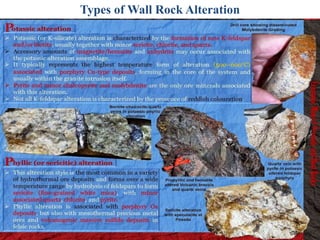
Types of Wall Rock Alteration
Continue……
Continue……
Continue…...
Conclusion-
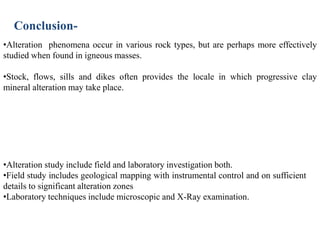
•Alteration phenomena occur in various rock types, but are perhaps more effectively
studied when found in igneous masses.
•Stock, flows, sills and dikes often provides the locale in which progressive clay
mineral alteration may take place.
•Alteration study include field and laboratory investigation both.
•Field study includes geological mapping with instrumental control and on sufficient
details to significant alteration zones
•Laboratory techniques include microscopic and X-Ray examination.
THANK YOU

Wall rock alteration

  • 1.
    Wall Rock Alteration Presentedby:- Arvind Shukla M.Sc.(Final),Applied Geology University of Allahabad Email:arvindshukla.au@gmial.com
  • 2.
    Introduction Hydrothermal fluid- •Underground hotwater-rich fluid capable of transporting metals in solution. •It contains all type of dissolve minerals. •Noting or pertaining to the action of hot, aqueous solution or gasses within or on the Earth’s surface. •Superheated water that remains liquid above boiling point because of extreme high pressure condition.
  • 3.
    Introduction…… •Alteration is acomplex process of ion exchange whereby some constituents are removed, others are added and still others are merely redistributed. •Unstable rocks undergo physical and chemical changes. •May be very suble (for ferromagnesian mineral) to very intense (silicification of limestone) . •May have reached the surface, or may be blind and found only in underground workings or in drill holes. •May range from simple recrystallization to addition, removal or rearrangement of chemical compounds. •Importance- Valuable tool in exploration and replacement ores are valuable product of wall rock alteration.
  • 4.
    Physical Effect ofAlteration •It include in recrystallization, change in permeability and color. •The recrystallized area is generally more permeable than the unaltered rock, suggesting that the ores owe their localization to increased permeability. •Argillization may reduce permeability of a rock. •Color change include bleaching and production of aureoles of various colors. •Pastel colours are especially prominent around certain ore deposits. •Pyrite is a standard alteration product around sunfide ore deposits (since iron is one of t he most abundant metals in the earth's crust). •Pyrite forms whenever sulfur is added to a host rock containing iron or ferromagnesian minerals. •Pyrite causes a striking colour change e.g. the pyritization of a red sandstone or shale will produce a bleached zone due to reduction of iron.
  • 5.
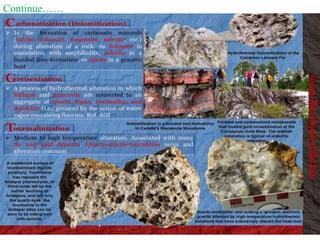
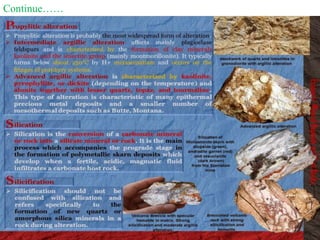
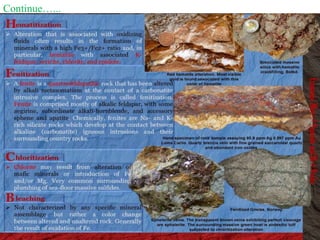
    Types of WallRock Alteration
  • 6.
  • 7.
  • 8.
  • 9.
    Conclusion- •Alteration phenomena occurin various rock types, but are perhaps more effectively studied when found in igneous masses. •Stock, flows, sills and dikes often provides the locale in which progressive clay mineral alteration may take place. •Alteration study include field and laboratory investigation both. •Field study includes geological mapping with instrumental control and on sufficient details to significant alteration zones •Laboratory techniques include microscopic and X-Ray examination.
  • 10.