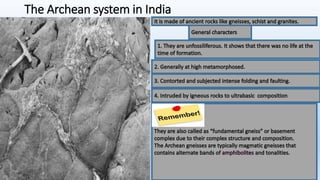
The Archean system in India
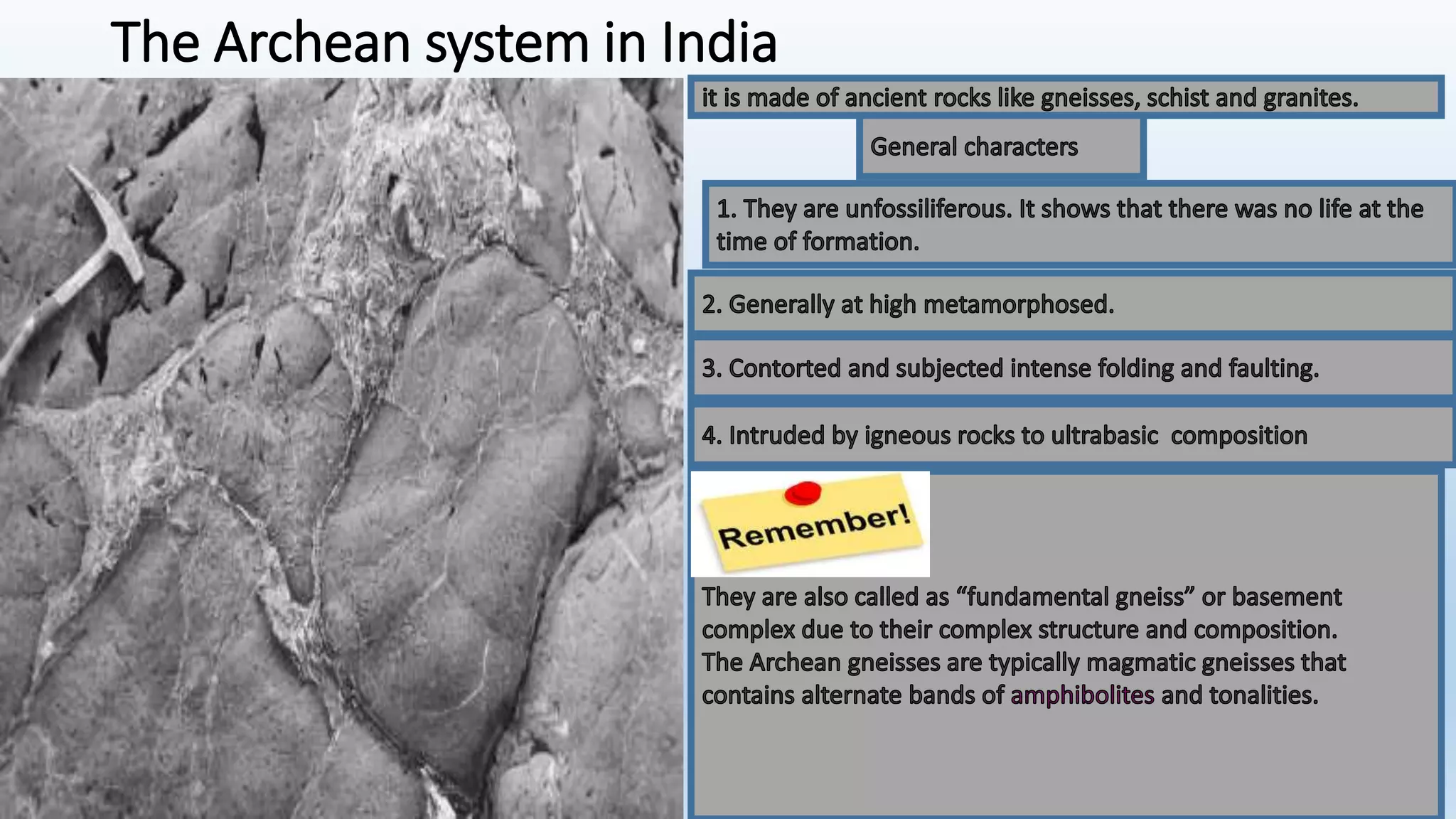
Gneiss: Gneiss is a high grade metamorphic rock, meaning that it has been subjected to higher
temperatures and pressures than schist. It is formed by the metamorphosis of granite,
or sedimentary rock. Gneiss displays distinct foliation, representing alternating layers composed of
different minerals. However, unlike slate and schist, gneiss does not preferentially break along planes of
foliation because less than 50% of the minerals formed during the metamorphism are aligned in thin
layers. Because of the coarseness of the foliation, the layers are often sub-parallel, i.e. they do not have a
constant thickness, and discontinuous.
Gneiss is typically associated with major mountain building episodes. During these episodes, sedimentary
or felsic igneous rocks are subjected to great pressures and temperatures generated by great depth of
burial, proximity to igneous intrusions and the tectonic forces generated during such episodes. Gneisses
from western Greenland comprise the oldest crustal rocks known (more than 3.5 billion years old).
Gneiss is an old German word meaning bright or sparkling.
Foliation: distinct plane of weakness in the rock. Foliation is caused by the re-alignment of minerals when they are subjected to
high pressure and temperature.
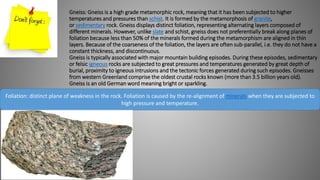
Schist:Schist is medium grade metamorphic rock, formed by the
metamorphosis of mudstone / shale, or some types of igneous rock, to a
higher degree than slate, i.e. it has been subjected to higher
temperatures and pressures.
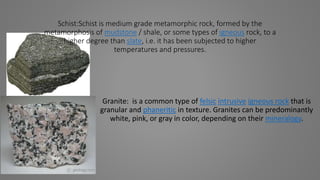
Granite: is a common type of felsic intrusive igneous rock that is
granular and phaneritic in texture. Granites can be predominantly
white, pink, or gray in color, depending on their mineralogy.
Felsic: In geology, felsic is an adjective describing igneous
rocks that are relatively rich in elements that
form feldspar and quartz.[1] It is contrasted with mafic rocks,
which are relatively richer in magnesium and iron. Felsic refers
to silicate minerals, magma, and rocks which are enriched in the
lighter elements such as silicon, oxygen, aluminium, sodium,
and potassium. Felsic magma or lava is higher
in viscosity than mafic magma/lava.
Felsic rocks are usually light in color and have specific
gravities less than 3. The most common felsic rock is granite.
Common felsic minerals include quartz, muscovite, orthoclase,
and the sodium-rich plagioclase feldspars (albite-rich).
A phanerite[1] is an igneous rock whose microstructure is made up
of crystals large enough to be distinguished with the unaided eye. (In contrast,
the crystals in an aphanitic rock are too small to be seen with the naked eye.)
Phaneritic texture forms when magma deep underground in
the plutonic environment cools slowly, giving the crystals time to grow.
Phanerites are often described as coarse
grained or macroscopically crystalline.
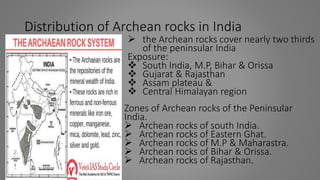
Distribution of Archean rocks in India
 the Archean rocks cover nearly two thirds
of the peninsular India
Exposure:
 South India, M.P, Bihar & Orissa
 Gujarat & Rajasthan
 Assam plateau &
 Central Himalayan region
Zones of Archean rocks of the Peninsular
India.
 Archean rocks of south India.
 Archean rocks of Eastern Ghat.
 Archean rocks of M.P & Maharastra.
 Archean rocks of Bihar & Orissa.
 Archean rocks of Rajasthan.
The archean system in india

The archean system in india

  • 1.
  • 2.
    Gneiss: Gneiss isa high grade metamorphic rock, meaning that it has been subjected to higher temperatures and pressures than schist. It is formed by the metamorphosis of granite, or sedimentary rock. Gneiss displays distinct foliation, representing alternating layers composed of different minerals. However, unlike slate and schist, gneiss does not preferentially break along planes of foliation because less than 50% of the minerals formed during the metamorphism are aligned in thin layers. Because of the coarseness of the foliation, the layers are often sub-parallel, i.e. they do not have a constant thickness, and discontinuous. Gneiss is typically associated with major mountain building episodes. During these episodes, sedimentary or felsic igneous rocks are subjected to great pressures and temperatures generated by great depth of burial, proximity to igneous intrusions and the tectonic forces generated during such episodes. Gneisses from western Greenland comprise the oldest crustal rocks known (more than 3.5 billion years old). Gneiss is an old German word meaning bright or sparkling. Foliation: distinct plane of weakness in the rock. Foliation is caused by the re-alignment of minerals when they are subjected to high pressure and temperature.
  • 3.
    Schist:Schist is mediumgrade metamorphic rock, formed by the metamorphosis of mudstone / shale, or some types of igneous rock, to a higher degree than slate, i.e. it has been subjected to higher temperatures and pressures. Granite: is a common type of felsic intrusive igneous rock that is granular and phaneritic in texture. Granites can be predominantly white, pink, or gray in color, depending on their mineralogy.
  • 4.
    Felsic: In geology,felsic is an adjective describing igneous rocks that are relatively rich in elements that form feldspar and quartz.[1] It is contrasted with mafic rocks, which are relatively richer in magnesium and iron. Felsic refers to silicate minerals, magma, and rocks which are enriched in the lighter elements such as silicon, oxygen, aluminium, sodium, and potassium. Felsic magma or lava is higher in viscosity than mafic magma/lava. Felsic rocks are usually light in color and have specific gravities less than 3. The most common felsic rock is granite. Common felsic minerals include quartz, muscovite, orthoclase, and the sodium-rich plagioclase feldspars (albite-rich). A phanerite[1] is an igneous rock whose microstructure is made up of crystals large enough to be distinguished with the unaided eye. (In contrast, the crystals in an aphanitic rock are too small to be seen with the naked eye.) Phaneritic texture forms when magma deep underground in the plutonic environment cools slowly, giving the crystals time to grow. Phanerites are often described as coarse grained or macroscopically crystalline.
  • 5.
    Distribution of Archeanrocks in India  the Archean rocks cover nearly two thirds of the peninsular India Exposure:  South India, M.P, Bihar & Orissa  Gujarat & Rajasthan  Assam plateau &  Central Himalayan region Zones of Archean rocks of the Peninsular India.  Archean rocks of south India.  Archean rocks of Eastern Ghat.  Archean rocks of M.P & Maharastra.  Archean rocks of Bihar & Orissa.  Archean rocks of Rajasthan.