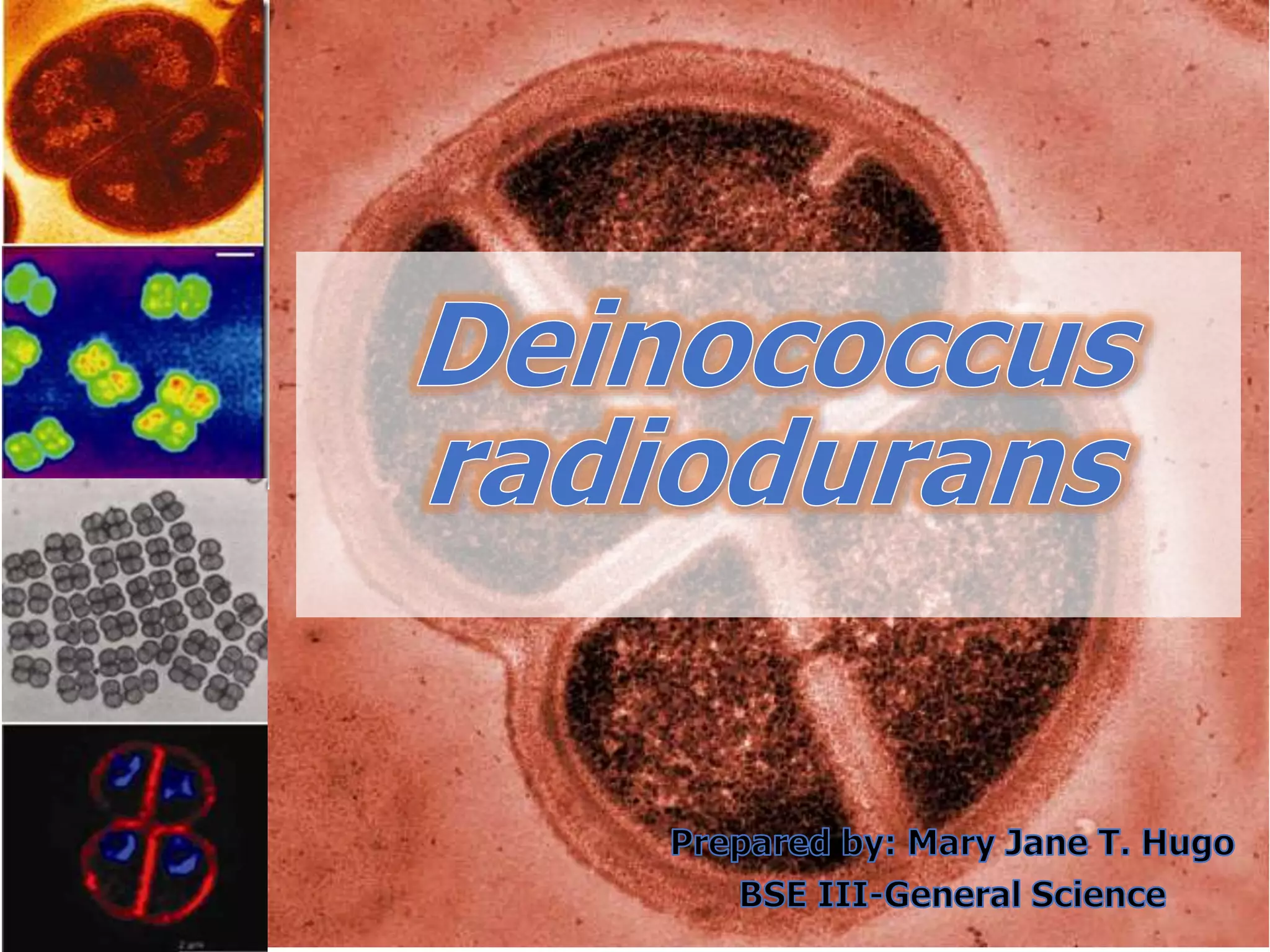
•one of the most radiation-resistant organisms known.
•a polyextremophile
•the world's toughest bacterium in The Guinness Book Of
World Records
•from the Ancient Greek δεινός (deinos) and κόκκος
(kokkos) meaning "terrible grain/berry" and
the Latin radius and durare, meaning "radiation surviving".
•formerly called Micrococcus radiodurans.
•Conan the Bacterium.
Deinococcus radiodurans
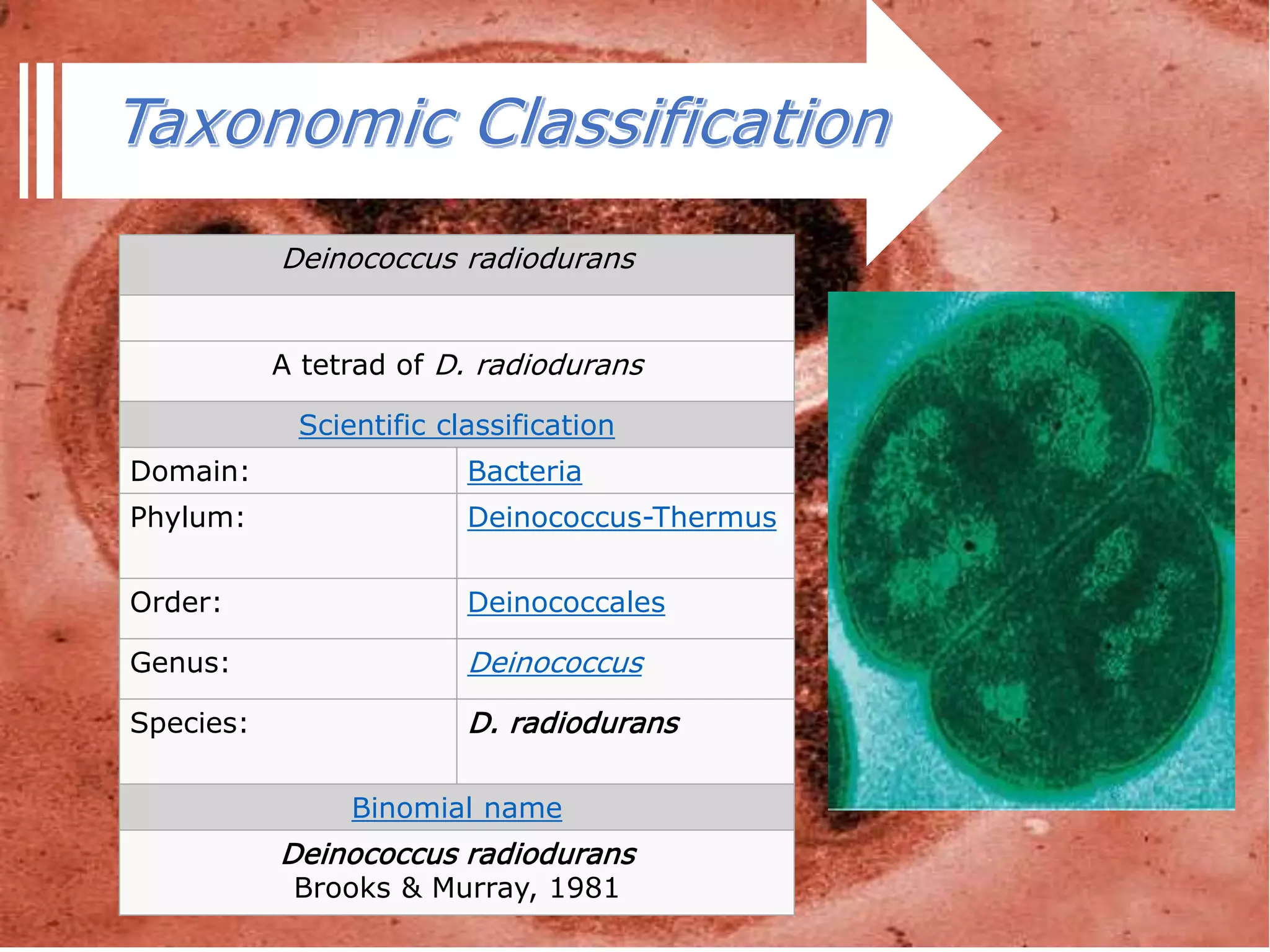
A tetrad of D. radiodurans
Scientific classification
Domain: Bacteria
Phylum: Deinococcus-Thermus
Order: Deinococcales
Genus: Deinococcus
Species: D. radiodurans
Binomial name
Deinococcus radiodurans
Brooks & Murray, 1981
•discovered in 1956 by Arthur W. Anderson at the
Oregon Agricultural Experiment Station
in Corvallis, Oregon.
•The complete DNA sequence of D.
radiodurans was published in 1999 by TIGR.
• A detailed annotation and analysis of the
genome appeared by Michael Daly and his
colleagues (2001).
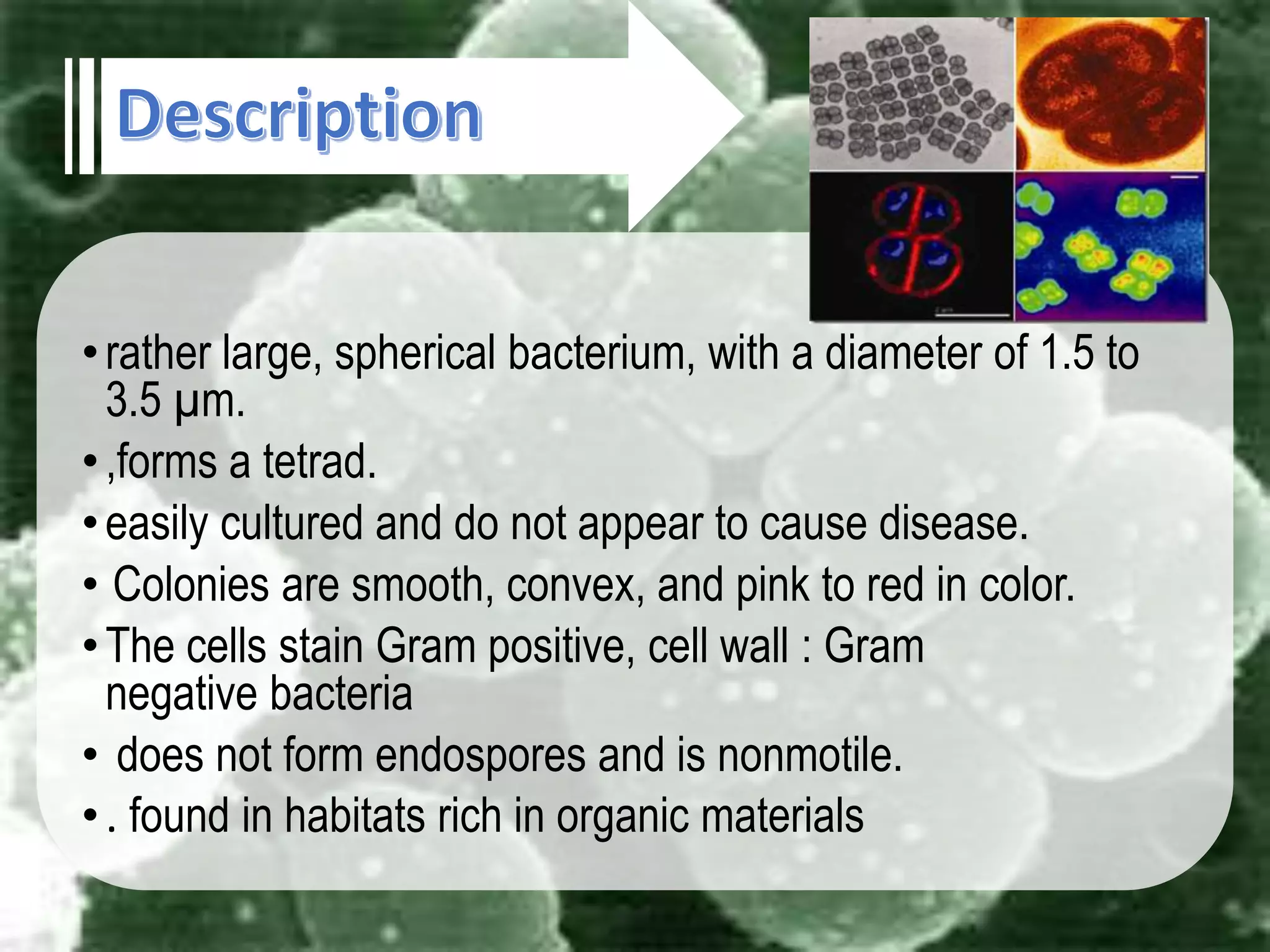
•rather large, spherical bacterium, with a diameter of 1.5 to
3.5 µm.
•,forms a tetrad.
•easily cultured and do not appear to cause disease.
• Colonies are smooth, convex, and pink to red in color.
•The cells stain Gram positive, cell wall : Gram
negative bacteria
• does not form endospores and is nonmotile.
•. found in habitats rich in organic materials
•an obligate aerobic chemoorganoheterotroph
•It is extremely resistant to ionizing
radiation, ultraviolet light, desiccation, and oxidizing
and electrophilic agents.
•genome consists of two circular chromosomes and
many plasmids
•its stationary phase, each bacterial cell 4 copies of
this genome; rapidly multiplying, each bacterium 8-
10 copies of the genome.
•capable of withstanding an acute dose of
5,000 Gy (500,000 rad) of ionizing radiation with
almost no loss of viability, and an acute dose of
15,000 Gy with 37% viability.
•has a unique ability to repair damaged DNA.
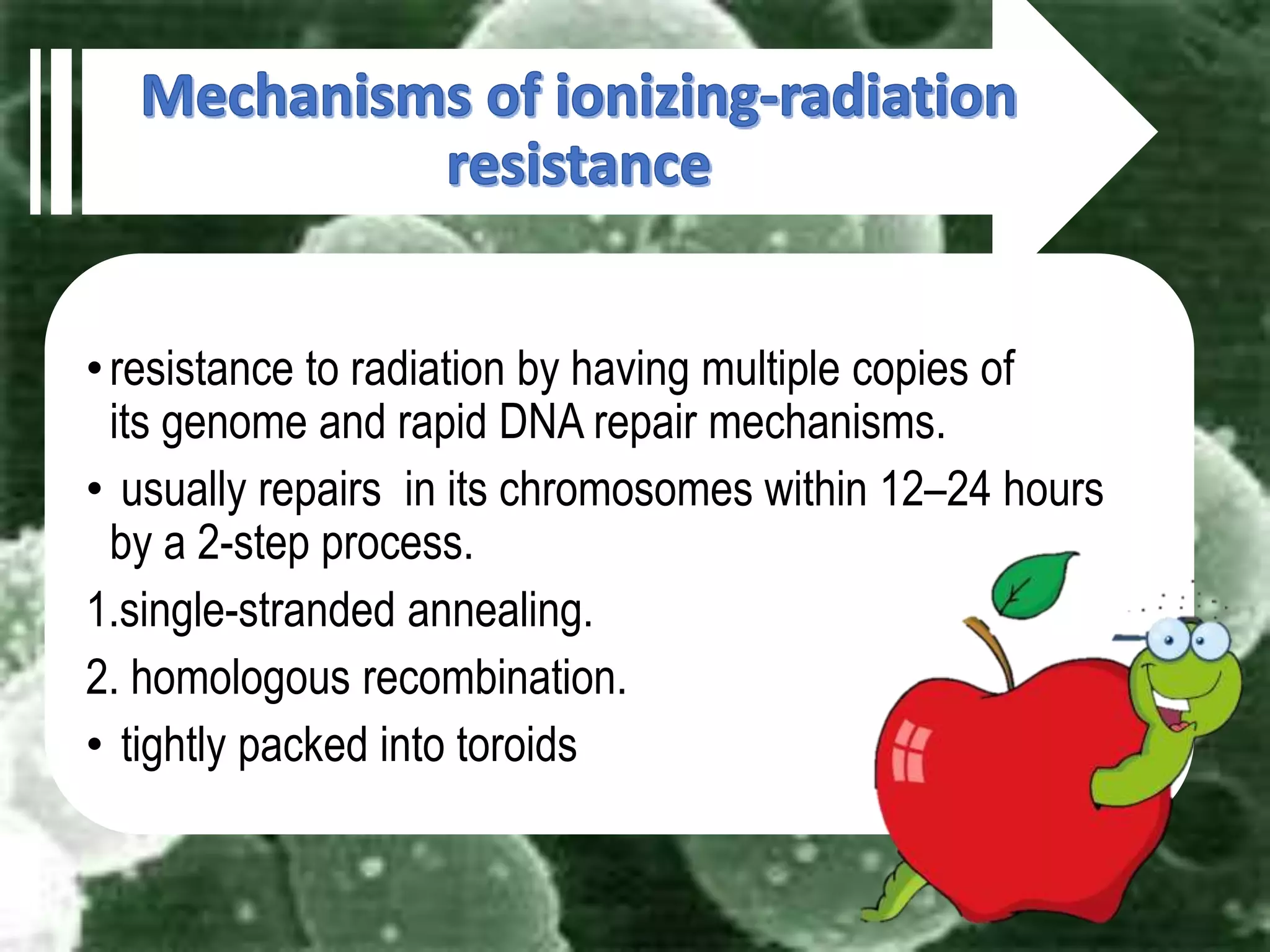
•resistance to radiation by having multiple copies of
its genome and rapid DNA repair mechanisms.
• usually repairs in its chromosomes within 12–24 hours
by a 2-step process.
1.single-stranded annealing.
2. homologous recombination.
• tightly packed into toroids
•capable of genetic transformation,
•Michael Daly has suggested the bacterium
uses manganese complexes as antioxidants for
protection against radiation.(2007)
•In 2009, nitric oxide was reported to play an important
role in the bacteria's recovery from radiation
exposure.
•genetically engineered for use in bioremediation to
consume and digest solvents and heavy metals,
even in a highly radioactive site.
•For example, the bacterial mercuric
reductase gene has been cloned from Escherichia
coli into Deinococcus to detoxify
the ionic mercury residue
•U.S. scientists demonstrated D. radiodurans could
be used as a means of information storage that
might survive a nuclear catastrophe (2003).
•http://web.mst.edu/~microbio/BIO221_2001/deinococc
us_radiodurans.html
•http://www.genomenewsnetwork.org/articles/07_02/dei
nococcus.shtml
•https://microbewiki.kenyon.edu/index.php/Deinococcus
_radiodurans
•http://www.majordifferences.com/2013/10/difference-
gram-positive-vs-gram_2.html#.VrtlS-Kqqkp

Deinococcus radiodurans

  • 2.
    •one of themost radiation-resistant organisms known. •a polyextremophile •the world's toughest bacterium in The Guinness Book Of World Records •from the Ancient Greek δεινός (deinos) and κόκκος (kokkos) meaning "terrible grain/berry" and the Latin radius and durare, meaning "radiation surviving". •formerly called Micrococcus radiodurans. •Conan the Bacterium.
  • 3.
    Deinococcus radiodurans A tetradof D. radiodurans Scientific classification Domain: Bacteria Phylum: Deinococcus-Thermus Order: Deinococcales Genus: Deinococcus Species: D. radiodurans Binomial name Deinococcus radiodurans Brooks & Murray, 1981
  • 4.
    •discovered in 1956by Arthur W. Anderson at the Oregon Agricultural Experiment Station in Corvallis, Oregon. •The complete DNA sequence of D. radiodurans was published in 1999 by TIGR. • A detailed annotation and analysis of the genome appeared by Michael Daly and his colleagues (2001).
  • 5.
    •rather large, sphericalbacterium, with a diameter of 1.5 to 3.5 µm. •,forms a tetrad. •easily cultured and do not appear to cause disease. • Colonies are smooth, convex, and pink to red in color. •The cells stain Gram positive, cell wall : Gram negative bacteria • does not form endospores and is nonmotile. •. found in habitats rich in organic materials
  • 6.
    •an obligate aerobicchemoorganoheterotroph •It is extremely resistant to ionizing radiation, ultraviolet light, desiccation, and oxidizing and electrophilic agents. •genome consists of two circular chromosomes and many plasmids •its stationary phase, each bacterial cell 4 copies of this genome; rapidly multiplying, each bacterium 8- 10 copies of the genome.
  • 7.
    •capable of withstandingan acute dose of 5,000 Gy (500,000 rad) of ionizing radiation with almost no loss of viability, and an acute dose of 15,000 Gy with 37% viability. •has a unique ability to repair damaged DNA.
  • 8.
    •resistance to radiationby having multiple copies of its genome and rapid DNA repair mechanisms. • usually repairs in its chromosomes within 12–24 hours by a 2-step process. 1.single-stranded annealing. 2. homologous recombination. • tightly packed into toroids
  • 9.
    •capable of genetictransformation, •Michael Daly has suggested the bacterium uses manganese complexes as antioxidants for protection against radiation.(2007) •In 2009, nitric oxide was reported to play an important role in the bacteria's recovery from radiation exposure.
  • 10.
    •genetically engineered foruse in bioremediation to consume and digest solvents and heavy metals, even in a highly radioactive site. •For example, the bacterial mercuric reductase gene has been cloned from Escherichia coli into Deinococcus to detoxify the ionic mercury residue
  • 11.
    •U.S. scientists demonstratedD. radiodurans could be used as a means of information storage that might survive a nuclear catastrophe (2003).
  • 12.

Editor's Notes

  • #8 .[A dose of 5,000 Gy is estimated to introduce several hundred double-strand breaks (DSBs) into the organism's DNA (~0.005 DSB/Gy/Mbp (haploid genome)). For comparison, a chest X-ray or Apollo mission involves about 1 mGy, 5 Gy can kill a human, 200-800 Gy will kill E. coli, and over 4,000 Gy will kill the radiation-resistant tardigrade.