EXTREMOPHILES
Ankita Behera
M.Sc Microbiology
St. George College of Management & Science
Bengaluru North University
 Micro-organisms in extreme environment is known as EXTREMOPHILES.
 Extremophile are those whose optimal growth conditions land outside the normal environment conditions.
 Many part of our earth contain extreme environment such as high temperature zones like volcanic zones
,polar regions, acidic and alkalophilic springs and cold pressurized depths of oceans.
 Many micro-organisms are found adapted to exceptional environments.
 Extremophiles are the micro-organisms that not only survive but successfully grow and flourish in
environment where normal life cannot.
 The important groups of micro-organisms in extreme environments are reffered as –
1)ACIDOPHILES
2)ALKALOPHILES
3)HALOPHILES
4)THERMOPHILES AND HYPERTHERMOPHILES
5)PSYCHROPHILES
6)BAROPHILES
7)OSMOPHILES
8)RADIODURANT MICROBES.
PSYCROPHILES
Temperatures in many parts reach above 5 degree
celcius because 70% of the earth is covered by deep
oceans providing cold conditions.
J.FOSTER in 1887 was first to see the growth and
reproduction of bacteria at low temperatures.
The term psychrophilic was used in 1902 by
S.SCHMIDT-NIELSON to describe micro-organisms
can grow and multiply at 0 degree celcius.
Also known as cold loving
Can also named as “pschrotrophic” and cold-blooded
animals.
Pschrophiles contribute to the
1]nutrient cycling.
2]biomass production
3]metabolic activities like
photosynthesis,nitrogen
fixation,methanogenesis and
degradation of natural and
xenobiotic organic compounds.
MICRO-ORGANISMS FOUND IN THOSE
TEMPERATURES:-
• BACTERIA:-Pseudomonas , Bacillus , Alcoligenes ,
Arthrobacter glacilis , Micrococcus criophilus , Vibrio
psychroerythrus , Aquaspirillum articum , Shiwanella
frigidimarina
• Microalgae:-Chlamydomonas nivalis
• Yeasts:- Candida , Cryptococcus , Rhodotorula ,
Sacchromyces.
• Fungi:-Penicillium , cladosporium
PSYCHROPHILLIC ORGANISMS UNDER
SCANNING ELECTRON MICROCOPE
ADAPTIVE MECHANISMS TO COLD
Cold adapted micro-organisms have evolved a complex
range of adaptions of their cellular constituents including
membranes,
Protein synthesis,
enzymes,
Energy-generating system
And
The components responsible for nutrient uptake to survive and
grow successfully in cold habitats.
When temperature decreases water begins to freeze leaving a more
conc.salts solution outside the microbial cells.
In response to that the micro-organisms will accumulate intracellular
compatible solutes to counteract the imposed osmotic stress and to
maintain cellular enzyme function.
but
A point will be reached when enzymes fail and intracellular ice may
begin to form.
So,the phenomenon of cold denaturation of proteins is well documented
as it generally occurs at temperature below -15 degree celcius. cold
denaturantion of protein due to sudden decreases in temperature
performs alteration in gene expression known as the “cold-
shockresponse”
• This response is distinct from general stress response
known as “cold shock” response which involves the
induction and synthesis os “cold shock proteins”.
• The cold shock proteins are “CspA” whose functions
are protein synthesis and mRNA folding and
sometimes act in freeze protection.
• CspA protein regulate gene expression involved in
DNA supercoiling and also RNA chaperones
BIOTECHNOLOGICAL APPLICATIONS
• In food biotechmology it is used for food preservation
taste improvement in alcoholic bevarages, frozen
foods , meat tenderising.
• Fine chemicals like organic phase biocatalysis.
• Low-energy waste treatment.
• Bioremediation process.etc
RADIODURANT MICROBES
RADIODURANS is an extremophilic
bacteria which are resistant to
radioactive.
It can survive in cold,dehydration,
vaccum and acid which makes them
known as “POLYEXTREMOPHILE”.
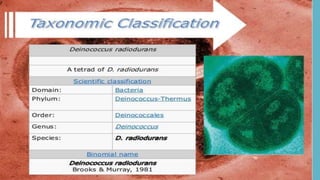
EX:-Deinococcus radiodurans
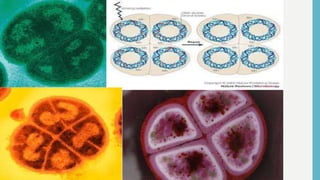
It is a rather large , spherical bacterium , with a
diameter of 1.5-3.5 um.
4 cells normally stick together forming a tetrad.
They are easily cultured and do not appear to cause
disease.
Colonies are smooth , convex and pink to red is color.
Cell stain gram positive although its cell envelope is
unusual.
They donot form endospore and is non-motile.
• It is an obligate aerobic chemoorganoheterotrophs .
• It is often found in rich in organic materials and can be
isolated from dried foods ,room dust , medical
instruments and textiles.
• It is extremely resistant to ionizing radiation, uv light ,
oxidizing and electrophilic agents.
• Its genome consists of 2 circular chromosomes and
3195 genes.
IONIZING RADIATION RESISTANCE
MECHANISMS:-
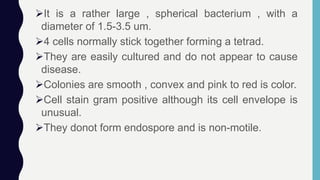
• Deinococcus radiodurans accomplishes its resistance to radiation by
having multiple copies of genome and DNA repair mechanisms.
• It usually repairs the break in its chromosomes within 12-24 hrs through
2 step process:-
1}firstly, they reconnect some chromosome fragments through a process
called single-stranded annealing.
2}secondly, a protein mends double-strand breaks through homologous
recombination.
This process doesnot introduce any more mutations than a normal
round of replication would.
THANK YOU

Extremophiles

  • 1.
    EXTREMOPHILES Ankita Behera M.Sc Microbiology St.George College of Management & Science Bengaluru North University
  • 2.
     Micro-organisms inextreme environment is known as EXTREMOPHILES.  Extremophile are those whose optimal growth conditions land outside the normal environment conditions.  Many part of our earth contain extreme environment such as high temperature zones like volcanic zones ,polar regions, acidic and alkalophilic springs and cold pressurized depths of oceans.  Many micro-organisms are found adapted to exceptional environments.  Extremophiles are the micro-organisms that not only survive but successfully grow and flourish in environment where normal life cannot.  The important groups of micro-organisms in extreme environments are reffered as – 1)ACIDOPHILES 2)ALKALOPHILES 3)HALOPHILES 4)THERMOPHILES AND HYPERTHERMOPHILES 5)PSYCHROPHILES 6)BAROPHILES 7)OSMOPHILES 8)RADIODURANT MICROBES.
  • 3.
  • 4.
    Temperatures in manyparts reach above 5 degree celcius because 70% of the earth is covered by deep oceans providing cold conditions. J.FOSTER in 1887 was first to see the growth and reproduction of bacteria at low temperatures. The term psychrophilic was used in 1902 by S.SCHMIDT-NIELSON to describe micro-organisms can grow and multiply at 0 degree celcius. Also known as cold loving Can also named as “pschrotrophic” and cold-blooded animals.
  • 5.
    Pschrophiles contribute tothe 1]nutrient cycling. 2]biomass production 3]metabolic activities like photosynthesis,nitrogen fixation,methanogenesis and degradation of natural and xenobiotic organic compounds.
  • 6.
    MICRO-ORGANISMS FOUND INTHOSE TEMPERATURES:- • BACTERIA:-Pseudomonas , Bacillus , Alcoligenes , Arthrobacter glacilis , Micrococcus criophilus , Vibrio psychroerythrus , Aquaspirillum articum , Shiwanella frigidimarina • Microalgae:-Chlamydomonas nivalis • Yeasts:- Candida , Cryptococcus , Rhodotorula , Sacchromyces. • Fungi:-Penicillium , cladosporium
  • 8.
  • 9.
    ADAPTIVE MECHANISMS TOCOLD Cold adapted micro-organisms have evolved a complex range of adaptions of their cellular constituents including membranes, Protein synthesis, enzymes, Energy-generating system And The components responsible for nutrient uptake to survive and grow successfully in cold habitats.
  • 10.
    When temperature decreaseswater begins to freeze leaving a more conc.salts solution outside the microbial cells. In response to that the micro-organisms will accumulate intracellular compatible solutes to counteract the imposed osmotic stress and to maintain cellular enzyme function. but A point will be reached when enzymes fail and intracellular ice may begin to form. So,the phenomenon of cold denaturation of proteins is well documented as it generally occurs at temperature below -15 degree celcius. cold denaturantion of protein due to sudden decreases in temperature performs alteration in gene expression known as the “cold- shockresponse”
  • 11.
    • This responseis distinct from general stress response known as “cold shock” response which involves the induction and synthesis os “cold shock proteins”. • The cold shock proteins are “CspA” whose functions are protein synthesis and mRNA folding and sometimes act in freeze protection. • CspA protein regulate gene expression involved in DNA supercoiling and also RNA chaperones
  • 12.
    BIOTECHNOLOGICAL APPLICATIONS • Infood biotechmology it is used for food preservation taste improvement in alcoholic bevarages, frozen foods , meat tenderising. • Fine chemicals like organic phase biocatalysis. • Low-energy waste treatment. • Bioremediation process.etc
  • 13.
  • 14.
    RADIODURANS is anextremophilic bacteria which are resistant to radioactive. It can survive in cold,dehydration, vaccum and acid which makes them known as “POLYEXTREMOPHILE”. EX:-Deinococcus radiodurans
  • 17.
    It is arather large , spherical bacterium , with a diameter of 1.5-3.5 um. 4 cells normally stick together forming a tetrad. They are easily cultured and do not appear to cause disease. Colonies are smooth , convex and pink to red is color. Cell stain gram positive although its cell envelope is unusual. They donot form endospore and is non-motile.
  • 18.
    • It isan obligate aerobic chemoorganoheterotrophs . • It is often found in rich in organic materials and can be isolated from dried foods ,room dust , medical instruments and textiles. • It is extremely resistant to ionizing radiation, uv light , oxidizing and electrophilic agents. • Its genome consists of 2 circular chromosomes and 3195 genes.
  • 19.
    IONIZING RADIATION RESISTANCE MECHANISMS:- •Deinococcus radiodurans accomplishes its resistance to radiation by having multiple copies of genome and DNA repair mechanisms. • It usually repairs the break in its chromosomes within 12-24 hrs through 2 step process:- 1}firstly, they reconnect some chromosome fragments through a process called single-stranded annealing. 2}secondly, a protein mends double-strand breaks through homologous recombination. This process doesnot introduce any more mutations than a normal round of replication would.
  • 22.