PHARMACEUTICAL
DEGRADATION
PRESENTED BY:
Rama Shukla
Deptt. of Pharmaceutics,
LNCP,Bhopal
DEGRADATION
The condition or process of
degrading or being
degraded.Decline to a lower
quality,condition or level.
PHARMACEUTICAL
DEGRADATION
• The incapacity or incapability of a
particular formulation in a specific
container to remain within a
particular chemical,
microbiological, therapeutical,
physical & toxicological
specification.
ASPIRIN
Decompose into acetic acid and salicylic acid
giving the acetic acid odour by the break
down. The breakdown is a chemical reaction
involving the collisions of the molecules.This
breakdown is affected by various factors
such as presence of oxygen, acidity,
alkalinity, moisture and light. This breakdown
is what we are calling degradation.
TYPES OF PHARMACEUTICAL
DEGRADATION
Pharmaceutical degradation is of
following type.
It can bedivided into three major
types:
1. Physical degradation
2. Chemical degradation
3. Microbiological degradation
PHYSICAL DEGRADATION
• It is the degradation which results
into the change of physical nature
of drug.
The formulation is totally changed by
way of appearance, organoleptic
properties, hardness, brittleness,
particle size.
• Factors effecting physical degradation
are as under:
1. Loss of volatile components
2. Loss of H2O
3. Absorption of H2O
4. Crystal growth
5. Polymorphic changes
6. Colour changes
1) Loss Of Volatile
Components:
Many drugs and excipients may be lost from
pharmaceutical products at ambient
temperature through vaporization.
These Volatile components such as
Alcohol ,ether,Iodine, volatile oils,Camphor
menthol etc escape from the formulations
rendering them degraded.
• EXAMPLE:
Aromatic
waters
Elixirs
Some types of tablets which contain
aromatic water (Nitroglycerine tablets)
PREVENTION:
Such product should be placed in well
closed container
Temperature should be proper.
2) LOSS OF H20:
• Evaporation of water from liquid preparations will
cause concentration of the drug to change with the
possibility of crystilization occurring if the solubility of
the drug in the solvent is exceeded. Water loss from oil-
in –water creams may result in a decrease in volume
and a surface rubbery feel. Further evaporation of the
water will cause the emulsion to crack.
• Some drugs are efflorescent, which mean
they will lose water to the atmosphere
resulting in a concentration of the drug
and overall weight loss.
• Water loss to the atmosphere can be
prevented by storing the
pharmaceutical product in a well
closed container.
EXAMPLES
• Saturated solution: by loss of water they
become supersaturated and precipitate as
crystals are formed .
• Emulsions: Loss of water lead to separation
of the two phases and change to other type
• Creams: especially oil/water, they become
dry by loss of water
3) ABSORPTION OF H20(MOISTURE)
HYGROSCOPITY
Hygroscopic drugs absorb the water from
external atmosphere causing the physical
degradation.
For example, some drugs are delisquent
(calcium chloride and potassium citrate),
whereas others are hygroscopic (glycerol and
dry plant extracts).
Effervescent powders and tablets will deteriorate
EXAMPLE
• Powders: Liquification and degradation may occur as a
result of absorption of water
Suppositories which base made from hydrophilic
substances as Glycerin, Gelatin, polyethylene glycol.
The consistency of these forms becomes jelly-like
appearance.
Products should be placed in well-closed container
and in dry place.
4) POLYMORPHISM
• Polymorphs are different crystal forms of the same
compound .Polymorphs differs from one another in the
crystal energies, the more energetic ones converting to
the least energetic or most stable one. Different
polymorphs of the same drug may exhibit different
solubility and melting points.
• In polymorphic changes crystal forms are
changed. A stable crystal form loosens.
This may cause alteration in solubility and
possibly crystalline growth in aqueous
suspensions.
• Ex Chloremphenicol Palmitate
• Cocoa Butter
5) CRYSTAL
GROWTH
• Drugs when loose water,become saturated
and crystal growth occurs.Molecules in the
crystal are not static, they can grow in size
and move when there is a medium to
travel.
• Crystallization is enhanced in porous
tablets.
EXAMPLE
• Carbamazepine tablets containing
stearic acid form column shaped
crystals on tablet surface during
storage at high temperature.
6) COLOUR
CHANGES Colour changes
are of two types. Loss of
colour
Development of colour
1) Loss of colour is due to
·PH change
2) Development of colour is due
to
· Exposure to light
• EXAMPLE:
• Phenolphthalein color changes as the Ph
changes.It is colorless in acidic solution and
pink in basic.
• PREVENTION:
PH should be adjusted
Exposure to light should be avoided
An attempt has been made to prevent the
fading by incorporating UV light absorbing
material.
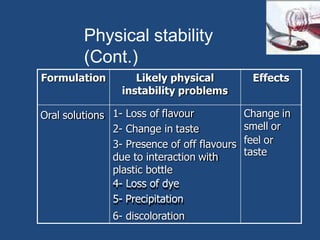
Physical stability
(Cont.)
Formulation Likely physical
instability problems
Effects
Oral solutions 1- Loss of flavour
2- Change in taste
due to interaction with
plastic bottle
4- Loss of dye
5- Precipitation
6- discoloration
Change in
smell or
3- Presence of off flavours feel or
taste
Physical stability
(Cont.)
Formulation Likely physical
instability problems
Effects
Suspensions 1 settling
2 caking
3 crystal growth
1-Loss of drug
content
uniformity in
different doses
from the bottle
2- loss of
elegance.
Physical stability
(Cont.)
Formulation Likely physical
instability problems
Effects
Emulsions 1 Creaming
2 coalescence
1- Loss of
drug content
uniformity in
different doses
from the bottle
2- loss of
elegance
Physical stability
(Cont.)
Coalescen
ce
Physical stability
(Cont.)
Formulation Likely physical
instability problems
Effects
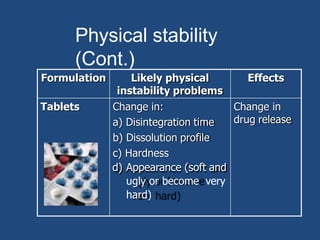
Tablets Change in:
a) Disintegration time
b) Dissolution profile
c) Hardness
d) Appearance (soft and
ugly or become very
hard)
Change in
drug release
Physical stability
(Cont.)
Formulation Likely physical
instability problems
Effects
Capsules Change in:
a) Appearance
b) Dissolution
c) Strength
Change in
drug release
Physical stability
(Cont.)
Formulation Likely physical Effects
instability problems
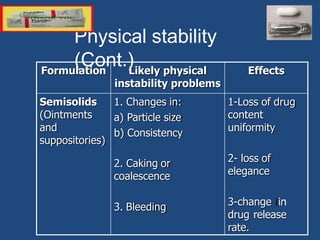
Semisolids
(Ointments
and
suppositories)
1. Changes in:
a) Particle size
b) Consistency
2. Caking or
coalescence
3. Bleeding
1-Loss of drug
content
uniformity
2- loss of
elegance
3-change in
drug release
rate.
CHEMICAL
DEGRADATION
It is the separation of chemical
compound into elements or simpler
compounds. Change in the
chemical nature of the drug is
called as chemical degradation.
TYPES OF CHEMICAL
DEGRADATION
• Types of chemical degradation
are
1. Hydrolysis
2. Oxidation
3. Decarboxylation
4. Isomerization
5. Polymerization
HYDROLYSIS
• Splitting by water.
• Drugs with functional groups such as
esters, amides, lactones or lactams may
be susceptible to hydrolytic degradation.
• It is probably the most commonly
encountered mode of drug degradation
because of the prevalence of such groups
in medicinal agents and the ubiquitous
nature of water.
• Example ASPIRIN:
Aspirin degrade into salicylic acid
and acetic acid giving vinegar like
odour.
OXIDATION
• Removal of an electropositive atom,
radical or electron, or the addition of
an electronegative atom or radical.
• Types:
Oxidation has two types
·Auto-oxidation
·Photo-oxidation
AUTO-OXIDATION
Oxidation in which the oxygen present
in the air is involved.
This process proceeds slowly under
the influence of atmospheric oxygen
e.g. Oil, fats & unsaturated
compound can undergo auto-
oxidation
PHOTO-OXIDATION
Oxidation in which removal of the
electron is involved with out
presence of O2.
This type is less frequently
encountered
e.g. It occurs in adrenaline,
riboflavin & ascorbic acid etc.
DECARBOXYLATION
Elimination of CO2 from a compound.Drug
substances having a carboxylic acid
group are sometimes susceptible to
decarboxylation,
• 4-Aminosalicylic acid is a good example.
ISOMERIZATION
It is the process by which one molecule is
transformed into another molecule which
has exactly the same atoms, but the
atoms are rearranged e.g. A-B-C →B-A-C
Conversion of an active drug into a less active
or inactive isomer having same structural
formula but different stereochemical
configuration
• Types of Isomerization:
1) Optical Isomerization
2) Geometrical Isomerization
OPTICAL ISOMERIZATION:
A change in the optical activity of a drug may result
as a change in its biological activity.
It is further divided
into:
(i)RACEMIZATION
(ii) EPIMERIZATION
RACEMIZATION:
It involves the optically active form
of a drug into its enantiomorph.
E.X : By the action of heat (-)
hyoscyamine is readily converted to
atropine which is the racemic
mixture of (+) & (-) hyoscyamine.
• Epimerization:
It occur with the compound having more
than one asymetric carbon atom in the
molecule.
E.X: Under prolonged storage solution
containing ergometrine is decomposed
by hydrolysis and isomerized to
ergometrinine.
GEOMETRICAL ISOMERIZATION:
• Loss of activity due to the difference in
potency exhibited by CIS & TRANS isomers
of some organic compounds.
EX: Active form of VITAMIN A molecule has all
trans configuration.In aqueous solution as a
component of multivitamin preparation,in
addition to oxidation VITAMIN A PALMITATE
isomerizes and form 6-mono cis and 2,6 di-cis
isomers,both have low potency.
POLYMERIZATION
• Combination of two or more identical
molecules to form a much larger and more
complex molecule.
e.g. Degradation of antiseptic formulations
and aldehydes is due to
polymerization.Formaldehyde solution may
result into formation of white deposit when
stand
in cold.
PHOTO DEGRADATION
Photodegradation is the process by which
light- sensitive drugs or excipient
molecules are chemically degraded by
light, room light or sunlight.
PHOTOLYSIS:
It is defined as decomposition of a drug by
light.
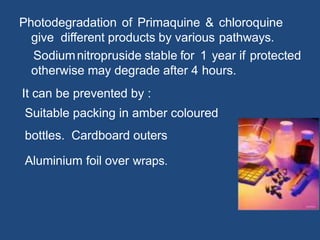
Photodegradation of Primaquine & chloroquine
give different products by various pathways.
Sodiumnitropruside stable for 1 year if protected
otherwise may degrade after 4 hours.
It can be prevented by :
Suitable packing in amber coloured
bottles. Cardboard outers
Aluminium foil over wraps.
Stabilization of drugs against hydrolysis, oxidation
and photolysis:
TEMPERATURE:
All the drug products are stored at suitable temperatures to
avoid thermal acceleration of decomposition.
LIGHT:
Light sensitive materials are stored in ambered
colour bottles
Humidity
Packing materials are chosen (usually glass
and plastic) to prevent exposure of drug
products to high humid condition.
Oxygen
Proper packing keeping the oxygen content
of the solution less and leaving very little
head space in the bottle above the drug
products are methods to fight against
oxidation
MICROBIAL DEGRADATION
• Contamination of a product may sometimes
cause a lot of damage and sometimes may not
be anything at all. Thus it is dependent on the
type of microbe and its level of toxicity it may
produce.
If parenterals or opthalmic formulations are
contaminated, it may cause serious harm.
• Pyrogens which are the metabolic
products of bacterial growth are usually
lipo polysaccharides and they represent a
particularly hazardous product released
by gram negative bacteria. If
administered inadvertently to a patient
they may cause chills and fever.
PREVENTION OF MICROBIAL DEGRADATION
• suitably designing the containers
• usually using single dose containers
• sticking to proper storage conditions
• adding an antimicrobial substance as
preservative.
METHOD FOR DETECTING CHEMICAL/
PHYSICAL DEGRADATION
• THERMAL ANALYSIS:
Following methods can be used
for detection,
DIFFERENTIAL SCANNING
CALORIMETRY (DSC) DIFFERENTIAL
THERMAL ANALYSIS (DTA)
DIFFERENTIAL THERMOGRAVIMETRY
(DTG)
THANK
YOU

degradation.pptx

  • 1.
  • 2.
    DEGRADATION The condition orprocess of degrading or being degraded.Decline to a lower quality,condition or level.
  • 3.
    PHARMACEUTICAL DEGRADATION • The incapacityor incapability of a particular formulation in a specific container to remain within a particular chemical, microbiological, therapeutical, physical & toxicological specification.
  • 4.
    ASPIRIN Decompose into aceticacid and salicylic acid giving the acetic acid odour by the break down. The breakdown is a chemical reaction involving the collisions of the molecules.This breakdown is affected by various factors such as presence of oxygen, acidity, alkalinity, moisture and light. This breakdown is what we are calling degradation.
  • 5.
    TYPES OF PHARMACEUTICAL DEGRADATION Pharmaceuticaldegradation is of following type. It can bedivided into three major types: 1. Physical degradation 2. Chemical degradation 3. Microbiological degradation
  • 6.
    PHYSICAL DEGRADATION • Itis the degradation which results into the change of physical nature of drug. The formulation is totally changed by way of appearance, organoleptic properties, hardness, brittleness, particle size.
  • 7.
    • Factors effectingphysical degradation are as under: 1. Loss of volatile components 2. Loss of H2O 3. Absorption of H2O 4. Crystal growth 5. Polymorphic changes 6. Colour changes
  • 8.
    1) Loss OfVolatile Components: Many drugs and excipients may be lost from pharmaceutical products at ambient temperature through vaporization. These Volatile components such as Alcohol ,ether,Iodine, volatile oils,Camphor menthol etc escape from the formulations rendering them degraded.
  • 9.
    • EXAMPLE: Aromatic waters Elixirs Some typesof tablets which contain aromatic water (Nitroglycerine tablets) PREVENTION: Such product should be placed in well closed container Temperature should be proper.
  • 10.
    2) LOSS OFH20: • Evaporation of water from liquid preparations will cause concentration of the drug to change with the possibility of crystilization occurring if the solubility of the drug in the solvent is exceeded. Water loss from oil- in –water creams may result in a decrease in volume and a surface rubbery feel. Further evaporation of the water will cause the emulsion to crack.
  • 11.
    • Some drugsare efflorescent, which mean they will lose water to the atmosphere resulting in a concentration of the drug and overall weight loss. • Water loss to the atmosphere can be prevented by storing the pharmaceutical product in a well closed container.
  • 12.
    EXAMPLES • Saturated solution:by loss of water they become supersaturated and precipitate as crystals are formed . • Emulsions: Loss of water lead to separation of the two phases and change to other type • Creams: especially oil/water, they become dry by loss of water
  • 13.
    3) ABSORPTION OFH20(MOISTURE) HYGROSCOPITY Hygroscopic drugs absorb the water from external atmosphere causing the physical degradation. For example, some drugs are delisquent (calcium chloride and potassium citrate), whereas others are hygroscopic (glycerol and dry plant extracts). Effervescent powders and tablets will deteriorate
  • 14.
    EXAMPLE • Powders: Liquificationand degradation may occur as a result of absorption of water Suppositories which base made from hydrophilic substances as Glycerin, Gelatin, polyethylene glycol. The consistency of these forms becomes jelly-like appearance. Products should be placed in well-closed container and in dry place.
  • 15.
    4) POLYMORPHISM • Polymorphsare different crystal forms of the same compound .Polymorphs differs from one another in the crystal energies, the more energetic ones converting to the least energetic or most stable one. Different polymorphs of the same drug may exhibit different solubility and melting points.
  • 16.
    • In polymorphicchanges crystal forms are changed. A stable crystal form loosens. This may cause alteration in solubility and possibly crystalline growth in aqueous suspensions. • Ex Chloremphenicol Palmitate • Cocoa Butter
  • 17.
    5) CRYSTAL GROWTH • Drugswhen loose water,become saturated and crystal growth occurs.Molecules in the crystal are not static, they can grow in size and move when there is a medium to travel. • Crystallization is enhanced in porous tablets.
  • 18.
    EXAMPLE • Carbamazepine tabletscontaining stearic acid form column shaped crystals on tablet surface during storage at high temperature.
  • 19.
    6) COLOUR CHANGES Colourchanges are of two types. Loss of colour Development of colour 1) Loss of colour is due to ·PH change 2) Development of colour is due to · Exposure to light
  • 20.
    • EXAMPLE: • Phenolphthaleincolor changes as the Ph changes.It is colorless in acidic solution and pink in basic. • PREVENTION: PH should be adjusted Exposure to light should be avoided An attempt has been made to prevent the fading by incorporating UV light absorbing material.
  • 21.
    Physical stability (Cont.) Formulation Likelyphysical instability problems Effects Oral solutions 1- Loss of flavour 2- Change in taste due to interaction with plastic bottle 4- Loss of dye 5- Precipitation 6- discoloration Change in smell or 3- Presence of off flavours feel or taste
  • 22.
    Physical stability (Cont.) Formulation Likelyphysical instability problems Effects Suspensions 1 settling 2 caking 3 crystal growth 1-Loss of drug content uniformity in different doses from the bottle 2- loss of elegance.
  • 23.
    Physical stability (Cont.) Formulation Likelyphysical instability problems Effects Emulsions 1 Creaming 2 coalescence 1- Loss of drug content uniformity in different doses from the bottle 2- loss of elegance
  • 24.
  • 25.
    Physical stability (Cont.) Formulation Likelyphysical instability problems Effects Tablets Change in: a) Disintegration time b) Dissolution profile c) Hardness d) Appearance (soft and ugly or become very hard) Change in drug release
  • 26.
    Physical stability (Cont.) Formulation Likelyphysical instability problems Effects Capsules Change in: a) Appearance b) Dissolution c) Strength Change in drug release
  • 27.
    Physical stability (Cont.) Formulation Likelyphysical Effects instability problems Semisolids (Ointments and suppositories) 1. Changes in: a) Particle size b) Consistency 2. Caking or coalescence 3. Bleeding 1-Loss of drug content uniformity 2- loss of elegance 3-change in drug release rate.
  • 28.
    CHEMICAL DEGRADATION It is theseparation of chemical compound into elements or simpler compounds. Change in the chemical nature of the drug is called as chemical degradation.
  • 29.
    TYPES OF CHEMICAL DEGRADATION •Types of chemical degradation are 1. Hydrolysis 2. Oxidation 3. Decarboxylation 4. Isomerization 5. Polymerization
  • 30.
    HYDROLYSIS • Splitting bywater. • Drugs with functional groups such as esters, amides, lactones or lactams may be susceptible to hydrolytic degradation. • It is probably the most commonly encountered mode of drug degradation because of the prevalence of such groups in medicinal agents and the ubiquitous nature of water.
  • 31.
    • Example ASPIRIN: Aspirindegrade into salicylic acid and acetic acid giving vinegar like odour.
  • 32.
    OXIDATION • Removal ofan electropositive atom, radical or electron, or the addition of an electronegative atom or radical. • Types: Oxidation has two types ·Auto-oxidation ·Photo-oxidation
  • 33.
    AUTO-OXIDATION Oxidation in whichthe oxygen present in the air is involved. This process proceeds slowly under the influence of atmospheric oxygen e.g. Oil, fats & unsaturated compound can undergo auto- oxidation
  • 34.
    PHOTO-OXIDATION Oxidation in whichremoval of the electron is involved with out presence of O2. This type is less frequently encountered e.g. It occurs in adrenaline, riboflavin & ascorbic acid etc.
  • 35.
    DECARBOXYLATION Elimination of CO2from a compound.Drug substances having a carboxylic acid group are sometimes susceptible to decarboxylation, • 4-Aminosalicylic acid is a good example.
  • 36.
    ISOMERIZATION It is theprocess by which one molecule is transformed into another molecule which has exactly the same atoms, but the atoms are rearranged e.g. A-B-C →B-A-C Conversion of an active drug into a less active or inactive isomer having same structural formula but different stereochemical configuration
  • 37.
    • Types ofIsomerization: 1) Optical Isomerization 2) Geometrical Isomerization OPTICAL ISOMERIZATION: A change in the optical activity of a drug may result as a change in its biological activity. It is further divided into: (i)RACEMIZATION (ii) EPIMERIZATION
  • 38.
    RACEMIZATION: It involves theoptically active form of a drug into its enantiomorph. E.X : By the action of heat (-) hyoscyamine is readily converted to atropine which is the racemic mixture of (+) & (-) hyoscyamine.
  • 39.
    • Epimerization: It occurwith the compound having more than one asymetric carbon atom in the molecule. E.X: Under prolonged storage solution containing ergometrine is decomposed by hydrolysis and isomerized to ergometrinine.
  • 40.
    GEOMETRICAL ISOMERIZATION: • Lossof activity due to the difference in potency exhibited by CIS & TRANS isomers of some organic compounds. EX: Active form of VITAMIN A molecule has all trans configuration.In aqueous solution as a component of multivitamin preparation,in addition to oxidation VITAMIN A PALMITATE isomerizes and form 6-mono cis and 2,6 di-cis isomers,both have low potency.
  • 41.
    POLYMERIZATION • Combination oftwo or more identical molecules to form a much larger and more complex molecule. e.g. Degradation of antiseptic formulations and aldehydes is due to polymerization.Formaldehyde solution may result into formation of white deposit when stand in cold.
  • 42.
    PHOTO DEGRADATION Photodegradation isthe process by which light- sensitive drugs or excipient molecules are chemically degraded by light, room light or sunlight. PHOTOLYSIS: It is defined as decomposition of a drug by light.
  • 43.
    Photodegradation of Primaquine& chloroquine give different products by various pathways. Sodiumnitropruside stable for 1 year if protected otherwise may degrade after 4 hours. It can be prevented by : Suitable packing in amber coloured bottles. Cardboard outers Aluminium foil over wraps.
  • 44.
    Stabilization of drugsagainst hydrolysis, oxidation and photolysis: TEMPERATURE: All the drug products are stored at suitable temperatures to avoid thermal acceleration of decomposition. LIGHT: Light sensitive materials are stored in ambered colour bottles
  • 45.
    Humidity Packing materials arechosen (usually glass and plastic) to prevent exposure of drug products to high humid condition. Oxygen Proper packing keeping the oxygen content of the solution less and leaving very little head space in the bottle above the drug products are methods to fight against oxidation
  • 46.
    MICROBIAL DEGRADATION • Contaminationof a product may sometimes cause a lot of damage and sometimes may not be anything at all. Thus it is dependent on the type of microbe and its level of toxicity it may produce. If parenterals or opthalmic formulations are contaminated, it may cause serious harm.
  • 47.
    • Pyrogens whichare the metabolic products of bacterial growth are usually lipo polysaccharides and they represent a particularly hazardous product released by gram negative bacteria. If administered inadvertently to a patient they may cause chills and fever.
  • 48.
    PREVENTION OF MICROBIALDEGRADATION • suitably designing the containers • usually using single dose containers • sticking to proper storage conditions • adding an antimicrobial substance as preservative.
  • 49.
    METHOD FOR DETECTINGCHEMICAL/ PHYSICAL DEGRADATION • THERMAL ANALYSIS: Following methods can be used for detection, DIFFERENTIAL SCANNING CALORIMETRY (DSC) DIFFERENTIAL THERMAL ANALYSIS (DTA) DIFFERENTIAL THERMOGRAVIMETRY (DTG)
  • 50.