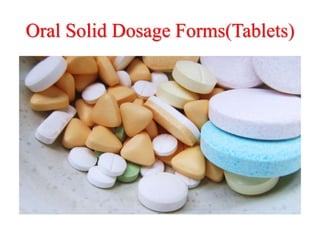
Oral Solid Dosage Forms(Tablets)
Introductory Concepts
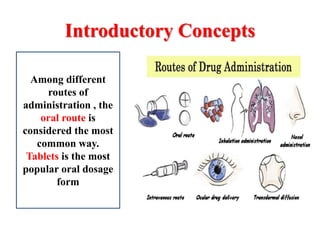
Among different
routes of
administration , the
oral route is
considered the most
common way.
Tablets is the most
popular oral dosage
form
Introductory Concepts
The term tablet derived from the Latin word
(tabuletta) which is related to the appearance
of the dosage form (small disc like)
In 1843 the first patent for a hand –operated
device used to form a tablet was granted.
After that , the use of tablets as a dosage form
increased gradually at small scale level.
Definition
Tablets defined as, solid preparations each
containing single dose of one or more active
ingredients and usually obtained by compressing
uniform volume of particles.(other methods like
molding and freeze drying are also used)
Tablets usually prepared with the aid of suitable
pharmaceutical excipients.
It vary in size , shape, weight , hardness,
thickness, disintegration ,and dissolution
depending on its intended use and manufacturing
method
Definition
Most tablets are used for oral administration,
swallowed whole, or after being chewed, some
are dissolved before administration, or retained
in mouth
Tablets such as those administered
sublingually ,buccally , or vaginally, are
prepared to have features most applicable to
their particular route of administration.
Definition
Tablets are used mainly to induce systemic
effect, but sometimes for local drug action in
the mouth or GIT, or to increase the pH of
stomach temporarily.
For systemic use, the drug must be released
from the tablet , dissolved in the fluid of the
mouth ,stomach or intestine and absorbed by
systemic circulation .
Advatages
Tablets are unit dosage form of great accuracy
with least content variability
The cost of production is very low.
Easiest and cheapest dosage form to package and
ship.
Portable dosage form due its light weight
Tablets are of high stability(physical ,chemical and
microbiological) compared with other dosage
forms
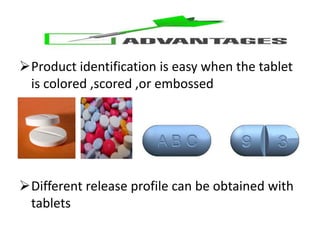
Product identification is easy when the tablet
is colored ,scored ,or embossed
Different release profile can be obtained with
tablets
Disadvantages
 Some drugs resist compression into
dense compacts due to its amorphous
nature or low density.
 Drugs with poor wetting , slow
dissolution properties, with window
absorption (bioavailability problems)
, intermediate to large dose or any
combination of these features may
complicate formation of tablets.
Disadvantages
 Drugs with bitter taste, objectionable odor, or those
sensitive to oxygen or atmospheric moisture may
require encapsulation before compression or may
require coating which impose additional cost, in such
cases capsules is considered better alternative.
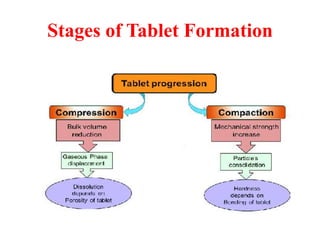
Stages of Tablet Formation
The tablets are prepared by directing particles
into close proximity by powder compression.
The particles cohere into porous, solid
specimen of defined geometry(compact).
Stages of Tablet Formation
Powder compression is the reduction in the
volume or increasing density of powder owing
to the application of a force.
Bonds are formed between particles which
provide coherence to the powder and compact
is formed.
Compaction is formation of solid specimen of
defined geometry due to compression.
Is compaction part from compression?
Stages of Tablet Formation
Parts of Tablet Machines
Types of Tablet Machines
1- Single-Punch Press
This type has one die and one pair of punches .
The output is about 200 tablets per minute
Its primary use is limited to the production of
small batches during formulation
developments and clinical trials
Types of Tablet Machines
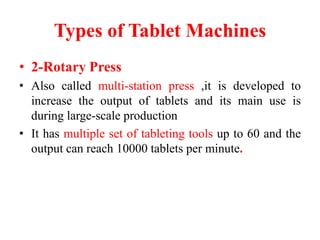
• 2-Rotary Press
• Also called multi-station press ,it is developed to
increase the output of tablets and its main use is
during large-scale production
• It has multiple set of tableting tools up to 60 and the
output can reach 10000 tablets per minute.
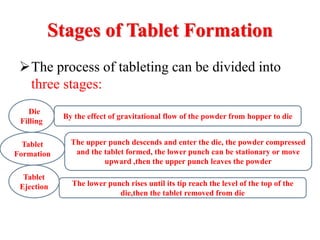
Stages of Tablet Formation
The process of tableting can be divided into
three stages:
DDie
Filling
Tablet
Formation
Tablet
Ejection
By the effect of gravitational flow of the powder from hopper to die
The upper punch descends and enter the die, the powder compressed
and the tablet formed, the lower punch can be stationary or move
upward ,then the upper punch leaves the powder
The lower punch rises until its tip reach the level of the top of the
die,then the tablet removed from die
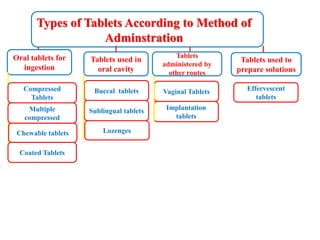
Oral tablets for
ingestion
Tablets used in
oral cavity
Tablets
administered by
other routes
Tablets used to
prepare solutions
Compressed
Tablets
Multiple
compressed
Chewable tablets
Coated Tablets
Buccal tablets
Sublingual tablets
Lozenges
Vaginal Tablets
Implantation
tablets
Effervescent
tablets
Types of Tablets According to Method of
Adminstration
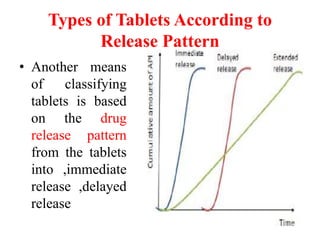
Types of Tablets According to
Release Pattern
• Another means
of classifying
tablets is based
on the drug
release pattern
from the tablets
into ,immediate
release ,delayed
release
Oral Tablets for Ingestion
1-Compressed tablets:
 These tablets are formed by compression and in their simplest form,
contain no special coating.
 They are made from powdered, crystalline, or granular materials,
alone or in combination with binders, disintegrants, controlled-
release polymers, lubricants, diluents, and in many cases colorants.
 The vast majority of tablets commercialized today are compressed
tablets, either in an uncoated or coated state.
 Most of these tablets are intended to provide rapid disintegration and
release to induce either local or systemic effect.
Oral Tablets for Ingestion
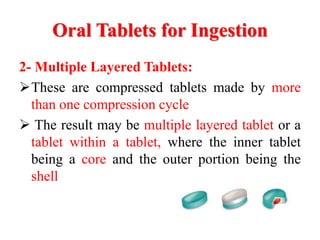
2- Multiple Layered Tablets:
These are compressed tablets made by more
than one compression cycle
 The result may be multiple layered tablet or a
tablet within a tablet, where the inner tablet
being a core and the outer portion being the
shell
Oral Tablets for Ingestion
Layered tablets are prepared by initial
compaction of a portion of a fill material in a
die ,
followed by additional fill material and
compression to form two or three layered
tablet.
Oral Tablets for Ingestion
The tablet within a tablet are prepared by
feeding previously compressed tablets into a
special tableting machine and compressing
another granulation layer around the
preformed tablets.
Each layer may contain the same or different
active ingredient.
Oral Tablets for Ingestion
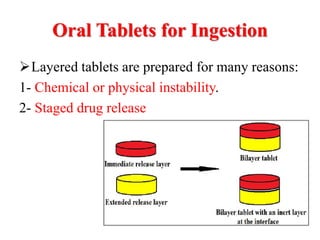
Layered tablets are prepared for many reasons:
1- Chemical or physical instability.
2- Staged drug release
Oral Tablets for Ingestion
If the mixing process is inadequate to
guarantee uniform distribution of two or more
active ingredients
Unique appearance of the of the layered tablet,
as each layer has different color to produce
distinctive-looking.
Oral Tablets for Ingestion
Disadvantages of the layered tablets:
1-release of part of sustained release layer with
the immediate release
2- tablet hardness not enough
3-the tablet has tendency to laminate
4- large size difficult to swallow, and require
complicated techniques in preparation.
Oral Tablets for Ingestion
3- Chewable Tablets
 Have smooth ,rapid disintegration upon chewing
(mechanical) ,.
 The drug is normally not dissolved in the mouth but in
stomach or intestine.
 It can be used to induce local and systemic effect
 Chewable tablets is very useful for administration of
tablets to children or elderly with difficulty in
swallowing solid dosage form without need of water.
Oral Tablets for Ingestion
• Chewable tablets are similar in composition to
conventional tablets except that the
disintegrant is not included.
• Flavoring and coloring agent such as mannitol
and sorbitol are commonly used in this type of
tablets.
Oral Solid Dosage Forms(Tablets)

Oral Solid Dosage Forms(Tablets)

  • 1.
    Oral Solid DosageForms(Tablets)
  • 2.
    Introductory Concepts Among different routesof administration , the oral route is considered the most common way. Tablets is the most popular oral dosage form
  • 3.
    Introductory Concepts The termtablet derived from the Latin word (tabuletta) which is related to the appearance of the dosage form (small disc like) In 1843 the first patent for a hand –operated device used to form a tablet was granted. After that , the use of tablets as a dosage form increased gradually at small scale level.
  • 4.
    Definition Tablets defined as,solid preparations each containing single dose of one or more active ingredients and usually obtained by compressing uniform volume of particles.(other methods like molding and freeze drying are also used) Tablets usually prepared with the aid of suitable pharmaceutical excipients. It vary in size , shape, weight , hardness, thickness, disintegration ,and dissolution depending on its intended use and manufacturing method
  • 5.
    Definition Most tablets areused for oral administration, swallowed whole, or after being chewed, some are dissolved before administration, or retained in mouth Tablets such as those administered sublingually ,buccally , or vaginally, are prepared to have features most applicable to their particular route of administration.
  • 6.
    Definition Tablets are usedmainly to induce systemic effect, but sometimes for local drug action in the mouth or GIT, or to increase the pH of stomach temporarily. For systemic use, the drug must be released from the tablet , dissolved in the fluid of the mouth ,stomach or intestine and absorbed by systemic circulation .
  • 8.
    Advatages Tablets are unitdosage form of great accuracy with least content variability The cost of production is very low. Easiest and cheapest dosage form to package and ship. Portable dosage form due its light weight Tablets are of high stability(physical ,chemical and microbiological) compared with other dosage forms
  • 9.
    Product identification iseasy when the tablet is colored ,scored ,or embossed Different release profile can be obtained with tablets
  • 10.
    Disadvantages  Some drugsresist compression into dense compacts due to its amorphous nature or low density.  Drugs with poor wetting , slow dissolution properties, with window absorption (bioavailability problems) , intermediate to large dose or any combination of these features may complicate formation of tablets.
  • 11.
    Disadvantages  Drugs withbitter taste, objectionable odor, or those sensitive to oxygen or atmospheric moisture may require encapsulation before compression or may require coating which impose additional cost, in such cases capsules is considered better alternative.
  • 12.
    Stages of TabletFormation The tablets are prepared by directing particles into close proximity by powder compression. The particles cohere into porous, solid specimen of defined geometry(compact).
  • 13.
    Stages of TabletFormation Powder compression is the reduction in the volume or increasing density of powder owing to the application of a force. Bonds are formed between particles which provide coherence to the powder and compact is formed. Compaction is formation of solid specimen of defined geometry due to compression. Is compaction part from compression?
  • 14.
  • 15.
  • 16.
    Types of TabletMachines 1- Single-Punch Press This type has one die and one pair of punches . The output is about 200 tablets per minute Its primary use is limited to the production of small batches during formulation developments and clinical trials
  • 17.
    Types of TabletMachines • 2-Rotary Press • Also called multi-station press ,it is developed to increase the output of tablets and its main use is during large-scale production • It has multiple set of tableting tools up to 60 and the output can reach 10000 tablets per minute.
  • 19.
    Stages of TabletFormation The process of tableting can be divided into three stages: DDie Filling Tablet Formation Tablet Ejection By the effect of gravitational flow of the powder from hopper to die The upper punch descends and enter the die, the powder compressed and the tablet formed, the lower punch can be stationary or move upward ,then the upper punch leaves the powder The lower punch rises until its tip reach the level of the top of the die,then the tablet removed from die
  • 20.
    Oral tablets for ingestion Tabletsused in oral cavity Tablets administered by other routes Tablets used to prepare solutions Compressed Tablets Multiple compressed Chewable tablets Coated Tablets Buccal tablets Sublingual tablets Lozenges Vaginal Tablets Implantation tablets Effervescent tablets Types of Tablets According to Method of Adminstration
  • 21.
    Types of TabletsAccording to Release Pattern • Another means of classifying tablets is based on the drug release pattern from the tablets into ,immediate release ,delayed release
  • 22.
    Oral Tablets forIngestion 1-Compressed tablets:  These tablets are formed by compression and in their simplest form, contain no special coating.  They are made from powdered, crystalline, or granular materials, alone or in combination with binders, disintegrants, controlled- release polymers, lubricants, diluents, and in many cases colorants.  The vast majority of tablets commercialized today are compressed tablets, either in an uncoated or coated state.  Most of these tablets are intended to provide rapid disintegration and release to induce either local or systemic effect.
  • 23.
    Oral Tablets forIngestion 2- Multiple Layered Tablets: These are compressed tablets made by more than one compression cycle  The result may be multiple layered tablet or a tablet within a tablet, where the inner tablet being a core and the outer portion being the shell
  • 24.
    Oral Tablets forIngestion Layered tablets are prepared by initial compaction of a portion of a fill material in a die , followed by additional fill material and compression to form two or three layered tablet.
  • 26.
    Oral Tablets forIngestion The tablet within a tablet are prepared by feeding previously compressed tablets into a special tableting machine and compressing another granulation layer around the preformed tablets. Each layer may contain the same or different active ingredient.
  • 27.
    Oral Tablets forIngestion Layered tablets are prepared for many reasons: 1- Chemical or physical instability. 2- Staged drug release
  • 28.
    Oral Tablets forIngestion If the mixing process is inadequate to guarantee uniform distribution of two or more active ingredients Unique appearance of the of the layered tablet, as each layer has different color to produce distinctive-looking.
  • 29.
  • 30.
    Oral Tablets forIngestion Disadvantages of the layered tablets: 1-release of part of sustained release layer with the immediate release 2- tablet hardness not enough 3-the tablet has tendency to laminate 4- large size difficult to swallow, and require complicated techniques in preparation.
  • 31.
    Oral Tablets forIngestion 3- Chewable Tablets  Have smooth ,rapid disintegration upon chewing (mechanical) ,.  The drug is normally not dissolved in the mouth but in stomach or intestine.  It can be used to induce local and systemic effect  Chewable tablets is very useful for administration of tablets to children or elderly with difficulty in swallowing solid dosage form without need of water.
  • 32.
    Oral Tablets forIngestion • Chewable tablets are similar in composition to conventional tablets except that the disintegrant is not included. • Flavoring and coloring agent such as mannitol and sorbitol are commonly used in this type of tablets.