CYCLO
ALKANES
Introduction
The carbocyclic or homocyclic compounds
containing closed chains or ring of carbon
atom and bearing certain resemblance to
aliphatic compounds in their properties are
known as cycloalkanes . They vary from
aliphatic compounds in that they possess a
cyclic structure.
3
Simple saturated cycloalkanes, also known
as alicyclic hydrocarbons , have the general
formula C n H 2n . The general formula is
isomeric with those of alkenes but
cycloalkanes do not have any double bond
but they contain the ring of carbon atoms
linked together by single bonds.
Nomenclature of Cycloalkanes
There are two systems for naming cycloalkanes:
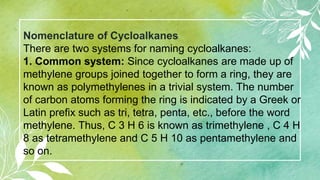
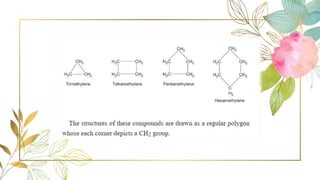
1. Common system: Since cycloalkanes are made up of
methylene groups joined together to form a ring, they are
known as polymethylenes in a trivial system. The number
of carbon atoms forming the ring is indicated by a Greek or
Latin prefix such as tri, tetra, penta, etc., before the word
methylene. Thus, C 3 H 6 is known as trimethylene , C 4 H
8 as tetramethylene and C 5 H 10 as pentamethylene and
so on.
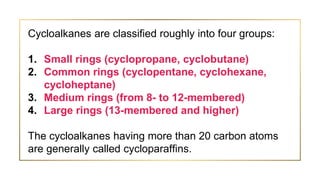
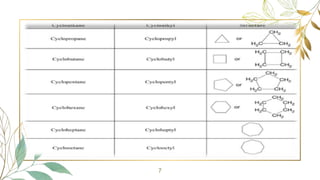
Cycloalkanes are classified roughly into four groups:
1. Small rings (cyclopropane, cyclobutane)
2. Common rings (cyclopentane, cyclohexane,
cycloheptane)
3. Medium rings (from 8- to 12-membered)
4. Large rings (13-membered and higher)
The cycloalkanes having more than 20 carbon atoms
are generally called cycloparaffins.
7
Preparation of Cycloalkanes
Following methods are commonly used for the
preparation of cycloalkanes.
1. Freund’s Method from α, ω-dihalides:
Dichloro or dibromoalkanes having terminal
halogen atoms, when treated with sodium or
zinc, yield the corresponding cycloalkanes. For
example,
IUPAC rules for nomenclature:
The general molecular formula of cycloalkanes is C n H
2 n . These are simplest cyclic molecules. These are
named after their corresponding linear alkanes with the
prefix cyclo.
a. Determine the cycloalkane to use as parent chain:
The parent chain is one with the maximum amount of
carbon atoms. if there are two cycloalkanes, then the
cycloalkanes with more carbons will be considered as
the parent chain.
Big concept
10
11
2. From barium or calcium salts of dibasic acids
(Wislicenus method): On dry distillation of barium
or calcium salts of dicarboxylic acids, a cycloketone
is obtained which can be reduced to cycloalkane by
Clemmenson’s reduction (Zn–Hg/HCl). This
method is useful for the preparation of only, six-
and seven-membered ring ketones which can be
further reduced to cycloalkanes. This method is not
suitable for preparation of cyclopropane or its
derivatives.
12
13
3. From alkenes: Derivatives of cycloalkanes are
prepared by treating alkenes with CH 2 I 2 in presence of
Zn–Cu couple or by diazomethane (CH 2 N 2 ) in
presence of UV light.
14
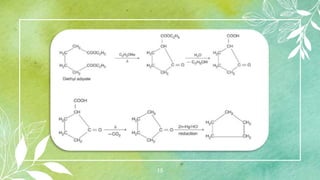
4Dieckmann cyclization: By Cyclic β-keto
esters are prepared by heating esters of
dicarboxylic acids in the presence of sodium
ethoxide. it undergoes intramolecular
Claisen condensation. These β-keto esters
on hydrolysis and subsequent heating gives
cyclic ketones, which are reduced by Zn–
Hg/HCl to give cycloalkanes:
15
5. From aromatic compounds: By the catalytic
reduction of benzene and its derivatives, we can easily
obtain six-membered cyclo compounds:
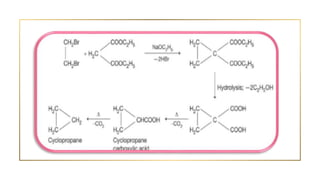
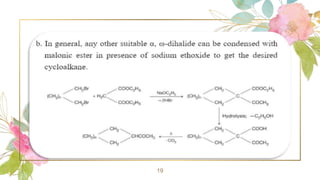
6. a. Condensation of α,ω-dihalide with
malonic ester (Perkin’s method):
α,ω-Dihalide is condensed with malonic
ester in the presence of NaOC 2 H 5 .
Alicyclic carboxylic ester thus obtained is
hydrolysed and decarboxylated to yield
cycloalkane.
19
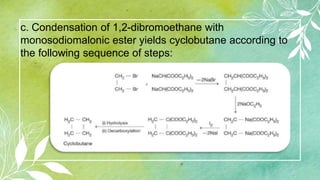
c. Condensation of 1,2-dibromoethane with
monosodiomalonic ester yields cyclobutane according to
the following sequence of steps:
21
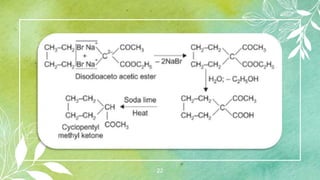
7. From disodio acetoacetic ester and
dihalogenated paraffins:
Disodio derivative of acetoacetic ester
condenses with dihalogenated paraffin to
form an ester which on hydrolysis and
decarboxylation gives cycloparaffins.
Cyclobutane cannot be obtained by this
method.
22
23
8. Addition of carbene to olefins—Synthesis of
cyclopropane derivatives: Highly reactive bivalent carbon
species, carbenes, add on to alkane molecules forming
cyclopropane derivatives. For example, dichloro or
dibromocarbenes, obtained by the reaction of potassium
tertiary butoxide on chloroform or bromoform, when treated
with alkenes undergo cis -addition to form cyclopropane
derivatives.
24
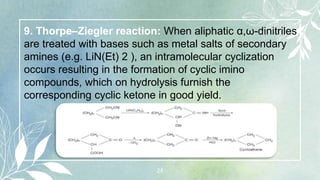
9. Thorpe–Ziegler reaction: When aliphatic α,ω-dinitriles
are treated with bases such as metal salts of secondary
amines (e.g. LiN(Et) 2 ), an intramolecular cyclization
occurs resulting in the formation of cyclic imino
compounds, which on hydrolysis furnish the
corresponding cyclic ketone in good yield.
25
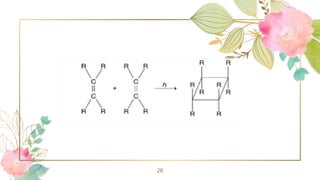
10. Photochemical [2+2] cycloaddition reactions:
[2+2] Cycloaddition reaction refers to an addition of two
alkene molecules using two π electrons each to form a
cyclobutane ring. A convenient method for the synthesis
of cyclobutane derivatives is photodimerization reaction
between two alkenes. These reactions take place in a
concerted manner involving a cyclic transition state.
Some suitable substituted alkenes such as R 2 C = CF 2
or CH 2 = CH — X (X = —COR, —CN, —COOR, etc.)
yield cyclobutane derivatives under thermal conditions.
26
27
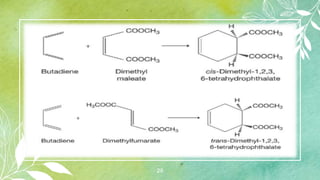
11. Diels–Alder reaction [4+2] Cycloaddition:
The [4+2] cycloaddition reaction between a conjugated
diene (4π-electron system) to form an adduct is known as
Diels–Alder reaction named after the two German
chemists, who received the noble Prize for chemistry in
1950. a typical example is the addition of 1,3-butadiene
with acrolein at 100°C to form tetrahydrobenz-aldehyde.
28
29
30
12. Demjanov rearrangement:
The rearrangement has been used for ring
expansion or contraction of alicyclic ring. The
reaction of nitrous acid on cycloalkymethylamines is
a general method for ring expansion.
Cyclobutylmethylamine will illustrate the behaviour of
this class of amines. In general four products are
formed; in this instance they are cyclopentanol,
cyclopentene, cyclobutylcarbinol and methylene
cyclobutane.
31

CYCLOALKANES.pptx

  • 1.
  • 2.
    Introduction The carbocyclic orhomocyclic compounds containing closed chains or ring of carbon atom and bearing certain resemblance to aliphatic compounds in their properties are known as cycloalkanes . They vary from aliphatic compounds in that they possess a cyclic structure.
  • 3.
    3 Simple saturated cycloalkanes,also known as alicyclic hydrocarbons , have the general formula C n H 2n . The general formula is isomeric with those of alkenes but cycloalkanes do not have any double bond but they contain the ring of carbon atoms linked together by single bonds.
  • 4.
    Nomenclature of Cycloalkanes Thereare two systems for naming cycloalkanes: 1. Common system: Since cycloalkanes are made up of methylene groups joined together to form a ring, they are known as polymethylenes in a trivial system. The number of carbon atoms forming the ring is indicated by a Greek or Latin prefix such as tri, tetra, penta, etc., before the word methylene. Thus, C 3 H 6 is known as trimethylene , C 4 H 8 as tetramethylene and C 5 H 10 as pentamethylene and so on.
  • 5.
    Cycloalkanes are classifiedroughly into four groups: 1. Small rings (cyclopropane, cyclobutane) 2. Common rings (cyclopentane, cyclohexane, cycloheptane) 3. Medium rings (from 8- to 12-membered) 4. Large rings (13-membered and higher) The cycloalkanes having more than 20 carbon atoms are generally called cycloparaffins.
  • 7.
  • 8.
    Preparation of Cycloalkanes Followingmethods are commonly used for the preparation of cycloalkanes. 1. Freund’s Method from α, ω-dihalides: Dichloro or dibromoalkanes having terminal halogen atoms, when treated with sodium or zinc, yield the corresponding cycloalkanes. For example,
  • 9.
    IUPAC rules fornomenclature: The general molecular formula of cycloalkanes is C n H 2 n . These are simplest cyclic molecules. These are named after their corresponding linear alkanes with the prefix cyclo. a. Determine the cycloalkane to use as parent chain: The parent chain is one with the maximum amount of carbon atoms. if there are two cycloalkanes, then the cycloalkanes with more carbons will be considered as the parent chain.
  • 10.
  • 11.
    11 2. From bariumor calcium salts of dibasic acids (Wislicenus method): On dry distillation of barium or calcium salts of dicarboxylic acids, a cycloketone is obtained which can be reduced to cycloalkane by Clemmenson’s reduction (Zn–Hg/HCl). This method is useful for the preparation of only, six- and seven-membered ring ketones which can be further reduced to cycloalkanes. This method is not suitable for preparation of cyclopropane or its derivatives.
  • 12.
  • 13.
    13 3. From alkenes:Derivatives of cycloalkanes are prepared by treating alkenes with CH 2 I 2 in presence of Zn–Cu couple or by diazomethane (CH 2 N 2 ) in presence of UV light.
  • 14.
    14 4Dieckmann cyclization: ByCyclic β-keto esters are prepared by heating esters of dicarboxylic acids in the presence of sodium ethoxide. it undergoes intramolecular Claisen condensation. These β-keto esters on hydrolysis and subsequent heating gives cyclic ketones, which are reduced by Zn– Hg/HCl to give cycloalkanes:
  • 15.
  • 16.
    5. From aromaticcompounds: By the catalytic reduction of benzene and its derivatives, we can easily obtain six-membered cyclo compounds:
  • 17.
    6. a. Condensationof α,ω-dihalide with malonic ester (Perkin’s method): α,ω-Dihalide is condensed with malonic ester in the presence of NaOC 2 H 5 . Alicyclic carboxylic ester thus obtained is hydrolysed and decarboxylated to yield cycloalkane.
  • 19.
  • 20.
    c. Condensation of1,2-dibromoethane with monosodiomalonic ester yields cyclobutane according to the following sequence of steps:
  • 21.
    21 7. From disodioacetoacetic ester and dihalogenated paraffins: Disodio derivative of acetoacetic ester condenses with dihalogenated paraffin to form an ester which on hydrolysis and decarboxylation gives cycloparaffins. Cyclobutane cannot be obtained by this method.
  • 22.
  • 23.
    23 8. Addition ofcarbene to olefins—Synthesis of cyclopropane derivatives: Highly reactive bivalent carbon species, carbenes, add on to alkane molecules forming cyclopropane derivatives. For example, dichloro or dibromocarbenes, obtained by the reaction of potassium tertiary butoxide on chloroform or bromoform, when treated with alkenes undergo cis -addition to form cyclopropane derivatives.
  • 24.
    24 9. Thorpe–Ziegler reaction:When aliphatic α,ω-dinitriles are treated with bases such as metal salts of secondary amines (e.g. LiN(Et) 2 ), an intramolecular cyclization occurs resulting in the formation of cyclic imino compounds, which on hydrolysis furnish the corresponding cyclic ketone in good yield.
  • 25.
    25 10. Photochemical [2+2]cycloaddition reactions: [2+2] Cycloaddition reaction refers to an addition of two alkene molecules using two π electrons each to form a cyclobutane ring. A convenient method for the synthesis of cyclobutane derivatives is photodimerization reaction between two alkenes. These reactions take place in a concerted manner involving a cyclic transition state. Some suitable substituted alkenes such as R 2 C = CF 2 or CH 2 = CH — X (X = —COR, —CN, —COOR, etc.) yield cyclobutane derivatives under thermal conditions.
  • 26.
  • 27.
    27 11. Diels–Alder reaction[4+2] Cycloaddition: The [4+2] cycloaddition reaction between a conjugated diene (4π-electron system) to form an adduct is known as Diels–Alder reaction named after the two German chemists, who received the noble Prize for chemistry in 1950. a typical example is the addition of 1,3-butadiene with acrolein at 100°C to form tetrahydrobenz-aldehyde.
  • 28.
  • 29.
  • 30.
    30 12. Demjanov rearrangement: Therearrangement has been used for ring expansion or contraction of alicyclic ring. The reaction of nitrous acid on cycloalkymethylamines is a general method for ring expansion. Cyclobutylmethylamine will illustrate the behaviour of this class of amines. In general four products are formed; in this instance they are cyclopentanol, cyclopentene, cyclobutylcarbinol and methylene cyclobutane.
  • 31.