DEFINITION OF ASSESSMENT
The process of collecting information or evidence
of a learner’s learning progress and achievement
over a period of time in order to improve teaching
and learning. (Bob Adamson )
Assessment is typically used to describe processes to
examine or measure student learning that results
from academic programs.
Assessment is not based on one test or one task,
neither it is expressed by mark nor by grade, but in
a report form with scales or levels as well as
description and comment from the teacher.
 The student’s achievement is often measured
against his/her own starting point rather than
compared against the skills or abilities of other
students.
•Assessment is the process of
gathering and discussing information
from multiple and diverse sources in
order to develop a deep
understanding of what students know,
understand, and can do with their
knowledge as a result of their
educational experiences; the process
culminates when assessment results
• All those activities undertaken by teachers, and
by their students in assessing themselves,
which provide information to be used as
feedback to modify the teaching and learning
activities in which they are engaged .
PRINCIPLES OF ASSESSMENT
Assessment should be aimed to improve students’ performance
Assessment should be based on an understanding of how students’
learn
Assessment should be an integral component of course design and
not something to add afterwards
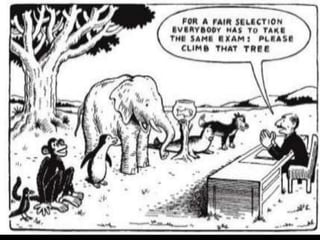
 Good assessment provides useful information to report credibly to
parents on student’s achievement
 Good assessment requires clarity of purpose, goals, standards and
criteria
 Good assessment requires a variety of measures.
 Assessment methods used should be valid, reliable and consistent .
8. Assessment requires attention to outcomes and processes.
 9. Assessment works best when it is ongoing rather than episodic.
Assessment for improved
performance involves feedback
and reflection.
THE ROLE OF ASSESSMENT IN LEARNING
• Assessment plays a major role in how students learn, their
motivation to learn, and how teachers teach.
• Assessment is used for various purposes.
• Assessment for learning: where assessment helps teachers gain
insight.
• Assessment as learning: where students develop an awareness .
• Assessment of learning: where assessment informs students,
teachers and parents, as well as the broader educational community,
of achievement at a certain point in time.
FUNCTIONS OF ASSESSMENT
• Capturing student time and attention.
• Generating appropriate student learning activity .
• Providing timely feedback which students pay attention to .
• Helping students to internalize the discipline’s standards and notions of
equality .
• Generating marks or grades which distinguish between students or
enable pass/fail decisions to be made .
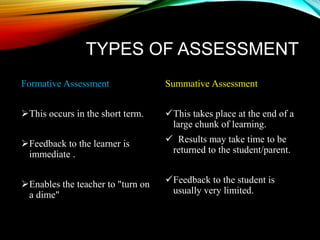
TYPES OF ASSESSMENT
Formative Assessment
This occurs in the short term.
Feedback to the learner is
immediate .
Enables the teacher to "turn on
a dime"
Summative Assessment
This takes place at the end of a
large chunk of learning.
 Results may take time to be
returned to the student/parent.
Feedback to the student is
usually very limited.
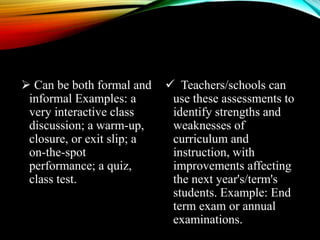
 Can be both formal and
informal Examples: a
very interactive class
discussion; a warm-up,
closure, or exit slip; a
on-the-spot
performance; a quiz,
class test.
 Teachers/schools can
use these assessments to
identify strengths and
weaknesses of
curriculum and
instruction, with
improvements affecting
the next year's/term's
students. Example: End
term exam or annual
examinations.
ADVANTAGES OF ASSESSMENT
Helps in knowing the position of a student when they enter a course.
 It provides data on student learning.
 It provides a large view of students’ need and assessment.
 In accordance to the students’ achievement, the curriculum and
teaching methods can be adjusted.
DISADVANTAGES OF ASSESSMENT
It limits the potential of a student to a mere ‘test’.
Under supervision and pressure and supervision, creativity and
performance is affected.
Though assessment aims at bringing out the latent knowledge, it often
conceals it by the pressure it creates.
The parameter to judge knowledge is just a test score.
DEFINITIONOFEVALUATION
The process of making overall judgment about one’s work or a whole
school’s work (Cameron)
Evaluation is concerned with a whole range of issues in and beyond
language education: lessons, courses, programs, and skills can be
evaluated.
It produces a global view of achievement usually based on many
different types of information, such as observation of lessons,
student’s test scores, teachers’ assessment reports, course
documents, or interviews with students and teachers, etc.
The term assessment and evaluation are often
used interchangeably, however, they actually
have different definitions.
Ewell (2003) explains that evaluation is
typically a broader concept than assessment as
it focuses on the over all, or summative
experience.
 Assessment and Evaluation
 Assessment and Evaluation

Assessment and Evaluation

  • 4.
    DEFINITION OF ASSESSMENT Theprocess of collecting information or evidence of a learner’s learning progress and achievement over a period of time in order to improve teaching and learning. (Bob Adamson ) Assessment is typically used to describe processes to examine or measure student learning that results from academic programs.
  • 5.
    Assessment is notbased on one test or one task, neither it is expressed by mark nor by grade, but in a report form with scales or levels as well as description and comment from the teacher.  The student’s achievement is often measured against his/her own starting point rather than compared against the skills or abilities of other students.
  • 6.
    •Assessment is theprocess of gathering and discussing information from multiple and diverse sources in order to develop a deep understanding of what students know, understand, and can do with their knowledge as a result of their educational experiences; the process culminates when assessment results
  • 7.
    • All thoseactivities undertaken by teachers, and by their students in assessing themselves, which provide information to be used as feedback to modify the teaching and learning activities in which they are engaged .
  • 9.
    PRINCIPLES OF ASSESSMENT Assessmentshould be aimed to improve students’ performance Assessment should be based on an understanding of how students’ learn Assessment should be an integral component of course design and not something to add afterwards  Good assessment provides useful information to report credibly to parents on student’s achievement
  • 10.
     Good assessmentrequires clarity of purpose, goals, standards and criteria  Good assessment requires a variety of measures.  Assessment methods used should be valid, reliable and consistent . 8. Assessment requires attention to outcomes and processes.  9. Assessment works best when it is ongoing rather than episodic.
  • 11.
    Assessment for improved performanceinvolves feedback and reflection.
  • 13.
    THE ROLE OFASSESSMENT IN LEARNING • Assessment plays a major role in how students learn, their motivation to learn, and how teachers teach. • Assessment is used for various purposes. • Assessment for learning: where assessment helps teachers gain insight. • Assessment as learning: where students develop an awareness . • Assessment of learning: where assessment informs students, teachers and parents, as well as the broader educational community, of achievement at a certain point in time.
  • 14.
    FUNCTIONS OF ASSESSMENT •Capturing student time and attention. • Generating appropriate student learning activity . • Providing timely feedback which students pay attention to . • Helping students to internalize the discipline’s standards and notions of equality . • Generating marks or grades which distinguish between students or enable pass/fail decisions to be made .
  • 15.
    TYPES OF ASSESSMENT FormativeAssessment This occurs in the short term. Feedback to the learner is immediate . Enables the teacher to "turn on a dime" Summative Assessment This takes place at the end of a large chunk of learning.  Results may take time to be returned to the student/parent. Feedback to the student is usually very limited.
  • 16.
     Can beboth formal and informal Examples: a very interactive class discussion; a warm-up, closure, or exit slip; a on-the-spot performance; a quiz, class test.  Teachers/schools can use these assessments to identify strengths and weaknesses of curriculum and instruction, with improvements affecting the next year's/term's students. Example: End term exam or annual examinations.
  • 17.
    ADVANTAGES OF ASSESSMENT Helpsin knowing the position of a student when they enter a course.  It provides data on student learning.  It provides a large view of students’ need and assessment.  In accordance to the students’ achievement, the curriculum and teaching methods can be adjusted.
  • 18.
    DISADVANTAGES OF ASSESSMENT Itlimits the potential of a student to a mere ‘test’. Under supervision and pressure and supervision, creativity and performance is affected. Though assessment aims at bringing out the latent knowledge, it often conceals it by the pressure it creates. The parameter to judge knowledge is just a test score.
  • 19.
    DEFINITIONOFEVALUATION The process ofmaking overall judgment about one’s work or a whole school’s work (Cameron) Evaluation is concerned with a whole range of issues in and beyond language education: lessons, courses, programs, and skills can be evaluated. It produces a global view of achievement usually based on many different types of information, such as observation of lessons, student’s test scores, teachers’ assessment reports, course documents, or interviews with students and teachers, etc.
  • 21.
    The term assessmentand evaluation are often used interchangeably, however, they actually have different definitions. Ewell (2003) explains that evaluation is typically a broader concept than assessment as it focuses on the over all, or summative experience.

Editor's Notes

  • #2 Start in the name of that Load who is the creator of whole universe.
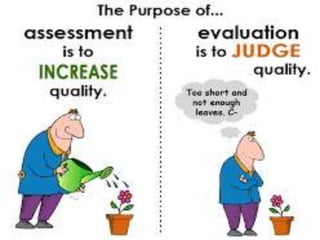
  • #4 See the difference between both picture, see their dresses and behavior.
  • #16 “turn on a dime” To have the ability to make a very sharp, agile turn. The dime is the smallest US coin, implying the sharpest possible turn.