Glycoside
Definition, classification, properties and test for identification
PRESENTED BY:
MR. PRITAM VIJAY JUVATKAR
ASSISTANT PROFESSOR
pvjuvatkar@rediffmail.com, +91 9987779536
KONKAN GYANPEETH RAHUL DHARKAR COLLEGE OF PHARMACY AND RESEARCH INSTITUTE,
KARJAT
UNIVERSITY OF MUMBAI
Pritam Vijay Juvatkar 9987779536 Glycoside 2
Definition
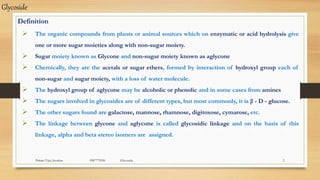
 The organic compounds from plants or animal sources which on enzymatic or acid hydrolysis give
one or more sugar moieties along with non-sugar moiety.
 Sugar moiety known as Glycone and non-sugar moiety known as aglycone
 Chemically, they are the acetals or sugar ethers, formed by interaction of hydroxyl group each of
non-sugar and sugar moiety, with a loss of water molecule.
 The hydroxyl group of aglycone may be alcoholic or phenolic and in some cases from amines
 The sugars involved in glycosides are of different types, but most commonly, it is β - D - glucose.
 The other sugars found are galactose, mannose, rhamnose, digitoxose, cymarose, etc.
 The linkage between glycone and aglycone is called glycosidic linkage and on the basis of this
linkage, alpha and beta stereo isomers are assigned.
Glycoside
Pritam Vijay Juvatkar 9987779536 Glycoside
3
Physical Properties of Glycoside
 Glycosides are crystalline or amorphous substances
 These are soluble in water and dilute alcohol with an exception of resin glycosides, but insoluble in
organic solvent like chloroform or ether.
 The aglycone moiety is soluble in non-polar solvents like benzene or ether.
Chemical Properties of Glycoside
 Glycosides are easily hydrolysed by water, mineral acids and enzymes.
 They show optical activity, normally with laevo rotatory effects.
 Glycosides do not reduce Fehling's solution until they are hydrolysed.
 They are believed to participate in growth regulation and protection of plant.
Glycoside
Pritam Vijay Juvatkar 9987779536 Glycoside 4
Classification of Glycosides (Chemical nature of aglycone moiety)
 Anthraquinone Glycosides - Aloe, Cascara, Rhubarb, Senna
 Aldehyde glycosides - Vanilla, Anantmul
 Bitter Glycosides - Gentian, Calumba, Quassia, Chirata, Kalmegh
 Sterol or Cardiac Glycosides - Digitalis, Strophantus
 Cyanogenetic Glycosides - Wild cherry bark, Bitter Almond
 Coumarin and Furanocoumarin glycosides - Visnega, Psoralea
 Flavanoids Flavonol glycosides - Buck Wheat, Citrus fruits, Gingko
 Isothiocyanate Glycosides - Mustard
 Phenol glycosides - Bear berry
 Saponins Glycosides -Quillaia, Dioscorea, Glycyrrhiza
 Steroidal glycolkaloids - Solanum
Pritam Vijay Juvatkar 9987779536 Glycoside 5
Classification of Glycosides-: Depend on glycosidic linkage form
 All types of glycosidal linkages are occured by interaction of - OH group of glycone and hydrogen
coming through any of the radicals like CH, - OH, - SH and· NH present on aglycone part.
 By elimination of one water molecule, linkage or a bridge is formed and the type of glycoside formed is
named by putting the element as prefix like C-glycoside, N-glycoside, O-glycoside or S-glycoside.
(1) C-glycosides (when sugar moiety is linked to carbon atom) :
Glycone---OH H C------Aglycone Glycone-----C------Aglycone H2O
 Aloe
 Cochineal contains C-glycoside in the form of a colouring matter called carminic acid,
Pritam Vijay Juvatkar 9987779536 Glycoside 6
Classification of Glycosides-: Depend on glycosidic linkage form
(2) 0 - glycosides (when sugar moiety is attached to oxygen atom) :
Glycone---OH H O-----Aglycone Glycone-----O------Aglycone H2O
 e.g. senna, rhubarb, etc.
(3) S - glycosides (when sugar is linked to sulphur atom)
Glycone---OH H S-----Aglycone Glycone-----S------Aglycone H2O
 Sinigrin from Black Mustard
(4) N - glycosides :
Glycone---OH H N-----Aglycone Glycone-----N------Aglycone H2O
Pritam Vijay Juvatkar 9987779536 Glycoside 7
Chemical Test of Glycoside
1. Baljet's test: For cardenoloids
2. Schoenteten's reaction (Borax test) : For aloe
3. Legal's test: For cardenoloids
4. Kellar Killani test: For deoxysugars
5. Libermann's test: For bufadenolids
6. Modified Borntrager’s test: This test indicates the presence of C-glycosides
7. Borntrager’s test : Anthraquinone derivatives
8. Foam test : Saponin Glycosides
9. Haemolytic test: Saponin Glycosides
Thank You
PRESENTED BY:
MR. PRITAM VIJAY JUVATKAR
ASSISTANT PROFESSOR
pvjuvatkar@rediffmail.com, +91 9987779536
KONKAN GYANPEETH RAHUL DHARKAR COLLEGE OF PHARMACY AND RESEARCH INSTITUTE,
KARJAT
UNIVERSITY OF MUMBAI
Disclosure
PRESENTED BY:
MR. PRITAM VIJAY JUVATKAR
ASSISTANT PROFESSOR
pvjuvatkar@rediffmail.com, +91 9987779536
KONKAN GYANPEETH RAHUL DHARKAR COLLEGE OF PHARMACY AND RESEARCH INSTITUTE,
KARJAT
UNIVERSITY OF MUMBAI
This Presentation is meant for Study Notes for B.Pharm Students only. Please do not
take as a reference for treatment for an ailments or other usage

Glycoside and its classification

  • 1.
    Glycoside Definition, classification, propertiesand test for identification PRESENTED BY: MR. PRITAM VIJAY JUVATKAR ASSISTANT PROFESSOR pvjuvatkar@rediffmail.com, +91 9987779536 KONKAN GYANPEETH RAHUL DHARKAR COLLEGE OF PHARMACY AND RESEARCH INSTITUTE, KARJAT UNIVERSITY OF MUMBAI
  • 2.
    Pritam Vijay Juvatkar9987779536 Glycoside 2 Definition  The organic compounds from plants or animal sources which on enzymatic or acid hydrolysis give one or more sugar moieties along with non-sugar moiety.  Sugar moiety known as Glycone and non-sugar moiety known as aglycone  Chemically, they are the acetals or sugar ethers, formed by interaction of hydroxyl group each of non-sugar and sugar moiety, with a loss of water molecule.  The hydroxyl group of aglycone may be alcoholic or phenolic and in some cases from amines  The sugars involved in glycosides are of different types, but most commonly, it is β - D - glucose.  The other sugars found are galactose, mannose, rhamnose, digitoxose, cymarose, etc.  The linkage between glycone and aglycone is called glycosidic linkage and on the basis of this linkage, alpha and beta stereo isomers are assigned. Glycoside
  • 3.
    Pritam Vijay Juvatkar9987779536 Glycoside 3 Physical Properties of Glycoside  Glycosides are crystalline or amorphous substances  These are soluble in water and dilute alcohol with an exception of resin glycosides, but insoluble in organic solvent like chloroform or ether.  The aglycone moiety is soluble in non-polar solvents like benzene or ether. Chemical Properties of Glycoside  Glycosides are easily hydrolysed by water, mineral acids and enzymes.  They show optical activity, normally with laevo rotatory effects.  Glycosides do not reduce Fehling's solution until they are hydrolysed.  They are believed to participate in growth regulation and protection of plant. Glycoside
  • 4.
    Pritam Vijay Juvatkar9987779536 Glycoside 4 Classification of Glycosides (Chemical nature of aglycone moiety)  Anthraquinone Glycosides - Aloe, Cascara, Rhubarb, Senna  Aldehyde glycosides - Vanilla, Anantmul  Bitter Glycosides - Gentian, Calumba, Quassia, Chirata, Kalmegh  Sterol or Cardiac Glycosides - Digitalis, Strophantus  Cyanogenetic Glycosides - Wild cherry bark, Bitter Almond  Coumarin and Furanocoumarin glycosides - Visnega, Psoralea  Flavanoids Flavonol glycosides - Buck Wheat, Citrus fruits, Gingko  Isothiocyanate Glycosides - Mustard  Phenol glycosides - Bear berry  Saponins Glycosides -Quillaia, Dioscorea, Glycyrrhiza  Steroidal glycolkaloids - Solanum
  • 5.
    Pritam Vijay Juvatkar9987779536 Glycoside 5 Classification of Glycosides-: Depend on glycosidic linkage form  All types of glycosidal linkages are occured by interaction of - OH group of glycone and hydrogen coming through any of the radicals like CH, - OH, - SH and· NH present on aglycone part.  By elimination of one water molecule, linkage or a bridge is formed and the type of glycoside formed is named by putting the element as prefix like C-glycoside, N-glycoside, O-glycoside or S-glycoside. (1) C-glycosides (when sugar moiety is linked to carbon atom) : Glycone---OH H C------Aglycone Glycone-----C------Aglycone H2O  Aloe  Cochineal contains C-glycoside in the form of a colouring matter called carminic acid,
  • 6.
    Pritam Vijay Juvatkar9987779536 Glycoside 6 Classification of Glycosides-: Depend on glycosidic linkage form (2) 0 - glycosides (when sugar moiety is attached to oxygen atom) : Glycone---OH H O-----Aglycone Glycone-----O------Aglycone H2O  e.g. senna, rhubarb, etc. (3) S - glycosides (when sugar is linked to sulphur atom) Glycone---OH H S-----Aglycone Glycone-----S------Aglycone H2O  Sinigrin from Black Mustard (4) N - glycosides : Glycone---OH H N-----Aglycone Glycone-----N------Aglycone H2O
  • 7.
    Pritam Vijay Juvatkar9987779536 Glycoside 7 Chemical Test of Glycoside 1. Baljet's test: For cardenoloids 2. Schoenteten's reaction (Borax test) : For aloe 3. Legal's test: For cardenoloids 4. Kellar Killani test: For deoxysugars 5. Libermann's test: For bufadenolids 6. Modified Borntrager’s test: This test indicates the presence of C-glycosides 7. Borntrager’s test : Anthraquinone derivatives 8. Foam test : Saponin Glycosides 9. Haemolytic test: Saponin Glycosides
  • 8.
    Thank You PRESENTED BY: MR.PRITAM VIJAY JUVATKAR ASSISTANT PROFESSOR pvjuvatkar@rediffmail.com, +91 9987779536 KONKAN GYANPEETH RAHUL DHARKAR COLLEGE OF PHARMACY AND RESEARCH INSTITUTE, KARJAT UNIVERSITY OF MUMBAI
  • 9.
    Disclosure PRESENTED BY: MR. PRITAMVIJAY JUVATKAR ASSISTANT PROFESSOR pvjuvatkar@rediffmail.com, +91 9987779536 KONKAN GYANPEETH RAHUL DHARKAR COLLEGE OF PHARMACY AND RESEARCH INSTITUTE, KARJAT UNIVERSITY OF MUMBAI This Presentation is meant for Study Notes for B.Pharm Students only. Please do not take as a reference for treatment for an ailments or other usage