Plant Tissue Culture
Academica In-Charge, HOD,
Pritam Juvatkar
Mobile :
Email : pritamjuvatkar@gmail.Com
9987779536
Department of Pharmacognosy and
Phytochemistry
Konkan Gyanpeeth Rahul Dharkar College of
Pharmacy and Research Institute, karjat
2. Taking an explant does not
usually destroy the mother
plant, so rare and
endangered plants can be
cloned safely
3. It is easy to select
desirable traits directly
from the culture setup
(invitro) thereby decreasing
the amount of space required,
for field trials
7. Plant tissue banks can be frozen and
then regenerated through tissueculture.
It preserves the pollen and cell
collections from which plantsmay be
propagated.
1. In a relatively short time and
space a large number of
plantlets can be
produced starting from the
single
explant
5. The time required is much shortened, no need
to wait for the whole life cycle of seed
development. For species that have long
generation time, low level of seed production,
or seeds that readily do not germinate, rapid
propagation is possible
6. In vitro growing plants usually
free, from the bacterial and fungal
diseases. Virus eradication and
maintenance of plants in virus free
state. This facilitates movement of
plant across international
boundaries.
4. Once established, a plant tissue culture line
can give a continuous supply of young plants
throughout the year
Importance
of Tissue
Culture
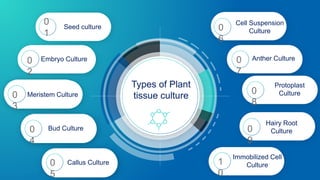
Embryo Culture
Improve
Bioavailability
0
1
Seed culture
Cell Suspension
Culture
Anther Culture
Protoplast
Culture
Improved Half
Life
Types of Plant
tissue culture
Bud Culture
Meristem Culture
Hairy Root
Culture
Improved Half
Life
Callus Culture
Immobilized Cell
Culture
0
2
0
3
0
4
0
5
0
6
0
7
0
8
1
0
0
9
06
05
04
03
02
01
Types of Tissue
Culture
Formulation designed by
Murashige and Skoog (1962),
revised by Linsmair and
Skoog (1965) can be
regarded as standard.
Special plant groups like
conifers have nutritional
requirements, which appear,
not to meet by standard
media, and then some
additional nutrients are
required in media.
Types of
Plant
Tissue
culture
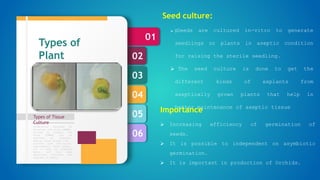
Seed culture:
 Seeds are cultured in-vitro to generate
seedlings or plants in aseptic condition
for raising the sterile seedling.
 The seed culture is done to get the
different kinds of explants from
aseptically grown plants that help in
better maintenance of aseptic tissue
Importance
 Increasing efficiency of germination of
seeds.
 It is possible to independent on asymbiotic
germination.
 It is important in production of Orchids.
06
05
04
03
02
01
Types of Tissue
Culture
Formulation designed by
Murashige and Skoog (1962),
revised by Linsmair and
Skoog (1965) can be
regarded as standard.
Special plant groups like
conifers have nutritional
requirements, which appear,
not to meet by standard
media, and then some
additional nutrients are
required in media.
Types of
Plant
Tissue
culture
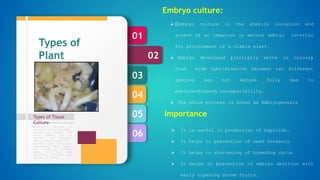
Embryo culture:
 Embryo culture is the sterile isolation and
growth of an immature or mature embryo in-vitro
for procurement of a viable plant.
 Embryo developed (initially white in colour)
from wide hybridization between two different
species may not mature fully due to
embryoendosperm incompatibility.
 The whole process is known as Embryogenesis
Importance
 It is useful in production of haploids.
 It helps in prevention of seed dormancy.
 It helps in shortening of breeding cycle.
 It helps in prevention of embryo abortion with
early ripening stone fruits.
06
05
04
03
02
01
Types of Tissue
Culture
Formulation designed by
Murashige and Skoog (1962),
revised by Linsmair and
Skoog (1965) can be
regarded as standard.
Special plant groups like
conifers have nutritional
requirements, which appear,
not to meet by standard
media, and then some
additional nutrients are
required in media.
Types of
Plant
Tissue
culture
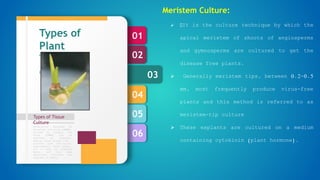
Meristem Culture:
 It is the culture technique by which the
apical meristem of shoots of angiosperms
and gymnosperms are cultured to get the
disease free plants.
 Generally meristem tips, between 0.2-0.5
mm, most frequently produce virus-free
plants and this method is referred to as
meristem-tip culture
 These explants are cultured on a medium
containing cytokinin (plant hormone).
06
05
04
03
02
01
Types of Tissue
Culture
Formulation designed by
Murashige and Skoog (1962),
revised by Linsmair and
Skoog (1965) can be
regarded as standard.
Special plant groups like
conifers have nutritional
requirements, which appear,
not to meet by standard
media, and then some
additional nutrients are
required in media.
Types of
Plant
Tissue
culture
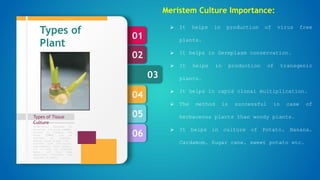
Meristem Culture Importance:
 It helps in production of virus free
plants.
 It helps in Germplasm conservation.

 It helps in production of transgenic
plants.
 It helps in rapid clonal multiplication.
 The method is successful in case of
herbaceous plants than woody plants.
 It helps in culture of Potato, Banana,
Cardamom, Sugar cane, sweet potato etc.
06
05
04
03
02
01
Types of Tissue
Culture
Formulation designed by
Murashige and Skoog (1962),
revised by Linsmair and
Skoog (1965) can be
regarded as standard.
Special plant groups like
conifers have nutritional
requirements, which appear,
not to meet by standard
media, and then some
additional nutrients are
required in media.
Type
s of
Plant
Tissu
e
cultu
re
Bud Culture:
 Buds contain active meristems in the
leaf axils, which are capable of growing
into a shoot.
 Each node of the stem is cut and allowed
to grow on a nutrient media to develop
the shoot tip from the axil which
ultimately develops into new plantlet.
 In axillary bud method, where the
axillary buds are isolated from the leaf
axils and develop into shoot tip under
little high cytokinin concentration
06
05
04
03
02
01
Types of Tissue
Culture
Formulation designed by
Murashige and Skoog (1962),
revised by Linsmair and
Skoog (1965) can be
regarded as standard.
Special plant groups like
conifers have nutritional
requirements, which appear,
not to meet by standard
media, and then some
additional nutrients are
required in media.
Type
s of
Plant
Tissu
e
cultu
re
Bud Culture Importance:
 Easy step for micropropagation.
 Easy method for production of disease
free plants.
 Isolation of phytoconstituents is easy.
06
05
04
03
02
01
Types of Tissue
Culture
Formulation designed by
Murashige and Skoog (1962),
revised by Linsmair and
Skoog (1965) can be
regarded as standard.
Special plant groups like
conifers have nutritional
requirements, which appear,
not to meet by standard
media, and then some
additional nutrients are
required in media.
Types of
Plant
Tissue
culture
Callus culture:
 It is culture of undifferentiated mass
of parenchyma cell produced from an
explant of a seedling or other plant part
in agar medium under aseptic condition is
known as callus culture.
 Callus is densely aggregated,
uncontrolled, undifferentiated,
unorganized, aerated homogenous
parenchymatous mass
06
05
04
03
02
01
Types of Tissue
Culture
Formulation designed by
Murashige and Skoog (1962),
revised by Linsmair and
Skoog (1965) can be
regarded as standard.
Special plant groups like
conifers have nutritional
requirements, which appear,
not to meet by standard
media, and then some
additional nutrients are
required in media.
Types of
Plant
Tissue
culture
Callus culture Importance:
 It is the source of tissue for plant
regeneration.
 The whole plant can be regenerated in large
number from callus tissue through manipulation
of the nutrient and plant hormones in the
culture medium.
 This phenomenon is known as plant regeneration
or organogenesis or morphogenesis. Chromosomal
variation occurs genetically or epigenetically
in the cells of callus tissue.
 Increased amount of secondary metabolites are
obtained by extraction of the particular callus
tissue.
 This method is the source of Tissue for Cell
06
05
04
03
02
01
Types of Tissue
Culture
Formulation designed by
Murashige and Skoog (1962),
revised by Linsmair and
Skoog (1965) can be
regarded as standard.
Special plant groups like
conifers have nutritional
requirements, which appear,
not to meet by standard
media, and then some
additional nutrients are
required in media.
Types of
Plant
Tissue
culture
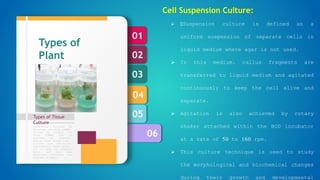
Cell Suspension Culture:
 Suspension culture is defined as a
uniform suspension of separate cells in
liquid medium where agar is not used.
 In this medium, callus fragments are
transferred to liquid medium and agitated
continuously to keep the cell alive and
separate.
 Agitation is also achieved by rotary
shaker attached within the BOD incubator
at a rate of 50 to 160 rpm.
 This culture technique is used to study
the morphological and biochemical changes
during their growth and developmental
06
05
04
03
02
01
Types of Tissue
Culture
Formulation designed by
Murashige and Skoog (1962),
revised by Linsmair and
Skoog (1965) can be
regarded as standard.
Special plant groups like
conifers have nutritional
requirements, which appear,
not to meet by standard
media, and then some
additional nutrients are
required in media.
Types of
Plant
Tissue
culture
Cell Suspension Culture Importance:
 Suspension culture is consists of only single
cells which are physiologically and
biochemically uniform.
 This culture is capable of contributing
significant information about cell physiology,
biochemistry, metabolic events etc.
 It is important for plant biotransformation and
plant genetic engineering.
 No toxic products are formed with this culture
technique.
 It helps for induction in somatic embryos and
shoots.
 It helps in in-vitro mutagenesis and selection
of mutants.
10
09
08
07
Types of Tissue
Culture
Formulation designed by
Murashige and Skoog (1962),
revised by Linsmair and
Skoog (1965) can be
regarded as standard.
Special plant groups like
conifers have nutritional
requirements, which appear,
not to meet by standard
media, and then some
additional nutrients are
required in media.
Types of
Plant
Tissue
culture
Anther culture:
 It is the in-vitro culture technique of
anther containing microspores from unopened
flower bud or immature pollen grains
(Pollen culture) on a suitable nutrient
medium under aseptic condition for the
purpose of development of haploid
plantlets.
 By this culture technique haploid cells
are obtained which is known as Androgenesis
10
09
08
07
Types of Tissue
Culture
Formulation designed by
Murashige and Skoog (1962),
revised by Linsmair and
Skoog (1965) can be
regarded as standard.
Special plant groups like
conifers have nutritional
requirements, which appear,
not to meet by standard
media, and then some
additional nutrients are
required in media.
Types of
Plant
Tissue
culture
Anther culture Importance:
 It is used to study genetic recombination
in higher plants.
 It is used to study mode of
differentiation from single cell to whole
organisms.
 It is used to study of factor
controlling pollen embryogenesis of
higher plants.
 It is used for mutation studies.
 It is used for hybrid development.
 It is used for genome mapping.
 It is used for formation of double
10
09
08
07
Types of Tissue
Culture
Formulation designed by
Murashige and Skoog (1962),
revised by Linsmair and
Skoog (1965) can be
regarded as standard.
Special plant groups like
conifers have nutritional
requirements, which appear,
not to meet by standard
media, and then some
additional nutrients are
required in media.
Types of
Plant
Tissue
culture
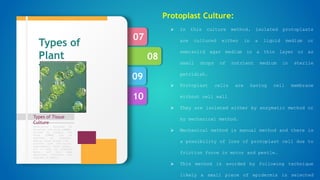
Protoplast Culture:
 In this culture method, isolated protoplasts
are cultured either in a liquid medium or
semisolid agar medium in a thin layer or as
small drops of nutrient medium in sterile
petridish.
 Protoplast cells are having cell membrane
without cell wall
 They are isolated either by enzymatic method or
by mechanical method.
 Mechanical method is manual method and there is
a possibility of loss of protoplast cell due to
friction force in motor and pestle.
 This method is avoided by following technique
likely a small piece of epidermis is selected
10
09
08
07
Types of Tissue
Culture
Formulation designed by
Murashige and Skoog (1962),
revised by Linsmair and
Skoog (1965) can be
regarded as standard.
Special plant groups like
conifers have nutritional
requirements, which appear,
not to meet by standard
media, and then some
additional nutrients are
required in media.
Types of
Plant
Tissue
culture
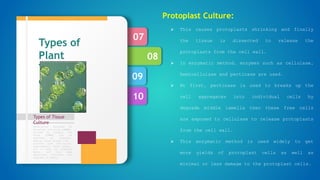
Protoplast Culture:
 This causes protoplasts shrinking and finally
the tissue is dissected to release the
protoplasts from the cell wall.
 In enzymatic method, enzymes such as cellulase,
hemicellulase and pectinase are used.
 At first, pectinase is used to breaks up the
cell aggregates into individual cells by
degrade middle lamella then these free cells
are exposed to cellulase to release protoplasts
from the cell wall.
 This enzymatic method is used widely to get
more yields of protoplast cells as well as
minimal or less damage to the protoplast cells.
10
09
08
07
Types of Tissue
Culture
Formulation designed by
Murashige and Skoog (1962),
revised by Linsmair and
Skoog (1965) can be
regarded as standard.
Special plant groups like
conifers have nutritional
requirements, which appear,
not to meet by standard
media, and then some
additional nutrients are
required in media.
Types of
Plant
Tissue
culture
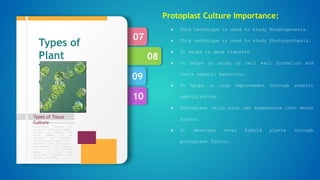
Protoplast Culture Importance:
 This technique is used to study Morphogenesis.
 This technique is used to study Photosynthesis.
 It helps in gene transfer.
 It helps in study of cell wall formation and
their osmotic behaviour.
 It helps in crop improvement through somatic
hybridization.
 Protoplast cells also can regenerate into whole
plants.
 It develops novel hybrid plants through
protoplast fusion.
10
09
08
07
Types of Tissue
Culture
Formulation designed by
Murashige and Skoog (1962),
revised by Linsmair and
Skoog (1965) can be
regarded as standard.
Special plant groups like
conifers have nutritional
requirements, which appear,
not to meet by standard
media, and then some
additional nutrients are
required in media.
Types of
Plant
Tissue
culture
Hairy Root Culture
 This technique is also known as transformed
root culture.
 It is a culture produced after the infection of
explants or cultures by anaturally occurring
soil bacterium Agrobacterium rhizogenes that
contains root-inducing plasmids (Ri plasmids)
are infect plant roots and cause them to
produce an opines (food source for the
bacterium) and abnormally very fast growth.
 It grows by increasing the rate of cell
division and cell elongation.
10
09
08
07
Types of Tissue
Culture
Formulation designed by
Murashige and Skoog (1962),
revised by Linsmair and
Skoog (1965) can be
regarded as standard.
Special plant groups like
conifers have nutritional
requirements, which appear,
not to meet by standard
media, and then some
additional nutrients are
required in media.
Types of
Plant
Tissue
culture
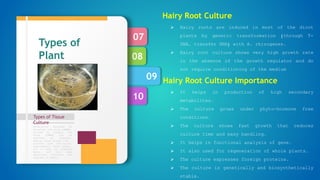
Hairy Root Culture
 Hairy roots are induced in most of the dicot
plants by genetic transformation (through T-
DNA, transfer DNA) with A. rhizogenes.
 Hairy root culture shows very high growth rate
in the absence of the growth regulator and do
not require conditioning of the medium
Hairy Root Culture Importance
 It helps in production of high secondary
metabolites.
 The culture grows under phyto-hormone free
conditions.
 The culture shows fast growth that reduces
culture time and easy handling.
 It helps in functional analysis of gene.
 It also used for regeneration of whole plants.
 The culture expresses foreign proteins.
 The culture is genetically and biosynthetically
stable.
10
09
08
07
Types of Tissue
Culture
Formulation designed by
Murashige and Skoog (1962),
revised by Linsmair and
Skoog (1965) can be
regarded as standard.
Special plant groups like
conifers have nutritional
requirements, which appear,
not to meet by standard
media, and then some
additional nutrients are
required in media.
Types of
Plant
Tissue
culture
Immobilized Cell Culture:
 It is the technique which confines the cells to
a definite region in a space, known as matrix.
 During that condition, the catalytic activity
of the cells retains and prevents its entry
into the mobile phase. Immobilization is
achieved by binding these cells onto or within
a solid support.
 Some of the important materials are used as
matrix like gelatin, polylysine, agarose,
alginate
10
09
08
07
Types of Tissue
Culture
Formulation designed by
Murashige and Skoog (1962),
revised by Linsmair and
Skoog (1965) can be
regarded as standard.
Special plant groups like
conifers have nutritional
requirements, which appear,
not to meet by standard
media, and then some
additional nutrients are
required in media.
Types of
Plant
Tissue
culture
Immobilized Cell Culture Importance:
 Encapsulation method protects cells from
mechanical damage in large fermenters.
 It is used in synthetic seed technology.
 It is used for transfer of protoplast.
 It is cultured as single cell for longer
period.
 It helps in conservation of rare cells for
further growth into whole plant.
 It helps in production of higher amount of
plant secondary metabolites.
 It helps in biotransformation.
06
05
04
03
02
01
Nutrition of Tissue
Culture
Formulation designed by
Murashige and Skoog (1962),
revised by Linsmair and
Skoog (1965) can be
regarded as standard.
Special plant groups like
conifers have nutritional
requirements, which appear,
not to meet by standard
media, and then some
additional nutrients are
required in media.
Tissue
culture
media
Generally all culture media are made
up of:
 Macronutrients
 Micronutrients
 Vitamins
 Growth regulations
 Carbohydrates (Sucrose)
Inorganic Nutrients:-Mineral elements are
very important in the life of a plant.
 Mg is a part of chlorophyll molecules
 Ca is a component of cell wall
 N is an essential part of amino acids, vitamins,
proteins and nucleic acid.
 Fe, Zn, and Mo are part of certain enzymes.
 Besides C, H, and O there are 12 elements, known to
be essential for Plant growth viz. N, P, S, K, Ca,
Mg, Fe, Mn, Cu, Zn, B and Mo.
Macro elements
06
05
04
03
02
01
Nutrition of Tissue
Culture
Formulation designed by
Murashige and Skoog (1962),
revised by Linsmair and
Skoog (1965) can be
regarded as standard.
Special plant groups like
conifers have nutritional
requirements, which appear,
not to meet by standard
media, and then some
additional nutrients are
required in media.
Tissue
culture
media
Macro elements
C- Carbon forms the backbone of many plants Bio-
molecules,
including starches and cellulose. It is fixed through
photosynthesis
from the carbon synthesis in the air and is a part of
the carbohydrates that store energy in the plant.
C-
Carbon
H- Hydrogen also is necessary for building the plant and
it is obtained almost entirely from water.
H-
Hydrogen
O- Oxygen is necessary for cellular respiration.
Cellular respiration is the process of generating energy
rich adenosine tri phosphate (ATP) via the consumption
of sugars made in photosynthesis. Plants produce oxygen
gas during photosynthesis to produce glucose but then
require oxygen to undergo aerobic cellular respiration
and break down this glucose and produce ATP.
O-
Oxygen
06
05
04
03
02
01
Nutrition of Tissue
Culture
Formulation designed by
Murashige and Skoog (1962),
revised by Linsmair and
Skoog (1965) can be
regarded as standard.
Special plant groups like
conifers have nutritional
requirements, which appear,
not to meet by standard
media, and then some
additional nutrients are
required in media.
Tissue
culture
media
Macro elements
N- Nitrogen is an essential component of all proteins.
Nitrogen
deficiency most often results in stunted growth.
N-
Nitrogen
P- Phosphorus is important in plant bioenergetics as a
component of ATP. It is needed for the conversion of
light energy to chemical
energy (ATP) during photosynthesis. Phosphorus can also
be used to modify the activity of various enzymes by
phosphorylation and can be used for cell signaling.
Since ATP can be used for the biosynthesis of many plant
bio molecules, it is important for plant growth and
flower/seed formation.
P-
Phosphorus
K- Potassium regulates the opening and closing of the
stomata by a potassium ion pump. Since stomata are
important in water regulation, potassium reduces water
loss from the leaves and increases drought tolerances.
Potassium deficiency may cause necrosis or interveinal
chlorosis.
K-
Potassiu
m
06
05
04
03
02
01
Nutrition of Tissue
Culture
Formulation designed by
Murashige and Skoog (1962),
revised by Linsmair and
Skoog (1965) can be
regarded as standard.
Special plant groups like
conifers have nutritional
requirements, which appear,
not to meet by standard
media, and then some
additional nutrients are
required in media.
Tissue
culture
media
Macro elements
Ca- Calcium regulates transport of other nutrients into
the plant. It is also involved in the activation of
certain plant enzymes. Calcium
deficiency results in stunting.
Ca-
Calcium
Mg- Magnesium is an important part of chlorophyll, a
critical plant
pigment important in photosynthesis. It is important in
the production of ATP through its role as an enzyme
cofactor. There are many other biological roles for
magnesium in biological system for more information.
Magnesium deficiency can result in interveinal
chlorosis.
Mg-
Magnesium
S- Sulphur is a structural component of some amino acids
and
vitamins. It is essential in the manufacturing of
chloroplasts.
S-
Sulphur
06
05
04
03
02
01
Nutrition of Tissue
Culture
Formulation designed by
Murashige and Skoog (1962),
revised by Linsmair and
Skoog (1965) can be
regarded as standard.
Special plant groups like
conifers have nutritional
requirements, which appear,
not to meet by standard
media, and then some
additional nutrients are
required in media.
Tissue
culture
media
Microelements
Fe- Iron is necessary for photosynthesis and is present
as an enzyme cofactor in plants. Iron deficiency can
result in intervenial
chlorosis and necrosis.
Fe- Iron
Zn- Zinc is required in a large number of enzymes and
plays an
essential role in DNA transcription. A typical symptom
of zinc deficiency is the stunted growth of leaves,
commonly known as “little leaf” and is caused by the
oxidative degradation of the growth hormone auxin.
Zn- Zinc
Mn- Manganese is necessary for building the
chloroplasts. Manganese deficiency may result in
coloration abnormalities, such as discolored spots on
the foliage.
Mn-
Manganese
These are essential as catalysts
for many biochemical
reactions; microelement
deficiency symptoms include
Leaf chlorosis (Fe, Zn, and Mn)
Shoot tip necrosis (B, Co, Ni)
inhibits ethylene synthesis.
06
05
04
03
02
01
Nutrition of Tissue
Culture
Formulation designed by
Murashige and Skoog (1962),
revised by Linsmair and
Skoog (1965) can be
regarded as standard.
Special plant groups like
conifers have nutritional
requirements, which appear,
not to meet by standard
media, and then some
additional nutrients are
required in media.
Tissue
culture
media
Microelements
B- Boron is important for binding of pectin in the RG II
region of primary cell wall; secondary roles may be in
sugar transport, cell division and synthesizing certain
enzymes. Boron deficiency causes necrosis in young
leaves and stunting.
B- Boron
Co- Cobalt has proved to be beneficial to at least some
plants, but
is essential in others, such as legumes where it is
required for nitrogen fixation.
Co- Cobalt
Ni- In higher plants, Nickel is essential for activation
of ureases, an
enzyme involved with nitrogen metabolism that is
required to process urea. Without Nickel, toxic leaves
of urea accumulate, leading to the formation of necrotic
lesions. In lower plants, Nickel activates several
enzymes involved in a variety of processes and can
substitute for Zinc and iron as a cofactor in some
enzymes.
Ni- Nickel
06
05
04
03
02
01
Nutrition of Tissue
Culture
Formulation designed by
Murashige and Skoog (1962),
revised by Linsmair and
Skoog (1965) can be
regarded as standard.
Special plant groups like
conifers have nutritional
requirements, which appear,
not to meet by standard
media, and then some
additional nutrients are
required in media.
Tissue
culture
media
Microelements
Si- Silicon deposited in the cell walls and contributes
to its
mechanical properties including rigidity and elasticity.
Si-
Silicon
Na- Sodium involved in the regeneration of
phosphoenolpyruvate
in CAM and C4 plants. It is also substitute for
potassium in some
circumstances.
Na- Sodium
V- Vanadium may be required by some plants, but at very
low
concentrations. It may also substitute for Molybdenum.
V-
Vanadium
Se- Selenium and Sodium may also be beneficial. Sodium
can
replace potassium’s regulation of stomatal opening and
closing.
Se-
Selenium
V i t a m i n s
A
Plants can produce their
requirements of vitamins.
However, plant cell cultures
need to be supplemented with
certain vitamins like
• Thiamine (vit B1),
• Niacin (vit B3), Pyridoxine
(vit B6),
• Myo-inositol
• (Member of the vit. B
complex).
Organic Nutrients
V i t a m i n s
A
• Thiamine – Involved in the
direct biosynthesis of
certain amino acids and
• essential co-factor of
carbohydrates metabolism.
• Vit E – Antioxidants.
• Vit C- To prevent blacking
during explant isolation.
• Vit D- Growth regulatory
effect
A m i n o A c i d s
B
Glycine- has little benefit in the
growth of plant. They may be
directly utilized by plant own be
provided as N2 source.
C a r b o n
S o u r c e s
C
Sucrose (is most commonly
used carbon source) at a
concentration of 3%, glucose
and fructose also known to
support plant
growth. Sucrose in the medium
is necessary for various
metabolic activities.
A u x i n
D
Auxin are involved in cell
division and elongation and in
cell wall synthesis. IAA, IBA,
NAA, 2, 4-D are the most
frequently used auxin in plant
tissue culture. The principal
naturally occurring auxin, the
IAA is not often used in the
tissue culture, because it is
unstable. IBA is slightly more
potent than IAA and is not
easily broken down. Hormones
of this group are involved with
elongation of stems and inter
nodes, tropism, apical
dominance abscission, rooting
etc.
Organic Nutrients :- Growth Regulators
C y t o k i n i n
E
These hormones, are concerned
with cell division, modification of
apical dominance, shoot
differentiation etc. Most
commonly used cytokinins are
BAP, BA, Kinetin, 2 ip and
Zeatin. They usually promote cell
division if added together with an
auxin. Of these, BAP is the most
effective cytokinins for
stimulating axillary shoot
proliferation.
G i b b e r e l l i n s
F
There are over 20 known
gibberellins. Of these, generally,
GA3 is used. They are rarely
used and reported to stimulate
normal development of plantlets
from in vitro formed adventives
embryos.
O t h e r s
G
Abscisic acid is most often
required for normal growth and
development of somatic
embryos and only in its
presence they resemble zygotic
embryos.
A g a r
H
This is obtained from red
algae, especially Gelidium
amansii.
Complex mixture of related
polysaccharides built up from
the sugar,
galactose. These include the
natural polymer fractions,
agarose, which gives strength
to the gel and the highly
charged anionic
polysaccharides
Agaro pectins which give agar
its viscosity.
Agar is used at varying
concentration from 0.8 to 1%.
Organic Nutrients :- Gelling Agent :-
A g a r o s e
I
Is commonly preferred over agar
for protoplast culture
G e l r i t e
J
There are over 20 known
gibberellins. Of these, generally,
GA3 is used. They are rarely
used and reported to stimulate
normal development of plantlets
from in vitro formed adventives
embryos.
O t h e r s
K
Abscisic acid is most often
required for normal growth and
development of somatic
embryos and only in its
presence they resemble zygotic
embryos.

Plant tissue culture Application

  • 1.
    Plant Tissue Culture AcademicaIn-Charge, HOD, Pritam Juvatkar Mobile : Email : pritamjuvatkar@gmail.Com 9987779536 Department of Pharmacognosy and Phytochemistry Konkan Gyanpeeth Rahul Dharkar College of Pharmacy and Research Institute, karjat
  • 2.
    2. Taking anexplant does not usually destroy the mother plant, so rare and endangered plants can be cloned safely 3. It is easy to select desirable traits directly from the culture setup (invitro) thereby decreasing the amount of space required, for field trials 7. Plant tissue banks can be frozen and then regenerated through tissueculture. It preserves the pollen and cell collections from which plantsmay be propagated. 1. In a relatively short time and space a large number of plantlets can be produced starting from the single explant 5. The time required is much shortened, no need to wait for the whole life cycle of seed development. For species that have long generation time, low level of seed production, or seeds that readily do not germinate, rapid propagation is possible 6. In vitro growing plants usually free, from the bacterial and fungal diseases. Virus eradication and maintenance of plants in virus free state. This facilitates movement of plant across international boundaries. 4. Once established, a plant tissue culture line can give a continuous supply of young plants throughout the year Importance of Tissue Culture
  • 3.
    Embryo Culture Improve Bioavailability 0 1 Seed culture CellSuspension Culture Anther Culture Protoplast Culture Improved Half Life Types of Plant tissue culture Bud Culture Meristem Culture Hairy Root Culture Improved Half Life Callus Culture Immobilized Cell Culture 0 2 0 3 0 4 0 5 0 6 0 7 0 8 1 0 0 9
  • 4.
    06 05 04 03 02 01 Types of Tissue Culture Formulationdesigned by Murashige and Skoog (1962), revised by Linsmair and Skoog (1965) can be regarded as standard. Special plant groups like conifers have nutritional requirements, which appear, not to meet by standard media, and then some additional nutrients are required in media. Types of Plant Tissue culture Seed culture:  Seeds are cultured in-vitro to generate seedlings or plants in aseptic condition for raising the sterile seedling.  The seed culture is done to get the different kinds of explants from aseptically grown plants that help in better maintenance of aseptic tissue Importance  Increasing efficiency of germination of seeds.  It is possible to independent on asymbiotic germination.  It is important in production of Orchids.
  • 5.
    06 05 04 03 02 01 Types of Tissue Culture Formulationdesigned by Murashige and Skoog (1962), revised by Linsmair and Skoog (1965) can be regarded as standard. Special plant groups like conifers have nutritional requirements, which appear, not to meet by standard media, and then some additional nutrients are required in media. Types of Plant Tissue culture Embryo culture:  Embryo culture is the sterile isolation and growth of an immature or mature embryo in-vitro for procurement of a viable plant.  Embryo developed (initially white in colour) from wide hybridization between two different species may not mature fully due to embryoendosperm incompatibility.  The whole process is known as Embryogenesis Importance  It is useful in production of haploids.  It helps in prevention of seed dormancy.  It helps in shortening of breeding cycle.  It helps in prevention of embryo abortion with early ripening stone fruits.
  • 6.
    06 05 04 03 02 01 Types of Tissue Culture Formulationdesigned by Murashige and Skoog (1962), revised by Linsmair and Skoog (1965) can be regarded as standard. Special plant groups like conifers have nutritional requirements, which appear, not to meet by standard media, and then some additional nutrients are required in media. Types of Plant Tissue culture Meristem Culture:  It is the culture technique by which the apical meristem of shoots of angiosperms and gymnosperms are cultured to get the disease free plants.  Generally meristem tips, between 0.2-0.5 mm, most frequently produce virus-free plants and this method is referred to as meristem-tip culture  These explants are cultured on a medium containing cytokinin (plant hormone).
  • 7.
    06 05 04 03 02 01 Types of Tissue Culture Formulationdesigned by Murashige and Skoog (1962), revised by Linsmair and Skoog (1965) can be regarded as standard. Special plant groups like conifers have nutritional requirements, which appear, not to meet by standard media, and then some additional nutrients are required in media. Types of Plant Tissue culture Meristem Culture Importance:  It helps in production of virus free plants.  It helps in Germplasm conservation.  It helps in production of transgenic plants.  It helps in rapid clonal multiplication.  The method is successful in case of herbaceous plants than woody plants.  It helps in culture of Potato, Banana, Cardamom, Sugar cane, sweet potato etc.

  • 8.
    06 05 04 03 02 01 Types of Tissue Culture Formulationdesigned by Murashige and Skoog (1962), revised by Linsmair and Skoog (1965) can be regarded as standard. Special plant groups like conifers have nutritional requirements, which appear, not to meet by standard media, and then some additional nutrients are required in media. Type s of Plant Tissu e cultu re Bud Culture:  Buds contain active meristems in the leaf axils, which are capable of growing into a shoot.  Each node of the stem is cut and allowed to grow on a nutrient media to develop the shoot tip from the axil which ultimately develops into new plantlet.  In axillary bud method, where the axillary buds are isolated from the leaf axils and develop into shoot tip under little high cytokinin concentration
  • 9.
    06 05 04 03 02 01 Types of Tissue Culture Formulationdesigned by Murashige and Skoog (1962), revised by Linsmair and Skoog (1965) can be regarded as standard. Special plant groups like conifers have nutritional requirements, which appear, not to meet by standard media, and then some additional nutrients are required in media. Type s of Plant Tissu e cultu re Bud Culture Importance:  Easy step for micropropagation.  Easy method for production of disease free plants.  Isolation of phytoconstituents is easy.
  • 10.
    06 05 04 03 02 01 Types of Tissue Culture Formulationdesigned by Murashige and Skoog (1962), revised by Linsmair and Skoog (1965) can be regarded as standard. Special plant groups like conifers have nutritional requirements, which appear, not to meet by standard media, and then some additional nutrients are required in media. Types of Plant Tissue culture Callus culture:  It is culture of undifferentiated mass of parenchyma cell produced from an explant of a seedling or other plant part in agar medium under aseptic condition is known as callus culture.  Callus is densely aggregated, uncontrolled, undifferentiated, unorganized, aerated homogenous parenchymatous mass
  • 11.
    06 05 04 03 02 01 Types of Tissue Culture Formulationdesigned by Murashige and Skoog (1962), revised by Linsmair and Skoog (1965) can be regarded as standard. Special plant groups like conifers have nutritional requirements, which appear, not to meet by standard media, and then some additional nutrients are required in media. Types of Plant Tissue culture Callus culture Importance:  It is the source of tissue for plant regeneration.  The whole plant can be regenerated in large number from callus tissue through manipulation of the nutrient and plant hormones in the culture medium.  This phenomenon is known as plant regeneration or organogenesis or morphogenesis. Chromosomal variation occurs genetically or epigenetically in the cells of callus tissue.  Increased amount of secondary metabolites are obtained by extraction of the particular callus tissue.  This method is the source of Tissue for Cell
  • 12.
    06 05 04 03 02 01 Types of Tissue Culture Formulationdesigned by Murashige and Skoog (1962), revised by Linsmair and Skoog (1965) can be regarded as standard. Special plant groups like conifers have nutritional requirements, which appear, not to meet by standard media, and then some additional nutrients are required in media. Types of Plant Tissue culture Cell Suspension Culture:  Suspension culture is defined as a uniform suspension of separate cells in liquid medium where agar is not used.  In this medium, callus fragments are transferred to liquid medium and agitated continuously to keep the cell alive and separate.  Agitation is also achieved by rotary shaker attached within the BOD incubator at a rate of 50 to 160 rpm.  This culture technique is used to study the morphological and biochemical changes during their growth and developmental
  • 13.
    06 05 04 03 02 01 Types of Tissue Culture Formulationdesigned by Murashige and Skoog (1962), revised by Linsmair and Skoog (1965) can be regarded as standard. Special plant groups like conifers have nutritional requirements, which appear, not to meet by standard media, and then some additional nutrients are required in media. Types of Plant Tissue culture Cell Suspension Culture Importance:  Suspension culture is consists of only single cells which are physiologically and biochemically uniform.  This culture is capable of contributing significant information about cell physiology, biochemistry, metabolic events etc.  It is important for plant biotransformation and plant genetic engineering.  No toxic products are formed with this culture technique.  It helps for induction in somatic embryos and shoots.  It helps in in-vitro mutagenesis and selection of mutants.
  • 14.
    10 09 08 07 Types of Tissue Culture Formulationdesigned by Murashige and Skoog (1962), revised by Linsmair and Skoog (1965) can be regarded as standard. Special plant groups like conifers have nutritional requirements, which appear, not to meet by standard media, and then some additional nutrients are required in media. Types of Plant Tissue culture Anther culture:  It is the in-vitro culture technique of anther containing microspores from unopened flower bud or immature pollen grains (Pollen culture) on a suitable nutrient medium under aseptic condition for the purpose of development of haploid plantlets.  By this culture technique haploid cells are obtained which is known as Androgenesis
  • 15.
    10 09 08 07 Types of Tissue Culture Formulationdesigned by Murashige and Skoog (1962), revised by Linsmair and Skoog (1965) can be regarded as standard. Special plant groups like conifers have nutritional requirements, which appear, not to meet by standard media, and then some additional nutrients are required in media. Types of Plant Tissue culture Anther culture Importance:  It is used to study genetic recombination in higher plants.  It is used to study mode of differentiation from single cell to whole organisms.  It is used to study of factor controlling pollen embryogenesis of higher plants.  It is used for mutation studies.  It is used for hybrid development.  It is used for genome mapping.  It is used for formation of double
  • 16.
    10 09 08 07 Types of Tissue Culture Formulationdesigned by Murashige and Skoog (1962), revised by Linsmair and Skoog (1965) can be regarded as standard. Special plant groups like conifers have nutritional requirements, which appear, not to meet by standard media, and then some additional nutrients are required in media. Types of Plant Tissue culture Protoplast Culture:  In this culture method, isolated protoplasts are cultured either in a liquid medium or semisolid agar medium in a thin layer or as small drops of nutrient medium in sterile petridish.  Protoplast cells are having cell membrane without cell wall  They are isolated either by enzymatic method or by mechanical method.  Mechanical method is manual method and there is a possibility of loss of protoplast cell due to friction force in motor and pestle.  This method is avoided by following technique likely a small piece of epidermis is selected
  • 17.
    10 09 08 07 Types of Tissue Culture Formulationdesigned by Murashige and Skoog (1962), revised by Linsmair and Skoog (1965) can be regarded as standard. Special plant groups like conifers have nutritional requirements, which appear, not to meet by standard media, and then some additional nutrients are required in media. Types of Plant Tissue culture Protoplast Culture:  This causes protoplasts shrinking and finally the tissue is dissected to release the protoplasts from the cell wall.  In enzymatic method, enzymes such as cellulase, hemicellulase and pectinase are used.  At first, pectinase is used to breaks up the cell aggregates into individual cells by degrade middle lamella then these free cells are exposed to cellulase to release protoplasts from the cell wall.  This enzymatic method is used widely to get more yields of protoplast cells as well as minimal or less damage to the protoplast cells.
  • 18.
    10 09 08 07 Types of Tissue Culture Formulationdesigned by Murashige and Skoog (1962), revised by Linsmair and Skoog (1965) can be regarded as standard. Special plant groups like conifers have nutritional requirements, which appear, not to meet by standard media, and then some additional nutrients are required in media. Types of Plant Tissue culture Protoplast Culture Importance:  This technique is used to study Morphogenesis.  This technique is used to study Photosynthesis.  It helps in gene transfer.  It helps in study of cell wall formation and their osmotic behaviour.  It helps in crop improvement through somatic hybridization.  Protoplast cells also can regenerate into whole plants.  It develops novel hybrid plants through protoplast fusion.
  • 19.
    10 09 08 07 Types of Tissue Culture Formulationdesigned by Murashige and Skoog (1962), revised by Linsmair and Skoog (1965) can be regarded as standard. Special plant groups like conifers have nutritional requirements, which appear, not to meet by standard media, and then some additional nutrients are required in media. Types of Plant Tissue culture Hairy Root Culture  This technique is also known as transformed root culture.  It is a culture produced after the infection of explants or cultures by anaturally occurring soil bacterium Agrobacterium rhizogenes that contains root-inducing plasmids (Ri plasmids) are infect plant roots and cause them to produce an opines (food source for the bacterium) and abnormally very fast growth.  It grows by increasing the rate of cell division and cell elongation.
  • 20.
    10 09 08 07 Types of Tissue Culture Formulationdesigned by Murashige and Skoog (1962), revised by Linsmair and Skoog (1965) can be regarded as standard. Special plant groups like conifers have nutritional requirements, which appear, not to meet by standard media, and then some additional nutrients are required in media. Types of Plant Tissue culture Hairy Root Culture  Hairy roots are induced in most of the dicot plants by genetic transformation (through T- DNA, transfer DNA) with A. rhizogenes.  Hairy root culture shows very high growth rate in the absence of the growth regulator and do not require conditioning of the medium Hairy Root Culture Importance  It helps in production of high secondary metabolites.  The culture grows under phyto-hormone free conditions.  The culture shows fast growth that reduces culture time and easy handling.  It helps in functional analysis of gene.  It also used for regeneration of whole plants.  The culture expresses foreign proteins.  The culture is genetically and biosynthetically stable.
  • 21.
    10 09 08 07 Types of Tissue Culture Formulationdesigned by Murashige and Skoog (1962), revised by Linsmair and Skoog (1965) can be regarded as standard. Special plant groups like conifers have nutritional requirements, which appear, not to meet by standard media, and then some additional nutrients are required in media. Types of Plant Tissue culture Immobilized Cell Culture:  It is the technique which confines the cells to a definite region in a space, known as matrix.  During that condition, the catalytic activity of the cells retains and prevents its entry into the mobile phase. Immobilization is achieved by binding these cells onto or within a solid support.  Some of the important materials are used as matrix like gelatin, polylysine, agarose, alginate
  • 22.
    10 09 08 07 Types of Tissue Culture Formulationdesigned by Murashige and Skoog (1962), revised by Linsmair and Skoog (1965) can be regarded as standard. Special plant groups like conifers have nutritional requirements, which appear, not to meet by standard media, and then some additional nutrients are required in media. Types of Plant Tissue culture Immobilized Cell Culture Importance:  Encapsulation method protects cells from mechanical damage in large fermenters.  It is used in synthetic seed technology.  It is used for transfer of protoplast.  It is cultured as single cell for longer period.  It helps in conservation of rare cells for further growth into whole plant.  It helps in production of higher amount of plant secondary metabolites.  It helps in biotransformation.
  • 23.
    06 05 04 03 02 01 Nutrition of Tissue Culture Formulationdesigned by Murashige and Skoog (1962), revised by Linsmair and Skoog (1965) can be regarded as standard. Special plant groups like conifers have nutritional requirements, which appear, not to meet by standard media, and then some additional nutrients are required in media. Tissue culture media Generally all culture media are made up of:  Macronutrients  Micronutrients  Vitamins  Growth regulations  Carbohydrates (Sucrose) Inorganic Nutrients:-Mineral elements are very important in the life of a plant.  Mg is a part of chlorophyll molecules  Ca is a component of cell wall  N is an essential part of amino acids, vitamins, proteins and nucleic acid.  Fe, Zn, and Mo are part of certain enzymes.  Besides C, H, and O there are 12 elements, known to be essential for Plant growth viz. N, P, S, K, Ca, Mg, Fe, Mn, Cu, Zn, B and Mo. Macro elements
  • 24.
    06 05 04 03 02 01 Nutrition of Tissue Culture Formulationdesigned by Murashige and Skoog (1962), revised by Linsmair and Skoog (1965) can be regarded as standard. Special plant groups like conifers have nutritional requirements, which appear, not to meet by standard media, and then some additional nutrients are required in media. Tissue culture media Macro elements C- Carbon forms the backbone of many plants Bio- molecules, including starches and cellulose. It is fixed through photosynthesis from the carbon synthesis in the air and is a part of the carbohydrates that store energy in the plant. C- Carbon H- Hydrogen also is necessary for building the plant and it is obtained almost entirely from water. H- Hydrogen O- Oxygen is necessary for cellular respiration. Cellular respiration is the process of generating energy rich adenosine tri phosphate (ATP) via the consumption of sugars made in photosynthesis. Plants produce oxygen gas during photosynthesis to produce glucose but then require oxygen to undergo aerobic cellular respiration and break down this glucose and produce ATP. O- Oxygen
  • 25.
    06 05 04 03 02 01 Nutrition of Tissue Culture Formulationdesigned by Murashige and Skoog (1962), revised by Linsmair and Skoog (1965) can be regarded as standard. Special plant groups like conifers have nutritional requirements, which appear, not to meet by standard media, and then some additional nutrients are required in media. Tissue culture media Macro elements N- Nitrogen is an essential component of all proteins. Nitrogen deficiency most often results in stunted growth. N- Nitrogen P- Phosphorus is important in plant bioenergetics as a component of ATP. It is needed for the conversion of light energy to chemical energy (ATP) during photosynthesis. Phosphorus can also be used to modify the activity of various enzymes by phosphorylation and can be used for cell signaling. Since ATP can be used for the biosynthesis of many plant bio molecules, it is important for plant growth and flower/seed formation. P- Phosphorus K- Potassium regulates the opening and closing of the stomata by a potassium ion pump. Since stomata are important in water regulation, potassium reduces water loss from the leaves and increases drought tolerances. Potassium deficiency may cause necrosis or interveinal chlorosis. K- Potassiu m
  • 26.
    06 05 04 03 02 01 Nutrition of Tissue Culture Formulationdesigned by Murashige and Skoog (1962), revised by Linsmair and Skoog (1965) can be regarded as standard. Special plant groups like conifers have nutritional requirements, which appear, not to meet by standard media, and then some additional nutrients are required in media. Tissue culture media Macro elements Ca- Calcium regulates transport of other nutrients into the plant. It is also involved in the activation of certain plant enzymes. Calcium deficiency results in stunting. Ca- Calcium Mg- Magnesium is an important part of chlorophyll, a critical plant pigment important in photosynthesis. It is important in the production of ATP through its role as an enzyme cofactor. There are many other biological roles for magnesium in biological system for more information. Magnesium deficiency can result in interveinal chlorosis. Mg- Magnesium S- Sulphur is a structural component of some amino acids and vitamins. It is essential in the manufacturing of chloroplasts. S- Sulphur
  • 27.
    06 05 04 03 02 01 Nutrition of Tissue Culture Formulationdesigned by Murashige and Skoog (1962), revised by Linsmair and Skoog (1965) can be regarded as standard. Special plant groups like conifers have nutritional requirements, which appear, not to meet by standard media, and then some additional nutrients are required in media. Tissue culture media Microelements Fe- Iron is necessary for photosynthesis and is present as an enzyme cofactor in plants. Iron deficiency can result in intervenial chlorosis and necrosis. Fe- Iron Zn- Zinc is required in a large number of enzymes and plays an essential role in DNA transcription. A typical symptom of zinc deficiency is the stunted growth of leaves, commonly known as “little leaf” and is caused by the oxidative degradation of the growth hormone auxin. Zn- Zinc Mn- Manganese is necessary for building the chloroplasts. Manganese deficiency may result in coloration abnormalities, such as discolored spots on the foliage. Mn- Manganese These are essential as catalysts for many biochemical reactions; microelement deficiency symptoms include Leaf chlorosis (Fe, Zn, and Mn) Shoot tip necrosis (B, Co, Ni) inhibits ethylene synthesis.
  • 28.
    06 05 04 03 02 01 Nutrition of Tissue Culture Formulationdesigned by Murashige and Skoog (1962), revised by Linsmair and Skoog (1965) can be regarded as standard. Special plant groups like conifers have nutritional requirements, which appear, not to meet by standard media, and then some additional nutrients are required in media. Tissue culture media Microelements B- Boron is important for binding of pectin in the RG II region of primary cell wall; secondary roles may be in sugar transport, cell division and synthesizing certain enzymes. Boron deficiency causes necrosis in young leaves and stunting. B- Boron Co- Cobalt has proved to be beneficial to at least some plants, but is essential in others, such as legumes where it is required for nitrogen fixation. Co- Cobalt Ni- In higher plants, Nickel is essential for activation of ureases, an enzyme involved with nitrogen metabolism that is required to process urea. Without Nickel, toxic leaves of urea accumulate, leading to the formation of necrotic lesions. In lower plants, Nickel activates several enzymes involved in a variety of processes and can substitute for Zinc and iron as a cofactor in some enzymes. Ni- Nickel
  • 29.
    06 05 04 03 02 01 Nutrition of Tissue Culture Formulationdesigned by Murashige and Skoog (1962), revised by Linsmair and Skoog (1965) can be regarded as standard. Special plant groups like conifers have nutritional requirements, which appear, not to meet by standard media, and then some additional nutrients are required in media. Tissue culture media Microelements Si- Silicon deposited in the cell walls and contributes to its mechanical properties including rigidity and elasticity. Si- Silicon Na- Sodium involved in the regeneration of phosphoenolpyruvate in CAM and C4 plants. It is also substitute for potassium in some circumstances. Na- Sodium V- Vanadium may be required by some plants, but at very low concentrations. It may also substitute for Molybdenum. V- Vanadium Se- Selenium and Sodium may also be beneficial. Sodium can replace potassium’s regulation of stomatal opening and closing. Se- Selenium
  • 30.
    V i ta m i n s A Plants can produce their requirements of vitamins. However, plant cell cultures need to be supplemented with certain vitamins like • Thiamine (vit B1), • Niacin (vit B3), Pyridoxine (vit B6), • Myo-inositol • (Member of the vit. B complex). Organic Nutrients V i t a m i n s A • Thiamine – Involved in the direct biosynthesis of certain amino acids and • essential co-factor of carbohydrates metabolism. • Vit E – Antioxidants. • Vit C- To prevent blacking during explant isolation. • Vit D- Growth regulatory effect A m i n o A c i d s B Glycine- has little benefit in the growth of plant. They may be directly utilized by plant own be provided as N2 source. C a r b o n S o u r c e s C Sucrose (is most commonly used carbon source) at a concentration of 3%, glucose and fructose also known to support plant growth. Sucrose in the medium is necessary for various metabolic activities.
  • 31.
    A u xi n D Auxin are involved in cell division and elongation and in cell wall synthesis. IAA, IBA, NAA, 2, 4-D are the most frequently used auxin in plant tissue culture. The principal naturally occurring auxin, the IAA is not often used in the tissue culture, because it is unstable. IBA is slightly more potent than IAA and is not easily broken down. Hormones of this group are involved with elongation of stems and inter nodes, tropism, apical dominance abscission, rooting etc. Organic Nutrients :- Growth Regulators C y t o k i n i n E These hormones, are concerned with cell division, modification of apical dominance, shoot differentiation etc. Most commonly used cytokinins are BAP, BA, Kinetin, 2 ip and Zeatin. They usually promote cell division if added together with an auxin. Of these, BAP is the most effective cytokinins for stimulating axillary shoot proliferation. G i b b e r e l l i n s F There are over 20 known gibberellins. Of these, generally, GA3 is used. They are rarely used and reported to stimulate normal development of plantlets from in vitro formed adventives embryos. O t h e r s G Abscisic acid is most often required for normal growth and development of somatic embryos and only in its presence they resemble zygotic embryos.
  • 32.
    A g ar H This is obtained from red algae, especially Gelidium amansii. Complex mixture of related polysaccharides built up from the sugar, galactose. These include the natural polymer fractions, agarose, which gives strength to the gel and the highly charged anionic polysaccharides Agaro pectins which give agar its viscosity. Agar is used at varying concentration from 0.8 to 1%. Organic Nutrients :- Gelling Agent :- A g a r o s e I Is commonly preferred over agar for protoplast culture G e l r i t e J There are over 20 known gibberellins. Of these, generally, GA3 is used. They are rarely used and reported to stimulate normal development of plantlets from in vitro formed adventives embryos. O t h e r s K Abscisic acid is most often required for normal growth and development of somatic embryos and only in its presence they resemble zygotic embryos.