Trends, Networks
and Critical
Thinking
in the 21st Century
Course Description
The course provides opportunities for students to discover patterns and extract
meanings from emerging trends. It aids in developing their critical and creative thinking
skills-- essential tools for decision making and understanding “ethics of care”. Global
trends in the 21st century are examined and are either accepted or rejected on a sound
set of criteria. Students will be asked to create and analyze scenarios that will challenge
them to;
(1) formulate their stances on issues or concerns;
(2) propose interventions and;
(3) formulate alternative futures.
The students will realize the interconnections between their neural connections and
social realities.
Trends, Networks and Critical Thinking in the
21st Century Culture
Trend vs. Fad
Objectives
At the end of the lesson we can;
1. Define trend and differentiate it
from a fad.
2. Explain the process on how to spot a
trend.
3. Enumerate the different elements
and characteristics of a trend.
4. Illustrate, create a trend or fad
ideas.
Guide Questions
1. What is a trend?
2. What is the difference
between trend and fad?
3. How to spot a trend?
4. What are the elements and
characteristics of a trend?
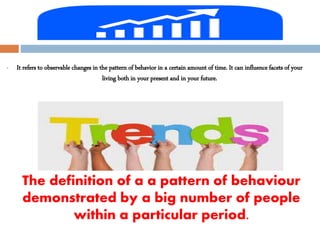
- It refers to observable changes in the pattern of behavior in a certain amount of time. It can influence facets of your
living both in your present and in your future.
The definition of a a pattern of behaviour
demonstrated by a big number of people
within a particular period.
 Field of Arts – fashion and music, a prevailing style or
preference such as realism movement in art,
emergence of the miniskirt and popularity of jazz
music.
 Economics – a general movement registering
statistical changes for a long period such as the
increasing cost of living and rate of unemployment.
 Politics – a tendency, drift or bend toward a certain
stance, thought or policy as when democratic
Southeast Asian countries favoured authoritarian
governments at a certain point in their histories.
 For Sociologist – it is a collective behavior or mass
involvement that is acceptable to society and shows a
“line of historical continuity” as it can be downplayed
today but can resurface sometime in the future.
 A pattern of gradual change
in a condition, output, or
process.
 An intense and widely shared
enthusiasm for something.
 Last an average of ten
years or more!
 Make your money and Run!
Defining a trend

Defining a trend

  • 1.
  • 2.
    Course Description The courseprovides opportunities for students to discover patterns and extract meanings from emerging trends. It aids in developing their critical and creative thinking skills-- essential tools for decision making and understanding “ethics of care”. Global trends in the 21st century are examined and are either accepted or rejected on a sound set of criteria. Students will be asked to create and analyze scenarios that will challenge them to; (1) formulate their stances on issues or concerns; (2) propose interventions and; (3) formulate alternative futures. The students will realize the interconnections between their neural connections and social realities. Trends, Networks and Critical Thinking in the 21st Century Culture
  • 4.
  • 5.
    Objectives At the endof the lesson we can; 1. Define trend and differentiate it from a fad. 2. Explain the process on how to spot a trend. 3. Enumerate the different elements and characteristics of a trend. 4. Illustrate, create a trend or fad ideas.
  • 6.
    Guide Questions 1. Whatis a trend? 2. What is the difference between trend and fad? 3. How to spot a trend? 4. What are the elements and characteristics of a trend?
  • 7.
    - It refersto observable changes in the pattern of behavior in a certain amount of time. It can influence facets of your living both in your present and in your future. The definition of a a pattern of behaviour demonstrated by a big number of people within a particular period.
  • 12.
     Field ofArts – fashion and music, a prevailing style or preference such as realism movement in art, emergence of the miniskirt and popularity of jazz music.  Economics – a general movement registering statistical changes for a long period such as the increasing cost of living and rate of unemployment.  Politics – a tendency, drift or bend toward a certain stance, thought or policy as when democratic Southeast Asian countries favoured authoritarian governments at a certain point in their histories.  For Sociologist – it is a collective behavior or mass involvement that is acceptable to society and shows a “line of historical continuity” as it can be downplayed today but can resurface sometime in the future.
  • 13.
     A patternof gradual change in a condition, output, or process.  An intense and widely shared enthusiasm for something.  Last an average of ten years or more!  Make your money and Run!